● Oil Crash, Israel Shock, Markets on Edge
A Variable More Material Than Trump: Middle East Risk, the Oil Sell-Off, and Why Equity Markets Remain Fragile
This market move is not adequately explained by a single Trump headline. While the surface narrative was “talks with Iran,” a sharp decline in crude prices and a brief Nasdaq rebound, the underlying structure is more complex.
This report summarizes, in a news-style format, (i) the geopolitical risk framework in the Middle East, (ii) the drivers behind the crude price drop, (iii) the differing incentives of the U.S., Iran, and Israel, and (iv) the key items investors should monitor.
1. What happened in today’s market: primary sequence
The initial catalyst was a social-media statement from Trump. He claimed “very good and productive” discussions with Iran and indicated he instructed a five-day delay of military action. Markets interpreted this as a reduced probability of near-term escalation.
As a result:
- WTI crude declined sharply
- Brent crude also sold off
- Risk appetite improved and U.S. equities, particularly tech-heavy indices, briefly rebounded
However, the move faded as investors questioned whether meaningful talks were actually underway.
2. Why crude fell: not demand/supply, but a “war-premium” repricing
The crude sell-off was not primarily a conventional fundamentals story. The key driver was a partial unwind of the war premium embedded in oil prices.
In a widening Middle East conflict, the first-order concern is energy supply disruption. The Strait of Hormuz is a critical conduit for global oil shipments; any credible risk of blockage tends to drive a rapid price spike.
Following Trump’s messaging (“talks with Iran,” “five-day delay”), the market repriced:
- a lower probability of immediate worst-case scenarios
- a near-term reduction in perceived Hormuz-related disruption risk
- a temporary easing of supply-shock expectations
Crucially, lower oil prices do not necessarily imply reduced systemic risk. Large price moves on single political headlines can indicate elevated market sensitivity and thin liquidity.
3. Why equities turned unstable again: divergence between rhetoric and actions
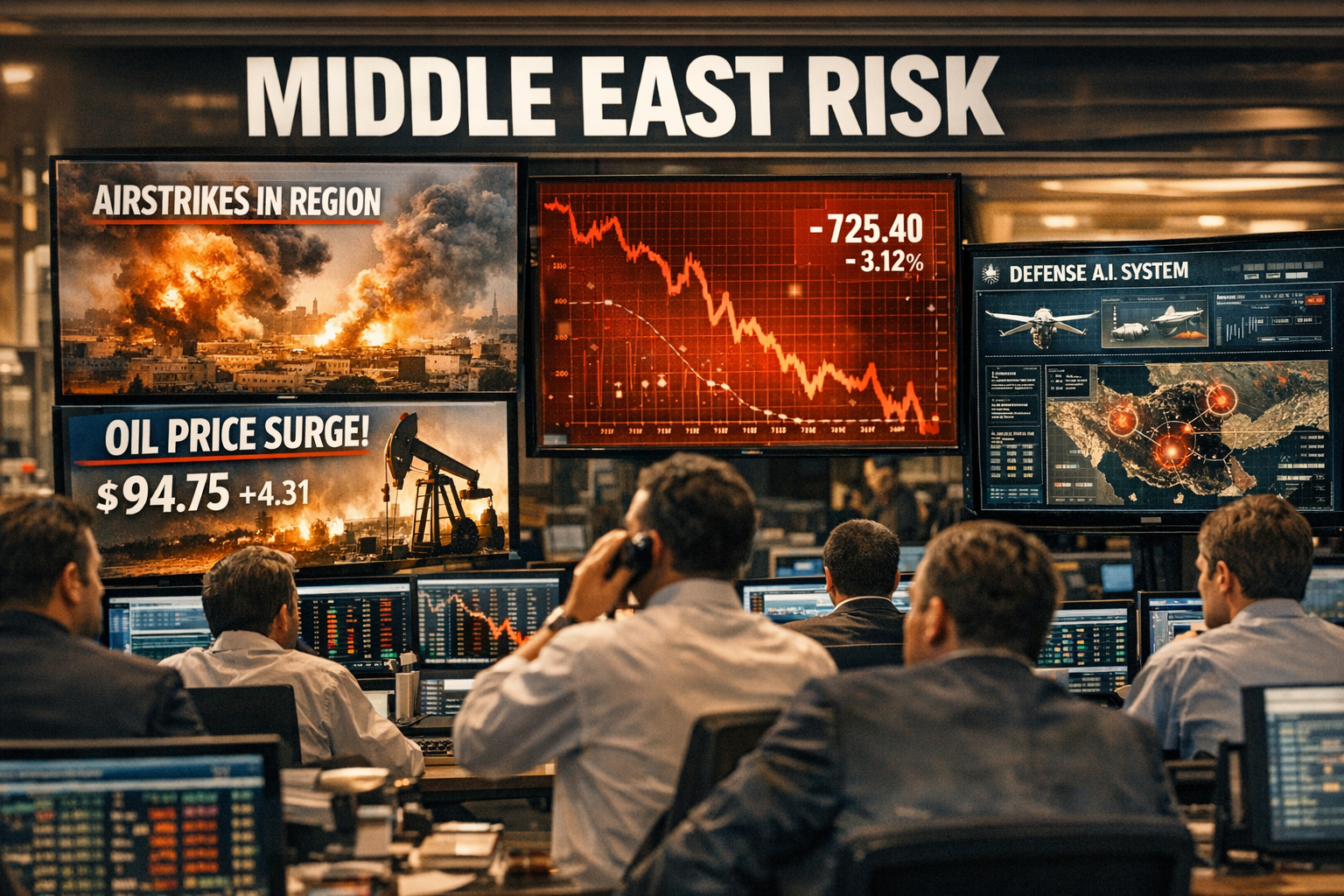
Equities weakened again because diplomatic signaling and military developments diverged. While Trump referenced dialogue, Israel continued airstrikes in central Tehran. Diplomatic de-escalation narratives conflicted with continued military escalation risk.
This is a high-uncertainty setup for investors because the primary question becomes decision authority and control: the market discounts “risk resolved” narratives when the operational reality remains tense.
Intraday divergence across the S&P 500, Nasdaq, and Russell indices reflected this uncertainty: an initial relief move, followed by renewed pricing of residual escalation risk.
4. Why U.S., Iranian, and Israeli incentives differ
4-1. United States: preference for containment over expansion
Based on public messaging, the U.S. appears to prefer managing the conflict through negotiation leverage rather than extending a prolonged military campaign. Policy incentives may include lowering energy prices, reducing domestic political costs, and limiting market disruption.
With inflation risks still relevant, higher oil prices would likely feed into CPI expectations and rate expectations, potentially affecting the Federal Reserve policy path.
4-2. Iran: possible openness to contacts, constrained by domestic power dynamics
Iranian responses are inconsistent. Some Western reporting suggests ongoing contacts, while Iranian major outlets deny negotiations.
This is consistent with Iran’s historical pattern: backchannel engagement may occur while public denial is maintained for domestic legitimacy and external posture. If contacts are not anchored to the supreme leader’s decision-making circle, the stability and durability of any understanding can be limited.
Markets may misprice risk if “talks” are interpreted as near-term deliverable agreements.
4-3. Israel: the variable the market is most likely to reprice
The most market-relevant variable may be Israel’s operational posture. If Israel continues or expands operations, U.S. de-escalation messaging may have reduced stabilizing effect.
In practical terms, markets may weight Israel’s actions more than U.S. intent. This can reintroduce upside risk in oil and downside risk in global equities.
5. Why Iranian and Western media narratives diverge
Iranian media deny direct talks, while Western political outlets report U.S.-Iran contacts. The divergence may reflect different levels of engagement rather than outright misinformation:
- not formal negotiations with top decision-makers
- potential indirect channels via intermediaries or third countries
Oman’s reported efforts to support safe passage around the Strait of Hormuz is consistent with its historical mediator role.
The most plausible range lies between “no contact” and “imminent agreement.”
6. Why this is not primarily a “Trump risk” episode
Investors may simplify the episode as communication-driven volatility. While headline risk from Trump is a factor, the core risk is structural.
Key points:1) Middle East risk is multi-actor: the U.S., Iran, and Israel operate with distinct objectives. De-escalation signals from one party can be offset by escalation from another.
2) Markets are reacting disproportionately to headlines, implying unstable directionality and elevated short-term volatility.
3) Energy prices are tightly coupled to security dynamics, complicating global macro expectations beyond standard demand/supply analysis.
7. Investor checklist: key items to monitor
7-1. Watch for an oil rebound
The sell-off may be temporary. Any expansion of Israeli strikes, renewed Hormuz risk, or Iranian retaliation could trigger a rapid retracement higher in oil. This would likely reinforce risk-off positioning.
7-2. Weight operational timelines over official statements
Trump’s messaging is insufficient as a standalone signal. Key indicators include whether the reported delay is maintained, whether contact channels persist, and whether on-the-ground conflict intensity declines.
7-3. Monitor changes in Israel’s posture
This remains the most consequential swing factor. Continued unilateral action would reduce the market-stabilizing impact of U.S. diplomatic narratives.
7-4. Treat the tech/semiconductor rebound as non-confirmatory
A Nasdaq bounce is not a definitive regime shift. Tech is simultaneously exposed to rates, oil, geopolitical risk, and USD moves; headline-driven conditions can amplify volatility.
8. Today’s key points (news-style)
1) Trump referenced productive discussions with Iran and suggested a five-day delay in military action.
2) Oil sold off sharply and U.S. equities initially rallied.
3) Iranian major outlets denied the existence of talks, prompting doubts about the narrative.
4) Israel continued strikes in central Tehran, limiting de-escalation optimism.
5) Markets faced a clash between diplomatic messaging and military reality.
6) Volatility is driven less by a single individual than by the misalignment of incentives across the U.S.-Iran-Israel triangle.
9. Under-covered but material points
1) This is not primarily about shifting Trump rhetoric; the key issue is who effectively controls the “end button” of escalation. Israel’s operational autonomy may be the dominant variable.
2) Falling oil is not unambiguously positive. A double-digit move on political headlines can indicate heightened sensitivity and fragile market depth.
3) Even if contacts exist, non-leadership or indirect channels imply limited durability. The “level” of dialogue and the location of decision authority matter more than the word “talks.”
4) This episode links directly to rates, inflation, and growth expectations. A renewed oil spike could revive inflation concerns, shift Fed expectations, and pressure growth-equity valuation multiples.
10. Equity outlook: prioritize risk re-validation over short-term bounces
The market is oscillating between relief and renewed concern within short windows. Treating a single rebound as a confirmed bottom is premature.
Near-term rebounds are possible on improved de-escalation headlines, but uncertainty remains elevated. Investors should monitor:
- incremental Middle East headlines
- oil retracement risk
- durability of Israel’s operational tempo
- specificity and continuity of U.S.-Iran contact channels
- persistence of risk-asset demand
The principal risk is not one headline. It is the continued misalignment among:
- a U.S. preference for ending or containing the conflict
- Iran’s internal constraints and credibility considerations
- Israel’s willingness to sustain military operations
< Summary >
Crude prices fell and equities rebounded after Trump referenced talks with Iran, but markets weakened again as Iranian media denied negotiations and Israel sustained strikes. The central driver is not Trump alone but the conflicting incentives across the U.S.-Iran-Israel triangle. The most material variable is Israel’s operational posture, and lower oil should not be interpreted as a definitive stability signal. Key items to monitor include Hormuz risk, oil retracement potential, the inflation/Fed pathway, and tech-sector volatility.
[Related Articles…]
- https://NextGenInsight.net?s=oil
- https://NextGenInsight.net?s=nasdaq
*Source: [ 내일은 투자왕 – 김단테 ]
– 증시의 진짜 문제는 트럼프가 아닙니다.
● Oil Shock, Rate-Hike Threat, AI War Premium
Brent Crude Hits USD 96 Then Rebounds Toward USD 105; October FOMC Hike Risk Re-Emerges — The Core Market Variable Is Elsewhere
Today’s price action can be summarized superficially as “de-escalation hopes → equities rebound → oil declines.” However, the underlying structure is more complex, linking crude oil, the FOMC, inflation dynamics, US equities, and AI-related stocks.
This report focuses on:
- Why Brent sold off sharply and then rebounded
- Why markets began to reprice not only delayed cuts but renewed hike risk
- Why defense-oriented AI names such as Palantir can trade at a structurally different premium than general tech
- How an oil shock can transmit through airlines, consumption, inflation, and equity valuation
1. Market snapshot: US equities rebounded on de-escalation expectations, but oil instability persists
On the 23rd, US risk assets opened strongly:
- Nasdaq: up ~1.65% at the open, extending toward ~2%
- S&P 500 and Dow: up in the ~1% range
- Russell 2000: close to ~2%, indicating broader risk-on participation
The immediate catalyst was messaging attributed to President Trump indicating “productive talks” with Iran and a five-day delay on potential strikes on Iranian energy infrastructure, which markets interpreted as a temporary reduction in tail risk.
Crude sold off sharply on the headlines, supporting a rapid rebound in large-cap growth and technology.
However, markets did not fully price a durable resolution:
- Brent fell toward USD 96 intraday, then reclaimed USD 100
- WTI rebounded around the USD 88–90 area
The dominant interpretation is postponement of risk, not elimination.
2. Why crude rebounded after the selloff: the market weighted Iran’s response more than US messaging
Brent and WTI both recorded double-digit intraday declines following the headline. The subsequent rebound reflected Iran’s public stance denying the existence of talks with Washington.
Key point: markets are increasingly distinguishing between headline drivers and actual decision-makers. Even forceful statements can suppress oil briefly, but absent confirmation of de-escalation and reduced operational risk, downside in crude may be limited.
3. The primary risk is not the Strait of Hormuz, but physical damage to energy infrastructure
Market discourse often centers on whether the Strait of Hormuz remains open. A more material variable is the condition of energy assets already impacted.
Warnings attributed to the IEA suggest that escalation could produce a shock comparable to combining a 1970s-style oil shock with the 2022 gas crisis. Damage across regional energy facilities (oilfields, petrochemical complexes, power infrastructure) implies repair and normalization may require time.
Political de-escalation and physical restoration are distinct. Supply capacity can remain impaired even if tensions cool.
4. Why this oil move is more dangerous: inflation re-acceleration and distortion of the policy path
The primary macro transmission channel is inflation expectations. A renewed rise in crude can destabilize the disinflation trajectory and extend the period of restrictive policy.
Market commentary referenced October FOMC hike probability briefly rising to ~35% before moderating; the more important signal is the re-emergence of hike risk as a scenario.
This repricing affects:
- US Treasury yields
- USD strength
- Growth equity valuation sensitivity
- EM capital flows
5. What an October hike probability implies: the market’s baseline is shifting
CME FedWatch probabilities change continuously; direction matters more than the point estimate. The mention of renewed hike odds indicates a shift from “timing and number of cuts” toward “whether hikes are back on the table.”
Implications:1) Higher-for-longer funding costs could persist, increasing stress on rate-sensitive balance sheets.
2) Growth equity valuation risk can re-surface, particularly for long-duration cash flows (AI, semiconductors, software).
3) Equity rebounds may lack durability if oil does not stabilize.
6. Character of the equity rebound: relief rally, not yet evidence of trend reversal
Major technology names (Nvidia, Amazon, AMD, Broadcom, Microsoft, Tesla) led gains, with financials also recovering. The move resembled a mean-reversion bounce from prior pressure.
However, the dominant driver remains geopolitical headlines rather than improving fundamentals. One-line updates on negotiations, infrastructure strikes, or shipping risks can rapidly reprice risk assets.
In this regime, monitor:
- Volatility compression versus expansion
- Oil re-acceleration
- Direction of US Treasury yields
7. Why energy remained resilient: markets are not dismissing persistent supply shock risk
Energy sector relative strength held even when oil dipped. This suggests investors are treating the oil impulse as more than transient noise and are discounting ongoing supply fragility.
8. Airlines reacted first: high oil prices compress earnings estimates rapidly
Airlines are among the fastest to reflect oil shocks due to fuel cost sensitivity. Commentary that management teams are stress-testing scenarios as high as WTI USD 175 should be interpreted as contingency planning rather than a base case.
Typical transmission in sustained high-oil conditions:
- Higher ticket prices
- Pressure on travel demand and discretionary consumption
- Pass-through into service inflation
Similar cost pressure would likely apply to carriers globally.
9. Why gold did not rise proportionally: real rates remain the dominant factor
Geopolitical stress does not mechanically translate into higher gold. If oil lifts inflation expectations but also reinforces expectations of restrictive policy, nominal yields can rise faster, lifting real yields. Higher real yields weaken non-yielding gold’s relative appeal.
Additionally, forced selling and margin dynamics can drive liquidation of liquid winners, including gold.
10. USD strength reasserts: the final beneficiary of risk aversion remains the dollar
Rising uncertainty combined with commodity-driven inflation risk and policy-path ambiguity tends to support USD demand.
This can pressure emerging markets via:
- Local currency weakness
- Higher volatility in foreign flows
- Imported inflation
Energy import-dependent economies are especially exposed when oil rises alongside USD appreciation.
11. Key AI name to monitor: Palantir is being re-rated as “defense AI infrastructure”
Among AI-related stocks, Palantir stood out as its positioning within formal defense AI programs regained attention.
The market distinction: shifting from episodic project revenue toward integration into operational defense systems. This can justify a different premium than consumer- or ad-exposed software, because defense budgets can expand as geopolitical risk rises.
This also highlights a broader AI theme: specialized, operational AI for defense, security, intelligence, and decision support may capture premium valuation alongside platform AI.
12. Why semiconductors and mega-cap AI rose: rotation back to long-duration themes, not only oil relief
Strength in Nvidia, AMD, Broadcom, Microsoft, and Amazon reflected not just the oil pullback but the market’s willingness to re-engage with AI infrastructure, cloud, and data-center capex if escalation is contained.
Related beneficiaries include power equipment and industrial infrastructure tied to data-center energy demand. The competitive imperative remains deployment speed and capacity expansion.
13. This week’s checkpoints: headlines over data; PMI direction matters most
With fewer major macro releases, markets may remain more sensitive to geopolitical updates and crude.
A key release is S&P Global Manufacturing and Services PMI. Stagflation risk is a latent concern: persistent price pressure alongside weakening activity complicates both policy and earnings.
- A weaker PMI may amplify growth concerns.
- A stronger PMI may reintroduce inflation and rate concerns.
14. Investment focus areas
14-1. Near term: monitor whether oil and yields rise together
If crude rises and US yields rise simultaneously, equity multiples face the most adverse configuration, limiting growth-led rebounds.
14-2. Technology upside exists, but volatility management is primary
AI and semiconductors remain strategic themes. Given elevated macro sensitivity, phased entry may be preferable to momentum chasing.
14-3. Energy and defense AI: potentially structural beneficiaries
If supply disruption risk persists, energy relative strength may hold. Defense AI exposures such as Palantir may warrant attention as re-rating candidates beyond short-term headlines.
14-4. Airlines, consumption, transport: assess margin resilience first
If high oil persists, earnings estimate cuts tend to appear early in these sectors. Focus on cost pass-through and margin defense rather than index-level rebounds.
15. Under-discussed core points
1) The central issue is not “war fear” alone, but the risk of prolonged damage to supply capacity and inflation dynamics. Physical infrastructure impairment can matter more than chokepoint status.
2) Oil is not only an energy issue; it can alter the policy path. This links directly to the FOMC and Treasury yields.
3) AI leadership may broaden beyond platform AI toward operational AI embedded in defense, security, energy, and industrial infrastructure.
4) The equity rebound was strong, but headline sensitivity remains high; scenario-based positioning is more relevant than directional conviction.
16. Conclusion: relief rally conditions coexist with structural inflation risk
US equities rebounded and oil briefly sold off, while AI and semiconductor leaders recovered. However, risk is not fully resolved.
The dominant variables remain:1) Crude holding near the USD 100 area
2) The resulting risk of renewed inflation pressure and a less dovish Fed trajectory
3) Continued AI capex, with potential rotation toward operational and defense-linked AI beneficiaries
Going forward, markets may be driven less by binary escalation headlines and more by:
- Duration of elevated oil prices
- Duration of restrictive policy
- Concentration of AI capex within the infrastructure stack
< Summary >
- Brent fell to around USD 96 before rebounding above USD 100, signaling persistent market fragility.
- US equities rebounded on de-escalation messaging, but Iran’s denial and infrastructure damage kept oil risk elevated.
- Higher oil prices can re-ignite inflation concerns, reviving discussion of an October FOMC hike.
- The rebound resembles a relief rally; oil and Treasury yield direction should be monitored jointly.
- Within AI, mega-cap leaders remain relevant, but defense-linked operational AI (e.g., Palantir) may receive a structural premium.
- The key market issue is not headlines alone, but sustained supply shock risk and policy-path repricing.
[Related Links…]
- https://NextGenInsight.net?s=oil
- https://NextGenInsight.net?s=AI
*Source: [ Maeil Business Newspaper ]
– 브렌트유 $96 터치후 다시 $105ㅣ10월 FOMC 금리인상 확률 35%ㅣ홍키자의 매일뉴욕