● Tesla-SpaceX Merger Bombshell, AI Empire Shockwave
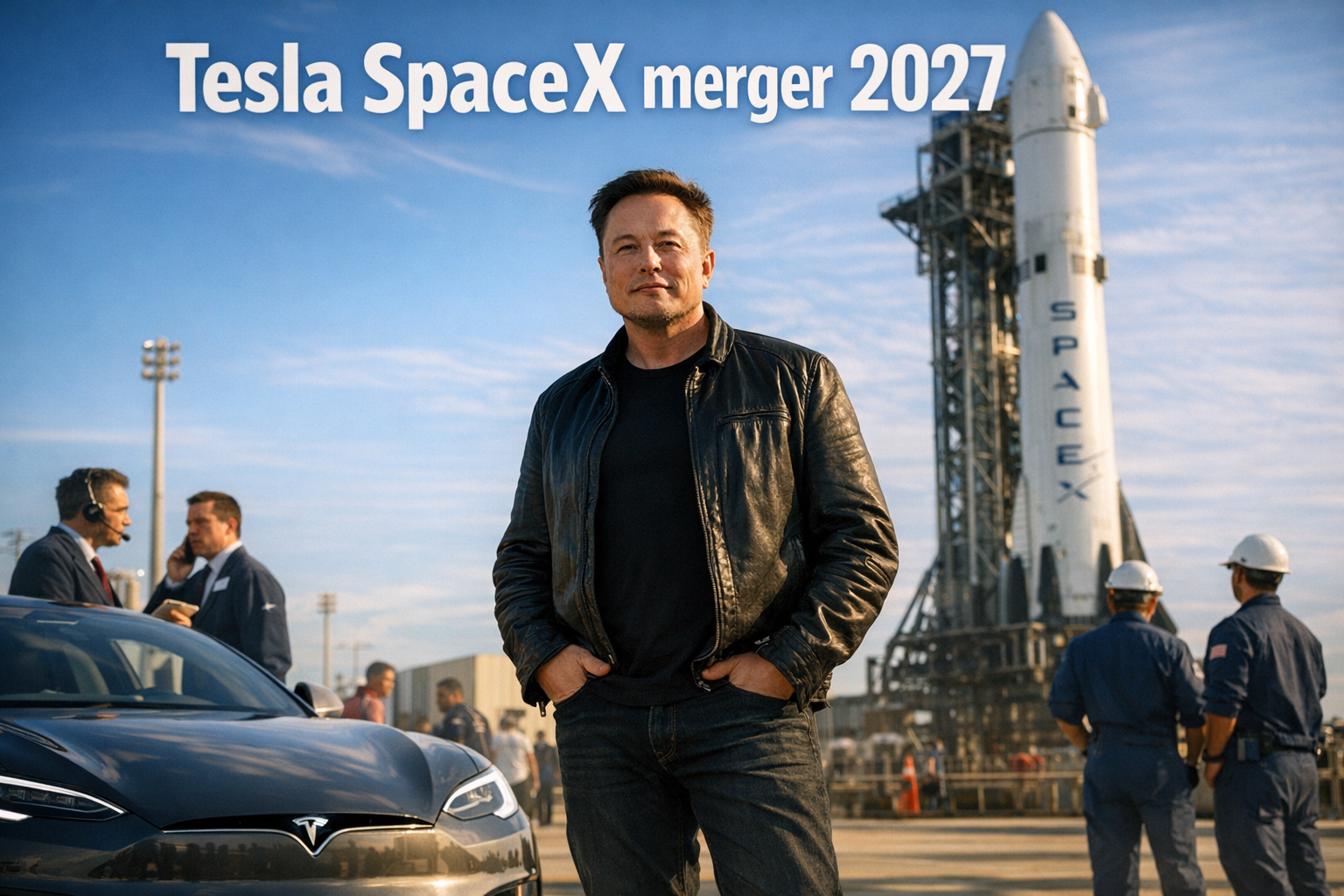
The Tesla–SpaceX 2027 Merger Narrative: The Details Are Too Specific to Dismiss as “Speculation”
This is not a routine discussion about Tesla’s equity outlook. It should be assessed as an integrated narrative linking (i) a proposed semiconductor “Terafab” in Austin estimated at KRW 30–37 trillion (USD 20–25 billion), (ii) potential capital and demand linkages among Tesla, SpaceX, and xAI, (iii) Elon Musk’s stated objective of securing 25% voting control, and (iv) the rationale for valuing Tesla as an AI infrastructure company rather than solely an EV manufacturer.
The central issue is not whether Tesla could reach a specific share price level, but whether Tesla is structurally transitioning from automotive manufacturing toward a vertically integrated platform spanning semiconductors, AI compute, robotics, and space-based networking.
1. Issue Snapshot: Key Market Takeaways
Dan Ives (Wedbush) reiterated a USD 600 Tesla price target and argued that a large-scale “Terafab” in Austin could become critical infrastructure linking Tesla and SpaceX.
The core market interpretation is that Tesla may (i) manufacture AI chips internally, (ii) allocate a meaningful portion to SpaceX’s space network, and (iii) potentially deepen integration across technology, capital structure, and governance.
If this framework is directionally correct, the key question shifts from “Is a merger feasible?” to “Why are enabling assets being built now?”
2. Terafab Scale: Why a KRW 30–37 Trillion Project Matters
Terafab capex is estimated at USD 20–25 billion (KRW ~30–37 trillion). This is not incremental capacity; it would represent a strategic investment capable of redefining corporate positioning.
A critical consideration is whether this capex sits outside Tesla’s previously communicated annual capex envelope, implying incremental cash flow pressure and potential shareholder dilution risk depending on financing.
3. Why Tesla Would Build Semiconductor Manufacturing In-House
The surface rationale is supply-chain control: reliance on foundry and memory partners may not match the pace and scale implied by Tesla’s AI roadmap.
More fundamentally, the objective appears to be controlling the primary bottleneck in AI execution. FSD, robotaxis, Optimus, AI data centers, and satellite-enabled services are all compute-constrained businesses.
This is less a procurement decision than a strategic move to internalize a key lever of industrial competitiveness.
4. Reported Output Mix: Indications of a Space-First Compute Strategy
A widely cited claim is that up to 80% of Terafab output could be allocated to a space-grade chip (D3), with the remaining 20% supporting terrestrial chips (AI5/AI6) for vehicles and robotics.
If accurate, Terafab would be oriented not primarily toward EV compute, but toward supporting a SpaceX-centered space AI infrastructure stack. This would materially affect how the market frames Tesla’s addressable opportunity and valuation comparables.
5. AI5 / AI6 / D3: Interpreting the Product Logic
5-1. AI5 / AI6: Terrestrial AI Processors
AI5 and AI6 are framed as next-generation compute for autonomy, robotaxi operations, and humanoid robotics. Performance improvement claims versus prior generations are substantial (including commentary of up to 50x vs. AI4).
To the extent these targets are realized, Tesla’s competitive set would shift from automotive OEMs toward autonomy software and robotics platform ecosystems.
5-2. D3: Radiation-Hardened Space Compute
D3 is described as radiation-tolerant compute designed for space environments, aligning directly with satellite networking and on-orbit data processing.
This reframes the topic from EV supply-chain optimization to convergence between space infrastructure and AI infrastructure.
6. Funding: The Primary Investor Concern
A project of this magnitude raises the immediate question of whether Tesla can finance it without impairing cash flow flexibility.
Cautious views emphasize incremental capex pressure, potential equity issuance or debt expansion, and dilution risk.
More constructive interpretations assume a shared structure with SpaceX and xAI, potentially spreading financing requirements and aligning long-term demand under internal counterparties.
7. Why a Joint Venture Structure Is Strategically Material
This is not solely about splitting capex. As a public company, Tesla operates under higher disclosure and governance constraints, while SpaceX and xAI (private) can be more flexible in capital formation and long-duration execution.
A plausible structure: Tesla contributes land, manufacturing infrastructure, and operational execution; SpaceX/xAI provide anchored demand and complementary funding capacity.
In macro terms, competition is increasingly ecosystem-based, integrating chips, power, data, networks, robotics, and space connectivity.
8. Terafab: Cost Center or Monetizable Asset?
If Tesla owns/builds the facility while SpaceX commits to long-term procurement and service payments, Terafab could be positioned as a durable cash-generating asset rather than pure capex drag.
The key investor variable is not only “how much is spent,” but “who provides sustained utilization and demand certainty.”
9. SpaceX IPO or Major Capital Raise as a Swing Factor
A SpaceX IPO or sizable private financing could materially improve the overall ecosystem’s capital flexibility. While timing remains uncertain, higher SpaceX valuation and liquidity could support more favorable funding outcomes for Terafab-linked initiatives.
This introduces a second-order view: Terafab may become a channel through which SpaceX capital flows into a Tesla-linked industrial base, rather than a one-way Tesla cash outflow.
10. The Core Logic Behind “2027 Merger”: Musk’s 25% Voting Control Objective
To evaluate a merger narrative, Musk’s emphasis on securing 25% voting control is central.
The argument is that current control may be insufficient for executing long-horizon, high-controversy initiatives in AI and robotics without vulnerability to board or institutional investor opposition.
Within this framework, a Tesla–SpaceX combination is framed not merely as industrial logic, but as a governance strategy to stabilize control.
11. How a Merger Could Address Voting Control
If SpaceX value increases meaningfully and a stock-for-stock transaction occurs, Musk’s SpaceX holdings could translate into larger influence within the combined entity without requiring Tesla to directly grant incremental voting power through additional compensation structures.
This could be viewed as an alternative route relative to controversial equity awards.
12. Merger Mechanics Are Not Costless: Dilution and Governance Risk
Skeptical views emphasize potential dilution for existing Tesla shareholders if a high-valued SpaceX is acquired via equity issuance.
Supportive views argue that the relevant comparison may shift away from EV multiples toward infrastructure/platform multiples spanning space, AI, semiconductors, and robotics. The question becomes whether dilution is offset by a larger combined value base.
13. Why Pursue a Complex Structure
A commonly cited rationale is Musk’s preference for control stability, informed by historical governance outcomes earlier in his career.
Under this interpretation, control is positioned as enabling long-duration technology execution amid AI safety concerns, defense-adjacent dual-use sensitivity, and large-capex uncertainty.
14. Dojo Reframed: From Underperformance Narrative to Strategic Pivot
One interpretation is that terrestrial data-center constraints (power cost, cooling, and infrastructure intensity) could motivate an alternative architecture leveraging space-based compute and networking.
This remains speculative and technically demanding, but aligns with a pattern of pursuing nontraditional infrastructure approaches when physical feasibility is judged acceptable.
15. Semiconductor Execution Risks: Equipment, Yield, and Manufacturing Know-How
The most material execution risk is whether Tesla can achieve advanced semiconductor manufacturing at competitive yield and reliability.
Constraints include EUV tool availability, process learning curves, talent concentration, supply-chain management, and the accumulated operational expertise held by incumbents.
Capital alone is insufficient in leading-edge manufacturing.
16. The Counter-Argument: Process Simplification via Dedicated High-Volume SKUs
The proposed approach differs from a general-purpose foundry model. The concept is to produce a limited set of high-priority chips at scale, simplifying process flows, testing loops, and iteration cycles.
If rapid design-to-fab feedback cycles are achieved, development velocity could improve. However, feasibility remains unproven at scale.
17. Talent Signals
Reported hiring of senior semiconductor engineering talent (including from leading foundry and equipment ecosystems) is cited as an operational signal. Hiring patterns can precede formal project confirmation.
If talent acquisition is sustained and specialized, Terafab may be progressing beyond concept toward execution planning.
18. Why This Matters in a Global Macro and Industrial Policy Context
This topic links to broader trends:
1) AI competition is increasingly constrained by hardware, power, cooling, networks, and robotics—not software alone.
2) US industrial policy continues to prioritize domestic manufacturing and strategic technology supply chains.
3) US equity markets often assign premium valuation to platform ecosystems that control multiple layers of the stack.
A credible shift toward AI infrastructure and space-enabled networks could influence how Tesla is categorized within public market sector frameworks.
19. Practical Variables Investors Should Monitor
19-1. Funding Structure
Equity issuance vs. debt expansion vs. JV structuring will drive market reaction and dilution expectations.
19-2. Tooling and Line Build-Out
Securing critical lithography and advanced process tooling, plus timeline to pilot output, is central.
19-3. Yield Validation
Until volume yields are demonstrated, skepticism is likely to dominate valuation implications.
19-4. SpaceX Liquidity Events
An IPO or major financing would strengthen the capital narrative supporting the ecosystem build-out.
19-5. Regulatory and Governance
Any merger or deep intercompany arrangement increases scrutiny around securities regulation, antitrust considerations, related-party governance, and shareholder litigation.
20. A Key Point Often Missed: Integration Without Legal Merger
The pivotal issue is not the announcement date of a merger. Terafab could function as an economic integration mechanism even without formal consolidation.
If Tesla builds capacity, SpaceX becomes an anchored customer, and xAI adds incremental demand, then chips, data, and infrastructure can converge into a functional ecosystem prior to any legal merger.
The investable question is the speed and credibility of vertical integration across compute, manufacturing, and network deployment.
21. Interpretation: The Questions That Matter More Than a Price Target
Three questions dominate the thesis:
1) Can Tesla credibly reposition from EV manufacturing toward AI infrastructure?
2) Can Tesla–SpaceX linkages be validated through recurring cash flows rather than narrative alignment?
3) Does governance consolidation enhance long-term execution without impairing shareholder value?
If these are answered positively, EV-centric valuation frameworks may become less relevant. If not, expectations may compress rapidly.
22. Conclusion: Treat “2027 Merger” as a Process, Not an Event
A 2027 Tesla–SpaceX merger remains unconfirmed. However, when Terafab scale, space-grade chip allocation, funding architecture, the 25% voting-control objective, and space-based compute narratives are evaluated together, the scenario functions as a coherent long-duration strategic pathway rather than a standalone rumor.
The primary issue is Tesla’s prospective identity: remaining an EV-led manufacturer or evolving into a platform spanning semiconductors, robotics, space connectivity, and AI compute infrastructure.
< Summary >
- Terafab is a USD 20–25 billion (KRW ~30–37 trillion) semiconductor initiative that could shift Tesla positioning from EV manufacturing toward AI infrastructure.
- Claims that up to 80% of output targets a space-grade D3 chip imply functional integration with SpaceX’s space AI/network stack.
- Funding risk is significant; a Tesla–SpaceX–xAI JV structure could reduce Tesla-only financial burden while strengthening long-term monetization pathways.
- The merger narrative is closely tied to Musk’s 25% voting-control objective and a broader integrated AI-industrial strategy.
- The critical monitoring point is not merger timing, but the pace at which semiconductors, AI compute, and space infrastructure are operationally connected.
[Related Articles…]
- Tesla AI Strategy and US Equity Re-Rating Considerations (NextGenInsight.net?s=Tesla)
- How Rising SpaceX Valuation May Affect the Global Economy (NextGenInsight.net?s=SpaceX)
*Source: [ 오늘의 테슬라 뉴스 ]
– 테슬라-스페이스X 2027년 합병하나! 37조원 ‘테라팹’과 머스크의 25% 지배력 시나리오, 주가 600달러의 비밀?● Tesla Terafab Shock, AI Space Power Grab, Iran Risk Twist
Tesla “Terafab”: The Strategic Core May Be Space-Linked Infrastructure, Not Semiconductors — Consolidated View on Autonomy Data, a Potential SpaceX IPO, and the Iran Variable
This development extends beyond a new semiconductor facility.
This report addresses: (i) why the market may be mis-framing Terafab, (ii) why a simple “short-term negative, long-term positive” narrative may be inadequate, (iii) the measurable trajectory of Full Self-Driving (FSD) performance, (iv) why a SpaceX IPO could catalyze a valuation reset across the space economy, and (v) how Iran-related geopolitical risk may affect equities, oil, and risk premia.
A key under-discussed angle is that Terafab’s end-state may be an integrated AI–space–energy infrastructure stack rather than purely terrestrial chip output.
1. Key Developments at a Glance
- Terafab may be better interpreted as a hyperscale AI infrastructure strategy than a conventional chip plant.
- The view that “large capital expenditure implies a near-term headwind” may be premature.
- The sequence of monetization matters: autonomy-driven cash flow could scale before peak CAPEX.
- Quantitative indicators of FSD usability and reliability have improved.
- A potential SpaceX IPO could trigger sector-wide re-rating in space-related assets.
- Iran-related risk has not cleared, but market pricing has begun to reflect partial de-escalation scenarios.
The critical variable is the order and timing of realization, not any single headline.
2. Why Terafab May Not Be a Conventional “Semiconductor Factory”
2-1. Semiconductor Output vs. System-Level Redesign
Interpreting Terafab as a standard foundry misses the primary thesis: redesigning the end-to-end manufacturing system.
Core elements emphasized include:
- Process completion within a single facility
- Single-purpose production architecture
- Minimization of non-value-added movement
- Rapid redesign of bottlenecks
- Short iteration cycles for continuous improvement
This resembles SpaceX’s rapid iteration approach applied to semiconductor manufacturing—less a late entry into foundry competition and more an attempt to compress improvement cycles structurally.
2-2. Interpreting “Harder Than Semiconductors”
Referencing Starship-scale system complexity appears intended to highlight an existing strength: manufacturing innovation proven in high-complexity, high-iteration domains.
The implication is that the objective is not marginal share capture in a mature industry, but the creation of a manufacturing “algorithm” that outpaces incumbent improvement rates.
3. Why It May Not Be a Near-Term Headwind: CAPEX Timing and Cash-Flow Sequencing
3-1. Market Concerns Typically Priced In
- Scale of CAPEX
- Potential near-term cash flow deterioration
- Dilution risk
- Long-dated payoff horizon
These concerns are structurally valid, but incomplete without a timeline.
3-2. Large-Scale CAPEX May Not Be Imminent
The Texas effort is described as closer to a testbed than the final Terafab, implying staged deployment rather than immediate full-scale spend:
- Texas-based pilot facility operations
- Process architecture validation
- Rapid iteration and improvement
- Final site selection
- Large-scale power infrastructure procurement
- Full CAPEX execution
Under this pathway, the peak funding burden may arrive later than the market assumes.
3-3. Autonomy Monetization Could Precede Peak CAPEX
If FSD and robotaxi monetization scales before major CAPEX ramps, Terafab can be framed as reinvestment infrastructure funded by expanding high-margin software/usage economics, rather than an isolated cash-consuming project.
This reduces the usefulness of a simplistic “short-term negative, long-term positive” label; the nearer-term impact depends on sequencing.
4. FSD Updates: Performance Should Be Evaluated Quantitatively
4-1. Hard-Braking Frequency Improvement
Referenced metrics indicate hard braking declined from ~18 events per 1,000 miles (v11) to ~5.5 events per 1,000 miles (v14), suggesting improved ride quality, prediction stability, and control confidence.
4-2. Reduced Driver Intervention via Accelerator Input
Accelerator intervention reportedly decreased from ~9% to ~3%, a proxy for reduced “frustration override” and rising user trust—relevant to subscription retention, conversion, and robotaxi scalability.
4-3. Growth in Active Fleet and Usage Share
FSD-enabled vehicles reportedly exceeded 1.1 million, alongside an increase in the share of total driving time conducted under FSD. Sustained usage intensity is a stronger value signal than feature attachment alone and can affect earnings mix via software contribution.
5. The Broader Thesis: AI Chips, Energy, and Space Infrastructure as an Integrated Stack
5-1. Why the “1 TW” Concept Matters
The cited “1 TW” framing refers to the energy implied by aggregate compute demand when the produced chips are operating, not the factory’s direct consumption.
This shifts the analysis from chip supply to power availability and thermal constraints.
5-2. Terrestrial Data Center Constraints and the Space-Infra Rationale
The logic chain presented is:
- On-Earth power procurement is increasingly constrained
- Hyperscale AI compute intensifies heat dissipation challenges
- Space may offer alternative solar collection and thermal rejection advantages
- Starship logistics, Optimus automation, solar generation, and AI silicon could converge into a single supply chain
This is a long-duration scenario, but the implication is that valuing Terafab strictly within traditional semiconductor frameworks may understate the intended platform scope: control over compute capacity and energy access.
6. Potential SpaceX IPO: A Catalyst for Re-Rating the Space Economy
6-1. Why IPO Optionality Matters
A public listing would force financial disclosure and formal market price discovery, potentially resetting valuation anchors across launch services, satellite connectivity, orbital infrastructure, and lunar logistics.
6-2. Strategic Tailwinds and Structural Advantage
Referenced NASA signaling suggests a shift from symbolic missions to durable infrastructure and sustained operations. In that context, SpaceX is positioned with:
- High launch cadence capacity
- Lower cost structure
- Reusability advantages
- Starship-driven heavy-lift logistics potential
- Network effects via Starlink integration
This combination is difficult for late entrants to replicate in the near term.
7. Iran-Related Geopolitical Risk: Markets Focus on the Risk Premium, Not the Event Headline
7-1. Why It Matters for Equities and Oil
Middle East risk directly affects crude pricing, inflation expectations, and risk-asset sentiment—particularly in a market sensitive to rates, supply-chain fragility, and volatility.
7-2. Prediction Markets, Oil Positioning, and Negotiation Signals
Referenced indicators include prediction-market pricing, rising Brent short positioning, and partial pricing of ceasefire/de-escalation probabilities. These are not definitive, but they can reflect incremental positioning ahead of official confirmation.
7-3. Negotiation Posture and Market Interpretation
The described posture combines conciliatory signaling with continued pressure. Markets can respond positively to a reduction in escalation probability even without a full resolution, via compression of the geopolitical risk premium over a 1–3 month horizon.
8. Under-Covered Core Point: Tesla Valuation Depends on More Than EV Manufacturing
8-1. Terafab as a “Civilization Infrastructure” Experiment
Standard analysis often centers on near-term P&L questions (CAPEX size, timing to profitability, share vs. incumbents). The proposed framing is broader: Terafab may sit within an integrated system linking:
- Next-generation AI infrastructure
- Space logistics via SpaceX
- Automation via Optimus
- Power supply via energy operations
- Data acquisition via autonomy deployment
This resembles an “industrial operating system” approach.
8-2. The Competitive Variable May Be Iteration Speed
The key gap may be the rate of improvement rather than binary success/failure. Faster design-update cycles can widen performance and cost advantages over time even if initial maturity is lower.
8-3. Autonomy Can Alter the Valuation Framework
If autonomy software revenue becomes material, Tesla’s multiple may shift from manufacturing-driven comparables toward platform-like frameworks, especially if macro conditions become more supportive of growth multiples.
9. Forward Monitoring Checklist
- FSD v14.3 and subsequent real-world performance progression
- Robotaxi rollout footprint, accident rates, and intervention metrics
- Terafab pilot buildout pace and disclosed milestones
- Updates on final large-site selection and power procurement
- Evidence of SpaceX IPO process (e.g., filing activity)
- Changes in lunar infrastructure procurement and launch award structures
- Iran negotiation progress and crude price direction
- Broad U.S. equity risk appetite and volatility regime
These items are interconnected; for example, oil stability can ease inflation pressure, influence rate expectations, and feed back into growth-asset valuation.
10. Conclusion: What the Market May Be Mis-Pricing and What to Track
Terafab is not solely a semiconductor expansion. It can be interpreted as a long-horizon effort to integrate AI silicon, autonomy compute demand, energy constraints, and space logistics into a unified infrastructure strategy.
A “near-term negative” classification may be premature if (i) CAPEX is staged and (ii) autonomy-linked cash flows scale before peak investment.
A potential SpaceX IPO may function as a sector-level valuation reset mechanism via disclosure and public-market price formation.
Iran-related developments should be monitored primarily through their impact on the geopolitical risk premium embedded in equities and oil, rather than through event headlines alone.
Most Material Under-Discussed Points
- Terafab’s strategic meaning may be integration of compute–power–space infrastructure, not chip unit volume alone.
- Peak CAPEX may be staged, potentially limiting immediate cash-flow shock.
- FSD’s investment relevance is tied to usage intensity and declining intervention rates, not promotional claims.
- A SpaceX IPO could establish new valuation benchmarks for the space economy.
- The key Iran variable is the trajectory of risk premia in oil and equities.
< Summary >
Terafab can be framed as a hyperscale infrastructure strategy linking AI, energy, and space-industrial logistics.
“Near-term negative” interpretations may be early if autonomy monetization precedes peak CAPEX.
FSD metrics cited indicate measurable improvement, and a SpaceX IPO could catalyze a broad re-rating of space assets.
Iran-related risk is most relevant via its effect on risk premia and crude, influencing broader equity sentiment.
[Related Articles…]
-
Tesla autonomy and robotaxi monetization: key points to monitor now
https://NextGenInsight.net?s=tesla -
Space industry inflection: SpaceX IPO optionality and the start of a lunar-base economy
https://NextGenInsight.net?s=space
*Source: [ 허니잼의 테슬라와 일론 ]
– [테슬라 라이브] 테라팹은 단기 악재 장기 호재가 아니다! 테라팹의 진정한 의미와 폭발하는 우주산업 / 이란 사태 속보 정리● LEGO Defies Baby Bust, Wins with Fan Frenzy, IP Power, Supply Chain Edge
Why LEGO Outperforms Even in a Low-Fertility Era: Consumer Trends, Global Supply Chains, and IP Economics in One Framework
Even as the child population declines, LEGO continues to strengthen its market position.
This report summarizes how LEGO has evolved beyond a toy manufacturer by reshaping consumer demand, redesigning its global supply chain, and combining IP-driven monetization with the adult hobby market to build a differentiated growth model.
It also explains why institutional analysts often view LEGO not as a company that follows demand, but as one that creates demand, and why this model matters for global macro conditions and investment strategy.
In effect, LEGO increasingly resembles a platform that designs “taste, immersion, collectability, and fandom experiences,” rather than a conventional toy company.
1. News-Style Core Briefing: Why LEGO Matters Now
LEGO is expanding its presence despite slowing momentum in traditional toys driven by declining birth rates and digital content substitution.
Key factors:
- Demand shift from child-centric consumption to the adult hobby segment
- Conversion of high-equity IP (Disney, Marvel, Harry Potter, F1) into a physical build experience
- Supply-chain resilience through distributed production across Mexico, Hungary, Vietnam, and the United States (planned)
This combination supports a premium consumer model that has shown relative resilience across cyclical conditions.
2. Origins: From a Carpentry Workshop to a Global Brand
LEGO began in 1932 in Billund, Denmark, when carpenter Ole Kirk Christiansen started producing wooden toys.
During the Great Depression era, the business was anchored in a quality-first philosophy under constrained consumer purchasing power.
2-1. The Structural Inflection: Plastic and the Interlocking System
The adoption of plastic was the turning point.
Despite early perceptions of plastic as an inferior material, LEGO used it to develop a precision interlocking brick system. This created a scalable product logic: customers do not purchase a single finished item; they buy an expandable system that can be disassembled, recombined, and extended over time.
This shifted LEGO from selling discrete products to monetizing a continuing creation system.
3. Redefining the Category: From Toys to Experience Goods
LEGO has migrated from a children’s toy category toward hobby goods, home decor objects, fandom merchandise, collectibles, and stress-relief consumption.
3-1. Consumers Pay for “Making,” Not Only “Owning”
LEGO’s value proposition is centered on the build process and the resulting display value.
Examples include Porsche 911, Bugatti, Nike-themed sets, landmarks, wall-mounted art, and major entertainment characters. The purchase embeds time investment, immersion, completion utility, and long-term ownership value.
3-2. Early Positioning in the Adult Collector (Kidult) Segment
LEGO identified adult preferences ahead of many peers.
For consumers in their 30s to 50s, LEGO functions as a hobby and self-reward purchase. The build time serves as decompression; finished sets can also function as interior design elements.
This positions LEGO as monetizing structured leisure time rather than only physical products.
4. Retail Execution: Best Practices in Experiential Store Design
LEGO’s retail format is built around participation and merchandising precision:
- Hands-on play/build areas
- City-specific exclusives
- Build-a-minifigure selection
- Small-ticket accessories (e.g., keychains)
- Large collaboration sets and wall-art formats
4-1. Selling a Universe, Not Shelf Space
Stores are organized by interest-based “worlds” (Disney, Harry Potter, City, gaming, automotive, architecture, film).
This shifts customer decision-making from “what to buy” to “which universe to enter,” increasing conversion and cross-category purchasing.
4-2. A Deliberate Price Ladder
LEGO maintains a tightly structured price architecture:
- Low-cost entry items (souvenirs, accessories)
- Mid-size giftable sets
- High-priced collector sets (hundreds of dollars)
This design increases brand entry probability and facilitates trading up over time.
5. Core Growth Engine: Physical Implementation of IP Economics
IP partnerships are central to LEGO’s current positioning.
By translating proven fandom IP (Marvel, Disney, Harry Potter, Nintendo, F1) into a buildable format, LEGO upgrades conventional merchandising into an experiential product.
5-1. From Passive Viewing to Active Construction
Typical IP merchandise is image-based branding.
LEGO enables consumers to build Hogwarts, assemble an Iron Man suit, or replicate a supercar in brick form, creating deeper engagement than standard goods.
5-2. Stronger IP Lowers Price Resistance and Supports Repeat Purchasing
IP-based products generally reduce price sensitivity due to emotional attachment and perceived collectability.
This supports premium pricing and increases repurchase propensity through ongoing franchise releases and fandom renewal cycles.
6. Why LEGO Can Grow in a Low-Fertility Era: Reweighting Toward Adults
Traditional toy demand is highly correlated with birth rates.
LEGO has partially decoupled from this linkage by expanding adult-facing lines spanning architecture, automotive, film, art, travel, and sports.
6-1. Reduced Dependence on Child Demographics
By broadening the target age range, LEGO reduces exposure to structural child-population decline and expands total addressable demand.
6-2. Cyclical Exposure with Defensive “Emotional Utility”
While toys are typically cyclical, LEGO’s adult segment often functions as hobby, stress relief, and self-reward spending.
In downturns, consumption may shift toward smaller discretionary indulgences rather than fully disappearing, improving revenue stability relative to conventional toys.
7. Supply-Chain Strength: Not Only a Brand Story
LEGO’s operational foundation is a key competitive advantage.
7-1. Production Diversification to Mitigate Geopolitical Risk
LEGO operates production across Mexico, Hungary, and Vietnam, and is pursuing a Virginia, USA facility targeted for 2027.
This aligns with broader global supply-chain restructuring and risk mitigation priorities.
7-2. Near-Market Production Reduces Time and Cost
Producing closer to end markets can reduce:
- Freight and logistics costs
- Delivery lead times
- Tariff and policy risk
This becomes more material under recurring geopolitical and trade disruptions.
7-3. Hybrid Profile: Content-Like Demand with Manufacturing-Grade Efficiency
Although LEGO presents as a lifestyle/IP brand externally, it maintains high manufacturing and supply-chain discipline internally.
The combination of strong brand equity and operational excellence tends to compound competitiveness over time.
8. Investment Relevance: Why LEGO Is Widely Analyzed Despite Being Private
LEGO is not publicly listed, but remains a reference case because its business model diverges structurally from traditional toy peers.
8-1. Demand Creation vs. Demand Following
Most toy companies are highly exposed to seasonality, demographic trends, and individual franchise cycles.
LEGO frequently triggers “must-have” purchase intent through new releases, indicating systematic demand creation rather than share competition within a fixed market.
8-2. Relatively Lower Inventory Risk
The toy industry often faces material obsolescence risk when trends fade.
LEGO benefits from high cross-set compatibility; bricks from discontinued sets remain usable across the ecosystem, extending product utility and reducing write-down pressure.
8-3. Defensive Characteristics as a Premium Consumer Product
LEGO is not low-priced, but consumers accept pricing due to bundled value:
- Build experience
- Display utility
- fandom satisfaction
- gifting demand
- self-reward psychology
This supports pricing power and raises competitive barriers versus standard toys.
9. Under-Discussed Core Point
Many commentaries frame LEGO as “a toy brand adults also enjoy.” A more investment-relevant framing is structural.
9-1. LEGO as an Analog Immersion Platform
In an attention-scarce environment driven by smartphones, short-form video, gaming, and social media, LEGO offers sustained offline focus.
Its competitive set therefore extends beyond toys to include games, streaming, mobile content, home decor, and mindfulness-oriented hobbies.
9-2. Monetizing Structured Time, Not Only Products
Purchasing LEGO includes:
- several hours of focused engagement
- completion satisfaction
- a physical, displayable output
- the option to rebuild and reconfigure
This model sells meaningful time allocation as part of the product proposition.
9-3. Potential Strength in an AI-Intensified Economy
As automation increases, demand may rise for tactile, hands-on creative activities with physical outcomes.
LEGO is positioned as a premium analog brand that can benefit from incremental preference for offline, material experiences.
10. Macro Implications: What LEGO Indicates About the Global Economy
LEGO is a useful case study for what can remain durable under demographic decline and supply-chain volatility.
10-1. Addressing Demographic Decline Through Age-Range Expansion
In structurally low-fertility markets, child-only targeting constrains growth.
Expanding customer age coverage is an applicable strategy across consumer categories.
10-2. Competitive Advantage Requires Both Content and Operations
Historically, content and manufacturing were separable competencies.
Current markets increasingly reward integration across brand universe, fandom mechanics, supply chain, and retail execution. LEGO exemplifies this integrated model.
10-3. In High-Uncertainty Periods, “High-Conviction Preference Brands” Outperform
With persistent pressure from inflation, rate volatility, and cyclical uncertainty, consumers become more selective.
Spending concentrates on products with durable personal meaning, longevity, and clear utility. LEGO aligns with these attributes.
11. Why LEGO May Remain in Focus
Primary drivers:1) Continued expansion potential in adult hobby demand
2) Ongoing scalability of IP collaboration
3) Supply-chain localization supporting earnings stability
4) Rising value of analog immersion under digital fatigue conditions
12. How to Frame LEGO
Viewing LEGO solely as a toy company is incomplete.
It operates at the intersection of hobby consumption, content/IP economics, manufacturing execution, fandom monetization, and premium consumer goods. This multi-engine structure explains its ability to sustain growth amid demographic decline, digital substitution, and supply-chain restructuring.
< Summary >
LEGO is among the few companies sustaining growth despite low fertility trends and an increasingly digital entertainment environment.
Key drivers include adult hobby market expansion, high-equity IP monetization, experiential retail, and diversified/globalized production.
Institutional analysis often frames LEGO as a premium consumer company with demand-creation capability rather than a traditional toy manufacturer. Its principal advantage is the design of immersion and collectability, not only product sales. The value of analog, hands-on premium brands may increase as AI adoption accelerates.
[Related Articles…]
- https://NextGenInsight.net?s=AI
- https://NextGenInsight.net?s=supply%20chain
*Source: [ Maeil Business Newspaper ]
– [어바웃 뉴욕] 작은 블록이 만든 새 소비 흐름, 레고의 변천사 | 길금희 특파원