● Orbital Salvage Meets Space Fuel
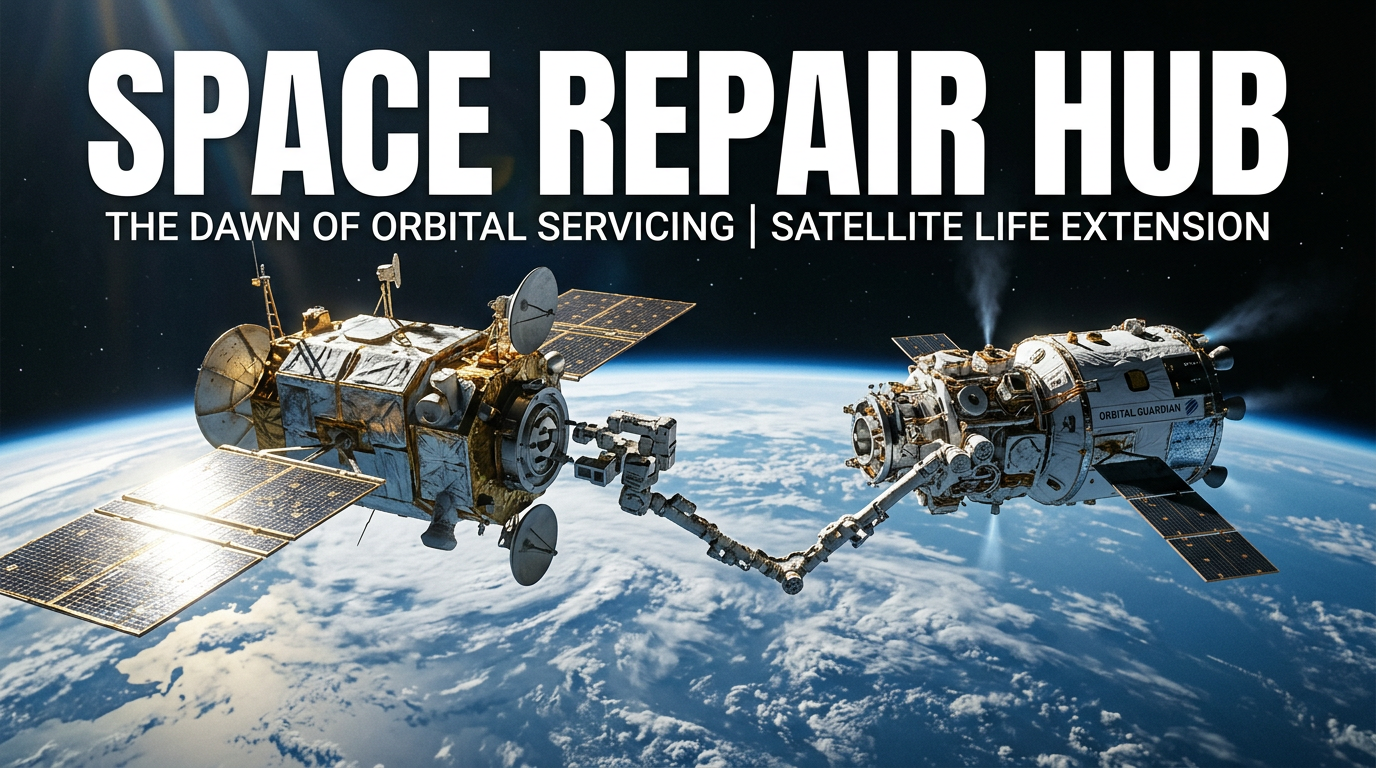
“Space Repair Shop·Fuel Station” is gaining traction… The era of discarding malfunctioning satellites is over, and the satellite lifetime extension & on-orbit service market is taking off
1) One-line summary of today’s news
The core point of this interview is that the era of simply abandoning a broken satellite as trash has ended, and that a ‘space repair shop·fuel station’ business centered on on-orbit services and extending satellite lifetimes can translate into real revenue. In particular, Walkerin Space is pushing a direction that bundles robotic satellites + AI + digital twins to enable direct repairs, replacements, and refueling in space.
2) Why this story matters right now (key takeaway the reader should remember)
– As launch costs fall under NewSpace, “verifying and making money directly in space” has become faster – Satellites are expensive (large/high-value), and even a “small parts issue” can bring the whole system down, so a service-first monetization model is opening up by targeting that window – This is competitive because the technical hurdles are high (extreme environments, collision avoidance, precise control, communication constraints), not just because the problems to solve are big
3) What we’ll cover in the main text
In today’s article, I’ll lay out all five items below in a news-style format. For each item, I’ll focus on “where the business actually makes money.”
① What the ‘satellite repair shop/fuel station’ business actually does
② The role of a physical AI-based ‘robot satellite’ used in extreme environments
③ A lifetime extension paradigm that saves a “30-billion-won satellite you were going to throw away after 3 years”
④ The rendezvous docking technology to be demonstrated in 2028 (approach without collisions·tracking·autonomous decision-making)
⑤ Korea’s only target: a sweet spot where fuel replenishment + repair/replacement can pay off immediately
What is a space repair shop·fuel station (on-orbit services)? : “AS becomes necessary” more and more often
Walkerin Space CEO Kim Hae-dong points first to structural problems in the past space industry.
– When satellites malfunction or run out of fuel, there hasn’t been anyone to go to the site to repair them, and the cycle of them being left as “space debris” has repeated.
– But after changes like rocket reusability (a shift in the NewSpace launch paradigm), expectations are turning into reality: even a broken satellite can be fixed and reused.
The name tag for this business is simple. Repair (fixing failures/replacing parts) + Refuel (fuel supply) + Continued operation (lifetime extension)
And it emphasizes that to carry out all of this in space, an approach different from how you do things in a “ground auto repair shop” is required.
The decisive difference between a ground repair shop and a space repair shop : “Vacuum·thermal·radiation” are different
The difficulty of the space environment that the representative describes is fairly specific.
– Vacuum condition
– Thermal changes repeat at extreme levels due to exposure to the sun
– Radiation exposure increases the likelihood of failures in electrical/electronic components
So it becomes explosively expensive for people (including spacesuits) to do it directly. Ultimately, “robots that can work instead of humans” are needed, and the structure is one where AI is attached to them.
Robot satellite + physical AI : the concept of ‘humanoid-type work’ that replaces humans
The solution Walkerin Space talks about is a “humanoid-type robot satellite.”
– Not a simple gripper type—pushing toward putting robots into space that look like a person performing the task even when viewed from far away
– Control starts from the ground (remote commands), but as they get closer, due to communication-cycle constraints, the satellite is designed to make decisions on its own
The representative is explicit that this is not just a simple robot, but a segment where physical AI is applied. In other words, they place weight on safely executing the task by having the system perceive the situation with sensors and calculate distance/collision risk on its own.
A lifetime extension model that saves the “30-billion-won satellite you used to make last 3 years then discard”
This is the part that’s truly important. They don’t only talk about direction—they show why it becomes money using a real case.
– In 2016, they launched an artificial satellite worth about 3 billion won to target 10 years of operation in Europe’s space agency
– After about 3 years, it collided with “space debris that was worth shoveling/sweeping” (i.e., debris you could have avoided) and developed problems with its power generation function
– As a result, the story is that the satellite became “space debris with no remaining usefulness.”
The representative’s argument: Don’t you throw away an entire high-end car just because the side mirror gets slightly damaged?
In space too, if it’s possible to replace/repair only the damaged parts, then – what was supposed to be used for 10 years – can have costs recovered and be made to last longer
That’s when the customer ends up needing an “SOS call” structure. So Walkerin Space sees a lifetime extension service through fuel replenishment as the sweet spot where revenue can occur fastest.
The key is this. It’s the viewpoint that “money moves not in the failed state, but in the state that is about to fail.”
A structure that enables waiting/repair/refueling at the same time : it’s advantageous to ‘keep watch’ from geostationary orbit
A robot satellite has the advantage of operating in geostationary orbit, where it can continuously observe and communicate. The representative explains this simply.
– In geostationary orbit, the satellite’s orbital speed matches Earth’s rotation speed, so it appears to stay over the Earth
– This makes it easier to operate while observing access and performing work from the ground
Meanwhile, the representative says that in low Earth orbit (e.g., 500~1000km), it moves quickly, which creates constraints on communication and observation.
Demonstration in 2028 : what rendezvous docking technology (safe approach·collision avoidance·autonomous decision-making) means
Walkerin Space mentions a plan for a 2028 space demonstration test where “two small satellites come closer and move away, then chase again and practice performing a task.”
Here, the important point is not “just docking technology,” but practicing safe approach, maintaining distance, and executing the work without colliding.
The method explained by the representative is step-by-step.
– When it’s far away: commands begin on the ground (remote control)
– As it gets closer, communication constraints increase, so autonomous decision-making based on the satellite’s onboard computers and sensors becomes important
They also detail the sensor setup.
– Camera (visible range)
– Lidar (distance/shape)
– IR sensor (for dark-environment 대응)
– Radar (additional detection/secondary perception)
And the reason AI becomes necessary is clear. Because a single mistake = collision/damage = failure of the business.
Digital twin/Simulation : operations control that lets you ‘do space work while wearing goggles’
The representative also introduces how to apply simulation twins and digital twins into real practice.
– When a robot satellite approaches a customer’s satellite and performs a task – with ground operators receiving the data – creating a concept where you can view the task status through a virtual environment as if it were happening in real space
This isn’t just a tech showcase—it’s important in terms of operating costs, safety, and training efficiency. It looks like a device to reduce the gap between demonstration and commercialization.
Fuel refueling ‘fuel-station model’: a competitive landscape that’s rare even internationally
In the fuel refueling (fuel resupply) sector, they say it’s not a market with “too many companies” even globally. Walkerin Space gives the impression that there are only a few places worldwide.
The companies mentioned as examples follow these trends.
– United States: approaches related to fuel tanks (standardized tanks) such as OvV (mentioned) and others
– Overseas large enterprises: Northrop Grumman—expanding technology based on cases of satellite lifetime extension services
– Japan-originated growth: Astroscale—growing from the concept of cleaning/capturing space debris
– Many startups: Starfish Space (mentioned), and others
Here, Walkerin Space’s differentiator is that it emphasized a structure where “who makes the fuel tank, who delivers it, and who performs the task” are separated.
That is,
– On the customer satellite side: prepare standardized fuel tanks
– On the robot satellite side: carry the fuel tank, then connect (deliver)
– For task execution: precise approach and safe docking by the robot satellite
This is how they implement the “fuel station + repair shop” with technology.
A market that makes money before ‘space debris cleanup’ : “a satellite that has value before failure/is already worth repairing”
This section is the sharpest part of the interview. Many people ask, “Why don’t you start with cleaning space debris?” And the representative answers in the sense that it’s “too far away.”
Walkerin Space views revenue priorities like this.
1) Lifetime extension through fuel refueling (the first area where money is made)
2) Even small damage (collision, battery, parts issues) extending a satellite’s life through “repair/replacement”
3) Expanding into services that can grow into the next stage (satellite work, other operations/manufacturing linkages, etc.)
So rather than making space debris handling itself the #1 priority, it’s the viewpoint that a “service that keeps satellites from becoming debris” can generate revenue first.
Because there are many low Earth orbit satellites, ‘AS control’ is harder : communication + ground-station constraints bring AI
The representative explains why rendezvous/docking demonstrations are difficult in low Earth orbit (LEO) by citing limitations in opportunities for communication with ground stations.
– With just one ground-station antenna, the “time window when communication passes” is extremely limited per day
– Therefore, the satellite must be able to maintain its own position/state and make decisions on its own
That’s why “control based on a set of various sensors + AI decisions + a digital twin” appears as a package. In that set, topics like AI semiconductors or computation optimization can’t help but naturally come along. (They explicitly mention AI technology integration in the interview.)
The most important ‘organizing takeaway’(the core that usually isn’t pulled elsewhere)
Probably most videos/articles can only say something like “a space repair shop is possible.” But in this content, the real core is elsewhere.
1) This business’s revenue logic is not ‘cleaning after a breakdown,’ but capturing as a service the conditions that make it break
2) The technology roadmap connects as “robot satellites (physical AI) → rendezvous docking (autonomous decisions) → digital twin (control/training efficiency)”
3) An operational design that can be demonstrated while being watched from geostationary orbit is a device that reduces risk on the path to commercialization
4) Even within a two-track approach focused on both expensive and cheap satellites (large high-value/large quantities of low-cost), Walkerin Space targets the ‘high-value repair potential’ first to chase faster revenue speed
5) In the end, it’s a signal that the center of gravity is shifting from the “satellite manufacturing industry” to the “satellite operations & maintenance industry.”
Next-Korea investment/industry checklist (for readers)
After reading this interview, the questions you should check are these.
– Who actually pays for and buys “fuel refueling/repair services”? (satellite operators/manufacturers/telecom companies, etc.)
– If rendezvous docking (approach·collision avoidance) passes the demonstration, what pipeline will be used to secure the next commercial customers?
– How much does digital-twin-based control reduce the operations staff/time required?
– After starting with high-value satellites, is there a business unit pricing structure that can expand to mid/low-value satellites as well?
< Summary >
– Space repair shops·fuel stations (on-orbit services) are businesses that save satellites that were being left behind due to failures/lack of fuel through repairs and fuel refueling.
– Unlike on the ground, space has high environmental difficulty—vacuum, thermal conditions, radiation, and so on—so it’s hard for people to do directly; therefore, robot satellites + physical AI + digital twins become the core.
– Revenue priority is extending satellite lifetime through fuel refueling and repairing small damage/replacing parts, not space debris cleanup.
– In the 2028 demonstration, they perform rendezvous docking; as they get closer, communication constraints increase, making satellite autonomous decision-making (sensors + AI) important.
– The competitive landscape is limited worldwide, and as the sole domestic target, a strategy was introduced that approaches the market by dividing up fuel-tank standardization/refueling systems and precise capture technology.
[Related articles…]
- “Rendezvous docking” and trends in satellite operation technology
- Competition in space control/demonstration created by digital twins
*Source: [ 티타임즈TV ]
– ‘우주 정비소’ 스타트업이 그리는 뉴 스페이스 시대 (워커린 스페이스 김해동 대표)