● OECD Shock, Middle East War Wipes Out Global Growth, Korea Hit Hardest
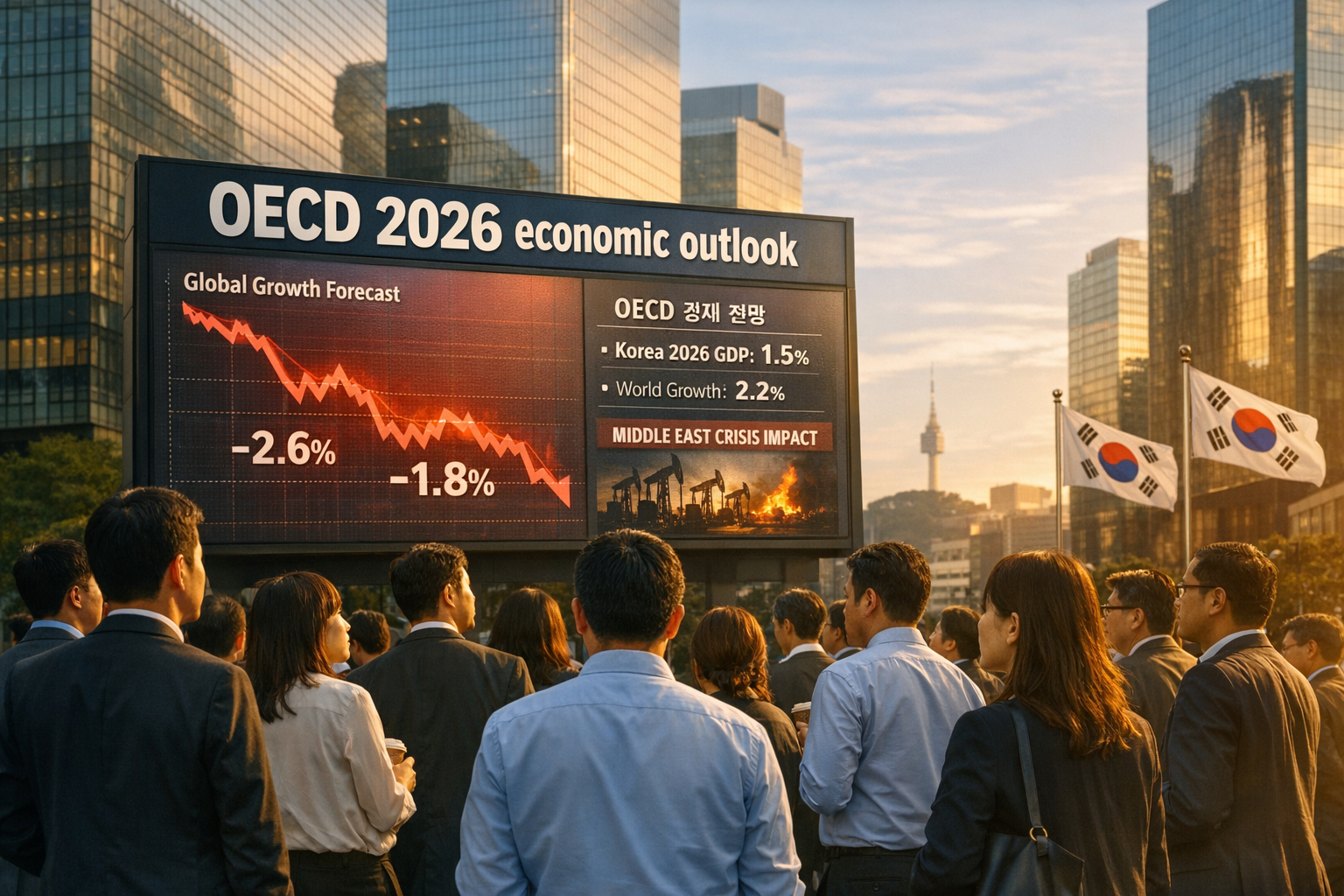
OECD 2026 Economic Outlook — Rapid Assessment: Middle East Conflict Eliminates 0.3pp of Global Upside; Why Korea Faces a Larger Shock
The key takeaway is not that “global growth remains at 2.9%.” While the headline number is unchanged, the growth path that could have lifted global growth to 3.2% has been removed by the escalation in the Middle East. The outlook also reflects renewed inflation pressure, a potential oil-price spike, a less certain rate-cut path, Korea’s energy-import vulnerability, supply-chain risk, and the government’s three-stage contingency framework.
1. This OECD update: interpretation matters more than the headline number
OECD assesses that global economic resilience is being tested amid escalating regional conflict. The 2026 global growth forecast is kept at 2.9%, which may appear unchanged versus the prior view. However, OECD indicates that absent the conflict escalation, conditions through February could have supported an upward revision to 3.2%. In effect, the conflict removes approximately 0.3 percentage points of potential global growth.
This signals a loss of recovery momentum due to geopolitical risk rather than a routine forecast adjustment.
2. Key points in report format
2-1. Global economy
- 2026 global growth: 2.9%
- 2027 global growth: 3.0%
- Headline similar to the December outlook, but the 3.2% upgrade scenario is fully offset by the Middle East conflict
- OECD’s assessment: the global economy is shifting from recovery back toward elevated uncertainty
2-2. Inflation outlook
- G20 inflation (2026): 4.0%
- G20 inflation (2027): 2.7%
- Higher energy prices re-accelerate inflation
- Disinflation likely to proceed more slowly than previously expected
2-3. Major economy growth
- United States: 2025 2.1% → 2026 2.0%
- Euro area: 2025 1.4% → 2026 0.8%
- Japan: 2025 1.2% → 2026 0.9%
- Korea: 2026 1.7%, 2027 2.1%
2-4. Korea inflation
- 2026 Korea inflation: 2.7%
- 2027 Korea inflation: 2.0%
- 2026 inflation revised materially higher versus the prior outlook
3. Why this functions as a stagflation risk signal
The outlook implies weaker growth alongside higher inflation. This combination pressures corporate earnings and employment while compressing real household income and consumption. For central banks, policy trade-offs intensify: easing to support growth risks reinforcing inflation, while tightening to contain inflation risks amplifying the downturn. This does not confirm stagflation, but indicates a higher probability of that risk profile.
4. Direct transmission channels from the Middle East conflict to the global economy
4-1. Channel 1: oil-price shock
Escalation in the region typically impacts energy markets first. Oil and gas prices feed broadly into cost structures across transport, power, and manufacturing, creating cost-push inflation that can propagate into headline CPI.
4-2. Channel 2: maritime logistics and supply-chain disruption
The Strait of Hormuz is a critical energy shipping route. Reduced transit can raise freight rates, increase delays, elevate inventory costs, and destabilize supply chains, increasing the probability of production disruptions. Import-cost-sensitive manufacturing economies face greater exposure.
4-3. Channel 3: monetary-policy path uncertainty
Markets had expected a gradual easing cycle in major economies. A renewed energy-driven inflation impulse could delay rate cuts or extend restrictive policy stances in the United States, Europe, the United Kingdom, and Korea, increasing uncertainty around the pivot.
5. Regional differentiation: United States, euro area, Japan, China
5-1. United States: slower consumption with renewed inflation pressure
OECD expects consumption to soften. Higher energy costs could further weaken demand while adding inflation pressure, complicating the Federal Reserve’s reaction function.
5-2. Euro area: among the most exposed regions
The euro area’s structure implies high sensitivity to energy prices, particularly in manufacturing-heavy economies. The 2026 growth forecast of 0.8% indicates limited buffer capacity against external shocks.
5-3. Japan: energy costs offset fiscal support
Fiscal expansion may support demand, but higher energy import costs can meaningfully offset that impulse, implying a continued trend of gradual slowing.
5-4. China: relatively better insulation
With prior deflationary pressure, a moderate inflation rebound may provide partial cyclical cushioning. Exposure to weaker global demand remains, but the direct energy shock may be less acute than in advanced import-dependent economies.
6. Korea outlook: why OECD emphasizes Korea
Korea’s 2026 growth is forecast at 1.7% (down 0.4pp versus December), while 2026 inflation is 2.7% (up 0.9pp). The mix implies simultaneous growth downgrades and inflation upgrades.
OECD’s focus reflects Korea’s high dependence on Middle East energy imports and an industrial structure where higher energy prices transmit quickly into production costs and export profitability.
6-1. Drivers of Korea’s higher vulnerability
- High reliance on Middle East crude oil and gas
- Manufacturing-intensive economy: energy-price increases pass through directly to unit costs
- Higher inflation can weaken consumer sentiment and domestic demand
- FX volatility can amplify import-price inflation
- Supply-chain disruptions could spread across semiconductors, petrochemicals, steel, and shipping
6-2. Rationale for the 2027 rebound scenario
OECD projects Korea growth at 2.1% in 2027, above 2026 by 0.4pp, and inflation easing to 2.0%. This frames the current shock as primarily an external energy shock rather than a structural breakdown. Korea’s fundamentals are not assessed as impaired, but external sensitivity is highlighted.
7. Policy response: OECD guidance and Korea’s three-stage plan
OECD emphasizes three operational principles:
- Timeliness
- Targeting vulnerable segments
- Preserving incentives for energy conservation
Korea indicates a three-stage response framework.
7-1. Stage 1: immediate stabilization
Deploy available fiscal and policy tools to stabilize prices, supply chains, vulnerable segments, and financial markets.
7-2. Stage 2: supplementary budget
Pursue an approximately KRW 25 trillion supplementary budget funded by excess tax revenue, with differentiated support targeted to vulnerable segments.
7-3. Stage 3: measures for prolonged conflict
Prepare additional stabilization measures if conditions persist beyond May.
Execution risk centers on speed and targeting rather than broad-based support.
8. Market focus: beyond policy rates
Rate expectations matter, but three variables may be more decisive for near-term outcomes.
8-1. Energy price path
The outlook assumes oil, gas, and fertilizer prices gradually decline from mid-2026. Deviations from this assumption could materially alter both growth and inflation trajectories.
8-2. Conflict duration
A short-lived shock may remain transient; a prolonged conflict could broaden into weaker investment, softer consumption, and higher financial-market volatility.
8-3. Supply-chain reconfiguration speed
With prior experience in diversification, the key determinant becomes how quickly firms can re-route logistics and secure alternative sourcing, shaping the magnitude and duration of output disruption.
9. Underappreciated implications
9-1. The primary cost is lost upside, not just forecast downgrades
The critical message is the removal of a recovery upgrade path. This affects confidence and capital allocation more than incremental forecast revisions.
9-2. Korea’s exposure is amplified by industrial structure
Energy shocks can cascade from import prices into production costs, margins, export competitiveness, and domestic demand.
9-3. Risk of “low growth persistence + cost-push inflation”
With trend growth already below long-run averages, renewed energy inflation increases policy constraints. Repetition of this mix could bias future outlooks more conservatively.
9-4. The 2027 recovery scenario remains conditional
The rebound assumes energy stabilization and de-escalation. Prolonged or broadened geopolitical risk could force revisions.
10. Practical checkpoints for investors and households
10-1. Faster pass-through into consumer prices
Energy and logistics costs typically feed quickly into transport, utilities, food, dining, and household goods.
10-2. Overreliance on rate-cut expectations is risky
With inflation re-emerging as a constraint, the rate path may become more complex and less accommodative than prior cycles.
10-3. Wider sector dispersion
Energy- and freight-intensive sectors and raw-material-dependent industries face margin pressure. Relative beneficiaries may include energy-efficiency solutions, defense, supply-chain substitution themes, clean energy, and AI-driven operational efficiency.
11. AI trend implications
11-1. Higher energy costs increase demand for AI optimization
AI-driven optimization in power use, routing, inventory, and predictive maintenance can produce measurable cost reductions. In higher uncertainty environments, firms prioritize efficiency, accelerating AI adoption.
11-2. AI’s role in supply-chain risk management expands
AI can improve monitoring and forecasting of route disruptions, input-price movements, and alternative sourcing options, shifting competitiveness toward faster shock-response capability.
11-3. For Korean corporates, AI transition functions as a defensive strategy
Given elevated exposure to energy and cost shocks, AI-based process efficiency and energy savings increasingly support margin defense rather than discretionary innovation.
12. Bottom line
- Global recovery momentum is being tested by the Middle East conflict.
- Although the 2026 global growth headline remains 2.9%, approximately 0.3pp of potential upside has been removed.
- Korea is likely to experience a larger combined growth downgrade and inflation upgrade due to energy-import dependence and manufacturing exposure.
A 2027 recovery path remains in the baseline, and there is no indication of a fundamental breakdown. The key near-term framework is to monitor oil prices, supply chains, inflation, policy rates, FX, and AI-enabled cost optimization as an integrated set.
< Summary >
OECD maintains 2026 global growth at 2.9%, but the upgrade path to 3.2% has been eliminated by the Middle East conflict. The central risk is renewed inflation and a higher stagflation-like profile. Korea is more exposed due to high Middle East energy dependence, with 2026 growth at 1.7% and inflation at 2.7%. A rebound to 2.1% growth in 2027 remains in the baseline, conditional on energy stabilization and de-escalation. Investors should track oil prices, supply chains, monetary policy, FX, and AI-driven cost optimization in combination.
[Related Articles…]
- https://NextGenInsight.net?s=economic-outlook
- https://NextGenInsight.net?s=AI
*Source: [ 경제 읽어주는 남자(김광석TV) ]
– [속보] OECD 2026년 경제전망 : 세계경제가 중동전쟁의 시험대에 올랐다. 세계경제 -0.3%p 조정 [즉시분석]
● Google Shock, Chip Meltdown, Iran War Risk
Google “TurboQuant” Shock, Sharp Declines in Samsung Electronics and SK hynix, and Rising U.S.–Iran Ground-Conflict Risk: The Essential Market Takeaways
Today’s market action cannot be explained solely by a decline in Samsung Electronics’ share price.
While headlines framed the move as “semiconductors fell on Google’s memory-saving technology,” the sell-off reflected a convergence of factors: a potential shift in AI semiconductor demand composition, foreign outflows, a Nasdaq pullback, Middle East geopolitical risk, and oil supply uncertainty.
This report focuses on the key drivers: why memory semiconductors reacted more sharply, why foreign investors had already been selling, why markets may price in de-escalation rhetorically while positioning defensively, and what risk management is warranted.
It also addresses topics often treated superficially elsewhere: whether memory-reduction techniques could structurally weaken long-term HBM demand, why Korea may be structurally more sensitive to Middle East risk, and why non-bond defensive assets are regaining relevance.
1. Market Snapshot: Multiple Shocks in Parallel
The most visible move in the domestic market was the sharp sell-off in Samsung Electronics and SK hynix.
Samsung Electronics fell by approximately the high-4% range, while SK hynix declined by more than 6%, with broad weakness across memory-related names.
Risk sentiment further deteriorated as Nasdaq futures softened after the local close.
Over the past month, the Nasdaq has corrected by roughly 5%, and the drawdown versus recent highs is approaching 10%, indicating a higher-burden valuation zone.
Accordingly, the move should be viewed as a continuation of an already-developing global risk-off and valuation-reset dynamic in tech, rather than a Korea-only semiconductor issue.
2. What “TurboQuant” Means: Why Memory Semiconductors Reacted
The immediate catalyst cited was Google’s so-called TurboQuant-related approach.
The core market inference is straightforward: if AI workloads can be executed with materially less memory, server and data-center memory content per system could decline.
Some market interpretations extrapolated to “up to one-sixth of prior memory requirements,” directly challenging the HBM-led growth narrative.
2-1. Three Interpretable Mechanisms
Based on the description, the concept can be interpreted through three mechanisms.
First, compressing the data representation, reducing the footprint required to run similar tasks.
Second, reducing storage of intermediate states by recomputation, trading higher compute for lower memory residency; this can be attractive where compute cost is more tolerable than memory cost.
Third, reformulating problems into more compact expressions, enabling equivalent tasks with smaller representations and lower memory usage.
2-2. Why the Headline Was Read as Negative for Memory
HBM’s AI-era strength has been tied to the need for ultra-fast memory paired with high-performance GPUs to process large datasets at scale.
Markets have largely traded on the premise that “larger AI models imply accelerating memory demand.”
This news challenged that premise: if performance can be preserved with less memory, the growth rate of memory content could decelerate.
Given that equities price expectations ahead of confirmed financial outcomes, even the introduction of this question can compress multiples for memory-centric names.
3. Is This a Structural Long-Term Negative? The Current Read Is Incomplete
Interpreting this as “the end of the HBM cycle” is premature.
The degree of real-world implementation, workload specificity, and whether it can alter data-center architectures at scale remain uncertain.
At this stage, it is more appropriately framed as a catalyst that raises the probability of medium- to long-term structural change, rather than an immediate, confirmed earnings impairment.
3-1. Why It Still Matters as a Negative Signal
Even without fully reshaping the industry, such efficiency improvements can reduce valuation premia by lowering forward demand and pricing assumptions.
Historically, multiple sectors have shown that end-market growth can coexist with rapid price declines and margin pressure driven by innovation and competition.
Total demand expansion and sustained equity re-rating are not equivalent.
3-2. Potential Offsetting Positives
Lower memory usage can improve the unit economics of AI services.
For many AI software companies constrained by infrastructure costs, broad adoption of efficiency techniques could accelerate progress toward profitability.
Therefore, while some hardware segments may face narrative pressure, certain AI platforms, services, and cloud-software businesses could benefit.
Going forward, “AI” should be segmented into beneficiaries of cost reduction versus segments exposed to unit pricing pressure.
4. More Important Than the One-Day Move: Why Foreign Investors Were Already Selling
The larger signal is that foreign investors had been reducing exposure to Korean semiconductors and the broader index for an extended period.
Foreign ownership trends suggest ongoing de-risking even during periods of price resilience in major names.
This implies the decline was not solely a headline-driven reaction; the news likely acted as a trigger within an existing cautious positioning regime.
4-1. Three Plausible Drivers of Foreign Selling
First, risk of prolonged Middle East conflict. If tensions affect energy supply, logistics, and industrial costs, Korea’s high energy-import dependence increases relative vulnerability.
Second, portfolio rebalancing and liquidity raising. Global investors often monetize relatively resilient markets to offset losses elsewhere and raise cash.
Third, ETF and passive-flow mechanics. Country, sector, semiconductor, and emerging-market flows can drive correlated selling in large index constituents independent of single-stock fundamentals.
5. The U.S.–Iran Conflict: Why Markets Appear to Move On While Risk Persists
Market behavior is currently bifurcated: headlines emphasize de-escalation and negotiation, while positioning remains cautious.
Markets may price in optimistic scenarios intermittently, but portfolios can remain defensively aligned until risk is conclusively reduced.
5-1. Why Durable Negotiation May Be Difficult
This is not a transient diplomatic episode; it reflects conflicting strategic interests among the U.S., Iran, and regional actors.
In such settings, outcomes more commonly reflect bargaining power and enforcement capacity than mutually acceptable compromise.
Short-term relief rallies should not be interpreted as confirmation that risk has dissipated.
5-2. Why Ground-Conflict Risk Is More Market-Relevant
A key concern is ground-conflict risk.
If troop deployment or operations concentrate around energy infrastructure, the probability of direct disruption rises.
Compared with limited airstrikes, ground conflict increases the likelihood of occupation dynamics, infrastructure damage, and protracted attrition, which markets typically price more aggressively.
Escalation into supply disruption could transmit through crude prices, freight rates, broader commodity pricing, and Asia’s manufacturing supply chains.
6. Why Korea May React More Sharply: Beyond Semiconductors
The day’s move reflected not only a semiconductor headline but also structural sensitivities in the Korean market.
6-1. Energy Import Dependence and Cost Pass-Through
Korea is structurally sensitive to rising energy and raw-material prices.
Prolonged Middle East risk can raise input costs across refining, chemicals, transportation, steel, and manufacturing.
Semiconductors are also exposed via electricity intensity, logistics, and materials supply chains.
6-2. Foreign Flows Have Outsize Index Impact
Korea’s index concentration and foreign participation make benchmark performance highly sensitive to positioning shifts in top constituents.
Directional changes in large names can mechanically drive index-level volatility.
6-3. KRW Sensitivity and Risk-Premium Repricing
In elevated geopolitical stress, KRW assets can face higher risk premia.
A stronger preference for USD assets can reduce foreign allocation to Korean equities, pressuring valuations independent of near-term fundamentals.
7. Key Takeaways
First.Google’s TurboQuant-related news increased perceived risk of reduced memory usage, triggering a sharp short-term shock to Samsung Electronics and SK hynix.
Second.Commercialization and scope of applicability remain uncertain; this is not yet evidence of imminent earnings collapse.
Third.However, it weakens the simplified narrative that “AI growth equals unlimited memory growth.”
Fourth.Today’s decline is better explained as a combined outcome of foreign outflows, the Nasdaq correction, and Middle East risk, with the technology headline as a catalyst.
Fifth.U.S.–Iran tensions reflect a coexistence of de-escalation rhetoric and residual military risk; ground-conflict risk could amplify market volatility through oil-supply concerns.
8. Investor Positioning: Prioritize Portfolio Resilience Over Directional Bets
The primary risk in this regime is binary thinking: either “semiconductors are finished” or “AI always rebounds so this is an unconditional buy.”
This environment favors asset allocation and hedging discipline over concentrated directional exposure.
8-1. If Semiconductor Exposure Is High, Diversify Within AI
If 60% or more of a portfolio is concentrated in semiconductors and AI hardware, diversification into lower-correlation exposures may be warranted.
Even within AI, semiconductor equipment, data-center infrastructure, AI software, and cloud services can exhibit different sensitivities to efficiency-driven shifts.
The relevant question is where costs are reduced versus where pricing and volume assumptions face pressure.
8-2. Consider Exposures That May Be More Defensive Under Prolonged Middle East Risk
If geopolitical risk persists, defense, energy, selected commodities, and parts of transportation may show relative resilience.
These exposures may not rise uniformly, but they can reduce portfolio drawdowns via diversification.
8-3. Bonds Alone May Be an Incomplete Safe Haven
In a regime with inflation uncertainty, fiscal constraints, and an unclear rate path, bonds may not function as a fully reliable hedge.
Diversified defensive allocations across cash, USD exposure, gold, and selected defensive equities may regain importance.
9. The Most Important Point Often Missed
The central issue is not whether memory demand falls to “one-sixth,” but that the AI investment narrative may shift from hardware expansion to efficiency optimization.
Markets have been anchored to scaling logic: larger models, more GPUs, more HBM, and larger data centers.
A transition toward delivering similar performance with less memory, lower power, and lower cost could change relative winners and valuation frameworks.
Hardware leaders may remain advantaged, but efficiency-oriented software, algorithm providers, and platforms benefiting from improved unit economics may see incremental re-rating.
This is a potential valuation-regime shift for U.S. and global technology equities, not merely a single-session headline.
10. Conclusion: In This Regime, Resilience Matters More Than Conviction
Today combined a semiconductor re-rating impulse, AI demand narrative risk, foreign selling, and Middle East geopolitics into a single volatility event.
TurboQuant-related developments created a near-term shock to memory equities and may signal a longer-term shift in AI ecosystem leadership.
Foreign selling appears to have been ongoing, suggesting today’s decline was consistent with pre-existing de-risking rather than purely idiosyncratic news.
If U.S.–Iran tensions evolve toward ground conflict and oil-supply disruption, Korea’s market sensitivity could increase via energy prices and supply-chain transmission.
In this setting, concentrated bets are less appropriate than improving portfolio survivability through exposure review, sector diversification, and selected defensive allocations.
< Summary >
Google TurboQuant-related efficiency narratives raised concerns about reduced memory usage, driving sharp declines in Samsung Electronics and SK hynix.
Commercialization uncertainty remains high; it is premature to conclude an immediate structural collapse.
The key shift is the potential rotation in AI investment logic from memory-centric expansion to cost-efficiency optimization.
Foreign investors had been persistently reducing exposure; the move reflects a convergence of Middle East risk, Nasdaq correction pressure, and outflows, with the technology headline as a trigger.
If U.S.–Iran tensions extend into ground conflict and oil-supply disruption, Korean equities may react more sharply due to structural sensitivities.
Current priorities include reviewing semiconductor concentration, diversifying exposures, and maintaining non-bond defensive allocations.
[Related Articles…]
- Potential Semiconductor Cycle Inflection and 2H Earnings Checkpoints
- Middle East Risk, Crude Oil, and Implications for Korean Equities
*Source: [ Jun’s economy lab ]
– 메모리 1/6만 필요한 구글 터보퀀트 충격과 미국, 이란 지상전 임박