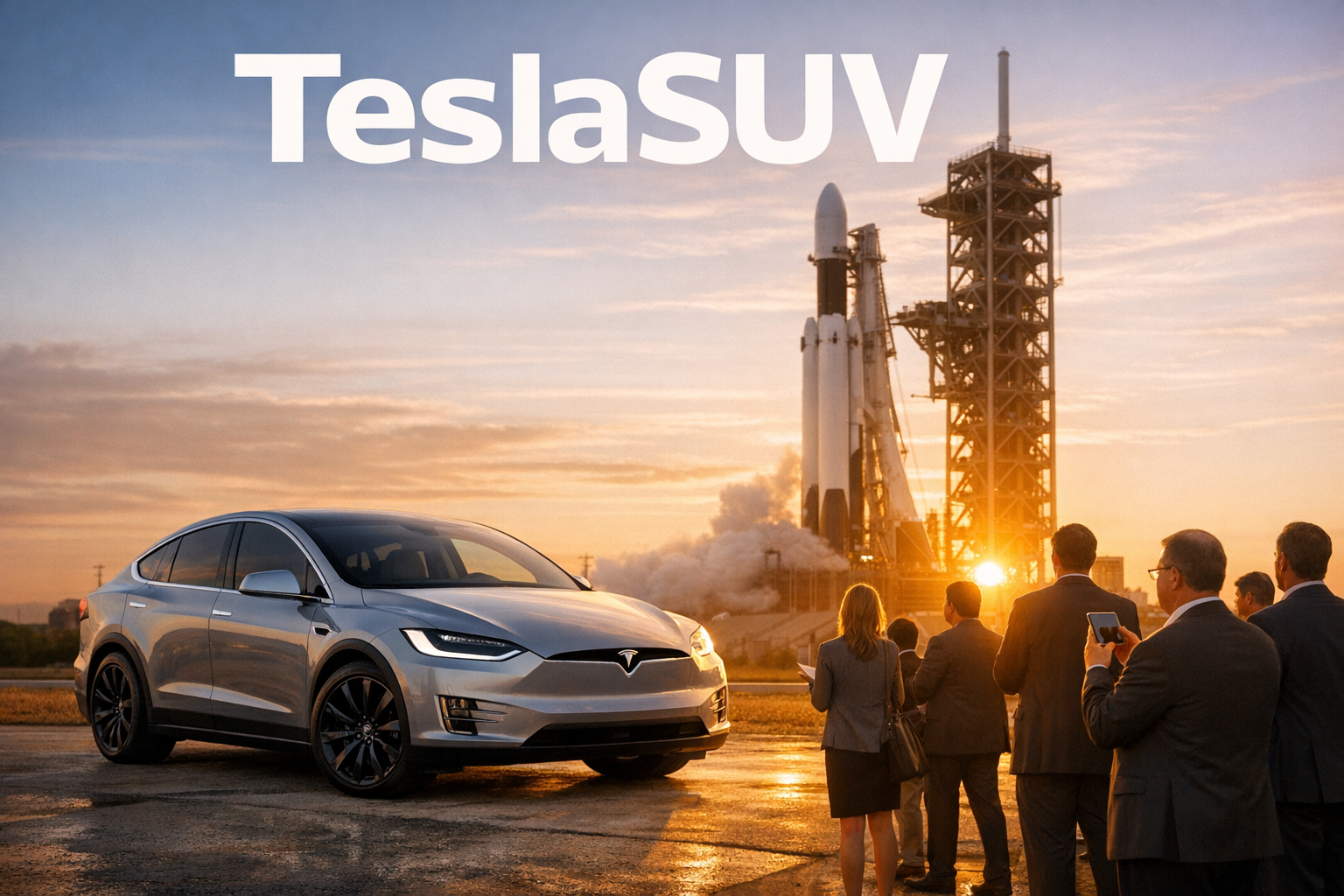
● Musk Shockwave, 6-Door Tesla SUV Buzz, SpaceX IPO Frenzy, Afeela Collapse
Ripple Effects of Elon Musk’s Single-Word Reply: 6-Door Tesla SUV Speculation, a 30% SpaceX IPO Retail Allocation Rumor, and the Reported Suspension of Afeela
This is not merely a Tesla “new model” rumor. The issue clusters around three interconnected themes:
1) The 6-door SUV concept functions less as a niche vehicle idea and more as a product proposal tied to household structure, fertility constraints, and mobility economics.
2) The reported discussion of allocating up to 30% of a potential SpaceX IPO to retail investors could affect US equity capital flows and, over time, the Tesla–SpaceX relationship and governance dynamics.
3) The reported suspension of Sony–Honda’s Afeela project highlights the gap between strong concepts and scalable, manufacturable businesses in the current EV market.
When assessed alongside Optimus hiring, Musk’s legal exposure, and Tesla’s vertical integration strategy, the news flow reflects broader linkages across global macro conditions, EV competition, AI commercialization, autonomy, and liquidity rotation driven by rate-cut expectations.
1. Primary Catalyst: Musk’s “Understood” and the 6-Door SUV Concept
A Tesla community member suggested that an SUV with a third row and dedicated doors for each seating row could be a major usability shift. Musk replied with a brief acknowledgment (“Understood”), which was interpreted by parts of the market as informal signal testing rather than casual engagement.
The reaction intensified because the concept addresses practical friction in family mobility—especially the cost and inconvenience burdens associated with multiple child seats.
2. Why a 6-Door SUV Became a Broader Social/Mobility Topic
The discussion centers on cabin width and child-seat constraints. In the US, stricter child-seat usage standards have reinforced a recurring issue: households with three children often face difficulty fitting three seats across a typical second row.
If three seats cannot be installed side-by-side, families may feel compelled to upgrade to larger SUVs or minivans. Some commentary links these upgrade costs to household budgeting and fertility decisions, reframing vehicle design as a component of living costs rather than discretionary consumption.
3. Limitations in Tesla’s Current Lineup
- Model Y: strong mass-market positioning and efficiency, but not optimized for multi-child households needing frequent third-row access; third-row usability and ingress/egress remain constrained.
- Model X: differentiated door architecture and space, but high pricing limits addressable demand.
A perceived gap remains for an affordable vehicle combining: (i) large interior volume, (ii) practical third-row access, and (iii) family-oriented ergonomics.
4. Potential Impact if a 6-Door Layout Were Implemented
The core value proposition is independent third-row access. Traditional 3-row SUVs often require folding or tilting the second row, which becomes inefficient when child seats are installed.
Dedicated doors for each row could reduce overlap in passenger movement and lower friction for:
- multi-child households,
- households transporting elderly family members,
- frequent carpool or multi-passenger use cases.
This is framed as a structural usability change rather than a feature-level upgrade.
5. Technical Feasibility: Why the Cybertruck Platform Is Cited
A frequent concern is body rigidity and crash safety as door openings increase. In conventional unibody designs, larger apertures can complicate structural reinforcement and B-pillar solutions.
Tesla’s Cybertruck introduced a non-traditional structural approach (exoskeleton-like framing and high-hardness stainless exterior elements). If a large SUV leveraged a related architecture, it could expand design space for multi-door configurations or equivalent third-row access solutions.
6. Practical Constraints: Parking, Door Mechanisms, Weight, and Efficiency
Key commercialization risks may be usability and cost rather than engineering novelty.
In markets with narrow parking spaces, additional doors can reduce practicality unless the opening mechanism is optimized. Potential approaches include:
1) Sliding doors
- Highest day-to-day practicality; brand positioning and cost implications remain uncertain.
2) Vertical-opening doors (similar to Model X concepts)
- Differentiation benefits, but added complexity and higher bill-of-materials risk.
3) Novel hinge concepts supported by 48V electronic architectures
- Consistent with Tesla’s wiring simplification trend, but likely to increase mass and cost.
Trade-offs include added weight, aerodynamic penalties, and manufacturing complexity. The key question is whether Tesla can balance minivan-level practicality with Tesla-style efficiency and cost discipline.
7. Summary of the 6-Door SUV Discussion
- Musk’s brief acknowledgment is being interpreted as informal product-direction probing.
- Target demand: families and users requiring frequent third-row access.
- Problem statement: three child-seat installation and independent third-row ingress/egress.
- A Cybertruck-derived structural approach could enable non-traditional packaging.
- Constraints: parking practicality, door actuation choice, weight, efficiency, and unit cost.
8. SpaceX IPO: Why a Reported 30% Retail Allocation Draws Attention
According to Reuters reporting, SpaceX has discussed allocating up to ~30% of IPO shares to retail investors if it proceeds with an offering. This would be atypical for a large IPO, which is generally institution-dominated with limited retail allocation.
A 30% figure would represent a material departure from standard Wall Street distribution practice.
9. Why the Allocation Could Signal Governance Intent
On the surface, a higher retail allocation may appear retail-friendly. Strategically, it can also be interpreted as a mechanism to broaden a supportive shareholder base.
Institutions can rotate exposure rapidly due to risk controls, regulatory constraints, and relative-value considerations. Retail investors aligned with the founder’s long-term narrative may be more stable in governance outcomes. This framing suggests the allocation structure could serve objectives beyond fundraising, including long-term control dynamics.
10. Why It Could Be a Near-Term Overhang for Tesla Shareholders
A SpaceX IPO could catalyze funding reallocation. Retail investors may reduce exposure to existing holdings—potentially including Tesla—to fund IPO participation or secondary-market purchases.
In a rate-sensitive environment where growth equities remain liquidity-driven, such a large event could increase volatility and temporarily pressure Tesla’s supply/demand balance.
11. Macro/Market View: Capital Rotation Risk
This is not solely a corporate event. If a mega-IPO absorbs a significant portion of retail liquidity, it may cause transient outflows from other high-duration equities. Therefore, the IPO is best framed as a US equity capital reallocation event, not just a listing.
12. Sony–Honda Afeela: Significance of a Reported Suspension
The reported suspension of the Afeela project carries symbolic weight because it was positioned as a high-profile collaboration combining Sony’s software/entertainment strengths with Honda’s manufacturing experience.
The reported friction points center on pricing and timing: a ~USD 90,000 premium sedan strategy became difficult amid EV demand normalization and intensifying price competition.
13. What the Afeela Outcome Illustrates About the EV Market
The EV market increasingly rewards:
- price/value alignment,
- charging ecosystem and reliability,
- software maturity and update cadence,
- autonomy credibility,
- total cost of ownership.
Feature narratives (sensor count, large displays, gaming integration, partnership branding) are less decisive unless they translate into measurable user value at scale.
14. Underemphasized Point: In-Car Entertainment Monetization Depends on High-Confidence Autonomy
Advanced in-vehicle media and gaming experiences expand in value primarily when the driver is meaningfully relieved from driving tasks. Without autonomy approaching high reliability, entertainment remains a stationary or limited-use feature.
This reduces willingness to pay for premium pricing tied to digital experiences. By contrast, Tesla’s approach has emphasized autonomy software and data accumulation as central value drivers, reinforcing the view that deployment velocity and real-world data advantage may matter more than hardware specification narratives.
15. Limits of Joint Ventures
Large-scale collaborations can face structural friction:
- slower decision-making,
- unclear accountability,
- misaligned incentives,
- conflicting technology priorities.
Tesla’s relative advantage is frequently attributed not only to technology but also to vertical integration and execution speed. In an EV–AI convergence period, the ability to integrate and ship rapidly may be more decisive than possessing isolated best-in-class components.
16. Optimus Hiring: Indications of Movement Toward Production Readiness
Reported expansion in Optimus-related hiring includes manufacturing engineering, data pipelines, and production-line roles. This suggests a shift from R&D emphasis toward production preparation.
If factory capacity (including parts of Fremont) is repurposed for Optimus, Tesla’s positioning could expand from automotive manufacturing toward a robotics platform company.
17. Why Optimus May Be Material Within AI Commercialization
Beyond chatbots, semiconductors, and cloud services, a major AI monetization pathway is physical-world automation. Humanoid robots in logistics, manufacturing, warehousing, and repetitive labor environments could reshape productivity and cost structures.
Demand may be accelerated by simultaneous wage inflation and labor scarcity trends in multiple economies. The implication is that robotics could become a structurally significant revenue and margin driver, not merely an ancillary product line.
18. Timeline Risk Remains High
Publicly referenced production targets (e.g., mass production by late 2026; very large annual volumes thereafter) should be treated as aggressive. Humanoid robotics involves higher environmental variability and tighter safety constraints than automotive production.
The strategic direction, however, is the primary signal: Tesla is attempting to extend AI value from software into physical labor.
19. Musk Legal Risk: Investor-Relevant Considerations
Legal disputes tied to prior transactions (including the Twitter acquisition) create potential personal-liability exposure. For investors, the relevant linkage is governance: elevated personal risk can increase sensitivity around control, voting dynamics, and defensive capital structure preferences across Musk-affiliated entities.
This context may partly explain perceived emphasis on supportive ownership and control stability.
20. Integrated View
The items appear distinct—6-door SUV speculation, SpaceX IPO structure, Afeela suspension, Optimus hiring, and legal developments—but share a common theme: Tesla and Musk-affiliated platforms are increasingly positioned beyond “automotive” toward integrated systems spanning mobility, labor automation, data, and capital markets.
Competitors remain more constrained by single-product strategies or slower joint-venture execution structures.
21. Key Takeaways Often Missed in General Coverage
1) The 6-door SUV discussion functions as a mobility-infrastructure product concept addressing family logistics and cost constraints.
2) A higher retail allocation in a SpaceX IPO could be interpreted as a supportive-capital-base strategy, not only a marketing choice.
3) The reported Afeela suspension reinforces that EV competition is shifting from hardware narratives to data, software integration, and manufacturing scalability.
4) Optimus is positioned not as a “next product,” but as a potential long-term core platform if execution and adoption materialize.
22. Monitoring Checklist for Investors and Industry Observers
- Whether Tesla provides additional signals indicating development of a large family vehicle or a Cybertruck-derived SUV.
- Whether SpaceX formalizes IPO terms, including the retail allocation percentage.
- Whether retail funding for an IPO drives measurable short-term pressure on large-cap growth equity flows (including Tesla).
- Whether Optimus production-line planning and mass-production prototype timelines become more concrete.
- Whether competitors shift from joint-venture approaches toward vertically integrated platform strategies.
23. One-Line Outlook
Near-term volatility may remain elevated due to rumor-driven positioning and liquidity sensitivity; the higher-level question is whether Tesla is increasingly valued as an integrated platform spanning mobility, labor automation, and data rather than as an EV-only manufacturer.
< Summary >
- Musk’s “Understood” response amplified discussion of a 6-door Tesla SUV and connected it to family mobility friction and child-seat-driven cost constraints.
- The functional core is independent third-row access; a Cybertruck-like structural approach could enable differentiated solutions.
- The reported SpaceX IPO retail allocation of up to ~30% would be unusual, potentially indicating a strategy to broaden a supportive shareholder base.
- Such an IPO could temporarily redirect retail capital away from existing growth holdings, creating near-term supply/demand pressure for Tesla shares.
- The reported suspension of Sony–Honda’s Afeela underscores that EV viability depends on scalable manufacturing, data, and software integration more than branding or concept-level differentiation.
- Optimus hiring suggests progression toward production readiness, potentially reframing Tesla as an AI-robotics platform company.
- The common thread is a platform expansion strategy spanning mobility, labor automation, and data, with capital markets dynamics acting as an additional catalyst.
[Related Articles…]
-
Tesla investment strategy and the EV market restructuring: key points
https://NextGenInsight.net?s=Tesla -
AI industry and humanoid robotics market outlook at a glance
https://NextGenInsight.net?s=AI
*Source: [ 오늘의 테슬라 뉴스 ]
– 일론 머스크 “알았다” 한마디에 발칵! 역대급 6도어 SUV 등장 예고부터 스페이스X 상장 물량 30% 배정, 아필라 프로젝트 중단발표!
● Trump Shockwave, Oil Spike, Nasdaq Slump, Inflation Nightmare
Trump’s “Final Strike” Option: The Market’s Most Feared Scenario—Oil Spike, Nasdaq Selloff, and Inflation Re-acceleration
Markets are no longer reacting to a single Middle East headline. The current risk cluster centers on: shifts in Trump’s Iran messaging, Hormuz Strait risk, a sharp rise in crude prices, potential re-acceleration in US inflation, and rapid spillover into the Nasdaq, US equities, and Korean equities.
This report consolidates: why Trump alternates between hawkish and conciliatory signals; why markets are increasingly pricing escalation risk over ceasefire expectations; how higher oil prices are undermining rate-cut expectations; and why semiconductors and AI-linked growth stocks are reacting more strongly to geopolitical headlines.
Key focus areas include: the relationship between Trump’s messaging and levels in Treasury yields and oil; the pressure created by potential strikes on Iran’s export hubs and maritime chokepoints; and the transmission from geopolitics into AI semiconductor risk appetite.
1. One-line market summary: Fear shifted from “the war” to “the risk of persistence”
The selloff reflects more than a geopolitical shock. Investors are increasingly concerned that the conflict could last longer than expected and that US–Iran negotiations may not resolve quickly.
- WTI crude: up over 3%
- Brent crude: up over 5%
- Nasdaq: down 2.38%
- Dow: down 1%
- S&P 500: down 1.74%
- Russell 2000: down 1.7%
- KOSPI overnight futures: down 3%
- KOSDAQ overnight futures: down 2.44%
This was broad-based risk-off: higher energy prices → higher inflation risk → renewed rate pressure → weakness across growth and small-cap equities.
2. Why markets are weighting escalation over ceasefire
The best-case scenario remains rapid de-escalation, reduced Hormuz uncertainty, and stabilization in crude. However, recent Trump messaging has not consistently supported that outcome.
2-1. Core pattern: keep negotiation optionality while increasing military pressure
Trump has indicated uncertainty about reaching an Iran deal, which markets interpret negatively because current risk pricing relies on an eventual diplomatic containment.
At the same time, he suggested the situation could be resolved soon and later signaled a more conciliatory stance, including a reported delay of energy-facility destruction by 10 days in response to Iran’s request.
With hawkish and conciliatory signals alternating, markets have limited basis for sustained relief.
2-2. NATO-related remarks added to policy uncertainty
Trump framed the Iran conflict as a test of NATO and expressed disappointment with the alliance.
Markets interpret this less as rhetoric and more as evidence of increased unpredictability in US alliance strategy and intervention posture. Elevated uncertainty increases the policy-risk premium.
3. The decisive theater: the Hormuz Strait and Iran’s oil export hubs
The critical issue is not only US–Iran confrontation, but direct pressure on a global energy chokepoint.
3-1. Why Kharg Island and Larak Island matter
Reports indicate the US Department of Defense has reviewed options including ground deployment and large-scale air operations, with discussion of targets such as Kharg Island (a key export hub) and Larak Island (a strategic position linked to control around the Hormuz Strait).
- Kharg Island functions as a central node for Iran’s crude exports.
- Larak Island carries strategic value for operations affecting Hormuz control.
- Even absent realized disruption, the probability of disruption can be priced immediately via a supply-risk premium.
The market can reprice crude rapidly on risk probabilities alone, transmitting the shock into global equities.
3-2. The primary fear is not a one-off disruption, but duration
Short-term spikes can be absorbed. Elevated crude sustained over time increases corporate input costs, logistics costs, and consumer inflation, and can shift central-bank expectations.
4. Why higher crude reopens the inflation and rates debate
The key macro channel is crude → inflation, not headlines themselves. OECD commentary has referenced scenarios where US inflation could rise toward 4.2% this year. If crude remains elevated, expected rate cuts may be pushed out.
4-1. The most challenging mix for the Fed
The Fed faces a difficult trade-off when growth slows while inflation rises. Cutting rates risks inflation; holding or hiking rates risks a sharper slowdown. Policy complexity increases materially.
4-2. A tactical link between Trump messaging and market thresholds
A notable pattern has been observed: when the US 10-year yield moves above ~4.4% or Brent approaches the ~$110 level, Trump messaging has tended to become more conciliatory.
This suggests sensitivity to financial-conditions tightening. However, it also implies hawkish pressure may persist until markets reach levels that trigger a restraint response, prolonging volatility.
5. Iran’s response signals: limited willingness to back down quickly
Reports indicate Iran has undertaken large-scale preparations in response to potential US action. Beyond force levels, the political message is that Iran intends to sustain deterrence and defense.
This reduces the probability of near-term unilateral de-escalation and increases the risk of prolonged tension, which can matter more for asset pricing than the initial intensity of conflict.
6. Why US equities moved sharply: a setup unfavorable for growth
The Nasdaq underperformed because growth valuations are more sensitive to discount rates and inflation. Rising crude can translate into inflation risk, higher yields, and multiple compression.
- Higher crude
- Higher inflation risk
- Reduced confidence in near-term rate cuts
- Upward pressure on long-term yields
- Greater valuation pressure on growth equities
Under this regime, AI, semiconductors, and software leaders can experience outsized drawdowns even without immediate earnings impairment.
7. Why semiconductors and AI-linked names react more acutely during geopolitical shocks
Micron and SanDisk were specifically referenced. Alongside geopolitics, a separate technology narrative has emerged that could be interpreted as weakening memory-demand assumptions, amplifying downside.
7-1. Sentiment moves before fundamentals
Structural earnings damage is not yet established. However, positioning and sentiment can deteriorate quickly. AI infrastructure beneficiaries have significant expectations priced in, so even small shifts in narratives about memory intensity can move prices materially.
Over the medium term, these headlines alone are insufficient to conclude a fundamental deterioration in memory-cycle conditions; the near-term impact is more consistent with sentiment and flows.
7-2. Key AI trend implications
AI competition is increasingly focused on power efficiency, memory usage, inference cost, and data-center operating cost optimization. Architectures that reduce memory footprint, software-level efficiency gains, and storage-bottleneck mitigation may become more important within the AI investment theme.
This can pressure memory-linked sentiment in the short run, while also signaling a broader transition toward “more performance per unit of resource” across AI infrastructure.
8. Implications for Korean equities: structural sensitivity
Weakness in KOSPI and KOSDAQ overnight futures is consistent with Korea’s structural exposure to:
- High dependence on imported crude
- USD strength pressure
- Potential foreign outflows
- Index concentration in semiconductors
- Direct transmission from US tech drawdowns
When crude rises and US equities fall concurrently, Korea faces compounded pressure through FX, flows, and sector composition. KOSDAQ, with higher weights in growth and higher-beta segments, can exhibit higher volatility in risk-off phases.
9. Key items to monitor
9-1. Geopolitics
Trump is maintaining military pressure while leaving negotiation optionality open. Markets are increasingly pricing escalation risk over ceasefire expectations.
9-2. Energy
Hormuz and Iran export-hub risks pushed crude sharply higher. Supply-risk premium is expanding ahead of confirmed disruption.
9-3. Macro
If crude remains elevated, US inflation may re-accelerate and rate-cut expectations may be delayed. Energy has re-emerged as a primary macro variable.
9-4. US equities
Nasdaq-led tech declined materially. Growth equities face larger drawdowns when geopolitical risk transmits into yield and inflation uncertainty.
9-5. AI and semiconductors
Memory and storage-related names reacted more sharply as technology narratives combined with risk-off sentiment. Short-term sentiment should be separated from medium-term fundamentals.
10. Under-discussed but material: the crude–inflation–rates–equities transmission
10-1. The critical factor is not headlines, but the crude–rates linkage
Market sensitivity is primarily to crude’s impact on inflation and rate expectations. The speed at which military risk converts into macro pricing is currently high.
10-2. Trump appears to manage messaging around financial-conditions thresholds
The alternating tone can be interpreted as tactical: calming signals emerge when market stress exceeds certain levels; pressure signals dominate before those thresholds. This structure can prolong volatility.
10-3. The AI theme is no longer insulated
While geopolitics and AI appear separate, markets connect them through:
- Higher crude increasing power and logistics costs
- Higher yields pressuring high-duration equity valuations
- Risk-off sentiment impacting crowded AI exposures first
AI positioning increasingly requires integrating technology trends with energy costs and the cost of capital.
11. Practical watchlist for investors
- Whether Trump escalates hawkish rhetoric or reinforces negotiation messaging
- Any tangible military action affecting the Hormuz Strait
- Whether Brent breaks higher through the $100–$110 range
- Whether the US 10-year yield rises rapidly again
- How Fed officials characterize oil-driven inflation risk
- Whether AI semiconductor and memory names stabilize after the initial shock
- Whether foreign flows into Korean equities deteriorate materially
12. Conclusion: the dominant risk is persistence of uncertainty
Markets are not uniformly pricing an assured full-scale war. The more probable risk being priced is sustained tension, elevated crude, and a consequent re-complication of US inflation and rate trajectories.
Trump’s statements are a variable, but the binding constraints are whether rhetoric translates into action and how far crude and Treasury yields reprice.
The current regime requires a connected framework across crude, US yields, Fed reaction function, and AI/semiconductor risk appetite to distinguish a transient headline shock from the start of a longer volatility phase.
< Summary >
Trump’s Iran messaging has alternated between hawkish and conciliatory tones, increasing uncertainty.
Hormuz and Iran export-hub risk drove a sharp rise in crude, destabilizing inflation and rates expectations.
Nasdaq and global equities corrected with growth leading; Korean equity futures weakened in parallel.
AI semiconductors and memory-linked names were pressured by combined geopolitical risk-off and shifting technology narratives; short-term sentiment should be distinguished from medium-term fundamentals.
The core market mechanism is crude up → inflation risk up → rate pressure up.
[Related Links…]
- Latest analysis on Trump-related volatility and global equities
- AI semiconductor market restructuring and memory-sector outlook
*Source: [ 내일은 투자왕 – 김단테 ]
– 최후의 일격 준비하는 트럼프.
● America-s Medical Bill Nightmare, Middle-Class Collapse, AI Profit Surge
USD 3,000+ for One ER Visit, Bankruptcy Even With Insurance: Why US Medical Costs Are Disrupting the Middle Class, Consumption, and Financial Markets
The US healthcare cost issue is not limited to high hospital bills. It is a structural mechanism that erodes middle-class balance sheets and links directly to the US macro outlook, inflation dynamics, labor-market incentives, fiscal policy, and the healthcare industry’s AI-driven transformation.
This report explains:
- Why households can face bankruptcy despite having insurance
- How ER, ambulance, and cancer-treatment costs become “bill shocks” in practice
- Why the Affordable Care Act (ACA) did not resolve underinsurance
- How prospective Medicaid cuts could transmit shocks across hospitals and local economies
- What this implies for US equities, global macro risk, and AI healthcare investment signals
A key focus is that the US healthcare-cost crisis is not only a social-policy problem; it acts as a catalyst affecting consumption, labor participation, household credit risk, regional hospital restructuring, and AI-enabled automation.
1. Key Takeaways: Why Illness Can Lead to Bankruptcy in the US
In Korea, national health insurance materially caps patient out-of-pocket burden for severe illness. In the US, even insured households can face costs large enough to destabilize finances, including for the middle class.
Medical expenses are widely cited as a leading driver of personal bankruptcy, underscoring that the system creates systemic household financial fragility rather than isolated inefficiency.
The risk is not confined to low-income households. Low-income groups may qualify for public coverage (e.g., Medicaid), and high-income households can self-insure via assets. The most exposed cohort is the middle class reliant on employer coverage but vulnerable to a simultaneous hit to savings and income from a major illness.
2. Why US Insurance Often Fails to Provide Effective Protection
2-1. Coverage Does Not Equal Protection
Unlike systems where coverage meaningfully limits patient liability at the point of care, US insurance typically layers multiple patient-pay components.
Core mechanisms:
- Deductible
- Coinsurance
- Out-of-pocket maximum
2-2. Deductible: Patient Pays Before Coverage Starts
A deductible is the amount paid by the patient before insurer cost-sharing applies. For example, with a USD 3,000 deductible, the first USD 3,000 is paid 100% by the patient.
A common misconception is that insurance pays from the first dollar. In practice, premiums are paid monthly, and large upfront payments may still be required when care is needed.
2-3. Coinsurance: Cost Sharing Continues After the Deductible
After meeting the deductible, patients often pay a fixed share of allowed charges. With an 80/20 structure, high-cost care (surgery, chemotherapy) can quickly generate patient liabilities from thousands to tens of thousands of dollars.
2-4. Out-of-Pocket Maximum: A Cap That Can Still Be High
Annual out-of-pocket caps exist, but the levels are substantial. For 2025, the individual-plan maximum is cited around USD 9,200. Adding annual premiums implies insured households can face total healthcare-related costs exceeding USD 10,000 per year.
Insurance functions less as a full safety net and more as a mechanism that limits tail risk at a still-material cost.
3. Cost Scale in Practice: ER, Ambulance, Surgery, Cancer Care
3-1. Why an ER Visit Becomes a Financial Risk
Average ER visit cost is cited around USD 2,715 (2025). Additional diagnostics, imaging, procedures, and specialist consultations can materially increase total charges.
3-2. Ambulance Costs and the Network Constraint
Ambulance services are cited around USD 940 to USD 1,277 on average. Patients generally cannot choose the provider in emergencies.
Network constraints are critical: benefits are significantly better for in-network providers. Out-of-network involvement during emergency transport or treatment can reduce coverage and increase patient liability.
3-3. Why Cancer Care Can Deplete Household Assets
Cancer care typically combines surgery, hospitalization, chemotherapy, imaging, rehabilitation, and prescriptions, creating large cumulative costs.
Even with insurance, out-of-pocket obligations can be sizable, and prolonged treatment can reduce labor income. The combined effect is rising expenses and declining income.
4. “Three-Stage Bankruptcy” Mechanism Under Severe Illness
4-1. Stage 1: Direct Medical Bills
ER care, hospitalization, surgery, and drug costs can rapidly deplete savings. Households may bridge costs via credit cards, home-equity borrowing, or informal loans, leaving persistent debt even after recovery.
4-2. Stage 2: Claim Denials and Administrative Burden
Claim denial is an additional structural risk. When coverage is denied, patients either forgo care or engage in costly and time-intensive disputes.
This converts cost risk into a combined pricing, legal/administrative, and information-asymmetry problem during periods of impaired health.
4-3. Stage 3: Income Loss and Employment-Linked Coverage
Employer-sponsored insurance is dominant. Severe illness can reduce work capacity, increasing job-loss risk; job loss can simultaneously remove insurance coverage.
This feedback loop expands healthcare costs into labor-market participation, productivity, and household-debt dynamics.
5. Why the Middle Class Is the Most Exposed
The middle class often fails to qualify for means-tested programs and lacks the assets to absorb catastrophic costs. As the primary driver of US consumption, middle-class retrenchment due to medical-cost insecurity can weigh on domestic demand and elevate recession risk.
6. Why the ACA Did Not Fully Resolve the Problem
6-1. Fewer Uninsured, Persistent Underinsurance
The ACA reduced the uninsured population, but the core issue extends beyond coverage status. High deductibles, expensive premiums, complex benefit design, and continued claim denials sustained underinsurance.
6-2. Structural Entrenchment and Lobbying Power
Healthcare stakeholders (pharma, insurers, hospital chains, medical devices, pharmacy distribution, PBMs) exert significant influence. Reform often redistributes margins across the value chain, making policy change slow and difficult.
7. 2025 Policy Variable: Implications of Medicaid Reductions
7-1. Transmission Beyond Low-Income Households
Medicaid reductions can increase the uninsured population and weaken hospital revenue, particularly in rural and financially constrained regions with high Medicaid mix. Risk includes service cuts and hospital closures.
7-2. Spillover to Local Economies and Employment
Hospitals are often major local employers. Downsizing or closures can reduce healthcare access while also pressuring local labor markets, property values, and consumption.
In a high-rate, fiscally constrained environment, these localized shocks can accelerate regional slowdowns.
8. Interpreting US vs. Korea: Healthcare as Economic Infrastructure
Korea’s system has its own constraints (premiums, non-covered services, tertiary-hospital congestion), but it materially limits catastrophic household exposure in severe illness.
Health insurance functions as economic infrastructure: limiting forced asset sales, preventing permanent labor-force exits, and supporting consumption and financial stability.
9. Macro View: The Core Issue Is Consumption and Household Credit
9-1. Medical Costs Function Like an Unpriced “Shadow Tax”
For households, medical spending is a difficult-to-forecast risk that can abruptly dominate budgets. Elevated healthcare insecurity incentivizes precautionary savings over discretionary consumption, creating a persistent drag on demand.
9-2. Medical Debt as a Credit-Market Risk
Households unable to pay may rely on revolving credit, personal loans, or home-equity borrowing. This shifts healthcare stress into broader household credit quality, with implications for rates, leverage, consumption capacity, and housing-market resilience.
10. AI Trend: Why US Healthcare Cost Pressure Accelerates AI Adoption
10-1. Cost Compression Drives Administrative and Clinical Automation
Rising costs increase incentives for payers and providers to deploy AI for productivity gains, including:
- Automated claims review and adjudication
- Imaging interpretation support
- Scheduling optimization
- Triage and patient routing
- Call-center automation
- Clinical note summarization and EHR workflow automation
Given healthcare’s labor intensity, AI-driven productivity gains can be economically significant and support sustained investor attention to AI-healthcare exposure.
10-2. AI Improves Efficiency but Does Not Resolve Structural Incentives
AI can reduce operational costs but does not inherently fix benefit design, drug-pricing dynamics, network constraints, or denial incentives. If AI primarily strengthens denial processes, patient outcomes and sentiment may deteriorate.
Investors should differentiate between productivity gains and patient-protection outcomes.
11. Investor Framework
11-1. Structural Growth With Elevated Policy Risk
US healthcare demand is supported by scale, aging demographics, and chronic disease prevalence. However, insurers, hospital chains, pharma, and medtech are highly exposed to policy and regulation, including Medicaid/Medicare changes, drug pricing, and antitrust enforcement.
11-2. AI Healthcare: Long-Duration Theme, Execution Risk High
AI healthcare equities may remain a durable theme, but dispersion should increase between firms with realized revenues and those driven primarily by narrative.
Key diligence factors:
- Hospital adoption rates
- Payer contract traction
- Data access and interoperability
- Regulatory clearance pathways
- Recurring revenue quality
12. Under-Emphasized Points With Market Relevance
12-1. A Structural Demand Headwind for the Middle Class
Healthcare-cost risk suppresses discretionary spending and supports defensive household balance-sheet behavior, acting as a durable macro headwind.
12-2. Employer-Linked Insurance Conflicts With AI-Driven Labor Flexibility
As AI increases labor-market flexibility (contract work, project-based employment), employer-tethered coverage can widen gaps and increase access inequality.
12-3. Likely Near-Term Winners: Cost-Reduction AI Over “Cure AI”
Commercial traction is more immediate in operational efficiency:
- Revenue-cycle and billing optimization
- Documentation automation
- Staffing augmentation
- Utilization management and routing
Revenue and cash-flow impact may be clearer than in longer-horizon therapeutic breakthroughs.
12-4. Structural Reform Requires Politics and Fiscal Capacity
Technology alone is insufficient. Investors should track fiscal policy, regulatory shifts, lobbying dynamics, and election-cycle risk alongside product innovation.
13. Conclusion (Investor-Relevant)
US medical costs link middle-class fragility, household leverage, consumption risk, regional hospital restructuring, political polarization, and AI-driven healthcare automation into a single interconnected theme.
For global investors, the system’s inefficiencies can both:
- Increase demand for automation and digital transformation solutions, and
- Introduce policy-driven earnings and valuation volatility across healthcare subsectors
< Summary >
- Even with insurance, deductibles, coinsurance, and network constraints drive high patient liability.
- ER, ambulance, and cancer-care costs can exceed middle-class capacity and remain a major bankruptcy catalyst.
- Post-ACA, underinsurance persists; 2025 Medicaid reductions may pressure vulnerable hospitals and local economies.
- The issue is macro-relevant via consumption, household debt, and recession sensitivity.
- Cost pressure can accelerate AI healthcare adoption, particularly in administrative and operational automation.
- AI does not resolve structural incentives; policy and industry structure remain decisive variables.
[Related Links…]
- AI Healthcare and Digital Transformation: Key Drivers of US Industry Restructuring in 2025 (NextGenInsight.net?s=AI)
- US Rates and Recession Signals: 2H Global Asset-Market Checkpoints (NextGenInsight.net?s=Rates)
*Source: [ Maeil Business Newspaper ]
– 응급실 한 번에 400만원? 미국에서 아프면 파산하는 이유 | 매일뉴욕 스페셜 | 홍성용 특파원