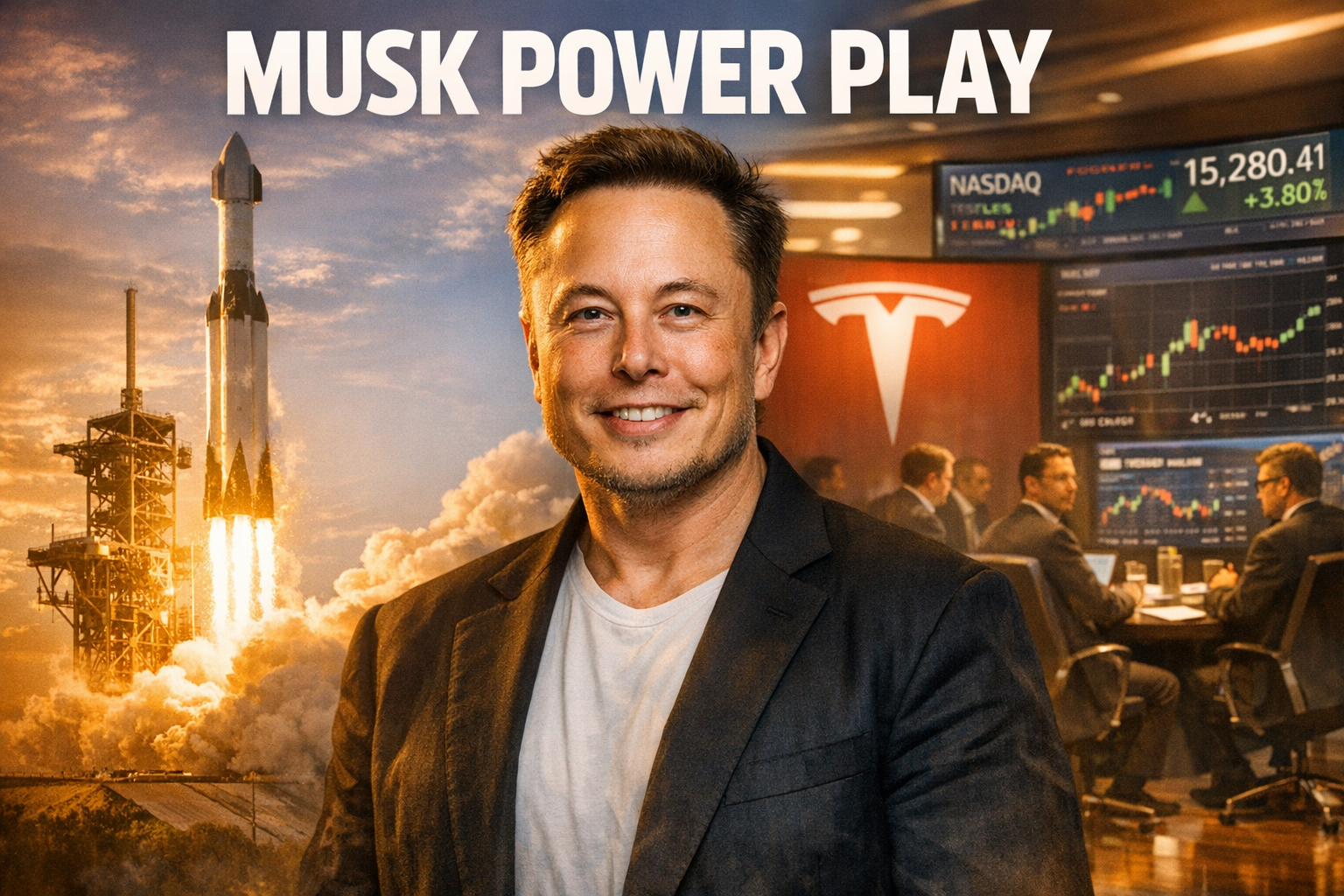
● Musk Masterplan, Dump Tesla, Chase SpaceX IPO Shock
Should Investors Rotate Out of Tesla Into SpaceX? Musk’s Strategic Objective May Be Elsewhere
This is not merely a choice between Tesla equity and a potential SpaceX IPO. The core issues are:
1) Nasdaq is effectively proposing new mechanics to accommodate mega-cap companies with very low public float.
2) Musk’s primary target may be the S&P 500 rather than the Nasdaq-100, given where substantially larger passive capital is concentrated.
3) The end-state may be less about short-term price support and more about governance—potentially securing ~25% voting control.
This report connects: Nasdaq’s proposed “5x weighting” concept, index-driven demand following a SpaceX listing, why some investors may prefer maintaining Tesla exposure, and Tesla’s operating drivers across deliveries, autonomy/robotaxi, and energy expansion—framed through five lenses: global macro, U.S. equities, AI industry, index flows, and Musk’s long-horizon strategy.
1. One-sentence summary
The headline question is “Sell Tesla and buy SpaceX?” The underlying question is whether Musk is preparing a broader capital-markets structure that links Tesla, SpaceX, and potentially xAI. The decision framework shifts from ticker selection to structural analysis.
2. News brief: what the market is pricing
Market commentary increasingly assumes that a SpaceX listing could trigger large inflows, driven by Nasdaq’s consideration of rule changes that may enable earlier, larger index inclusion for ultra-large issuers. Attention has focused on a “5x weighting” concept for low-float companies.
If applied, SpaceX could receive an index weight materially larger than its initial tradable float would imply, compelling passive vehicles (e.g., Nasdaq-100 trackers such as QQQ, subject to eligibility and timing) to buy mechanically. The resulting setup is constrained supply with structurally enforced demand, implying potential early-stage price pressure and volatility.
3. Why Nasdaq’s “5x weighting” concept matters
3-1. Core concept
Index methodologies typically adjust for free float. Large insiders’ holdings reduce index weight relative to full market capitalization. The proposal under discussion would treat issuers with <20% float as having an effective float up to 5x the actual float for index-weighting purposes.
Illustration: if initial float is 4.3%, the index could treat it as roughly 21.5% (4.3% x 5), effectively granting “large-cap treatment” despite limited shares available for trading.
3-2. Why this can amplify flows
Passive funds follow rules rather than discretionary valuation judgments. When a stock enters an index, passive funds buy to target weight. If tradable float is small, forced buying against limited supply can increase price impact and volatility.
3-3. Why Nasdaq would consider it
This is consistent with exchange competition for flagship listings. SpaceX has strategic narrative value across AI-adjacent infrastructure, space launch, defense exposure, satellite communications, and Starlink. Rules that reduce low-float friction can improve listing attractiveness and potentially shift market attention and volumes toward the exchange.
4. The larger arena may be the S&P 500, not the Nasdaq-100
4-1. Why the S&P 500 is more consequential
Nasdaq-100 inclusion is meaningful, but the deepest passive capital base remains tied to the S&P 500. For issuers, capturing S&P 500-related demand can be more impactful than accelerating Nasdaq-100 inclusion.
4-2. Immediate S&P 500 inclusion is generally difficult
Newly listed companies typically need a trading and eligibility history before S&P 500 consideration, making near-immediate inclusion uncommon.
4-3. The market is monitoring merger pathways
A frequently discussed scenario is a Tesla–SpaceX combination (e.g., via stock exchange), potentially allowing a successor entity to inherit index representation. Past large-scale mergers indicate index committees may prioritize market representativeness and continuity over rigid waiting periods, depending on facts and structure.
4-4. Why this would be material
If a combined entity retained Tesla’s S&P 500 position, passive funds could be required to rebalance into the new structure at scale, making this an index-flow event rather than a conventional corporate action.
5. Why pursue a complex structure: governance and ~25% voting control
5-1. Control can outweigh headline valuation
The strategic objective may center on durable governance control to execute long-duration plans spanning autonomy, robotics, AI, space-based connectivity, defense-adjacent programs, and data infrastructure.
5-2. Tesla’s public-company governance constraints
As a public issuer, Tesla is exposed to continuous governance pressure: institutional voting dynamics, litigation risk, compensation disputes, and activism. This increases the premium on maintaining a voting-control buffer.
5-3. SpaceX governance is more concentrated
SpaceX is commonly viewed as more tightly controlled by Musk, including governance features that may strengthen control. A transaction between entities with different control profiles could raise Musk’s effective control without requiring proportionate cash purchases of Tesla shares.
5-4. Potential end-state: an integrated “Musk ecosystem”
Longer-term narratives extend beyond Tesla + SpaceX to include xAI, X, Starlink, robotaxi networks, and humanoid robotics. The conceptual structure resembles a platform-and-infrastructure conglomerate spanning mobility, energy, AI, space communications, and robotics.
6. Tesla fundamentals: not a single-variable story
6-1. 2026 Q1 delivery expectations and seasonality
Street discussion references ~365,000 deliveries for 2026 Q1. Quarter-over-quarter comparisons can be misleading due to typical year-end delivery pull-forward and incentives. Year-over-year comparisons may better reflect underlying trajectory; the data are frequently interpreted as a potential early signal of stabilization or re-acceleration after an extended slowdown, though confirmation depends on subsequent quarters.
6-2. The market is increasingly focused on Tesla Energy
Investor framing has broadened from EV manufacturing toward energy storage and grid infrastructure. Storage demand is supported by grid reliability needs, renewable penetration, U.S. infrastructure investment, and accelerating data-center power requirements.
From an AI-driven macro perspective, data-center expansion increases power demand and the value of storage and load-balancing. Tesla Energy is therefore increasingly analyzed as a potential AI-era infrastructure lever rather than a secondary segment.
7. Why autonomy is again central
7-1. FSD perception is shifting toward performance data
Recent user-reported long-distance drives with minimal interventions are influencing sentiment. Anecdotes are not equivalent to commercialization proof, but market questioning has shifted from “if/when” to “how close” and what regulatory and operational hurdles remain.
7-2. The operating model matters as much as the software
Monetization depends on fleet operations: maintenance, insurance and liability allocation, dispatch, pricing, passenger experience, charging turnaround, and utilization. Tesla’s vertical integration (vehicle, software, OTA, charging, data capture) is cited as a structural advantage for cost and iteration speed.
Robotaxi models shift economics from one-time vehicle margin to recurring platform revenue, potentially changing the profit profile if executed at scale.
7-3. Manufacturing-readiness signals can re-rate expectations
Ongoing sightings of test vehicles and indications of production preparation tend to be weighted more heavily than event-stage announcements, as investors look for commercialization inflection points.
8. Interpreting claims of 80–90% margins
8-1. Focus on the business model, not the headline number
An 80–90% margin figure is aggressive and is not applicable to consolidated revenue. It is better interpreted as a potential gross-profit profile for a platform-like robotaxi service under favorable assumptions. The key takeaway is the possibility of a mix shift from manufacturing to platform economics.
8-2. Why winner-take-most dynamics are discussed
Mobility platforms can exhibit network effects. Lower costs can enable lower prices, attracting more demand, generating more data, improving service quality, and reinforcing competitive advantage. Vertical integration is often cited as enabling this loop.
8-3. Key constraints remain
Regulatory approval, geographic permitting, accident and liability frameworks, insurance structure, city-level constraints, and competitive responses are material. Competitors with demonstrated deployments (e.g., Waymo) remain relevant, and dominance should not be assumed.
9. The practical investor question: should Tesla be sold to buy SpaceX?
9-1. Risks of a simple rotation
Even if SpaceX lists, IPO allocation for retail investors may be limited. For non-U.S. investors, access and allocation can be more constrained, and brokerage participation is uncertain.
9-2. Tax and execution risk
Selling Tesla can create realized-tax consequences, while IPO participation is uncertain. This produces an asymmetry: the sale is definitive, the replacement purchase may not be achievable at desired size or price.
9-3. A dual-track approach is often more implementable
Instead of a full exit from Tesla, a partial retention strategy combined with opportunistic SpaceX exposure (direct allocation if available, or other compliant indirect avenues) may reduce execution risk. If any structural combination or ecosystem-level transaction were to occur, Tesla ownership could function as a partial proxy exposure pathway, depending on transaction terms.
10. Regulatory and institutional constraints to monitor
10-1. Antitrust and concentration scrutiny
A structure linking Tesla, SpaceX, and xAI could raise concerns around market power, competition, and data concentration.
10-2. Index-committee discretion
Even if Nasdaq rules change, implementation timing and applicability are uncertain. S&P 500 inclusion decisions are committee-driven; conditions or phased treatment can occur where passive-flow impacts are large.
10-3. Political sensitivity
Space, communications, defense-adjacent contracting, AI, and autonomy are politically exposed domains. Election cycles and administration priorities can alter regulatory intensity and contracting posture.
11. Key point often missed in mainstream coverage
11-1. This is less about IPO hype and more about index-flow engineering
Institutional positioning often focuses on index inclusion mechanics and passive rebalancing timing rather than retail-level IPO enthusiasm.
11-2. Tesla valuation is not solely a function of vehicle deliveries
Energy storage, autonomy, robotaxi economics, AI training data, and robotics can influence multiple expansion or contraction; Tesla sits between manufacturing and platform valuation frameworks.
11-3. The objective may be governance completion, not the listing event
The strategic value of a SpaceX listing may lie in how it can be used to reshape ecosystem control and capital-markets influence.
11-4. In the AI era, power and mobility are linked
AI-driven data-center buildouts increase power demand, elevating the strategic relevance of storage and distributed energy operations. This supports the view that Tesla’s energy segment can be a consequential AI-infrastructure exposure.
12. Action-oriented checklist for investors
12-1. A full Tesla-to-SpaceX switch can be premature
Consider IPO access, allocation uncertainty, tax impact, and index-mechanics uncertainty.
12-2. Focus on listing structure, not just listing probability
Key variables: IPO vs direct listing, initial float, eligibility and timing for Nasdaq-100-related inclusion, and any credible pathway toward S&P 500-related passive flows.
12-3. Maintain a multi-segment view of Tesla
Assess EVs, energy storage, autonomy/robotaxi, and robotics as interconnected drivers.
12-4. Ecosystem framing is increasingly relevant
Analyze Tesla in relation to SpaceX, xAI, X, Starlink, robotics, and autonomy networks rather than as an isolated auto OEM.
13. Consolidated conclusion
The SpaceX listing debate is not simply “Tesla vs SpaceX.” It combines Nasdaq methodology changes, U.S. passive-flow dynamics, governance incentives around voting control, and Tesla’s expanding AI/energy/robotaxi optionality. The primary task for investors is to monitor which structural outcomes become feasible and which instruments capture the resulting flows.
< Summary >
The SpaceX IPO narrative is fundamentally about potential index-driven flow design—Nasdaq’s proposed 5x weighting for low-float issuers, accelerated Nasdaq-100-related inclusion mechanics, and possible pathways that could ultimately intersect with S&P 500 passive capital.
Musk’s strategic priority may be governance—potentially targeting ~25% voting control and ecosystem consolidation—rather than near-term price performance.
Tesla is increasingly evaluated not only on vehicle volumes but also on energy storage, autonomy/robotaxi economics, and AI-era infrastructure relevance.
Given tax and IPO allocation uncertainty, a full rotation out of Tesla into SpaceX may carry execution risk; maintaining Tesla exposure while pursuing SpaceX opportunities in parallel may be more practical.
[Related Articles…]
Tesla price outlook and key variables for the robotaxi era: https://NextGenInsight.net?s=Tesla
AI industry investment strategy and U.S. mega-cap rotation points: https://NextGenInsight.net?s=AI
*Source: [ 오늘의 테슬라 뉴스 ]
– 테슬라 팔고 SpaceX 갈아탈까? ‘5배 가중치’의 비밀과 S&P 500을 향한 머스크의 감춰진 설계는?
● Oil Shock, Markets Crumble, AI War Surge
Middle East War Risk Reshapes the Global Outlook: Oil Spike, Equity Selloff, Supply-Chain Rewiring, and the Real Variable in AI/Drone Warfare
The key market issue is not simply the outbreak of conflict. The current shock links a sharp rise in crude prices, higher global equity volatility, renewed inflation risk, deeper supply-chain fragility, and faster diffusion of AI-enabled unmanned warfare technologies.
Market focus has centered on oil and equities, but critical variables are: (i) the real-economy impact of a Strait of Hormuz disruption now moving beyond headlines into physical supply, (ii) a shift toward self-prioritizing national policies, and (iii) acceleration in AI/drone-centric warfare capabilities with spillovers into industrial and defense supply chains.
1. Key Headlines (Snapshot)
WTI rose roughly 7% in one session; Brent gained about 6%. Brent returned to approximately USD 114/bbl, with a move toward USD 120/bbl increasingly discussed.
US equities weakened broadly on the energy shock. Nasdaq fell more than 2%; Dow -1.7%, S&P 500 -1.6%, Russell 2000 -1.7%.
US 30-year Treasury yields moved back above 5%. The VIX exceeded 30, near the highest level in a year.
Risk assets outside energy faced broad pressure.
2. Global Market Reaction: Drivers of Volatility
2-1. Equities: Classic Risk-Off with Inflation/Rate Transmission
The decline reflects not only geopolitical risk but also the inflation impulse from higher oil, which increases rate sensitivity and compresses valuations across both growth and cyclical sectors. The larger Nasdaq drawdown is consistent with higher discount rates and growth uncertainty.
2-2. Relative Resilience in Select Memory/Storage Names
Some memory and storage-related stocks held up comparatively better. Prior drawdowns and views that fundamentals were not fully impaired limited incremental selling pressure. Markets are differentiating between indiscriminate de-risking and names with perceived earnings durability and oversold positioning.
2-3. Outperformance: Defensives and Energy
Defensives such as Walmart, Costco, Coca-Cola, and Pepsi were relatively stronger, consistent with rising recession sensitivity.
Energy names such as Exxon Mobil and Chevron strengthened on expectations that supply disruptions support upstream and integrated cash flows.
2-4. Korea: Higher Sensitivity
KOSPI and KOSDAQ overnight futures were down roughly 3% and 2%, respectively. Korea’s index structure is semiconductor-heavy while remaining highly dependent on imported energy. Even if memory-cycle expectations provide partial support, higher crude and supply-chain instability can pressure the broader market.
3. Conflict Update (Past 24 Hours)
3-1. US/Israel Strikes; Iran Response
Reports indicated US and Israeli strikes on Iranian nuclear-related and steel facilities, followed by Iranian retaliation and higher regional tension. Iran’s foreign minister condemned the attacks and warned of significant consequences for Israel.
3-2. Core Market Fear: Escalation and Duration
Markets are pricing not only limited confrontation but the risk of expanded ground involvement. With troop deployment already in place and additional deployment discussed, the probability of a prolonged conflict has increased. Duration is a primary driver of risk premia.
4. Why Oil Risk Is Increasing: From Sentiment to Physical Supply
4-1. Strait of Hormuz: Physical Shock Phase
A key issue is timing: cargoes that departed prior to the disruption have largely arrived. The next phase can reflect an actual supply gap rather than headline risk, increasing sensitivity in spot pricing and downstream availability.
4-2. Implications of Restricted Passage Including China-Linked Shipping
Even China-linked vessels reportedly faced passage restrictions, reducing expectations for broad exemptions. This shifts the narrative toward a more structural disruption risk.
4-3. Oil-to-Inflation Transmission
Higher crude affects not only retail fuel but also freight, power, chemical feedstocks, food pricing, and broad manufacturing cost bases. This can complicate central-bank policy paths and widen macro uncertainty.
5. Self-Prioritization: Supply-Chain Reconfiguration in Practice
5-1. Japan: Strategic Stockpiles Prioritized for Domestic Use
Japan indicated it would supply domestic refiners from reserves and did not plan direct crude support for other Asian economies, signaling domestic-first policy under stress.
5-2. Australia: Early Signs of Retail Fuel Tightness
Reports of fuel shortages at hundreds of stations suggest the disruption is transmitting to end markets across Asia-Pacific.
5-3. Korea: Significance of Naphtha Export Restrictions
Korea’s naphtha export restrictions represent a material risk. Naphtha is a core feedstock for plastics and a wide range of petrochemical products. Korea functions as a key hub converting imported Middle Eastern crude into higher value-added petrochemical outputs. Limiting naphtha exports can disrupt manufacturing supply chains at the plastics and chemical-material layer. The US is not fully self-sufficient in these inputs, implying potential indirect exposure.
5-4. Supply-Chain Strategy: From Efficiency to Security
The episode reinforces a transition from efficiency-led to security-led supply chains. Energy, critical raw materials, and chemical-material security are becoming central variables in the global growth and inflation outlook.
6. AI Trend and Industrial Implications: Technology Shifts Highlighted by the War
6-1. Drone Warfare Transition Toward AI-Enabled Unmanned Systems
A notable development is the adoption of advanced FPV drone tactics, reportedly informed by Russian operational lessons. Counter-electronic-warfare adaptations, including fiber-optic tethered control concepts, indicate rapid tactical innovation. The integration of AI, sensors, autonomy, computer vision, resilient communications, and edge processing is likely to reshape defense procurement and adjacent industrial ecosystems.
6-2. Limits to US Preparedness Against Low-Cost Unmanned Threats
Reports suggested gaps in US readiness against new FPV drone threat profiles. If sustained, this implies asymmetric exposure where low-cost unmanned systems can challenge high-end militaries. Investment relevance includes AI drones, counter-drone systems, defense semiconductors, electronic warfare, satellite communications, and edge analytics.
6-3. Civil-Military Convergence in AI
Computer vision, autonomous control software, precision mapping, low-latency links, compact batteries, and optical sensors are dual-use. Intensifying conflict increases military demand for commercially derived technologies. AI trend analysis should extend beyond generative AI to physical-world AI systems, including robotics, drones, defense AI, and industrial automation.
7. Political Scenarios: Constraints on US Leadership Choices
7-1. Potential Regime Consolidation Effects
An assessment highlighted that external attacks can reduce domestic dissent and strengthen internal cohesion. Economic dissatisfaction can be temporarily overridden by national security narratives.
7-2. Trade-Offs: Sustained Airstrikes vs. Ground Escalation
Airstrikes alone may not achieve decisive objectives, while ground escalation carries high financial and political costs. Rapid pursuit of ceasefire can be perceived as ceding initiative, complicating exit strategy design.
7-3. Domestic Approval Constraints
Polling and media signals indicated weakening support in some segments. Prolonged conflict can raise energy and living costs, feeding back into electoral and domestic policy risk.
8. Three Forward Scenarios
8-1. Scenario A: Prolonged Attrition
A high-volatility scenario featuring persistent drone strikes, maritime disruption, and limited air operations. Oil can remain elevated for longer, sustaining cross-asset volatility.
8-2. Scenario B: Ambiguous Ceasefire with Reciprocal Concessions
A plausible pathway where concessions (e.g., investment channels or sanctions-related relief) are exchanged for de-escalation, with both sides claiming political victory. A fragile ceasefire could persist.
8-3. Scenario C: Expanded Ground Involvement and Broad Escalation
The highest-risk outcome, combining oil spikes, re-accelerating inflation, heightened recession probability, intensified safe-haven flows, and deeper supply-chain disruption. Global growth expectations could be revised down materially under this path.
9. Monitoring Checklist (Investors and Real Economy)
9-1. Focus Beyond Crude: Refining and Petrochemical Supply Chains
Track not only crude but also naphtha, refined products, petrochemical feedstocks, and transport fuel availability. Inflation pressure can emerge more forcefully through these channels.
9-2. Relative Strength: Defensives and Energy
If instability persists, consumer defensives, energy, and selective materials can continue to show relative resilience, while rate-sensitive growth may remain pressured.
9-3. AI-Defense Convergence
Key themes include defense AI, drones, counter-drone, real-time analytics software, precision sensors, and tactical communications.
9-4. Return of Resource Nationalism
Strategic stockpiling, export controls, and domestic-first allocation policies may increase, reinforcing medium-term supply-chain rewiring.
10. Under-Discussed Variables
10-1. Oil Is Rising on Emerging Physical Gaps, Not Only Fear
As pre-disruption cargoes are absorbed, marginal pricing may become more reactive to physical tightness.
10-2. Korea’s Naphtha Variable Is Systemically Relevant
Constraints at the petrochemical feedstock level can cascade into plastics, packaging, auto components, and electronics materials.
10-3. The Conflict Illustrates a New Industrial Order in AI-Enabled Warfare
The industrial impact extends beyond generative AI to integrated hardware-software unmanned systems and defense-adjacent supply chains.
10-4. National Self-Prioritization Is Already Visible
Japan, Korea, and Australia illustrate how domestic-first policies can dominate over coordination under stress, with implications for global trade flows.
11. Conclusion: Markets Are Pricing a Regime Shift
This is not a standalone regional conflict. Oil, inflation, rates, equities, supply-chain security, resource nationalism, and AI-enabled warfare diffusion are moving together. The central implication is a higher probability that energy security, supply-chain control, and AI-driven defense technologies become more decisive pillars of the global economic regime.
< Summary >
Rising Middle East tension drove a sharp oil rally and global equity selloff. The key issue is the transition from headline risk to physical supply disruption following constraints in the Strait of Hormuz. Japan, Korea, and Australia indicate a shift toward domestic-first policies. Korea’s naphtha export restrictions could become a major variable for global manufacturing supply chains. The conflict also highlights increasing strategic relevance of AI drones, unmanned systems, and counter-drone capabilities. Investors should monitor oil, inflation, supply-chain rewiring, and AI-defense technologies in combination.
[Related…]
Oil: Post-spike inflection points for global equities and commodities
https://NextGenInsight.net?s=oil
AI: How AI warfare technology and the drone industry reshape the investment map
https://NextGenInsight.net?s=AI
*Source: [ 내일은 투자왕 – 김단테 ]
– 각자도생. 아비규환.
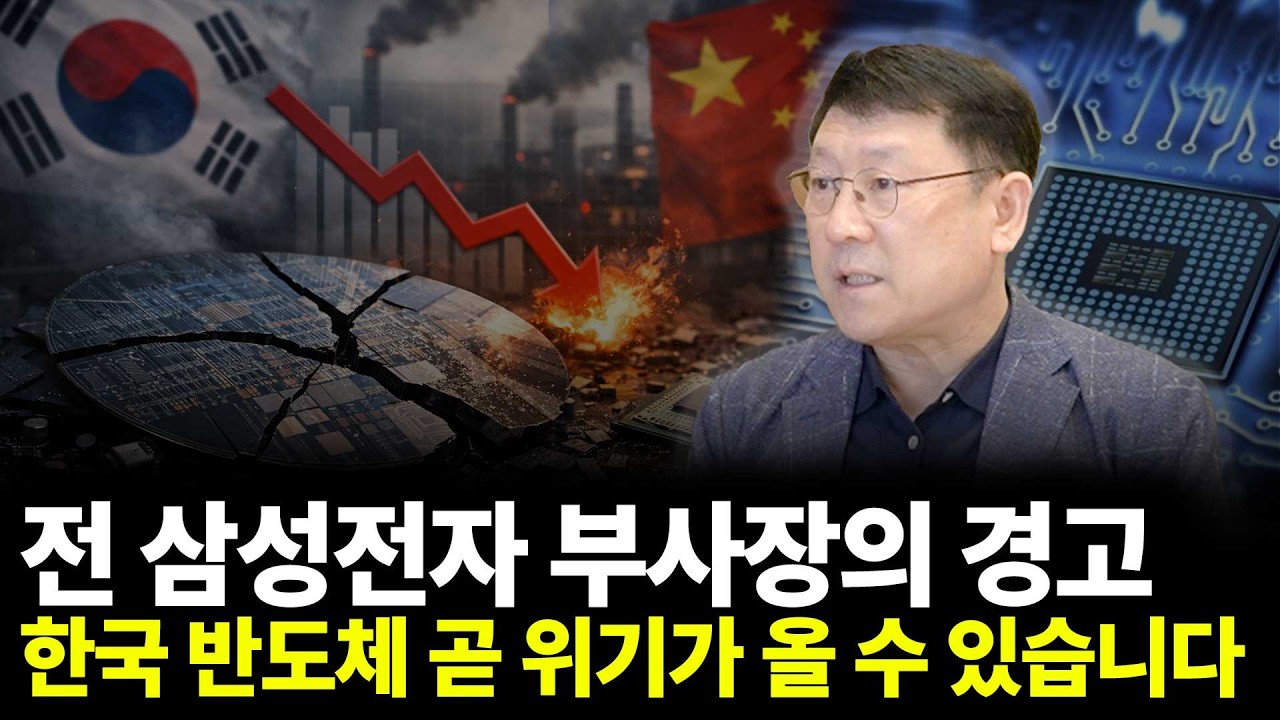
● Samsung Shock, China Surge, AI Chip War
Warning from a Former Samsung Electronics Executive Vice President: Structural Risk Signals for Korea’s Semiconductor Industry — The Real Variables Across Samsung, China, the U.S., and the AI Semiconductor Market
The core issue surrounding Korea’s semiconductor sector is no longer whether the market is in a “super-cycle.” The operating environment is shifting structurally.
This report consolidates the critical threads: why Samsung Electronics overcame prior downturns to reach global leadership; how China is closing the gap; the practical limits of U.S. restrictions; and how AI-driven demand may reshape both the semiconductor market and global supply chains.
Two under-addressed points are emphasized:
- China’s catch-up approach is not simple replication; it targets paradigm shifts to overtake incumbents at inflection points.
- Korea’s primary risk is less the narrowing technology gap itself than weakening capacity for sustained investment and erosion of ecosystem resilience.
Semiconductor outlooks increasingly require an integrated view across Korea’s economy, equity market implications, and investment decisions related to Samsung Electronics.
1. Key Takeaways: What Is Happening Now
A former Samsung Electronics executive vice president recently warned that Korea’s semiconductor industry could face a structural crisis in the near term.
Four drivers were highlighted:
- AI semiconductor demand is supporting the current cycle, but does not automatically secure Korea’s long-term competitiveness.
- China is accelerating its catch-up via concentrated national funding, talent, and industrial policy.
- U.S. restrictions may not fully contain China and may instead increase the urgency and pace of localization.
- Korea’s ability to sustain long-horizon investment through downcycles is weakening, making “technology leadership” harder to defend.
While AI is lifting memory conditions at the surface, competitive dynamics and the strategic “rules of the game” are shifting underneath.
2. How This Semiconductor Cycle Differs from Prior Cycles
2-1. Prior Super-Cycles Were Primarily Supply–Demand Cycles
Traditional semiconductor super-cycles were driven by demand–supply imbalance.
Because fab expansion typically requires 2–3 years, rapid demand increases cannot be met immediately. Customers often over-order (bullwhip demand), pushing prices sharply higher. When pricing turns, customers cut or delay orders; inventory correction amplifies price declines.
2-2. This Cycle Is AI-Infrastructure-Led
Current momentum is driven less by general economic recovery and more by structural AI infrastructure investment.
Data centers, servers, high-performance memory, HBM, and advanced packaging demand are expanding faster than expected. This increases the likelihood of a longer cycle relative to purely inventory-driven rebounds.
However, strong AI demand does not guarantee sustained leadership for Korean firms.
2-3. Strong Market Conditions vs. Durable Competitiveness
Samsung Electronics and SK hynix are benefiting from AI memory demand, but competition is moving to the next phase:
- Speed of capacity 확보 and ramp
- Yield, quality, and reliability at scale
- Securing equipment, materials, and talent within the supply chain
A super-cycle can support profits, but can also provide catch-up time for latecomers.
3. Why Samsung Electronics Succeeded in Semiconductors
3-1. Strategic Conviction and Counter-Cyclical Investment
The key factor was not only technical strength. Leadership maintained the view that semiconductors could not be abandoned, and sustained investment even during loss-making periods.
Most companies respond to downturns with capex cuts and hiring freezes; in semiconductors, that typically weakens competitive position in the next upcycle. Samsung’s counter-cyclical investment enabled post-crisis share gains and technology leadership.
3-2. Government Policy and Industrial Strategy Were Material
Korea’s semiconductor rise also reflected:
- Policy support
- Industrial cluster development
- Export-oriented manufacturing strategy
The outcome was a system-level industrial structure, not a firm-only achievement.
3-3. The Central Question Now
Whether Korea can again commit to long-duration semiconductor investment while absorbing short-term losses. Confidence on this point is weakening, and that is presented as the core issue.
4. What China Is Doing to Become a Semiconductor Power
4-1. A Long-Running Industrial Campaign
China’s semiconductor drive did not begin in the last 2–3 years. Efforts date to the 1990s, strengthened through the 2000s. Policy inflection points included the 2014 semiconductor development plan and the 2015 “Made in China 2025” framework, after which semiconductors became central to national security and strategic competition.
4-2. Two Main Policy Instruments: Tax Incentives and State Funds
China’s approach centers on:
- Large-scale tax incentives
- National semiconductor funds plus local government support
Example mechanisms include multi-year corporate tax exemptions for manufacturers at 28nm and below once profitability is achieved, alongside local funds, land support, and preferential financing.
This structure reduces exit risk: firms can survive prolonged losses, absorb longer learning curves, and consolidate into larger entities via policy-driven restructuring.
4-3. “Fragmentation Then Consolidation”
A repeated pattern across solar, steel, batteries, and EVs:1) Many firms enter2) Price competition intensifies3) Government-led consolidation follows4) Surviving firms scale and improve global competitiveness
Semiconductors may follow a similar trajectory.
5. Why China’s Capacity Strategy Matters
5-1. Beyond Low Pricing: Influence on Standards and Market Structure
China’s capacity expansion is not limited to low-cost supply. The typical sequence:
- Undercut pricing to destabilize competitors
- Use scale and supply stability to influence industry norms and purchasing behavior
- Competitors weaken via margin pressure
- Domestic consolidation produces larger national champions
Comparable dynamics have been observed in smartphones, displays, solar, batteries, and EVs.
5-2. The Global Regime Has Shifted to Subsidy Competition
While China’s subsidies were historically criticized under WTO norms, the U.S. is also deploying large-scale industrial support through semiconductor incentives and IRA-type frameworks.
The operative rule is increasingly: scale and speed in strategic industries. This pressures mid-sized economies such as Korea, which may not match either U.S.-level subsidy scale or China-style national mobilization.
6. How Far China’s Semiconductor Technology Has Progressed
6-1. NAND: The Gap Has Narrowed Significantly
NAND flash stacking technology is assessed as closer to Korea than commonly assumed. Differences may remain in yield, quality, and mass-production execution, but pure spec-based comparisons suggest China is no longer far behind.
6-2. DRAM and HBM: A Meaningful Gap Remains, but Not a Safe Zone
DRAM and HBM require higher precision and process complexity, making catch-up harder. Some views place the gap at roughly several generations, potentially around five years.
Restricted access to EUV constrains China’s leading-edge scaling. However, the prevailing framing is shifting from “impossible” to “slower.”
6-3. Ecosystem Localization Across the Stack
China is pursuing localization across:
- Tools and equipment
- Components and materials
- Testing
- Design
- Packaging
Some equipment segments are assessed to have achieved substantial progress. Given semiconductors are an ecosystem competition, the risk is not one firm but an industrial cluster scaling in parallel.
7. Core Concept: China’s “Overtaking on the Curve” Strategy
7-1. Not Straight-Line Catch-Up
A central concept is “overtaking on the curve”: avoiding direct replication against incumbents and instead leveraging paradigm changes to leapfrog at inflection points.
China often targets technology transition periods and generational shifts rather than mature, fully optimized incumbent domains.
7-2. EVs as the Reference Case
China assessed it would be difficult to win head-on in internal combustion vehicles, and treated EV transition as the opportunity:
- Early policy targets
- Subsidies
- License-plate incentives
- Charging infrastructure build-out
- Battery value chain development
- Leveraging domestic market scale
China now has outsized global EV presence.
7-3. Similar Leapfrogging Pathways in Semiconductors
Potential semiconductor inflection points include:
- Commodity memory to AI-optimized memory
- Node scaling to advanced packaging competition
- General-purpose servers to AI data-center architectures
- Conventional design flows to AI-driven design automation
China may seek to bypass existing rules and set new benchmarks in these transition zones.
8. Why China’s Catch-Up Speed Can Be High
8-1. Capacity to Absorb Trial-and-Error
Technology leadership requires sustained experimentation. China is building the scale in capital, time, manpower, and institutional tolerance for failure to support iterative learning.
8-2. Large STEM Talent Supply
China’s annual STEM graduate volume is materially larger. Absolute quantity does not guarantee outcomes, but in long-horizon, labor-intensive industries it increases the available pool across R&D, process engineering, equipment development, software, and manufacturing operations.
8-3. Domestic Market as a High-Velocity Testbed
Market scale supports rapid iteration: validation, early volume, price declines, and improvement loops. Policy and market are combined to enable repeated attempts.
8-4. High-Intensity Work Practices as an Operational Variable
High-intensity work norms were cited as a practical, if controversial, contributor to speed in frontier catch-up efforts.
9. U.S. Restrictions on China: How Effective Are They
9-1. Strategic Objective: Contain China’s Advanced Technology Rise
U.S. actions are framed primarily as a response to strategic competition, not simply trade imbalance. As China’s economic scale and technology capability approached the U.S., containment of key technologies intensified.
9-2. Semiconductors as the Core Theater
Semiconductors underpin AI, defense, communications, and manufacturing. The U.S. is using export controls, tool restrictions, and entity-level measures to slow China’s progress.
9-3. Restrictions Can Accelerate Localization
In the short term, controls—especially EUV access limits—are impactful. Over the medium term, they can increase China’s localization urgency, shifting the effort from optimization to survival-driven substitution.
Korea should not treat U.S. controls as a durable protective barrier.
10. The Technology Conflict Is Expanding Beyond Semiconductors
10-1. Broader Strategic Industry Scope
Supply-chain restructuring now extends into batteries, rare earths, biotech, robotics, and quantum computing. For Korea, this matters because it can function as an alternative supplier in multiple strategic categories.
10-2. Risk and Opportunity for Korea
As the U.S. reduces China dependence, Korean firms may gain share opportunities. Capturing them requires coordinated positioning across technology, trade policy, supply-chain management, and overseas investment execution.
11. Will China Catch Up to Korea’s Semiconductors Within a Few Years
11-1. Precise Timing Is Not Deterministic
No definitive year was asserted. Semiconductors have higher complexity than many manufacturing categories; tacit know-how, equipment learning, and yield discipline are decisive.
11-2. Directionally, the Debate Is Shifting to “How Long Can the Lead Be Defended”
In NAND, China appears near a threshold; in DRAM and HBM, catch-up could accelerate if equipment constraints ease or alternative approaches mature.
11-3. EUV Is a Constraint, Not a Permanent Shield
China is exploring workarounds such as multi-patterning and pursuing domestic tool development. Even without full EUV parity, “good-enough” capability could enable progression to the next stage.
12. The Primary Risks Korea’s Semiconductor Industry Must Track
12-1. Weakening Investment Endurance Is More Critical Than the Pure Technology Gap
Many discussions focus on the numeric technology gap. The larger risk is Korea’s reduced ability to sustain long-duration investment and ecosystem build-out.
Semiconductors require 10+ year investment horizons.
12-2. Talent and Ecosystem Competition Is Rising in Importance
Future competitiveness depends on integration across:
- Design
- Materials, parts, and equipment
- Packaging
- AI software and systems capability
- Talent development
A narrow memory-centric strategy could underperform in ecosystem competition.
12-3. AI-Era Shifts Reduce the Safety of Memory Leadership
AI creates opportunity for Korean firms, but also changes the basis of competition. HBM demand alone is insufficient; packaging, interconnects, power efficiency, server-level optimization, and system integration increasingly determine value capture.
13. The Most Material Points Often Missed in General Media
13-1. The Risk Is Strategic, Not Simply Cyclical
A focus on memory pricing, HBM benefits, and earnings rebound can obscure a larger shift: China and the U.S. are changing the game at the national-strategy level, while Korea often interprets developments through near-term corporate performance.
13-2. China Is Not Following Korea in a Straight Line
China is positioned to use AI, packaging, tool localization, and domestic scaling to alter the competitive basis at transition points rather than mirror incumbent trajectories.
13-3. U.S. Restrictions Do Not Permanently Protect Korea
U.S. policy is oriented toward U.S.-centric supply-chain restructuring, not shielding Korean firms. Requirements for local investment and compliance standards may increase.
13-4. Korea Must Rebuild Samsung’s Historical “Playbook”
The historical differentiator was sustained investment through downturns. The current priority is resisting retreat from next-generation process and ecosystem investment in favor of short-term earnings defense.
14. Investor Checklist
14-1. For Samsung Electronics and SK hynix: Evaluate Investment Direction, Not Only the Cycle
Key areas to monitor:
- HBM capacity expansion (capex)
- Advanced packaging strategy
- Foundry competitiveness
- Global customer acquisition
- Long-term technology roadmaps
14-2. Track China via Ecosystem Indicators, Not Headlines
More informative indicators include:
- Equipment localization rate
- Talent inflows
- Local government support intensity
- Yield progression in mass production
- Customer adoption breadth
14-3. U.S. Policy Shifts Can Transmit Directly to Korea’s Equity and FX Markets
Semiconductor conflict affects FX, exports, the Korea equity index, supply chains, and overseas investment burdens. Semiconductors are likely to remain a central macro variable for Korea.
15. Conclusion: The Priority Is Not “Upcycle Optimism” but “Re-Architecting Sustainable Leadership”
AI demand may support favorable market conditions in the near term. However, it does not ensure durable Korean advantage.
China is pursuing national-scale catch-up, the U.S. is restructuring supply chains around domestic priorities, and the rule-set is moving toward subsidies, security alignment, and technology bloc formation.
Korea’s competitiveness depends on restoring long-horizon investment discipline, ecosystem strengthening, and transition-ready strategy. The binding constraint may be less the pace of technology convergence than the weakening institutional capacity to widen the gap again.
< Summary >
AI-driven demand is improving market conditions, but long-term Korean competitiveness is a separate issue.
Samsung’s historical advantage was sustained investment through downcycles.
China is accelerating catch-up via tax policy, state funding, talent scale, and domestic-market leverage.
China often targets inflection points to leapfrog incumbents rather than replicate them directly.
U.S. restrictions have near-term impact but can accelerate China’s localization over time.
Korea’s primary risk is weakening investment endurance and ecosystem resilience, more than the technology gap itself.
The key variable is whether Korea can redesign and sustain leadership beyond the current upcycle.
[Related Articles…]
2026 Semiconductor Market Outlook and Key Variables for Korea’s Exports
https://NextGenInsight.net?s=semiconductors
AI Power Competition and Global Supply Chain Reconfiguration: Where Korean Firms May Capture Opportunities
https://NextGenInsight.net?s=AI
*Source: [ Jun’s economy lab ]
– 전 삼성전자 부사장의 경고, 한국 반도체 곧 위기가 올 수 있습니다(ft.이병철 교수 1부)