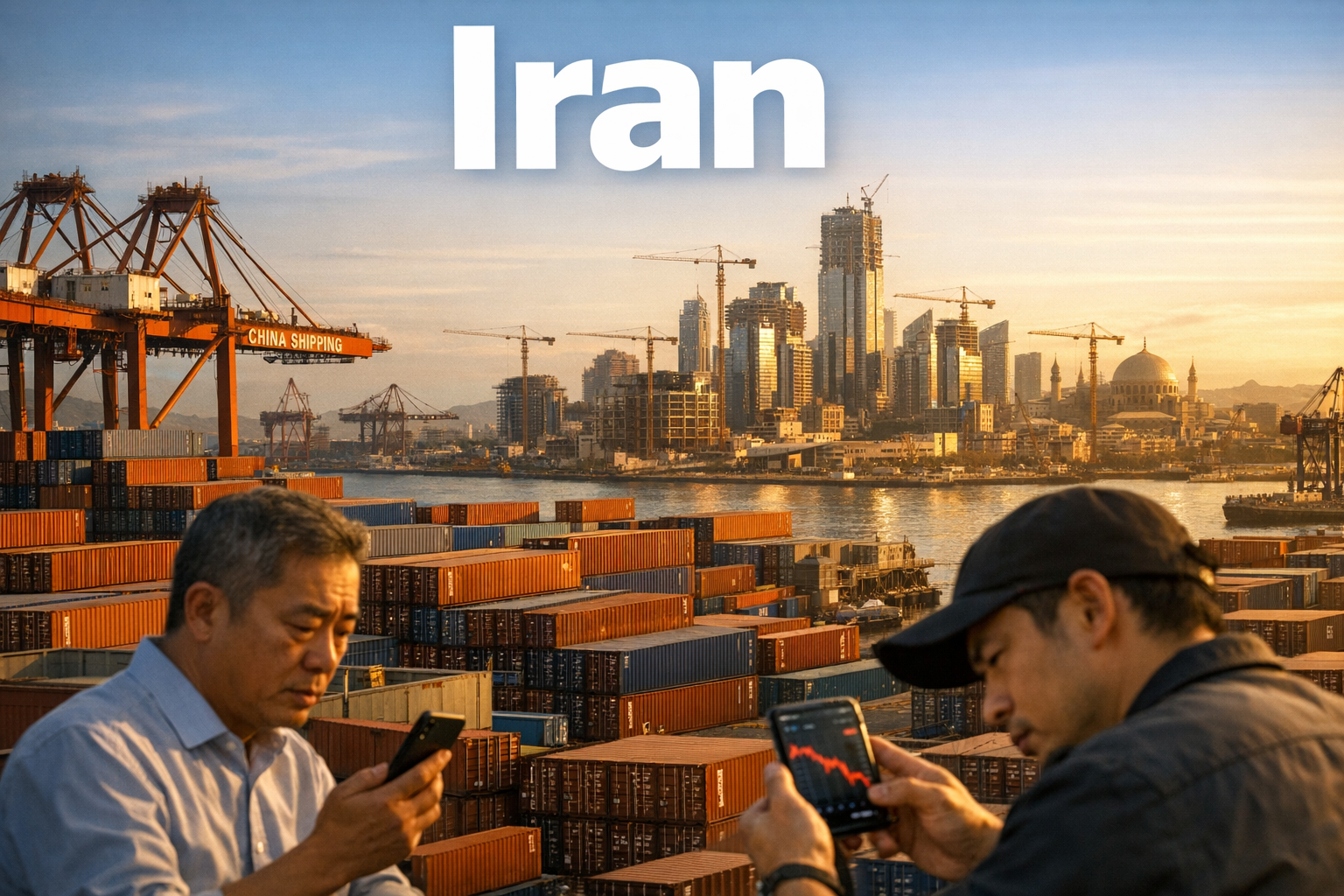
● Middle East Rebuild Boom, Korea Jackpot or Energy Shock
Post-War Middle East Reconstruction Premium: Will a Tangible Opportunity Open for Korean Corporates? A Consolidated View Across Iran, the Gulf, and Energy Security
A ceasefire or end of hostilities typically shifts capital flows from risk hedging to reconstruction and stabilization.The key issue is not headline “reconstruction beneficiaries,” but where and how Korean companies can capture bankable opportunities, and how this links to energy security, oil and gas pricing, global supply chains, and macro outlook.
This report goes beyond generic “reconstruction demand” narratives and focuses on:why Iran could become the largest swing factor,why Korea must compete with integrated diplomacy/ODA/financing packages (not procurement alone),and why Korea should treat LNG and gas disruption risk as more acute than crude price volatility.
Coverage includes post-war EPC and infrastructure award potential, an Iran reopening scenario under sanctions easing, Strait of Hormuz risk transmission to Korean industry, immediate policy priorities, and linkages to AI-enabled infrastructure (nuclear, smart cities, and digitized operations).
1. Core development: A ceasefire/settlement would likely trigger an influx of “reconstruction capital”
A transition to a ceasefire or post-war phase would likely generate accelerated demand to restore refineries, storage facilities, ports and terminals, plants, and power infrastructure.
Korean firms are relevant due to established execution capability in offshore projects, petrochemical plants, urban development, power generation, nuclear, and engineering, with a record of schedule adherence.
Post-war restoration typically compresses the design–procurement–construction cycle, prioritizing rapid delivery, schedule certainty, and operational stability.
Competitive advantage is likely to accrue less to lowest-cost bidders and more to contractors able to deliver under schedule and quality constraints in elevated-risk environments.
2. Key swing factor: The primary upside market could be Iran rather than Saudi Arabia
A central thesis is that Iran could represent the largest upside optionality.Historically, Korean Middle East business has been concentrated in Gulf markets such as Saudi Arabia, the UAE, and Qatar.
Iran combines large geography and resources with significant infrastructure and industrial obsolescence; prolonged sanctions have deferred modernization across multiple sectors.
If US and UN-related sanctions constraints materially ease, Iran could re-emerge as a large-scale restoration and modernization market.
Potential entry areas include plants, grid and power systems, petrochemicals, urban infrastructure, transport, industrial facilities, healthcare infrastructure, smart cities, and ICT networks.
The addressable market is structurally oriented toward modernization, enabling attachment opportunities in digital transformation, automation, energy efficiency, smart industrial parks, and AI-enabled operations and maintenance.
3. Why Korean firms can be competitive: The region increasingly prioritizes execution reliability over lowest-price construction
Three core strengths are typically cited:
First, speed and schedule certainty. Post-war recovery is tightly linked to political stabilization, livelihoods, and export normalization.
Second, integrated delivery capability. Korean contractors can package engineering, procurement, construction, commissioning, and operational support.
Third, validated track record. Reference projects such as the UAE Barakah nuclear program have reinforced credibility on delivery and quality.
As Gulf countries pursue energy transition and industrial upgrading in parallel, competitiveness may shift toward Korea-style integrated packages combining nuclear, renewables, smart grids, digital operating platforms, and industrial AI.
4. Constraint: A purely transactional approach can reduce access to opportunities
Regional counterparts may discount partners perceived as opportunistic.Questions can emerge regarding contributions to regional stability, human capital, and long-term cooperation beyond commercial extraction.
The market places high value on relationship durability, education and technology cooperation, and people-to-people ties.
Examples include participation of Korea-trained talent in Gulf strategic programs and clinical training links with Korean institutions; these create reputational capital beyond contract awards.
In practice, bid outcomes can be influenced by long-horizon cooperation in education, science and technology, healthcare, talent development, and joint R&D alongside price and capability.
5. Energy security: Korea’s higher-impact risk may be LNG/gas disruption rather than crude price increases
Market focus often centers on crude benchmarks, but Korea’s industrial structure implies that LNG and gas supply interruptions may transmit more directly into real-economy disruption.
Crude price increases primarily generate cost inflation; gas shortages can constrain power generation, manufacturing, chemicals, and urban energy services.
Korea’s energy import exposure to routes transiting the Strait of Hormuz links regional maritime risk directly to inflation, output, trade balance, and utilization rates.
Required responses extend beyond short-term contingency plans and include diversification of supply sources, LNG contract portfolio optimization, strategic stockpiles, generation mix resilience, and integrated planning across nuclear, renewables, and gas infrastructure.
6. Why a “joint management” framework for the Strait of Hormuz is viewed as low probability
A post-war scenario involving US/NATO or multilateral joint management of the Strait is assessed as politically difficult.
Iran is likely to view such arrangements as sovereignty-infringing; even with formal understandings, indirect escalation via coastal missile or drone capabilities could persist.
If nuclear-related negotiations and broader settlements progress, domestic and regional political opposition to sustained external naval management may intensify.
Stability is therefore more dependent on a durable regional balance that includes Iran than on external maritime governance alone.
7. Policy priority 1: Import diversification must move from principle to execution
High Middle East dependence has been a longstanding vulnerability; the current episode underscores execution urgency.
Key items for government and corporates:
- Diversify crude import origins
- Reassess LNG long-term contract portfolio
- Validate alternative shipping and routing contingencies
- Strengthen strategic stockpile systems
- Increase flexibility of the power-generation fuel mix
- Enhance supply-chain risk management for Middle East-dependent industries
This is not solely a resource procurement issue; it directly affects macro stability, export reliability, industrial competitiveness, and inflation management.
8. Policy priority 2: Technology alone is insufficient; competitiveness requires financing packages
Post-conflict and emerging markets often require financing-led solutions; award decisions depend on the bidder’s ability to structure and mobilize capital, not only deliver engineering.
Korea’s current export-credit and policy-finance capacity may be insufficient to consistently underwrite large-scale infrastructure and resource-linked projects.
Competitors have expanded influence through bundled financing, making procurement materially a financing competition.
A scalable model requires integrating technology, execution, operations capability, public finance, and private capital mobilization into a single package.
9. Policy priority 3: ODA functions as strategic capital, not discretionary cost
Official development assistance is positioned as a tool that compounds diplomatic leverage and market access over time.
In heavily damaged areas, early-stage recovery support via ODA can establish credibility as a long-term partner rather than a short-term contractor.
Such credibility can later convert into opportunities across construction, healthcare, power, telecom, education, and urban development.
Low ODA intensity relative to peer benchmarks is framed as a capacity gap for a mid-to-large economy seeking sustained diplomatic and commercial influence.
10. Implication of the UAE Barakah nuclear program: Trust created in the region scales globally
Barakah is treated as a reference case for schedule discipline, quality, operational stability, and localization, strengthening Korea’s export credibility.
The reference value extends beyond the region and can support negotiations in other nuclear export markets.
The relationship can evolve from supplier–buyer to partnership, enabling co-development or co-export models in nuclear, energy, and infrastructure.
This architecture is extensible to smart grids, hydrogen, storage, digital power plants, and AI-based asset management.
11. Post-war regional configuration: Potential Israel–Gulf–Korea triangular cooperation
If the regional order stabilizes, expanded normalization frameworks could open multi-party cooperation structures.
A plausible construct is Israel–Gulf–Korea collaboration:Israel contributes advanced technology and digital security capabilities;Gulf states provide capital and large-scale infrastructure demand;Korea contributes manufacturing, construction, systems integration, and operations.
Potential application areas include smart cities, water management, agri-tech, security, energy transition, semiconductor enabling infrastructure, and dual-use civil–defense technologies.
These themes link directly to AI infrastructure, cloud/data centers, industrial automation, digital government, and defense-tech convergence.
12. AI-trend lens: Reconstruction is shifting from concrete-only to digitized, upgraded infrastructure
Reconstruction is increasingly expected to embed digital infrastructure rather than replicate legacy assets.
Power restoration can incorporate smart grids; industrial park rebuilding can embed automation and AI-driven maintenance; urban renewal can integrate surveillance, traffic, logistics, and energy management platforms.
Gulf economies are already prioritizing smart cities and diversification; post-war demand may skew toward “upgrade reconstruction” rather than basic replacement.
Targetable segments for Korean companies:
- AI-based plant operations optimization
- Predictive maintenance systems
- Smart city command-and-control platforms
- Energy efficiency solutions
- Nuclear and power-plant digital twins
- Industrial robots and automation equipment
- Digital logistics and port management systems
Accordingly, the opportunity set may broaden from EPC firms to software, data, sensors, telecom, cloud, security, and AI providers.
13. Execution checklist for government and corporates
13-1. Government actions
- Prepare country-level post-war recovery roadmaps in advance
- Develop Iran re-entry scenarios contingent on sanctions easing
- Accelerate energy import diversification policy
- Reassess strategic stockpiles and LNG contingency frameworks
- Expand export credit, policy finance, and guarantee programs
- Link ODA to recovery assistance and long-term cooperation strategy
- Strengthen science/technology, education, and health diplomacy
13-2. Corporate actions
- Recalibrate local partnerships across the region
- Map reconstruction demand by sector and align portfolios
- Build integrated offerings across plants, power, telecom, and urban development
- Embed financing structures into bids
- Develop AI/automation-enabled operating models
- Prepare ESG and community-impact strategies alongside delivery plans
14. Highest-signal points
- The primary determinant of reconstruction access may be political trust, not bid volume alone.
- Iran is high-uncertainty but potentially the largest incremental market under easing constraints.
- Korea’s key vulnerability may be LNG/gas disruption rather than crude price fluctuations.
- Winning post-war markets likely requires financing packages and ODA-linked credibility.
- Reconstruction may tilt toward AI-enabled, digital, upgrade-oriented infrastructure investment.
- Education, healthcare, and science/technology cooperation can be as material as procurement competitiveness.
15. Conclusion: Capital flows toward trusted partners, not reconstruction narratives alone
Post-war Middle East reconstruction can create significant opportunities for Korean corporates across established Gulf markets and, conditionally, Iran.
Realization is not automatic and depends on energy-security preparedness, diversification execution, expanded development cooperation, strengthened policy finance, sustained diplomatic credibility, and AI/digital integration strategies.
The issue set connects directly to Korea’s macro outlook, energy security, commodity price exposure, supply-chain resilience, and forward-looking AI-linked industrial opportunities.
Outcomes will depend on whether Korea positions as a long-term recovery and modernization partner and executes accordingly.
< Summary >
A ceasefire/end of conflict could open large-scale reconstruction demand.
Korean firms may benefit given competitive positioning in plants, construction, nuclear, and engineering execution.
Iran could represent the largest swing opportunity if sanctions constraints ease.
A credibility-first approach combining diplomacy, ODA, education/health cooperation, and technology partnerships is likely to be required.
Korea’s higher-impact risk may be LNG/gas supply disruption, making energy-security measures urgent.
Reconstruction is likely to expand into AI-enabled smart cities and digital infrastructure rather than basic asset replacement.
Government priorities include diversification, expanded policy finance, and strengthened ODA; corporates should prepare financing-led bids and AI-enabled integrated solutions.
[Related Articles…]
- Middle East reconstruction and Korean corporate opportunity set: consolidated view
- AI infrastructure investment expansion and global industrial realignment outlook
*Source: [ 경제 읽어주는 남자(김광석TV) ]
– 전쟁 끝나면 ‘돈’이 몰린다… 중동 재건, 한국 기업에 “반전 드라마” | 경읽남과 토론합시다 | 마영삼x김영목_3편
● China Military Meltdown, Xi Purge Shock, Post-CCP Panic
Unusual Signals in China’s Military: A Genuine Crisis Phase?
A consolidated investor-focused brief covering potential stress in the Xi system, risks of internal fragmentation, and indications that the US strategic community is preparing for “post-CCP” scenarios.
China’s current risk profile extends beyond economic deceleration. Multiple vectors are converging: potential command-level gaps, repeated senior-level purges, weakening central control capacity, possible re-emergence of regional identity dynamics, and growing evidence that parts of the US policy ecosystem are modeling outcomes “after” the Chinese Communist Party (CCP).
This report outlines: (i) why abnormalities in the Central Military Commission (CMC) matter, (ii) how purges may affect Taiwan and East Asian security, (iii) why internal fault lines are structural rather than confined to minority regions, and (iv) potential spillovers to global supply chains, macro variables, and investment positioning.
The key framing is not “China is strong,” but “a very large system facing growing internal operational instability.”
1. Core Development to Monitor
China’s military leadership may not be functioning normally
The most material claim is that the CCP’s Central Military Commission may be in a condition that impairs normal operation.
The CMC is the apex of China’s military command. Because the People’s Liberation Army (PLA) functions primarily as the Party’s armed force, disruption at the CMC level can translate into broader stress at the political core.
If multiple members are absent, removed, or unable to execute duties, the issue is not personnel turnover but potential degradation of:
- wartime command
- crisis response
- external military decision-making
- Taiwan Strait contingency management
For markets, the highest-risk scenario is often not the probability of conflict itself, but reduced predictability and coherence in counterpart decision-making.
2. Why a CMC “Gap” Is High-Risk
Beyond purges: weakened national crisis-management capacity
Military purges are not unusual in authoritarian systems. The risk is elevated when scale, timing, and functional vacancies coincide.
If the top decision body cannot reliably deliberate and execute, crisis response speed and coordination may fall sharply even if outward control appears strong.
In high-stakes theaters (Taiwan, South China Sea, US-China military friction), this can increase the probability of miscalculation, overreaction, or operational confusion.
3. Interpreting Reports Around Zhang Youxia and Internal Power Dynamics
The central issue is declining internal trust, not any single rumor
Reports frequently cite Zhang Youxia as a key figure with operational credibility, alongside speculation about unclear whereabouts.
Individual “disappearance” or coup narratives are difficult to verify and can be overstated. The more relevant signal is why such narratives persist: declining confidence in PLA leadership stability and internal cohesion.
The structural concern is a system where political loyalty tests can dominate assessments of operational competence, reinforcing distrust at senior levels.
4. Xi Jinping’s Military Purges: Anti-Corruption or Power Consolidation?
Most consistent interpretation: both
Terms such as “two-faced” or “disloyal” cadres are politically meaningful signals in CCP discourse, often used to justify removal of officials seen as corrupt and/or politically unreliable.
Anti-corruption campaigns in the PLA typically require tighter personal control. However, stronger one-man control can also intensify information distortion and reduce candor upward.
This creates a feedback loop:
- tighter control
- reduced truthful reporting
- higher risk of miscalibrated policy decisions
The pattern is consistent with late-stage risks in rigid authoritarian governance: intensified control coinciding with weaker reality assessment.
5. Weapon-System Credibility and the Purge Dynamic
Possible linkage between performance doubts and leadership distrust
Claims that certain Chinese air-defense or weapons systems underperformed in real-world conditions may include exaggeration, but they highlight a relevant modernization risk: limited combat validation and politicized performance reporting.
China has invested heavily in:
- missiles and air defense
- naval expansion
- high-end platforms and C4ISR modernization
If performance metrics are inflated and testing signals are filtered, capability may diverge materially from reported readiness. In that context, accountability can cascade through senior commands and procurement networks, incentivizing further purges and compounding command fragility.
6. Does Internal Stress Increase the Likelihood of War?
Large-scale war generally becomes harder under internal instability
A common hypothesis is that domestic problems raise incentives to externalize conflict. While the incentive can exist, high-complexity operations such as a Taiwan invasion require:
- stable political cohesion
- trusted command structures
- credible military readiness
- robust logistics and industrial capacity
With concurrent pressures (purges, loyalty-driven promotions, slower growth, property-sector strain, capital outflow pressures), the feasibility of major war can decrease even as signaling becomes louder. The near-term risk may skew toward coercive posturing and crisis volatility rather than full-scale conflict.
7. Structural Context: Was China Always a Naturally Unified State?
Regional identity and center-local dynamics remain latent fault lines
China is often treated as a monolithic unit, but historical, linguistic, and regional differences are substantial. This extends beyond border regions and includes distinct identities among Han-majority provinces and major urban economies.
If central control weakens, risks include:
- reduced administrative compliance
- fiscal fragmentation under debt stress
- weakened public security coordination
- erosion of political legitimacy
This suggests that integration has been sustained partly by the Party-state’s coercive and administrative capacity rather than purely organic cohesion.
8. “Fragmentation” Risk: Probability vs. Functional Degradation
Formal breakup is unlikely near term; functional segmentation is plausible
A rapid, visible state collapse remains a low-probability scenario for a nuclear-armed major power. The more realistic concern is functional degradation without formal secession, such as:
- local governments prioritizing survival over central directives
- uneven stress events linked to local debt/property dynamics
- simultaneous ethnic/security incidents
- factional clustering within security institutions
Even without formal fragmentation, governance degradation can significantly affect global supply chains, commodities, shipping, FX, and export demand across Asia.
9. Is the US Preparing for “Post-CCP” Scenarios?
Strategic discourse is expanding beyond competition to contingency design
References to Hudson Institute-style scenario work suggest a shift in parts of the US strategic community from “how to compete with China” to “how to manage outcomes after CCP rule.”
Such reports are not official policy by default. The investable implication is the direction of strategic thinking: China is increasingly framed not only as a competitor, but as a high-risk system where regime-contingency planning is relevant.
If this framing strengthens, US-China friction is more likely to broaden across:
- technology controls
- financial and sanctions tools
- supply-chain restructuring
- alliance and security posture adjustments
10. Global Macro and Market Implications
China risk is transitioning from growth risk to system risk
China-linked risk is no longer limited to GDP prints and property cycles. Potential spillovers are increasingly systemic.
10-1. Accelerated Supply-Chain Reconfiguration
Persistent governance uncertainty, geopolitics, and sanctions risk incentivize reduced single-country manufacturing dependence. Beneficiaries may include Vietnam, India, Mexico, and Indonesia.
Korean corporates should reassess China exposure, particularly in semiconductors, batteries, chemicals, and auto components.
10-2. Higher Demand for Safe Assets
Rising political/military risk premia can support USD, US Treasuries, and gold. KRW and Korea risk assets may experience heightened volatility during shocks.
10-3. Headwinds to Korean Exports
Weak China domestic demand and policy uncertainty can pressure Korea’s intermediate-goods exports. Combined with China’s push for supply-chain self-reliance, a return to prior-cycle export elasticity may be slower than expected.
10-4. Energy and Shipping Volatility
Instability in the Taiwan Strait, South China Sea, or broader Northeast Asian sea lanes can move freight rates, insurance costs, and commodity pricing, with second-order effects on inflation and rate expectations.
11. Korea-Relevant Baseline Scenario
More likely than collapse: prolonged instability in a large power
The key question for Korea is less whether China “breaks up” and more how to operate amid an unstable major power over an extended period.
A practical base case is:
- prolonged low growth
- tighter political controls
- elevated military tension
- concealed internal fractures
- regionally uneven administrative performance
This environment exports volatility without delivering a clear “reset,” complicating planning for firms and policymakers.
Priority responses include:
- export-market diversification
- stronger autonomy in strategic industries
- energy security upgrades
- defense-industrial competitiveness
- restructuring in sectors with high China dependence
12. Underemphasized Core Risk
The primary vulnerability is information distortion inside the system
Many narratives focus on sensational elements (coup rumors, disappearances, breakup claims). The central risk is structural: coercive control can prevent accurate information from reaching top leadership.
Mechanisms include:
- inflated readiness and performance reporting
- local data manipulation to satisfy targets
- corporate behavior optimized for metrics over fundamentals
- leadership feedback loops driven by loyalty competition
In such systems, crisis response can prioritize concealment over correction, increasing policy error risk. This dynamic matters across security, macro policy, supply chains, commodities, semiconductors, and global risk sentiment.
13. News-Style Summary for Investors
1) Abnormalities at the CMC level should be treated as a governance and crisis-management risk, not merely rumor.
2) PLA purges combine anti-corruption with power consolidation, potentially weakening command trust and execution capacity.
3) A major war remains possible but is operationally harder under internal instability; near-term risk may skew toward coercive signaling and crisis volatility.
4) Internal stress is structural and extends beyond minority regions to center-local governance and regional identity dynamics.
5) US strategic thinking increasingly includes “post-CCP” contingencies, implying a more durable, system-level competition.
6) Korea should plan for prolonged instability rather than position for imminent collapse.
14. Practical Monitoring Points (Investors and Corporate Planning)
For investors: treat China headlines as geopolitical and policy-risk indicators, not only cyclical data. Consider positioning linked to:
- supply-chain reallocation beneficiaries
- defense and security-linked sectors
- energy infrastructure
- US-centered advanced-technology ecosystems
- assets resilient to USD strength and risk-off regimes
For corporates: assess whether revenue, sourcing, and capex are structurally dependent on China, and whether diversification plans are executable within a 3-year horizon. Sectors with higher sensitivity include semiconductors, batteries, autos, shipbuilding, defense, and logistics.
15. Conclusion
China’s principal risk is less a near-term “collapse” than increasing rigidity with declining system trust. The interaction of purges, loyalty-driven incentives, regional governance stress, macro slowdown, and long-duration US-China rivalry can reduce predictability and raise tail risks.
China-related developments should be evaluated through power structure, information integrity, command-chain stability, center-local control, and US strategic posture, rather than isolated incidents. China is increasingly a global volatility driver rather than a stable growth engine.
< Summary >
Unusual signals in China’s military are not limited to personnel changes; they may indicate weakening central control and degraded crisis-response capacity.
Xi’s military restructuring blends anti-corruption and power centralization, potentially undermining operational capability and information reliability.
China “fragmentation” risk is more plausibly expressed as center-local tension, regional identity reactivation, and functional segmentation rather than formal state breakup.
Parts of the US strategic community are developing post-CCP scenarios, consistent with a long-duration system competition framework.
For Korea, the priority is preparation for prolonged Chinese instability via supply-chain adaptation, geopolitical risk management, and reduced concentration exposure.
[Related Articles…]
https://NextGenInsight.net?s=China
https://NextGenInsight.net?s=AI
*Source: [ 달란트투자 ]
– 중국 군부 이상징후 포착. 곧 대륙이 갈갈이 찢어진다|이춘근 박사, 김정호 교수 특집