● Hidden Debt Timebomb, AI Credit Crack, Global Market Shock
The Core Risk More Material Than Middle East Conflict: Why Deterioration in the US Private Credit Market Is a Key Variable for the 2026 Global Outlook
Middle East conflict, FX volatility, and oil-price instability can distract markets from a potentially larger risk.
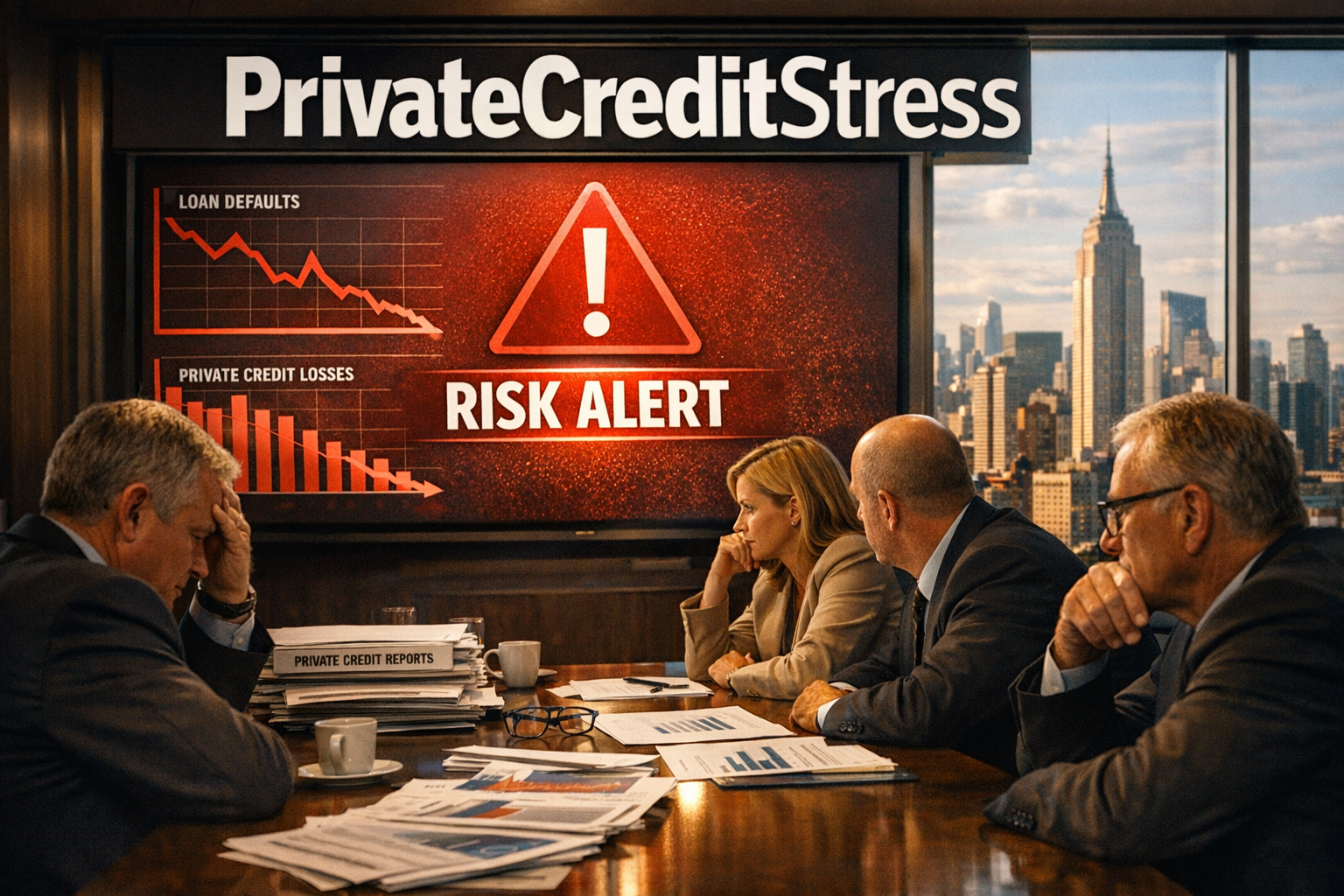
The issue is not merely that the US private credit market is weakening. The relevant questions are: where risk migrated after tightening bank regulation, why software/SaaS/healthcare lending is a plausible starting point for stress, and how these dynamics could transmit to US equities, KOSPI, FX, rates, and ultimately to Korea’s productive finance and AI industry ecosystem.
This report summarizes the narrative in a news-style format and highlights a key under-discussed point: the structure of hidden impairment may be more consequential than the headline default rate.
1. One-sentence framing
While geopolitical shocks draw attention outward, credit risk that accumulated inside the US private credit market is increasingly surfacing.
The central risk is not “defaults” per se, but uncertainty over the true magnitude and location of impairment. Markets typically price uncertainty more aggressively than known losses; this can evolve from a sector issue into a system-wide confidence problem.
2. News-style summary
2-1. What is happening
The US private credit market expanded rapidly after 2008. As bank regulation tightened, banks reduced higher-risk corporate lending; private funds, BDCs, and alternative asset managers filled the gap.
Lower-rated or asset-light companies gained access to capital, and investors sought higher yields in a low-rate era.
With higher rates, slowing operating performance, and AI-driven pressure on legacy software/SaaS business models, questions around debt service capacity are increasing.
2-2. Why it is drawing attention now
A visible trigger has been redemption restrictions.
Many private credit funds hold illiquid loans while offering investors periodic liquidity (e.g., quarterly redemptions). If redemption requests surge, assets cannot be liquidated quickly, creating liquidity stress that can lead to gating, forced sales, valuation declines, and further confidence erosion.
2-3. Which sectors are most vulnerable
Software and SaaS are frequently cited as sensitive areas.
These companies are typically asset-light and were valued on expected future growth. As generative AI and AI agents scale, pricing power and barriers to entry in enterprise software may weaken, reducing the future cash flows assumed at underwriting.
2-4. What markets fear most
Markets are not primarily focused on the reported delinquency/default rate, but on opacity:
- borrower and position-level exposures
- underwriting terms and covenant details
- accuracy of sector classification
- timing of loss recognition in accounting/valuation
Greater opacity increases conservative pricing and risk premia across US equities, corporate credit, high yield, and private markets.
3. Why private credit grew, and why it was structurally beneficial
3-1. Private credit is not inherently negative
Private credit provides capital to segments banks may not serve effectively: startups, private growth companies, mid-market firms, and specialized industries. It can function as productive finance by allocating capital based on technology and growth potential.
3-2. Comparison with Korea
Korea is often characterized as collateral-driven (notably real estate). Asset-light technology firms can face funding constraints, limiting ecosystem scale.
US private credit partially addressed this gap. The correct framing is not “private credit should disappear,” but that a useful market may be facing side effects from rapid growth and insufficient transparency.
4. Why it is compared with 2008, and why it is not the same
4-1. The shared element is uncertainty
In 2008, the core issue was not only impairment but also the inability to identify who held the risk. Private credit similarly has limited disclosure, manager discretion in valuation, and relatively low-frequency reporting, making real-time risk assessment difficult.
4-2. Key differences
A direct replay of a 2008-style banking collapse is not a baseline assumption. Current stress is more concentrated in nonbanks and private markets; transmission channels and speed may differ. However, a slower, longer-lasting tightening of credit conditions remains plausible.
5. How hidden impairment can accumulate
5-1. Headline default rates can be misleading
Apparent stability in default rates can reflect delay mechanisms:
- restructurings and maturity extensions
- changes in interest payment terms
- delayed recognition of economic impairment
- reclassification of assets
This can suppress visible defaults while underlying credit quality deteriorates.
5-2. Sector classification distortion
Exposures may be categorized as food, retail, or services while the economic engine is software/SaaS. Misclassification reduces the market’s ability to measure sector concentration and can increase perceived tail risk in software-linked credit.
5-3. Liquidity promises vs. asset liquidity
Private credit is structurally illiquid. Offering periodic redemptions can be stable under normal inflows and steady valuations, but becomes fragile under stress. Liquidity events often propagate faster than credit events.
6. Why SaaS and AI are central
6-1. AI may compress software moats
Legacy SaaS depended on recurring revenue, switching costs, and enterprise complexity. AI agents and generative AI can replicate or substitute functions at lower cost, increasing:
- growth deceleration risk
- pricing pressure
- churn risk
- valuation repricing
This can transmit from equity valuations to loan performance and refinancing capacity.
6-2. AI as both growth catalyst and credit shock
AI narratives are typically framed around beneficiaries such as semiconductors and data centers. Less discussed is AI’s potential to reduce the creditworthiness of incumbent software/service models, which can act as a trigger for private credit stress.
7. Probability and pathways of broader financial stress
7-1. Base case: gradual credit tightening
A more likely scenario than an immediate systemic collapse is a progressive tightening centered in nonbanks:
- higher lending standards
- more difficult refinancing
- higher all-in funding costs
- weaker sentiment in private growth investing
The real economy impact would be concentrated in mid-market and growth companies.
7-2. Downside scenario: gates and forced sales feedback loop
Risk increases if redemption restrictions become widespread, leading to asset sales, price declines, mark-downs, and renewed redemption pressure. Potential spillovers include public corporate credit, high yield, regional banks, and venture funding conditions.
7-3. Mitigating factors
- risk is relatively more outside core banks
- regulators and the Fed are more focused on liquidity transmission than pre-2008
- large US financial institutions generally have stronger capital positions than in 2008
The more realistic market impact is sustained pressure on risk asset valuations and a drag on rate-cut expectations, rather than an immediate global crisis.
8. Implications for Korea and KOSPI
8-1. Higher FX volatility risk
Geopolitical risk already supports USD strength. Adding US private credit concerns can reinforce safe-haven flows, increasing the probability that USD/KRW deviates from prior expectations. This is typically negative for Korean equities.
8-2. Greater sector dispersion in KOSPI
Increased global risk aversion can weaken foreign flows, with growth and small/mid caps often underperforming first. Areas with stronger relative resilience may include AI infrastructure, semiconductors, defense, and energy supply-chain themes.
8-3. Strategic implications for Korea’s AI ecosystem
Korea needs more technology-based productive finance to scale AI and advanced industries. The US experience suggests innovation finance is necessary, but low-transparency innovation finance can amplify volatility and confidence shocks.
9. Key under-discussed points
9-1. The core issue is a concealed credit cycle, not geopolitics
War dominates headlines, but a weakening domestic US credit cycle can be more persistent and structurally damaging through earnings and investment channels.
9-2. AI both lifts markets and reveals credit fractures
AI can support market leadership while simultaneously undermining incumbent cash-flow assumptions in software, accelerating credit repricing.
9-3. Stable reported metrics are not sufficient
In private markets, risk often surfaces with a lag. The key question is not only what the metric prints, but why it remains low.
10. Indicators to monitor
10-1. Expansion of redemption restrictions
A direct signal of liquidity stress.
10-2. Continued valuation and earnings pressure in software/SaaS
Further deterioration would raise private credit loss expectations.
10-3. High-yield spreads and regional bank conditions
Signals of spillover from private to public credit and banking.
10-4. Changes in the Fed’s policy stance
Financial stability concerns can influence the policy reaction function; persistent inflation can delay easing and worsen refinancing stress.
10-5. Funding conditions for US private growth companies
Refinancing rates, new lending terms, and valuation haircuts are practical measures of tightening.
11. Synthesis
The issue is not that private credit is inherently problematic. The key points are:
1) Productive finance that served a real function may be entering a confidence challenge due to overexpansion and opacity.
2) AI is not only an equity upside narrative; it can reduce the credit quality of legacy software business models.
3) While geopolitical shocks dominate attention, more durable stress can accumulate inside the US credit system.
Global outlook assessment should integrate oil/FX with private credit, nonbank risk, and AI-driven industry repricing.
12. Practical investor framing
Avoid assuming an imminent crisis, but also avoid complacency based on headline metrics.
Current conditions reflect a multi-factor interaction: USD strength, higher-for-longer rates, nonbank credit stress, and AI-driven repricing in software. A concise summary for the 2026 outlook is:
“AI-driven growth opportunities and AI-exposed credit fractures may progress in parallel.”
< Summary >
The US private credit market historically provided productive finance for startups and private growth companies. However, higher rates, redemption restrictions, limited transparency, and SaaS-linked impairment risk are increasing the probability of concealed credit stress.
AI diffusion can weaken incumbent software competitiveness, potentially amplifying private credit deterioration.
This resembles a nonbank-led credit tightening more than an immediate 2008-style crisis, but it can impose structural pressure on US equities, FX, KOSPI, and broader global risk assets.
The analytical priority is to monitor the US domestic credit system and AI-driven industry restructuring alongside geopolitical variables.
[Related Articles…]
- USD/KRW volatility and Korean equity allocation strategy during USD strength periods: https://NextGenInsight.net?s=환율
- Post-AI software industry restructuring and identifying primary beneficiaries: https://NextGenInsight.net?s=AI
*Source: [ 경제 읽어주는 남자(김광석TV) ]
– 중동전쟁에 가려진 진짜 위기. 미국 사모대출 시장의 숨겨진 부실 | 경읽남과 토론합시다 | 나탈리허 변호사_1편
● Debt Bomb, Oil Shock, Credit Crunch
US Private Credit Stress and Prolonged Middle East Conflict: Key Takeaways on Potential Systemic Risk
This issue extends beyond the US private credit market. Elevated interest rates, potential oil price spikes, a prolonged Middle East conflict, and latent credit deterioration are increasingly being assessed together by global investors.
This report summarizes:
- Why private credit stress is intensifying
- Similarities to and differences from the 2008 Global Financial Crisis (GFC)
- Potential transmission channels to Korean financial markets, equities, and real estate
- Under-discussed factors that may be more material than headline default rates
1. One-line problem statement
Non-bank private credit managers have materially expanded direct lending to lower-quality borrowers. With high rates and slowing growth persisting, debt service capacity is weakening.
If a prolonged Middle East conflict lifts crude oil prices, inflation pressures could re-accelerate and revive concerns about higher-for-longer policy rates. This combination would likely accelerate loss recognition among already fragile borrowers.
The central concern is not whether losses exist, but how delayed recognition may amplify the eventual magnitude and market impact.
2. What the US private credit market is
2-1. Simplified structure
Private credit refers to non-bank entities (e.g., private funds) lending directly to companies rather than through banks. Typical borrowers include pre-IPO firms, SMEs, and higher-risk companies with limited access to bank credit.
Common structures:
- Funds raising capital from investors and lending to companies
- Vehicles such as BDCs raising capital and originating loans directly
The market can provide productive financing where banks are constrained. Risk rises materially when liquidity tightens and rates remain elevated.
2-2. Why it appears riskier recently
Key risk drivers:
- High share of lower-credit-quality borrowers
- Large proportion of floating-rate loans
- Less transparent valuation practices
- Lighter regulatory constraints than banks
Floating-rate exposure is a critical vulnerability: when policy rates stay high, interest burdens increase mechanically, and modest revenue weakness can impair debt service capacity.
3. Core risk signal: losses may be understated relative to headline metrics
3-1. Default rates can create a false sense of stability
Private credit stress may be larger than observed default statistics, partly due to mechanisms that delay formal recognition of impairment.
3-2. Why PIK matters
PIK (payment-in-kind) capitalizes interest into principal when borrowers cannot pay cash interest. It does not typically register as delinquency, but it often indicates cash flow insufficiency.
An increase in PIK usage can suppress near-term default rates while increasing leverage and future repayment burdens, raising the risk of abrupt loss recognition later.
3-3. Maturity extensions and covenant resets have similar implications
Extending maturities or relaxing terms can prevent immediate default but does not necessarily restore underlying repayment capacity. In this market, latent credit risk may be more informative than official default statistics.
4. Similarities to the 2008 GFC
4-1. Concentration in lower-quality borrowers
In 2008, subprime mortgages expanded credit to weaker household borrowers; rising rates and weakening collateral values drove delinquencies higher. Today, the primary borrowers are companies rather than households, but the credit-quality profile is similarly fragile.
4-2. High sensitivity to floating rates
As in 2008, higher rates amplify stress. Private credit borrowers are structurally exposed to prolonged high rates, particularly if revenue growth slows while refinancing costs increase.
4-3. Rising defaults and redemption pressure
Early-stage stress typically follows a pattern: delinquencies rise, defaults increase, and investors seek liquidity. Managers may then face pressure to raise cash, potentially forcing asset sales and creating price dislocations. Some non-listed BDCs and private credit products have shown increasing signs of such pressure.
4-4. Oil-driven inflation risk
In 2008, high oil prices and tightening conditions added macro strain. A prolonged Middle East conflict could again lift oil prices, complicating disinflation and limiting the speed of policy easing. This would tighten financial conditions and pressure weaker borrowers first.
5. Key differences versus 2008
5-1. Lower systemic derivatives linkage
The 2008 crisis became systemic largely because credit losses were embedded in complex securitizations (e.g., CDOs) and distributed across the financial system. Private credit today includes some structured exposure (e.g., CLOs), but overall linkage is generally assessed as less extensive than in 2008, reducing the probability of immediate system-wide paralysis.
5-2. Banks’ direct exposure appears more limited
In 2008, banks were the central transmission mechanism. Post-crisis regulation has reduced direct bank exposure. However, banks may still be indirectly connected through financing to managers or related products. Current evidence does not yet indicate a shock large enough to destabilize the banking system broadly.
5-3. More developed Federal Reserve liquidity tools
Policy response frameworks are more mature, and standing liquidity facilities are more established. If instability spreads, the Fed can provide liquidity to limit contagion. This serves as a meaningful buffer relative to 2008.
6. Probability of escalation into a financial crisis
At present, a direct transition into a 2008-scale global financial crisis appears unlikely. However, continued deterioration without orderly loss recognition could elevate systemic risk.
6-1. Base case
Gradual loss recognition, localized valuation write-downs, and increased use of redemption limits in some funds/BDCs. Market volatility may rise, but systemic failure is not the central case.
6-2. Adverse case triggers
A more severe outcome becomes more plausible if multiple conditions coincide:
- Prolonged Middle East conflict and further oil price spikes
- Inflation re-acceleration
- Delayed rate cuts or renewed tightening expectations
- Rising corporate insolvencies among weaker issuers
- Broader redemption gates and forced asset sales
Under this set of conditions, private credit stress could reprice risk premia across global credit markets rather than remain an isolated asset-class issue.
7. Potential implications for Korea
7-1. Loss risk in overseas alternative investments
Korean financial institutions have exposure to overseas private credit strategies. Even absent realized losses, near-term impacts can include redemption delays, mark-to-market declines, and balance-sheet valuation adjustments.
7-2. Higher funding costs and tighter lending standards
If global credit conditions deteriorate, domestic lenders typically adopt more conservative underwriting. Corporate funding conditions may tighten, particularly where vulnerabilities already exist (e.g., real estate project finance, lower-quality corporate bonds, and smaller construction firms).
7-3. Indirect impact on equities and real estate via risk sentiment
The primary channel may be risk aversion rather than direct loss transmission. Heightened attention to overseas alternative-asset losses can pressure domestic risk assets, with financials and cyclicals potentially more sensitive. Real estate markets may face weaker liquidity and slower transactions if credit availability contracts.
8. News-style summary
8-1. Key development
Credit stress is increasing in US private credit as lower-quality borrowers face rising debt service burdens. PIK interest, maturity extensions, and term renegotiations may mask cash flow weakness and understate true credit impairment.
8-2. Market context
A prolonged Middle East conflict could raise oil prices, reinforce inflation pressure, and slow the pace of monetary easing. Higher-for-longer rates would increase default risk among weaker corporate borrowers.
8-3. Comparison with 2008
Similarities: concentration in weaker borrowers, floating-rate sensitivity, and early-stage redemption pressure. Differences: less pervasive derivatives linkage and lower direct bank exposure.
8-4. Korea: key transmission channels
Potential impacts include losses or valuation adjustments in overseas alternative investments, tighter domestic funding conditions, higher equity volatility, and weaker real estate sentiment.
9. Under-discussed points with high relevance
9-1. The key is hidden cash flow stress, not headline default rates
Default rates are backward-looking. More informative is the share of borrowers unable to service interest in cash. PIK, maturity extensions, and renegotiations are delay mechanisms rather than evidence of financial recovery.
9-2. The Middle East variable primarily alters the rate path
The critical linkage is monetary policy: oil price increases can lift inflation, delay rate cuts, and tighten financial conditions, intensifying pressure on weaker borrowers.
9-3. The risk profile resembles slow-moving stress in shadow finance
The dominant risk is less an abrupt bank-centered failure and more a gradual accumulation of losses in less-regulated non-bank channels. Slow recognition can foster complacency and increase the likelihood of a sharper repricing later.
10. Practical monitoring checklist for investors
- Whether crude oil enters a sustained upward trend
- Whether the timing of Fed rate cuts is pushed back
- Whether redemption gates and withdrawal limits increase in BDCs/private credit funds
- Whether US high-yield spreads widen sharply
- Whether disclosures of overseas alternative-asset valuation losses increase among Korean financial institutions
11. Bottom line
Risk signals in US private credit are rising, and the interaction of inflation dynamics, oil prices, and the rate path could increase pressure on weaker borrowers. While an immediate system-wide collapse comparable to 2008 is not the base case, gradual loss accumulation in shadow finance may raise global market volatility and tighten financial conditions.
The primary question is less whether stress emerges, and more how broadly and how long it affects risk premia and liquidity across markets.
< Summary >
US private credit is experiencing rising credit stress amid high rates and slowing growth. Latent impairment indicators (PIK interest, maturity extensions) may be more material than headline default rates.
Similarities to 2008 include weaker borrower profiles, floating-rate sensitivity, and early redemption pressure. Differences include less extensive securitization/derivatives transmission and lower direct bank exposure, reducing the likelihood of immediate systemic failure.
Prolonged Middle East conflict and higher oil prices can influence inflation and delay easing, amplifying credit stress. Korea may face indirect impacts through overseas alternative investment valuations, tighter funding conditions, higher equity volatility, and weaker real estate sentiment.
[Related Posts…]
- Rate-Cut Delays and the Repricing of Global Asset Markets: Key Reallocation Points (NextGenInsight.net?s=rate)
- AI Investing: Bubble vs. Structural Growth, 2026 Key Checkpoints (NextGenInsight.net?s=AI)
*Source: [ 경제 읽어주는 남자(김광석TV) ]
– [속보] 미국 사모대출 신용불안, 중동전쟁 장기화되면 금융위기로 전이될까? [즉시분석]
● Oil Shock, Hormuz Risk, Iran Crisis
The Iran Situation: Prolonged Conflict, Tehran Blackouts, and Hormuz Risk—The Market’s Core Focus Lies Elsewhere
This episode should not be viewed as a standalone Middle East geopolitical headline. Markets are simultaneously pricing the transmission channels into global crude oil, Hormuz Strait shipping risk, US midterm-election dynamics, Iran’s internal power frictions, and potential spillovers into global financial conditions as well as AI and semiconductor supply chains.
This report focuses on why US index futures were less unstable than expected, why oil is the more critical leading indicator, why Tehran’s blackout may not be a simple power issue, and what these risks imply for AI-era infrastructure spending and data-center power strategy.
1. Market Snapshot: Equities Weaker, Volatility Contained, Oil Strong
Based on the cited flow, US equity index futures opened down roughly 0.5%.
More important than the equity move was that the VIX futures spike remained limited. In prior Middle East shocks, equity declines were typically accompanied by sharp volatility repricing. The current configuration suggests the market is not yet fully discounting a worst-case scenario.
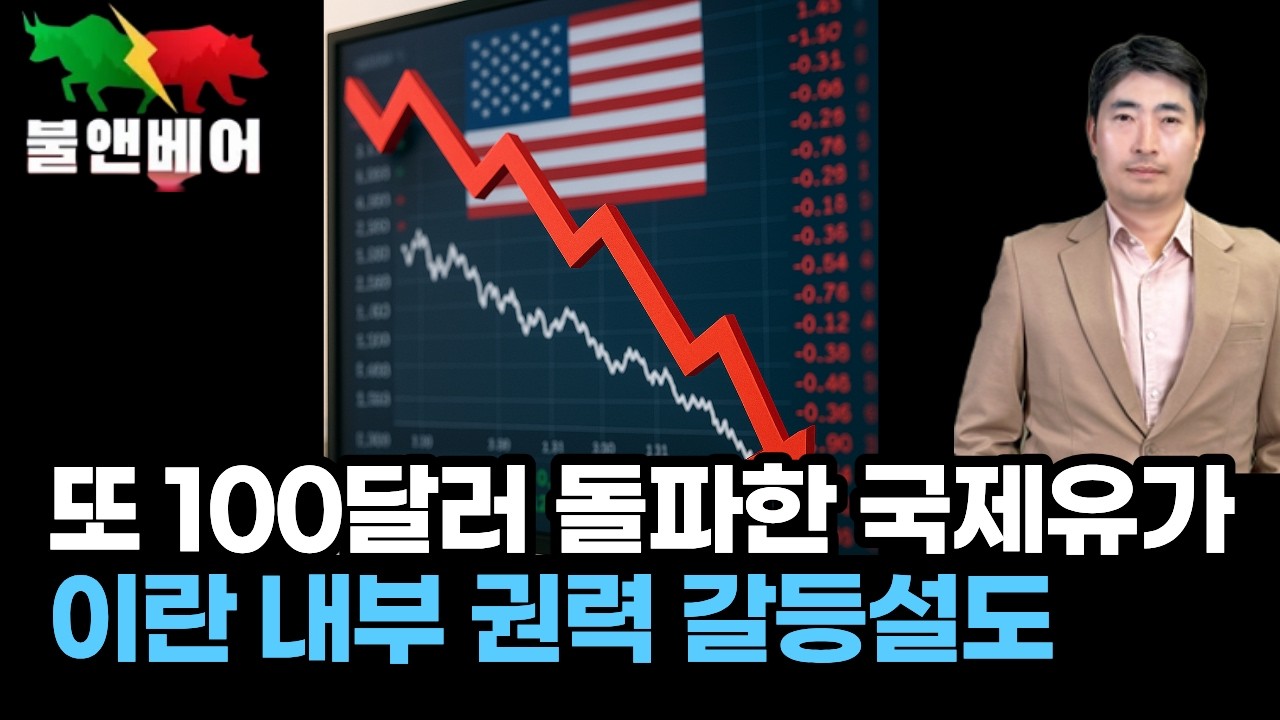
By contrast, WTI moving above USD 100 and reaching ~USD 102 warrants closer attention. Equities can remain in a wait-and-see posture; energy prices transmit rapidly into the real economy.
2. Why Crude Oil Is the Central Variable
The most market-sensitive variable in this situation is crude oil. If the conflict intensifies, the first pressure point is the oil transport corridor—centered on the Strait of Hormuz.
2-1. Why the Strait of Hormuz Matters
The Hormuz Strait is a critical artery for global seaborne oil flows. Even partial restrictions can elevate supply concerns and drive rapid oil price increases. In practice, transit risk is often more directly reflected in prices than battlefield developments.
2-2. Why Iran’s Demands Are Difficult to Accept
The text notes Iran rejected a 15-point US proposal and presented a 5-point counterproposal, including:
- Cessation of US and Israeli attacks
- A mechanism to guarantee prevention of war
- Compensation for war damage
- Cessation of attacks on Iran-aligned groups in Lebanon and Iraq
- International recognition of Iranian sovereignty over the Strait of Hormuz
The last item is the most sensitive. Recognizing Iranian sovereignty over Hormuz is effectively a claim to control a global energy chokepoint—difficult for the US and Gulf states to accept.
2-3. Why Regional States Also Reject Iran’s Position
The situation is not strictly a “US vs. Iran” framework. The text cites UAE-linked commentary characterizing Iranian attempts to control Hormuz as akin to global coercion. It also references Gulf states and Jordan taking a lead role in condemnation initiatives. The issue is increasingly framed as who governs the rules of energy transport, not only regional rivalries.
3. Diverging Incentives: US De-escalation vs. Israeli Escalation
A key interpretation is that US and Israeli interests may not be fully aligned. The text suggests Trump has reduced hawkish rhetoric and appears to be creating distance from deeper involvement, while Israel may seek to extend pressure given perceived military advantage.
3-1. Why the US May Prefer to Avoid Escalation
A prolonged Middle East conflict increases US political and economic costs:
- Direct war expenditures
- Higher oil prices
- Added inflation pressure
- Potential deterioration in public sentiment
With the US economy balancing rates, inflation, and slowing consumption, a sustained oil shock is particularly adverse. This links foreign policy to domestic macro conditions and elections.
3-2. US Midterms and Shifting Political Pricing
The text references Polymarket odds rising for Democratic control of Congress. This can be interpreted as market pricing for potential weakening of Trump’s political leverage. If risk persists, fatigue may rise and higher fuel-driven inflation could pressure centrist support. Markets tend to focus on election dynamics through the lens of household purchasing power.
4. Iran Is Not Monolithic: Friction Between the President and the IRGC
The text highlights internal Iranian power tensions. Public messaging remains hardline, but internal conflict appears to be intensifying between economic constraints and security-first doctrine.
4-1. Differing Views: Pragmatists vs. Hardliners
President Pezeshkian is characterized as relatively pragmatic, viewing sustained escalation as economically damaging. The IRGC commander’s camp is described as more hardline, prioritizing regime security and deterrence, and criticizing the government’s reform failures.
4-2. Where Effective Power Sits
The key point is that influence appears tilted toward the IRGC rather than the formal government. This increases the probability that military logic dominates over economic compromise—an unfavorable market scenario because it can prolong oil and supply-chain risk.
5. Why Tehran Blackouts Matter: Not Merely a Power Issue
The report notes power outages in Tehran and surrounding areas. The text raises the possibility of strikes on critical power infrastructure, which would be symbolically and operationally significant.
5-1. Power-Grid Disruption and Regime Stability
Power systems are strategic infrastructure. Large-scale outages can disrupt:
- Industrial output
- Communications
- Payments and settlement
- Household consumption
- Hospital operations
If sustained, outages can accelerate public discontent. With internal political frictions already present, blackouts can become a catalyst for instability.
5-2. Why Power Infrastructure Is More Critical in the AI Era
Power grids are now core to the digital economy. Data centers, cloud services, AI training/inference, semiconductor fabrication, and smart manufacturing all depend on stable electricity. A Middle East energy shock can raise global power and cooling costs, as well as logistics costs—directly affecting the unit economics of AI infrastructure investment. Geopolitical risk increasingly impacts AI cost structure, not only oil.
6. Key Scenarios to Monitor
6-1. Scenario 1: Controlled, Limited Conflict (Base Case)
The most plausible base case is ongoing rhetoric and limited engagements while avoiding full-scale war. Oil remains elevated, and financial markets can partially adapt. However, renewed inflation pressure may reduce rate-cut expectations.
6-2. Scenario 2: Expanded Hormuz Transit Disruption (Highest Risk)
This is the most destabilizing scenario. Even partial disruptions—ship detentions, passage restrictions, insurance-cost spikes, or shipping delays—can trigger broad repricing, including:
- Sharp oil increases
- Re-acceleration of inflation
- Higher aviation and shipping costs
- Margin compression in manufacturing
6-3. Scenario 3: Intensifying Internal Iranian Fractures
Accumulated blackouts and economic stress could widen internal rifts. This does not necessarily imply de-escalation; it can also incentivize external hardline actions to reinforce internal cohesion.
7. Investor Implications
7-1. Sector Effects: Near-Term Energy/Defense; Medium-Term Inflation Path
In this regime, relative strength may appear in energy, defense, shipping, and commodities. Sectors with high fuel and transport cost exposure—airlines, consumer, and logistics-intensive industries—may face pressure.
7-2. The Link Between Oil, Rates, and Equities
If elevated oil persists, expectations for central-bank easing can deteriorate. The episode becomes a rates/inflation/valuation issue for US equities. Growth equities, including the Nasdaq complex, may be more sensitive to oil-driven rate repricing than to headlines.
7-3. Bitcoin: Liquidity Asset, Not a Traditional Safe Haven
The presence of Bitcoin in the topic set should not be interpreted as a safe-haven bid. In risk regimes like this, Bitcoin often trades as a liquidity- and sentiment-sensitive asset, influenced by USD direction and policy expectations. Monitoring how oil affects Fed pricing and the dollar is more relevant than assuming geopolitical-driven upside.
8. News-Style Key Points
First, US futures opened weaker, but volatility repricing was limited.
Markets are not fully discounting a full-scale war scenario.
Second, WTI above USD 100 is the most direct market shock.
Oil affects inflation, rates, consumption, and corporate earnings.
Third, Iran’s Hormuz-related demand is difficult for both the US and regional states to accept.
This reduces the likelihood of a quick settlement.
Fourth, US and Israeli incentives may diverge.
The US faces political constraints on escalation; Israel may prefer sustained pressure.
Fifth, internal Iranian differences between the presidency and the IRGC are increasingly visible.
Effective power appears closer to hardline institutions.
Sixth, Tehran’s blackout can be interpreted as an infrastructure and stability signal.
This matters for energy markets and for AI-era power dependency.
9. The Most Underemphasized Point in Broader Media
The critical issue is not “whether a war begins,” but whether higher energy prices can reverse the global disinflation trajectory. Markets ultimately move on measurable variables. If WTI remains above USD 100:
- Fed rate-cut expectations may be pushed out
- US equity valuation sensitivity may increase
- Manufacturing and consumption can be pressured simultaneously
This is not only a Middle East event; it can require revisions to global macro and AI investment assumptions, because AI competitiveness depends on power, cooling, semiconductor supply chains, and data-center operating costs.
10. Indicators to Track
1) Evidence of Hormuz transit disruption
2) Whether oil stabilizes above USD 100
3) US midterm polling and Trump approval dynamics
4) Escalation of internal Iranian power conflict
5) Whether Tehran blackouts are isolated or the start of broader infrastructure pressure
The current setup resembles a classic escalation game where near-term headlines are less informative than the linkage across oil, maritime logistics, political calendars, power infrastructure, and market rates.
< Summary >
The Iran situation is a multi-factor risk spanning oil prices, Hormuz Strait logistics, US midterm politics, internal Iranian power competition, and Tehran blackouts. Financial markets are reacting more to oil than to equities; WTI above USD 100 is the key variable that can re-accelerate inflation and alter the rates path. US political incentives appear to favor de-escalation, while Israel may sustain pressure; Iran’s internal divisions are visible, but effective power appears concentrated among hardliners. Tehran’s blackout is a potential infrastructure and stability signal with implications extending to AI-era data centers and semiconductor cost structures. The core risk is not the conflict headline itself, but the extent to which energy prices reshape global macro expectations and AI infrastructure economics.
[Related Posts…]
- US Rate Outlook and Global Asset-Market Dynamics: https://NextGenInsight.net?s=rate
- AI Infrastructure Investment and Semiconductor Market Restructuring: https://NextGenInsight.net?s=AI
*Source: [ Maeil Business Newspaper ]
– [홍장원의 불앤베어] 끝나지 않는 이란 사태.. 테헤란 정전 소식도