● Starlink Mega-Shift
SpaceX “6th in market cap” shock… the real core takeaway wasn’t the rocket, it was “satellite communications + 6G + physical AI”
One-line summary of today’s news
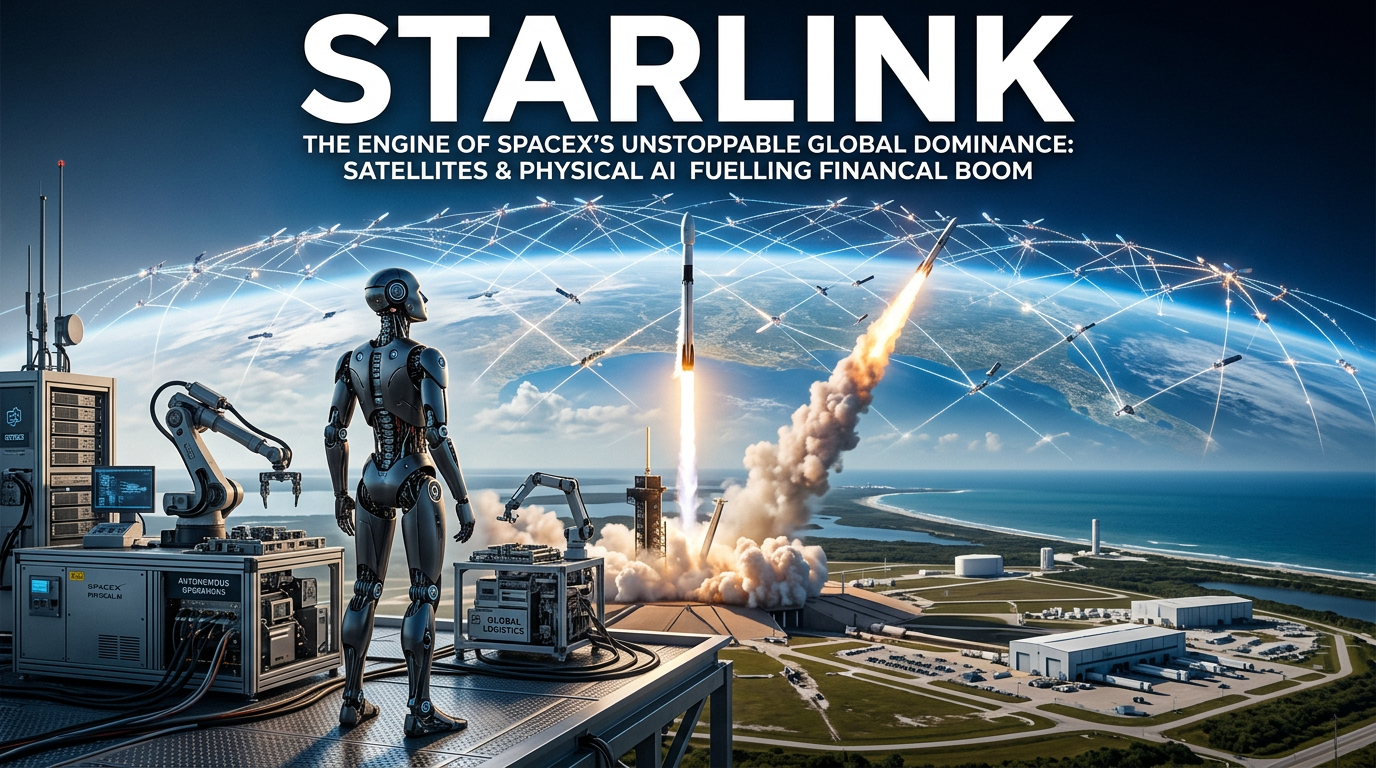
A recent analysis suggests that SpaceX is not just a rocket company; its corporate value is being re-evaluated through global communication infrastructure based on Starlink (in effect, the core infrastructure of the so-called 6G era).
And in this flow, a scenario was presented where Starship commercialization creates a virtuous cycle of “sharp drop in launch costs → mass deployment of satellites → improved communication quality,” ultimately connecting to physical AI as the key takeaway.
“5 points” readers should definitely remember
- What determines SpaceX’s value is not the rocket, but the overwhelming share of Starlink (satellite internet)
- Starlink makes up most of revenue, has high margins, and very strong growth
- Rocket reuse (lower launch cost versus competitors) is creating the foundation for “expanding communication infrastructure”
- If Starship becomes commercialized, a structure can be completed that enables sending more satellites, more cheaply, to raise communication quality
- The vertical integration scenario that connects Tesla, autonomous driving, robotics, and XAI is boosting market expectations
[1] The “rocket company” framing is now outdated… closer to a communications infrastructure company
The starting point of the original analysis is quite clear.
Unlike its name, SpaceX’s essence isn’t the rocket launches themselves, but
a global internet infrastructure that covers global communications demand with satellites.
The reason this detail is especially important is that the “growth and moat” the market sees is completely different from the rocket business.
- Rocket: strong one-off (or project-based) revenue characteristics
- Starlink: recurring revenue characteristics + possible network effects (more users → better quality → reinvestment)
- As a result, the moat can be made sturdier than with rockets
In this article, Starlink is described as communication infrastructure that leads 6G, explaining its moat as an “advantage competitive edge.”
[2] Starlink makes up most of enterprise value… the key basis is the revenue structure
The content repeatedly emphasized in the original piece is the “valuation basis.”
- Starlink revenue share: mentioned as roughly 70% of total revenue
- 2025 revenue scale: presented at about $8 billion
- Margins: described as above 50%
- Growth: assumes a growth rate around 50% per year
Here, the important part is the market logic that “satellite internet has few substitutes.”
There’s also a realistic point to consider.
In Korea, due to geographic and infrastructure characteristics, satellite internet demand may not explode right away, but
globally,
- aircraft/ships
- remote areas and disaster regions
- drones and remote industries
- future 6G-based autonomous driving/ultra-connected services
In these areas, once Starlink is in place, it creates a structure where “the number of use cases keeps increasing.”
The original text states outright that “Starlink is essentially the core of SpaceX’s business.”
[3] The competitive edge in technology is rocket reuse… the “cost gap” acts as a moat
SpaceX’s rocket competitiveness comes from “reuse.”
The gist of the original piece is this.
- Competitors: rockets have a relatively one-time nature
- SpaceX: boosters reused up to 32 times, with an average around 20 times mentioned
- Result: the launch cost per kg has reportedly dropped to about $2,700
- Expressed as roughly a 1/10 gap versus competitors
And this is why it connects to the communications-company logic:
If launch costs fall, more satellites can be deployed;
as satellites increase, service quality rises (including lower latency, etc.);
as users grow, revenue increases, enabling reinvestment again—creating a virtuous cycle.
In other words, the moat of “communications infrastructure” is formed from the “launch infrastructure cost structure.”
[4] Starship commercialization: observations suggest a “cost inflection point” could arrive
The original text describes Starship like this:
- Falcon lineup: satellite payload is relatively limited (around 20–40 satellites mentioned)
- Starship: payload could be much larger (200–400 satellites mentioned), making mass deployment possible
- Goal: a significant drop in launch cost per kg
- Final goal: a scenario where costs fall below $100
The “inflection point” mentioned here doesn’t mean costs simply dip a little;
it’s closer to the idea that launch costs could break structurally, allowing the satellite deployment strategy to change completely.
Then the era of sending something into space as if by an expensive parcel service ends,
and communications/sensor/data infrastructure can be built on a far larger scale.
[5] Why launch so many satellites… “latency” and “real-time capability” are game changers
The core effect of satellites emphasized in the original piece is “internet latency.”
- Current reference: operated in low Earth orbit (roughly 550 km altitude mentioned)
- Latency: becomes much shorter than existing satellites, referencing game-level quality
- Result: internet coverage becomes possible anywhere on Earth
This isn’t just convenience; it ultimately connects to “real-time communications” required by field AI/robots/autonomous driving.
In Korea, people may feel it less, but
given that there are many terrain and communications blind spots around the world, the explanation is that market potential could expand.
[6] The combination with Tesla: the synergy of “rocket + satellites + communications + autonomous driving” is terrifying
One of the most striking links from the original piece is this section.
Starlink antenna modules are built into Tesla vehicles,
- and then vehicles worldwide connect to the satellite network
- and if communication quality improves,
- autonomous driving/vehicle data processing/services can develop more reliably
Beyond that,
- as more satellites are added, communication quality improves
- user base increases → cash flow grows
- investing that cash back into launches/satellite expansion again
- then the virtuous cycle repeats
This “vertical integration” picture is presented as a reason why market expectations are growing.
The article also says you can feel a direction of trying to secure the future technology ecosystem by placing even Optimus (robotics) and XAI on the same track.
[7] Is the final goal a space data center?… next is “physical AI”
The original text explains two branches of Elon Musk’s vision’s big axes.
1) Space data center (a picture of running AI/computing in space)
- generate power with solar panels
- in space, since radiative heat dissipation matters more than convection/conduction, use heat sinks
- ideas like moving graphics cards and heat sinks appear
2) Physical AI (AI that moves in the real world)
- for autonomous driving, drones, robots, etc., communication loss can lead to accidents/risks
- but if satellites become dense, you can reduce risks like “communication loss for 1 second”
- once 6G is completed, physical AI can communicate anywhere without latency, as a foundation
The conclusion of this article is an interpretation that it can be seen as a motivation even more closely aligned with physical AI than “Mars.”
[8] Valuation debate: PSR 60x… but here’s why the market could still be persuaded
The numbers directly mentioned in the original piece are fairly aggressive.
- 2026 revenue-based PSR: described as 60x
- criticism that this kind of valuation is not common
- as a comparison example, it references multiples of other growth stocks / big-tech-level companies
- ultimately, an argument that “extraordinary growth” and a “scenario narrative (technology + market expansion)” can support the valuation
There’s also a calculation suggesting that XAI (original expression: XAI) could become a separate value axis.
- XAI’s value alone could be substantial
- and with the IPO market mood (investment sentiment) added, the tone suggests that an evaluation like $1.5 trillion “isn’t completely impossible”
However, at the same time, the original piece emphasizes risks too.
- profitability of a space data center is still a question mark
- feasibility must be guaranteed
- be cautious about overly premature expectations
This balanced wording may be more important for readers’ real-world perspective.
[9] Additional technical variable: mass production of inter-satellite laser communication (inter-satellite)
There’s a part in the original text that is described technically as “sickening.”
- inter-satellite laser communication that communicates with lasers between satellites
- an explanation that mass production lowers unit costs, lowering the cost barrier
- an observation that optical-communication infrastructure became real through the combination of plug-and-play + lasers
The reason this matters is that
Starlink becomes the foundation for increasing efficiency not with a “ground-to-satellite” focus, but with the “satellite network itself.”
As a result, it connects to the technology elements that support the current logic of Starlink’s performance and scalability.
Main content to convey (reinterpreted from my perspective)
The most important conclusion is this.
SpaceX’s investment point is not
its ability to launch something into space, but
its ability to create the conditions that “physical-world AI” needs through satellite internet (6G-class communication infrastructure).
And those conditions ultimately depend on
- whether launch costs fall structurally
- whether satellites can be mass deployed
- whether latency and quality rise to levels that are perceptibly significant
- whether an ecosystem that extends to Tesla/robotics/XAI gets tied together
It all comes down to that.
So this article centers the valuation debate on a bigger picture that extends beyond “SpaceX = rocket,”
into a model of communications infrastructure + physical AI infrastructure.
< Summary >
- SpaceX is being re-evaluated not as a rocket company, but as a Starlink-based global communications infrastructure company
- Starlink is presented as accounting for most revenue, with high margins and fast growth (around 50% annually)
- With launch costs lowered through rocket reuse, mass satellite deployment becomes possible via a virtuous cycle
- Starship commercialization could lead to higher satellite payloads → sharp drops in launch costs → improved communication quality
- The market expectations are boosted by a vertical integration scenario connecting Tesla (vehicle integration), autonomous driving, robotics, and XAI
- The final picture appears in an interpretation that it’s closer to physical AI than to a space data center
- While valuation (about 60x PSR) is expensive, the perspective is presented that growth/technology/scenario could justify it, along with an emphasis on caution
- Mass production of inter-satellite laser communication is presented as a technical variable supporting the current logic of Starlink expansion
[Please provide related articles…]
*Source: [ 월텍남 – 월스트리트 테크남 ]
– 스페이스 X, 세계 시총 순위 6위 “충격”