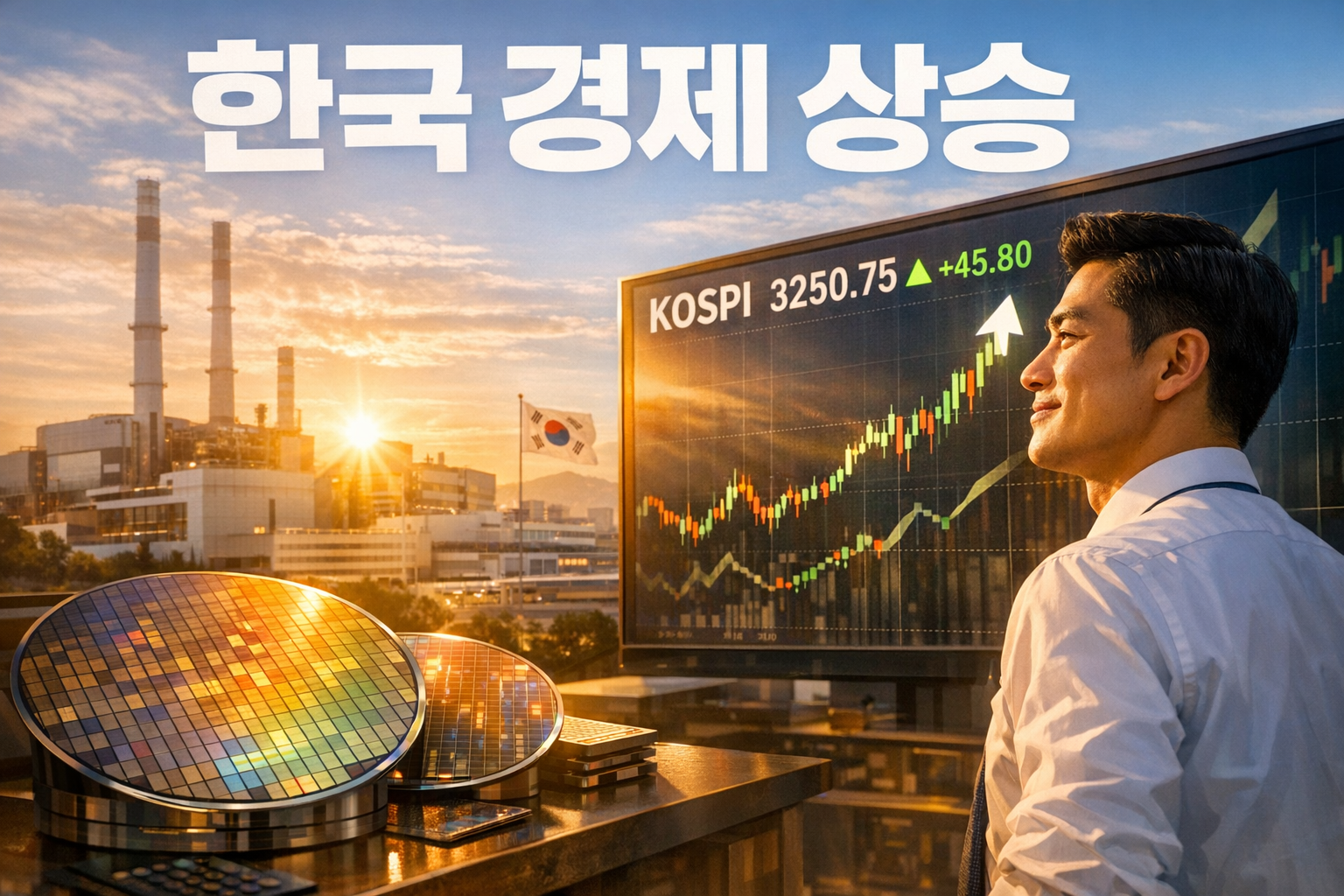
● US-China War, Korea Wins
Why a US-Led Hegemonic Conflict Can Be an Opportunity for Korean Equities
Key Investment Themes Across Korean Manufacturing, AI, Defense, and Energy
If markets are interpreted only through rates, FX, and inflation, positioning tends to lag. A more durable framework is the US-China strategic rivalry and its implications for supply-chain restructuring over the next 10–30 years. This report consolidates the structural rationale for Korea’s role as a critical manufacturing partner to the US and outlines long-duration themes across semiconductors, defense, shipbuilding, nuclear, power equipment, solar, and robotics.
1. What is actually driving markets now
Investors monitor policy rates, FX, crude oil, and inflation. These are important outcomes, but the primary driver is the underlying force shaping those outcomes: a sustained US-China hegemonic rivalry.
The prior regime prioritized globalization and cost efficiency. The current regime prioritizes security, supply-chain resilience, manufacturing capacity, and control of strategic assets. The key question has shifted from “who can produce cheapest” to “who can produce reliably under stress.”
2. Four pillars of the new Cold War: the structural market framework
The investment environment can be organized into four interconnected pillars:
- Arms buildup
- Technology competition
- Energy competition
- Currency conflict and/or digital-asset competition
2-1. Arms buildup: why defense is not a short-lived theme
The Russia-Ukraine war, Middle East instability, and cross-strait tensions are interpreted as signals of a persistent global rearmament cycle. Defense has shifted from a “war-driven trade” to an element of national infrastructure, with budgets rising and emphasis increasing on rapid production, replenishment, and self-reliance.
2-2. Technology competition: AI and semiconductors as strategic power
AI and semiconductors should be assessed not only as innovation cycles but as strategic assets. AI scaling requires massive compute, and industrial execution depends on high-volume manufacturing and relief of bottlenecks such as high-bandwidth memory (HBM).
Korea’s advantages are concentrated in:
- HBM
- Memory semiconductors
- Advanced manufacturing execution
2-3. Energy competition: AI depends on electricity
AI-driven data-center expansion materially increases power demand. Energy becomes enabling infrastructure for technology leadership.
Key sub-themes include:
- Nuclear power
- SMRs
- Extra-high-voltage grids
- Transformers and power equipment
- Solar supply chains
- LNG transport and shipbuilding
This implies AI tailwinds extend beyond chips to power infrastructure and energy systems.
2-4. Currency conflict: digital assets and changing monetary architecture
Digital assets and evolving payment/settlement rails are treated as part of broader power competition, linked to reserve-currency influence, cross-border capital movement, and digital financial infrastructure. Volatility remains high; medium- to long-term relevance is framed as structural rather than price-driven.
3. Why the rivalry is unlikely to end quickly
The US-Soviet Cold War lasted approximately 46 years (1945–1991). The current US-China rivalry is framed as similarly structural rather than cyclical, driven by:
- Competition for technological standards and industrial leadership
- Supply-chain control and manufacturing dominance
- National-security constraints that limit compromise
A prolonged contest increases the probability of sustained beneficiaries positioned between the blocs.
4. Why Korea can be the US “missing piece”
The central thesis is that the US has strong capabilities in design, finance, branding, and services, but weakened domestic manufacturing capacity after decades of offshoring. As the US attempts to reduce strategic dependence on China, it requires alternative manufacturing partners.
4-1. The current state of US manufacturing
US manufacturing is cited near ~9% of GDP, with semiconductor production share materially below historical levels and shipbuilding capacity described as negligible. A binding constraint is skilled labor: building plants is capital-intensive but feasible; restoring industrial ecosystems and operational expertise is slow.
4-2. Why the US needs a China substitute
The US is pursuing supply-chain reconfiguration through friend-shoring, reshoring, and nearshoring. The required partner set is constrained by:
- Advanced manufacturing capability
- Speed of execution and scaling
- Quality and reliability
- Security alignment with the US
- Broad industrial coverage sufficient to offset China exposure
Korea is positioned as a credible candidate under these constraints.
5. Why Korea: comparative positioning versus Taiwan, Japan, and Europe
5-1. Taiwan
Taiwan is dominant in foundry manufacturing but has a narrower industrial breadth relative to Korea’s multi-layer manufacturing stack (defense, shipbuilding, batteries, nuclear, power equipment). Geopolitical risk also limits concentrated reliance.
5-2. Japan
Japan retains strength in materials, components, and equipment, but is assessed as less aggressive in visibility and breadth across forward-growth strategic industries.
5-3. Europe
Europe (notably Germany) remains a manufacturing base but faces challenges from higher energy costs, China exposure, and slower defense production ramp. The issue is not capability, but speed.
5-4. Korea’s differentiation
Korea maintains an unusually broad set of strategic manufacturing capabilities aligned with US priorities:
- Semiconductors
- Shipbuilding
- Defense
- Nuclear power
- Power equipment
- Batteries
- Robotics
- Aerospace-related manufacturing
Korean corporates have also been tested in high-intensity competition with China, reinforcing execution credibility on cost, quality, delivery, and technical responsiveness.
6. Korean sectors with long-duration relevance
6-1. Semiconductors: the critical bottleneck in the AI era
AI scaling increases semiconductor demand, with memory and HBM identified as key bottlenecks. The industry is framed as shifting from “produce-then-sell” cyclicality toward pre-committed demand and capacity scarcity, where manufacturing capacity is a strategic asset. This raises the probability of valuation reassessment for leading Korean players.
6-2. Shipbuilding: beneficiary of US energy strategy and naval capacity gaps
US shipbuilding capacity is constrained, with gaps in maintenance/repair and commercial construction. Concurrently, LNG export ambitions imply sustained demand for LNG carriers. Korea remains competitive in high-value vessels, LNG carriers, specialized ships, and defense-adjacent shipbuilding.
6-3. Defense: speed and cost-performance in a sustained rearmament cycle
Defense demand is supported by resupply constraints in Europe, rising air-defense and strike-system needs in parts of the Middle East, reduced confidence in Russian/Chinese systems, and procurement constraints on certain suppliers. Korea’s cited advantages include:
- Fast delivery
- Field-validated performance
- Competitive cost-effectiveness
- High trust for allied procurement
This supports the view of potential share gains as global defense sourcing reallocates.
6-4. Nuclear and SMRs: practical baseload solutions amid power demand growth
Rising data-center load increases the value of stable baseload generation. Renewables alone may be insufficient near-term, reinforcing nuclear relevance. Korea’s advantages include build experience, schedule discipline, cost competitiveness, and operational stability. US execution constraints can expand partnership opportunities.
6-5. Power equipment and grids: the underappreciated core of AI enablement
Data-center expansion is limited by grid capacity and equipment availability. Medium-term beneficiaries include:
- Transformers
- Extra-high-voltage cables
- Grid control and power-management equipment
- Transmission and distribution capex exposure
This is framed as infrastructure-driven demand rather than a typical cycle trade.
6-6. Solar: potential cracks in China’s dominance
China has led solar via price advantage. Supply-chain security and policy-driven exclusion mechanisms could alter competitive dynamics, potentially reopening opportunity for non-China supply chains under a reconfigured regime.
7. Investment strategy: prioritize structure over short-term trading
Even correct sector selection can fail under momentum-driven behavior:
- Buying after sharp rallies
- Selling into drawdowns
- Rotating across sectors based on headlines
- Overreacting to short-term news flow
A structural allocation framework is emphasized over theme-chasing, particularly for long-horizon accounts. Sector-level conclusions still require issuer-level differentiation.
8. Why a KOSPI-wide approach may be insufficient
Korean market exposure is not equivalent to exposure to strategic manufacturing beneficiaries. The index includes financials, telecom, and domestic consumption sectors that may be less directly linked to US supply-chain restructuring. The key risk-adjusted opportunity is framed as selective exposure to Korea-based strategic manufacturing tied to global reindustrialization and AI infrastructure.
9. Key points (news-style)
9-1. Macro
The US-China rivalry is treated as a long-duration structural shift. Arms, technology, energy, and currency/digital-asset competition are advancing in parallel.
9-2. US transition
The US retains strength in design and finance but faces manufacturing constraints; reducing China dependence requires alternative partners.
9-3. Korea’s positioning
Korea has breadth across semiconductors, shipbuilding, defense, nuclear, and power equipment, supporting relevance within US-led supply-chain reconfiguration.
9-4. Beneficiary sectors
- Semiconductors: AI-era bottleneck relief
- Shipbuilding: LNG expansion and defense-adjacent gaps
- Defense: sustained rearmament demand
- Nuclear and power equipment: power-infrastructure capex cycle
9-5. Investment implications
A medium- to long-term framework is preferred over short-term thematic trading; selective concentration in strategic sectors can be more effective than broad diversification by default.
10. The most important point often missed
The core constraint is time, not funding. Industrial ecosystems—skilled labor, supplier networks, production know-how, delivery management, and quality systems—cannot be rebuilt quickly. This creates a window in which Korean firms can function as strategic partners rather than incremental subcontractors.
This is positioned not only as a potential export uplift but as a possible catalyst for partial reduction in the “Korea discount” if Korea’s role in global supply chains is re-rated.
AI beneficiaries are also framed broadly: capital flows extend beyond software into electricity, chips, equipment, plants, logistics, defense, and shipbuilding. AI scales on physical infrastructure and security.
11. Additional investment framing
The market may be entering a regime where manufacturing capability itself commands a premium alongside software/platform economics. Korea’s “capacity to build” can be revalued over a multi-year horizon.
Risks and constraints:
- Elevated volatility after rapid price appreciation
- Wide dispersion in fundamentals across companies within the same sector
- Policy changes and order-cycle timing must be monitored
- Long-term theses can diverge materially from near-term pricing
A structurally informed, diversified implementation may be more robust than short-term thematic positioning.
12. Conclusion
The environment is not a binary “US up, Korea down” regime. If US strategic investment accelerates, Korean strategic manufacturers that enable the US supply-chain transition can benefit.
The central connected drivers are:
- US-China rivalry
- Supply-chain restructuring
- AI infrastructure buildout
- Rising defense demand
- Grid and power-infrastructure capex
These are treated as one linked system rather than separate themes. Korea’s strategic manufacturing breadth places it near the center of this system, supporting a durable framework for Korean equity selection beyond day-to-day macro indicators.
< Summary >
The US-China rivalry is a long-duration structural shift. The key pillars are arms, technology, energy, and currency/digital-asset competition. The US faces manufacturing constraints and requires non-China partners. Korea holds broad strategic manufacturing capabilities across semiconductors, shipbuilding, defense, nuclear, and power equipment. This positioning can align with US supply-chain restructuring and AI infrastructure expansion, supporting a medium- to long-term investment framework.
[Related Articles…]
AI infrastructure buildout beneficiaries: semiconductors and power equipment
https://NextGenInsight.net?s=AI
Defense supercycle: long-term outlook for Korean defense equities
https://NextGenInsight.net?s=Defense
*Source: [ 소수몽키 ]
– 미국발 패권전쟁으로 오히려 한국은 절호의 기회? 장기로 주목 받을 주식들┃최영진 한화자산운용 부사장
● Villa Supply Collapse, Apartment Floor Rising
Focus on Apartment Price Stabilization Rather Than Housing Security: The Real Aftermath of the Villa Supply Collapse in Korea’s Real Estate Market
This is not a niche issue limited to the villa segment. It affects:
- Why the downside floor for Seoul apartment prices can be influenced by villa supply
- Why post-jeonse-fraud aversion to villas is worsening conditions for renters and non-homeowners
- Why more redevelopment and reconstruction can remove the “housing ladder” for middle- and lower-income households
- Why current real estate policy is tilted toward apartment price management rather than broad housing stability
Key points often missed in mainstream coverage:
- The paradox that a collapse in villa supply can limit declines in apartment prices
- Rising housing costs extend the time required for wealth accumulation among young households, newlyweds, and low-income renter households
1. One-sentence summary
Korea’s housing problem is no longer confined to apartments: collapsing villa supply is breaking the housing ladder and simultaneously destabilizing the apartment market, rental market, jeonse market, monthly rent burdens, and the path to homeownership for non-owners.
2. News-style key takeaways
2-1. Policy and market attention is concentrated on apartment price stability
- Policy focus disproportionately tracks apartment preferences.
- Housing stability is not equivalent to stabilizing apartment prices.
- The most exposed groups are renter households (jeonse/monthly), not high-priced apartment buyers waiting to enter.
2-2. Rapid loss of confidence in the villa market after jeonse fraud
- Multi-year jeonse fraud shocks materially damaged villa perceptions.
- Buyer demand declined; jeonse demand also weakened.
- Developers face simultaneous blockage in presales and capital recycling.
2-3. New villa supply has effectively stalled
- Many villa projects rely on a combined presale + jeonse deposit cash-flow model.
- With jeonse demand drying up and construction costs rising, feasibility deteriorates.
- In parts of the Seoul metro area, new villa starts have dropped sharply.
2-4. Redevelopment and reconstruction are reducing existing villa stock
- While positive for branded apartment supply, many projects replace multi-family low-rise stock with higher-priced apartments.
- The mid-tier housing product is being removed from the market.
2-5. Geopolitical risk and raw material inflation intensify supply contraction
- Middle East conflict risk can lift energy, materials, and logistics costs.
- Higher costs hit low-margin, small-scale projects first (villas, small renewal projects).
- External shocks can accelerate an already fragile supply structure.
3. Why villa supply matters: the housing ladder
3-1. Most households cannot enter apartments as a first step
- Early-career workers, one-person households, newlyweds, and lower-income households typically transition through multiple housing types before apartments.
3-2. Villas function as a critical “bridge” product
- More stable than boarding rooms or studios, with a lower entry barrier than apartments.
- If the bridge disappears, households are pushed into more distant or lower-quality options.
3-3. Erosion of job access and education access
- Reduced villa supply compresses affordable options near jobs and schools.
- Households are pushed to outer suburbs, increasing commuting time and cost.
- This reduces disposable income and can impair productivity and quality of life.
4. Core paradox: villa supply collapse can raise the downside floor for apartment prices
4-1. Apartments and villas are connected markets
- They act as substitutes within the same living area.
4-2. Villa pricing can serve as an effective floor for apartment pricing
- Example: apartments at KRW 1.0bn and nearby villas at KRW 0.5bn.
- If apartments fall to the villa price level, demand shifts strongly toward apartments.
- This creates structural resistance to apartments trading below villa levels for extended periods.
4-3. If villa supply contracts, villa prices can remain firm
- Essential demand persists for the segment.
- With fewer new units and shrinking existing stock, remaining units face concentrated demand.
- Villa prices or rents may fall less than expected or rise.
4-4. Apartment downside becomes more constrained
- If villa prices hold or rise, the apartment price floor effectively shifts upward.
- This does not stabilize housing affordability; it can mechanically limit apartment price declines.
5. Why this is more damaging for renters and non-homeowners
5-1. Weak resale confidence suppresses jeonse demand
- When sale liquidity and price confidence deteriorate, jeonse is avoided due to deposit recovery risk.
5-2. Demand shifts toward monthly rent
- Monthly rent implies higher recurring cash outflows than jeonse.
- This reduces savings capacity.
5-3. Time to homeownership extends
- A common pathway was: lower-cost purchase or lower-cost tenure while accumulating down payment capital.
- With both villa transactions and jeonse perceived as risky, households face higher monthly rent burdens and slower capital formation.
5-4. Apartment price management can conflict with housing stability
- Focusing on apartment price optics can increase monthly rent pressure and shrink options for the most vulnerable groups.
6. Why the market alone is unlikely to resolve the distortion
6-1. Local governments have incentives to favor branded apartment outcomes
- Political incentives reward “premium city” and “branded apartment” narratives.
- Expanding low- to mid-cost rental safety nets has weaker political appeal.
6-2. Low-rise villa districts are naturally converted into higher-priced apartments
- This reduces the stock of affordable units.
6-3. Structural bias likely persists without central-government intervention
- Requires review of: central-local governance, public rental supply mechanisms, and incentive design within renewal projects.
7. Plausible market scenarios
7-1. Decline in low-cost housing options within Seoul
- New supply contraction plus removal of existing stock reduces affordable choices.
7-2. Accelerating out-migration to outer metro areas
- Young households and lower-income groups may be pushed outward.
- Similar “apartmentization” dynamics may later replicate in outer regions.
7-3. Rising monthly rent pressures
- Jeonse avoidance + villa supply contraction increases monthly-rent demand and pricing pressure.
- This raises effective housing inflation.
7-4. Construction cost inflation hits small-unit supply first
- Materials and labor inflation are more damaging to low-margin small-unit supply than to large projects.
- Supply contraction is asymmetric against housing types used by vulnerable groups.
7-5. Broader macroeconomic drag
- Higher housing costs reduce consumption capacity.
- Longer commutes reduce productivity.
- Delayed marriage/childbirth and reduced labor mobility may follow.
8. Policy priorities
8-1. Reset policy objectives from “price” to “housing stability”
- Start from identifying which groups face the greatest housing insecurity.
8-2. Restore institutional trust in villas and low-rise multi-family housing
- Strengthen anti-fraud controls, title transparency, appraisal/price verification, and guarantee frameworks.
- Without trust restoration, both demand and supply remain impaired.
8-3. Expand renter-centered measures
- Increase stable rental supply and rent-buffer mechanisms for households unlikely to buy in the near term.
8-4. Preserve or replace mid- to low-priced stock during redevelopment/reconstruction
- Integrate affordability preservation into renewal design, not only headline apartment supply counts.
8-5. Incorporate macro variables: rates, inflation, geopolitics
- Market outcomes depend on interest-rate paths, inflation, energy prices, conflict risk, and construction cost dynamics.
9. Most important points often omitted in mainstream coverage
9-1. Villas are not merely “unpopular housing”; they influence the apartment downside floor
- Villa supply conditions can shape how far apartment prices can fall.
9-2. Higher costs for housing-vulnerable groups increase wealth inequality
- Higher monthly rent slows down-payment accumulation and widens asset gaps.
9-3. More redevelopment can increase total units while reducing “affordable” units
- Supply expansion in aggregate can coincide with a decline in accessible price segments.
9-4. Jeonse fraud prevention and villa market normalization must be designed together
- Narrow fraud-only responses can suppress legitimate transactions and rental supply, increasing instability.
9-5. Spillover extends to urban structure and labor markets
- Reduced job proximity and higher settling costs can affect labor mobility, consumption, fertility decisions, and regional economic activity.
10. Investor and asset-allocation implications
10-1. Apartment-only frameworks are increasingly incomplete
- Requires monitoring of non-apartment markets, rental shifts, rate policy, and supply cost structures.
10-2. End-users should evaluate total cost of occupancy
- Even if purchase prices soften, higher rent, interest expense, and commuting costs can raise the real burden.
10-3. Scarcity premium risk in habitable mid-priced stock
- With shrinking supply of accessible price tiers, certain well-located small-format units may be re-rated.
10-4. Link real estate views to macro pathways
- Emphasize rate trajectories, inflation, geopolitics, commodity inputs, and household debt constraints over short-term price moves.
11. Conclusion
The principal risk is not short-term apartment price volatility, but the erosion of the housing ladder driven by collapsing villa supply. This can:
- Increase monthly rent burdens for renter households
- Delay wealth accumulation for non-homeowners
- Raise the downside floor for Seoul apartment prices
- Create negative spillovers to broader economic dynamism
The required policy pivot is from “property price policy” toward renter-centered housing stability spanning young households, newlyweds, low-income groups, and long-term renters.
- Post-jeonse-fraud aversion has sharply reduced new villa supply.
- Redevelopment/reconstruction is also shrinking existing villa stock, weakening the housing ladder.
- As renters avoid jeonse and shift to monthly rent, the time to homeownership lengthens.
- Because villa prices can act as a floor for apartment prices, a villa supply collapse can paradoxically limit apartment price declines.
- Policy emphasis should shift from apartment price stabilization to renter-centered housing stability.
[Related Articles…]
- 2026 Real Estate Market Outlook: Seoul Apartments and Non-Apartment Trends at a Glance (NextGenInsight.net?s=Real%20Estate)
- Rate-Cut Expectations and Korea’s Economic Shifts: Implications for Asset Markets (NextGenInsight.net?s=Interest%20Rates)
*Source: [ 경제 읽어주는 남자(김광석TV) ]
– 주거 안정이 아니라 아파트 가격 안정만 본 결과. 빌라 공급 붕괴가 남긴 후폭풍 | 경읽남과 토론합시다 | 박정호 교수_3편