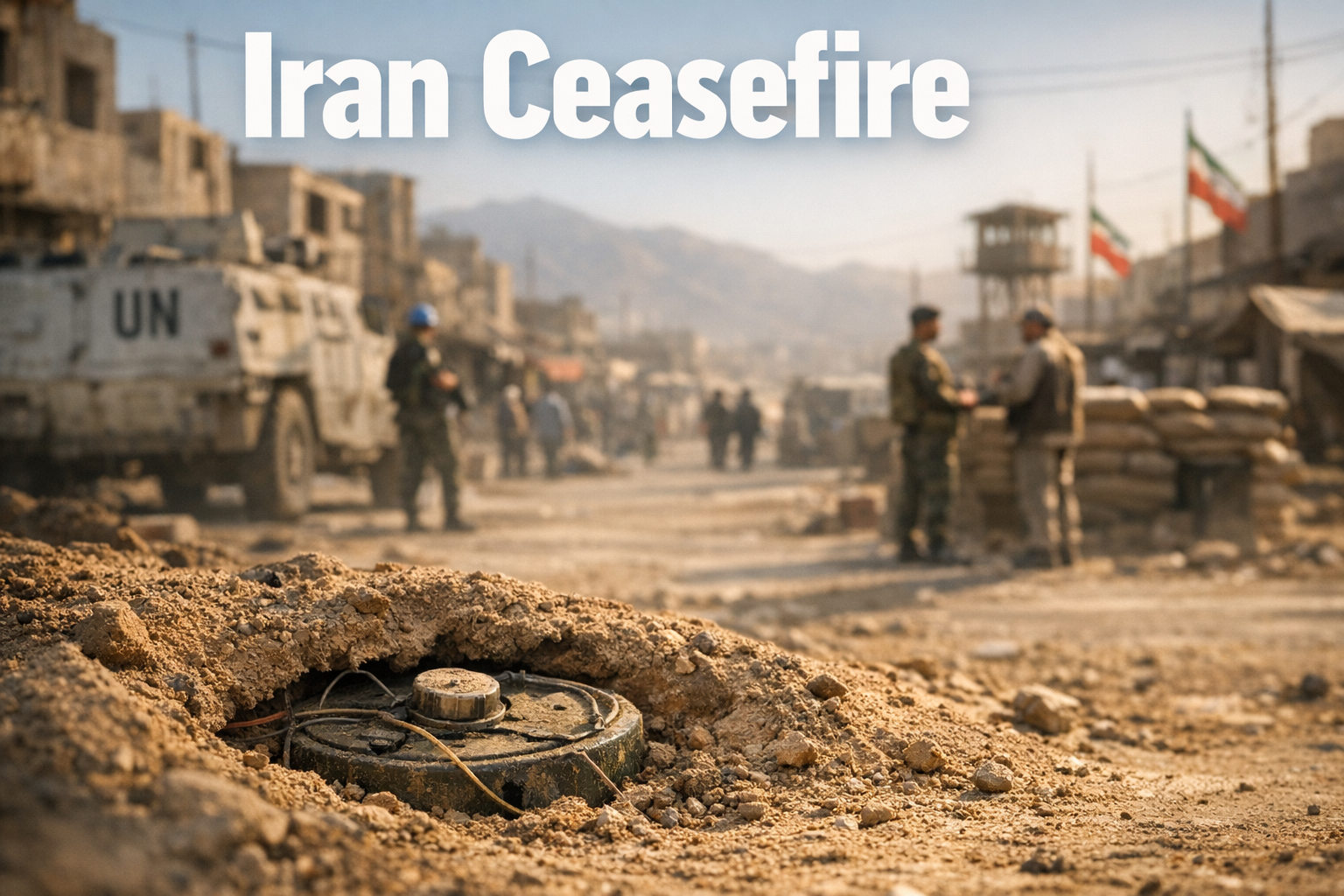
● Iran Truce Shock, Hormuz Toll, Oil Jolt
Iran Agrees to a Two-Week Ceasefire: Markets Cheered, but the Key Issues Are Elsewhere—Hormuz Transit Fees, Uranium-Enrichment Wording Discrepancies, and the Next Direction for Oil
This two-week ceasefire arrangement is positive on the surface. Equities rallied, crude prices eased, and risk appetite improved. However, the underlying terms suggest residual—and potentially institutionalized—costs and unresolved flashpoints.
This report summarizes:
- The core elements of the Hormuz-related ceasefire arrangement
- Three issues most likely to trigger renewed US-Iran friction
- Why Iranian transit-fee collection could become a long-duration variable for oil and supply chains
- The significance of an AP-reported discrepancy in uranium-enrichment language across document versions
- Potential implications for Korean equities, commodities, and the global macro outlook
Key framing:
- The conditions of the ceasefire may matter more than the ceasefire itself.
- Avoiding war does not necessarily imply lower costs.
1. Why markets reacted so strongly to the two-week ceasefire
The agreement reportedly halts bombing and attacks for two weeks, creating immediate relief across risk assets.
The key messages attributed to the Trump side:1) A two-week pause in attacks on Iran
2) Iran’s agreement to the “complete, immediate, and safe” reopening of the Strait of Hormuz
Immediate market response:
- KOSPI and KOSDAQ rebounded sharply
- WTI and Brent fell back below USD 100
Macro transmission mechanism:
- Lower perceived Middle East risk tends to reduce crude risk premia first
- Lower oil reduces inflation concerns
- This feeds into rate-cut expectations and equity valuation support, particularly for energy-importing markets
2. Why the “trap” narrative is emerging
The ceasefire appears closer to a temporary pause than a durable resolution. More importantly, it may not remove the cost of conflict; it may formalize parts of it.
Primary risk: Strait of Hormuz transit fees.
Discussion points:
- A structure may be forming in which Iran collects official transit fees in Hormuz
- A figure of approximately USD 2 million per vessel has been referenced
- While the fee may look manageable versus a blockade scenario, it could reshape cost structures and risk pricing over time
Second-order effects are potentially more material than the direct fee:
- Maritime freight and insurance costs
- Rerouting and logistics inefficiencies
- Energy procurement strategy shifts
- Inventory and working-capital behavior across refiners and petrochemicals
- Broader supply-chain reconfiguration costs
3. Three issues with high probability of renewed US-Iran confrontation
3-1. Security guarantees / non-attack commitments
Iran is likely to seek more than a short ceasefire, potentially pursuing explicit non-attack assurances.
Constraints:
- The US may view long-term non-attack guarantees as limiting military options
- Israel is likely to resist arrangements that constrain preventive or retaliatory capabilities
Implication: a two-week pause is feasible; a binding long-term security guarantee is materially harder.
3-2. Uranium enrichment rights
The core nuclear issue remains “how much enrichment is permitted,” not merely whether a weapon is being built.
Considerations:
- Enrichment can be framed as civilian capability, but higher levels increase military optionality
- The US is unlikely to concede broad enrichment latitude without stringent constraints and verification
Implication: the ceasefire can hold while talks continue, but enrichment thresholds remain a structural breakpoint.
3-3. Control of the Strait of Hormuz
Hormuz governance is the most immediate economic lever.
If Iran’s operational influence expands—especially with fee collection—this becomes:
- A de facto taxation or tolling power over a critical global energy corridor
- A mechanism for persistent risk premia even absent active conflict
4. Why Hormuz transit fees may matter more than headline oil moves
Direct pass-through estimates often imply a limited impact:
- AI-based simulations cited suggest roughly USD 1–3 per barrel on pure cost allocation
However, markets may price a broader risk premium once tolling is institutionalized:
- Uncertainty over future disruptions or partial closures
- Higher insurance premia
- Higher probability of rerouting decisions
- Operational and inventory policy shifts by refiners and petrochemicals
- Supply-chain resilience spending
Combined effects could plausibly support an additional USD 10–15 per barrel in risk premium under adverse sentiment, with tail risk above that in renewed stress.
Conclusion: the ceasefire may reduce “shock spikes,” but it may leave a “structural premium” in place.
5. Global macro points to monitor
5-1. Inflation re-acceleration risk
A sustained rebound in oil would lift inflation expectations and pressure the path of rate cuts.
Energy-price transmission:
- Transport, chemicals, manufacturing inputs, and consumer goods
Implication: higher oil can weigh on equity multiples in markets pricing easing cycles.
5-2. Implications for Korea: economy and equities
Korea is a major energy importer; Hormuz risk and higher crude are direct macro headwinds.
Likely sector dispersion:
- Airlines, shipping, chemicals, and refining: input-cost sensitivity
- Autos and broader manufacturing: freight and logistics inflation
- Defense, commodities, and select energy-linked names: potential relative beneficiaries
- Exporters: simultaneous monitoring of FX and input costs
Near term: ceasefire-driven relief may support indices. Over time: cost normalization could increase sector differentiation.
5-3. US monetary policy and global financial conditions
Reduced geopolitical stress is positive, but structurally higher oil complicates the Federal Reserve’s trade-offs:
- Easing to support growth vs. inflation persistence from energy
Market focus should shift from the announcement effect to the level where oil stabilizes over the next 1–4 weeks.
6. Key sensitivity from AP reporting: uranium-enrichment wording differs by language version
AP reporting indicates a discrepancy:
- The Persian-language version reportedly included wording implying acceptance of uranium enrichment
- The English-language version circulated to diplomats and journalists reportedly omitted that phrasing
Why this matters:
- Language discrepancies create future dispute vectors: “no such agreement was reached”
- Enrichment is a high-sensitivity topic for the US; ambiguity increases renegotiation and escalation risk
- The issue may not be fully priced by markets focused on the ceasefire headline
7. Does this evolve into a longer-term ceasefire?
A longer “managed tension” equilibrium is plausible:
- Initial escalation followed by extensions, partial concessions, and intentionally ambiguous commitments
- Similar patterns have appeared in other US external negotiations
Investment-relevant framing:
- More consistent with “managed tension” than “peace”
- The distinction matters for risk premia and cost persistence
8. Fact pattern summary (news-style)
- A two-week US-Iran ceasefire agreement drove a sharp rebound in global and Korean equities
- Crude fell sharply in the near term, moving below USD 100
- Iran reportedly committed to safe reopening of Hormuz; toll collection could become formalized
- The referenced ~USD 2 million per vessel toll is less important than the associated risk premium and supply-chain effects
- Major unresolved disputes: non-attack guarantees, enrichment rights, and Hormuz control
- AP reports language discrepancies between Persian and English versions regarding uranium enrichment
- The trajectory may shift toward extended postponement and “managed tension” rather than final settlement
9. Investor checklist (implementation-oriented)
9-1. Confirm whether oil has structurally turned, or is temporarily suppressed
Monitor:
- Hormuz tolling developments
- Insurance and freight rates
- Rerouting indicators
- Inventory behavior across energy and chemicals
9-2. Sector selection may matter more than index direction
Initial index relief may fade into:
- Cost-sensitive losers vs. beneficiaries of higher risk premia and defense/commodities dynamics
9-3. Document language detail can reprice risk quickly
Institutional focus will likely include:
- Interpretation disputes and verification clauses, not only ceasefire status
10. Under-covered core point
The essential outcome is not “war ended,” but “war risk deferred with a visible price.”
If Hormuz tolling becomes institutionalized:
- Conflict may pause while a lasting cost framework remains
- Global oil and supply chains may embed a durable premium
The enrichment-language discrepancy represents a potential trigger for renewed confrontation.
11. Conclusion
The agreement is supportive in the short term: it reduces the probability of immediate escalation and stabilizes crude and risk assets. However, the primary disputes remain unresolved:
- Non-attack guarantees
- Uranium enrichment parameters
- Strait of Hormuz control
- Interpretation risk from language discrepancies
For investors, focus on the ceasefire’s conditions and implementation mechanics rather than the headline. The event links directly to:
- Oil prices
- Inflation expectations
- Rate-cut timing
- Korean equity sector dispersion
- Supply-chain cost structure shifts
In effect, the risk may not have disappeared; it may have been converted into a more explicit and potentially persistent cost premium.
< Summary >
A two-week US-Iran ceasefire drove a near-term relief rally in equities and a pullback in crude. The key medium-term risks are the potential institutionalization of Strait of Hormuz transit fees and the AP-reported discrepancy in uranium-enrichment wording across language versions.
The US and Iran remain exposed to renewed friction over non-attack guarantees, enrichment rights, and Hormuz control. While the direct toll may imply only modest per-barrel costs, insurance, supply-chain adjustments, and risk premia could be more significant, potentially sustaining a higher oil premium.
The most consistent interpretation is not durable peace but a phase of managed tension. Investors should monitor oil stabilization levels, inflation expectations, Korea sector impacts, and negotiation-document interpretation risk.
[Related Links…]
- https://NextGenInsight.net?s=oil
- https://NextGenInsight.net?s=AI
*Source: [ 내일은 투자왕 – 김단테 ]
– 이란 2주 휴전 협상. 함정이 있습니다.
● AI Frenzy, OpenAI, Anthropic, Chip Surge
OpenAI and Anthropic Valuations Surge: Key AI Beneficiaries Attracting Global Capital
The critical issue is no longer the broad statement that “AI is rising.” More relevant are: (i) how far valuations of OpenAI and Anthropic have expanded, (ii) why capital is concentrating in private AI leaders rather than listed equities, and (iii) how these flows are translating into listed beneficiaries across AI infrastructure, semiconductors, optical networking, CPUs, and internet infrastructure. This report links global equity positioning with the AI infrastructure cycle and highlights an under-discussed point: as AI agents scale, internet usage patterns and the underlying architecture may shift, potentially changing the set of primary beneficiaries.
1. The Market’s Core Focus Is Shifting from Listed Mega-Caps to OpenAI and Anthropic
OpenAI valuation approaches large-cap public-market scale
Investor attention has refocused on OpenAI and Anthropic. OpenAI’s valuation is referenced around USD 852 billion, comparable to the upper tier of U.S. listed market capitalizations.
Despite recurring concerns around cost intensity, competition, and profitability, private-market valuation signals remain firm, indicating a divergence between negative headlines and prevailing capital allocation.
Anthropic demand is accelerating
In recent private-market activity, demand for Anthropic has intensified. With Claude as its flagship model, certain secondary transactions have implied valuations in the USD 500–600 billion range, in some cases reflecting premiums exceeding 50% versus prior reference points.
This dynamic suggests strong price-setting power in private markets: buyers are accepting elevated entry levels despite the absence of a public listing.
Why capital is concentrating
Two drivers are central:1) Platform positioning at the center of the AI value chain
2) Strong IPO optionality and listing expectations
Institutional investors seek exposure pre-IPO, while broader markets anticipate significant post-listing attention. The result is a liquidity pull into private AI leaders that can propagate into adjacent listed beneficiaries.
2. Why AI Capital Is Expanding Into Other Sectors
AI continues to create new inflection points
AI has exhibited successive catalysts rather than a single boom-and-cooldown cycle:
- 2022: mass adoption shock driven by ChatGPT
- Subsequent phase: buildout of generative AI infrastructure
- Current phase: emergence of AI agents as the next catalyst
The shift from “question-answering AI” to “execution-oriented AI” may be material because it can change requirements across compute, networking, and data center architecture.
Capital flows are broadening
Investor focus has expanded beyond OpenAI and NVIDIA to include enabling layers:
- infrastructure and cloud-edge delivery
- memory
- optical connectivity
- CPUs
This has widened the investable AI theme and dispersed sector-level inflows.
3. First-Order Beneficiaries: Memory Semiconductors Re-Strengthen as a Core Axis
Memory remains fundamental to AI infrastructure
A consistently strong segment has been memory semiconductors, including Samsung Electronics, SK Hynix, and Micron. As model size and throughput increase, storage and high-bandwidth memory demand rises structurally.
AI agents may further increase memory intensity through:
- concurrent task execution
- context persistence
- session continuity
- multi-workload operations
Implications of Apple’s supply pre-emption
Market discussion has highlighted Apple securing mobile memory supply aggressively, potentially tolerating margin trade-offs to lock in volume.
If accurate, the signal is that major OEMs may be anticipating tighter memory availability. Early procurement can support downstream pricing power and product competitiveness, while laggards may face higher unit costs and share pressure.
The launch of memory-focused ETFs as a signal
Memory-concentrated ETFs have been listed overseas with high weightings in Samsung Electronics, SK Hynix, and Micron, often including storage-related names.
Two interpretations are relevant:
- Positive: a simplified access channel for global investors to allocate to Korean and Japanese memory exposure
- Cautionary: thematic concentration products can coincide with late-cycle positioning, implying a need to monitor near-term valuation and sentiment risk
4. Second-Order Beneficiaries: Optical Networking as the Data Center Circulatory System
Why optical is re-rating
As AI data centers scale, the constraint increasingly shifts from compute quantity to interconnect efficiency: chip-to-chip, server-to-server, and data center network throughput. Optical connectivity typically provides higher bandwidth and lower bottlenecks than copper-based alternatives in large clusters.
What NVIDIA’s investment signals
NVIDIA’s investments in Lumentum, Coherent, and Marvell have been interpreted as strategic positioning around infrastructure bottlenecks. The implication is that AI performance competition is expanding from GPU counts to data movement speed and fabric efficiency, supporting a re-rating of optical and networking suppliers.
5. Key Under-Discussed Point: AI Agents May Create a Different Set of Winners
AI agents are not chatbots
AI agents aim to execute multi-step workflows, including:
- email handling
- calendar management
- search and retrieval
- document summarization
- price comparison
- reservations and checkout
- customer support automation
- data organization
Agent-based systems can parallelize tasks at scale, potentially driving step-changes in internet traffic composition and enterprise IT architecture.
Why internet infrastructure names such as Fastly are resurfacing
Edge cloud and high-performance network providers (e.g., Fastly) may benefit if machine-to-machine traffic grows faster than human click-driven traffic. In such a scenario, latency, routing optimization, and edge processing become more critical.
Some projections suggest AI-driven traffic could surpass human usage by 2027; the key implication is architectural, not merely volumetric.
The internet may shift from human-first to AI-first usage
Most web services, payments, and search flows are designed around humans as the primary user. If AI increasingly performs discovery, evaluation, and transaction execution, core internet assumptions may change, impacting:
- infrastructure provisioning
- security requirements
- payment rails
- API-driven commerce
6. Visa’s Signal: Payment Agency May Shift from Humans to AI
Early framing of AI-mediated consumption
Visa has emphasized that payment initiation may increasingly involve AI, not only human decision-making. AI can potentially handle:
- product discovery and comparison
- evaluation of terms and conditions
- optimization of purchase choices
- execution up to the payment step
If AI moves from recommendation into transaction pathways, the commerce interface and competitive dynamics may change.
Businesses are beginning to design for B2A (Business-to-AI)
In addition to B2C and B2B, firms are considering Business-to-AI models, treating AI as an operational decision and execution endpoint. This could reshape:
- search advertising
- e-commerce funnel design
- fintech integration
- payment network utilization
- customer experience architecture
7. CPU Re-Rating: Why Intel and AMD Are Being Reconsidered
Hardware needs may differ between generative AI and agentic AI
To date, GPUs have dominated investment narratives due to training and inference performance. AI agents, however, may increase demand for orchestration, multitasking, and OS-level workload management, potentially elevating CPU relevance.
CPUs may regain importance in agentic workflows
Workflows involving browsers, automation tools, document processing, scheduling, and system-level operations can be CPU-intensive. This has renewed market discussion around Intel and AMD, given Intel’s scale in CPUs and AMD’s momentum in high-performance segments.
Intel facility repurchase as a positioning signal
Intel’s reported repurchase of previously sold manufacturing assets at a premium has prompted interpretations ranging from capacity strategy to renewed confidence in core operations. While not sufficient to confirm a trend reversal, it indicates the market is less willing to categorize CPU incumbents solely as legacy exposure.
8. News-Style Key Takeaways: How to Read Current Positioning
First, AI capital concentration may not be near completion
As long as private-market premiums for OpenAI and Anthropic persist and IPO optionality remains, inflows into the broader AI ecosystem may continue, with periodic rotation into listed beneficiaries.
Second, AI beneficiaries extend well beyond GPUs
Beneficiary breadth is expanding across:
- memory semiconductors
- optical networking
- edge cloud and internet delivery infrastructure
- payment infrastructure
- CPUs
Third, a shift in internet usage patterns could drive broader industry reconfiguration
If AI becomes a primary actor in search, payments, commerce, and work execution, multiple layers may be restructured: advertising, security, server infrastructure, and data center design.
9. Most Material Point: Redefinition of the Internet’s Primary User
The core issue is not valuation headlines but user-identity transition
Public discussion often centers on valuation levels of OpenAI and Anthropic. A more material consideration is whether AI agents become primary actors in:
- internet navigation
- payment execution
- search behavior
- commercial discovery
This is closer to a structural shift in the digital economy than a single technology rally. The key investment question may increasingly be: who captures toll-like economics as AI activity scales.
In this framework, potential durable beneficiaries are not limited to model developers but include owners of essential enabling infrastructure across memory, optical connectivity, CPUs, edge networks, and payment rails.
10. Investment Checklist
Near-term
- Assess the degree to which OpenAI/Anthropic IPO expectations translate into sector-level flows
- Monitor memory valuation, sentiment, and earnings confirmation
- Expect elevated volatility in optical/networking names tied to NVIDIA-related headlines and capex signals
Medium-term
- Track adoption velocity of AI agents in consumer products and enterprise software
- Validate growth via observable metrics: traffic patterns, data center build plans, and disclosed capex
Long-term
- If AI increasingly substitutes for search, payments, commerce actions, and workflow automation, market leadership may rotate further from platform incumbents toward infrastructure-oriented beneficiaries.
< Summary >
OpenAI and Anthropic are being valued at levels comparable to top-tier public-market companies, attracting substantial global capital in private markets. The AI beneficiary set is expanding beyond GPUs to include memory semiconductors, optical networking, CPUs, edge cloud, and payment infrastructure. If AI agents scale, AI may become a principal user of the internet and commerce systems, implying potential structural changes across search, advertising, payments, security, server infrastructure, and data center architectures. The central investment lens may shift from “which model is best” to “who captures essential infrastructure economics as AI activity increases.”
[Related Articles…]
- https://NextGenInsight.net?s=AI
- https://NextGenInsight.net?s=semiconductors
*Source: [ 소수몽키 ]
– 앤트로픽&오픈AI 기업가치 폭등, 지금 전세계 돈 빨아들이는 AI 수혜주들
● Seoul Housing Crunch, Rent Shock, Buy Now or Pay More
With Jeonse Contracting, Monthly Rents Rising, and a Looming Supply Shortfall in Seoul Apartments, the Core Reasons Unhoused Households Aged 30–49 Should Consider Buying Now
This is not a simple real-estate outlook. It consolidates: (i) why tenant-market instability can worsen structurally, (ii) why monthly-rent cash-flow pressure is underestimated, (iii) why Seoul apartment transactions and key Seoul-metro locations are regaining strategic importance, and (iv) why the current period may represent a practical window for first-time buyers aged 30–49.
Beyond price forecasts, the key drivers are: collapse in non-apartment supply, shrinking tenant choice sets, policy targeting mismatch, and potential repricing of areas with confirmed transport infrastructure.
1. The dominant shift: a structural transition from Jeonse to Monthly Rent
The primary issue is no longer whether Jeonse prices rise or fall; the Jeonse inventory itself is contracting.
- Even large apartment complexes show limited Jeonse listings
- Remaining listings are increasingly monthly-rent oriented
- Tenant choice is narrowing as Jeonse supply declines
- The ability to use deposits to reduce monthly outflows is weakening
- Lower cash-flow households face higher housing-cost stress
The market is shifting from “expensive Jeonse” to “insufficient Jeonse, forced monthly rent.”
2. The driver: a deeper collapse in the non-apartment segment
Market attention often concentrates on Seoul apartments, but non-apartment housing (multi-family, villas, officetels) has historically been a major supply channel for mainstream households.
Combined effects have materially weakened this segment: fraud-related risk perceptions, demand aversion, tighter guarantees, lending constraints, and layered regulations, reducing feasibility for suppliers and compressing new supply.
- Demand contraction for non-apartments
- Tighter lending constraints
- Higher guarantee/institutional risk
- Deteriorating project economics
- Resulting supply decline
This represents a breakdown of the housing “ladder” for middle- and lower-income households, increasing outward migration pressure toward outer Seoul, Gyeonggi, and Incheon.
3. News-style briefing: 5 market developments
3-1. Rising concerns over Seoul and Seoul-metro housing supply shortages
Seoul apartment supply constraints are a recurring theme. With non-apartment supply also shrinking, overall housing supply resilience weakens as substitutes disappear.
3-2. The core issue exceeds “Jeonse crisis”: Jeonse erosion
The key risk is not only price spikes but the reduction in available Jeonse options. With fewer alternatives, households are increasingly compelled to accept monthly rent.
3-3. Monthly-rent burden is larger in lived cash-flow terms
Even if conversion-rate arithmetic suggests monthly rent may be manageable, households experience higher stress due to fixed recurring outflows. For ages 30–49, this can directly impede asset formation.
3-4. Policy goals vs. the most housing-insecure cohorts
Stabilization policy must address the households least likely to achieve homeownership over the next 10–20 years. Price stabilization alone may not resolve long-horizon insecurity for structurally constrained renters.
3-5. For first-time buyers, this can be a “credit-accessible” period
Under strict credit regimes, multi-home owners can be constrained more than owner-occupier first-time buyers. In specific cases (first-time purchase, non-regulated areas, mid-priced housing), LTV capacity may remain.
4. Why ages 30–49 should evaluate buying now
The conclusion is that exiting prolonged renter status earlier can be strategically important, driven by four considerations:
4-1. Renting repeats housing uncertainty every 2–4 years
Renter households often face renewal/move risk on 2- or 4-year cycles. Owner-occupiers typically maintain longer average tenure, improving stability.
4-2. Ownership can provide both housing stability and asset accumulation
Long holding periods in resilient locations can support inflation hedging and wealth accumulation. Outcomes depend materially on location selection.
4-3. In a monthly-rent era, ownership can improve cash-flow defensibility
While debt service can be burdensome, principal repayment converts outflows into asset accumulation. With inflation and rent increases, ownership can function as a hedge for household cash flows.
4-4. More important than Seoul price forecasts: securing an attainable entry location
Rather than targeting top-tier districts immediately, a practical approach is to secure positions in areas with confirmed transport improvements and improving Seoul access.
5. Actionable approach under credit constraints: non-regulated areas + first-time buyer status + confirmed transport catalysts
Key implementation points:
- Regulated zones often face lower LTV ceilings
- Non-regulated zones can allow higher LTV
- First-time buyers may receive additional preferential treatment
- Entry can be feasible with lower initial equity, conditional on location quality and commute viability
This is not a recommendation to buy indiscriminately; the target is locations with durable demand and practical commuting access.
6. Why GTX matters: transport premium as a core Seoul-metro repricing mechanism
Confirmed or high-visibility rail projects (GTX-A, potential GTX-B/GTX-C, Sinansan Line, Dongbuk Line) can influence repricing via time-to-employment reductions.
- Confirmed transport plans increase valuation visibility
- Shorter commutes raise residential preference and end-user demand
- End-user demand can support downside resilience
- Substitution demand from unaffordable Seoul apartments shifts to improved-access corridors
Prices remain closely linked to employment accessibility, with strong gravity toward dense job clusters, particularly in the Gangnam area.
7. Case interpretation: why areas such as Deogyang, Hwajeong, and Changneung are referenced
The intent is not a specific endorsement but a shared screening logic: existing or early-entry stock in Seoul-commutable areas with confirmed transport upgrades.
Selection criteria:
- Access to key Seoul employment hubs
- Rail lines already operating or with credible, scheduled delivery
- Relative underperformance vs. upgraded accessibility
- Adequate living infrastructure to sustain owner-occupier demand
- Plausible step-up (trade-up) path within reachable price bands
The focus is 5–10 year repricing potential rather than short-term spikes.
8. Practical action plan for owner-occupier households aged 30–49
8-1. Avoid “only top-tier districts matter”
Owner-occupier strategy should prioritize attainable entry points aligned with capital constraints. The practical objective is Seoul living access, not necessarily a Seoul address.
8-2. Prioritize Seoul-commutable Seoul-metro core nodes
Sustained end-user demand depends on commute feasibility. Confirmed regional rail materially improves functional access.
8-3. Treat the first purchase as a bridge, not the final destination
A first home often functions as a platform for later upgrades. Build a roadmap around tax thresholds, borrowing capacity, and livability, with planned intervals (2/4/10 years).
8-4. Recalculate: persist with monthly rent vs. convert to ownership
Evaluate not only price direction but also: rent inflation, Jeonse contraction, credit availability, and future supply constraints. Many households may find the ownership option comparatively favorable after full cost and risk normalization.
9. Policy lens: the central problem in housing stability
Housing policy focused solely on price levels can conflict with stability objectives if vulnerable renter cohorts are pushed into higher monthly-rent exposure. Official survey results often indicate tenant preference for expanded Jeonse supply and affordable Jeonse credit; persistent gaps between policy design and on-the-ground demand warrant review.
10. Under-discussed essentials
10-1. The core of the Jeonse crisis is not price, but loss of choice
Reduced ability to choose between Jeonse and monthly rent increases perceived and realized housing insecurity.
10-2. Non-apartment supply collapse equals erosion of the mainstream housing base
If multi-family/villa/officetel markets weaken, entry pathways for young adults and newly formed households narrow materially.
10-3. The most vulnerable cohort is “unable to buy even if prices fall”
For structurally constrained households, stable rental terms and affordability mechanisms can matter more than modest price corrections.
10-4. In stressed markets, first-time end-users can access policy-enabled opportunities
Credit, tax, exemption thresholds, and non-regulated-area rules can create relative advantages for first-time buyers versus leveraged multi-home owners.
10-5. The forward framework: location + transport + cash flow
Broad “Seoul rises” heuristics are less reliable. Durable outcomes depend on employment access, travel time improvements, and household cash-flow sustainability.
11. Conclusion: prioritize structural housing-market shifts over price fear
The market is being shaped by concurrent forces: Jeonse contraction, monthly-rent expansion, non-apartment supply breakdown, Seoul/metro supply tightness, and transport-driven re-ranking of locations.
For households aged 30–49 without housing, the strategic choice set is effectively:
- remain in a tenant market with shrinking Jeonse availability and rising monthly-rent exposure; or
- secure an affordable, livable first home within sustainable cash-flow constraints
Buying is not universally optimal, but a passive “wait for lower prices” posture is inferior to a quantified assessment of feasible locations, financing capacity, and long-run housing-cost risk.
A practical screen integrates: non-regulated areas, first-time buyer eligibility, confirmed transport upgrades, and relevant tax thresholds, particularly when Seoul apartment entry is infeasible.
< Summary >
- The Jeonse market’s core issue is shrinking supply and loss of tenant choice, not only pricing.
- The collapse in non-apartment supply weakens the mainstream housing foundation.
- Monthly rent can appear favorable by conversion math but impose higher cash-flow stress.
- Housing-stability policy should prioritize the realities of the most vulnerable renter cohorts.
- First-time buyers aged 30–49 may still access ownership via non-regulated areas, first-time buyer programs, and confirmed transport corridors.
- A robust framework integrates location, transport, and cash flow rather than isolating single headlines (prices, supply, regulation).
[Related Articles…]
- GTX-driven repricing of the Seoul metro market: which corridors may move first (NextGenInsight.net?s=GTX)
- Post-Jeonse shift to monthly rent: asset strategy implications for non-owners (NextGenInsight.net?s=Jeonse)
*Source: [ 경제 읽어주는 남자(김광석TV) ]
– 전세는 사라지고 월세만 남는다. 3040 무주택자라면 지금 집 사야 하는 이유 | 경읽남과 토론합시다 | 김학렬 소장_2편