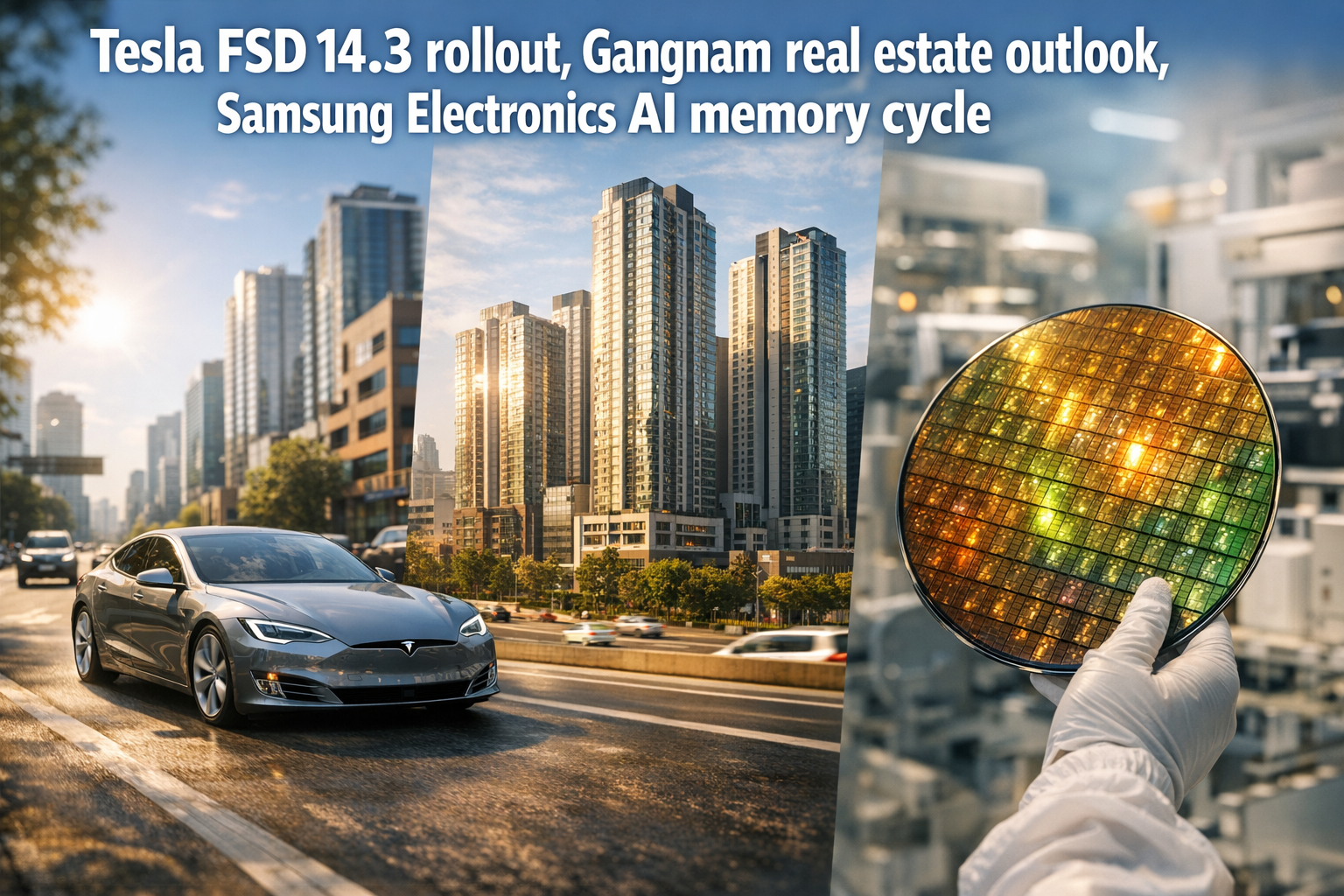
● Tesla FSD 14-3 Shocker, Last Puzzle, No Stock Pop
FSD 14.3 Rollout Begins: The Real Meaning of Musk’s “Final Puzzle Piece”
Why Tesla’s Stock Is Not Responding
This development is easy to misread as a routine autonomy update. The key issues are the architectural changes in FSD 14.3, how they map to robotaxi commercialization, why equity markets are not repricing immediately, the widening HW3 vs. HW4 gap, and the 2026 strategic timeline.
1. Key Update: FSD 14.3 Rollout Signals a Structural Shift in Tesla Autonomy
Tesla has begun rolling out FSD 14.3. This release is less about incremental features and more about redesigning the AI execution stack. Musk’s description of it as the “final puzzle piece” is best interpreted in that context.
- ~20% improvement in AI reaction speed
- Significant neural network architecture upgrades
- Compiler and runtime redesigned from the ground up
- Improved parking and small-obstacle detection
- Enhanced reinforcement-learning efficiency using real-world driving data
This is closer to an AI architecture rebuild than a standard patch. The core implication is not only better performance, but potentially faster future improvement cycles.
2. Five Material Changes in FSD 14.3
2-1. A ~20% Reaction-Speed Gain Has Safety and Trust Implications
In autonomy, reaction speed affects braking, lane changes, pedestrian detection, and evasive maneuvers. In dense urban environments, marginal latency reductions can materially change perceived smoothness and confidence.
2-2. Rewriting the AI Compiler and Runtime Enables Faster Iteration
The primary strategic signal is the full rewrite of the compiler and runtime used to run Tesla’s AI. This can shorten the feedback loop from data collection to training, validation, and fleet deployment. Markets typically value iteration velocity more than one-off benchmark gains.
2-3. Parking Improvements Are Closer to Robotaxi Requirements Than a Convenience Feature
Reported behavior suggests more accurate identification of parkable areas and improved parking-lot navigation (e.g., large retail lots and airport parking). Robotaxi viability requires end-to-end automation, including drop-off, safe stopping, parking, staging, and re-departure.
2-4. Stronger Coupling Between Real-World Data and Reinforcement Learning
Tesla’s fleet-scale data advantage remains a structural barrier for competitors. This release appears oriented toward converting edge-case exposure into improved learning efficiency.
2-5. Better Small-Object Detection Is Directly Relevant to Regulatory Approval
Regulators tend to focus on rare, safety-critical scenarios rather than curated demos. Improvements in detection of small animals, debris, temporary traffic control, and emergency scenes can be relevant to approval pathways.
3. On-Road Observations: Improvements and Remaining Limitations
3-1. Early User Feedback Is Generally Positive
Common reported improvements include:
- Faster, more natural responses
- Noticeably better parking-location prediction
- More flexible sign recognition and routing decisions
- Improved handling of complex parking-lot layouts
Complex, semi-structured environments are typically harder than highways; performance there is operationally meaningful.
3-2. Better Handling of Police Vehicles, Blockages, and Detours
Some videos show route re-selection rather than simple stopping when a police vehicle blocks the path, indicating improved situational context handling.
3-3. Still Not at a “Regulator-Ready” Level for Broad Unsupervised Expansion
Observed failure cases include:
- Incorrect decisions in no-left-turn zones
- Attempted exit against “do not enter” signage
- Awkward rerouting after missing a parking space
The release represents progress, but it does not eliminate the typical timing gap between technical improvement and regulatory clearance.
4. Why the Stock Is Not Rising: Markets Price Cash Flows and Certainty
4-1. FSD Improvements Do Not Immediately Convert Into Revenue Recognition
Investors generally require clarity on:
- Timing of regulatory approvals
- Timing of fully driverless commercialization
- Timing of profit contribution
Absent concrete milestones, technical progress may be only partially reflected in valuation.
4-2. Tesla Is Still Valued Largely Through an Auto-Industry Earnings Lens
Many market participants continue to anchor on deliveries, regional demand (U.S./China), pricing, and margin pressure. Near-term fundamentals can dominate software-progress narratives.
4-3. HW4-First Rollout Limits Near-Term Addressable Impact
If the most material gains accrue primarily to HW4 vehicles while HW3 waits for a “light” version targeted around mid-2026, investors may discount scalability and near-term monetization across the installed base.
4-4. Rates and Growth-Equity Multiples Remain a Constraint
Tesla’s valuation sensitivity to rates and liquidity conditions is structurally high. Single-product technical catalysts often fail to expand multiples when macro conditions are restrictive.
5. Why This Matters for Robotaxi Commercialization
5-1. Robotaxi Success Requires Operational Completeness, Not Only Driving Performance
Operational requirements include:
- Selecting safe pickup/drop-off points
- Entering/exiting dense commercial areas
- Safe curb management near destinations
- Automated parking and staging between rides
- Detouring around temporary controls
Parking and spatial understanding upgrades therefore map directly to service economics.
5-2. Iteration Speed Is a Competitive Weapon
In autonomy markets, the likely winner is not the firm with the best single snapshot, but the one with the steepest improvement curve. Compiler/runtime redesign suggests Tesla is investing in faster deploy-train-validate cycles.
6. HW3 vs. HW4: Strategic Implications
6-1. HW4 Prioritization Signals Where Tesla Expects the Autonomy Baseline to Settle
A HW4-centered rollout implies that commercialization standards may increasingly align with the HW4 ecosystem, even if that creates near-term dissatisfaction among HW3 owners.
6-2. Installed-Base Monetization Remains a Key Variable
If top-tier functionality concentrates on newer hardware, customer sentiment, upgrade policy, and brand trust could become more relevant. For investors, the breadth of monetization across the fleet is material to the FSD narrative.
7. Why 2026 Is Frequently Cited: Cybercab, Optimus, and European Approval
7-1. Cybercab Production Readiness Is Physical Infrastructure for Robotaxi
Robotaxi is not software-only; it requires dedicated vehicle platforms and fleet operations. Observations of Cybercab-like vehicles staged at Giga Texas are consistent with preparation for service launch planning.
7-2. Rising Unsupervised Driving Share in Austin Suggests Transition Toward Real Operations
A higher share of driverless operation in a constrained geography can be interpreted as a step toward accumulating operational and regulatory trust, independent of nationwide rollout.
7-3. European Approval Could Be a Re-Rating Catalyst Beyond the U.S. Narrative
If European regulatory barriers begin to fall, autonomy and mobility-platform valuation arguments could expand beyond a single-market story.
8. Underemphasized Points
8-1. The Core Value Is “Faster Improvement,” Not Only “Better Current Performance”
AI economics often reward the slope of the learning curve. FSD 14.3 appears to prioritize the system’s capacity to improve faster and deploy more frequently.
8-2. Parking Progress Is Economically Material for Robotaxi Unit Economics
The last 50 meters and last 5 minutes often determine whether human intervention is needed. Reducing intervention reduces operating cost and improves scalability.
8-3. The Market Has Not Fully Priced Tesla as an AI Platform Company
If market perception shifts toward valuing Tesla via data networks, autonomy subscriptions, robotaxi take rates, and robotics optionality, the valuation framework could change. Current pricing remains heavily influenced by near-term EV fundamentals.
9. Investor Checklist
9-1. Near-Term
- Limited probability of immediate equity repricing from technical updates
- Deliveries, margins, and U.S. demand stabilization remain dominant drivers
- Ongoing monitoring of rates and growth-equity risk appetite
9-2. Medium-Term
- Cadence of post-14.3 releases
- Magnitude of improvement on HW4
- Expansion of Austin robotaxi operating scope
- Safety data accumulation and regulator engagement
9-3. Long-Term
- Probability of Cybercab commercialization around 2026
- Potential AI-platform synergies with Optimus
- Scope and timing of European approvals
- Potential transition in market classification from automaker to AI infrastructure/platform
10. Conclusion: Equity Is Quiet, but the Technical Direction Is Large
FSD 14.3 is not a routine feature update; it reflects meaningful changes to the AI execution stack. The more important implication is the potential acceleration of future improvement cycles and operational completeness required for robotaxi.
Key risks remain: earnings uncertainty, regulatory timing, HW3 vs. HW4 divergence, safety sensitivity, and growth-multiple constraints. However, the release can be viewed as a milestone in Tesla’s broader shift toward an AI-based mobility platform.
< Summary >
FSD 14.3 represents an architectural inflection rather than a minor update. Core elements include ~20% faster reaction speed, neural-network upgrades, a redesigned compiler/runtime, and improved parking capability. These changes are relevant to robotaxi operations and faster learning/deployment loops. The stock may not respond immediately due to regulatory uncertainty, near-term financial drivers, HW4-skewed benefits, and macro valuation constraints. The central takeaway is improved iteration velocity, with 2026-related catalysts (Cybercab, Optimus, and potential European approvals) remaining key variables.
[Related]
- Tesla Robotaxi Strategy: Revenue Models the Market May Be Missing (NextGenInsight.net?s=Tesla)
- AI Semiconductors and Autonomous Driving: Core U.S. Equity Growth Themes Into 2026 (NextGenInsight.net?s=AI)
*Source: [ 오늘의 테슬라 뉴스 ]
– FSD 14.3 배포 시작, 머스크 “마지막 퍼즐” 주가는 왜 안 오를까?
● Gangnam-Defies-Crash
Why There Is No “Second Gangnam,” and Why Gangnam Home Prices Repeatedly Stabilize
Current real estate cycles typically produce two recurring questions: whether Gangnam is finally peaking during corrections, and where a “second Gangnam” might emerge. The core conclusion is structural: Gangnam’s resilience is driven less by preference and more by the interaction of jobs concentration, transport connectivity, urban design, and policy limitations.
This report consolidates (i) why Gangnam repeatedly recovers, (ii) why new towns have not become substitutes, (iii) why job-housing proximity continues to support Seoul apartment prices, and (iv) what owner-occupiers and investors should differentiate during correction phases. A key framing is that pricing reflects commuting structure and daily-life efficiency more than housing quality alone, and that supply expansion has not consistently produced comparable living satisfaction.
1. Core Thesis: “There Is No Second Gangnam”
The central conclusion is that a “second Gangnam” is unlikely to form under Korea’s current urban and labor-market structure. The issue is not that Gangnam is expensive, but that few locations can simultaneously replicate its full set of conditions.
Two primary drivers are highlighted:
- First, high-quality employment remains concentrated in Seoul and established business districts.
- Second, balanced regional development and new-town strategies have underperformed relative to expectations.
2. Primary Driver of Resilience: Employment Has Not Decentralized from Seoul
2-1. Housing Prices Function as “Commuting Cost”
While education, branding, and redevelopment catalysts matter, commuting time is frequently the dominant variable. When commuting exceeds roughly one hour, perceived housing value declines sharply even if the unit is newer or larger. Conversely, smaller and more expensive homes closer to major employment hubs can command sustained premiums.
In practice, home prices reflect not only physical assets but also the monetization of saved time and reduced daily friction.
2-2. Seoul’s Major Employment Hubs Are Established
Key commuting destinations include Yeouido, Yeoksam, Jongno, and the Gasan Digital Complex. Demand persistence correlates with transit lines that provide high-efficiency access to these hubs. This is often observed around Line 2, Line 3, Line 7, and Line 9, which function as compressed access networks to major business nodes.
As a result, peripheral new towns without comparable connectivity struggle to serve as functional substitutes for Gangnam.
2-3. Job-Housing Proximity Is a Structural Premium
Job-housing proximity is no longer a niche preference. For dual-income households, families with childcare and education constraints, and employees with frequent in-office attendance, the difference between 30-minute and 90-minute commutes materially changes lifestyle feasibility.
Accordingly, Gangnam’s price stability is better explained by its role as a highly efficient access zone to high-value employment, rather than by wealth preference alone.
3. Why New Towns and Regional-Balance Policies Did Not Create Substitutes
3-1. Households Follow Jobs, Not Housing Supply
Policy frameworks often assumed that large-scale housing supply would attract population. In practice, mobility is driven primarily by employment opportunity, income potential, and related education and career pathways concentrated in the capital region.
When jobs remain centralized while housing supply expands in peripheral or non-core areas:
- Demand concentrates in core areas.
- Supply accumulates in outer areas.
- Price polarization intensifies.
This implies that divergence is not only a supply-shortage story, but also a misalignment of demand and supply locations.
3-2. Limits Highlighted by Sejong and Innovation Cities
Cases such as Sejong and innovation-city programs suggest that building new administrative functions, supplying housing, and adding transport do not automatically create a comparable lifestyle ecosystem. A city’s market premium typically requires coordinated development of:
- High-quality private-sector employment
- Daily-life retail and services
- Education and healthcare infrastructure
- Walkable neighborhood structure
- Coherence between transport and residential patterns
Where these are incomplete, new supply may not translate into sustained pricing power.
3-3. Transport Nodes Did Not Consistently Become Living Nodes
The Cheonan-Asan Station case is cited as a transport hub (KTX/SRT) that did not fully translate into a walkable, integrated residential-commercial environment. Market adoption tends to depend on:
- Walkable access to the station
- Nearby daily convenience infrastructure
- Car-free feasibility after work
- Integration of housing, retail, and employment functions
Transport infrastructure alone is insufficient; alignment with everyday movement patterns is required for durable value formation.
4. Gangnam’s Strength Is Closer to “Non-Substitutability” Than “Scarcity”
Scarcity matters, but the deeper driver is that few areas offer comparable combined utility. Key components include:
- Access to Seoul’s major employment hubs
- Education-driven demand concentration
- Deep private-sector commercial ecosystem
- Persistent preference among high-asset households
- Overlapping layers of transport infrastructure
- Brand and symbolic capital
Because these factors co-locate, demand does not fully collapse during downturns.
5. Key Points in Investor-Report Format
5-1. Market Assessment
Even with transaction freezes and price corrections, core districts including the Gangnam 3 areas tend to retain structural demand, supporting relatively higher rebound probability. Non-core and peripheral areas remain more sensitive to rates, credit controls, and supply shocks.
5-2. Policy Assessment
New-town policies contributed to headline supply expansion but were less effective in creating full-scale Seoul-substitute living zones. Expanding housing without dispersing employment may widen regional price gaps.
5-3. Transport Implications
“Golden-line” subway connectivity to major employment districts is likely to remain a key explanatory variable for apartment pricing. GTX/KTX/SRT matter, but sustained value depends on last-mile walkability and day-to-day convenience.
5-4. Demand Shifts
Owner-occupiers increasingly prioritize commuting time, daily movement patterns, and education conditions over unit size. Dual-income and professional demand is likely to remain concentrated in core and near-core Seoul locations.
6. Under-Discussed Drivers
6-1. Premiums Are Driven by Lifestyle Fatigue Reduction
Beyond rates, lending, and supply, pricing strength reflects a structure that reduces daily fatigue: shorter commutes, dense amenities, strong education and consumption clusters, and persistent high-income demand. In this framing, pricing embeds operational life efficiency, not only expectations.
6-2. Supply Was Expanded, but “Attractiveness” Was Not Fully Designed
The primary limitation was not simply construction quality, but insufficient reasons for households to relocate. Sustainable city competitiveness typically requires synchronized outcomes across commuting, retail, education, culture, healthcare, green space, and community formation. Supply-first approaches frequently miss these linkages.
6-3. The “Second Gangnam” Question May Be Mis-Specified
A more decision-relevant question is: which areas can improve both access to Seoul’s employment cores and overall living satisfaction. Rather than seeking replication, evaluation should focus on how each area secures job-housing proximity and daily-life convenience.
7. What to Monitor: Owner-Occupiers vs. Investors
7-1. Owner-Occupiers
The primary decision variable is not short-term price movement but residence efficiency:
- Actual door-to-door commute time
- Seamless transfers across subway and bus networks
- Education and childcare infrastructure depth
- Existence of an already-functioning retail/services ecosystem
- Whether upcoming supply improves or degrades living satisfaction
A discounted peripheral purchase can be outweighed by recurring time and energy costs.
7-2. Investors
Avoid simplistic assumptions such as “new town equals appreciation” or “new station equals appreciation.” Key diligence items include:
- True connectivity to employment centers
- Completeness of walkable living zones
- Balance of residential and commercial functions
- Risk of supply exceeding local demand
- Retail vacancy and infrastructure gaps
In higher uncertainty, markets tend to reprice based on fundamentals of habitability and employment linkage rather than headline development announcements.
8. Consolidated Conclusion
Gangnam is resilient not because it is expensive, but because Korea’s urban structure repeatedly reinforces its position. While corrections can occur, long-term breakdown is constrained by persistent concentration of employment, education, transport, and consumption in Seoul—especially within specific core districts.
For new towns and regional-balance strategies to become true alternatives, they must relocate not only housing supply but also private-sector jobs and a complete lifestyle ecosystem. Without this, the premium of existing core Seoul locations is likely to reassert over cycles.
The implication is not that only Gangnam is investable, but that market structure is likely to remain increasingly organized around job-housing proximity, daily-life efficiency, and access to high-value employment.
9. Forward Watchlist
- Expansion or relocation of Seoul’s core business districts
- Supply changes from redevelopment and reconstruction in central Seoul
- Whether GTX and broader regional transport networks materially reshape living zones
- Strengthening of self-sufficiency (jobs and services) in Sejong, innovation cities, and new towns
- Sensitivity of core demand to interest rates and credit regulation
- Whether AI trends and remote/hybrid work alter office and housing preferences
Remote work may not immediately weaken the core premium, as higher-income roles often retain in-person collaboration and network effects. Technology-driven change could also reinforce talent and firm clustering rather than dispersion.
< Summary >
A “second Gangnam” is unlikely to be created through apartment supply alone. Gangnam’s recurrent price stability is structurally supported by concentrated core employment, job-housing proximity demand, high-performance transit corridors, dense lifestyle infrastructure, and the limits of new-town policy execution.
The primary determinant is commuting and daily-life structure, not housing quality alone. Owner-occupiers should prioritize commute and living efficiency; investors should prioritize employment linkage and local self-sufficiency. Corrections can occur, but premiums tied to non-substitutable locations tend to be persistent.
[Related Links…]
- 2026 Real Estate Outlook and Seoul Apartment Market Summary: https://NextGenInsight.net?s=real%20estate
- AI-Era Employment Restructuring and New Variables for Capital-Region Real Estate: https://NextGenInsight.net?s=AI
*Source: [ 경제 읽어주는 남자(김광석TV) ]
– 제2의 강남은 어디인가. 강남 집값이 결국 다시 버티는 구조적 이유 | 북리뷰 ‘대한민국 부동산의 역사’_2편
● Samsung-Driven AI Memory Surge
Following Samsung Electronics’ Earnings Surprise, the Key Issue Is Not the “Numbers” but “Why Global Capital Is Concentrating in Korea Now”
The latest quarterly result from Samsung Electronics should be read as more than a one-off earnings beat.
This report consolidates the core points investors should focus on:
- Why Samsung’s results exceeded consensus meaningfully
- Why Jensen Huang and global Big Tech leadership are visiting Korea
- How far AI-driven semiconductor and memory demand may extend
- Implications for Samsung’s equity performance and the drivers behind foreign selling
- What matters for investors within the broader KOSPI and global macro backdrop
The central question is not simply “strong earnings” or “HBM strength,” but why this cycle is structurally different from prior semiconductor upcycles, how the AI token economy amplifies memory demand, and why Samsung Electronics and SK hynix appear discounted versus global peers.
1. Samsung Electronics Q1 Results: Why the Market Reacted
Samsung Electronics’ 2026 Q1 performance was interpreted as a material upside surprise versus market expectations.
Consensus began in the high KRW 30 trillion range, was revised upward to the low KRW 50 trillion range by 일부 brokerages immediately ahead of the release, and the reported figure was still perceived as stronger than those raised estimates.
The key takeaway was that results were expected to improve, but the magnitude suggested a stronger-than-anticipated memory cycle.
1-1. Primary Driver: Price, Not Volume
The earnings surprise is better explained by pricing than by a sudden jump in shipments.
Capacity cannot expand meaningfully in a short time; therefore, rapid earnings improvement typically reflects ASP expansion. Interpretation extended beyond DRAM to NAND, suggesting demand strength is broadening.
AI server demand is no longer only an HBM narrative. General-purpose DRAM and NAND are increasingly required due to data storage, caching, intermediate-state handling, and long-context management in data centers.
1-2. Why the Stock Did Not Rally Sharply on the Day
Equities discount forward expectations rather than current-quarter performance. The market focus quickly shifts from “a strong quarter” to “can conditions improve further from here.”
At the margin, geopolitical risk (notably Middle East tensions), US political uncertainty, FX volatility, and the long-standing “sell into strength” framing in semiconductors constrained immediate upside.
However, confirmation of improved earnings quality tends to raise the medium-term valuation floor.
2. Why This Semiconductor Cycle Should Not Be Treated as a Standard Memory Cycle
This cycle differs from prior memory cycles driven primarily by smartphones, PCs, and traditional server refresh dynamics.
The current cycle is led by AI infrastructure investment, i.e., an enterprise CAPEX cycle rather than a consumer replacement cycle. This distinction materially affects durability.
2-1. A Big Tech “Platform Survival” CAPEX Cycle
Microsoft, Meta, Amazon, Google, and Oracle face incentives to maintain AI investment momentum. A pullback can be interpreted as losing strategic position, not merely cost discipline.
Accordingly, AI infrastructure spend may prove less sensitive to oil prices, interest rates, and headline geopolitical risks than traditional demand cycles.
2-2. Lessons From Early HBM Investment Decisions
HBM previously appeared less attractive due to yield risk and cost burden. SK hynix invested more aggressively and has benefited disproportionately as AI demand accelerated.
This supports the view that, during early monetization debates, under-investing can lead to loss of strategic positioning. Current AI CAPEX decisions reflect competitive dynamics more than near-term margin optimization.
3. Why Jensen Huang Visited Korea: Memory Supply Constraints
The core question is: why are Nvidia’s CEO, OpenAI, and other global technology leaders visiting Korea?
This behavior is more consistent with securing scarce supply than with marketing. In the AI stack, the bottleneck is not only GPUs but also high-performance memory and broader memory components required across server architectures.
In practical terms, AI compute cannot scale without sufficient memory.
3-1. Strategic Meaning: Securing Memory Supply Lines
These visits should be interpreted as operational signals of tight memory supply. For investors, actions by key buyers can be more informative than headline narratives.
3-2. Implication: Current-Year Allocation Is Largely Committed; Negotiations Focus on Next Year
A key point is that much of the current-year supply is effectively allocated, and negotiations are shifting to next-year volumes.
In memory, durable upcycles often become visible when customers attempt to lock in future supply, indicating potential structural tightness rather than transient demand.
4. Why the AI Token Economy Can Amplify Memory Demand
Treating AI demand as “more GPUs” understates the system-level implication. Token consumption increasingly maps into semiconductor demand.
4-1. Token Growth Can Drive Non-Linear Memory Demand
AI is shifting from simple Q&A to reasoning, task execution, and agentic workflows.
Agent-like systems can require orders of magnitude more tokens than conversational use cases. Memory demand can rise more than proportionally due to:
- Context persistence
- Temporary state retention
- Long-term memory management
- Storage of intermediate computation results
4-2. The Agent Era Is Also a Memory Era
As AI systems orchestrate multi-step workflows across tools and retain state over longer horizons, stable and scalable memory becomes a strategic constraint.
Therefore, current performance should not be viewed only as a cyclical recovery; it also reflects an architectural shift toward memory-intensive AI services.
4-3. Caching, Compression, and Efficiency Are Not Necessarily Bearish for Memory
Efficiency innovations typically signal binding constraints. Optimization efforts suggest memory scarcity, not oversupply.
As such, these technologies can be interpreted as evidence that memory is a critical resource in AI competition.
5. When Could Samsung’s Earnings Peak?
This is central to equity performance. Markets often discount peaks roughly six months in advance.
The relevant question is not whether current earnings are strong, but when the market begins to price a peak.
5-1. Baseline Scenario: Visibility Through 1H 2027
Current positioning implies expectations for favorable conditions into 2027, with more meaningful supply additions anticipated from 2028 onward.
Potential contributors include:
- SK hynix Yongin expansion
- Micron capacity additions
- Samsung Electronics 신규 line ramp
As supply expands, the intensity of current tightness could moderate. Under typical discounting dynamics, 1H 2027 may be a key inflection window, though the timing can extend if demand surprises to the upside.
5-2. The Expected Peak Has Already Shifted Out
Prior expectations assumed earlier supply normalization. Stronger demand and delayed normalization have pushed peak assumptions later.
This supports a monitoring framework based on quarterly demand and pricing signals rather than fixed exit timing.
6. Samsung Electronics Equity Outlook: Potential to Break Prior Highs
On earnings fundamentals, a higher valuation is plausible. The primary constraint is the speed of market re-rating.
6-1. Valuation Still Screens Inexpensive
On a PER basis, Samsung Electronics and SK hynix trade at materially lower multiples than global large-cap technology peers.
If earnings rise faster than price, valuation compresses mechanically, reflecting that market framing remains anchored to past memory-cycle patterns. Re-rating depends on whether durability is re-underwritten.
6-2. Why the Market Remains Skeptical
Key overhangs include:
- The entrenched view of semiconductors as a cyclical industry
- Macro risks (Middle East conflict, US political uncertainty)
- FX volatility and foreign flow instability
The market is not rejecting current earnings; it is discounting uncertainty around duration. Credibility and persistence matter more than the latest print.
7. Why Foreign Investors Sold Samsung Electronics
Foreign selling should not be interpreted solely as a bearish fundamental view.
7-1. The Most Practical Driver: Portfolio Weight Rebalancing
A significant portion of foreign flows reflect fund mandates. As Samsung Electronics and SK hynix weights rise within the KOSPI, some funds must reduce exposure due to concentration limits.
This creates “sell despite strength” behavior driven by rules rather than forward earnings views.
7-2. Additional Drivers
- Peak-cycle concerns in memory
- FX-driven hedging and translation-loss considerations
- De-risking across emerging markets amid geopolitical stress
Peak concerns were partially mitigated by the latest earnings confirmation. If rebalancing pressures ease, the remaining variables are geopolitical stability and FX normalization, which could influence re-engagement.
8. What Matters in the Global Macro and KOSPI Context
KOSPI direction is influenced not only by domestic earnings but also by:
- US equities
- Rates
- USD strength
- KRW FX dynamics
- Middle East risk
- The AI investment cycle
Samsung exposure should be evaluated within this global framework.
8-1. More Important Than War Headlines: AI CAPEX Has Not Rolled Over
Short-term news shocks are influential, but capital allocation drives medium-term earnings.
To date, Big Tech has sustained or expanded AI investment plans. This matters for both the Nasdaq and KOSPI via the ecosystem linkage from Nvidia to Korean memory suppliers and, in turn, to Korea’s index valuation.
8-2. Korea’s Equity Beta Remains Semiconductor-Led
Semiconductors dominate marginal index direction. A resilient memory cycle supports the index’s underlying strength; a downturn would likely weigh on the overall market even if other sectors improve.
Therefore, Samsung’s earnings surprise is also an indicator of index-level resilience.
9. Under-Discussed Points That Matter Most
9-1. Key Point 1: Not Only HBM; Broad Memory Benefits
AI expansion can lift demand not only for HBM but also for commodity DRAM and NAND as AI infrastructure requires computation plus storage and state.
9-2. Key Point 2: Executive Visits Are Supply-Constraint Evidence
On-the-ground engagement signals urgency in securing memory. Buyer behavior is a direct indicator of tight supply.
9-3. Key Point 3: The AI Token Economy Converges With a Memory Economy
As agentic AI scales, memory’s strategic value rises alongside compute.
9-4. Key Point 4: Foreign Selling Is Not a Pure Sentiment Signal
Flows can be driven by structural constraints and mandates. Over-interpreting foreign selling as fundamental deterioration risks mispricing.
10. Investor Takeaways
Samsung Electronics and SK hynix remain core beneficiaries of the AI semiconductor cycle.
Near-term volatility may persist due to geopolitics and FX, but medium-term drivers are earnings revisions and structural demand shifts.
Key indicators to monitor:
- Quarterly earnings trajectory
- Memory pricing (DRAM and NAND)
- Big Tech AI CAPEX plans
- Foreign flow stabilization and re-entry
Market conviction remains incomplete, but fundamentals have continued to strengthen. Over time, sustained earnings tends to pull narrative and valuation with it.
11. One-Line Conclusion
The core message of Samsung’s earnings surprise is not “better-than-expected profits,” but that AI token-driven growth is making memory tightness increasingly structural; investor focus should remain on buyer behavior, forward allocation negotiations, and the evolving memory intensity of AI services.
< Summary >
Samsung Electronics’ Q1 earnings surprise can be interpreted as a signal of structurally tighter memory conditions driven by expanding AI infrastructure.
Demand tailwinds extend beyond HBM to DRAM and NAND.
Visits by Jensen Huang and other global technology leaders suggest intensifying competition to secure memory supply.
As AI agents and token-intensive workloads expand, memory demand may accelerate further.
While the stock may remain sensitive to geopolitics, FX, and foreign flows in the near term, fundamentals indicate potential for re-rating.
Semiconductors remain the central pillar of the KOSPI, and the latest results support the view that this pillar remains intact.
[Related Articles…]
- Samsung Electronics stock outlook and key semiconductor cycle framework: https://NextGenInsight.net?s=Samsung%20Electronics
- AI semiconductor investment strategy and Big Tech demand analysis: https://NextGenInsight.net?s=AI
*Source: [ Jun’s economy lab ]
– 삼성전자 어닝서프라이즈 이후에 대한 생각(ft.염승환 이사 1부)