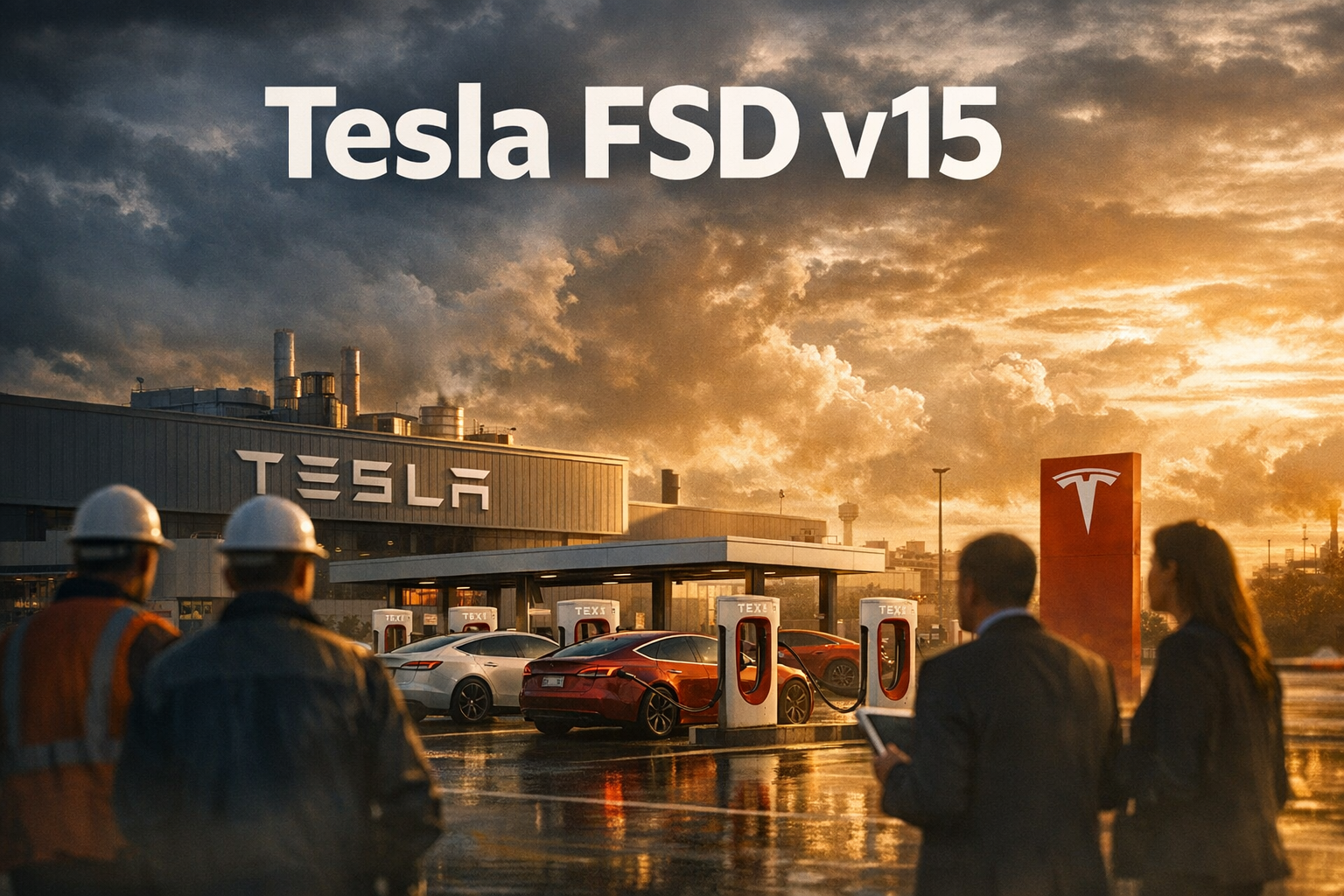
● Tesla Shockwave, FSD Surge, Cybercab Twist
Tesla: Small SUV, FSD v15, and a Steering-Wheel Cybercab — Bullish or Bearish? Key Points to Review Ahead of Earnings
Current Tesla-related news flow is mixed.
Reuters reported a “new SUV smaller and cheaper than the Model Y,” Elon Musk reiterated that “FSD version 15 is on a different level,” and multiple “Cybercab vehicles with steering wheels” were reportedly spotted at Giga Texas.
Individually, these may appear incremental. Viewed together, they signal a potential shift in Tesla’s strategic identity:
- A return to mass-market EV volume growth
- Continued positioning as an autonomy/AI-led company
- A transitional strategy attempting to execute both
This report summarizes why market interpretations diverge, what the developments imply within the EV competitive landscape, what to monitor from a U.S. equity and tech valuation perspective, and the under-discussed points that may matter most into earnings.
1. Consolidated summary of the current Tesla news flow
- Tesla shares modestly rebounded after four consecutive down sessions
- Reuters: Tesla is developing a smaller, lower-priced SUV than the Model Y
- China is cited as a potential production location
- Musk: FSD v15 will operate on a significantly larger model and target materially higher capability
- At Giga Texas, multiple Cybercab units were reportedly observed with steering wheels
- The earnings release in ~13 days may become the key inflection point for interpretation
These items connect to a single question: what will drive Tesla’s next leg of growth.
2. Reuters small-SUV report: why the market immediately split
2-1. Core substance of the report
Per Reuters, Tesla is developing a compact SUV shorter and cheaper than the Model Y, with potential China-based production.
The key issue is not merely “a new model,” but whether this implies:
- A platform distinct from the current Model 3 / Model Y architecture
- Supplier outreach that suggests early-stage execution rather than concept-only intent
If accurate, this points to a cost-structure reset effort rather than a simple lineup extension.
2-2. Why skepticism also increased
The report appears to conflict with prior messaging from Musk, who previously downplayed the strategic value of a conventional low-cost EV program (often associated with the “$25,000 car” narrative), emphasizing autonomy-focused strategy instead.
The market is therefore bifurcating:
- “Tesla is reverting to a mass-market volume strategy to recover deliveries”
- “The signal is inconsistent with prior guidance; confirmation risk remains high”
Tesla has not officially confirmed or denied the report. Investors should treat this as a topic likely to be tested during earnings Q&A rather than as settled guidance.
3. Why the news can be interpreted as bullish
3-1. Potential support for delivery growth
A near-term constraint is slowing auto volume growth.
Model 3 and Model Y have already seen multiple price adjustments, and refresh-driven demand uplift appears less durable than in prior cycles. In China, local competitors led by BYD are sustaining pressure through lower pricing, tighter segmentation, and faster cadence.
A lower-priced SUV could be a volume-recovery lever.
3-2. China production could improve cost competitiveness
If China production is accurate, Tesla could benefit from:
- Supply-chain efficiency
- Lower manufacturing cost
- Mature battery and component ecosystems
This could enable lower pricing while defending margins relative to non-China production alternatives.
In a higher-rate environment with softer consumer demand, more accessible price points typically screen better than premium-only positioning.
3-3. A refreshed narrative for investor positioning
Recent stock pressure reflects not only near-term fundamentals but also a perceived lack of a clear incremental growth narrative.
A compact SUV can reintroduce an auto-driven growth vector, which may support sentiment in the short term provided execution appears credible.
4. Why it can also be interpreted as bearish
4-1. Tesla’s valuation premium is anchored in AI/autonomy, not autos
Tesla’s valuation is difficult to justify on traditional auto metrics. The premium is tied to framing Tesla as an autonomy, robotics, energy storage, and AI platform company.
A push toward lower-priced mass-market vehicles may weaken that narrative and increase multiple compression risk if investors re-rate Tesla closer to an auto manufacturer.
4-2. Margin dilution risk
Lower-priced vehicles typically reduce per-unit profitability.
Tesla’s longer-term margin thesis is tied to software monetization (including FSD), network effects (robotaxi), and other high-margin services. If the strategy shifts toward volume at lower ASPs without a visible software attach-rate ramp, market concerns about structural margin dilution may increase.
4-3. Strategic inconsistency risk
CEO messaging materially influences equity perception. If prior skepticism toward conventional low-cost EV programs is followed by indications of renewed emphasis, investors may question strategic coherence.
Equity markets often penalize perceived strategy drift, independent of near-term results.
5. FSD version 15: potential inflection or another iteration cycle
5-1. Key substance of Musk’s comments
Musk indicated FSD v15 will use a much larger model and target materially improved safety and capability in complex environments.
From an AI perspective, scaling model capacity and training sophistication can be directionally meaningful, particularly for real-world inference stability in autonomous driving.
5-2. Why the market response is not uniformly positive
The primary issue is credibility and “expectation fatigue.”
Across prior iterations (v13, v14, and subsequent minor releases), improvements have been discussed, but timelines, perceived user experience, and commercialization pace have remained uneven relative to expectations.
As a result, v15 may be discounted until deployment evidence and measurable outcomes are visible.
5-3. The principal diligence questions
The critical issues are not only model size, but commercialization and regulatory viability:
- Can safety performance reach a threshold compatible with regulatory approval pathways?
- Can the cost structure support scalable commercial service?
- Can Tesla present operating metrics competitive with players such as Waymo?
Technical progress and monetizable autonomy are not equivalent; the gap must narrow to sustain the AI premium.
6. Steering-wheel Cybercab: potentially the most consequential signal
6-1. Why this matters
Reports of Cybercab units with steering wheels are notable because the initial Cybercab concept emphasized a steering-wheel- and pedal-less design.
If steering wheels are present in test or pre-production units, it may indicate a shift toward a staged rollout rather than immediate deployment of fully driverless vehicles.
6-2. Regulation as the pacing factor
This is less an EV product issue and more an industrial policy and regulatory constraint.
In the U.S., large-scale deployment of fully driverless vehicles requires alignment across federal and state rules, insurance frameworks, liability standards, and certification regimes.
A steering-wheel configuration may therefore represent a pragmatic approach to operate within regulatory ambiguity, rather than a technological retreat.
6-3. Linking the Cybercab signal to the small-SUV report
An additional interpretation is that the “smaller, cheaper SUV” could be:
- A conventional mass-market model, or
- A consumer-sellable derivative of a Cybercab/robotaxi platform
Under the latter scenario, Tesla could prioritize consumer sales to generate cash flow and fleet data, then expand autonomy monetization as regulatory conditions improve.
This framing supports the view of a transitional bridge to an AI-driven model rather than a pure reversion to an auto-only thesis.
7. Key questions likely to matter most on the earnings call
Given proximity to earnings, commentary may be more market-moving than reported numbers. Priority questions:
- Will Tesla confirm or deny the compact SUV report?
- Is a new platform aimed at mass-market EVs or robotaxi derivatives?
- What is the deployment timeline and roadmap for FSD v15?
- Is Cybercab in testing, pre-production, or commercial-readiness phase?
- Is the steering wheel a test artifact or a regulatory/operational design choice?
- How does China production fit into global supply-chain and geopolitical risk management?
- How does Tesla balance auto gross margin with sustaining the AI/autonomy premium?
Ambiguous responses could leave the stock in a “high expectations, limited verification” regime. A clear roadmap could support valuation even if near-term financials are soft.
8. Equity implications
8-1. Near term: higher volatility risk
The catalyst set is mixed:
- Bullish: compact SUV optionality, potential delivery recovery, v15 anticipation
- Bearish: strategy confusion risk, margin pressure, autonomy commercialization uncertainty, earnings sensitivity
This combination typically produces volatility before it produces direction, particularly for high-multiple names in a rate- and macro-sensitive market.
8-2. Medium term: “identity” is the core driver
Tesla’s equity value will likely remain more sensitive to how the market categorizes the company than to quarterly delivery prints alone.
If positioned as an EV manufacturer, valuation support is more constrained. If positioned as an AI/autonomy/robotics platform, premium valuation can persist. The current developments directly test that boundary.
9. Under-discussed points
9-1. The timing matters more than the product headline
This is not occurring in a neutral environment. It coincides with:
- Slower delivery growth
- Intensifying China competition
- Delays or uncertainty in robotaxi commercialization
- Investor fatigue around repeated FSD milestones
The compact SUV signal can be viewed as a response to pressure to reinforce the growth narrative.
9-2. A steering-wheel Cybercab may be a commercialization workaround
Insisting on fully driverless deployment may extend timelines materially due to regulation.
A steering-wheel variant can accelerate market entry, enable data accumulation, support brand expansion, and generate cash flow while buying time for regulatory maturation.
9-3. Execution sequencing is the primary risk
Tesla’s challenge may be less about technical ambition and more about sequencing:
The compact SUV, FSD, Cybercab, Optimus, and energy initiatives all compete for attention and capital. The market is increasingly focused on what Tesla can monetize first, and how it stages proof points over the next several quarters.
10. Conclusion: simultaneously bullish and bearish
The developments do not resolve cleanly into a single directional read.
- The compact SUV report can be bullish for volume recovery and market expansion, but bearish if it triggers a re-rating toward an auto-only multiple.
- FSD v15 is strategically important, but markets now prioritize validated deployment and commercialization evidence over claims.
- A steering-wheel Cybercab may disappoint purists, but it may be the most pragmatic indicator of a staged approach aligned with regulatory realities.
The central issue remains Tesla’s strategic identity: mass-market EV growth, AI/autonomy platform, or a transitional bridge between the two. The upcoming earnings call is likely to provide the first high-signal, company-level articulation tying these threads together.
< Summary >
- Reuters’ compact SUV report supports a delivery recovery thesis but may pressure the AI-driven valuation premium by reinforcing an auto-manufacturer framing.
- FSD v15 is directionally positive, but the market is likely to demand deployment data and commercialization milestones.
- A steering-wheel Cybercab may reflect a transitional, regulation-aware rollout strategy rather than a retreat.
- The earnings call will likely determine whether the compact SUV, autonomy roadmap, and Cybercab commercialization path form a coherent strategy that can support investor confidence.
[Related Articles…]
- Tesla: key variables to monitor ahead of earnings (NextGenInsight.net?s=Tesla)
- How autonomous-driving regulatory shifts affect U.S. equities (NextGenInsight.net?s=autonomous-driving)
*Source: [ 오늘의 테슬라 뉴스 ]
– 머스크가 “의미 없다” 했던 그 차, 로이터 “테슬라가 만들고 있다” 이걸 호재로 봐야 하나? 악재로 봐야 하나?
● RateHike Shock, KRW Rout, Inflation Fear
Bank of Korea’s 7th Consecutive Hold: Not the End, but the Start
This decision is not a routine “policy rate hold.” It is better interpreted as a hold that preserves the option of a hike at the next meeting.
Key variables are intertwined: USD/KRW volatility around the 1,500 level, Middle East-driven oil price spikes, renewed domestic inflation pressure, Seoul housing and household debt risks, the Korea–US rate differential, and the policy stance under incoming Governor Hyun Song Shin.
This report explains (i) why the Bank of Korea (BOK) did not hike immediately, (ii) why markets are increasingly re-pricing hike risk, and (iii) how the outlook links to 2026 macro conditions and AI/digital finance trends.
1. Key Takeaways from This Monetary Policy Meeting
The BOK held the Base Rate at 2.50%.
This marks the 7th consecutive hold, and Governor Rhee Chang-yong concluded his final Monetary Policy Board meeting with no rate change. Market interpretation has shifted.
- Base Rate: 2.50% (unchanged)
- Consecutive holds: 7
- Policy rate gap vs. the US: ~1.25%p
- Core variables: FX, inflation, oil, housing, growth
- Policy interpretation: from “holding while considering cuts” to “holding while considering hikes”
Bottom line: “Unable to hike today, but the next meeting could differ.”
2. Why the BOK Held: The Most Direct Rationale
The primary driver was uncertainty.
The BOK needs confirmation on whether Middle East conflict escalation persists, how far oil prices rise, and how strongly the shock passes through to import and consumer prices. Central banks tend to act on realized data and validated trajectories rather than on preliminary expectations.
In practice: FX and inflation risks have increased, but the near-term pass-through into official inflation indicators is not yet fully observable, raising the cost of pre-emptive tightening.
3. FX Instability: The Most Sensitive Variable
The key external-market issue is a high USD/KRW level near 1,500, a psychologically and historically material threshold given the rarity of such KRW weakness since the Global Financial Crisis.
3-1. Why FX Matters
A weaker KRW raises import prices. For an economy with high energy and commodity import dependence, high FX levels translate into inflation pressure. Oil, gas, and industrial inputs are USD-priced, increasing local-currency costs, corporate input expenses, and eventually CPI with a lag.
3-2. Why Rate Hikes Can Support FX Stability
Higher rates increase relative yield attractiveness of KRW assets, potentially moderating capital outflow pressure and KRW depreciation. Rate policy is not sufficient alone, but it can act as a stabilizing tool when rate differentials are large and geopolitical risks are elevated.
3-3. Why This Hold Is Not “Ignoring FX”
A hold does not imply the BOK is complacent about FX. If USD/KRW remains elevated, the probability of a hike discussion at the next meeting increases. FX is not the immediate trigger in this meeting, but it is among the strongest potential triggers for the next.
4. Inflation Risk: Not Fully Visible in Data Yet, but Rising
Headline CPI appears close to the 2% target, which may look stable. The core risk is the inflation path in coming releases.
4-1. Lagged Pass-Through from Oil Shocks
Oil price jumps do not feed into CPI immediately; transmission runs through import costs, refining, logistics, distribution, and retail pricing with a multi-month lag. Stable current prints can be followed by higher readings 1–3 months later.
4-2. Import Prices Become More Critical
Korea’s energy import dependence magnifies the effect of oil shocks, and elevated USD/KRW amplifies the pass-through further. Concurrent increases in oil and FX can meaningfully accelerate import price inflation and raise the probability of renewed inflation momentum.
4-3. Why the BOK Did Not Hike Now
Policy decisions are anchored on official data and trends. The BOK appears to view inflation risk as elevated but still in the “expected deterioration” phase rather than “confirmed deterioration,” supporting a hold.
5. Housing and Household Debt: Core Domestic Financial Stability Constraint
If FX and inflation are external constraints, domestic financial stability is dominated by housing and household leverage. Seoul housing trends are particularly sensitive for the BOK.
5-1. Seoul-Led Price Strength and Polarization
Seoul apartment prices remain firm while regional markets show mixed stabilization. The pattern looks less like a broad recovery and more like capital concentration in core areas, which can re-accelerate credit growth and household debt expansion.
5-2. The Practical Barrier to Rate Cuts
The meeting reinforced that rate cuts are not the near-term policy baseline. Cutting into renewed housing/credit momentum would raise the probability of larger asset-market imbalances. Policy weight is therefore tilted toward financial stability rather than growth support, limiting easing flexibility.
6. Growth Deceleration: The Main Brake on Hiking
FX argues for tightening, inflation risk argues for tightening, and housing/credit risks argue against easing. Growth argues against tightening.
This is the core policy dilemma.
6-1. OECD Downward Revision
OECD lowered Korea’s growth forecast from 2.1% to 1.7%, a material downgrade that signals higher sensitivity to global shocks.
6-2. Why Korea Is More Exposed
- Low energy self-sufficiency
- Manufacturing-heavy structure with high commodity dependence
- High reliance on Middle East energy supply
These factors make geopolitical energy shocks more directly contractionary, increasing the risk that rate hikes suppress activity even if they help contain inflation.
7. The Primary Meaning of the Hold: End of Cut Expectations, Repricing of Hike Risk
The policy narrative has shifted. Earlier holds were aligned with “when to cut.” This hold is aligned with “when to hike.” For markets, that implies a turning point in the policy reaction function, not merely a static decision.
8. Incoming Governor Variable: Will Hyun Song Shin Be More Hawkish?
Market attention is shifting to Governor-designate Hyun Song Shin. His global market and policy experience may increase emphasis on international financial conditions and structural risk management.
8-1. Market Perception of Policy Stance
Markets broadly interpret him as potentially more hawkish than the outgoing governor, implying faster or clearer action if inflation and financial stability risks intensify. Actual outcomes remain data-dependent.
8-2. Why the First Meeting Matters
The first meeting under a new governor signals priority ordering among FX, inflation, growth, and financial stability, shaping the forward policy framework.
9. Data to Monitor: The Key Inflection Is After May
Policy direction will be driven by incoming data:
- April CPI
- May CPI
- Import price inflation
- Persistence of USD/KRW near 1,500
- Additional oil price upside
- Seoul housing prices and household lending trends
If CPI re-approaches ~3% and FX remains elevated, rate-hike discussions could become more concrete from May onward.
10. Why the US Comparison Matters
Viewing Korea in isolation can be misleading. Relative positioning versus the US clarifies constraints.
US policy rates remain above Korea’s. With a more restrictive starting point, the US may face less immediate pressure to hike again on a marginal inflation shock. Korea, holding at 2.50% after prior easing, may see restrictive intensity fade more quickly if inflation re-accelerates, potentially forcing earlier tightening consideration than the Federal Reserve.
11. Global Macro Context
This meeting reflects broader global dynamics:
- Expanding geopolitical risk
- Re-emerging energy price instability
- Retreat in rate-cut expectations
Earlier expectations for a gradual easing cycle are being revised as oil and geopolitical risks re-ignite inflation concerns. Spillovers can affect Korean equities, rates, FX, housing, and corporate investment.
12. Why AI Trends Are Macro-Linked
AI is increasingly sensitive to macro conditions.
12-1. High Rates and AI Investment
Higher rates increase funding costs, affecting industries requiring large upfront capex such as semiconductors, data centers, and cloud infrastructure. Conversely, AI solutions that deliver measurable productivity gains may benefit from corporate cost-reduction demand.
12-2. FX and the AI Semiconductor Supply Chain
KRW weakness may support exporters’ pricing, but it raises local-currency costs for importing AI servers, GPUs, and advanced equipment, tightening capex conditions for domestic buyers.
12-3. Digital Finance and Stablecoins
KRW volatility, USD preference, and payment-system changes affect stablecoin and digital-asset markets. In high-FX regimes, interest in USD-linked instruments rises, while regulators may become more sensitive to capital flow and financial stability risks. This is relevant to the evolving intersection of central bank policy and digital money frameworks.
13. Snapshot Summary (News-Style)
(1) BOK holds the Base Rate at 2.50%
The 7th consecutive hold; the outgoing governor concluded his final meeting without a rate change.
(2) FX instability remains
USD/KRW near 1,500 is a material macro burden; prolonged elevation increases the likelihood of renewed hike discussions.
(3) Inflation appears stable, but forward risk is rising
Middle East conflict and higher oil prices may feed into inflation with a lag, increasing the probability of upside CPI surprises.
(4) Housing and household debt constrain easing
Seoul housing resilience and capital concentration raise financial stability concerns, limiting the scope for rate cuts.
(5) Slower growth constrains tightening
OECD’s downward revision underscores the key constraint on immediate hikes.
(6) The first meeting under the incoming governor is the key inflection
If inflation and FX data deteriorate after May, the probability of a hike under the new leadership increases.
14. Most Material Point: Policy Framework Shift
The key is not the absence of a hike today, but the shift in the policy framework toward financial stability, FX sensitivity, and inflation re-acceleration risk, away from growth-focused easing.
Implication: Korea may remain in a “high-for-longer” regime where rate cuts are difficult even under low growth, affecting housing, equities, rates, private investment, consumption, corporate capex, and AI infrastructure deployment.
15. Base-Case Scenario (Author’s Framework)
Most likely sequencing:
- Near-term continuation of the hold
- Rapid weakening of market rate-cut expectations
- Heightened tightening vigilance if April–May CPI and FX worsen
- More hawkish communication risk under new leadership
- Actual hikes considered only if data strengthens materially
Practical interpretation: not an imminent hike, but a regime where hike risk cannot be dismissed.
16. Practical Implications for Households, Real Estate, FX Exposure, and Investors
Households
Borrowers should reassess plans predicated on near-term rate cuts.
Real estate
The divergence between prime Seoul areas and non-core regions may widen; a synchronized market upturn is unlikely.
FX exposure
Individuals and firms with high USD-linked spending should prepare for prolonged high FX conditions.
Investing
Beyond rates, oil, FX, and global risk appetite are key market drivers.
AI and tech
A prolonged high-rate environment tends to favor AI companies with earnings and cash flow over purely expectation-driven names.
The BOK held the Base Rate at 2.50% for the 7th consecutive meeting. This is not a neutral hold; it reflects elevated vigilance regarding FX instability, potential inflation re-acceleration, and housing/household debt risks.
Middle East conflict and oil price increases may lift inflation over coming months, and sustained USD/KRW strength would increase the probability that hike discussions become actionable under the next governor.
Core message: the rate-cut narrative has weakened, and the policy regime is shifting toward preserving tightening optionality.
[Related Links…]
- https://NextGenInsight.net?s=interest-rate
- https://NextGenInsight.net?s=AI
*Source: [ 경제 읽어주는 남자(김광석TV) ]
– [속보] 이창용 총재의 마지막 금통위, 7연속 금리동결. 신현송 차기 총재는 금리인상 할까? 환율불안과 물가불안 금리인상 가능성 고조 [즉시분석]
● Tariff Shock, Coffee Prices Surge, Supply Chains Squeeze, Korea Hit
One Year of US Tariffs: From a 34% Coffee Price Surge to Korea’s Export Shock — No Clear Winner
This issue is not a binary assessment of whether the Trump tariffs “worked.” A complete evaluation requires linking (i) US consumer-price impacts, (ii) manufacturing employment outcomes, (iii) the extent of supply-chain separation from China, and (iv) structural changes to Korea and the global supply chain.
Key questions addressed:
- Who ultimately bears tariff costs.
- Why prices are slow to decline after rising.
- Why Korea appears disadvantaged yet retains strategic leverage.
- Which industries matter most for investors and corporates going forward.
1. News-Style Overview: Outcomes After One Year
On April 2, 2025, President Trump announced broad tariff measures:
- China: up to 145%
- Korea: 25%
- Global baseline: at least 10%
After one year, results are mixed:
- US household cost of living increased materially.
- Manufacturing jobs did not expand as targeted and instead declined.
- Tariff revenue rose sharply, but the incidence largely fell on US households and firms.
- Dependence on China declined in some categories, but full decoupling did not occur.
- Korea reduced the worst-case outcome via negotiation, but experienced weaker export momentum and diminished price competitiveness.
Net effect: higher consumer burden, reduced corporate investment appetite, and weaker trust among allies.
2. US Consumer Impact: Tariff Costs Were Largely Passed Through to Households
2-1. Coffee +34%: A High-Visibility Cost-of-Living Shock
- In 2025, average ground-coffee prices in US cities rose by 34% (approximately USD 8.30 to ~USD 11).
- Contributing factors included climate-driven crop shortfalls and higher logistics costs.
- With ~99% of US coffee consumption imported, tariffs likely amplified an existing upward price trend.
- Non-alcoholic beverage prices continued to show upside pressure, with further increases discussed for 2026.
2-2. Apparel: Disproportionate Pressure on Lower-Income Consumers
- Apparel prices rose 14% versus the pre-tariff trend.
- Frequently purchased items (children’s clothing, basic T-shirts, sneakers) saw the most acute impact.
- Major production hubs (Vietnam, Cambodia, China) were included in tariff targeting, lifting prices for low-cost consumer goods.
2-3. Autos: Higher New and Used Vehicle Prices
- Tariff-related cost increases were estimated at USD 3,300–4,000 per vehicle for new cars.
- Used-car prices rose 4.8%, consistent with substitution away from higher-priced new vehicles.
- Vehicle price increases tend to propagate into broader household budgets via insurance, financing, and maintenance costs.
2-4. Food and Broad Living Costs: Diffuse but High-Frequency Inflation
- As of February 2026, food prices rose 3.1% YoY, with continued upside risk.
- Estimated household purchasing-power erosion: at least USD 1,000 to as much as USD 1,700 per household (approximately KRW 2.55 million equivalent in the source text).
3. Did Tariffs Reduce Inflation? Evidence Does Not Support That Conclusion
- The administration’s logic: tariffs would drive domestic production, increase competition, and reduce prices.
- CPI inflation slowed to ~2.4% YoY by February 2026, but this aligned with a prior disinflation trend rather than a clear tariff-driven effect.
- Post-increase price stickiness was evident: even if tariffs are reduced or constrained by legal rulings, consumer prices typically adjust downward slowly.
- Structural implication: tariffs can be implemented quickly, but consumer-price reversals are gradual, embedding higher living costs.
4. Why Manufacturing “Reshoring” Did Not Materialize
4-1. Factory Build-Out Requires Time and Capital
- Complex facilities (semiconductors, batteries, auto parts) cannot be established within one or two quarters.
- A single semiconductor fab typically requires 4–5 years, including permitting, equipment, workforce, power, and water infrastructure.
4-2. Policy Uncertainty Suppressed Investment
- Businesses were more constrained by policy volatility than by tariff levels alone.
- Tariff rules reportedly changed more than 50 times within one year, complicating location and capex decisions.
- US manufacturing employment declined by 89,000 through February 2026, contrary to policy objectives.
5. Tariff Revenue Increased, but the Domestic Economy Bore the Cost
- 2025 tariff revenue reached USD 264 billion, roughly triple the prior year.
- Incidence: primarily US importers, and ultimately US firms and consumers, rather than foreign exporters.
- Higher tariff receipts therefore also indicate an internal transfer of cost within the US economy.
6. Trade Deficit and FDI: Headline Improvements Were Not Structural
6-1. Annual Goods Trade Deficit Hit a Record Despite Monthly Volatility
- The annual goods trade deficit reached USD 1.24 trillion, a record high.
- A key driver was import front-loading as firms accumulated inventory ahead of tariff increases, producing short-term distortions rather than structural improvement.
6-2. Foreign Direct Investment Underperformed Expectations
- 2025 FDI totaled USD 288 billion, down YoY and below the 10-year average.
- Tariffs alone were insufficient to attract capital; investors prioritized policy credibility, regulatory consistency, labor availability, cost structure, and power infrastructure.
7. Strategic Objective: National Security More Than Price Stabilization
- Tariffs functioned as an industrial and geopolitical tool, not solely as a price or revenue mechanism.
- Strategic priority: reducing exposure to China-centered supply chains in sectors linked to national security:
- Semiconductors
- Rare earths
- Batteries
- Auto parts
8. China Supply-Chain Separation: Partial Progress, Material Constraints
8-1. Direct Imports from China Declined
- US imports from China fell to roughly half of the prior-year level by mid-2025.
- Production shifted in part to Vietnam, Taiwan, and India.
8-2. Transshipment and “Third-Country Assembly” Expanded
- Chinese firms increased routing via third countries (e.g., final assembly in Vietnam) to reduce tariff exposure.
- China’s 2025 trade surplus reached USD 1.1 trillion, a record, indicating continued leverage in upstream components and materials.
8-3. Rare-Earth Countermeasures Highlighted Strategic Vulnerabilities
- China used rare-earth export restrictions as a response lever.
- Rare earths are critical inputs for EVs, semiconductors, and defense supply chains.
- With limited US domestic mining capacity, exposure remains high.
- The remaining phase of decoupling is concentrated in the most difficult segments: refining, materials, and specialized intermediate goods.
9. Implications for Korea: Worst-Case Avoided, Structural Pressure Increased
9-1. High Sensitivity Due to Export Dependence
- Korea’s production base is tightly linked to external demand, increasing sensitivity to US market changes.
- Preferential tariff treatment under the Korea–US FTA was a core competitiveness pillar; broad tariffs weakened this advantage.
9-2. Response Strategy: Negotiation and US Investment Commitments
- Korea pursued parallel tracks: expanded US investment and diplomatic negotiation.
- The tariff rate reportedly moved from 25% toward ~15%.
- Concessions partly reflected investments already planned, while security cooperation supported bargaining outcomes.
9-3. Measurable Costs Persisted
- Relative price-competitiveness versus Japan narrowed materially.
- Korea’s exports to the US declined in 2025 for the first time in nine years.
- Auto exports fell 13.5%.
- GDP growth slowed to ~1%.
10. What Investors and Korean Corporates Should Monitor
10-1. The US Market Remains Core, but the Operating Model Must Shift
- A pure export-led approach is increasingly constrained.
- Higher weighting is required for:
- Local production
- Local sourcing
- Local partnerships
- Autos, batteries, and semiconductors are converging toward US-based supply-chain integration as a default strategy.
10-2. Supply-Chain Reconfiguration Is a Multi-Year Megatrend
- Drivers likely to persist:
- US–China strategic competition
- National-security-led industrial policy
- Allied supply-chain bloc formation
- Korean firms must make explicit long-term choices on where to locate critical processes, materials, data, and design capabilities.
10-3. AI-Era Priority Sectors: Semiconductors, Power, and Materials
- AI investment returns are increasingly tied to infrastructure rather than application-layer services alone.
- Data centers require:
- High-performance semiconductors
- Grid capacity and power equipment
- Cooling systems
- Rare earths and specialty materials
- Areas to monitor include semiconductor packaging, power equipment, battery materials, industrial automation, and defense-AI adjacencies.
11. Under-Discussed Core Points
11-1. Tariffs Function as an Indirect Cost-of-Living Tax
- For households, tariffs translate into higher recurring expenses without corresponding wage increases.
11-2. The Primary Side Effect Is Uncertainty, Not Only Higher Prices
- Businesses often tolerate moderately higher costs more readily than unstable policy.
- Uncertainty over the durability of tariff rates suppresses capex and reshoring decisions.
11-3. Removing China from Supply Chains Is Structurally Difficult
- China’s role extends beyond assembly into components, materials, refining, and intermediate goods networks.
- The decisive variable is the pace at which allies can create new, scalable production capacity.
11-4. Korea Faces Both Risk and Strategic Opportunity
- Korea is pressured by US policy, yet retains leverage in:
- Semiconductors
- Batteries
- Shipbuilding
- Defense
- Power equipment
- US efforts to reduce China exposure are difficult to execute without Korean participation, positioning Korea as a potential negotiation node rather than a passive price-taker.
12. Final Interpretation: More Cost Reallocation Than “Victory”
- The first year of tariffs did not produce a clear winner.
- The US increased pressure on China, but US consumers bore significant costs.
- China absorbed direct pressure while expanding workaround routes and retaining upstream leverage.
- Korea mitigated peak risk through negotiation, but lost competitiveness and export momentum.
Overall, the policy primarily reallocated costs across US households, multinational firms, and allied economies rather than creating net new wealth. Volatility risk remains elevated amid elections, additional trade investigations, semiconductor and battery policy actions, and competition for AI-critical resources.
< Summary >
- The central outcome of year one was higher US household living costs.
- Coffee +34%, with additional increases in apparel and autos, alongside broader food and daily-expense inflation.
- Tariff revenue rose, but the burden largely fell on US firms and consumers.
- Manufacturing jobs declined; inflation suppression was not clearly attributable to tariffs.
- Partial supply-chain separation from China occurred, but was constrained by transshipment and rare-earth leverage.
- Korea avoided the worst-case tariff outcome, yet faced weaker exports and reduced price competitiveness.
- Investors should prioritize long-duration themes: supply-chain restructuring and AI infrastructure exposure across semiconductors, batteries, power, and materials.
[Related Posts…]
- Global supply-chain shifts and Korea’s export strategy after US tariff restructuring (NextGenInsight.net?s=tariff)
- AI semiconductor power competition and Korea’s strategic opportunities between the US and China (NextGenInsight.net?s=AI)
*Source: [ Maeil Business Newspaper ]
– “커피값 34% 폭등, 가구당 255만원 증발” 미국 관세 1년 청구서 | 매일뉴욕 스페셜 | 홍성용 특파원