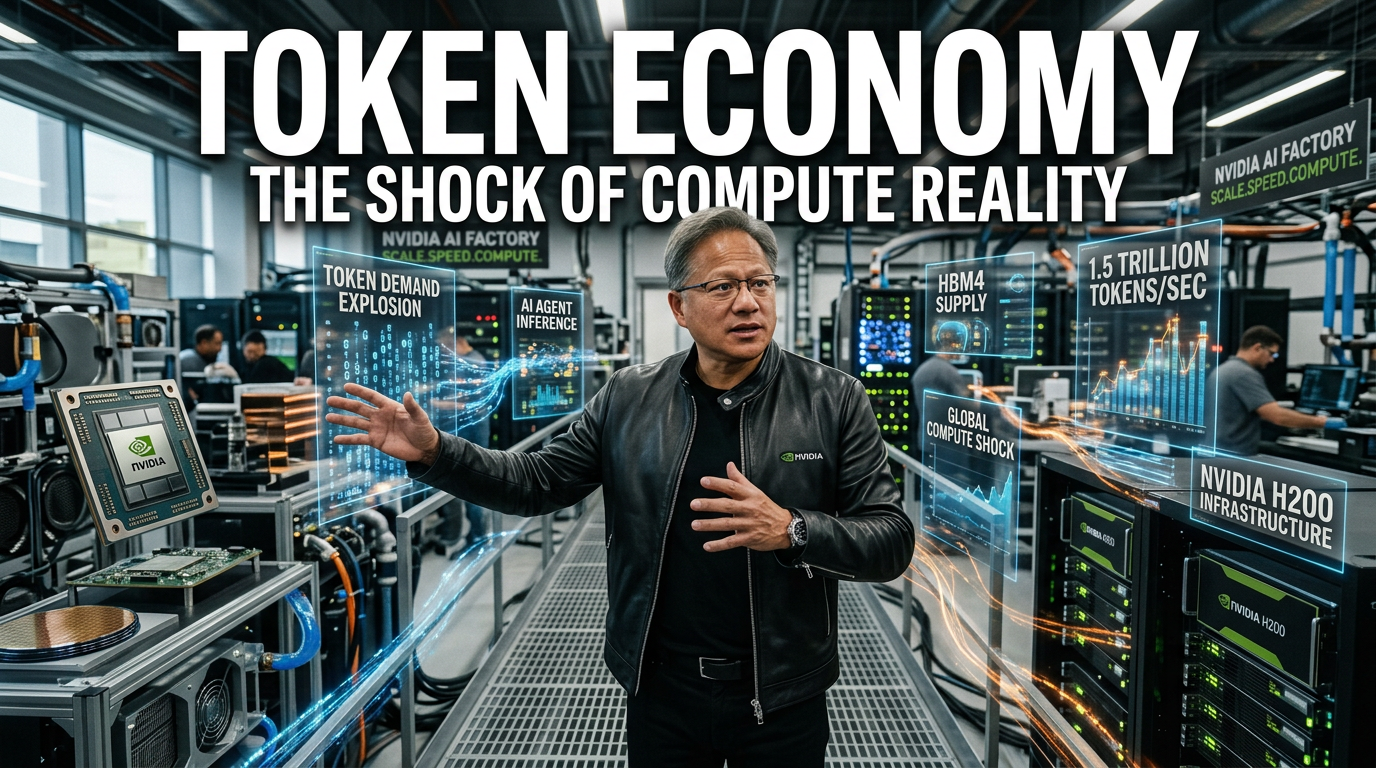
● Tokenized AI Labor Fuels the Data Center Boom
Complete Breakdown of the ‘Token Economy’ Declared by Jensen Huang: The 7 Things Companies Should Be Preparing for in the Agentic AI Era
The core point you should make sure to read to the very end is exactly three things.
1) The claim that AI, rather than providing “answers,” performs “work (task execution),” and the tokens generated in that process become the new raw material of the industry
2) The key point that data centers will become token-minting factories (AI factories) rather than collections of servers, and that cost competition will be completely reshaped
3) NVIDIA’s big-picture plan to create a standard by bundling “hardware-software-agent orchestration” in one go, all the way from Vera Rubin (next-gen superchip) + Groq LPU + NemoClaw
From here, I’ll break down the contents from GTC 2026 like news, so that you can immediately grasp “what’s happening” and “what companies need to do.”
I also wove in the core economics/AI SEO keywords naturally embedded in the sentences.
- Large language models (LLMs)
- Data center infrastructure
- Semiconductor roadmaps
- Agentic AI
- Tokenomics
1) One-Line Summary of GTC 2026: AI Moves from ‘Question-Answer Tool’ to ‘Work-Performing Laborer’
The change NVIDIA pushed at this GTC 2026 is simpler than you might think.
Conventional AI: a structure where users ask and AI answers
Changed AI (agentic AI): a structure where AI sets goals, uses tools, and completes tasks end-to-end
Jensen Huang described this shift as the moment when AI becomes a “foundational layer that determines survival,” the way electricity became the basic layer for industry.
And the more this labor repeats, the “fragments of intelligence” produced in the process are tokens.
2) Agent Scaling: The “Fourth Law” That Changes How Work Is Done
NVIDIA explains why AI suddenly became good at doing tasks in terms of “laws.”
1) Pre-training scaling: build baseline stamina by using more data + larger models
2) Post-training scaling: refine by guiding what’s correct/how it should look (form learning)
3) Test-time scaling: internally think/review multiple times before answering
4) Agent scaling (this key takeaway): not just thinking, but using external tools to achieve goals, collaborating with other AIs, and running thousands to tens of thousands of loops to complete the result
For example, if the request is “plan a family trip,” previous AI often responded with text and ended there.
In contrast, agentic AI was described as including “task execution” beyond airfare price comparisons—down to sending hotel confirmations and more.
The reason this shakes up the industry structure is simple.
As the time and number of actions to process a single question increase, token generation volume also explodes.
3) ‘Tokens’ Are Not Just Strings, but Digital Raw Materials Consumed/Produced by Intelligence
There’s a point that people misunderstand the most.
Thinking of tokens as “just pieces of text consumed in conversation” only gets you halfway to understanding.
What NVIDIA calls tokens are closer to core raw materials—generated in the process where agentic AI makes decisions and executes to achieve a goal.
If coal/electricity are the materials that power a factory,
then tokens become the “fuel” and the “output” as agents perform work on their own.
4) Core of the Token Economy: “Tokens Are Not All the Same” → Prices Differ by Intelligence Density
One of the most economically strong messages at this GTC 2026 is this.
The claim that the value (price) of tokens is not fixed, but varies according to intelligence density.
Explained with examples:
- Simple tasks like weather queries: low token value (usable at low cost/available in low-cost circulation)
- Complex logistics warehouse route-searching for autonomous robots: high token value (high-density reasoning/activity outcomes)
In other words, a shift from
“pay rent and rent models”
to a “result-centered” model where you’re billed based on input work/created-consumed tokens + outcomes.
5) Turning Data Centers into ‘AI Factories’: Tokens Produced per Watt Becomes the Revenue Equation
The point where the token economy becomes real money is the data center.
NVIDIA explained data center revenue in this way.
- tokens per watt × available power
Since power is physically limited, the winners will be the places that “produce more tokens more efficiently.”
The important shift here is that the basis of competition changes.
It’s no longer just whether you installed more GPUs; rather,
- generating tokens of the desired quality
- at how low a unit cost
- how quickly
- and how reliably they are generated/consumed/distributed
becomes the data center’s core KPI.
6) Corporate Response Strategy: Survival Is About a ‘Token Mix,’ Not “Using a Top-Tier Model for Every Task”
As the token economy fully kicks in, internal corporate decision-making changes too.
Previously (mostly):
- a tendency to run the expensive model uniformly for all tasks
Direction of change (NVIDIA’s picture):
- a strategy of mixing token tiers based on the nature of each task (a token mix)
Concepts like these show up in examples.
- Customer support: relatively lighter/lower-cost tokens (possibly available as free tiers)
- Core decision-making: high-cost/high-density tokens (like ultra-tier categories)
Ultimately, corporate competitiveness is summarized as the ability to
create or secure high-quality tokens that are cheap, fast, and reliable enough to run agents.
7) NVIDIA Hardware Roadmap: Using Vera Rubin + Groq LPU to Target a 10x Reduction in Production Cost per Token
Now we’re getting “specific equipment,” not just “good talk.”
(1) Next-gen superchip: ‘Vera Rubin’
- Both CPU + GPU are based on new architectures
- Key change: adopting HBM4 memory
HBM4 reduces bandwidth bottlenecks, focusing on solving data bottlenecks that arise during agent scaling.
NVIDIA’s points are straightforward.
- economic advantage to cut production cost per token by 10x versus the prior baseline
- multiple-fold improvements in inference/learning performance compared to the previous generation
(2) Maximize inference speed: Integrating ‘Groq LPU’
In agentic AI, inference (generation) is split into roles.
- Prefill: the stage that converts user requests into tokens
- Decode: the stage that converts tokens into actual answers
NVIDIA explained that they configured it so that:
- GPUs specialize in the prefill side
- LPUs specialize in the decode side
In short, it’s an approach that “splits chip roles by stage even for the same inference” to maximize performance.
(3) Data center ‘VeraRoin’ platform: Packaging everything together up to switches/network/DPU
The emphasis is on a configuration that boosts performance by viewing the entire data center as a unit, not just a single chip.
- MV-Link switches
- Super NIC
- DPU
- Ethernet switches
and other components combined into platform-level flows.
(4) MVL 72: A scaling device that “dramatically” increases tokens produced per second
Here are the numbers NVIDIA claims.
- a configuration that sharply increases tokens produced per second versus the previous generation
- structurally amplifying token production at the data center level
The intent of this message is clear.
To make money in the token economy, you have to resolve “system bottlenecks” all the way through—not just improve “chip performance.”
8) Software/Orchestration Standard: Targeting ‘Collaboration Without Agent Collisions’ with NemoClaw
To create tokens, you need a “token-generating AI loop,” and
to run multiple agents, you need an “operating system that delegates work to each other.”
So NVIDIA presented NemoClaw as an agent operations/orchestration platform.
The core comes down to two points.
1) Agents communicate with each other and split up responsibilities
2) Long agentic loops (opening a browser, analyzing data, distributing tasks) are managed as a standard interface
From a corporate standpoint, it connects to the conclusion that you must consider hardware (Vera Rubin/LPU) + software (the NemoClaw ecosystem) together.
9) Physical AI/Robotics Expansion: Scenarios Where Tokens Translate into “Physical Labor”
Here NVIDIA’s picture goes one step further.
NVIDIA hinted that the token economy may not remain confined to the digital realm and could expand via robots (physical).
- Project Grout: robot brain model
- Isaac (simulation): robotics training/validation environment
In other words, it targets a “digital-physical bridge” that links
tokens (raw materials of intelligence) → robots’ actions/execution (physical labor).
Also, this doesn’t read like mere hype;
it’s a long-term vision suggesting that when the token economy expands into a “massive intelligence factory,” its impact can extend into physical industries.
10) Incorporating the ‘Token Economy’ Flow Even into Games/Graphics: The Direction of DLSS 5
Finally, the most noticeable change is in gaming graphics.
DLSS 5 emphasized an approach closer to predicting scenes and “drawing newly” with AI, beyond simple upscaling.
That is, it can be interpreted as a signal that graphics computation is also trying to move into the token economy flow (generation/reasoning/optimization).
5 Lines of the “Most Important Conclusion” That Isn’t Neatly Organized Elsewhere
You can take just this section and think through it.
1) The essence of tokenomics isn’t the “tokens” themselves, but that as the length of agentic loops increases, token demand rises structurally.
2) The winners and losers for companies shift from the ability to use expensive models to the ability to control costs with an agent-level token mix per job.
3) The data center KPI becomes tokens produced per watt, not just compute performance.
4) The way NVIDIA wins is a standardized strategy that bundles chips-memory-LPU-network-orchestration as a set, not as standalone components.
5) Over the long term, as tokens translate into robot behavior, the likelihood is high that the impact of the digital economy will extend to physical industries.
Main Points to Convey (One More Core Takeaway)
To sum it up, GTC 2026 isn’t about “AI getting better.”
It reads like an event where NVIDIA declared an economic order in which AI performs labor, and the outputs of that process (tokens) become raw materials for industry.
And to make that order real, NVIDIA is pushing a package of
Vera Rubin (token production efficiency) + Groq LPU (inference-stage optimization) + NemoClaw (agent orchestration).
So for companies, the question must change now.
- Not “Which model is better?”
- but “In our workflows, which token combination delivers the cheapest, fastest, and most reliably completed results?”
That could be a key competition point for the next 2–3 years.
< Summary >
The token economy is a concept where ‘intelligence fragments (tokens)’ generated in the process of agentic AI setting goals, using external tools, and completing tasks become raw materials for industry.
Not all tokens have the same value; their price (tier) varies by intelligence density, and the billing model moves toward outcome-based charging.
Data centers become “AI factories” that maximize tokens produced per watt beyond just being collections of servers, and the data center strategy KPI changes as well.
To lower the production cost per token, NVIDIA integrates Vera Rubin (HBM4) and the Groq LPU, and increases tokens produced per second through system-level platforms and MVL scaling.
On the software side, NVIDIA proposed creating an agent orchestration standard with NemoClaw and also aims to broaden the influence of the token economy by expanding into robotics/graphics.
[Related articles…]
- Tokenomics and Agentic AI Investment Checkpoints: 5 Things to Verify Now
- Data Center Infrastructure Will Change: From Competition in Performance per Watt to ‘Token Production’
*Source: [ 티타임즈TV ]
– 젠슨 황이 밝힌 ‘토큰 경제’의 모든 것 (GTC 2026 총정리)