● Market Chaos to AI Surge
Institutional Capital Deployed Under Fear: Is It Returning to U.S. Equities? The Core Message Behind Wall Street Notes and the Resurgence in AI Infrastructure
This move appears less like a simple price rebound and more like an inflection point for assessing whether institutional capital that de-risked amid war-related risk can re-enter U.S. equities.
This report consolidates: the implications of a 7-session advance; why Trump-driven geopolitical risk is increasingly treated as “noise”; the chase-buying scenarios discussed by Goldman Sachs and Bank of America; and why the market is assigning higher relative value to AI infrastructure and semiconductors than to software.
A key under-discussed point is that the rebound is primarily a liquidity and capital reallocation event rather than a purely sentiment-driven relief rally.
1. Market Snapshot (This Week)
- The three major U.S. indices rose approximately 3%–4% on a weekly basis
- A rare 7 consecutive trading-session advance occurred
- War and negotiation uncertainty persists, but positioning implies reduced probability of the worst-case path
- Sentiment improved primarily in mega-cap tech (Amazon, Meta, Nvidia, Alphabet)
- Software and select growth segments remained weak
The market did not strengthen uniformly; inflows appear concentrated in perceived leadership, reinforcing a polarized tape.
2. Why Geopolitical Headlines Are Moving Markets Less
2-1. Why the Market Did Not Break on an Inconclusive Negotiation
The initial direct talks between the U.S. and Iran ended without a clear agreement, which could be interpreted negatively.
However, price action remained relatively orderly, consistent with investors treating the outcome as not meaningfully incremental.
Equities often discount peak fear early; subsequent outcomes that are “less bad” than priced can support rebounds. Recent behavior aligns with this pattern.
2-2. Similarities to Last Year’s U.S.-China Tariff Negotiations
When tariff shocks first emerged, markets reacted sharply to each headline.
As talks extended through multiple rounds, market sensitivity diminished and incremental impact faded.
Middle East risk may follow a similar path: initial fear priced quickly, then gradually reclassified as recurring noise.
2-3. Lessons From the Russia-Ukraine War
The Russia-Ukraine conflict initially caused a significant global market shock, but its marginal influence on equities declined over time.
This was less about resolution and more about risk becoming understood and incorporated into pricing.
The key variable is not whether conflict risk disappears, but how quickly markets habituate and price it.
3. Trump Messaging: Why Markets Interpret It as Reduced Uncertainty
3-1. Diminishing Leverage of the Strait of Hormuz and Iran’s Options
Recent Trump remarks emphasize that Iran’s practical leverage may be narrowing.
Signals around demining and normalization of maritime passage reduce tail-risk concerns regarding energy supply disruptions.
For markets, this suggests residual risk remains but may be more containable than previously assumed.
3-2. Explicit Emphasis on U.S. Crude Sales
Trump has openly promoted expanded U.S. crude and natural gas exports, signaling a U.S.-centric energy strategy.
Markets often prefer clear policy direction to ambiguous messaging; increased clarity can reduce uncertainty premia.
3-3. The Underlying Frame: China Containment
Interpreting recent developments solely as Middle East risk may be incomplete.
Trump’s messaging implies an intent to pressure China’s energy procurement channels that benefited from discounted Venezuelan and Iranian supply and to use this as leverage in broader negotiations.
Accordingly, the dominant macro frame increasingly resembles strategic competition with China rather than an isolated regional issue.
4. The Primary Wall Street Focus: Potential Re-Entry of Institutional Flows
4-1. Why Institutions Sell First in Fear Regimes
Unlike retail investors, institutions operate under client mandates, periodic performance constraints, and formal risk controls.
When geopolitical risk rises and volatility spikes, they often reduce equity exposure mechanically.
The recent drawdown is consistent with meaningful institutional de-risking and cash raising.
4-2. Goldman Sachs: Trend-Following Systematic Flows
Goldman Sachs argues the rebound could shift systematic trend-following strategies back toward net buying.
These strategies typically buy strength and sell weakness.
As short-, mid-, and long-term trend signals recover, short covering and incremental long additions could coincide, supporting a firmer market floor.
4-3. Bank of America: Reaffirmation of a “Trump Put”
Bank of America highlights the perception that a severe equity drawdown is not in Trump’s political interest.
If this belief strengthens, downside positioning can unwind and sidelined cash may re-enter via chase buying.
This is consistent with a potential shift from “sell rallies” toward “buy dips,” at least tactically.
5. Leadership in the Rebound: Why AI Infrastructure Is Reasserting Itself
5-1. Concurrent Strength Across Semis, Memory, Optical, and Power
The strongest segment this week was AI infrastructure.
Semiconductors, memory, optical networking, and power equipment rallied, reflecting exposure to data-center buildouts.
This indicates capital rotating toward areas with more visible earnings and confirmed capex linkage.
5-2. Amazon as a Catalyst for Higher Investment Expectations
Amazon emphasized in shareholder communications and interviews its focus on in-house chips, infrastructure investment, and monetization potential.
This reinforced the view that AI investment is not peaking and may broaden further.
The effect extended beyond the stock itself, supporting the broader AI supply chain, including Nvidia.
5-3. Meta and Alphabet Reinforced the Tone
Meta gained attention on the back of strong reception to model performance assessments.
Alphabet rebounded on expectations for expanded arrangements related to Anthropic.
Within mega-cap tech, companies actively executing AI capex are receiving relative valuation support.
6. Why Software Remains Weak
6-1. Market Focus Has Shifted From “AI Beneficiary” to “AI Displacement Risk”
Software was previously grouped as an AI beneficiary, but market framing has shifted.
Investors increasingly emphasize the risk that AI substitutes portions of legacy software functionality rather than merely improving productivity.
As model providers (e.g., Anthropic, OpenAI) expand capabilities, concerns rise over SaaS pricing power and differentiation.
6-2. Price Action Confirms Polarization
While semiconductors have approached or broken to new highs, software continues to breach prior lows.
This divergence reflects narrative and cash-flow confidence differentials, not only short-term flows.
The market is separating “AI enablers” from segments perceived as vulnerable to AI-driven disruption.
7. Geographic Performance
7-1. Strength in Korea and Taiwan Is Structural, Not Accidental
Non-U.S. outperformance has been a theme, and the latest rebound again highlighted Korea and Taiwan.
Global AI capex transmits directly into the semiconductor supply chain.
Given leadership in memory, foundry, components, and equipment, both markets are viewed as direct beneficiaries.
7-2. Brazil, Australia, and Latin America Also Merit Attention
When energy, materials, and industrials improve alongside commodity pricing, resource-linked markets often strengthen.
This rebound had characteristics of a “leadership reversion” move, which also supported commodity-oriented regions.
8. Market Attention Is Rotating Back to Earnings
8-1. Financials Set the Initial Tone
The coming week features results from Goldman Sachs, JPMorgan, BlackRock, and other financials.
Key inputs are less about headline earnings and more about commentary on credit, consumer demand, wealth management flows, and market liquidity.
Constructive read-throughs could extend the rally from relief into earnings-driven risk appetite.
8-2. ASML and TSMC as the Primary Thermometer for AI Capex
ASML and TSMC results function as proxies for global semiconductor capex, AI demand durability, and leading-edge node utilization.
Resilient guidance could reinforce semiconductor leadership.
8-3. Why Netflix Matters as a Tech Sentiment Indicator
Netflix is not directly tied to AI infrastructure, but it is often treated as a high-frequency indicator for large-cap tech risk appetite.
A strong report and market reaction can support broader tech sentiment.
Recent stabilization and improvement in Netflix’s trend is therefore a relevant cross-check.
9. Underappreciated Micro Issue: SanDisk and Index-Inclusion Flows
SanDisk has maintained strong performance and now has confirmed inclusion in both the S&P 500 and the Nasdaq-100, increasing passive inflow expectations.
Index additions are not purely informational; they can drive mechanical demand from passive vehicles.
Conversely, software deletions underscore the market’s current skepticism toward the sector.
10. Key Points (News-Style Summary)
- U.S. equities extended gains for 7 consecutive sessions, sustaining a relief-driven advance
- Middle East negotiation uncertainty persists, but marginal market sensitivity appears to be declining
- Trump’s energy and China-focused messaging is being interpreted as incremental clarity
- Goldman Sachs and Bank of America highlight the potential for institutional chase buying
- AI infrastructure (semis, memory, optical networking, power) led the rebound
- Software continues to weaken on AI displacement concerns, intensifying sector divergence
- Korea and Taiwan remain relative leaders due to semiconductor supply-chain leverage
- Next catalysts: financial earnings, ASML, TSMC, and Netflix
11. Most Important Point Often Missed Elsewhere
11-1. The Core Variable Is Not War Headlines, but the Speed of Liquidity Re-Entry
Market direction is more directly driven by how quickly institutional capital rotates back into risk assets than by day-to-day conflict headlines.
The rebound’s significance lies in the shift from active selling to reduced forced selling and potential re-risking.
11-2. This Is Not a Broad Beta Market; It Is a Selective Market
Mega-cap strength does not imply uniform upside across technology.
The market is awarding premium multiples to hardware and infrastructure tied to data-center investment while applying more conservative assumptions to legacy software.
Security selection has therefore become more consequential.
11-3. Middle East Risk Is the Surface; Strategic U.S.-China Competition May Be the Underlying Driver
Viewed in isolation, geopolitical headlines appear fragmented.
A unified interpretation is that U.S. strategy is increasingly centered on constraining China, linking energy, supply chains, semiconductors, trade, and diplomacy.
12. Investor Takeaways
Material uncertainties remain, including conflict risk and policy-driven volatility.
However, current price behavior is more consistent with markets probing a post-worst-case regime than continuously repricing peak fear.
Positioning may favor selective exposure to areas with clearer earnings and flow support rather than indiscriminate risk taking.
From a global macro perspective, energy strategy, semiconductor supply chains, AI capex, and selective emerging-market strength appear increasingly interconnected.
< Summary >
The recent U.S. equity rebound appears more linked to potential institutional re-entry than to a simple relief rally.
Geopolitical headlines may increasingly be treated as noise; Trump’s messaging is being interpreted as incremental clarification rather than pure escalation.
Market leadership is centered on AI infrastructure, semiconductors, memory, and power rather than software.
Korea and Taiwan continue to benefit from semiconductor supply-chain exposure, while upcoming financial results, ASML, TSMC, and Netflix may shape the next phase.
Overall, this remains a selective market in which capital concentrates where earnings visibility and flow support are highest.
[Related Articles…]
- AI Infrastructure Investment Expansion: Is a New Semiconductor Supercycle Emerging?
- Post-Rebound U.S. Equities: Key Earnings-Season Checkpoints
*Source: [ 소수몽키 ]
– 공포에 던졌던 대규모 자금 다시 돌아온다? 월가 충격 보고서 적중할까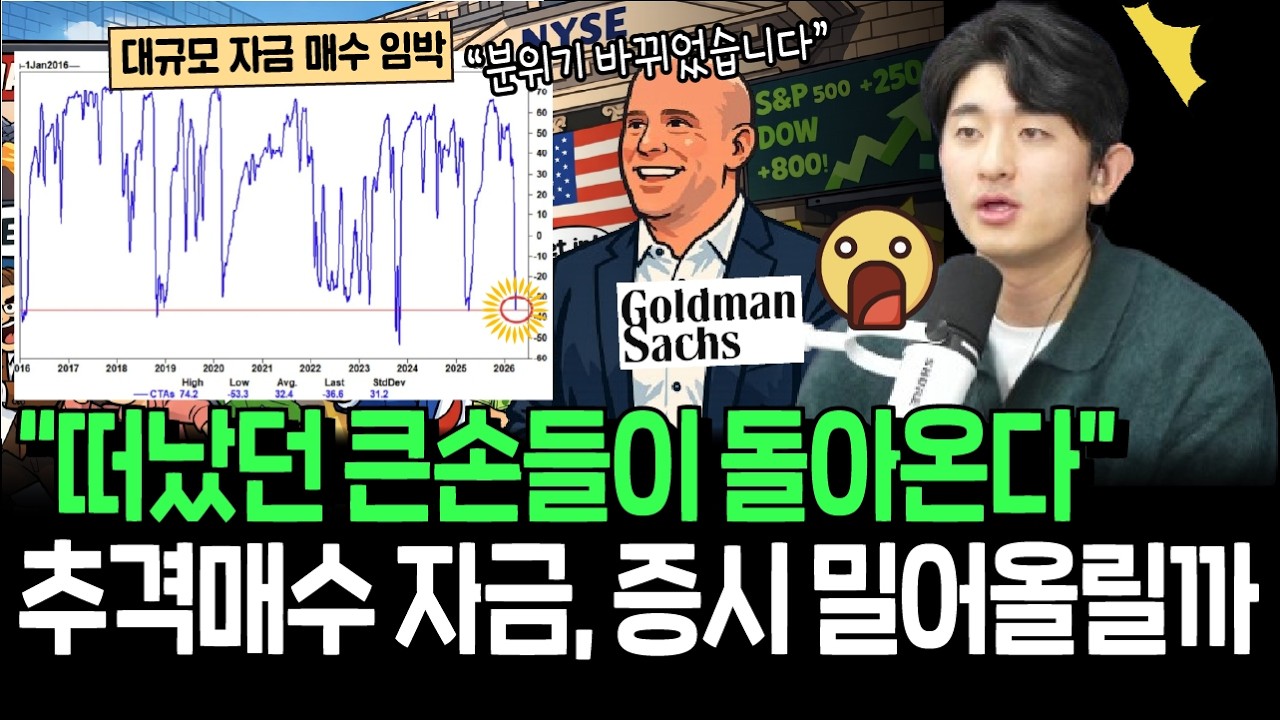
● Hormuz Shock, Trump Gamble, Crypto Toll War
Strait of Hormuz Transit Fees Are Not a Simple Dispute: Trump’s Incentives and Scenarios for Global Economic Reordering
This issue should not be framed solely as “Middle East risk may raise oil prices.” The debate over transit fees in the Strait of Hormuz links to global supply chains, inflation, commodities, dollar hegemony, the diffusion of Bitcoin and stablecoins, and strategic implications for the Korean economy.
Focus areas typically under-covered include: why the scenario may be politically tolerable for Trump; why Iran may prioritize payment rails over legal arguments; and why Korean industrial production and energy-import strategies may need to adapt.
1. Core point: Structural change can proceed even if conflict de-escalates
Even without near-term escalation, rising tension around the Strait of Hormuz and the Bab el-Mandeb is already exerting pressure that can reshape the global economic structure. As with post-pandemic supply chains, Middle East risk may generate persistent changes rather than a temporary shock.
The key is not only whether passage is blocked, but whether a “paid passage” regime becomes normalized. If so, impacts extend beyond crude prices to freight rates, import prices, inventory strategy, crude sourcing, and global monetary arrangements.
2. Situation brief: What is occurring
2-1. Bab el-Mandeb and Hormuz are being used simultaneously as pressure points
The Strait of Hormuz is a major chokepoint, with roughly 20% of global oil shipments transiting. The Bab el-Mandeb is also strategic, with approximately 9–10% of global oil consumption-equivalent flows passing through.
Simultaneous pressure on both routes increases uncertainty for energy and logistics markets. References to both straits by Iran and aligned actors may function more as bargaining leverage than as an indicator of full-scale closure: Hormuz as the direct lever, the Red Sea corridor as a secondary destabilizer to broaden pressure.
2-2. Transit fees in the Strait of Hormuz are not a straightforward international-law issue
Under UNCLOS principles, straits used for international navigation generally provide for transit passage. Unilateral transit fees therefore conflict with common legal interpretations, unlike cases such as the Suez Canal where an artificial infrastructure and maintenance-cost rationale exists.
However, the current environment features more frequent outcomes driven by power dynamics rather than legal norms. As a result, a “legally contested but politically feasible” toll regime cannot be excluded.
2-3. Reports of payment shifting from stablecoins to Bitcoin: why it matters
A reported shift in settlement from stablecoins to Bitcoin is not merely a payment-method change. It signals an attempt to build settlement channels that bypass legacy financial networks.
Given sanctions exposure and SWIFT-related constraints, Iran has incentives to use digital assets with greater sanction-resistance. Whether Bitcoin or stablecoins are used, the strategic direction is similar: experimentation with non-traditional settlement for maritime and energy-linked transactions.
3. How Trump’s incentives may be interpreted
3-1. “User countries should solve it”: implied burden shifting
The message can be read as reduced direct US involvement. Yet the US is not insulated: allies import Middle Eastern crude, refine and process it, and supply products into US markets. Disruption at Hormuz can transmit into US manufacturing costs and consumer inflation even if direct crude imports are limited.
Emphasizing “user-country responsibility” can shift costs to allies and markets while preserving US political leverage.
3-2. Political incentives may dominate administrative principles
Key question: would Trump act as a rules-based administrator or as a political actor optimizing for elections and approval. The latter is plausible.
A controlled de-escalation that limits inflation and supports a favorable liquidity backdrop is politically valuable. Direct compensation to Iran is politically costly; tacit acceptance of fees could provide a negotiated off-ramp without explicit reparations. The decision calculus may prioritize political utility over strict legal consistency.
3-3. Bitcoin and stablecoin diffusion may not be uniformly negative for the US
While expanded digital-asset settlement can appear to weaken the dollar system, the US may be able to absorb and institutionalize it.
Stablecoins often generate demand for US Treasury collateral, especially short-dated bills. Even if Bitcoin settlement expands, supporting infrastructure (liquidity, exchanges, custody, hedging) may grow around dollar-based systems. A plausible pathway is not “digital assets weakening the dollar,” but “digital rails enabling a redesigned dollar-centric system.”
4. Why Iran may pursue transit fees
4-1. Post-conflict reconstruction financing
Iran faces material costs from conflict-related damage. If direct compensation is unattainable, transit fees can function as a quasi-indirect reparation mechanism. Even a USD 1 per barrel-equivalent charge could scale into meaningful revenue.
4-2. Sanctions circumvention and settlement sovereignty
With sanctions limiting usability of proceeds within traditional dollar channels, alternative settlement is a strategic requirement. Digital assets are not a marginal technical choice but a sanctions-evasion and settlement-sovereignty tool.
4-3. Rial weakness and high inflation
In a high-inflation environment, receiving revenue in local currency is less attractive than value-preserving external assets. Settlement in Bitcoin or dollar-linked instruments can be rational as a store-of-value and transfer mechanism.
5. Five channels of impact on Korea and the global economy
5-1. Faster geoeconomic fragmentation
A key risk is discriminatory fee structures by country alignment: lower costs for Iran-friendly states and higher costs for US-aligned users. This would politicize shipping corridors and accelerate fragmentation.
Korea faces a structural dilemma: security alignment with the US and high Middle East energy dependence. Past vessel seizure incidents also suggest limited ability to secure “neutral” treatment.
5-2. Persistent upward pressure on freight rates and crude prices
A single-fee shock may be manageable, but precedent-setting is the core risk. If other chokepoints adopt similar logic, structural freight-cost inflation could follow, feeding import prices and broader inflation.
This complicates central-bank decision-making even in environments where rate cuts are priced in.
5-3. Production models shifting from JIT toward inventory and strategic stockpiles
Firms have already internalized that pure just-in-time models are fragile under geopolitical shocks. Passage risk and toll regimes increase incentives to hold more raw-material and critical-component inventory.
Inventory may be reclassified from “cost” to “insurance,” altering cost structures and expanding demand for warehousing, stockpile facilities, smart logistics, and AI-based demand forecasting.
5-4. Accelerated diversification of crude import sources
For Korea, high Middle East dependency becomes a renewed strategic risk, supporting faster diversification including increased US crude.
The US has strengthened its position as a major producer and exporter, and US political leadership may use the situation to justify stronger requests for allied purchases of US energy. Korea may partially accommodate under energy-security constraints.
5-5. A new phase in US–China monetary competition
Long-term significance centers on the monetary and settlement order. China continues to promote CNY settlement; the US seeks to preserve dollar-centric finance.
If transit fees begin to be charged via digital assets, parts of energy trade settlement could detach from SWIFT-centric rails. The competitive arena shifts from trade invoicing toward digital settlement infrastructure.
The scenario is not necessarily adverse for the US if stablecoin regulation and Treasury-demand reinforcement are pursued in parallel. The more relevant frame may be “re-engineering dollar primacy through digital assets.”
6. Under-covered critical points
6-1. The primary issue is settlement-infrastructure transition, not the fee level
Most commentary centers on crude and freight. The higher-order issue is settlement. Once maritime passage fees are payable in Bitcoin or stablecoins, energy logistics and digital assets become operationally linked, potentially extending to crude, LNG, and strategic minerals.
6-2. Middle East de-escalation optics alongside US financial restructuring
A dual-track outcome is plausible: visible conflict management combined with expansion of a US-anchored digital-dollar ecosystem and reinforcement of Treasury demand.
6-3. Korea must redesign supply-chain strategy beyond crude
The issue spans petrochemicals, semiconductors, autos, batteries, shipping, aviation, and defense. Higher input and logistics costs directly affect export competitiveness.
Required responses include: diversified energy procurement, critical-material inventory policy, AI-based supply-chain risk prediction, and integrated FX/commodity hedging.
7. Implications through an AI and Industry 4.0 lens
7-1. Rising demand for AI supply-chain management
As geopolitical risk rises, firms will demand capabilities beyond standard ERP: real-time risk detection and dynamic route and sourcing optimization. Focus areas include AI demand forecasting, freight-rate prediction, energy-price simulation, and multi-sourcing recommendation systems.
AI shifts from a cost-optimization tool to a resilience tool.
7-2. Faster experimentation with blockchain-based trade settlement
The issue indicates that blockchain settlement can move from “crypto investment” into real-economy trade, including energy logistics cost settlement. Integration may extend across trade finance, shipping documentation, insurance, and payment confirmation.
7-3. Stronger linkage between digital assets and commodity markets
If digital-asset settlement increases even marginally in oil, gas, and strategic minerals, correlation between financial markets and commodity markets may increase. Bitcoin may acquire additional geopolitical utility as a sanctions-avoidance and settlement alternative.
8. Practical monitoring points for Korea: macro and investment
8-1. Near-term indicators
- Crude price trends
- Freight indices
- KRW/USD exchange rate
- Earnings sensitivity in refining, airlines, and shipping
- Growth in US crude imports by Korea
8-2. Medium-term indicators
- Korea’s energy-import diversification policy
- Strategic stockpile expansion
- Corporate inventory-policy shifts
- Capex growth in logistics automation and AI supply-chain solutions
8-3. Long-term indicators
- Reconfiguration of dollar primacy
- Expansion of CNY settlement
- Penetration of Bitcoin and stablecoins into physical trade settlement
- Changes in the demand structure for US Treasuries
9. Conclusion: This is an “order-change” development, not an oil headline
The Strait of Hormuz transit fee debate is not limited to whether oil prices rise. It is an early signal of how post-conflict costs are allocated, how trade is settled, and how blocs and infrastructure may bifurcate.
Trump’s incentives may be closer to maximizing US political and financial leverage than to narrowly managing Middle East security. Korea should treat the issue as a combined challenge across energy security, supply-chain redesign, digital settlement evolution, and AI-driven industrial strategy.
< Summary >
- The Strait of Hormuz transit fee debate is a structural issue that can simultaneously affect supply chains, crude prices, inflation, commodities, and monetary-competition dynamics.
- Trump may prefer an implicit fee-based off-ramp over explicit compensation; Iran has incentives to seek digital-asset settlement to fund reconstruction and circumvent sanctions.
- Potential second-order effects include geoeconomic fragmentation, structurally higher freight costs, shifts away from JIT toward inventory, faster crude-source diversification, and intensified US–China competition in digital settlement infrastructure.
- The critical vector is settlement-infrastructure transition; Korea should redesign energy security and AI-enabled supply-chain strategy accordingly.
[Related Articles…]
- https://NextGenInsight.net?s=AI
- https://NextGenInsight.net?s=%EB%8B%AC%EB%9F%AC
*Source: [ 경제 읽어주는 남자(김광석TV) ]
– 호르무즈 해협 통행료 징수에 담긴 트럼프의 ‘진짜 의도’와 그 파장 [경읽남 240화]
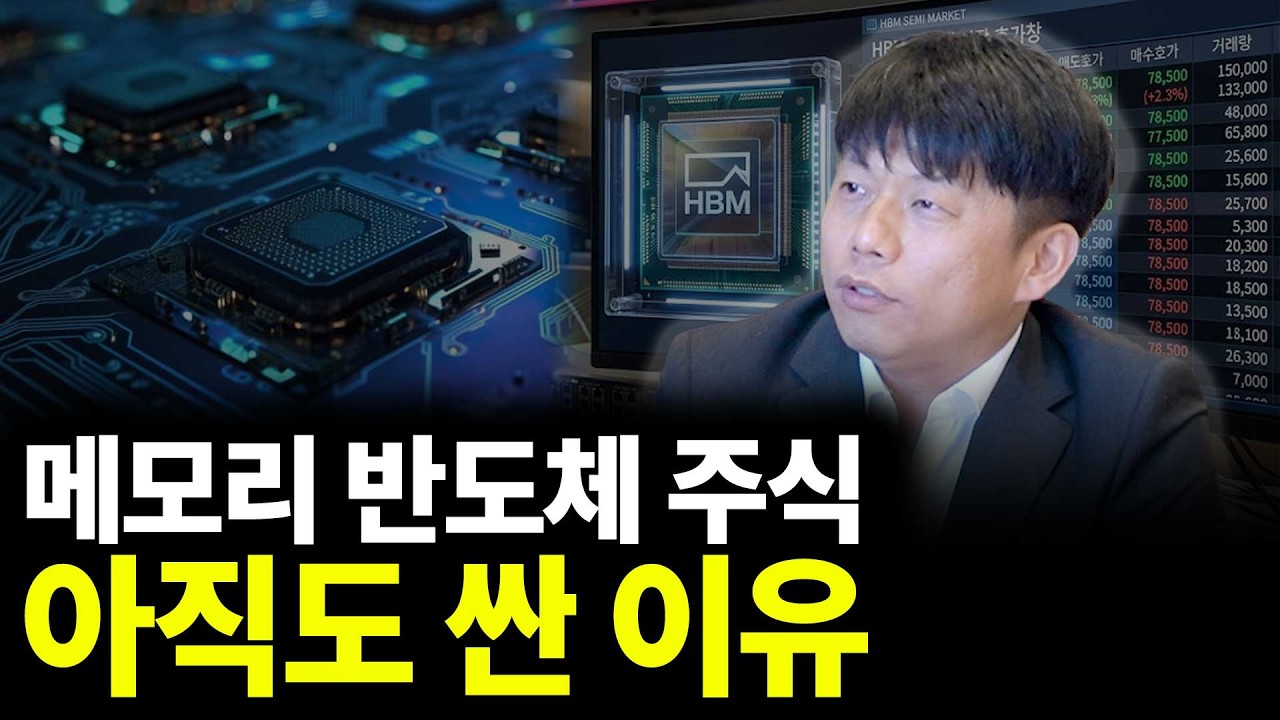
● Memory Boom, HBM Surge, AI Goldmine
Memory Semiconductor Equities Still Appear Undervalued: The Key Re-Rating Drivers for Samsung Electronics and SK Hynix
The current memory semiconductor market should not be viewed solely through the lens of a cyclical upturn. Three factors are increasingly central:1) China, Taiwan, and Japan are not closing the gap in HBM and advanced memory as quickly as previously assumed.
2) As AI adoption accelerates, the persistent bottleneck is increasingly memory rather than compute.
3) As the ecosystem expands into optical interconnects, photonics, and physical AI, memory, backend processes, and substrates may be re-rated together.
This report summarizes why valuation still appears discounted for Samsung Electronics, SK Hynix, and memory-related equities; where HBM competitive dynamics stand; whether turbo quantization and compression-focused AI could structurally reduce memory demand; and where capital is most likely to concentrate in the post-2026 semiconductor cycle. It also highlights two under-discussed points: talent mobility as a critical competitive variable, and data movement (not computation) as a core constraint in the AI era.
1. Key takeaways: Why memory semiconductor equities still look inexpensive
AI-driven demand, HBM tightness, and data-center expansion have supported positive expectations. However, Samsung Electronics and several memory-related equities have not consistently received a full premium.
A primary reason is market anchoring to legacy memory cyclicality, i.e., the assumption that memory remains predominantly a cycle-driven industry.
The demand mix is shifting from PC/smartphone-driven volumes toward AI servers, HBM, data centers, autonomous systems, and physical AI. This suggests a change in demand quality, not merely a rebound.
The valuation discount may therefore reflect delayed recognition of structural change rather than a lack of near-term earnings improvement.
2. Can Japan, Taiwan, and China catch up in HBM?
2-1. Bottom line: Unlikely within three years
A common view is that it will be difficult for Japan, Taiwan, and China to meaningfully catch Korea in HBM and advanced memory within the next three years. This reflects combined gaps in process generation, yield, design margin, and mass-production experience.
2-2. Taiwan is strong, but memory is a different competitive game
Taiwan’s dominance in foundry is well established (e.g., TSMC’s execution, yield management, and advanced-node operations). However, memory competitiveness depends heavily on tightly coupled design-and-manufacturing integration.
In memory, yield resilience relies on design choices such as redundancy and production-proven know-how. The key is not only how small features can be printed, but how effectively design and manufacturing are co-optimized to maintain performance despite defects. This capability is difficult to replicate quickly.
Historically, Taiwan’s attempts to scale memory have been less durable, underscoring that approaches optimized for logic foundry do not transfer directly to memory.
2-3. Japan: greater emphasis on logic ecosystem than memory resurgence
Japan is more focused on rebuilding an advanced manufacturing and logic ecosystem than on large-scale memory revival. Remaining domestic memory capacity is limited, and major initiatives such as Rapidus are more aligned with advanced logic than with memory.
Accordingly, Japan is not widely viewed as an immediate direct threat to Korea’s memory incumbents.
2-4. China: high intensity, but a three-year process gap remains material
China’s policy support and capital base are substantial, sustaining investor concern about long-term convergence. The key variable is timing.
A frequently cited gap in advanced DRAM is approximately three years. In semiconductors, a three-year gap is significant: a difference of roughly two process generations can translate into ~30% wafer productivity differences, which can widen further once yield dispersion is incorporated. This can create a large cost and margin advantage even at similar selling prices.
China may expand output share, but achieving comparable profitability and head-to-head competition at the high end likely requires more time.
3. The critical risk: People may matter more than technology
In semiconductors, equipment, IP, design, and materials are important, but senior engineering experience is often decisive.
Process recipes, yield stabilization, defect pattern response, and ramp-to-volume execution contain substantial tacit knowledge that is not easily transferred through documentation.
China’s most effective acceleration lever is therefore talent acquisition rather than equipment procurement alone. If key personnel move, the pace of convergence can increase materially.
Investors should monitor not only process-node headlines, but also talent flows, technology-leakage enforcement, and cross-border hiring dynamics.
4. Do turbo quantization, compression, and low-cost AI reduce memory demand?
4-1. Low probability of near-term structural disruption
Efficiency gains in AI models raise recurring concerns that memory procurement could decline. However, the market environment remains tight, and hyperscalers have strong incentives to translate efficiency into higher performance and faster scaling rather than proportional spending cuts.
In practice, a 6x efficiency improvement is more likely to be reinvested into performance and deployment expansion than to result in a 6x reduction in hardware demand.
4-2. Compression adoption depends on reliability, not only performance
Compression is attractive for cost reduction, but at data-center scale, accuracy and operational reliability are critical. If compression/decompression introduces errors, the risk profile increases materially, and even small data errors can affect model outputs.
Large-scale commercialization therefore requires robust system-level reliability, including alignment with error-correction mechanisms such as ECC.
4-3. Recent low-cost AI cases highlight memory and data-movement optimization
Many “low-cost AI” examples are less about using fewer GPUs and more about optimizing memory utilization and data movement. This reinforces that memory remains a central bottleneck: faster compute does not translate into performance if data cannot be supplied efficiently.
As efficiency techniques improve, the competitive focus may shift further toward how effectively memory and data movement are managed, rather than reducing memory’s importance.
5. Why optical interconnects are gaining attention
5-1. The core driver is performance per watt
The dominant AI-era hardware constraint is performance per watt. Data-center power consumption is rising, increasing the premium on achieving more performance at lower energy cost.
5-2. HBM’s value is driven by proximity
HBM sits adjacent to the GPU, reducing physical distance for data transfer and improving energy efficiency relative to fetching data from farther memory tiers. The value proposition is therefore both bandwidth and proximity-driven power efficiency.
5-3. Optical interconnects address copper’s scaling limits
Within data centers, connectivity is increasingly shifting toward optical links as bandwidth and distance requirements rise. Copper suffers from resistive losses and power inefficiency at high speed and longer reach. Optical solutions can offer superior throughput and energy characteristics at scale, making them increasingly infrastructure-critical for AI data centers.
5-4. Adoption sequence: inter-rack optics -> intra-rack optics -> photonics packaging
Near-term growth is strongest in larger-link domains (e.g., rack-to-rack). Subsequent phases are expected to move into intra-rack connectivity and, longer term, into package-level and chip-to-chip optical solutions.
Key terms include silicon photonics and photonics packaging. Broad commercialization is often discussed around 2028–2030, implying that investment timing should distinguish near-term revenue opportunities from longer-duration R&D themes.
6. Physical AI: why semiconductors become more critical
6-1. Physical AI is a semiconductor-intensive system
Physical AI includes robots, autonomous vehicles, and industrial automation. These systems require a wide semiconductor stack: sensors, GPUs/CPUs, power semiconductors, connectivity chips, memory, and MCUs. This is less a single-chip story and more an ecosystem-wide expansion.
6-2. Memory remains central
Robotics and autonomy require real-time perception and decision-making using high-volume sensor data. Latency and reliability are critical; memory bandwidth, capacity, and data integrity strongly influence system responsiveness. Compute alone cannot deliver performance without adequate memory support.
6-3. Substrates, packaging, and backend processes also re-rate
As physical AI scales, attention should extend beyond front-end wafers to substrates, packaging, and backend manufacturing. Larger integrated systems require stable interconnects, power delivery, and signal integrity, increasing the relevance of PCBs, high-layer substrates, package substrates, and related components.
As AI hardware complexity rises, value capture may broaden from marquee chip designers to enabling supply-chain layers such as substrates and advanced packaging.
7. Investment framework: key groups to monitor
7-1. Memory semiconductors
Core keywords: HBM, DDR, server DRAM, NAND normalization. This segment is most directly linked to AI infrastructure capex. The re-rating thesis for Samsung Electronics and SK Hynix is closely tied to HBM-driven mix improvement and sustained server memory demand.
HBM is not simply a higher-spec DRAM; it functions as a bottleneck solution for AI, supporting differentiated pricing and margins versus commodity DRAM.
7-2. Optical interconnects and silicon photonics
These trends align with data-center scaling and energy-efficiency requirements. However, near-term earnings exposure and longer-term optionality are mixed; investors should separate technologies by commercialization timing.
7-3. Substrates, packaging, and backend processes
As AI silicon becomes more complex, bottlenecks increasingly migrate into packaging and backend capacity. Substrate tightness, advanced packaging growth, and thermal management requirements are central drivers.
7-4. Physical AI semiconductor ecosystem
Autonomy, robotics, and industrial automation are likely to remain multi-year themes. Beneficiaries may span memory, logic, sensors, substrates, and power semiconductors.
8. Under-discussed points
8-1. The competitive core is tacit manufacturing knowledge
Markets often emphasize export controls and capex. In practice, tacit know-how and production experience can be more decisive. This makes talent depth and retention a potentially critical competitive variable.
8-2. The AI bottleneck is increasingly data movement cost
GPU performance is important, but moving data quickly, accurately, and efficiently is becoming the dominant constraint. Under this framing, HBM, optical interconnects, photonics, packaging, and substrates form a coherent theme: data-movement optimization.
8-3. The valuation discount may reflect recognition lag, not weak fundamentals
If the market continues to frame memory primarily as cyclical, valuation may lag structural shifts. If memory is increasingly interpreted as AI infrastructure, the valuation framework itself could change.
9. Practical investor checklist
- Continuously distinguish whether HBM demand is transitory or structurally durable.
- Avoid both complacency and overreaction on China; monitor talent mobility as a concrete risk factor.
- Treat optical interconnects and photonics as related but not identical themes; commercialization timelines differ.
- For physical AI, evaluate the stack: memory, packaging/substrates, sensors, and power devices.
- In equities, narrative shifts can re-rate multiples ahead of reported earnings.
10. Conclusion: Why memory semiconductors merit renewed focus now
The current memory upcycle is not solely cyclical. Multiple drivers are progressing simultaneously: AI infrastructure expansion, HBM-led product-mix change, intensified data-movement bottlenecks, and expansion narratives into optical interconnects and physical AI.
Korean memory leaders retain meaningful advantages in technology and mass-production execution, while competitor catch-up appears constrained by time, yield learning, and experience.
The perception of “cheap” valuations may reflect that the market has not fully repriced memory as AI-era infrastructure. Investors should monitor interest rates, FX, capex, and data-center investment cycles, while evaluating memory not only as a cyclical exposure but as a core enabling asset in AI compute systems.
< Summary >
Memory semiconductor equities may still screen as inexpensive because markets remain anchored to legacy cyclicality frameworks.
In practice, AI adoption is strengthening structural demand for HBM, server DRAM, and data-center memory.
Competitive catch-up from China, Taiwan, and Japan appears limited in the near term; gaps in advanced process, yield, and mass-production experience remain material.
Even with AI efficiency advances, bottlenecks persist in memory and data movement, limiting the likelihood of a rapid decline in memory’s strategic importance.
A full-cycle view should incorporate optical interconnects, photonics, physical AI, and substrates/packaging to interpret semiconductor opportunities more holistically.
[Related links…]
- https://NextGenInsight.net?s=HBM
- https://NextGenInsight.net?s=optical%20interconnects
*Source: [ Jun’s economy lab ]
– 메모리 반도체 주식 아직도 싼 이유 (ft. 박준영 대표 2부)