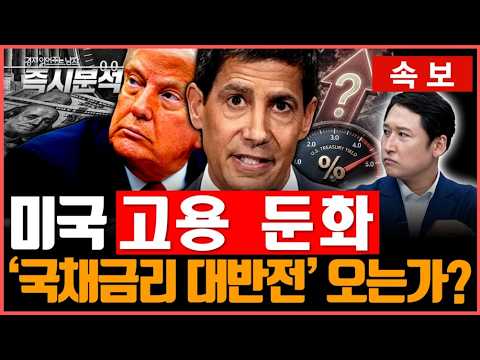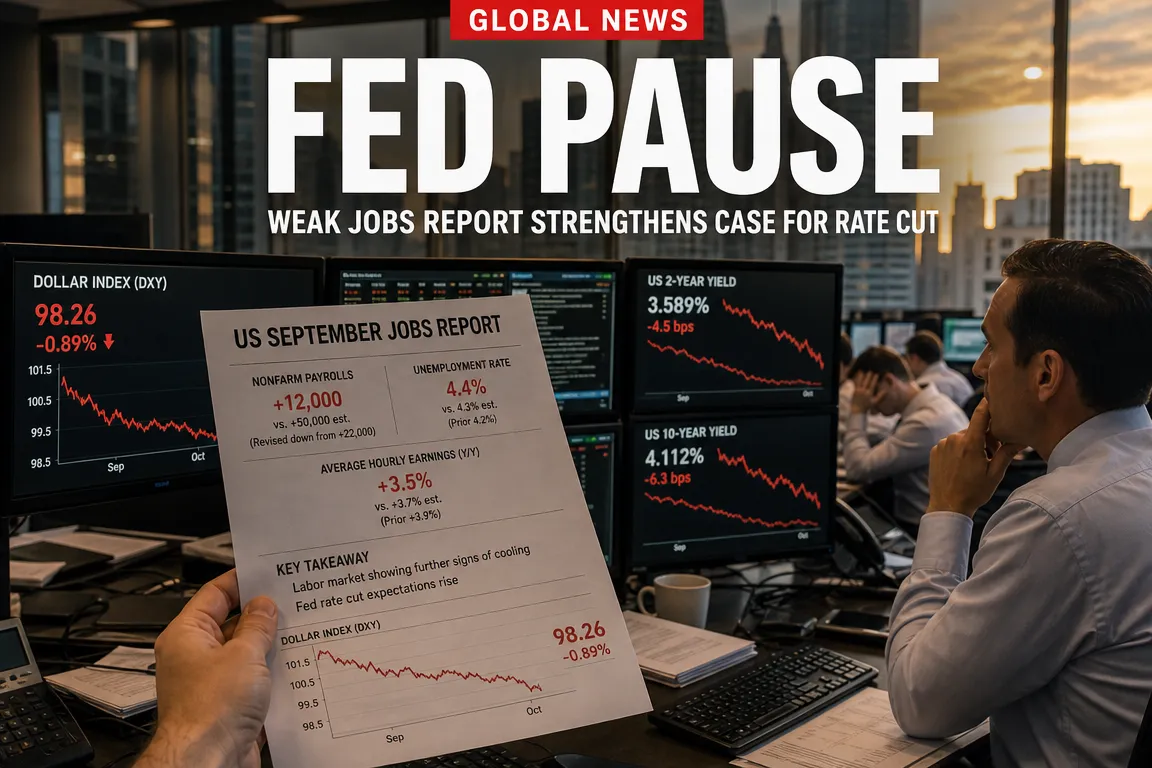
● Job Shock, Fed Pause, Dollar Drops
U.S. September Employment Data Weakens; Will It Constrain Further Fed Rate Hikes?
The key point in the latest U.S. employment report is not simply that employment deteriorated.
Nonfarm payrolls, the unemployment rate, and wage growth all came in weaker than market expectations, indicating renewed uncertainty over the Federal Reserve’s policy path.
Immediately after the release, U.S. Treasury yields and the dollar index fell sharply, suggesting that markets interpreted the data less as a recession signal and more as relief from further rate-hike pressure.
This report summarizes U.S. September employment data, the Fed’s policy outlook, the U.S. economic backdrop, changes in rate-cut expectations, and implications for Bank of Korea monetary policy.
1. Key Takeaways from U.S. September Employment Data
The U.S. Bureau of Labor Statistics reported that nonfarm payrolls increased by 29,000 in September.
The market had expected roughly 84,000, so the actual figure was only about one-third of consensus.
Given that payrolls rose by 133,000 in the previous month, the pace of labor-market cooling has accelerated materially.
- September nonfarm payrolls: +29,000
- Market expectation: about +84,000
- Previous month payrolls: +133,000
- September unemployment rate: 4.2%
- Market expectation for unemployment rate: 4.1%
- Average hourly earnings: $37.81
- Wage growth: 3.0%
All three major indicators weakened relative to both expectations and prior-month levels.
As a result, markets have quickly concluded that the Fed will find it more difficult to justify additional tightening.
2. Unemployment Rate at 4.2%: Is This a Shock?
The U.S. unemployment rate rose to 4.2% in September.
This was 0.1 percentage point above the market forecast of 4.1%.
With the unemployment rate having recently hovered around 4.1%, this increase clearly signals labor-market cooling.
However, it would be premature to classify the number as an outright employment shock or labor-market crisis.
In the U.S., 4.5% is often viewed as an important threshold for unemployment.
The current 4.2% level remains below that benchmark.
Accordingly, the data point to a gradual easing of labor-market overheating rather than a collapse in employment.
3. Why the 29,000 Payroll Gain Matters
The most notable aspect of the report is the size of the nonfarm payroll increase.
Markets had expected roughly 80,000 to 90,000 new jobs in September.
Instead, payrolls rose by only 29,000.
This does not imply that the U.S. economy has entered recession suddenly.
It does suggest that firms are becoming more cautious on hiring.
Under a higher-rate environment, financing costs rise and both investment and hiring tend to slow.
Higher U.S. Treasury yields also push up corporate borrowing costs.
Large technology companies may be better positioned due to stronger cash holdings, but manufacturers, smaller firms, and consumer-facing companies face greater financing pressure.
Over time, this combination reduces investment and slows hiring.
4. Wage Growth at 3.0%: Positive for Inflation
Average hourly earnings rose by 5 cents month over month to $37.81.
Year-over-year wage growth slowed to 3.0%.
Markets had expected wage growth near 3.2%, but the actual reading was lower.
From a labor-market perspective, slower wage growth is negative.
It may reflect rising job-seeker supply and weakening labor demand.
From an inflation standpoint, however, it is constructive.
Faster wage growth supports consumer spending and keeps services inflation sticky.
Slower wage growth should help ease underlying price pressures over time.
This is particularly relevant for the Fed, which remains focused on sticky inflation dynamics.
5. A “3×2” Weakness Across the Report
The report should be viewed in terms of both sequential and expectation-based deterioration.
The key point is that all three indicators weakened versus both the prior month and market expectations.
- Unemployment rate: weaker than prior month, weaker than expected
- Nonfarm payrolls: weaker than prior month, weaker than expected
- Wage growth: slower than prior month, slower than expected
In other words, six separate comparison points across three indicators all point to labor-market softening.
This materially weakens the case for further Fed tightening.
6. The U.S. Economy Is Still Resilient, Which Makes the Picture More Complicated
Weaker employment data do not necessarily mean the broader U.S. economy has turned soft.
U.S. GDP growth was 2.1% in Q1 2026.
GDP growth in Q2 was 2.2%.
These are still solid growth rates.
Third-quarter growth estimates also remain firm.
Atlanta Fed GDPNow currently projects Q3 GDP growth at around 3.7%.
The New York Fed estimate is around 2.33%.
On a growth basis, the U.S. economy remains resilient.
The new signal is that the labor market is beginning to cool.
That combination makes the Fed’s policy decision more difficult.
Growth remains solid, employment is softening, and inflation has not yet fully normalized.
7. Has the Probability of Another Fed Rate Hike Declined?
The latest employment data should reduce the likelihood of another Fed rate hike.
The Fed’s mandate includes both price stability and maximum employment.
Until recently, price stability has taken precedence, leading to rate hikes aimed at reducing demand.
However, rising unemployment and sharply weaker hiring change the balance.
The Fed is unlikely to continue tightening if doing so risks excessive labor-market weakness.
This report raises the question of whether the Fed still needs to move aggressively.
Moreover, U.S. Treasury yields are already high enough to create tightening conditions through the market itself.
Even without an additional policy hike, financial conditions are already restrictive for households and firms.
8. Why “Bad Is Good” Is Back
The latest employment data can be viewed through the classic “Bad Is Good” lens.
Weak employment is negative for the real economy.
However, for financial markets, it can be positive if it reduces the risk of additional Fed tightening.
Slower hiring lowers the probability of further rate hikes.
Lower hike expectations push Treasury yields down.
Falling Treasury yields ease pressure on the dollar.
This can support equities and other risk assets in the short term.
Following the release, U.S. Treasury yields fell sharply.
The dollar index also declined.
Markets appear to have interpreted the data as limiting the Fed’s room to tighten further.
9. What Falling Treasury Yields and a Weaker Dollar Signal
U.S. Treasury yields serve as the benchmark for global financial conditions.
When Treasury yields rise, borrowing costs across markets tend to increase.
When they fall, risk assets generally gain some relief.
The post-release decline in Treasury yields indicates that markets are pricing in lower odds of additional tightening.
The drop in the dollar index reflects the same logic.
If the Fed is less likely to raise rates further, the dollar’s relative appeal weakens.
This has implications for emerging markets, the KRW/USD exchange rate, and global equities.
For Korea in particular, U.S. yields and dollar trends remain critical external variables.
10. Market Scenarios for the October and December FOMC Meetings
Before the employment release, markets still retained some caution about the possibility of another rate hike.
After the report, the probability of a hold at the October FOMC appears higher.
As previously framed, the probability of a hold was cited at about 78.4%, while the probability of a hike was about 21%.
If the Fed already raised rates in September, it will likely want time to assess the effect.
The December FOMC remains data-dependent.
If CPI, PCE, and employment data remain firm in October and November, the case for another hike could re-emerge.
Conversely, if inflation cools further and labor data weaken again, a hold in December would become more likely.
11. The Fed’s Core Dilemma
The Fed faces a difficult trade-off.
U.S. growth remains solid.
Inflation has not yet fully reached target.
At the same time, the labor market is starting to soften.
If the Fed raises rates further, labor-market weakness could accelerate.
If it pauses too soon, inflation could reaccelerate.
As a result, the Fed is likely to remain highly data-dependent rather than respond to a single release.
Officials who emphasize the transmission mechanism of monetary policy are likely to view higher Treasury yields as already creating sufficient restraint.
That implies the Fed may have room to pause if financial conditions are already restrictive without another policy move.
12. Implications for the Bank of Korea’s Policy Path
The softer U.S. employment data may also affect the Bank of Korea indirectly.
The BOK must balance U.S. rates, the KRW/USD exchange rate, domestic inflation, household debt, and growth conditions.
Assuming the BOK has already raised rates in July and August, the October 22 policy meeting would likely require a cautious assessment of any additional hike.
If U.S. tightening pressure eases, the need for Korea to follow aggressively also diminishes.
However, inflation and FX stability remain important constraints.
If a weaker dollar helps stabilize the won, the BOK could gain flexibility to slow the pace of tightening.
If oil prices or the exchange rate become unstable again, further tightening cannot be ruled out entirely.
13. The Main Point That Is Easy to Miss
Many reports will focus only on softer employment and reduced hike pressure.
But the more important point is that U.S. labor-market cooling may already be driven in part by rising market interest rates, not just the Fed funds rate.
Even if the Fed does not hike again, financial conditions are already tightening.
Higher corporate borrowing costs are reducing investment.
Lower investment leads to slower hiring.
That may be the underlying driver behind the weaker labor data.
Another important factor is the divergence between large technology firms and the rest of the economy.
Large-cap technology companies remain relatively resilient due to strong cash flow and continued AI-related investment.
Traditional industries, smaller firms, and highly leveraged companies are more exposed to sustained high rates.
In other words, the U.S. economy may still appear strong at the aggregate level while internal dispersion is widening.
That will likely matter for sector positioning and broader growth expectations going forward.
14. Signals Investors Should Monitor
First, monitor U.S. Treasury yields.
If yields rise again despite weaker employment, markets may be focusing more on inflation or fiscal risks.
Second, track the dollar index.
A weaker dollar would generally support emerging-market assets and the won.
A renewed dollar rebound would pressure Korean equities and FX conditions.
Third, watch CPI and PCE inflation data.
Even with weaker employment, a reacceleration in inflation could prompt a more hawkish Fed stance.
Fourth, monitor whether nonfarm payrolls continue to slow.
One weak report is not enough to confirm a recession.
However, additional softness in October and November would strengthen the case for rate-cut expectations.
Fifth, focus on corporate earnings for labor and financing cost pressures.
Prolonged high rates will continue to compress margins.
Companies with heavier debt burdens and weaker cash flow are more sensitive to rate dynamics.
15. Policy Outlook
Based on the current trend, a hold at the October FOMC appears more likely.
The Fed will want time to assess the lagged effects of the September hike.
Monetary policy does not affect the real economy immediately.
It typically takes time to filter through market rates, investment, consumption, and employment.
The December FOMC will depend on the inflation and labor data path.
If CPI and PCE stabilize and employment softens further, the Fed may be close to ending the tightening cycle.
If inflation rises again, however, another hike could remain on the table.
At this stage, the market should not expect immediate rate cuts.
The more realistic interpretation is that the probability of rate hikes ending has increased.
16. Conclusion from the September Employment Report
The September U.S. employment report shows that the labor market is moving from overheating toward gradual cooling.
Unemployment rose, payroll gains were far below expectations, and wage growth slowed.
Together, these results weaken the case for additional Fed tightening.
At the same time, the U.S. economy is not yet weak enough to justify a recession call.
Markets are therefore responding more to relief on rate pressure than to fear of a sharp downturn.
That is why the report is being treated as “Bad Is Good.”
Going forward, inflation will be the critical variable.
If weaker employment is accompanied by further disinflation, the Fed will move closer to ending the hiking cycle.
If inflation reaccelerates while labor weakens, the policy challenge will intensify.
For investors, U.S. labor data, Fed policy, policy rates, rate-cut expectations, and Treasury yields should be viewed as a single connected framework.
What matters most is not the data alone, but how markets interpret and price it.
< Summary >
U.S. nonfarm payrolls rose by only 29,000 in September, well below expectations.
The unemployment rate increased to 4.2%, and wage growth slowed to 3.0%.
Across payrolls, unemployment, and wages, the data were weaker than both prior-month levels and market forecasts.
Because the unemployment rate remains below 4.5%, the report is better viewed as labor-market cooling rather than a labor shock.
The data lowered the likelihood of an additional Fed rate hike in October.
U.S. Treasury yields and the dollar index fell immediately after the release.
Markets are treating the report as “Bad Is Good.”
The next key variables are CPI, PCE, and the October and November employment reports.
At present, the market is moving more toward the view that rate hikes are ending than toward immediate rate cuts.
[Related Articles…]
*Source: [ 경제 읽어주는 남자(김광석TV) ]
– [속보] 미국 9월 고용 예상치 크게 밑돌아 : 연준 추가금리 인상 제동? [즉시분석]