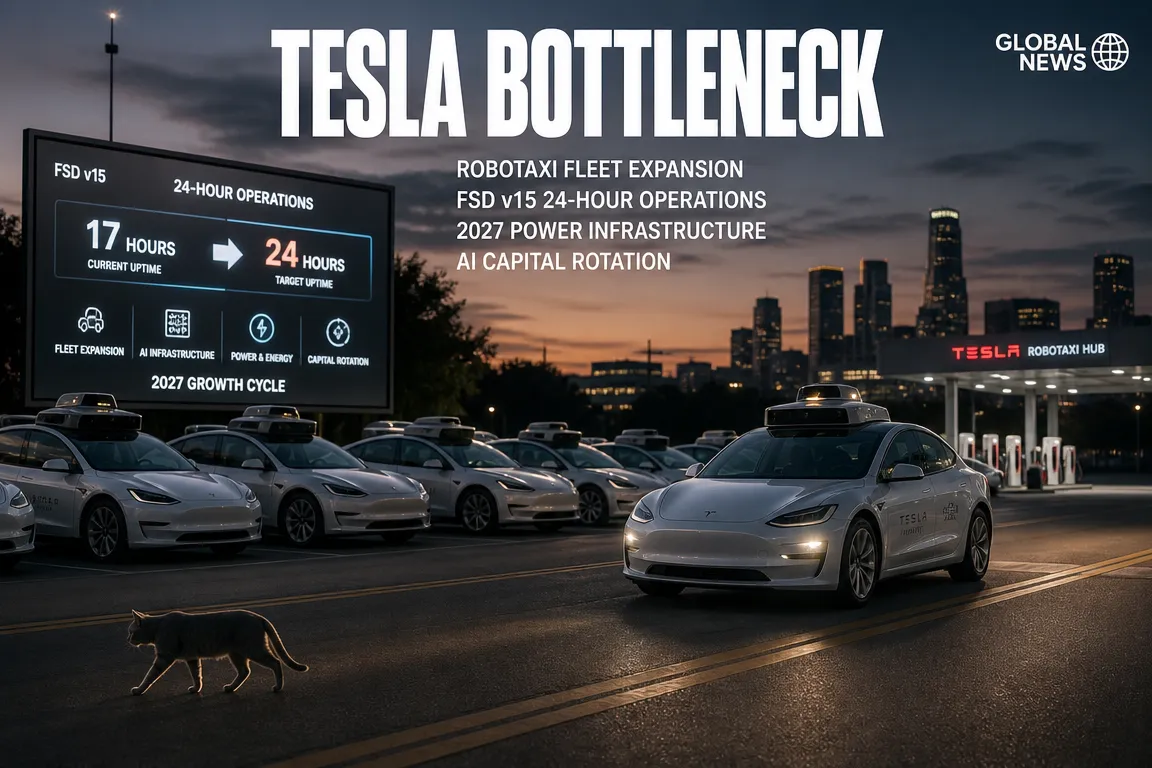
● Tesla RoboTaxi Shock, 4X Fleet Surge, 1-Hour Gain, 2027 Gold Rush
Dan Ives: “This Year Is the Trailer” | The Real Reason Tesla’s Robotaxi Fleet Grew 4x While Operating Hours Increased by Only 1 Hour
The key issue in this development is not simply that Cybercab registrations rose from 45 to 169.
The more important point is that the fleet nearly quadrupled in one month, while actual operating time increased by only 1 hour per day.
This is also linked to Elon Musk’s remarks about avoiding “a gray cat on gray asphalt at night,” FSD version 15, NHTSA regulatory scrutiny, and Dan Ives’ view that 2027 could mark Tesla’s “golden era.”
In other words, this story is less about Tesla’s near-term stock performance and more about the operational bottleneck in autonomous driving commercialization.
For Tesla shareholders holding shares in the $370 range, the key variables are robotaxi operating hours, city expansion, and FSD software upgrades rather than the stock chart alone.
1. Key News in One Line
- Tesla Cybercabs in Texas increased from about 45 to 169 in roughly one month.
- Including Model Y robotaxis, Tesla’s autonomous fleet in Texas is estimated at about 589 vehicles.
- However, Austin robotaxi operating hours increased by only 1 hour, from 10 p.m. to 11 p.m.
- Elon Musk described the core challenge as avoiding small pets that are difficult to see at night.
- Dan Ives characterized this year as an “appetizer” ahead of Tesla’s potential 2027 inflection point.
2. Macro Conditions Are Becoming More Supportive for EV Demand
The original report also referenced Middle East geopolitical risk alongside Tesla news.
The Houthis in Yemen claimed responsibility for missile and drone attacks on Saudi Aramco facilities, while Saudi Arabia denied the claims.
The cause of the fire at the Aramco refining facility has not been confirmed.
What has been confirmed in markets is that Gulf-region exports fell to roughly 60% to 80% of normal levels and Brent crude rose above $100 per barrel.
Higher oil prices increase the ownership cost of internal combustion vehicles and can create a more favorable backdrop for EV adoption.
When fuel prices rise, consumers tend to become more sensitive to the cost differential between charging and gasoline.
This may affect demand not only for Tesla but for the broader EV market as well.
3. Tesla Event Schedule | Road Reveal Delayed to October 15
The road reveal event originally scheduled for October 1 has been postponed to October 15 due to storm forecasts.
The exact start time and location have not yet been disclosed.
Although this may appear to be a simple event delay, Tesla investors will continue to watch for signals on new products, production plans, and autonomous driving software updates.
4. Cybercab Registrations Are Rising Quickly
According to the report, Cybercabs began being registered for commercial use in Texas on September 3.
The initial registration count was 45 vehicles.
The current count has risen to 169 vehicles.
That is nearly a fourfold increase in about one month.
Over the past two weeks alone, 111 vehicles were added.
Between October 1 and October 2, 43 vehicles were newly registered.
At this pace, Tesla’s robotaxi business appears to be expanding rapidly.
| Category | Figure | Investor Implication |
|---|---|---|
| Initial Cybercab registrations | 45 vehicles | Starting point for commercial deployment in Texas |
| Current Cybercab registrations | 169 vehicles | Nearly 4x growth in about one month |
| Increase over the past two weeks | 111 vehicles | Acceleration in registration pace |
| Model Y robotaxis | About 420 vehicles | Expansion through existing vehicle platform |
| Total autonomous fleet in Texas | About 589 vehicles | Approaching Waymo-scale competition in Texas |
5. The More Important Figure Is Operating Time
Tesla’s official robotaxi account said Austin operating hours were extended to 11 p.m.
Elon Musk also confirmed the change from 10 p.m. to 11 p.m.
Because service starts at 6 a.m., daily operating time increased from 16 hours to 17 hours.
The key issue is that the fleet size increased almost fourfold, while operating hours rose by only 1 hour.
This is the central point of the story.
Vehicle supply can be expanded through production and registration, but operating hours depend on software performance and safety validation.
In effect, Tesla’s bottleneck in robotaxi deployment is not vehicle supply but nighttime autonomous driving reliability.
6. CNBC’s View of Cybercab Service Strengths and Weaknesses
According to CNBC, user complaints have focused more on service quality than on autonomous driving safety itself.
Reported issues included long wait times.
There were also cases of passengers being picked up or dropped off at the wrong location.
Some vehicles reportedly failed to fully close upward-opening doors or trunks.
A university student in Austin who has taken Cybercab about 30 times said that waiting more than 45 minutes was common at launch.
He added that wait times have improved as demand has become more evenly distributed.
He described the ride quality as very smooth and said no major accidents or collisions have been reported so far.
This is important.
The current issue is less about autonomous driving danger and more about an early-stage service operation.
7. Tesla’s Position Becomes Clearer When Compared with Waymo
Waymo reportedly has 1,154 commercial vehicles registered in Texas alone.
Tesla’s Cybercabs and Model Y robotaxis combined are estimated at about 589 vehicles.
On a Texas basis, Tesla has reached roughly half of Waymo’s scale.
But on a U.S. basis, Waymo operates more than 4,000 autonomous vehicles.
Its weekly paid rides exceed 500,000.
That is more than 70,000 rides per day.
Waymo also operates 24 hours a day.
That remains the most significant gap between Tesla and Waymo.
| Comparison Item | Tesla | Waymo |
|---|---|---|
| Vehicles registered in Texas | About 589 | About 1,154 |
| U.S. fleet scale | Early expansion phase | More than 4,000 vehicles |
| Operating hours | 6 a.m. to 11 p.m. | 24 hours |
| Weekly paid rides | Limited disclosure | More than 500,000 |
| Key challenge | Nighttime safety, regulatory approval | Service expansion, accident risk management |
8. Elon Musk’s Core Point | Not Traffic Lights or Pedestrians, But the “Gray Cat” Problem
Elon Musk confirmed the extension to 11 p.m. and made a notable comment about the remaining challenge.
He said Tesla’s current priority is avoiding small pets that are difficult to see at night.
More specifically, he referred to avoiding a gray kitten on gray asphalt in low-light conditions.
At first glance, this may sound unusual.
From an autonomous driving perspective, however, it is a meaningful technical issue.
Humans are larger and more visually distinct, making them easier to recognize.
Small animals are harder to detect because they are small, move unpredictably, and can blend into the road surface.
Tesla is pursuing autonomous driving through camera-based vision AI rather than lidar.
As a result, the combination of darkness, gray pavement, and a small animal is a real stress test for Tesla’s AI system.
9. Why FSD Version 15 Matters
The report identified FSD version 15 as the key software release for addressing this issue.
Some early form of FSD version 15 is reportedly already running in certain robotaxis.
During the July earnings call, Elon Musk said the version 15 system would include about seven major improvements.
He also said roughly 40% of that initial capability is already operating in current vehicles.
The target this month is to complete the remaining improvements and deploy the full version across the robotaxi fleet, which would support 24-hour operations.
FSD version 15 is reported to contain 10 times more parameters than FSD version 14 used in owner vehicles, reaching about 10 billion parameters.
The significance is not simply model size.
It implies greater capacity to interpret complex scenes, distinguish smaller objects, and handle more nuanced decision-making.
10. Why 24-Hour Operations Would Change Robotaxi Economics
Current Austin robotaxi operations run for 17 hours per day.
If 24-hour operations are enabled, available service time would increase by about 41%.
That means the same vehicle could be used more intensively without adding new units.
Demand at 3 a.m. is not equal to demand at 6 p.m.
Therefore, revenue would not automatically rise by 41%.
However, the fleet could absorb demand that is currently inaccessible, including airport transfers, night-shift commuting, and late-night travel.
In robotaxi businesses, utilization matters far more than vehicle sales.
For investors, the difference between a car manufacturer and a mobility platform is reflected in valuation.
That is why a move to 24-hour operations is an important checkpoint for long-term Tesla investors.
11. Does Lidar Solve the Problem? A Practical Answer
Waymo uses lidar.
Lidar measures distance with lasers, so the difference between day and night is less pronounced.
That is a clear advantage for nighttime detection.
Waymo’s 24-hour operation also reflects that advantage.
However, lidar does not solve every problem.
The report cited a Waymo incident on October 27, 2023, at 11:30 p.m. in San Francisco, when a vehicle struck a gray tabby cat named KitKat, a neighborhood mascot.
Waymo said the vehicle had stopped to pick up a passenger and the cat moved under the vehicle as it started moving.
In 2023, a separate Waymo incident involving a dog was also reported.
In other words, detecting and reacting to small animals at night remains difficult even for lidar-based systems.
Tesla’s challenge is not that camera-based autonomy cannot operate at night, but rather that Tesla appears to be managing risk more conservatively than Waymo.
12. Tesla’s Caution Also Relates to NHTSA Scrutiny
The U.S. National Highway Traffic Safety Administration began reviewing compliance with federal safety standards shortly after the Cybercab launch.
Tesla was originally expected to respond by September 30, but the company reportedly received an extension.
The specific details have not been disclosed.
However, the timing aligns with Elon Musk’s emphasis on safety caution in autonomous driving.
If a nighttime incident were to occur while Tesla is awaiting its NHTSA response, it could delay not only Austin operating-hour expansion but also entry into other cities.
For Tesla, a single incident could affect the timeline for the entire robotaxi program.
That helps explain why vehicle registrations are rising quickly while operating-hour expansion remains measured.
13. Dan Ives’ Main View | “This Year Is the Appetizer, The Real Story Is 2027”
Dan Ives, one of Wall Street’s most optimistic Tesla analysts, made a key comment in a CNBC interview.
He said Tesla could reach a major inflection point in the first half to middle of 2027.
He added that if robotaxi and autonomous driving momentum accelerate, Optimus could also gain traction in the transition from late this year into next year.
He described 2027 as a potential golden period for Tesla.
He also said he believes there is more than an 80% probability that SpaceX and Tesla could eventually combine by the end of next year.
This is a view Ives has consistently raised over time.
That said, any actual merger would depend on board approval, regulation, shareholder consent, and valuation considerations.
14. The Core of Ives’ Expansion Thesis Is Scale Economics
Ives sees scalability as the key driver of the robotaxi business.
Tesla needs to expand into more cities.
It must move from pilot operations to a true Cybercab rollout.
At that point, he believes the business can move to a higher growth phase.
He described the current phase as an appetizer ahead of a decisive 2027 inflection point.
Importantly, he did not characterize the current year as a failure.
Demand is stabilizing, and the company is laying the foundation for stronger growth later.
15. What $370-Level Tesla Shareholders Should Watch
For Tesla shareholders holding at the $370 level, near-term stock action alone is not enough.
Robotaxi operations are a central part of Tesla’s potential shift in valuation from an automaker to an AI platform company.
Accordingly, investors should track the following indicators as closely as delivery numbers.
- First, whether FSD version 15 is fully deployed this year across the robotaxi fleet.
- Second, whether Austin operating hours expand beyond 11 p.m. into overnight service.
- Third, whether 24-hour operations are actually launched.
- Fourth, whether a second city is confirmed for expansion.
- Fifth, whether NHTSA-related issues slow or constrain rollout.
Tesla will need more than expectations to drive a sustained move in the stock.
Vehicle registration growth matters, but operating-hour expansion and city scaling are stronger signals.
16. Next Candidate Cities | San Antonio, Dallas, Nevada, Florida
CNBC mentioned San Antonio, Dallas, Nevada, and Florida as potential next robotaxi markets.
No final decision has been announced.
However, expansion into a second city would be a strong sign that Tesla has gained confidence in both its autonomous technology and operational stability.
When a city changes, so do road layouts, traffic behavior, weather, and regulatory conditions.
The real test is whether a system that works in Austin can remain stable elsewhere.
For robotaxi operations to become a meaningful investment story, Tesla must move beyond a single-city pilot model to a multi-city expansion framework.
17. The Most Important Point Often Understated in Other Coverage
The most important takeaway is that Tesla is not currently constrained by vehicle supply, but by operating hours.
Most coverage focuses on the increase in Cybercab registrations.
However, the economics of robotaxi operations depend more on utilization than on fleet count.
Even if the fleet quadruples, the business model does not fully open if operations remain limited to before 11 p.m.
That bottleneck is not factory output, but FSD software and regulatory risk.
This is the difference between a traditional automaker and an AI-driven autonomous mobility company.
Tesla’s long-term identity as either an EV manufacturer or an AI mobility platform may be determined in this phase.
18. Investment Interpretation
This year’s Tesla robotaxi news contains both progress and restraint.
Elon Musk had previously said robotaxi adoption could spread broadly in the U.S. by year-end.
But even Dan Ives now views this year as an appetizer rather than the main event.
That implies expectations should be moderated in the near term.
At the same time, it does not mean the long-term direction has changed.
Demand is stabilizing, vehicles are increasing, and FSD version 15 remains a key upcoming catalyst.
Over the next three months, investors may be better served by focusing on operating metrics rather than Tesla’s share price alone.
19. Key Checklist Going Forward
- Confirm whether the full FSD version 15 release is deployed.
- Check whether FSD version 15 is applied to the entire robotaxi fleet.
- Monitor whether operating hours extend from 11 p.m. to midnight, overnight, or 24 hours.
- Assess how the NHTSA review and response affect expansion.
- Watch for confirmation of a second city launch.
- Track whether the gap with Waymo’s paid rides continues to narrow.
- Assess whether Optimus and robotaxi operations become connected in Tesla’s 2027 growth narrative.
< Summary >
Tesla Cybercabs in Texas increased from 45 to 169 in a short period.
Including Model Y robotaxis, Tesla’s autonomous fleet in Texas is estimated at about 589 vehicles.
However, operating hours increased from 16 hours per day to only 17 hours.
Elon Musk said the main challenge is avoiding small pets, especially a gray cat on gray asphalt at night.
This is the key bottleneck for FSD version 15 and 24-hour robotaxi operations.
Waymo remains ahead in 24-hour operations and large-scale paid rides, although small-animal risk exists even in lidar-based systems.
Tesla is likely expanding cautiously because of NHTSA scrutiny.
Dan Ives described this year as an appetizer ahead of Tesla’s potential 2027 golden period.
For shareholders in the $370 range, the key variables are FSD version 15, 24-hour operations, and second-city expansion rather than short-term stock action.
[Related Articles…]
- Tesla Robotaxi and AI Autonomy Investment Themes
- Robotaxi Market Expansion and Global Mobility Competition
*Source: [ 오늘의 테슬라 뉴스 ]
– 댄 아이브스 “올해는 예고편” — 사이버캡 4배 늘었는데 운행은 1시간만, $370 테슬라 주주는?
● Power Surge, AI Spillover, Seoul Housing Squeeze
2027 Economic Outlook: Capital Rotation After Semiconductors Will Favor Power Infrastructure, Physical AI, and Seoul Real Estate
The key points in this 2027 outlook are threefold.
First, capital is no longer moving solely on the basis of interest-rate cuts; government fiscal policy and AI investment direction are becoming more important drivers.
Second, after semiconductors and HBM led the 2026 market, attention is likely to shift toward the energy value chain, including power infrastructure, data centers, SMRs, power semiconductors, and ESS.
Third, Seoul real estate is shifting away from a simple up-or-down price debate and toward a survival-buying market shaped by lease shortages, a transition to monthly rent, supply constraints, and tax changes.
Although semiconductors, AI, and real estate may appear to move independently, the core issue is the same.
In 2027, capital is likely to flow not to the highest-growth sectors, but to areas where bottlenecks emerge.
Viewed this way, the global economic outlook, interest-rate outlook, semiconductor cycle, AI value chain, and Seoul real estate outlook are all connected.
1. 2027 Key Theme: Capital Rotation and Fiscal Dominance
The central concept in this outlook is capital rotation.
Traditionally, capital moves into risk assets when interest rates decline and liquidity expands.
However, 2027 should be viewed differently.
Interest-rate cuts alone may no longer explain market direction, as government fiscal spending and the AI investment cycle may have a greater influence on capital flows.
-
Traditional formula: Rate cuts → liquidity expansion → gains in equities and real estate.
-
2027 formula: Even without full monetary easing, fiscal spending and AI-related investment may concentrate capital in specific industries.
-
Core shift: Fiscal policy may become more influential than monetary policy.
This is often described as fiscal dominance.
In practical terms, the central bank may seek to keep rates elevated to control inflation, while the government spends to prevent an economic slowdown.
The result is a policy structure in which monetary and fiscal policy move in opposite directions.
As a result, markets should not be interpreted through a simple tightening-versus-easing framework.
In 2027, the interaction between monetary and fiscal policy may create more complex effects across asset markets.
2. Geopolitical Distortion from the Middle East Conflict: Oil, Inflation, and Rates
A key assumption in this outlook is the Middle East conflict.
The conflict pushed up global oil prices, and higher oil prices re-accelerated inflation.
As inflation rose again, major central banks shifted away from rate cuts toward rate hikes or sustained high rates.
-
Higher oil prices: Rising energy costs.
-
Inflation rebound: Pressure on both actual inflation and inflation expectations.
-
Rising bond yields: Market rates responded first.
-
Policy adjustment: Changes in monetary stance across Korea, the United States, Europe, and Japan.
Importantly, central banks do not raise rates only because of inflation.
If government bond yields rise too far, fiscal interest burdens increase and financial markets can become unstable.
Rate hikes also serve to signal anti-inflation credibility to the market.
If that credibility is restored, demand for government bonds may improve and yields may stabilize.
Although the policy stance appears restrictive, it may also be viewed as an effort to preserve confidence in sovereign bond markets and the U.S. dollar system.
3. 2027 Interest-Rate Outlook: Further Tightening Appears Limited, Inflation Remains the Main Variable
The main view in this outlook is that the scope for additional aggressive tightening in 2027 is limited.
The reason is the base effect in inflation.
Inflation is measured on a year-over-year basis.
If oil and inflation rose sharply in 2026, then inflation growth in 2027 may naturally slow unless energy prices accelerate again.
-
2026: Oil, inflation, and rate shock driven by the Middle East conflict.
-
2027: Inflation may move closer to the 2% range due to the base effect.
-
Rate direction: Further hikes may be limited, with renewed discussion of cuts once inflation stabilizes.
The key condition is that the conflict does not intensify further.
If geopolitical risk rises again and oil prices spike, the rate outlook could change quickly.
For that reason, the 2027 outlook should be assessed through scenarios rather than a single forecast.
4. Korea Economic Scenarios: Semiconductors and Geopolitical Risk Remain the Main Variables
Korea’s economy was supported in 2026 by semiconductor exports.
However, the composition of that export growth matters.
Export value increased sharply, but much of the gain reflected higher prices rather than a large increase in shipment volumes.
If semiconductor prices plateau or decline, Korea’s exports and growth may weaken.
-
Base case: Semiconductor export momentum continues and the Middle East conflict remains contained.
-
Bull case: Physical AI expands demand and geopolitical risk eases.
-
Bear case: Global big-tech CAPEX slows, semiconductor prices fall, and the Middle East conflict widens.
Korea’s macro outlook ultimately depends on two variables.
Whether the semiconductor supercycle continues.
And whether geopolitical risk intensifies.
5. Where the Next Leaders May Emerge After Semiconductors: The Bottleneck Is Moving
DRAM and HBM led the market in 2026.
AI data-center investment drove strong demand for GPUs, HBM, and high-performance memory.
In 2027, however, the bottleneck may shift from semiconductors to power infrastructure.
Market leaders tend to emerge where demand exceeds supply.
In 2026, HBM and DRAM were constrained.
In 2027, the power required to operate data centers may become the binding constraint.
-
2025: AI and Physical AI become defined investment themes.
-
2026: Investment plans focus on data centers, GPUs, and HBM.
-
2027: Commercial deployment expands and power demand rises sharply.
This does not mean semiconductors are over.
It means investor attention may expand from semiconductors to the infrastructure needed to power them.
6. AI Value Chain: Infrastructure Matters More Than Services
The AI value chain can be divided into four layers.
-
AI services: Chatbots, search, image generation, and workflow automation.
-
AI models: OpenAI, Google, Anthropic, and Chinese AI models.
-
AI infrastructure: Data centers, servers, GPUs, HBM, and networks.
-
Power infrastructure: Generation, transmission, distribution, power semiconductors, ESS, and SMR.
Many investors focus on AI services.
However, capital typically moves first into the infrastructure that makes those services possible.
In 2026, GPUs and HBM were central; in 2027, power infrastructure may become the focus.
As more data centers are built, electricity consumption rises sharply.
The challenge is that grids and generation capacity may not keep pace with data-center growth.
7. Why Power Infrastructure Could Become Central in 2027
It is often said that a single data center can consume as much power as a small city.
As AI models expand, more data centers are built, and Physical AI products spread, electricity demand may rise faster.
The key question in 2027 may therefore shift from whether semiconductors are available to whether sufficient power exists to run them.
-
Generation: Nuclear, SMR, solar, wind, and fossil-fuel generation.
-
Transmission: High-voltage networks that move power over long distances.
-
Distribution: Systems that supply reliable power to data centers and industrial zones.
-
Storage: ESS for power buffering and peak-demand response.
-
Efficiency: SiC power semiconductors and next-generation power control technologies.
In the AI data-center era, generating more electricity is not enough.
How efficiently power is controlled, stored, and delivered to the right location becomes equally important.
8. SMR and Power Semiconductors: Likely Beneficiaries After Semiconductors
SMR stands for Small Modular Reactor.
Traditional large-scale nuclear plants typically require nearly a decade to complete.
By contrast, AI competition requires power now.
That makes SMRs more relevant because they can be built in modular form and deployed faster.
-
SMR advantages: Modular fabrication can shorten on-site installation time.
-
Power system shift: Movement from centralized generation to more distributed generation.
-
Link to AI data centers: Local power self-sufficiency and stable supply are becoming more important.
Power semiconductors are also important.
They function as valves that control power flow.
In particular, SiC power semiconductors are viewed as a next-generation technology that reduces power loss and improves efficiency.
They are used in EV charging, solar inverters, rail, data centers, robotics, and AI devices.
Overall, the key areas within 2027 power infrastructure investment may include SMR, ESS, power semiconductors, copper, and transmission and distribution networks.
9. Physical AI: 2027 Could Mark the Start of Productization
Physical AI refers to AI being embedded into real-world physical products.
While often associated only with robots, the concept is broader.
AI refrigerators, washing machines, automobiles, smartphones, PCs, microphones, and robots all fall under Physical AI.
-
AI service era: Using AI on screens.
-
Physical AI era: AI embedded in consumer devices and industrial equipment.
-
2027 focus: Movement from concept and planning to actual product launches and replacement demand.
Korea is well positioned in this transition.
The country has capabilities across semiconductors, batteries, telecommunications, home appliances, automobiles, robotics, and power equipment.
This is also one reason why NVIDIA may be strengthening cooperation with Korean firms.
GPU capacity alone is not enough to build a Physical AI ecosystem.
It also requires GPUs, HBM, data centers, telecom networks, power grids, and device manufacturing capabilities.
10. Hidden Opportunities in the Physical AI Value Chain: Sensors, Actuators, and Batteries
In robotics and AI hardware, intelligence alone is not enough.
Sensors are required for perception.
Actuators are required for movement.
Batteries are required for long operating time.
-
Sensors: The sensory layer of Physical AI.
-
Actuators: The joints and movement mechanisms of robots.
-
Batteries: A key determinant of runtime for humanoid robots and AI devices.
-
Adhesives and materials: Critical for stable sensor integration in automobiles and robots.
China is advancing quickly in robotics and general-purpose AI hardware.
As a result, it may be difficult for Korean companies to dominate the entire humanoid market.
However, they may remain competitive in batteries, actuators, high-performance sensors, materials, and power-control components.
11. An Underappreciated Issue: AI Model Pricing Could Change Semiconductor Demand
One of the most important issues in this outlook is the pricing competitiveness of Chinese AI models.
U.S. AI companies have supported large-scale CAPEX investment by purchasing substantial quantities of GPUs and HBM, benefiting Korean semiconductor firms.
However, if companies increasingly adopt lower-cost Chinese AI models, what happens next?
Lower AI model costs are positive for consumers and enterprises.
But if they slow the pace of U.S. big-tech data-center investment, HBM and DRAM demand growth could also slow.
Many reports simply state that AI will continue to grow.
From an investment perspective, however, how AI is priced may matter as much as who leads it.
Price competition can be more disruptive than technology competition.
As seen in lidar markets, where Chinese firms undercut U.S. peers through aggressive pricing, a similar dynamic could emerge in AI models.
12. Outlook for Samsung Electronics and SK hynix: Strong Earnings, Different Market Expectations
Semiconductor company earnings may remain strong through 2026 and early 2027.
However, equity prices are driven not only by current earnings, but by expectations for further improvement.
The outlook highlighted declining DRAM share for Samsung Electronics, rising share for China’s CXMT, intensifying HBM competition, and structural issues in foundry competitiveness as key variables.
-
DRAM: Export value increased on price gains, but shipment growth remained limited.
-
HBM: Demand remains strong, but competition is intensifying.
-
Chinese memory: Share gains may begin with lower-end DRAM.
-
U.S.-China self-sufficiency: A long-term challenge for Korea’s export-led model.
This does not imply weakness in semiconductors.
Rather, it suggests that investors should not rely only on semiconductors to assess the 2027 market.
Market leaders often emerge where the next bottleneck appears.
13. Seoul Real Estate Outlook: Lease Shortage Matters More Than the Direction of Prices
The key issue in Seoul real estate is not simply whether prices rise or fall.
The more important issue is the shortage of leases and the shift toward monthly rent.
Seoul apartments have already been in an uptrend for more than 80 weeks, with gains spreading from Gangnam to the Han River belt, and then to northern Seoul and southern Gyeonggi.
This cannot be explained by liquidity alone.
It reflects survival buying, as end users are pushed into purchase decisions by lease instability.
-
Gangnam: Tax burdens and holding costs may lead to some distressed listings.
-
Han River belt: Follow-on demand after gains in Gangnam.
-
Northern Seoul: Higher upside due to relatively lower price levels.
-
Southern Gyeonggi, Incheon, outer suburbs: Demand may spill over as Seoul becomes unaffordable.
For non-homeowners, waiting to buy only when prices fall is often unrealistic.
During periods of price weakness, uncertainty rises and borrowing conditions deteriorate, making actual purchases difficult.
14. How Long Can the Lease System Hold Up? Instability May Last at Least Five Years
The outlook suggests that lease-market instability could persist for at least five years.
The main reason is supply.
New apartments typically require four to five years from construction start to move-in.
Even if supply expansion begins now, lease inventory will not increase quickly.
-
Longer construction periods: Higher material and labor costs, safety regulations, environmental requirements, and work-hour limits all extend timelines.
-
Limited Seoul supply: Land scarcity and the long lead time for redevelopment reduce flexibility.
-
Rising landlord burden: Higher taxes and regulation encourage monthly rent over leases.
-
Tenant uncertainty: Lease shortages and monthly-rent pressure may increase simultaneously.
If this continues, Seoul may transition more rapidly from a lease-based market to a monthly-rent-based market.
The main risk is a structure closer to Singapore, where monthly housing costs are high.
15. Structural Issues in Seoul Real Estate: Demand Is Strong, Supply Is Difficult
Seoul real estate has structural constraints that are difficult to solve through short-term policy.
Seoul concentration persists because education, jobs, transportation, healthcare, and cultural infrastructure are all centered there.
Even if Seoul’s population declines, housing demand does not necessarily fall.
People are being priced out into Gyeonggi and Incheon; the preference for Seoul itself remains intact.
-
Seoul demand: Newly married couples, workers, in-migration from outside the capital, education demand, and divorce or household-splitting demand.
-
Seoul supply: Limited new construction, redevelopment delays, and rising project costs.
-
Capital-region spillover: Demand moves to Gyeonggi and Incheon as Seoul becomes less affordable.
The key question is therefore not whether Seoul’s population declines, but whether housing supply can keep up with demand to live in Seoul.
Under current conditions, supply constraints remain difficult to resolve.
16. Tax Changes and Market Distortions: Distressed Sales and Selective Selling
Tax policy is a major variable for high-end and long-term property owners.
Holding-period deductions, residency requirements, high-value property thresholds, and multi-homeowner rules can all influence sale timing.
In Gangnam in particular, some listings may emerge to avoid tax burdens.
These are not necessarily sales driven by expectations of falling prices; they may simply reflect rational tax optimization.
-
Panic selling: Listings driven by expectations of price declines.
-
Rational selling: Listings driven by tax optimization.
The two are not the same.
News coverage often labels both as distressed sales, but the underlying cause should be distinguished.
Panic selling can signal a downtrend, while tax-driven sales may diminish after a certain period.
17. Strategy for Non-Homeowners: Affordability Matters More Than Price Forecasts
For non-homeowners, the question is less “When should I buy?” and more “Can I sustain ownership?”
A home is not as easy to trade as equities.
Therefore, long-term occupancy and cash-flow management matter more than trying to buy at the exact bottom.
-
Debt-service capacity: Whether mortgage payments remain manageable even if rates rise.
-
Housing stability: Whether the tenant can avoid repeated lease renewals and uncertainty.
-
Location choice: If prime Seoul is out of reach, outer Seoul, Gyeonggi, and Incheon may be practical alternatives.
-
Downside resilience: Buyers should be able to absorb 1–3 years of price correction after purchase.
The priority is not aggressive leveraged buying.
For end users, affordability and risk management matter more than price speculation.
18. Core Framework for 2027 Asset Markets: Focus on Bottlenecks, Not Just Macroeconomics
Three questions are central to assessing the 2027 market.
-
First, where does capital come from?
Fiscal spending and government-led industrial investment may matter more than rate cuts.
-
Second, where does the bottleneck emerge?
HBM and DRAM were the bottlenecks in 2026, but power infrastructure may be the bottleneck in 2027.
-
Third, where does end-user demand migrate?
Lease shortages and the shift to monthly rent may push demand toward northern Seoul, Gyeonggi, and Incheon.
This framework makes the market much clearer.
The AI revolution does not end with semiconductors; it extends into power, data centers, Physical AI, and property demand.
Seoul real estate should be viewed not as a simple liquidity-driven market, but as a structurally constrained market shaped by supply shortages and housing insecurity.
19. The Most Important Issues Rarely Discussed in Other Media
The first key point is that the next theme after semiconductors is power, not more semiconductors.
Most investment discussions still focus on HBM, GPUs, and semiconductor equipment.
However, in 2027, the market may shift toward power networks, copper, transformers, power semiconductors, ESS, and SMR because data centers may be constrained by electricity availability.
The second key point is that AI model price competition could weaken semiconductor demand.
AI growth does not automatically mean endless HBM demand growth.
If low-cost Chinese AI models gain traction, U.S. big-tech CAPEX could slow, which would reduce expectations for semiconductor demand.
The third key point is that Seoul real estate may become more sensitive to monthly rent than to home-price direction.
Rising home prices are burdensome, but a reduction in lease supply combined with a sharp rise in monthly rent can change household cost structures materially.
If monthly rent rises sharply, the burden on households that cannot buy will increase further.
The fourth key point is that not all declines are the same.
Tax-driven distressed listings differ from panic-driven distressed listings.
A Gangnam distressed listing does not automatically signal a broad market downturn.
The fifth key point is that 2027 may be the year AI moves beyond the screen.
AI will extend beyond chatbots and image generation into refrigerators, vehicles, robots, smartphones, PCs, and industrial equipment.
That shift may create new opportunities in sensors, actuators, batteries, and power-control components.
< Summary >
The central theme for the 2027 outlook is capital rotation.
The market is moving beyond a simple focus on rate cuts, toward a structure where fiscal spending and AI investment cycles determine capital direction.
If semiconductors and HBM led in 2026, then power infrastructure, SMR, ESS, power semiconductors, and data centers may emerge as the next bottlenecks in 2027.
Physical AI is likely to move from concept to actual product deployment, increasing the importance of sensors, actuators, batteries, AI appliances, and robotics.
Seoul real estate is being reshaped by lease shortages, a shift to monthly rent, supply constraints, and tax changes, and is becoming a survival-buying market.
The key to strategy is not short-term forecasting, but identifying where the next bottleneck will emerge and whether the investor can bear the associated risk.
[Related Articles…]
- Power infrastructure investment trends across the AI value chain
- Seoul real estate outlook and lease-market response strategies
*Source: [ 경제 읽어주는 남자(김광석TV) ]
– [풀버전] 2027년 ‘돈의 역류’가 시작된다… 반도체 다음 돈이 몰릴 곳은 여기입니다 | 경제학교 월간특강 | 2027경제전망 ‘북콘서트’x김인만 소장(부동산)