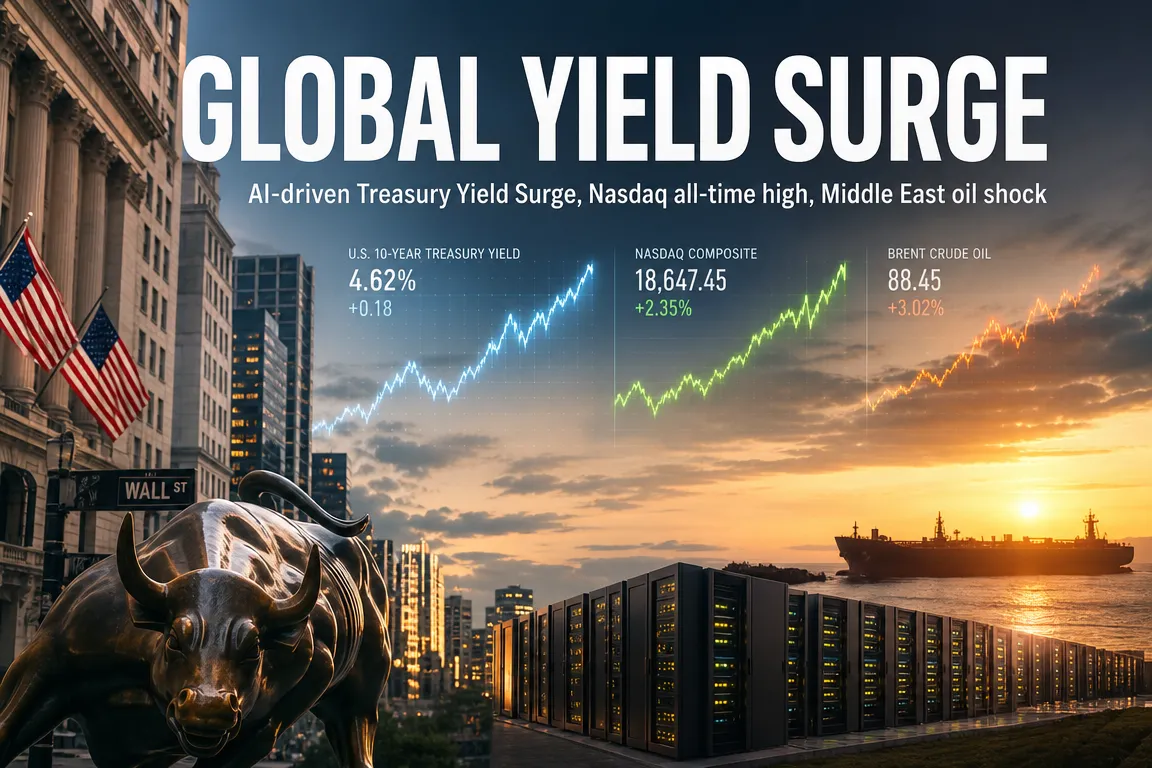
● AI-Driven Yield Surge, Nasdaq Defies Gravity
Six Real Drivers Behind the Surge in Government Bond Yields and the Secret Behind Nasdaq’s All-Time High: AI-Driven Capital Rotation
The most important point in today’s market is not simply that government bond yields have risen.
The real issue is who is buying and selling government bonds, and where that capital is moving.
The current move links higher global bond yields, Middle East geopolitical risk, crude oil, inflation, policy-rate expectations, China’s US Treasury sales, Big Tech corporate bond issuance, and Nasdaq strength into a single framework.
One factor that many headlines overlook is that the AI investment cycle is influencing both the bond market and the equity market at the same time.
The reason Nasdaq is reaching record highs even with Treasury yields above 5% is also explained by this dynamic.
1. Rising global bond yields: why markets are concerned
Global government bond yields have remained elevated across major markets.
Based on the source material, the US 30-year Treasury yield moved above 5.6%, while the US 10-year Treasury yield was also cited around 5.3%.
Rising bond yields are not only a fixed-income issue.
Higher yields increase government interest costs and raise corporate funding costs.
As a result, private companies may reduce bond issuance and new investment.
In economics, this is known as the crowding-out effect.
When governments borrow heavily through bond issuance, less capital is available to the private sector.
Bond yield increases therefore affect the real economy, corporate investment, equities, real estate, and exchange rates.
2. First driver of higher yields: geopolitical tension and crude oil
The first driver is geopolitical tension centered on the Middle East.
When war risks rise in the region, crude oil is typically the first asset to react.
Higher oil prices raise transport costs, energy costs, and manufacturing input costs.
These cost pressures then feed into inflation concerns.
For central banks, rising inflation risk makes policy-rate cuts more difficult.
The chain is clear: Middle East risk → higher oil prices → inflation concerns → delayed rate cuts or renewed tightening → higher bond yields.
The source material also assumed that geopolitical tensions were pronounced in March and September 2026, and could ease somewhat after October.
The key point is not whether a conflict ends, but how markets price energy-related risk.
3. Second driver: monetary tightening and policy-rate uncertainty
The second driver is monetary tightening.
For some time, markets expected the Federal Reserve and other major central banks to shift toward rate cuts.
However, the picture changes when oil prices and inflation become unstable again.
Central banks are unlikely to lower rates aggressively until they are confident inflation is contained.
The source material described a tightening stance across the US, Korea, and the euro area.
Korea was said to have raised policy rates twice, and the euro area to have increased rates twice as well.
More recently, however, inflation data has been more stable than expected, and comments from Fed officials suggesting there is no need to rush into further hikes have helped stabilize bond yields.
The main variable ahead remains inflation data.
If CPI, PPI, wage growth, or crude oil rise again, bond-market volatility could reaccelerate.
4. Third driver: fiscal expansion and higher bond issuance
The third driver is fiscal expansion.
The US and other major economies are deploying substantial fiscal spending on growth support, welfare, defense, industrial policy, energy transition, and AI infrastructure.
A large share of this spending is financed through bond issuance.
As bond supply increases, prices fall and yields rise.
This is closely related to the concept of fiscal dominance.
Central banks may tighten to contain inflation, while governments expand spending to support growth and industry.
Monetary policy is pressing the brake while fiscal policy is pressing the accelerator.
This policy mismatch adds upward pressure to bond yields.
Fiscal expansion is not a temporary event but a structural issue.
Aging demographics, higher defense spending, the energy transition, semiconductor investment, and power infrastructure expansion are likely to keep government spending elevated.
5. Fourth driver: China’s sales of US Treasuries
The fourth driver is China’s sales of US Treasuries.
China was once among the largest holders of US government bonds.
However, its Treasury holdings have declined steadily from the peak around 2013.
The source material said selling was especially strong in January, February, and March 2026, and again in June and July.
There are several possible explanations.
It may reflect financial security concerns amid US-China tensions, the need for dollar liquidity to defend the yuan, or efforts to diversify reserves toward gold and other assets.
Whatever the motive, the market impact is the same.
When a major holder becomes a seller, Treasury prices fall and yields rise.
At the same time, the US government is issuing more debt while large existing holders are reducing exposure.
This creates a structure in which supply rises while demand weakens.
6. Fifth driver: Big Tech corporate bond issuance and AI infrastructure investment
The fifth driver is corporate bond issuance by Big Tech companies.
Although corporate bonds and government bonds are often viewed as separate markets, they compete for investor capital.
Companies such as Google, Amazon, Microsoft, and Meta are often viewed as highly creditworthy, in some cases even more so than sovereign issuers.
As these firms increase capital spending on AI data centers, semiconductors, cloud computing, and power infrastructure, they may rely more heavily on bond issuance.
For investors, these corporate bonds can act as substitutes for US Treasuries within the fixed-income market.
The source material noted that the four hyperscalers have seen free cash flow decline in 2026, leading them to fund investment gaps through bond issuance.
As AI investment expands, Big Tech requires more capital.
When that financing comes through the bond market, it also puts upward pressure on Treasury yields.
7. Sixth driver and the key point: a shift in Treasury investor composition
The original title referred to five reasons, but the most important additional point is the sixth.
It is the change in the investor base for government bonds.
In the past, central banks and public institutions were major buyers of Treasuries.
Today, non-Fed holders, private investors, and overseas private institutions account for a larger share.
The source material said non-Fed holders accounted for nearly 80% of Treasury holdings, while private-sector ownership among foreign holders reached around 50%.
This shift matters significantly.
Central banks and public institutions do not trade Treasuries as actively.
Private investors, by contrast, are highly yield-sensitive.
They may avoid buying when yields appear too low and demand higher compensation.
They can also sell more quickly when market conditions change.
As the Treasury investor base shifts toward private capital, average yields may rise and volatility may increase.
This is one of the most important points often omitted in market commentary.
8. Why Nasdaq is making new highs despite higher yields
In general, rising bond yields are a headwind for equities.
If US Treasuries offer around 5%, the incentive to take equity risk declines.
Even so, Nasdaq remains strong.
The reason is straightforward.
Capital is not flowing into all stocks equally; it is concentrating in AI value-chain companies with proven earnings growth.
The source material used Micron as a representative example.
Micron’s quarterly revenue reportedly rose 379%, while annual earnings growth was described as 256%.
This indicates that AI semiconductors, memory, and data-center investment are translating into actual corporate results.
Revenue growth rates cited for Nvidia, Alphabet, Apple, Microsoft, and Amazon were 106%, 24%, 16%, 17.8%, and more than 19%, respectively.
Given that global GDP growth is around 3% and the growth rates of major economies are in the low single digits, these figures are exceptional.
As a result, capital can continue to flow into companies with growth rates far above bond yields.
9. AI-driven capital rotation: where money goes when it leaves bonds
Higher bond yields mean lower bond prices.
In other words, someone is selling bonds.
The question is where that capital goes.
Real estate remains constrained by higher borrowing costs.
Gold and crypto can absorb some flows, but neither offers the same earnings visibility across the broader market.
Capital therefore tends to move toward sectors with both growth and earnings confirmation.
At present, that center of gravity is the AI value chain.
Key areas include AI semiconductors, HBM memory, cloud services, data centers, power infrastructure, cooling systems, networking equipment, and software platforms.
This is what the source material describes as AI-driven capital rotation.
The old rule that higher rates automatically pressure stocks is no longer fully valid.
Instead, the market is buying only companies that are growing faster than rates.
10. The most important point often missed by other coverage
First, rising bond yields are not only an inflation issue; they also reflect a structural change in Treasury demand.
The market is moving from an era in which central banks were major buyers to one in which private investors demand higher returns.
Second, expanded AI investment by Big Tech is affecting the Treasury market.
As companies issue more corporate debt to fund AI data centers and power infrastructure, corporate bonds compete with Treasuries for investor capital.
Third, Nasdaq’s strength is closer to an earnings-driven market than a liquidity-driven one.
The index is not rising because all equities are improving, but because AI-related companies are delivering exceptional earnings growth.
Fourth, the next key bottleneck is power infrastructure.
As AI models scale, data-center electricity demand rises sharply, and investment in grids and generation capacity may become the next constraint.
The next cycle after semiconductors is likely to come from power infrastructure, cooling, energy storage, and transmission assets.
11. Key monitoring points for investors
-
Crude oil
If Middle East risk eases, inflation pressure may moderate and bond yields may stabilize.
If crude oil surges again, expectations for rate cuts could weaken.
-
US 10-year Treasury yield
This is the benchmark for global asset pricing.
If it does not stabilize, emerging-market equities and exchange rates may remain under pressure.
-
China’s Treasury holdings
If China continues to reduce its US Treasury exposure, supply-demand imbalances in Treasuries may persist.
-
Big Tech corporate bond issuance
As AI capex expands, corporate bond issuance may increase and influence broader bond-market yields.
-
AI company earnings
For Nasdaq strength to continue, AI companies must keep translating investment into revenue and profit growth.
If earnings weaken, higher-rate pressure could weigh on equity valuations again.
< Summary >
The main drivers of higher bond yields are geopolitical tension, higher crude oil prices, inflation concerns, monetary tightening, fiscal expansion, China’s sales of US Treasuries, Big Tech corporate bond issuance, and a shift in Treasury investor composition.
As private investors account for a larger share of Treasury ownership, yield volatility may remain elevated.
Nasdaq remains resilient because AI value-chain companies are delivering exceptional earnings growth.
The current market is not one in which all assets are rising; capital is concentrating in AI semiconductors, cloud services, data centers, and power infrastructure where earnings are visible.
In short, the current market must be understood through both bond yields and the AI investment cycle.
[Related Articles…]
- Treasury Yield Surge and Global Market Implications
- AI Investment Cycle and Big Tech Earnings Outlook
*Source: [ 경제 읽어주는 남자(김광석TV) ]
– 국채금리 오르는 ‘5가지 이유.’ 국채 손바뀜이 일어난다. 나스닥은 왜 최고치를 경신하나 [경읽남 265화]
● Middle-East-Shock,Oil-Squeeze,Drone-War
Middle East Risk Reintensifies: Why Iran’s Blockade Risk, Saudi Air Defense, and the Ukraine War Must Be Viewed Together
The core issue is not simply that Iran was attacked.
The more important point is that pressure on Iran’s oil exports, Saudi air-defense vulnerabilities, the drone-driven evolution of the Ukraine war, and the operational depletion of North Korean weapons are now interconnected.
This dynamic could affect crude oil prices, the global economic outlook, geopolitical risk, defense stocks, and supply-chain restructuring at the same time.
The original video was recorded on September 28, so some statements should be treated as a strong interpretation rather than confirmed fact. It is important to separate factual developments from market implications.
1. Key News Summary: The Real Variable Is the “Dual Blockade” of Sea and Air
-
Claims have emerged that Iran is under pressure at sea and in the air.
The original source describes Iran as being effectively under a dual blockade, with crude oil exports nearly halted.
-
Iran’s capacity for a prolonged conflict is being questioned.
As military confrontation drags on, Iran could face increasing stress in foreign-exchange earnings, oil exports, military procurement, and domestic economic stability.
-
Saudi Arabia is also not a secure zone.
Saudi Arabia, a known buyer of the Korean air-defense system Cheongung-II, is cited as having strong demand for air-defense reinforcement.
-
Damage to North Korean weapons in the Ukraine war is increasing.
According to the original source, Ukrainian forces destroyed a North Korean Type 75 multiple rocket launcher with drones on September 11, and losses of North Korean equipment are gradually becoming more visible.
2. First Clarification: The Claim That Saudi Arabia Bombed Iran Requires Verification
The video title uses a strong phrase suggesting that Saudi Arabia bombed Iran.
However, direct military confrontation on that scale would immediately trigger major reactions in global news and financial markets.
Accordingly, investors should not treat “direct Saudi bombing” as confirmed fact, but rather as a scenario involving intensifying maritime and aerial pressure on Iran.
Markets often react more quickly to the risk premium than to verified battlefield facts.
Investors focus first on whether shipping lanes may be disrupted, insurance costs may rise, or the Strait of Hormuz may face heightened risk.
3. Why Iran Is Under Pressure: Oil Exports and Foreign-Currency Inflows Are the Weak Point
Iran’s economy remains heavily dependent on oil exports.
If oil exports are constrained, the impact extends beyond lower petroleum revenue.
Dollar inflows decline, import settlement capacity weakens, and military procurement becomes more difficult.
If maritime blockade risks or air-control pressure are added, the economy can gradually come under broad strain.
-
First, lower oil exports
Restrictions on Iran’s main revenue source could sharply weaken fiscal flexibility.
-
Second, higher maritime insurance costs
Rising regional tensions tend to increase shipping insurance and transport costs.
These costs are ultimately reflected in global oil prices and logistics expenses.
-
Third, currency instability
A shortage of foreign currency can intensify pressure on the rial and raise inflation.
-
Fourth, reduced resilience in a prolonged conflict
Military endurance and economic endurance are not the same.
When energy exports, financial channels, and logistics networks are simultaneously strained, national capacity can erode quickly.
4. Why Saudi Arabia Is Also Exposed: Defensive Costs Rise Faster Than Offensive Costs
Saudi Arabia is a critical player in the global energy market.
At the same time, it remains vulnerable to drone, ballistic missile, and cruise missile attacks.
Refineries, oil storage facilities, ports, airports, and power infrastructure are particularly sensitive targets and can move global markets after a single strike.
Against this backdrop, Saudi interest in systems such as Cheongung-II is not simply a weapons procurement issue.
It reflects a broader shift in which Middle Eastern countries are diversifying beyond exclusive reliance on U.S. systems and expanding options through Korean, European, and domestic defense suppliers.
This is also an important development for defense-sector investors.
-
Significance of Cheongung-II
A medium-range surface-to-air system designed to counter aircraft and ballistic missile threats.
-
Saudi demand
Repeated drone and missile threats are increasing the need for layered air-defense capabilities.
-
Opportunity for Korean defense firms
The combination of the Ukraine war and Middle East risk is expanding export opportunities for Korean defense manufacturers.
5. Ukraine War Focus: The Significance of Destroying a North Korean Type 75 Multiple Rocket Launcher
The original source states that Ukrainian forces destroyed a North Korean Type 75 multiple rocket launcher with drones on September 11.
The key point is not the loss of one weapon system.
The broader implication is that North Korean weapons are being used and depleted on the Russian battlefield, while their vulnerabilities are being documented in combat conditions.
-
Operational exposure of North Korean weapons
Once used in combat, performance, accuracy, durability, and weaknesses become visible.
-
Advancement in Ukrainian drone tactics
Low-cost drones continue to destroy high-value equipment on the battlefield.
-
Signal of Russian equipment shortages
Greater reliance on North Korean weapons may indicate pressure on Russian inventory and production capacity.
-
Possible North Korean personnel losses
The original source also suggests that North Korean casualties may be increasing.
This is one reason analysts are monitoring the possibility of support extending beyond weapons to personnel and technical assistance.
6. “Fire in Moscow” and Large-Scale Strikes: The War Is Shifting Toward Rear-Area Infrastructure
The original source uses the phrase “fire in Moscow” and refers to large-scale attacks on Ukraine.
A major shift in the war has been the expansion of targeting beyond the front line to rear infrastructure, energy facilities, military plants, and air bases.
This changes the nature of the conflict.
It is no longer only a ground war between armies; it is increasingly an industrial war aimed at disrupting power grids, refineries, ports, communications networks, and weapons production.
Ultimately, war endurance depends less on troop numbers than on production capacity, electricity supply, semiconductor access, and drone manufacturing speed.
7. The Most Important Economic Variable: Oil Prices and a Renewed Inflation Risk
If Middle East risk rises, the first market indicator to watch is crude oil.
When Iran, Saudi Arabia, and the Strait of Hormuz are mentioned together, the oil market tends to respond quickly.
-
Potential rise in oil prices
Concerns over supply disruption can add a geopolitical risk premium to Brent and WTI prices.
-
Higher inflation pressure
Rising oil prices eventually feed into transportation costs, utility charges, and consumer prices.
-
Weaker expectations for rate cuts
If inflation rises again, major central banks may slow the pace of monetary easing.
-
Greater pressure on emerging markets
Countries highly dependent on energy imports may face simultaneous stress in external balances and exchange rates.
Middle East conflict is therefore not only a regional issue.
It is a multi-layered variable that can affect global growth, exchange rates, interest rates, commodity prices, and equity markets.
8. AI Trend Perspective: War Has Already Become a Contest of Drones, AI, and Air Defense
The most important element in the original source is the role of drones.
Ukraine’s use of drones to destroy North Korean multiple rocket launchers shows the direction of modern warfare.
Wars are no longer decided only by expensive fighters and tanks.
Low-cost drones, AI image analysis, electronic warfare, satellite intelligence, and automated target identification are now central to the battlefield.
-
AI image analysis
AI processes drone footage to identify targets more quickly.
-
Autonomous drones
Systems that can track targets even under GPS jamming are becoming more important.
-
Electronic warfare 대응
Jamming systems and counter-jamming technologies are advancing in parallel.
-
Advanced air defense
Using expensive missiles to intercept cheap drones is economically inefficient.
As a result, demand is rising for lasers, directed-energy systems, and lower-cost interception platforms.
This trend is also linked to AI semiconductors, military sensors, communications equipment, batteries, and satellite-data industries.
Defense and AI are increasingly converging into a single market.
9. The Key Point Often Missed: Defensive Costs Are Rising Faster Than Offensive Costs
Many headlines focus on who attacked whom.
From a market perspective, the more important issue is the cost of defense.
A drone may cost only a few thousand to a few tens of thousands of dollars, while intercepting it can require missiles worth millions.
In other words, attackers can destabilize cheaply, while defenders must spend heavily to respond.
If this pattern continues, Saudi Arabia, the UAE, Israel, Europe, South Korea, and Japan will all face pressure to raise air-defense budgets.
This may create opportunities for Korean defense companies.
However, investors should focus not only on headline demand but also on actual contracts, delivery schedules, local production terms, and margin structure.
10. Implications for the Korean Economy: Oil, FX, and Defense Exports Must Be Viewed Together
South Korea is highly dependent on energy imports.
If Middle East risk rises, the Korean economy faces both costs and opportunities.
-
Negative factors
Higher oil prices increase Korea’s import costs.
Combined with a weaker won, this can raise the cost burden on companies.
-
Positive factors
Rising demand for air-defense systems in the Middle East may support Korean defense exports.
-
What to watch
Defense exports should be assessed not only by contract size, but also by delivery timing, local production requirements, technology transfer terms, and profitability.
11. Key Monitoring Points for Investors
-
Conditions in the Strait of Hormuz
Risk to oil transit routes can quickly affect crude prices.
-
Iranian oil-export data
Confirmed declines in exports could strengthen upward pressure on oil prices.
-
Air-defense procurement by Saudi Arabia and the UAE
Demand for Cheongung-II, Patriot, THAAD, and European air-defense systems should be monitored together.
-
Ukrainian drone effectiveness
The types of equipment destroyed by drones provide a leading indicator for future defense trends.
-
Combat data from North Korean weapons
The extent to which North Korean weapons are deployed and destroyed in Russia’s war effort is relevant to wider security assessments.
-
U.S. rates and oil-price interaction
Higher oil prices may reaccelerate inflation and weaken expectations for rate cuts.
12. Conclusion: The Middle East and Ukraine Should Not Be Viewed Separately
The central message is that the Middle East and the war in Ukraine are not isolated events.
Pressure on Iran’s oil exports, Saudi air-defense demand, Russia’s use of North Korean weapons, and Ukraine’s drone tactics are all part of a connected framework.
That framework involves energy security, defense exports, AI-enabled warfare, and global supply-chain realignment.
Markets are likely to respond not only to war headlines, but also to whether oil flows are disrupted, air-defense procurement increases, and drone warfare continues to evolve.
< Summary >
Iran remains vulnerable due to its dependence on oil exports and foreign-currency inflows, and sustained maritime or air pressure could weaken its ability to sustain a prolonged conflict.
Saudi Arabia remains exposed to drone and missile threats, supporting demand for air-defense systems such as Cheongung-II.
In Ukraine, North Korean weapons are being consumed in combat, while drone warfare is increasingly effective against higher-value systems.
Middle East risk can directly affect oil prices, inflation, interest rates, exchange rates, and defense equities.
The most important structural change is that warfare is becoming a technology-driven contest combining AI, drones, air defense, and satellite intelligence.
[Related Articles…]
- How Middle East Risk Shapes Global Oil Markets and Economic Outlook
- Defense Stocks and Drone Warfare in the AI Conflict Era
*Source: [ 달란트투자 ]
– 사우디 폭격에 이란 쑥대밭 망해버린 이란 충격적인 상황 | 김대영 군사평론가 3부