● Tesla Zero Shock, TSMC Snub, AI Chip Fight
Why Musk’s “ZERO” Statement Matters: Tesla’s AI Chip Factory Is about Tesla’s Priority Access, Not TSMC Ownership
The core issue is not simply whether TSMC will operate Tesla’s chip factory.
The real point is that the key bottleneck behind Tesla’s valuation support in autonomous driving, robotaxis, and Optimus is AI semiconductors.
Elon Musk’s uppercase response, “ZERO,” was not just a denial that TSMC would take control.
It was a statement that Tesla will not allow a third party to determine chip production priority.
The issue does not end there.
With the Texas chip plant being discussed at a scale of up to KRW 159 trillion, Tesla’s actual funding burden has not yet been disclosed.
Tesla’s current valuation near USD 378 per share reflects expectations tied more to FSD, Cybercab, Optimus, and AI data centers than to auto margins.
The common denominator across those future growth drivers is chips.
For that reason, the Terafab issue should be viewed not as a dispute among semiconductor companies, but as a matter affecting Tesla’s long-term valuation and near-term cash flow at the same time.
1. Current market backdrop: U.S. rates, AI investment, and semiconductor capex are pressuring Tesla simultaneously
In the source material, Tesla closed down 0.75% at USD 377.81.
The decline reflects not only company-specific news, but also the interaction between U.S. interest rates and the AI investment cycle.
- Fed minutes:
The September FOMC minutes indicated unanimous support for the latest rate increase.
Most members reportedly favored one additional hike before year-end. - Market view:
The market, however, assigns a higher probability to a rate hold at the next meeting.
August inflation was lower than expected, and September job gains slowed.
In short, the Fed sees inflation as still problematic, while the market believes weaker growth will limit further tightening. - 10-year Treasury yield:
The source cites the U.S. 10-year Treasury yield at 5.28%.
In an environment where government bonds offer 5%+ returns, growth stocks that depend on distant earnings become relatively less attractive. - AI investment boom paradox:
The Fed has cited not only energy prices but also the AI investment boom as an inflationary force.
The implication is that data centers, chip fabs, power infrastructure, components, and engineering labor are all rising in cost together.
This is the key point.
AI semiconductors and data center investment are both Tesla’s future growth engines and sources of higher U.S. rates and capex pressure.
2. How the Terafab debate started: Is TSMC the owner or just a tenant?
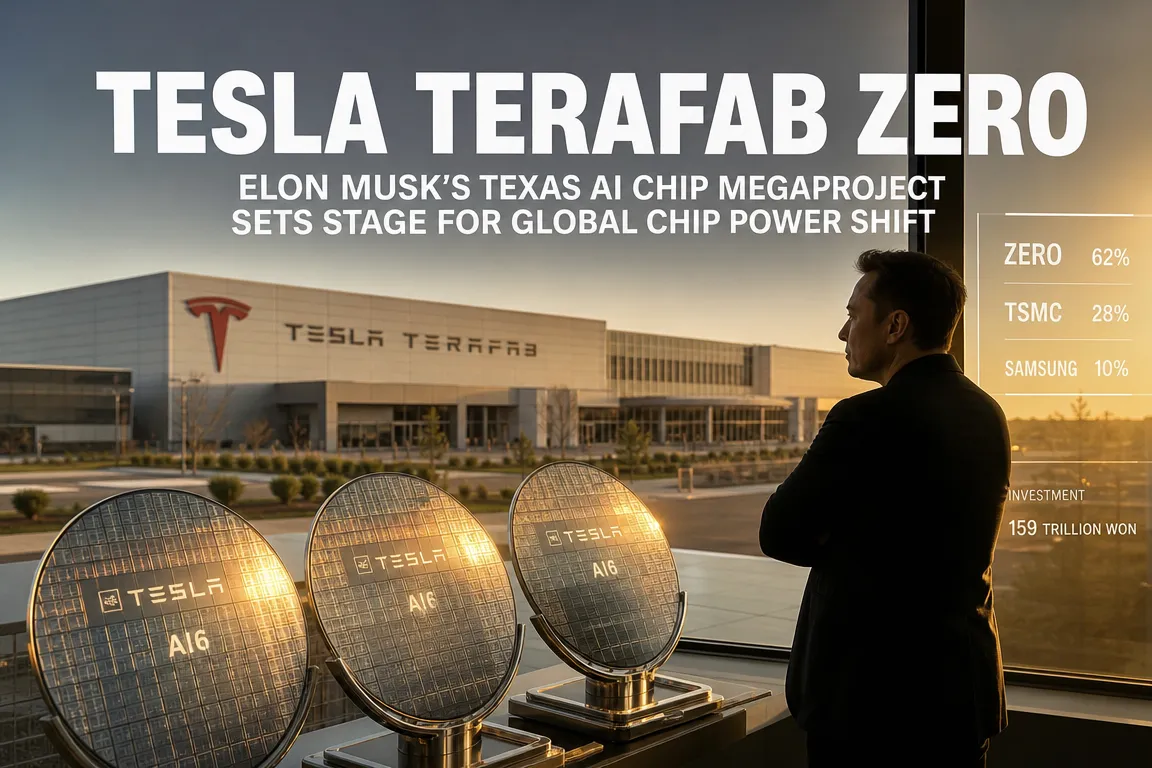
The center of the dispute is Tesla and SpaceX’s planned chip factory in Texas, known as Terafab.
The facility is being interpreted as linked to Tesla’s autonomous driving chips, Optimus robot chips, and SpaceX’s data center chips.
- Intel’s role:
Intel reportedly joined as a technology partner in April.
Musk previously referred to Intel’s next-generation 14A process as a core manufacturing node for Terafab. - TSMC discussions acknowledged:
Musk later confirmed that discussions were also taking place with TSMC.
Some market participants then speculated that TSMC could ultimately own and operate the facility. - Musk’s response:
Musk replied that “we build it, we operate it.”
He then emphasized that there is “ZERO” doubt. - TSMC’s position:
Under Musk’s description, TSMC would not be the owner of the factory, but rather a tenant using part of the space if needed.
Following this statement, Intel shares rebounded in after-hours trading, while TSMC’s U.S.-listed shares weakened.
On the surface, this may appear to be an Intel-versus-TSMC foundry rivalry, but the real issue is Tesla’s control over its semiconductor supply chain.
3. Why Musk cannot hand Terafab to TSMC: chip priority is directly tied to Tesla’s future revenue
For Tesla, the most dangerous scenario would be building a factory while TSMC determines production priority.
TSMC already serves major customers such as Nvidia, Apple, and AMD.
If TSMC were to control Terafab’s operations, there would be no guarantee that Tesla chips would be prioritized when needed.
That could delay autonomous driving, robotaxi, and Optimus rollout timelines based on chip supply.
In that context, Musk’s “ZERO” should not be read as a matter of pride.
It is a strategic statement that Tesla will not hand over priority control for its core product launches to an external foundry.
4. Why chips have become scarce: SpaceX is reportedly raising USD 40 billion to buy Nvidia chips
The source notes a report that SpaceX may borrow USD 40 billion, or about KRW 54 trillion, to secure Nvidia chips.
The significance is that AI semiconductors are no longer just components; they are now core productive assets.
- Payback period:
SpaceX reportedly believes it can recover the investment in chips within about one year.
Some brokerage estimates place the payback period at around 18 months. - Expansion in compute capacity:
The source says SpaceX plans to expand compute capacity from 1.4GW at the end of Q2 to 15GW by the end of next year.
That would represent more than a tenfold increase. - Industry-wide AI trend:
Morgan Stanley estimates that AI infrastructure buildout could require about USD 1.5 trillion in external funding by 2028.
Goldman Sachs also said AI company bond issuance is contributing to pressure on U.S. Treasury yields.
In simple terms, the market is increasingly divided between companies that own chips and companies that must buy them, even if they borrow to do so.
Nvidia and AMD sell chips, while Tesla and SpaceX remain closer to the buyer side.
This is why Musk wants to build the chip factory himself.
Over the long term, he is trying to move Tesla out of a dependent position in the AI semiconductor supply chain.
5. The real link to Tesla’s stock: the market is valuing FSD, robotaxis, and Optimus, not just autos
The source cites Tesla’s Q2 operating margin at 1.4%.
That implies only about KRW 14,000 of operating profit for every KRW 1 million in vehicle sales.
Net income was about USD 1.1 billion, but a meaningful portion was attributed to the increase in SpaceX’s equity value.
That indicates the auto business alone is still under margin pressure.
Even so, Tesla trades near USD 377 because investors are not valuing it only as an automaker.
The market is pricing Tesla more as a company tied to autonomous software, robotaxis, humanoid robotics, and AI infrastructure.
- FSD:
Tesla’s Full Self-Driving software requires both in-vehicle AI compute and data center training capacity. - Cybercab:
A steering-wheel-free robotaxi cannot scale without stable access to AI chips. - Optimus:
The humanoid robot is one of Tesla’s most important future value drivers and requires high-performance, low-power chips. - AI data centers:
FSD training and robotics development require substantial compute resources.
In other words, Tesla’s future businesses all depend on chips.
If chip supply becomes constrained, Tesla’s long-term valuation premium could also weaken.
6. AI5 and Samsung Electronics: Tesla is already heavily dependent on external foundries
Tesla’s next-generation AI5 chip is reportedly being manufactured by Samsung Electronics.
The two companies are said to have a supply agreement worth about USD 16.5 billion through 2033.
Reports also indicate that trial production has started at Samsung’s Taylor, Texas, facility.
However, full-scale production is expected next year, which means Tesla cannot immediately secure all the chips it needs.
Musk has reportedly suggested that AI5 chips will go first to Optimus and data centers rather than vehicles.
If Tesla believes the current AI4 chip is sufficient for unsupervised autonomy, then deploying the more advanced AI5 first to robots and servers is logical.
This also has a broader implication.
It suggests that Optimus, one of the market’s biggest expectations for Tesla, may require the largest share of high-end chips.
7. Terafab timeline: if pilot production starts in 2029, Tesla must rely on third-party fabs until then
According to reports citing an internal memo from Intel’s CEO, pilot wafer production at Terafab could begin in 2029.
Initial output is said to be around 3,000 wafers per month.
If this timeline is accurate, Tesla will have to rely on Samsung Electronics, TSMC, and other foundries for several more years.
Terafab is a long-term solution, not an immediate fix for supply bottlenecks.
Intel remains another variable.
Intel’s 14A process is still in customer qualification, and Intel Foundry continues to report large operating losses despite revenue growth.
For that reason, Musk’s discussions with TSMC are understandable.
Relying only on Intel would carry process risk, while TSMC remains the world’s leading manufacturing force.
However, if TSMC were to gain operating control, Tesla’s priority could weaken.
That is why Musk appears to be drawing a clear line: cooperation is possible, but control will not be transferred.
8. The KRW 159 trillion question: the key risk is that Tesla’s funding share has not been disclosed
The source says the first phase of Terafab may require USD 16.8 billion, or about KRW 22.5 trillion.
The full multi-stage project could reach as much as KRW 159 trillion.
The key issue is that the division of costs between Tesla and SpaceX has not yet been publicly clarified.
Musk reportedly referred to a chip allocation ratio of roughly Tesla 25% and SpaceX 75%, but that does not necessarily mean the same ratio applies to capital spending.
- Scenario 1: equal sharing of phase-one costs
Tesla’s share would be about USD 8.4 billion, or more than KRW 11 trillion. - Scenario 2: cost sharing in line with chip allocation
Tesla’s burden may be lower, but the structure of priority access and cost allocation becomes more complex. - Scenario 3: SpaceX bears most of the cost
Tesla’s short-term financial burden would ease, but investors would still need to assess how much of the factory’s output ultimately benefits Tesla.
This is the core point often missed elsewhere.
For Terafab to be positive for Tesla’s stock, investors need not only stable chip access, but also clarity on how much of the cost flows through Tesla’s financial statements.
9. Tesla’s cash flow: spending is currently rising faster than cash generation
Tesla reported cash and investments of USD 43.5 billion at the end of Q2, or more than KRW 58 trillion.
That does not indicate an immediate liquidity problem.
However, free cash flow in Q2 was negative USD 1.09 billion.
The company spent more on factories, equipment, and AI infrastructure than it generated from operations.
Tesla has guided to capital expenditures of more than USD 25 billion this year.
If USD 8.3 billion was already spent in the first half, second-half capex could approach USD 17 billion.
In an environment where U.S. rates remain above 5%, such large-scale capex can weigh on investor sentiment.
For growth stocks, the central question remains when earnings will convert into durable free cash flow.
10. Key items to watch in the Q3 earnings release
The upcoming Q3 earnings release is likely to focus on more than vehicle deliveries and revenue.
Investors will likely examine Terafab, AI semiconductors, autonomous driving, Optimus, and capex plans closely.
- First, Terafab funding structure
Investors need clarity on how Tesla and SpaceX will split the cost.
This is the most important issue for Tesla shareholders. - Second, any change in full-year capex guidance
The market will watch whether the existing guidance of more than USD 25 billion is maintained or increased. - Third, the AI5 ramp schedule
The production timeline at Samsung’s Taylor, Texas, facility and its product deployment plan matter. - Fourth, Optimus chip demand
Investors should monitor when Optimus moves into meaningful production and whether chip supply is sufficient. - Fifth, FSD subscription growth
The source notes 1.48 million FSD subscriptions in Q2, up 56%.
Continued growth would increase demand for both data center and vehicle compute. - Sixth, Intel 14A process risk
Intel Foundry’s process validation and manufacturing stability are critical to Terafab’s success. - Seventh, the scope of TSMC cooperation
Investors need to determine whether TSMC is merely a partner, a partial production collaborator, or providing process support.
11. The key point often missed: Terafab is not just a chip factory, but a mechanism for allocating Tesla’s future economic benefit
Many reports frame this issue as Intel versus TSMC, or as Musk’s push for semiconductor independence.
But the more important point is that Terafab may become a mechanism for determining how future economic value is shared between Tesla and SpaceX.
If chips produced at Terafab are used in Tesla vehicles, Optimus, and robotaxis, Tesla shareholders gain direct value.
If a large share is allocated to SpaceX data centers or space infrastructure, investors must assess whether the benefits justify Tesla’s contribution.
The right question is therefore more specific than whether TSMC operates the factory.
What Tesla pays, how many chips it receives, and how those chips translate into product revenue are the real issues.
For Tesla’s valuation premium to remain justified, Terafab must become a facility that generates actual cash flow, not merely a form of future insurance.
Direct chip manufacturing is strategically powerful over the long term, but it can also increase cash burn and pressure margins in the near term.
12. Investment view: long-term upside and near-term burden coexist
- Long-term upside:
If Tesla directly controls its AI semiconductor supply chain, the scale-up potential for FSD, robotaxis, and Optimus improves.
Reduced reliance on external foundry bottlenecks could enhance launch timing and cost control. - Near-term burden:
Terafab requires large investment, and high U.S. rates make major capex less attractive to the market.
With Tesla’s free cash flow currently negative, investors are likely to scrutinize the plan more closely. - Key variables:
The amount Tesla will actually fund, the AI5 ramp schedule, Optimus production plans, FSD subscription growth, and Intel’s process stability remain the main variables.
In conclusion, Musk’s “ZERO” is less a rejection of TSMC and more a statement that Tesla will not give up control over the chip priority structure behind its future businesses.
For shareholders, the more important question is not whether this strategy is directionally correct, but how much of the potentially KRW 159 trillion investment burden will fall on Tesla.
< Summary >
Musk’s “ZERO” statement is a strong denial that TSMC will own or operate Terafab.
The key message is that Tesla does not want to surrender priority control over AI chip production to an external party.
Tesla’s future valuation depends on FSD, robotaxis, and Optimus, all of which require chip supply.
However, the Terafab investment could reach as much as KRW 159 trillion, and Tesla’s share has not been disclosed.
In a high-rate environment, large-scale capex may pressure Tesla’s stock in the near term.
In the Q3 earnings release, investors should closely monitor Terafab cost sharing, AI5 timing, Optimus chip demand, and full-year capex guidance.
[Related Articles…]
- Tesla AI Semiconductor Strategy and Stock Outlook
- Global Semiconductor Supply Chains and the AI Investment Cycle
*Source: [ 오늘의 테슬라 뉴스 ]
– 머스크 “의심의 여지 ZERO, TSMC엔 안 넘긴다” — 그런데 159조 칩 공장 청구서엔 테슬라 몫이 안 적혀 있습니다, $378 주주는?
● Samsung,100Trillion,Shock,Semi-Supercycle,Peaking
Samsung Electronics Enters the 100 Trillion Won Operating Profit Era, but the Key Issue Is the Next Phase of the Semiconductor Cycle, Not the Record Result
The most notable figure in Samsung Electronics’ latest earnings release is quarterly operating profit of 107.4 trillion won.
For investors, however, the more important point is different.
Revenue came in slightly below market expectations, while operating profit reached a record high but growth is beginning to slow.
In other words, while the result is an earnings surprise on the surface, the market is already focusing on semiconductor price peak-out risk, a weaker won-dollar exchange rate, competition from Chinese memory makers, and changes in HBM market share.
This report connects Samsung Electronics’ earnings, SK hynix’s share price, the semiconductor outlook, the KOSPI outlook, and AI data center investment trends.
1. Key Takeaways From Samsung Electronics’ Preliminary Third-Quarter Results
Samsung Electronics announced preliminary consolidated third-quarter 2026 revenue of 195 trillion won and operating profit of 107.4 trillion won.
This is regarded as the first quarterly operating profit in Korean corporate history to exceed 100 trillion won.
It is also an unprecedented level of quarterly operating profit among global technology companies.
| Item | Preliminary Q3 2026 | Interpretation |
|---|---|---|
| Revenue | 195 trillion won | Up sequentially, but below market consensus |
| Operating profit | 107.4 trillion won | Record quarterly result |
| Operating margin | About 55.1% | Supported by a sharp rise in memory semiconductor prices |
| Market consensus | Revenue about 200.6416 trillion won, operating profit about 106.6401 trillion won | Operating profit beat, revenue missed |
The key point is that operating profit beat expectations while revenue missed.
This combination matters in equity markets.
Markets care not only about the absolute level of earnings but also about the pace of growth and the durability of pricing.
2. Why Operating Profit Surged: Memory Semiconductor Prices
The main driver of the result appears to have been the DS division, especially the memory business.
Higher HBM, DRAM, and NAND prices were all reflected in the earnings.
The DS division’s operating margin is believed to have remained in the 70% range in the third quarter, following the second quarter.
DRAM operating margin may have exceeded 80%.
According to DRAMeXchange, the average price of PC standard DDR4 8Gb DRAM rose from $13 in March to $26 in September.
The average price of 128Gb NAND also rose from $17.73 to $30.61 over the same period.
The expansion of AI data center investment increased demand for server memory, lifting prices across broader memory products.
In practical terms, AI companies are buying large volumes of HBM, DRAM, NAND, and server equipment to build data centers, and Korean semiconductor companies have been major beneficiaries.
This is the most important factor in understanding Korean exports and the KOSPI outlook.
3. Why the Market Is Not Simply Celebrating
On the surface, the numbers suggest that Samsung Electronics and SK hynix shares should rally immediately.
However, the market has likely already priced in part of the strong earnings.
At such times, the familiar market saying applies: buy the rumor, sell the news.
Even after record results in the second quarter, there were concerns about profit-taking after the announcement.
The same interpretation is possible here.
The market has already moved to a different question.
- Can semiconductor price gains continue into the fourth quarter?
- Can HBM demand keep growing at the current pace?
- Can Samsung Electronics and SK hynix maintain market share?
- How much will a stronger won reduce profitability?
- How serious is the competitive threat from China’s CXMT?
In other words, the market is now focusing less on how much was earned this quarter and more on whether earnings can continue to rise faster.
4. The Most Important Point: Earnings Are Rising, but Growth Is Slowing
The most important issue in Samsung Electronics’ results is not the absolute size of profit, but the change in growth rates.
According to the source text, Samsung Electronics’ revenue rose from the 133 trillion won range in Q1 2026 to 171.5 trillion won in Q2 and 195 trillion won in Q3.
Operating profit also increased from the 57 trillion won range in Q1 to 89.5 trillion won in Q2 and 107.4 trillion won in Q3.
However, the year-on-year growth rates show a different trend.
Second-quarter operating profit growth was cited at around 1,812%.
Third-quarter operating profit growth fell to around 782%.
That is still exceptionally strong growth.
But markets focus on the direction of the growth rate.
Once the growth rate starts to slow, valuation pressure can emerge even if profits remain very large.
This is the key issue in assessing the potential for a sharp rebound in Samsung Electronics and SK hynix shares.
The real economy is in a strong phase, but the stock market may still price in a range-bound or corrective phase.
5. Korean Exports Are Now Even More Dependent on Semiconductors
A particularly important point is the share of semiconductors in Korea’s total exports.
Semiconductors have shifted from being one major export sector to a variable that effectively drives the export cycle itself.
| Period | Semiconductor Share of Korean Exports | Interpretation |
|---|---|---|
| Earlier periods | About 9% | An important export industry |
| 2024 | About 20% | Rising semiconductor contribution |
| 2025 | About 24% | AI investment effect becoming visible |
| 3Q 2026 cumulative | About 41.8% | Korean exports increasingly tied to the semiconductor cycle |
At this level, it is difficult to discuss the Korean economy without semiconductors.
Samsung Electronics and SK hynix results are now not just company-specific events, but variables linked to Korea’s growth rate, exchange rate, trade balance, and KOSPI outlook.
The expansion of AI data center investment has clearly boosted Korean semiconductor exports.
This means AI is not only changing software industries, but also reshaping Korea’s manufacturing and export structure.
6. Fourth-Quarter Focus: Possible Peak-Out in Semiconductor Prices
Third-quarter results were strong because DRAM and NAND prices were still rising.
However, price increases and the rate of price increases should be treated differently.
The source text notes that the pace of DRAM and NAND price gains slowed gradually through the second and third quarters.
Prices remain high, but the rate of increase may weaken.
This is the point that markets are concerned about.
In the semiconductor cycle, share prices typically move before prices peak.
The market starts discounting peak-out risk not after prices top out, but when the rate of increase begins to slow.
Accordingly, the key issue in the fourth quarter is not simply whether Samsung Electronics continues to generate large profits, but whether DRAM and NAND price momentum is sustained.
7. A Stronger Won-Dollar Exchange Rate Is a Headwind for Exporters
Another important variable is the won-dollar exchange rate.
The source text refers to the exchange rate moving down toward the low 1,300 won range.
Exchange-rate stability is positive for the broader Korean economy.
It reduces import price pressure and supports foreign-exchange stability.
For export-oriented companies such as Samsung Electronics and SK hynix, however, the impact is different.
When dollar revenue is translated into won, a weaker won increases Korean-currency revenue and profit.
Conversely, a stronger won can reduce Korean-currency profitability even if dollar sales remain unchanged.
In other words, the high exchange rate in the first half of 2026 likely supported operating profit for exporters.
But as the year progresses into the second half and the fourth quarter, a stronger won may weigh on profitability.
This is an important point that is often overlooked in market commentary.
To assess the sustainability of Samsung Electronics’ earnings, investors need to monitor both semiconductor prices and the exchange rate.
8. Changing Competitive Dynamics Between Samsung Electronics and SK hynix
Samsung Electronics and SK hynix are both benefiting from the memory semiconductor supercycle.
However, there are also market-share concerns.
The source text notes that Samsung Electronics’ DRAM share has recovered somewhat, but not to its former peak above 40%.
SK hynix also appears to be facing some share pressure.
The most notable variable is the growth of China’s CXMT.
Samsung Electronics, SK hynix, and Micron are all growing, but if CXMT grows faster, the market share of Korean companies could come under pressure.
Therefore, even if revenue and profit increase, the market will not view the outcome as fully positive if share is lost.
Semiconductors are an industry where scale, technology, and customer trust are critical, so changes in market share are directly tied to long-term competitiveness.
9. HBM Market: An Opportunity for Samsung Electronics, a Share-Retention Challenge for SK hynix
HBM is a core component in the AI semiconductor era.
It is directly linked to NVIDIA GPUs, AI servers, and large-scale data centers.
SK hynix has established a strong position in HBM, and this has been a major driver of its stock performance.
The source text indicates that Samsung Electronics achieved meaningful progress in the HBM market in Q2 2026 and is expected to post good results in Q3 as well.
This is an opportunity for Samsung Electronics.
For SK hynix, the key issue is whether it can defend its HBM share.
The HBM market is not determined by volume alone.
Customer qualification, yield, packaging technology, power efficiency, and delivery stability are all important.
If Samsung Electronics regains share in HBM, that would support Samsung’s stock, but it could also intensify competition for SK hynix.
10. Foundry Remains Samsung Electronics’ Weakest Area
Another major business segment for Samsung Electronics is foundry.
However, the source text notes that Samsung Electronics’ foundry market share has fallen from the double-digit range into the single digits, to around 7%.
This is a significant risk.
Even if memory semiconductors perform strongly, weak foundry competitiveness can limit Samsung Electronics’ long-term growth story.
In the AI semiconductor market, companies such as NVIDIA, AMD, Broadcom, Google, and Amazon are increasingly relying on custom chip design and foundry production.
If Samsung cannot narrow the gap with TSMC, it may remain concentrated on memory-driven benefits within the AI value chain.
Accordingly, Samsung Electronics’ earnings should not be judged solely on memory strength.
HBM competitiveness and any recovery in foundry share are likely to shape the company’s long-term valuation.
11. The Most Important Point Missing From Many Headlines
The real key takeaway is not simply that Samsung Electronics posted record profit.
The more important point is that the Korean economy and the KOSPI are becoming increasingly tied to the AI semiconductor cycle.
First, if semiconductors account for more than 40% of Korean exports, semiconductor prices effectively determine the direction of the Korean economy.
Second, Samsung Electronics and SK hynix earnings now need to be interpreted like macroeconomic indicators.
Third, the real economy may remain strong even as the stock market discounts slowing growth and peak-out risk in advance.
Fourth, a stronger won may be positive for consumers and inflation, but negative for exporters’ earnings.
Fifth, Samsung Electronics’ recovery in HBM may come at the expense of SK hynix’s market share.
Sixth, the rise of China’s CXMT may have a greater impact on long-term valuation than near-term earnings.
From this perspective, a sharp rebound in Samsung Electronics and SK hynix will not depend on this quarter’s earnings alone.
It will depend on semiconductor price momentum, HBM customer wins, exchange-rate direction, Chinese competition, and foreign investor flows into the KOSPI.
12. Investor Checklist
- Review Samsung Electronics’ finalized results in late October, especially the DS division operating margin.
- Check HBM revenue mix and comments on major customer qualification progress.
- Monitor whether DRAM and NAND price momentum continues into the fourth quarter.
- Track whether the won-dollar exchange rate moves further below the low 1,300 range.
- Watch for changes in SK hynix’s HBM market share.
- Monitor CXMT’s production expansion and pricing strategy.
- Assess whether the KOSPI continues to trade on earnings momentum or moves into a profit-taking phase.
At this stage, investors should focus not only on the earnings level, but also on the quality and sustainability of those earnings.
The semiconductor outlook remains constructive, but the key issue for share prices is whether expectations have already been priced in.
13. Conclusion on the Potential for a Sharp Rebound in Samsung Electronics and SK hynix
The fundamentals for Samsung Electronics and SK hynix remain solid.
AI data center investment, HBM demand, memory price gains, and strong Korean exports all remain supportive.
However, short-term share performance is likely to respond more to the pace of future growth than to the scale of current record profits.
Samsung Electronics is benefiting from memory earnings improvement and HBM recovery.
At the same time, the decline in foundry share and a stronger won remain headwinds.
SK hynix has been rewarded with a premium because of its HBM competitiveness.
However, if Samsung Electronics continues to recover in HBM, share retention becomes the key issue for SK hynix.
Accordingly, a sharp rally is more likely if fourth-quarter semiconductor prices remain firm, additional HBM orders are secured, and foreign investor flows improve.
On the other hand, if price momentum slows and profit-taking intensifies, the KOSPI and large-cap semiconductor stocks could remain range-bound.
< Summary >
Samsung Electronics reported preliminary third-quarter revenue of 195 trillion won and operating profit of 107.4 trillion won, setting a record quarterly profit.
Operating profit beat expectations, while revenue missed consensus, producing both an earnings surprise and a revenue miss.
The key driver was price gains in DRAM, NAND, and HBM supported by expanding AI data center investment.
However, slowing growth, the possibility of semiconductor price peak-out, a stronger won, competition from China’s CXMT, and weaker foundry share remain headwinds.
The main variables for Samsung Electronics and SK hynix shares are no longer just this quarter’s earnings, but the pace of semiconductor price gains and changes in HBM market share.
In short, the real economy remains strong, but the stock market may already be discounting the next phase of the cycle.
[Related Articles…]
- AI Semiconductor Supercycle and the Outlook for Korean Exports
- Impact of a Stronger Won on Samsung Electronics and Exporter Earnings
*Source: [ 경제 읽어주는 남자(김광석TV) ]
– [속보] 삼성전자 역대급 영업이익. 삼성전자-SK하이닉스 급반등 할까? [즉시분석]