● Samsung-Earnings-Disappoints,Stocks-Stall,AI-Race-Heats-Up
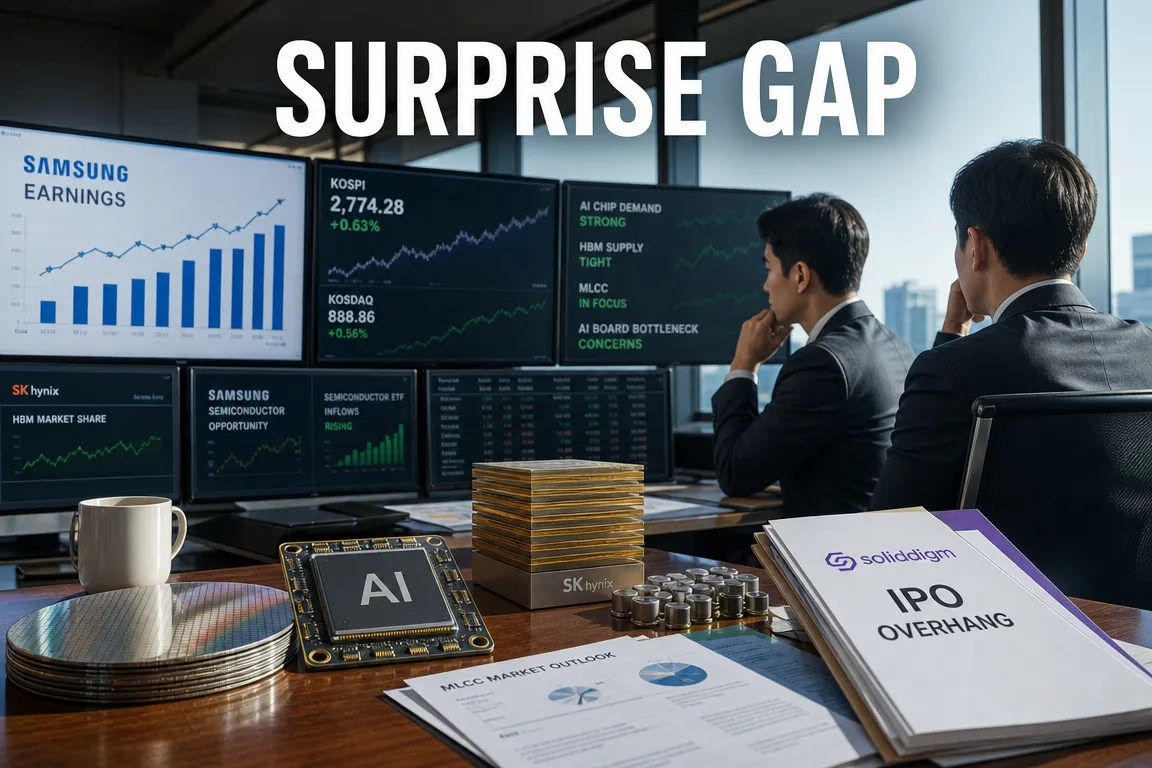
Reasons Samsung Electronics’ Record Earnings Did Not Lift the Share Price: The Market Wanted an Upside Surprise, Not Just Solid Results
Samsung Electronics’ earnings announcement was not weak on a headline basis.
It was more a case of resilience than disappointment.
However, the share price and the broader KOSPI tone were far less enthusiastic than expected.
The key point is straightforward.
The market had already priced in some degree of earnings improvement, and the stock would have required a meaningfully stronger-than-expected result to re-rate higher.
This article summarizes Samsung Electronics’ earnings, the SK Hynix issue, the KOSPI outlook, the semiconductor cycle, and the market’s current focus in a news-style format.
1. Samsung Electronics preliminary earnings: acceptable numbers, but not strong enough to exceed expectations
The core message from Samsung Electronics’ preliminary results is that revenue came in slightly below market expectations, while operating profit came in slightly above them.
Overall, the outcome was close to consensus.
- Revenue: slightly below market expectations
- Operating profit: slightly above market expectations
- Overall assessment: solid, but not a strong surprise
The key issue is not whether the results were good or bad.
Equity markets focus on how much better results are relative to expectations.
Even if Samsung Electronics delivered a stable result, the stock would not react strongly if that level of improvement had already been anticipated.
For a mega-cap name like Samsung Electronics, strong share price momentum requires more than simply good earnings.
Foreign flows, KOSPI direction, the semiconductor cycle, memory pricing, and HBM competitiveness all need to align.
2. Why did Samsung Electronics’ share price fail to rise decisively despite record earnings?
The main reason for the subdued reaction was that the market had already incorporated much of the expected improvement.
Investors were not unaware of the earnings recovery.
Improving memory prices, AI server demand, production cuts, and inventory normalization had already been widely discussed.
As a result, what the market wanted from this release was not just recovery.
It wanted a clear upside surprise versus consensus.
- Did revenue come in well above expectations?
- Did operating margin improve enough to surprise the market?
- Did HBM and AI semiconductor execution show a stronger signal than competitors?
- Was the next-quarter outlook more aggressive than expected?
This release was interpreted as reasonable, but not exceptional.
That left room for short-term profit taking.
3. The market is selling even on good news
Recent market behavior shows that even positive news often fails to drive meaningful follow-through.
That reflects a pattern in which investors buy ahead of expected developments and then sell once the news is confirmed.
This is commonly described as a “sell the news” pattern.
Samsung Electronics’ earnings announcement followed a similar dynamic.
- Accumulation ahead of expected earnings improvement
- Confirmation of preliminary results
- Lack of additional upside if results merely match expectations
- Short-term profit taking
In other words, Samsung Electronics did not fall because earnings were poor.
The stock weakened because there was insufficient new information to justify a further rerating.
4. Why SK Hynix also came under pressure: the Solidigm IPO issue
The original article also mentioned the Solidigm IPO issue in connection with SK Hynix’s share price weakness.
Solidigm is a subsidiary acquired through SK Hynix’s purchase of Intel’s NAND business.
News that advisers were selected for a possible listing was interpreted negatively by the market.
The reason is simple.
If a subsidiary is listed, the parent company may no longer capture the full value of that business on a consolidated basis.
- Before subsidiary listing: the subsidiary’s value may be fully reflected in the parent
- After subsidiary listing: some value may be allocated to minority shareholders
- Market reaction: concern over potential holding-company discount
In Korea, investors are particularly sensitive to subsidiary listings.
As seen in the LG Chem and LG Energy Solution case, listing a core growth asset can raise concerns about value dilution for existing shareholders.
For SK Hynix, the listing could support capital flexibility, revalue the business, or strengthen the NAND portfolio.
However, from a short-term share price perspective, the first reaction is often concern that a valuable asset is being separated from the parent.
5. The difference between Samsung Electronics and SK Hynix: the market is more sensitive to HBM leadership
The most important semiconductor theme today is not standard DRAM but HBM.
HBM is high-bandwidth memory used in AI servers and GPUs.
It is directly linked to demand from Nvidia, AMD, and hyperscale data center investment.
SK Hynix is widely seen as the leader in HBM.
Samsung Electronics, by contrast, is still being evaluated on whether it can regain competitiveness.
- How quickly can Samsung expand HBM customer qualifications?
- Can it strengthen its position within Nvidia’s supply chain?
- How much of memory price recovery will translate into margin expansion?
- How quickly can losses in foundry and system semiconductors narrow?
In other words, the market is not only asking whether Samsung is earning more.
It is asking whether Samsung is gaining meaningful ground in the AI semiconductor value chain.
Without a clearer answer, the stock is likely to remain range-bound.
6. Why the KOSPI has struggled to rebound: large-cap earnings alone are not enough
Samsung Electronics carries a large weight in the KOSPI.
As a result, if Samsung does not rise decisively, the index itself is unlikely to break out strongly.
The KOSPI remains trapped in a range.
There is support from the semiconductor recovery, but there are also persistent headwinds.
- Uncertainty over the timing of U.S. rate cuts
- Strong dollar and weak won pressure
- Volatile foreign investor flows
- Slower-than-expected recovery in China
- Valuation pressure after a strong AI rally
For a more constructive KOSPI outlook, Samsung Electronics’ earnings improvement must be accompanied by foreign inflows, exchange rate stability, U.S. equity strength, and a recovery in semiconductor exports.
7. What the market really wants to see is next quarter’s numbers
This earnings release is backward-looking.
Share prices, however, discount the future.
That is why investors are more focused on the next quarter and on full-year guidance.
The key questions for Samsung Electronics are as follows.
- How long can memory pricing momentum continue?
- How quickly can HBM revenue gain share?
- Can foundry losses narrow materially?
- Will smartphone and consumer electronics demand recover?
- Will the AI investment cycle translate directly into earnings?
For Samsung Electronics to re-rate meaningfully, the market needs evidence that performance is not only improving, but continuing to improve.
8. The key point often missed in other coverage: the issue is not earnings, but leadership premium
Many reports frame the issue as either weaker-than-expected Samsung earnings or a soft KOSPI.
The more important point is different.
Investors are increasingly focused on which company will capture the leadership premium of the AI cycle.
In previous memory cycles, Samsung Electronics was naturally seen as the primary beneficiary of an industry recovery.
In the current AI cycle, however, HBM, GPU supply chains, cloud data center investment, and advanced packaging are central, which has changed the market’s evaluation framework.
The key question is no longer simply whether Samsung is profitable.
- Can Samsung gain pricing power in AI memory?
- Can it narrow the HBM gap with SK Hynix?
- Can it be recognized as a core supplier in global AI infrastructure investment?
- Can it be re-rated as an AI infrastructure name rather than a cyclical memory stock?
Until there is greater confidence on these points, Samsung’s share price may remain limited despite better earnings.
If the market sees clearer evidence, it could quickly restore a premium valuation.
9. Key checkpoints for investors
When assessing Samsung Electronics and SK Hynix, it is important to look beyond short-term share price moves.
The following factors should be monitored together.
- Samsung Electronics share price: whether foreign investors turn net buyers after earnings
- SK Hynix: the structure and execution of the Solidigm listing process
- KOSPI outlook: whether semiconductor large caps can break the index range
- Semiconductor cycle: whether DRAM and NAND price increases continue
- HBM competitiveness: customer qualification and supply expansion updates
- FX: stability in USD/KRW
- U.S. equities: the performance of Nvidia and other AI-related names
Foreign investors often treat Korean semiconductors as a single sector theme.
As a result, one company’s issue can influence sentiment across the entire group.
10. Conclusion: the market is not rejecting Samsung Electronics, but it is demanding stronger evidence
Samsung Electronics’ earnings should not be characterized as disappointing.
They are better viewed as a resilient result in a recovering cycle.
However, equity markets are selective.
Good earnings alone are not enough; a clear upside surprise is required.
The reason Samsung’s share price remains constrained is more a question of expectations than weak performance.
The market is asking not only for recovery, but for a clear re-establishment of leadership in AI semiconductors.
SK Hynix still retains a strong HBM position, but the Solidigm IPO issue introduces a short-term overhang related to governance and shareholder value.
In the end, three issues remain central.
- Can Samsung Electronics deliver clear progress in HBM competitiveness?
- Can SK Hynix structure the Solidigm listing without harming parent value?
- Can the KOSPI break out of its range led by semiconductor large caps?
The market is not ignoring earnings.
It is focusing on the next stage of growth.
< Summary >
Samsung Electronics’ results were broadly in line with expectations, but not strong enough to drive a major rerating.
The market had already priced in much of the semiconductor recovery, and short-term profit taking followed the announcement.
SK Hynix came under pressure as the Solidigm IPO raised concerns over potential value dilution at the parent level.
The KOSPI remains range-bound as Samsung Electronics and SK Hynix have not provided enough momentum to lift the index decisively.
Key variables ahead include Samsung’s HBM competitiveness, AI supply chain penetration, foreign investor flows, and the sustainability of memory price gains.
Investors are now focusing less on current earnings and more on which company will lead the AI semiconductor cycle.
[Related Articles…]
*Source: [ 내일은 투자왕 – 김단테 ]
– 삼성전자 역대급 실적에도 반응이 싸늘한 이유 #삼성전자 #코스피 #하이닉스
● AI-MLCC-Bottleneck, Spike, Power-Hungry, Surging, Shortage
The Next Battleground for AI Semiconductors: Why MLCCs and AI Boards Are Emerging as the Real Bottlenecks
If you missed this year’s rally in memory semiconductors and HBM, it may be time to shift attention from AI semiconductors themselves to the core components that actually enable AI servers to operate.
This is not simply a story that “components are next after semiconductors.”
As AI data centers expand, bottlenecks are emerging not only in GPUs, HBM, and CPUs, but also in MLCCs that stabilize power delivery and AI boards that connect the chips.
MLCCs account for only about 0.06% of total server rack cost, yet without them an AI server cannot function.
The key investment point is that this small component is beginning to gain pricing power.
1. Key News: AI Infrastructure Investment Is Expanding From Semiconductors to Component Bottlenecks
AI infrastructure investment remains robust.
Large technology companies continue to build AI data centers, and demand for AI servers within those facilities is increasing rapidly.
Until now, market attention has been concentrated on Nvidia GPUs, HBM memory, foundries, and advanced packaging.
However, AI servers are not complete with chips alone.
To operate properly, GPUs, HBM, and CPUs require components that stabilize power, transmit signals, and manage heat and space efficiency.
The most representative components are MLCCs and AI boards.
- Rising demand for AI servers increases demand for GPUs and HBM
- Higher GPU and HBM content increases demand for MLCCs and semiconductor boards
- Demand for high-performance components exceeds existing capacity
- Supply shortages lead to delivery delays and price increases
- Price increases may improve margins for major component suppliers
In practical terms, a “name your price” structure seen in the memory market this year is spreading into select core component markets.
Within the AI semiconductor supply chain, bottlenecks are no longer limited to GPUs and HBM; they are expanding into MLCCs and AI boards.
2. What MLCCs Are: Power Stabilizers for AI Servers
MLCC stands for Multi-Layer Ceramic Capacitor.
Its function is simple: it stores electrical energy temporarily and releases it quickly when needed.
In an AI server, an MLCC functions as a power buffer.
When a GPU processes large-scale workloads, it can draw a sudden surge of power.
If the power supply cannot deliver electricity immediately and stably, voltage may drop momentarily.
Semiconductors are highly sensitive to voltage fluctuations, which can cause malfunctions, data errors, communication issues, and in severe cases, chip damage.
MLCCs stabilize voltage by releasing stored energy in such moments.
They also absorb excess power when input surges occur.
As a result, MLCCs serve as a stabilizing device that manages both power shortages and excess supply.
For AI servers, they are small but indispensable.
3. Why MLCCs Also Function as Noise Filters
MLCCs do more than store power.
Electricity contains fine electrical noise.
If this noise reaches sensitive semiconductors such as GPUs and HBM, digital signals may be distorted.
MLCCs also act as filters that suppress this noise.
- They stabilize voltage.
- They improve power efficiency.
- They help manage heat.
- They enhance signal quality.
- They improve space efficiency through compact, high-capacity design.
Because AI servers consume substantial power and process workloads at high speed, power stability and signal quality are critical.
Accordingly, MLCCs are installed in large numbers throughout the server, including around GPUs, HBM, and power delivery circuits.
A conventional server uses around 2,000 MLCCs, while an AI server may require approximately 20,000 to 30,000 units.
That implies demand more than ten times higher.
4. Why MLCC Demand Is Surging Now
The core of AI servers is high-performance GPUs.
As GPU performance improves, power consumption rises as well.
Higher power consumption increases the need for voltage stabilization.
As a result, the number of MLCCs required per GPU also increases.
The key point is that demand is not rising only in volume.
MLCCs used in AI servers must be smaller, store more energy, and meet higher reliability standards.
In other words, demand is increasing for high-capacity, high-performance MLCCs rather than standard products.
High-performance MLCCs are more difficult to manufacture.
Even on the same equipment, they consume far more production capacity than standard products.
The source text indicates that high-spec products require at least 4 times and up to 7 times the production capacity of conventional products.
This means that as companies allocate more capacity to high-value products, supply of standard products declines.
This structure is intensifying shortages across the MLCC market.
5. The Most Important Number: MLCCs Are Cheap, but AI Servers Cannot Operate Without Them
One of the most compelling aspects of the MLCC investment case is the price structure.
MLCC costs in a single AI server rack are estimated at around $4,320.
By contrast, the total price of a server rack is about $7.8 million.
That implies MLCCs account for only about 0.06% of total cost.
Yet without this small component, the server rack cannot function properly.
For customers, securing a stable supply of a 0.06%-cost component is essential to completing a multi-million-dollar AI server system.
Accordingly, even modest price increases are likely to attract orders toward suppliers that can deliver on schedule.
This is the core logic behind rising MLCC prices.
Although the cost share is small, the component is indispensable, which gives suppliers greater pricing power in a shortage environment.
This pattern resembles what has already been observed in memory semiconductor cycles.
6. Why AI Boards Matter: The Critical Interface Connecting GPUs and Mainboards
AI boards are emerging as another critical bottleneck alongside MLCCs.
A board connects semiconductors such as GPUs, HBM, and CPUs to the mainboard.
It is not merely a substrate; it is a high-precision component that transmits electrical signals and data quickly and reliably.
The terminal pitch of semiconductor chips differs from that of mainboards.
For that reason, chips cannot simply be mounted directly on the mainboard.
A medium is needed to match the two formats and transmit signals between them.
That role is performed by high-performance semiconductor boards such as FCBGA.
As AI semiconductors become more advanced, boards also become larger and more complex.
Two terms frequently used in the board market are larger surface area and higher layer count.
Larger surface area means board size is increasing.
Higher layer count means the internal board stack is becoming more complex.
Both indicate rising technical difficulty.
7. Why Glass Substrates Are Also Gaining Attention
Glass substrates are also emerging as an important theme in the AI semiconductor supply chain.
High-performance AI chips generate significant heat, and package sizes are expanding.
Conventional materials may be vulnerable to heat and physical deformation.
Glass substrates are drawing attention as next-generation boards that can improve warpage control and thermal stability.
In other words, the AI board market is not just expanding existing products.
It is undergoing a technological transition toward larger surface area boards, higher-layer boards, and glass substrates.
This transition is raising barriers to entry for incumbent leaders.
As a result, orders are likely to concentrate among proven suppliers.
8. How Severe Is the Supply Shortage: Orders Are Far Outpacing Shipments
The supply shortage in MLCCs is visible in the numbers.
A key indicator is the book-to-bill ratio.
If the ratio is above 1, incoming orders exceed shipments.
- Murata overall book-to-bill ratio: 1.34
- Murata MLCC division book-to-bill ratio: 1.47
- Samsung Electro-Mechanics book-to-bill ratio: 1.31
- Taiyo Yuden book-to-bill ratio: 1.72
- Industry average book-to-bill ratio: 1.04
For Murata, the MLCC supercycle in 2018 saw a book-to-bill ratio of around 1.25.
Current readings in some segments are higher than that level.
This suggests that MLCC demand is entering a new cycle driven by AI servers beyond the smartphone and automotive cycles of the past.
9. Delivery Lead Times Are Also Worsening: High-Capacity MLCCs Can Reach 40 Weeks
Supply shortages are also reflected in lead times.
As of late 2024, MLCC lead times are cited at around 10 weeks.
By 2026, standard products are expected to reach about 16 weeks, while high-capacity products may extend to around 23 weeks.
Samsung Electro-Mechanics’ high-capacity products are cited at about 40 weeks in 2026.
A 40-week lead time effectively means customers must place orders far in advance or risk missing required delivery dates.
In such conditions, customers are more likely to prioritize supply stability over price.
This creates room for major suppliers to raise prices and improve profitability.
10. Why Supply Cannot Be Increased Immediately
It may appear that additional supply can simply be added by expanding factories.
However, MLCCs and AI boards are not that straightforward.
First, high-spec products consume substantial production capacity.
Second, technical difficulty makes yield improvement challenging.
Third, equipment itself is constrained, leading to long lead times for machinery.
Fourth, even after expansion is approved, it takes time before output reaches the market.
The source text suggests that capacity additions by major companies may be reflected primarily between 2027 and 2029.
Accordingly, supply tightness around 2026 is unlikely to be resolved quickly.
However, if AI infrastructure investment slows by the time these expansions come online in 2027 to 2029, the cycle could weaken.
This is a key risk to monitor.
11. The New ETF Launch: KIWOOM Global MLCC & AI Board TOP4+ ETF
The KIWOOM Global MLCC & AI Board TOP4+ ETF is scheduled to launch on Tuesday, October 13, 2026.
The ETF focuses on companies tied to MLCCs and AI boards that are expected to benefit from expanding AI infrastructure investment.
Its emphasis is on core component suppliers within the AI server supply chain rather than on semiconductors themselves.
The TOP4+ structure is also important.
The top four holdings receive the highest weights, with the remainder allocated across additional constituents.
According to the source text, the first and second holdings receive 25% each, while the third and fourth receive 15% each.
In total, about 80% of the ETF is concentrated in the top four names.
The remaining six constituents are selected with reference to factors such as market capitalization.
12. ETF Selection Method: AI Analyzes Industry Keywords and Corporate Relevance
The ETF selects constituents based on key themes such as MLCC, FCBGA, and glass substrates.
It uses AI to analyze company filings, news, and data to measure similarity between each stock and the relevant industry keywords.
The result is a portfolio built around companies with the highest thematic relevance.
The ETF also undergoes periodic rebalancing.
If industry structure changes or new leaders emerge, portfolio weights and constituents may be adjusted.
Given the rapid pace of change in the AI semiconductor supply chain, this rebalancing mechanism may be a meaningful advantage.
13. Key Constituents: The Portfolio Is Centered on Korean and Japanese Companies
A notable feature of this ETF is that it contains little to no U.S. exposure and is centered instead on Korean and Japanese companies.
At first glance, a global ETF might appear likely to include U.S. names, but the MLCC and AI board supply chain is concentrated in Korea and Japan.
Demand originates from U.S. big tech, while supply is provided by key Asian component manufacturers.
- Murata Manufacturing: global leader in MLCCs
- Samsung Electro-Mechanics: a major Korean company with both MLCC and AI board exposure
- Taiyo Yuden: a major Japanese MLCC company
- LG Innotek: actively expanding its board business as a growth segment
- Doosan: a materials company involved in CCL, or copper-clad laminates
- Ibiden: an important supplier in the AI accelerator board supply chain
- TDK: a leading Japanese electronic components company
- ISU Petasys: a company often cited as benefiting from high-layer boards for AI servers
- Daeduck Electronics: a major domestic company in semiconductor boards and PCB
- Simmtech: a company with technology in semiconductor package substrates
14. MLCC Market Share: Industry Concentration Remains Very High
The MLCC industry is dominated by a small number of leading firms.
In the overall MLCC market, Murata holds about 40%, Samsung Electro-Mechanics about 23%, Taiyo Yuden about 11%, and TDK about 7%.
This is a highly concentrated industry.
In high-spec MLCCs for AI servers, concentration is even higher.
Murata is estimated at about 45%, and Samsung Electro-Mechanics at about 40%, meaning the two companies together account for roughly 85% of the market.
This indicates that established leaders have very strong positions in the high-performance MLCC segment.
15. Key Points That Are Often Overlooked
First, MLCCs are not expensive components, which actually creates room for price increases.
From a customer perspective, MLCC cost is only a tiny share of total server cost.
However, without MLCCs the server cannot operate.
That makes customers reluctant to delay purchases even if prices rise.
This structure creates strong pricing power.
Second, producing high-spec MLCCs reduces supply available for standard products.
Because high-performance products consume 4 to 7 times more production capacity, increasing output of those products reduces capacity for conventional lines.
As a result, AI server demand can tighten supply across broader electronics markets.
Third, AI boards are not simple connection parts; they are critical to high-speed signal integrity.
Even if GPUs and HBM are advanced, overall performance suffers if the board cannot transmit signals reliably.
For that reason, customers are likely to prefer proven suppliers.
Fourth, the benefits of U.S. AI infrastructure spending are flowing to Korean and Japanese component makers.
When U.S. big tech companies such as Nvidia, Microsoft, Amazon, and Google expand data center spending, the impact can translate into earnings improvement for component suppliers in Asia.
This is an important point from a global macro perspective.
Fifth, capacity additions in 2028 to 2029 may also become a risk factor.
Current supply is tight, but if new capacity enters the market in a few years while AI infrastructure investment growth slows, the cycle could change.
Accordingly, this theme requires attention to both structural growth and cyclical risk.
16. Key Risks for Investors
- Possible slowdown in large tech companies’ AI infrastructure spending
- Impact of 2027 to 2029 capacity additions on industry conditions
- High concentration risk, with about 80% of the ETF in the top four holdings
- Foreign exchange exposure due to the Korea- and Japan-centered portfolio
- MLCCs and boards remain exposed to the electronics cycle
- Initial trading volume and liquidity of a newly listed ETF should be checked carefully
- Valuation risk may rise if enthusiasm for AI semiconductors becomes excessive
17. Which Investors May Find This ETF Suitable
Investors already holding ETFs linked to Nvidia, GPUs, HBM, memory semiconductors, or foundries may view this ETF as a portfolio complement.
Where existing semiconductor ETFs provide exposure to AI semiconductors, the KIWOOM Global MLCC & AI Board TOP4+ ETF offers exposure to the AI server component supply chain.
If one expects the AI infrastructure investment cycle to continue, a strategy that includes not only semiconductors but also materials, components, and boards along the value chain may be appropriate.
This ETF may be particularly relevant for investors seeking to extend AI exposure beyond U.S. equities into key Korean and Japanese component manufacturers.
That said, this is a concentrated thematic ETF focused on specific companies and industries.
It is therefore more suitable as a satellite allocation than as a core portfolio holding.
A phased accumulation approach and periodic review of industry conditions are advisable.
18. Key Indicators to Monitor
- Nvidia’s next GPU roadmap and changes in power consumption
- AI data center investment plans at Microsoft, Amazon, Google, and Meta
- Changes in book-to-bill ratios at Murata, Samsung Electro-Mechanics, and Taiyo Yuden
- Lead-time trends for high-capacity MLCCs
- Order backlog and expansion schedules at AI board suppliers
- Average selling price trends for MLCCs
- Commercialization pace of glass substrates
- Exchange rate trends for the Korean won and Japanese yen
- Market absorption of new supply from 2027 to 2029
< Summary >
The next investment battleground for AI semiconductors is MLCCs and AI boards.
AI servers cannot operate on GPUs and HBM alone; they also require MLCCs for power stability and high-performance boards for chip connectivity.
AI servers use more than ten times as many MLCCs as conventional servers, and shortages are deepening as demand rises for high-spec products.
Although MLCCs account for only about 0.06% of total server cost, they are indispensable, which is strengthening pricing power.
AI boards connect GPUs to mainboards and ensure stable high-speed signal transmission, while technological complexity is increasing through larger formats, higher layer counts, and glass substrates.
The KIWOOM Global MLCC & AI Board TOP4+ ETF concentrates on Korean and Japanese component leaders such as Murata, Samsung Electro-Mechanics, Taiyo Yuden, and LG Innotek.
Key risks include a slowdown in big tech AI infrastructure spending, capacity additions in 2027 to 2029, high portfolio concentration, and foreign exchange volatility.
For investors already exposed to semiconductor ETFs, this may serve as a complementary way to extend exposure across the AI infrastructure supply chain.
[Related Articles…]
- AI Infrastructure Investment Cycle and Global Supply Chain Shifts
- Why Semiconductor Boards and MLCCs Are Drawing Attention
*Source: [ 소수몽키 ]
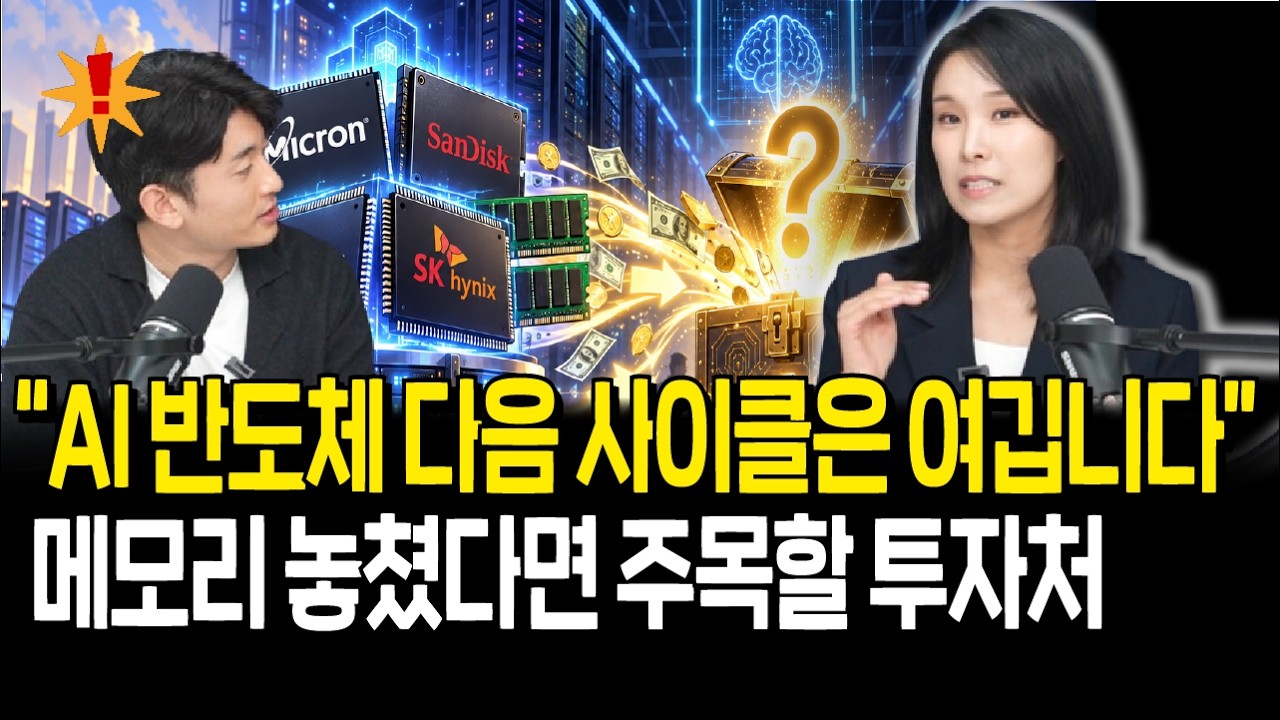
– 올해 메모리 놓친 사람 주목? AI 반도체 다음 격전지가 될 투자처