● Treasury Yield Shock Fuels AI Semiconductor Frenzy
The Clash Between the U.S. Treasury Yield Rebound Above 5.3% and the AI Semiconductor Rally: The Real Reason Behind Micron’s 3x and Marvell’s 10x Growth Outlook
The core point of this market is not simply that “stocks took a breather.”
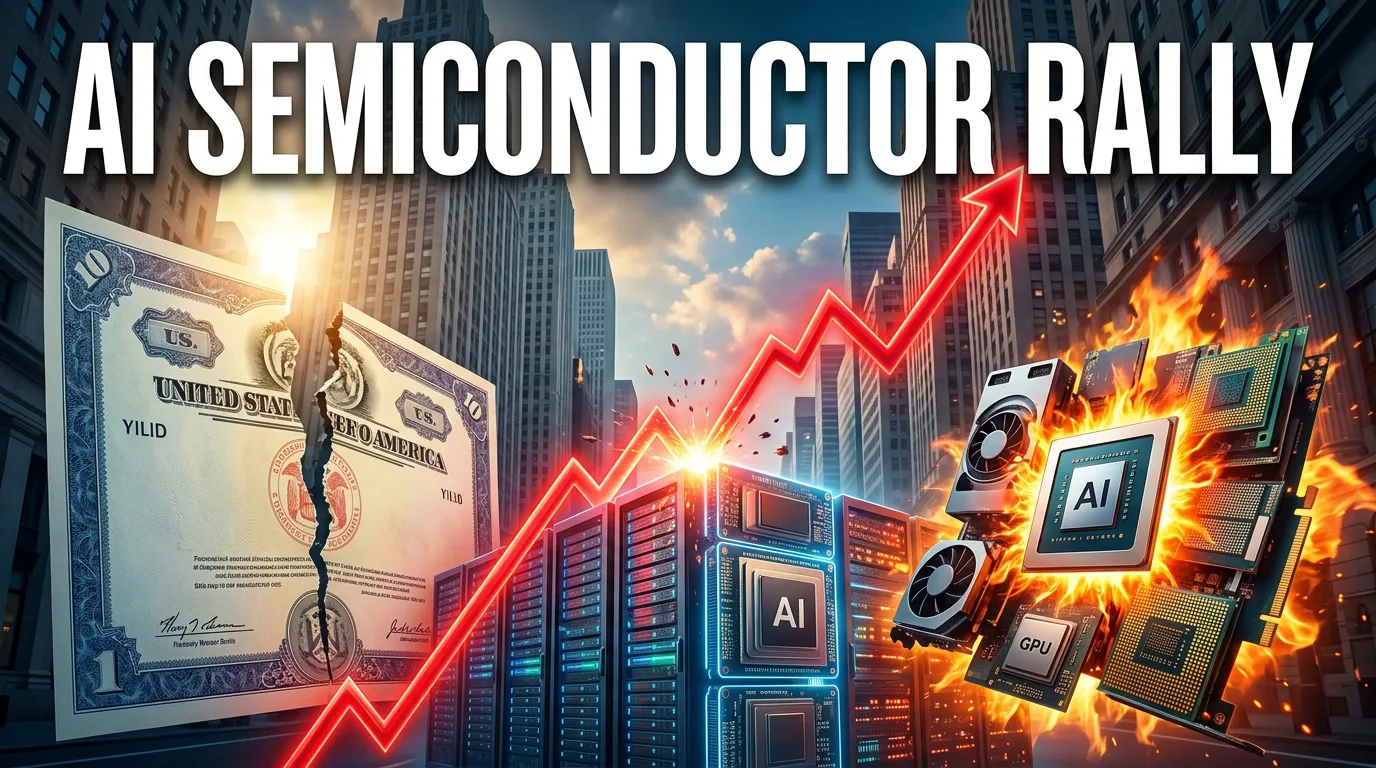
While U.S. Treasury yields surged to around 5.3%, at the same time AI semiconductor companies are receiving wildly optimistic growth forecasts.
On one side, U.S. Treasuries, the safe-haven asset, are offering returns in the 5% range; on the other, the Micron, Marvell, and Nvidia ecosystem is once again receiving strong expectations from the explosion in AI data center investment.
In today’s article, we will sort out in one place the reasons for the U.S. stock market correction, the structural background behind the sharp rise in Treasury yields, the burden of big tech’s AI infrastructure investment, the competition between SpaceX and xAI to secure Nvidia chips, and the explosive growth outlook for Marvell and Micron.
1. U.S. Market Close: The Indices Took a Break, but the AI Semiconductor Story Got Stronger
On October 7, the U.S. stock market broadly entered a pause.
The Nasdaq, Dow Jones, and S&P 500 slipped slightly near their all-time highs.
The Russell 2000, which is centered on small- and mid-cap stocks, fell relatively sharply, and the Philadelphia Semiconductor Index also underwent a short-term correction.
Bitcoin also pulled back into the $80,000 range, adding pressure across risk assets.
-
Nasdaq: Slight correction near all-time highs
-
S&P 500: Taking a breather after fatigue from the rally
-
Russell 2000: Relatively weak on rate concerns
-
Philadelphia Semiconductor Index: Profit-taking in AI semiconductors
-
Bitcoin: Declined as risk appetite weakened
On the surface it looks like a simple correction, but underneath the story is much more complex.
Sharp rises in U.S. Treasury yields, inflation concerns, big tech corporate bond issuance, and the expansion of AI data center investment are all intertwined.
2. What a 5.3% U.S. Treasury Yield Means: Why It Burdens the Stock Market
The biggest reason for this market correction is once again U.S. Treasury yields.
The 10-year U.S. Treasury yield climbed as high as 5.35% intraday before closing around 5.28%.
The 30-year Treasury yield also rose to around 5.7%, increasing pressure on long-term rates.
For individual investors, 5.3% may not seem that high.
But for pension funds, insurers, and large institutional investors, it is a completely different story.
U.S. Treasuries are effectively the most representative safe-haven asset in the global financial market.
If that safe-haven asset offers a return in the 5% range, there is less reason to force money into volatile stocks.
This is especially true for institutions such as the National Pension Service, insurance companies, and large pension funds that manage long-term capital.
For them, a 5% U.S. Treasury yield is a very attractive option.
In the end, some capital moves from stocks to bonds.
That is the core structure putting pressure on the stock market.
3. The Real Reason Treasury Yields Rose: It’s Not Just Inflation
Normally, when Treasury yields rise, people first think of inflation concerns and the Fed’s tightening stance.
Of course, inflation is also an important backdrop this time.
When oil and commodity prices rise, prices can be reaccelerated, and there is concern that the Fed may keep the policy rate elevated for longer.
But there is another important factor behind this rise in Treasury yields.
It is the massive issuance of corporate bonds by big tech and AI infrastructure companies.
Meta, Alphabet, Microsoft, Oracle, SpaceX, and AI cloud companies are entering the bond market in large size to raise funds for data center investment.
These companies are borrowing new money to fund enormous AI infrastructure spending.
As corporate bond supply rises in this process, it also affects yields across the bond market.
Simply put, the structure looks like this.
-
The U.S. government issues Treasuries.
-
At the same time, big tech companies also issue corporate bonds in large volumes.
-
From an investor’s perspective, if a relatively safe large tech corporate bond yields 6%, the attractiveness of 5% Treasury yields declines.
-
If demand for Treasuries weakens, Treasury prices fall.
-
When Treasury prices fall, Treasury yields rise.
In other words, this rate increase is not simply a matter of “the Fed may raise rates.”
The AI data center investment boom is pushing into the bond market as well.
4. Why the 10-Year Treasury Yield Pulled Back from Its Intraday High
The 10-year U.S. Treasury yield rose to 5.35% intraday, but closed around 5.28%.
The reason it eased from the high was that the 10-year Treasury auction came in better than expected.
The U.S. Treasury issued $39 billion of 10-year Treasuries.
Demand in this auction was stronger than expected.
While the recent average bid-to-cover ratio had been around 2.5x, this time it came in around 2.77x.
When bond demand is strong, bond prices rise.
When bond prices rise, yields fall.
Bond prices and yields move in opposite directions.
Understanding this basic principle makes it much easier to read the recent market trend.
5. The Explosion in Big Tech AI Investment: The Problem Is That They Are Spending Too Much
The AI investment cycle is no longer just a trend.
Cloud companies, neo-clouds, and even sovereign AI projects at the national level are all jumping into AI infrastructure investment.
Based on the original text, AI-related capital expenditures in 2025 were presented at around $400 billion.
In 2026, they were mentioned as potentially expanding to around $791 billion, and later to more than $1 trillion.
At the dollar level, $1 trillion corresponds to an enormous amount, roughly more than KRW 1,300 trillion.
The problem is that this spending is pressuring big tech’s cash flow.
The key metric here is FCF, or free cash flow.
FCF is simply the cash a company actually has left after subtracting investment spending from the money it earned through operations.
In formula terms, it is operating cash flow minus CAPEX, or capital expenditures.
Big tech companies are making a tremendous amount of money from operations.
Operating cash flow remains strong, and growth rates are high.
But the pace of AI data center investment is too fast.
Even when they make a lot of money, they are spending even more on GPUs, memory, power, network equipment, and data center construction.
So even if a company is good, its stock does not necessarily go up.
Investors look not only at “how much money this company makes,” but also at “how much cash remains after investment.”
6. The Core Cost of Data Centers: After GPUs Comes Memory
The biggest cost in AI data center investment is obviously Nvidia GPUs.
GPUs account for a very large share of total data center equipment costs.
But the area that will become even more important going forward is memory.
As AI models get larger and inference demand increases, demand for HBM, high-performance DRAM, and high-speed storage will explode.
Some forecasts suggest that the memory share of data center costs could rise to around 50% in the future.
This is a very important signal for Samsung Electronics, SK hynix, and Micron.
Investors who only look at GPUs in the AI semiconductor market may miss the bigger picture.
The real bottleneck is not just GPUs, but HBM and high-performance memory supply.
That is why memory prices, long-term supply agreements, HBM production capacity, and customer preemption are becoming key variables for semiconductor stocks.
7. Why Corporate Bond Issuance Is Increasing: They Need to Lay AI Infrastructure Even if They Have to Borrow
Big tech companies have plenty of cash.
Even so, they borrow new money.
The reason is simple.
They see the return on AI infrastructure investment as far higher than the cost of borrowing.
The original text explains that new borrowing in 2026 could reach around $320 billion, or roughly KRW 500 trillion.
If big tech raises funds at around 6% and expects an investment return of more than 20%, then from management’s perspective there is no reason not to borrow.
Companies like Alphabet, Microsoft, and Meta have very high credit ratings.
They can practically raise funds at spreads close to those of the U.S. government.
So if the 10-year Treasury yield is 5.3%, these companies can borrow at around 6%.
If they can borrow at 6% and earn more than 20% returns from AI cloud, computing services, and model training and inference infrastructure, then borrowing will inevitably keep increasing aggressively.
8. The SpaceX and xAI Ecosystem: Why They Should Be Viewed as AI Infrastructure Companies, Not Just Space Companies
The part most strongly emphasized in the original text is the large-scale financing in the SpaceX and xAI ecosystem.
Roughly $40 billion, close to KRW 60 trillion, in debt financing was mentioned.
That is an extremely aggressive bet given that it is about the same scale as the company’s revenue.
The important perspective here is that SpaceX should not be viewed only as a space company.
Elon Musk’s ecosystem is now linking Starlink communications, xAI, data centers, low-Earth-orbit infrastructure, and its own AI models into something like a single AI infrastructure platform.
The original text emphasized the scale of xAI’s Colossus 2 data center and its securing of Nvidia GB200, GB300, and Blackwell chips.
Specific numbers in the original text referred to securing hundreds of thousands of Blackwell-series chips, and later to having intentions to purchase on a massive scale through the Vera Rubin architecture as well.
The core takeaway is this.
Musk’s ecosystem is not just a company that makes AI models; it is trying to dominate the computing infrastructure that runs AI itself.
If this strategy succeeds, xAI, Starlink, Tesla, and SpaceX could be connected into one gigantic AI network.
9. Marvell Outlook: 10x Data Center Revenue Growth Within 5 Years?
One of the hottest companies recently is Marvell Technology.
Marvell projected that data center revenue could grow to $70 billion to $90 billion in fiscal 2031.
If fiscal 2026 revenue is around $8.2 billion based on the original text, that would amount to a 10x growth target in about five years.
The reason this shocked the market is that company management usually does not present numbers this aggressive.
Most CEOs emphasize risks and provide conservative guidance.
But Marvell showed very strong confidence in the growth of the AI data center market.
Marvell’s key growth engines are broadly twofold.
-
First, ASIC-based custom AI semiconductors.
-
Second, networking and optical communication solutions that handle data center connectivity.
Large customers such as Google, Amazon, Meta, and Microsoft have strong demand to design their own AI chips.
That is where ASIC design capabilities are needed.
Broadcom is the leading name, and Marvell is also emerging as an important player in this market.
Another area is connectivity.
In AI data centers, it is not enough for a single GPU to be good.
Hundreds of thousands of chips must be connected quickly.
That is why switch chips, interconnects, optical transceivers, cables, and networking semiconductors are becoming increasingly important.
Marvell is being revalued not as a simple semiconductor company, but as an AI data center connectivity infrastructure company.
10. The Logic Behind Marvell’s Stock Potentially Rising 10x
The original text mentioned a forecast that Marvell’s revenue could grow 10x and adjusted EPS could increase by nearly 12x.
If the valuation remains intact, the interpretation is that the stock price could theoretically rise significantly as well.
Of course, the actual stock price does not move that simply.
Rates, valuation, competition, customer orders, margins, and supply chain risk all matter.
Still, the reason the market has begun to look at Marvell differently is clear.
In the AI era, the bottleneck is expanding from GPUs into networking, memory, power, and custom semiconductors.
Marvell is regarded as a company that can capture both networking and ASIC opportunities.
11. Micron Outlook: The Background Behind the $3,000 Price Target
Micron is also receiving strong attention.
The original text mentioned that the global semiconductor sales growth rate in August reached 144%.
The memory industry is rebounding strongly, and AI server demand is driving it higher.
In particular, the appearance of a Micron price target as high as $3,000 drew market attention.
That is a very aggressive outlook relative to the current stock price, but it means the market is viewing the memory cycle differently.
In the past, memory semiconductors were a classic cyclical industry.
When prices rose, companies expanded capacity; when supply increased, prices collapsed, and the cycle repeated.
But in the AI server era, demand for high-performance memory is structurally increasing.
HBM, high-capacity DRAM, and data center SSDs do not move the same way as ordinary consumer cycles.
This is exactly why Micron is being revalued.
In the AI semiconductor market, it may not be as prominent as Nvidia, but memory is an essential component that is absolutely necessary.
12. Why Samsung Electronics and SK hynix May Not Rise as Strongly
The original text also mentioned that Samsung Electronics and SK hynix shares have not been rising as strongly as expected.
For Micron to rebound powerfully, the representative global memory stocks, Samsung Electronics and SK hynix, need to move together.
But domestic semiconductor stocks often have limited price momentum for several reasons.
The key thing investors should look at is not just quarterly earnings.
What really matters is long-term supply agreements, or LTAs.
In Samsung Electronics’ earnings release, more important than operating profit is the share of HBM and high-performance memory covered by long-term contracts.
The original text suggested that whether more than 70% of total volume is covered by long-term supply contracts could become a critical turning point.
If that threshold is exceeded, market confidence in the memory cycle could improve significantly.
13. Intel and TSMC: A Semiconductor Value Chain Shaken by One Musk Comment
Among AI semiconductor stocks, Intel fell sharply for two consecutive days recently.
The original text explains that this was influenced by the nuance of Elon Musk seemingly mentioning the possibility of cooperation with TSMC on his own semiconductor factory.
With expectations previously building around cooperation with Intel, the emergence of a TSMC possibility led Intel’s stock to weaken.
Then, when Musk appeared to reopen the possibility of Intel, the market reacted with confusion.
This scene shows how sensitive the AI semiconductor value chain is.
A single client, a single tweet, or a single cooperation rumor can create market cap swings worth tens of trillions of won.
14. Big Tech and Software: Profit-Taking in Winners, Relative Strength in Amazon
The big tech trend was mixed.
Amazon rose about 1.4%, showing relatively good momentum.
By contrast, Meta fell about 2% as investors took profits after its recent strong run.
Software and cybersecurity stocks saw profit-taking, especially in names that had recently risen sharply.
CrowdStrike weakened despite news of a target price increase.
This shows that even with positive news, stocks that have already risen a lot can face near-term selling.
AI software, security, and cloud-related stocks retain long-term growth potential, but in a rising-rate environment they can come under valuation pressure.
15. Power, Nuclear, and Space Stocks: Another Beneficiary of AI Infrastructure Expansion
As AI data center investment grows, electricity demand also explodes.
That is why nuclear power, power infrastructure, and generation companies are also drawing attention recently.
The original text mentioned that power-related stocks such as Vistra and Talen showed strong momentum.
AI infrastructure investment is not just a semiconductor story.
All industries involved in building data centers, supplying power, creating cooling systems, and connecting networks are affected.
That is why the AI investment cycle is spreading into semiconductors, power, nuclear power, optical communications, cloud, and even real estate infrastructure.
16. What Comes Next: Earnings Season Is the Real Battleground
The market is now entering earnings season again.
From mid-month, earnings from major financial names will begin with JPMorgan, followed by TSMC’s third-quarter results and then big tech earnings.
The core things investors should watch are as follows.
-
Economic assessment from major financial companies such as JPMorgan
-
TSMC’s AI semiconductor demand and advanced process guidance
-
Samsung Electronics’ HBM supply contracts and long-term supply agreement share
-
SK hynix’s HBM profitability and customer expansion
-
The AI CAPEX scale of Microsoft, Alphabet, Amazon, and Meta
-
Big tech’s free cash flow and capacity for shareholder returns
-
The sustainability of AI data center investment
Stock prices already reflect much of the expectations.
So if actual earnings and guidance fail to meet expectations, a correction may follow.
Conversely, if AI infrastructure investment and monetization move more strongly than the market expects, semiconductors and big tech could continue their strong rally.
17. The Most Important Point Rarely Explained in Other News Coverage
The most important point in this market is that “the AI boom can push rates higher.”
AI is usually interpreted only as a positive for stocks.
But right now, AI investment has become so large that big tech is issuing massive amounts of corporate bonds.
This corporate bond issuance increases supply in the bond market and also puts pressure on Treasury yields.
In other words, the AI boom can be a tailwind for stocks but a headwind for rates.
And higher rates, in turn, weigh on stock valuations.
That paradox is the core of today’s market.
The second important point is that the competitive landscape for big tech is changing.
Going forward, the winners will not be only the companies that make the best AI models.
The companies that secure computing power will win.
How many Nvidia chips they secure, how quickly they can build data centers, and how reliably they can obtain power are all sources of competitiveness.
The third point is the revaluation of memory.
AI semiconductor investors often focus only on Nvidia, but the real bottleneck is shifting toward HBM and high-performance memory.
That is why Micron, Samsung Electronics, and SK hynix are being watched again.
The fourth point is the rise of connectivity infrastructure companies like Marvell.
AI data centers are an industry that connects hundreds of thousands of chips as if they were one system, not just a single chip.
That is why networking semiconductors, optical communications, ASICs, and switch chips are becoming the new key beneficiaries.
18. Investor Takeaway: This Is a Market Where a Bull Run and Rate Pressure Exist at the Same Time
The current market is in a very interesting phase.
On one side, U.S. Treasury yields above 5% are pressuring stock valuations.
On the other side, the AI semiconductor and data center investment cycle is proceeding at one of the strongest levels in history.
In such a market, investors should not simply say, “Rates are high, so sell stocks,” or “AI is great, so buy everything.”
You need to examine company-by-company cash flow, investment burden, customer contracts, and monetization speed.
Especially going forward, the following criteria matter.
-
Does the expansion of AI investment lead to actual revenue growth?
-
Is free cash flow maintained despite rising CAPEX?
-
Does the burden of corporate bond issuance damage the company’s financial structure?
-
Do memory and networking bottlenecks translate into price increases?
-
Do big tech earnings confirm signals of AI monetization?
In conclusion, the market is currently in a phase where risk and opportunity are both increasing.
You have to look at U.S. Treasury yields, inflation, big tech earnings, AI semiconductors, and data center investment together to see the full picture.
< Summary >
The U.S. stock market entered a breather near all-time highs.
The biggest burden was the 10-year U.S. Treasury yield rising intraday to 5.35%.
The rise in Treasury yields is due not only to inflation concerns but also to the large-scale corporate bond issuance by big tech and AI infrastructure companies.
As AI data center investment explodes, big tech CAPEX and borrowing are rising rapidly.
The SpaceX and xAI ecosystem is being revalued as an AI infrastructure company beyond just a space company.
Marvell stood out as a beneficiary of ASIC and networking semiconductors by presenting a 10x data center revenue growth outlook.
Micron has seen strong price target forecasts emerge on the back of the recovery in memory conditions and AI server demand.
For Samsung Electronics and SK hynix, the share of long-term HBM supply contracts is a more important variable than simple earnings.
The real battleground ahead is whether AI investment and monetization are actually confirmed in the earnings releases from JPMorgan, TSMC, Samsung Electronics, and big tech.
[Related Articles…]
- U.S. Treasury Yield Surge and Global Market Outlook
- AI Semiconductor Supercycle and Data Center Investment Analysis
*Source: [ 월텍남 – 월스트리트 테크남 ]
– 국채금리 폭등중…그런데 마이크론 3배, 마벨 10배 오른다는 전망까지?