● OpenAI Revenue Shock, Nasdaq Jitters, AI Growth Trust on Edge
OpenAI Revenue Controversy: The Nasdaq Decline Is Less Important Than Confidence in AI Growth Rates
The key issue is not that OpenAI’s revenue suddenly fell by $20 billion.
The more important point is that AI revenue measurement, annual recurring revenue (ARR) methodology, potential Anthropic growth deceleration, the Nasdaq selloff, and weaker AI investment sentiment became linked at the same time.
In simple terms, the market was not reacting to “OpenAI failing to make money,” but to uncertainty over how accurate the AI growth figures really are.
OpenAI and Anthropic are private AI companies, but they are already key variables for Nvidia, Microsoft, Google, Amazon, semiconductors, cloud services, and even the broader KOSPI.
As a result, this was not a minor OpenAI headline. It was an event that affected both the AI bubble debate and the possibility of a broader global equity correction.
1. What happened: OpenAI revenue revised from $70 billion to $50 billion?
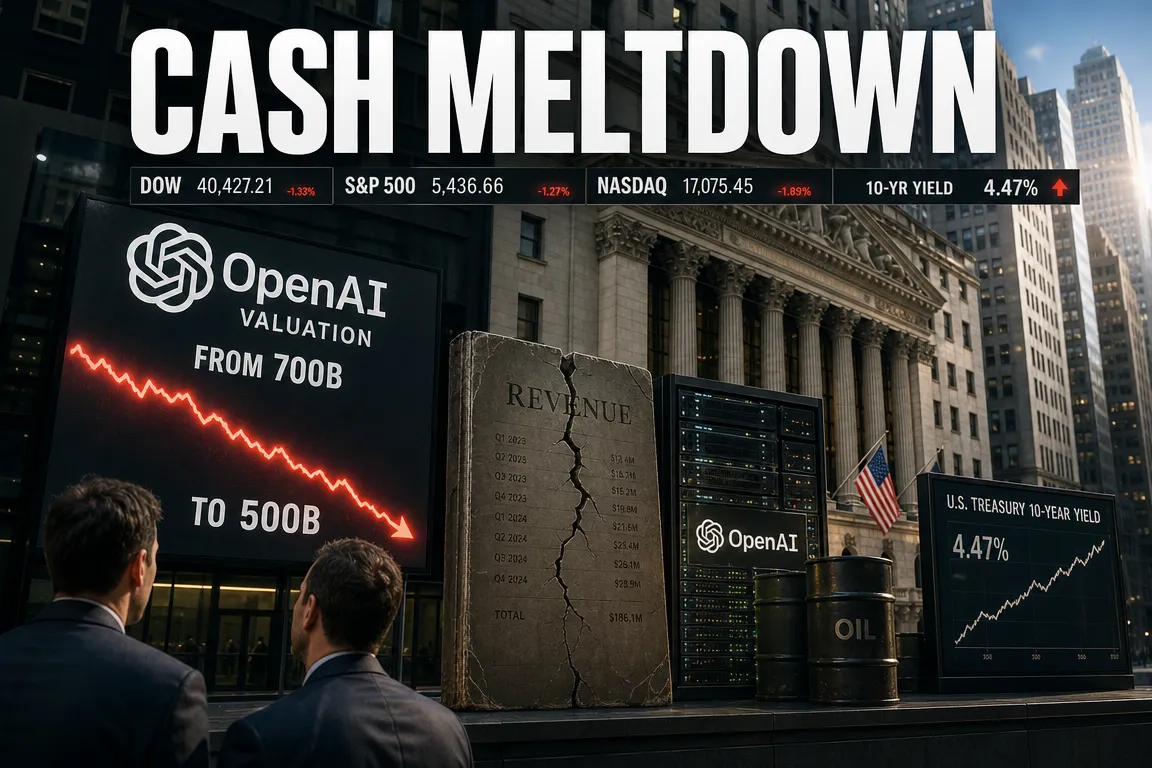
The market reaction was driven by reports that OpenAI’s annualized revenue, or ARR, was closer to $50 billion than the previously cited $70 billion.
ARR stands for Annual Recurring Revenue and refers to an annualized figure based on a monthly revenue run rate.
For example, if a company generates $4 billion per month, its annualized revenue would be approximately $48 billion.
The issue is that ARR is not the same as audited revenue under accounting standards.
Because private companies disclose limited financial information, investors often rely on investor materials or media reports, which can lead to different interpretations.
- Previous market perception: OpenAI ARR at approximately $70 billion
- Financial Times report: OpenAI ARR near $50 billion based on investor materials
- Difference: Approximately $20 billion
- Market reaction: Nasdaq decline and weaker sentiment toward AI-related stocks
At first glance, it appeared as though $20 billion in OpenAI revenue had disappeared.
In reality, the more likely explanation is a difference in how revenue was calculated.
2. The core issue is not a revenue decline, but a difference in methodology
The most important point in this controversy is that OpenAI did not actually lose revenue overnight.
The earlier $70 billion figure appears to have reflected a broader comparison framework used for benchmarking against Anthropic.
The newly reported $50 billion figure appears closer to OpenAI’s own prior communication approach.
In practical terms:
- OpenAI methodology: Revenue calculated primarily from direct sales
- Anthropic comparison method: May include broader revenue recognition through cloud and distribution channels
- Result: The same business can appear as either $50 billion or $70 billion in ARR depending on the methodology
For example, if OpenAI generates $50 billion in direct customer revenue, the figure could be higher if revenue routed through AWS, Google Cloud, or other distribution partners is partially included.
Including channel revenue makes ARR appear larger, while direct-sales-only treatment produces a more conservative number.
This is not a story about OpenAI collapsing.
It is a story about whether the revenue figure investors were using was already adjusted by hidden assumptions.
3. Why did Nasdaq fall? AI equities are driven more by expectations than by current numbers
The reason Nasdaq declined after the report is not that OpenAI is a listed company.
OpenAI is private, but it functions as a reference point for global AI sentiment.
When ChatGPT growth appears strong, the market turns more positive on GPU demand, Microsoft cloud revenue, data center investment, and semiconductor demand.
When OpenAI’s growth rate is questioned, expectations for the entire AI infrastructure cycle weaken.
The market is currently pricing in very high expectations for the AI sector.
AI-related stocks are not driven only by current earnings.
They are priced on the assumption of rapid growth over the next several years.
As a result, even a change in one revenue figure can trigger concerns about valuation levels across the sector.
- OpenAI ARR revision → doubts about AI growth rates
- Doubts about AI growth rates → weaker outlook for cloud and semiconductor demand
- Weaker demand outlook → lower sentiment toward Nvidia, large-cap tech, and Nasdaq
- U.S. equity correction → added pressure on KOSPI, especially semiconductors and AI infrastructure names
The market response was driven less by the $20 billion difference itself than by the reliability of the AI growth narrative.
4. What investors are really concerned about: Can the numbers be trusted?
For investors, the biggest concern is not weaker results but uncertainty.
This OpenAI controversy raised a basic question: under what methodology was the number calculated?
Private AI companies do not provide the same level of disclosure as listed companies, such as quarterly reports, audited statements, or detailed revenue breakdowns.
Investors therefore rely on media reports, investor presentations, internal estimates, and third-party data to value these companies.
The challenge is that AI revenue structures are more complex than those of traditional software companies.
- Enterprise subscription revenue
- Usage-based API revenue
- Cloud marketplace distribution revenue
- Strategic partnership revenue
- Model licensing and usage rights revenue
- Potential future conversion from free user bases
How these revenue streams are classified can materially change the growth rate.
In particular, gross versus net treatment of revenue generated through cloud partners can significantly affect ARR.
This is often overlooked in headlines, but it is one of the most important issues.
5. Anthropic may be the more important variable
In this discussion, Anthropic may deserve more attention than OpenAI.
Anthropic, which operates Claude, is one of the leading generative AI companies and is viewed alongside OpenAI as a top-tier AI growth story.
Recent third-party estimates have suggested that Anthropic’s annualized revenue growth may be slowing or flattening.
These figures are not official results, so they should not be treated as confirmed data.
However, the market is highly sensitive to such signals.
If Anthropic’s IPO-related disclosures show weaker growth than expected, AI sentiment could weaken further.
If OpenAI’s revenue interpretation alone can move Nasdaq, then weaker-than-expected actual data from Anthropic could have a larger impact.
- OpenAI issue: ARR controversy caused by methodology differences
- Anthropic risk: Possible slowdown in actual growth
- Market concern: Whether high growth can continue among leading AI companies
- Transmission path: AI software → cloud → semiconductors → global equity markets
The AI industry is now being tested less on who has the better model and more on how quickly that model can generate revenue.
6. Why KOSPI may be more sensitive
If Nasdaq benefited from AI optimism, KOSPI has also been heavily influenced by expectations tied to semiconductors and AI infrastructure.
Korean equities are particularly exposed to memory semiconductors, HBM, server investment, and data center demand.
As a result, any deterioration in U.S. AI sentiment can create above-average volatility in KOSPI.
Typically, U.S. mega-cap tech stocks move first, followed by pressure on Asian semiconductor supply chains.
If foreign investors rotate quickly, the short-term downside in KOSPI can widen.
- Nasdaq decline signals weaker global risk appetite.
- AI bubble debate may extend into concerns over semiconductor valuations.
- OpenAI revenue controversy may weaken the outlook for AI service demand.
- Anthropic growth concerns may lead to a reassessment of AI startup valuations.
- KOSPI outlook depends largely on foreign flows and semiconductor cycle expectations.
That said, this single event does not mean the AI cycle has ended.
The more important implication is that AI companies must now demonstrate not only revenue growth, but also profitability, cost discipline, and customer retention.
7. The most important points often missed in other coverage
First, ARR is revenue, but it is not profit.
AI companies may show rapid revenue growth, but GPU costs, cloud costs, data center costs, and model training expenses are also very large.
Therefore, whether OpenAI’s ARR is $50 billion or $70 billion is less important than how much cash flow remains after these costs.
Second, the quality of AI revenue matters.
Valuation depends on whether revenue comes from long-term enterprise contracts, temporary API usage spikes, or indirect channel sales.
Even if the top-line amount is the same, enterprise value differs significantly depending on recurrence, margin, and retention.
Third, cloud partner revenue is difficult to interpret.
Revenue generated through AWS, Google Cloud, or Microsoft Azure can look very different depending on whether it is reported on a gross or net basis.
This can materially affect how investors assess growth.
Fourth, the market is now demanding monetization, not just model performance.
In 2023 and 2024, the narrative that AI would transform the world was often enough.
Now the market is asking how much revenue is being generated, what the cost structure looks like, and when profitability will emerge.
Fifth, Anthropic’s IPO could become the next major test for the AI market.
If Anthropic’s listing materials confirm slower growth or heavy cost pressure, valuations across AI-related stocks could come under pressure.
Conversely, stronger-than-expected growth and customer expansion could restore sentiment.
8. Key indicators investors should monitor
After the OpenAI revenue controversy, ARR alone is no longer sufficient.
When evaluating AI companies and related stocks, investors should also monitor the following:
- ARR growth rate: How quickly revenue is expanding
- Net revenue retention: Whether existing customers are increasing usage
- Gross margin: How much remains after delivering the AI service
- Compute costs: GPU and cloud costs relative to revenue
- Enterprise customer mix: The share of more stable B2B revenue versus consumer subscriptions
- Channel dependency: The mix between direct and indirect revenue
- Cash burn rate: Whether expenses are growing faster than revenue
- IPO timing: Whether any delay reflects slower growth or weaker market conditions
The AI sector still has significant growth potential.
However, it is entering a phase in which growth narratives alone may no longer justify valuations.
Going forward, AI sentiment, U.S. rates, semiconductor demand, cloud spending, and corporate earnings are likely to move together.
9. One-sentence summary
This was not a case of OpenAI losing $20 billion in revenue; it was a case of the market losing confidence in the basis for AI growth figures.
The event also highlighted how heavily AI valuations depend on expectations.
Going forward, the key question is not whether OpenAI’s ARR is $50 billion or $70 billion.
The more important issue is whether AI companies can prove both high growth and profitability.
The answer to that question is likely to shape Nasdaq, Nvidia, large-cap tech, and KOSPI.
< Summary >
The OpenAI $20 billion revenue controversy was not a real revenue decline, but a difference in ARR methodology.
The previously cited $70 billion figure may have reflected a benchmark adjusted for Anthropic comparison, while the $50 billion figure appears closer to OpenAI’s own method.
The market reaction was driven less by OpenAI’s actual performance than by weakened confidence in AI growth-rate figures.
Potential Anthropic growth slowdown and IPO uncertainty may become the next major variables for AI sentiment.
Investors should assess not only ARR, but also revenue quality, gross margin, cloud costs, customer retention, and cash flow.
[Related Articles…]
- OpenAI Growth and AI Monetization Strategy Analysis
- Nasdaq Selloff and Global AI Equity Market Outlook
*Source: [ 내일은 투자왕 – 김단테 ]
– OpenAI의 매출 200억 달러가 사라졌다??● Oil, Yields, Chaos
Oil Surges 5% and U.S. Treasury Yield Hits 5.35%: Why Wall Street Turned Volatile
The key issue today is not simply that oil prices rose.
The market was hit simultaneously by a jump in crude prices, higher U.S. Treasury yields, warnings of additional Federal Reserve rate hikes, inflation concerns linked to AI investment, and weakness in stocks despite strong semiconductor earnings.
At first glance, the move appears driven by Middle East risk and hurricane-related disruptions. However, the more important factor is the extent to which AI investment and large-scale borrowing by governments and corporations are pushing bond yields higher.
This trend could affect U.S. equities, semiconductors, banks, oil prices, the dollar, and Bitcoin at the same time.
1. U.S. Stocks Open Lower: Higher Oil and Higher Rates Are a Difficult Mix for Growth Stocks
On October 8, U.S. equities opened under broad pressure.
S&P 500 futures were weak, while Nasdaq 100 futures fell about 0.5%.
The Dow Jones and Russell 2000 also declined, reflecting a broader risk-off tone.
- Crude oil rose about 4% to 5% in a single day.
- The U.S. 10-year Treasury yield approached 5.3%.
- The 30-year Treasury yield moved into the 5.6% range, increasing long-end rate pressure.
- The U.S. dollar index was slightly firmer.
- Bitcoin also weakened as risk assets came under pressure.
Higher oil prices increase inflation pressure.
Rising inflation expectations increase the likelihood that the Fed will keep rates higher for longer or raise rates further.
That pushes Treasury yields higher and weighs on growth stocks such as large-cap technology and semiconductors, whose valuations depend heavily on future earnings.
2. Crude Oil Rises 5%: Middle East Risk and Hurricane Disruptions Hit Simultaneously
Brent crude rose to roughly $104 to $105 per barrel, while WTI traded near $92 per barrel.
The latest oil move reflected both short-term and structural factors.
2-1. Middle East Supply Risk: Strait of Hormuz Concerns Return
Risk to oil shipping in the Middle East has increased.
In particular, reports of higher attack frequency near the Strait of Hormuz have unsettled the market.
Even if producing countries try to reroute exports through pipelines and other routes, concerns remain that tankers carrying crude could still be targeted.
- Shipping costs increased.
- Marine insurance premiums rose.
- Uncertainty over crude transport security intensified.
These added costs are ultimately reflected in oil prices.
The issue is not only output, but also the higher risk and expense of transporting crude.
2-2. Hurricane Impact: 25% of Gulf of Mexico Production Suspended
The first Atlantic hurricane of the year hit the U.S.
Hurricane Isaias reportedly reached maximum sustained winds of around 130 km/h.
As a result, major energy companies such as Shell and Chevron preemptively reduced operations at offshore facilities in the Gulf of Mexico.
- About 25% of Gulf of Mexico oil production was suspended.
- Daily production losses were estimated at about 510,000 barrels.
- Concerns over refinery damage were also priced in.
The Gulf of Mexico is a key offshore production region for the United States.
When hurricanes approach, companies typically evacuate personnel and shut down facilities for safety reasons.
As a result, supply disruption is priced in before actual damage occurs.
2-3. Declining Inventories Added to the Tight Supply Signal
According to the Energy Information Administration, U.S. crude inventories fell by 3.2 million barrels last week.
The market had expected an increase of 1.7 million barrels, so the result was sharply different from forecasts.
A draw in inventories indicates tighter-than-expected supply conditions.
Middle East risk, hurricane disruptions, and lower inventories combined to amplify the oil rally.
3. Trump Reportedly Considers Additional Strikes on Iran: Political Premium in Oil Increases
Reports indicated that President Trump is considering additional airstrikes on Iran ahead of the midterm elections.
The National Security team reportedly discussed the Iran issue at Camp David, and the U.S. military has prepared new operational options.
No decision on action or timing has been confirmed.
Still, markets react immediately even to the possibility.
If additional attacks on Iran materialize, concerns over the oil supply chain could deepen.
In particular, a wider Strait of Hormuz risk could push crude prices beyond a short-term spike and toward a more sustained high-price environment.
4. U.S. Treasury Yields Near 5.3%: The Biggest Constraint on Equities
The U.S. 10-year Treasury yield rose to around 5.29%.
The 30-year Treasury yield reached the 5.6% range, adding pressure to long-term financing costs.
This is close to the highest level seen since the early 2000s.
When yields rise to this extent, equities face three major headwinds.
- Higher discount rates reduce growth-stock valuations by lowering the present value of future earnings.
- Borrowing costs rise, discouraging investment and mergers and acquisitions.
- Higher Treasury yields reduce the relative appeal of equities.
Semiconductors and large-cap technology are especially sensitive to rising rates.
Even strong earnings may not support share prices when U.S. Treasury yields rise quickly.
5. U.S. 10-Year Treasury Auction Was Stronger Than Expected: Foreign Demand Was Solid
The previous day’s 10-year Treasury auction was stronger than expected.
The U.S. Treasury issued $39 billion of 10-year notes, with a stop-out yield near 5.3%.
The bid-to-cover ratio was 2.77x, above the recent average of 2.5x.
Foreign demand stood out.
Indirect bidders, which include foreign investors, accounted for 80.3% of the award, above the recent average of 74.7%.
By contrast, primary dealer takedown was only 2.5%, the lowest level since the global financial crisis.
In practical terms, foreign investors viewed yields as sufficiently attractive at these levels.
The sharp decline in Treasury prices appears to have drawn value-buying interest.
6. Today’s Main Focus Is the 30-Year Treasury Auction
Market attention has shifted to the 30-year Treasury auction.
The planned issue size is $22 billion.
Because of its long duration, the 30-year bond is more sensitive to long-term inflation, fiscal deficits, and growth expectations.
If the auction is strong, the market may interpret it as evidence that Treasury demand remains resilient despite higher yields.
If it is weak, the relief from the stronger 10-year auction could quickly fade.
Additional Treasury auctions in 20-year, 2-year, 5-year, and 7-year maturities will follow.
Accordingly, Treasury yield movements are likely to remain a key driver of U.S. equity direction.
7. FOMC Minutes: AI Investment May Add to Inflation Pressure
The most important point in the September FOMC minutes was the Fed’s view on AI investment.
The Fed acknowledged that AI could lower prices over the long term by improving productivity.
However, it also said AI could add to inflation pressure in the near term.
AI investment is not limited to software.
It requires data center construction, power-grid expansion, and heavy purchases of GPUs and memory chips.
It also increases demand for servers, cooling systems, real estate, power equipment, labor, and materials.
- Data center construction demand is rising.
- Power infrastructure spending is increasing.
- GPU and memory chip prices are rising.
- Corporations are issuing more debt to fund investment, increasing competition for capital.
- Bond yields face upward pressure as a result.
This is the most important market implication today.
AI remains a growth driver, but it is also becoming a new source of pressure on rates and inflation.
8. Fed Governor Waller: Another Rate Hike May Be Needed, but Not at Every Meeting
Fed Governor Christopher Waller said another rate hike may be necessary.
He also indicated that consecutive hikes at every meeting are not required.
The market interpreted this as a possible hold in October and a rate increase in December.
Waller identified three inflation drivers.
- High oil prices.
- Demand from AI investment.
- Tariff-related price pressure.
He described the labor market as still stable.
This suggests the Fed does not yet see enough weakness to justify ending tightening purely on growth concerns.
Going forward, CPI, PCE, labor data, and oil prices will be central to the December rate decision.
9. Samsung Electronics and TSMC Report Strong Earnings, but Shares Fall: “Rates Matter More Than Good Results”
Samsung Electronics delivered a strong preliminary third-quarter earnings report.
Operating profit surged on higher memory chip prices.
While some reports cited a figure of 107 trillion won, the key takeaway is the sharp earnings improvement and recovery in memory demand.
Despite this, Samsung Electronics shares fell in the Korean market.
The reasons were twofold.
- Much of the memory-cycle recovery may already be reflected in the stock price.
- Rising U.S. Treasury yields are pressuring global semiconductor stocks.
TSMC also reported strong September and third-quarter revenue.
Third-quarter revenue reached a record level and exceeded market expectations.
Even so, TSMC shares were weaker in the Taiwan market and in U.S. premarket trading.
The semiconductor industry fundamentals remain solid.
However, the market is now asking less whether earnings are strong and more whether those earnings can be sustained in a high-rate environment.
10. Positive for Micron, but Investors Must Monitor the Supply Cycle
Samsung’s strong results are also a positive signal for Micron investors.
Samsung and Micron are both major players in the DRAM market.
Samsung’s large profit increase from higher memory prices suggests stronger profitability across the industry.
Some Wall Street analysts have raised Micron price targets aggressively.
The core argument is that new capacity expansion will not happen immediately, and the period of tight supply may last longer than expected.
However, semiconductors are a classic cyclical industry.
When prices rise, producers eventually increase output.
As supply expands, oversupply can emerge later and prices can fall again.
Investors should therefore focus not only on earnings, but also on the timing of supply growth and the durability of pricing.
11. Broadcom and OpenAI Reportedly Discuss $30 Billion Financing: The Hidden Cost of AI Growth
Broadcom is reportedly discussing $30 billion in financing to secure semiconductors for OpenAI.
Broadcom has a strong position in custom AI chips.
OpenAI is pursuing not only general-purpose GPUs but also chips designed for its own use cases.
The issue is cost.
Securing large volumes of AI semiconductors requires financing on the order of tens of billions of dollars.
Broadcom was previously reported to be pursuing $60 billion in financing for AI infrastructure related to Anthropic.
This trend is linked to the bond market.
When AI companies and large technology firms issue hundreds of billions of dollars in corporate debt, investors may choose between Treasuries and corporate bonds.
As a result, Treasuries may need to offer higher yields to attract capital.
In effect, the AI investment boom is adding upward pressure on U.S. Treasury yields.
12. U.S. Bank Stocks Weaken: Higher Rates Are Not Always Good for Banks
Major U.S. banks will begin reporting third-quarter earnings next week.
JPMorgan, Goldman Sachs, Citi, Wells Fargo, Morgan Stanley, and Bank of America are scheduled to report sequentially.
The market expects earnings at large banks to rise about 20% from a year earlier.
However, bank stocks have already weakened.
The KBW Bank Index has fallen about 13% from its August high.
Higher rates can support net interest margins, but an excessive rise in long-term yields also creates drawbacks.
- Deposit funding costs increase.
- Corporate loan demand may weaken.
- Bond valuation losses become a greater burden.
- IPO and M&A activity may slow.
- Investment banking fee income may decline.
Reports also indicated that IPOs by Ora, a smart ring company, and SB Energy, an AI data center developer, were postponed.
Higher rates can freeze capital markets.
13. The Most Important Point Markets Are Overlooking Today
First, AI investment is both a positive for equities and a driver of higher rates.
Most coverage focuses on stronger demand for AI semiconductors and better growth prospects for big tech.
However, if AI data centers, power infrastructure, semiconductors, and debt issuance all expand together, inflation and U.S. Treasury yields can rise.
Second, the era in which strong semiconductor earnings automatically lifted share prices may be fading.
Samsung Electronics and TSMC reported strong results, but their shares fell.
The market is now placing greater emphasis on rates, the supply cycle, financing costs, and valuation.
Third, oil price gains should be viewed separately as a short-term hurricane effect and a longer-term Middle East risk premium.
Hurricane-related disruptions may normalize within about a week if damage is limited.
By contrast, the possibility of strikes on Iran and risk around the Strait of Hormuz could influence markets for a much longer period.
Fourth, U.S. Treasury auctions have become a key driver of equity direction.
Investors now need to watch not only corporate earnings but also demand at 10-year and 30-year Treasury auctions.
Unless long-term yields stabilize, any equity rebound may remain limited.
14. Key Monitoring Points for Investors
- Track how long Brent crude remains above $100.
- Monitor whether the U.S. 10-year yield moves further above 5.3%.
- Watch whether demand at the 30-year Treasury auction is strong or weak.
- Assess whether the probability of another Fed hike in December rises further.
- Review post-earnings guidance for memory prices after results from Samsung Electronics, TSMC, and Micron.
- Monitor how Broadcom and OpenAI financing discussions affect bond market supply and demand.
- Check deposit costs, loan demand, and IPO fee trends in U.S. bank earnings.
< Summary >
Crude oil rose nearly 5% as Middle East shipping risks and hurricane-driven production disruptions in the Gulf of Mexico tightened supply.
The U.S. 10-year Treasury yield approached 5.3%, pressuring U.S. equities and semiconductor stocks.
The Fed has indicated that AI investment could add to inflation and rate pressure in the near term.
Samsung Electronics and TSMC posted strong results, but shares fell as higher rates and elevated expectations weighed on sentiment.
Broadcom’s and OpenAI’s financing discussions highlight the bond market cost of AI growth.
Key market variables ahead include crude oil, U.S. Treasury yields, the Fed’s policy path, the semiconductor supply cycle, and U.S. bank earnings.
[Related Articles…]
*Source: [ Maeil Business Newspaper ]
– 유가 5% 폭등 美국채금리 5.35%|트럼프 이란 재공습 검토|허리케인 원유 생산 차질|삼성·TSMC 호실적 주가 하락|美 30년물 입찰|연준 추가 인상 경고|홍혜진의 뉴욕브리핑