● Debt Trap, Self Destructing Businesses, 5060 Collapse
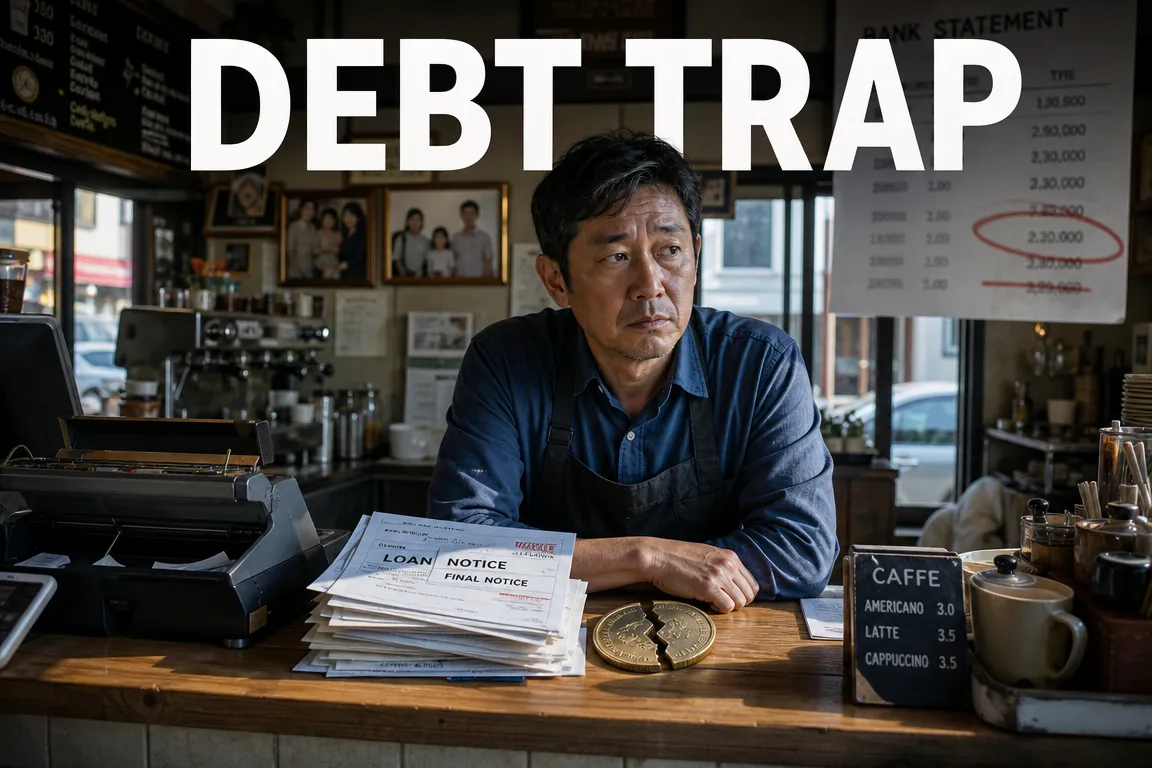
“Do not repay debt too aggressively”: The most common mistake made by self-employed owners and late-career founders on the verge of insolvency
The central point is not the provocative claim that people should stop repaying debt.
The issue is the structural reasons behind the surge in business closures, personal rehabilitation, personal bankruptcy, multiple debt burdens, and late-career 50s–60s entrepreneurship.
In particular, the key risk is the pattern in which self-employed owners endure until the end under recession and high interest rates, only to accumulate larger debt and damage family and personal relationships in the process.
This is linked to Korea’s persistent structural issues: a high share of self-employment, a culture that does not tolerate failure, and a financial system that makes re-entry difficult.
The most dangerous decision today is taking on new debt to service existing debt under the assumption that conditions will improve soon.
1. Current self-employed insolvencies reflect structural weakness, not individual incompetence
The first point raised is that self-employed insolvency should not be viewed solely as a personal failure.
Most business owners do not start with the intention of failing.
They try to absorb rent, renovation costs, key money, inventory, labor, and operating expenses while keeping the business alive.
The problem is that when sales weaken, revenue declines while fixed costs remain unchanged.
Debt then accumulates, and a point is reached where closure becomes unavoidable.
In practice, however, owners often do not exit at that point.
They hesitate because of sunk costs, time already invested, and social pressure.
Above all, many remain attached to the belief that demand may recover if they wait long enough.
- Sales weaken.
- Interest payments on existing debt become difficult to service.
- Closure feels premature or wasteful.
- New borrowing is used to cover existing debt.
- Money is borrowed from family and acquaintances.
- Multiple debt obligations accumulate.
- Debt remains even after closure.
This is the cycle most commonly seen among Korea’s self-employed owners today.
The issue is therefore not simply weak demand or poor business execution.
It is a structural problem in which the burden of economic slowdown and delayed domestic recovery falls disproportionately on the self-employed.
2. Why trend-driven businesses are risky: the common pattern behind tanghulu, macaron, and castella shops
The examples of tanghulu, macarons, and castella illustrate the risk of trend-driven businesses.
The main problem is that these concepts appear easy to enter but have very short life cycles.
They initially attract queues and social media attention.
As a result, many assume entry is still timely.
However, trend-based businesses expand supply rapidly.
Similar stores open in the same area, and consumer attention shifts elsewhere.
At that point, sales can fall sharply.
The problem is that fixed costs do not fall with sales.
Rent remains, labor costs are difficult to reduce, and startup debt and renovation expenses remain outstanding.
As a result, owners often incur even greater losses precisely when they should be exiting.
- Trend-based concepts make revenue forecasting difficult.
- Low barriers to entry accelerate competition.
- The trend may end before the initial investment is recovered.
- Closure costs and residual debt create a double burden.
- Waiting longer often increases losses.
The key issue in trend-driven ventures is not how well they sell at launch, but how quickly the owner can exit if conditions deteriorate.
3. Why closure and bankruptcy are especially difficult in Korea
One of the most important structural observations is that closing a business in Korea is much more difficult than opening one.
Starting a business is relatively simple.
But shutting it down and restarting is far more complex.
A closure filing does not end the matter.
Outstanding loans, lease contracts, employee issues, taxes, guarantees, card loans, and private borrowing from acquaintances may all remain.
In the past, many small and midsize company owners also signed personal guarantees when taking corporate loans.
Although such practices have declined, owners still often retain significant personal liability in practice.
The same applies to companies and startups financed through Korea Technology Finance Corporation or Korea Credit Guarantee Fund-backed lending.
While corporations are formally limited-liability entities, founders rarely become fully detached from failure in practice.
This encourages owners to continue operating rather than acknowledge failure and exit.
In doing so, they may resort to personal credit loans, card loans, borrowing from others, and in some cases even borderline illegal measures.
4. “Corporations may fail, but individuals must be able to restart” is a basic capitalist principle
The video highlights an important comparison.
In the United States, entrepreneurs often restart after bankruptcy.
Trump is known to have gone through multiple bankruptcy proceedings, and historical figures such as Ford also experienced failure.
In U.S.-style capitalism, failure is more often treated as experience.
By contrast, in Korea, once a person files for bankruptcy or fails to repay institutional debt properly, re-entry becomes highly difficult.
It is difficult to receive another opportunity from Korea Technology Finance Corporation, Korea Credit Guarantee Fund, or commercial banks, and the social stigma of failure remains.
Under such conditions, business owners are less able to acknowledge failure early.
As a result, they fail to cut losses at an appropriate time and instead accumulate larger debt before collapsing.
Capitalism depends on entrepreneurship, failure, and re-entry.
If failure becomes a permanent mark, innovation declines.
This applies to startups, franchises, SMEs, and the self-employed alike.
There must be an exit path for failure if people are to continue launching new ventures.
5. Why insolvency among 50s–60s entrepreneurs is increasing: retirement often leads to involuntary self-employment
Korea’s self-employment rate is high by OECD standards.
The share of self-employed workers among total employment is estimated at about 20%–23%, which is a relatively elevated level.
Within that group, people in their 50s and 60s account for a particularly large share.
The reason is clear.
After retirement from a primary job, re-employment is difficult.
The Korean economy has not created enough jobs to absorb older workers.
As a result, many people in their 50s and 60s enter entrepreneurship not as a choice, but as a survival strategy.
The problem is that they are often pushed into sectors they know little about rather than areas where they have relevant experience.
- Monetizing 30 years of experience from a large company often requires substantial capital.
- AI, sales, trade, manufacturing, and technology-based businesses can require significant upfront investment.
- The required capital may be 1 billion won, 2 billion won, or more.
- For that reason, many move into restaurants, franchises, or small retail businesses with lower entry barriers.
- They then compete in sectors where they have limited experience.
This increases risk.
When entering an unfamiliar business, judgment deteriorates.
Owners may rely too heavily on a franchisor’s claims, misread the local market, or enter based on trend alone.
The same logic applies to investment decisions.
People are often exposed to losses in stocks, crypto, real estate, or presale products because they move in too quickly without sufficient understanding.
6. Why the 50s–60s group faces greater risk: they often support both parents and children
People in their 50s and 60s are not only supporting themselves.
They often support parents in their 70s and 80s.
They also bear education and living expenses for children in their teens and 20s.
In many cases, children in their 30s are also not yet independent and continue to depend on their parents.
The problem is that the likelihood of receiving support from the next generation later in life is declining.
As a result, this cohort faces pressure from both older and younger generations at the same time.
When income stops under these conditions, anxiety rises sharply.
This makes people more likely to enter ventures or investments without adequate review.
This cannot be explained simply as greed.
It reflects the combined pressure of retirement planning, family support, failed re-employment, high living costs, and household debt.
7. The most important advice: do not create new debt to repay old debt
The message emphasized most strongly is that people should not overfocus on repaying debt in a way that creates larger problems.
This does not mean debt repayment is unnecessary.
Contracts must be honored, and borrowed money should be repaid.
However, creating riskier new debt in order to service existing debt is a more serious problem.
The following actions are especially dangerous:
- Using card loans to cover bank loans.
- Turning to private lenders to cover card loans.
- Taking personal credit loans to service business loans.
- Borrowing from family or friends to cover existing obligations.
- Working 16 hours a day or more while sacrificing health.
These choices may appear to provide short-term relief.
But over the long term, they reduce the chance of recovery.
In particular, failing to repay money borrowed from family or friends damages both finances and relationships.
For people in their 50s and 60s, that loss can be especially severe.
Accordingly, the first step is not repayment but a clear assessment of the debt structure.
Owners must determine what is realistically serviceable and whether formal procedures such as personal rehabilitation or personal bankruptcy should be considered.
What matters is restructuring for survival, not simply continuing repayment at any cost.
8. Using health as collateral to repay debt is also dangerous
Another important point is health.
Many self-employed owners run a business during the day and work night jobs such as driving services or delivery work to repay debt.
This may be sustainable in the short term.
But over time, the body cannot absorb the strain.
This is particularly serious for people in their 50s and 60s, because once health deteriorates, generating cash flow again becomes difficult.
Medical expenses then compound the problem.
Repaying debt at the expense of health can result in losing both income and physical capacity.
The reason governments maintain personal rehabilitation and personal bankruptcy systems is precisely this.
Forcing people to continue repaying debts they cannot realistically service may create greater losses for society as a whole.
Structured debt adjustment and the restoration of economic activity are necessary safeguards in capitalist systems.
9. Personal rehabilitation and personal bankruptcy are re-entry mechanisms, not moral failures
In Korea, personal rehabilitation and personal bankruptcy are still widely seen as shameful.
But these systems are not designed only to protect debtors.
They exist to improve overall economic efficiency.
When a person burdened by unmanageable debt leaves the labor market, society also suffers a loss.
By contrast, restructuring debt and restoring the ability to work benefits the broader economy.
Bankruptcy systems also exist in developed capitalist countries, including the United States.
In fact, some observers argue that Korea’s procedures are comparatively strict.
For that reason, considering personal rehabilitation or personal bankruptcy should not automatically be viewed as moral failure.
The key is to understand the legal framework properly and seek expert advice tailored to the individual case.
10. The core point rarely stated in other media: Korea lacks a safe landing path after failure
Most media coverage focuses on business closure rates, delinquency, and weak domestic demand.
But the more important point here is that Korea lacks sufficient structural support for a safe landing after failure.
The greater risk is not failure itself, but the inability to acknowledge failure.
Even when business owners want to exit early to limit losses, they cannot do so because of the debt and credit consequences that remain after closure.
Corporate founders are left carrying the company’s failure as though it were a failure of their entire life.
As a result, endurance is prioritized over rational decision-making.
Under this structure, entrepreneurship can become a channel through which the middle class is destabilized rather than a path to innovation.
In the AI era, converting prior career experience into new business opportunities becomes more important.
However, Korea’s 50s–60s cohort often lacks sufficient support to connect their experience with AI tools, data, digital sales, and global markets.
As a result, they are pushed into sectors they know less about, such as restaurants, franchises, or real estate investments.
The policy response needed is not limited to simple startup subsidies.
It must include mechanisms for failure exit, re-entry financing, mid-career retraining, and AI-based productivity support for small businesses.
The self-employed issue is not merely a welfare issue; it is tied to Korea’s growth rate, labor market structure, and financial stability.
11. Checklist for current business owners and prospective founders
- Calculate actual cash flow after rent, labor, materials, and interest expenses.
- If operating losses continue for three consecutive months, prioritize restructuring over endurance.
- Avoid new borrowing used solely to repay existing debt.
- Consult on personal rehabilitation before borrowing from family or friends.
- For trend-driven businesses, assume a highly conservative payback period.
- For franchises, review closure rates and actual franchisee profitability, not only the franchisor’s materials.
- Do not treat closure as a failure; treat it as a loss-minimization strategy.
- Repayment strategies that damage health are more dangerous in the long run.
- If debt is no longer manageable, consult legal professionals about personal rehabilitation, personal bankruptcy, or debt restructuring.
12. What policy needs now: exit design matters more than startup support
Korea has many policies that encourage startups, but still lacks a strong system for helping failed entrepreneurs recover.
Expanding startup education and loan support alone may push more people into debt.
What is needed now is education on closure scenarios and risk management before entrepreneurship begins.
For late-career founders in their 50s and 60s, the focus should not be limited to opening a restaurant.
They should be guided toward models that use prior career experience, such as consulting with AI tools, B2B sales, overseas sourcing, or professional-service businesses that require limited capital.
This is a more practical way to reduce failure among older entrepreneurs.
Financial institutions should also move beyond simply excluding people with failed histories and instead build systems that assess re-entry potential.
That would reduce the incentive to keep operating until losses become irreversible and would allow people to exit earlier and return to economic activity sooner.
< Summary >
Self-employed insolvency is driven more by structural factors than by individual incompetence.
The most dangerous behavior is taking on new debt to repay old debt.
Trend-based businesses require exit planning as much as entry planning.
People in their 50s and 60s are pushed into self-employment after retirement and face higher failure risk in unfamiliar sectors.
Personal rehabilitation and personal bankruptcy are re-entry tools, not moral failures.
Enduring while sacrificing health and relationships is a more dangerous strategy in the long run.
For Korea’s economy, exit support, re-entry systems, and AI-based transition support for mid-career and older workers are likely to matter more than additional startup promotion.
[Related Articles…]
*Source: [ 경제 읽어주는 남자(김광석TV) ]
– “빚을 너무 열심히 갚지 마세요” 자영업자가 파산 직전 가장 많이 하는 실수 | 경읽남과 토론합시다 | 박기태 변호사 [2편]● SpaceX Shocks Telecoms, Delta Bets on Amazon, AI Chaos, Markets Jittery
Why Delta Chose Amazon Leo Instead of Starlink: SpaceX’s Telecom Entry, U.S. Telco Selloff, and OpenAI Revenue Debate
The key market takeaway today is not simply that U.S. equities rebounded.
SpaceX’s acquisition of low-band spectrum has opened a path into the U.S. telecom market, triggering roughly $62 billion in combined market capitalization losses for Verizon, T-Mobile, and AT&T in a single session.
At the same time, Delta Air Lines chose Amazon Leo over Starlink, shifting the airline connectivity market from a speed competition toward a broader ecosystem competition.
In parallel, the OpenAI revenue accounting debate, AI semiconductor consolidation, warnings around the 10-year Treasury yield at 5.5%, and the upcoming September CPI report are converging into a meaningful market inflection point.
1. U.S. Market Performance: Indices Rebounded, but Breadth Remained Mixed
U.S. equities broadly recovered.
The Dow Jones Industrial Average rose 0.83%, the S&P 500 gained 0.59%, and the Nasdaq advanced 0.64%.
The U.S. dollar index, 10-year Treasury yield, crude oil, gold, and Bitcoin also moved higher during the session.
- Dow Jones Industrial Average: up 0.83%
- S&P 500: up 0.59%
- Nasdaq: up 0.64%
- S&P 500 for the week: up approximately 1.15%
- Nasdaq for the week: up approximately 0.64%
- Dow Jones for the week: up approximately 0.93%
However, the internal structure of the market remained uneven.
AI software names rebounded, while AI semiconductor stocks remained under pressure.
This distinction is central to the current market setup.
2. AI Software Rebounded, While AI Semiconductors Remained Fragile
Microsoft, Amazon, and Alphabet traded relatively well.
AI software and infrastructure names such as Palantir, Oracle, CoreWeave, and Dell posted strong performance.
By contrast, AI semiconductor names, including Nvidia, remained pressured after the OpenAI revenue controversy.
- AI software: Palantir, Oracle, CoreWeave, and Dell were strong
- Large-cap tech: Microsoft, Amazon, Alphabet, and Tesla were generally firm
- AI semiconductors: Nvidia, Micron, and semiconductor ETFs were weaker
- Micron: down about 0.66%
- SK Hynix: down about 0.86%
- SOXX semiconductor ETF: down about 0.69%
- DRAM ETF: up about 0.64%
The market is no longer treating AI as a single trade.
Investors are increasingly separating software, cloud, data center infrastructure, semiconductors, and power infrastructure within the AI theme.
AI semiconductors still have long-term growth potential, but in the near term they remain sensitive to valuation and customer revenue validation concerns.
3. The Core of the OpenAI Revenue Debate: The Issue Is the Accounting Method, Not a Revenue Decline
The main AI-related catalyst this week was the debate over OpenAI’s annualized revenue.
Following a Financial Times report, the market initially worried that OpenAI’s revenue may be about $20 billion below expectations.
However, the key issue was not a deterioration in growth, but the distinction between gross revenue and net revenue.
- Market consensus: OpenAI annualized revenue of about $70 billion
- Reported controversy: roughly $50 billion in net revenue as of late September
- Reason for the gap: inclusion or exclusion of fees paid to external cloud partners such as Microsoft and Google Cloud
- OpenAI’s approach: reporting net revenue after third-party cloud distribution fees
- Some competitors’ approach: reporting on a gross revenue basis
The Financial Times later corrected its reporting to clarify that the $50 billion figure referred to net revenue.
Bloomberg also reported that OpenAI could reach a $70 billion annualized revenue run rate by year-end, even if it currently stands near $50 billion on a net basis.
In other words, the market overreacted to a reporting issue rather than a collapse in OpenAI’s growth trajectory.
The broader issue is more important.
As frontier AI companies such as OpenAI and Anthropic grow, investors will need to compare companies using consistent definitions of revenue.
Going forward, AI company analysis should focus not only on revenue, but also on net revenue, gross revenue, cloud costs, distribution fees, and actual cash flow.
4. The More Important Implication: AI Revenue Debate Marks the Beginning of an Accounting Standard Debate
This OpenAI issue may appear to be a short-term headline event.
However, it is better understood as the beginning of a broader debate over how AI companies should report revenue.
- AI companies are deeply integrated with cloud providers.
- Whether to treat gross customer payments or net amounts after cloud costs as revenue can materially change the numbers.
- Comparing gross-revenue and net-revenue companies without adjustment can distort growth rates.
- AI semiconductor demand forecasts are ultimately tied to the actual monetization capacity of end customers.
The key question for AI investing is no longer simply “how large is revenue?”
It is how that revenue is calculated, and how much profit remains after costs.
Without that discipline, investors may swing between excessive optimism and excessive fear in AI semiconductors, cloud, and data center names.
5. Crude Oil: Hurricane-Driven Supply Disruptions, but Likely Temporary
Crude oil prices moved higher.
Geopolitical risk in the Middle East remains in the background, but the more immediate driver was a hurricane in the U.S. Gulf of Mexico.
The storm forced significant shutdowns in offshore oil production facilities.
- Gulf of Mexico oil production shut-in: about 71%
- Natural gas production shut-in: about 58.8%
- Previous reported levels: 25% for oil and 16% for natural gas
- Hurricane intensity: strengthened to Category 3
This is more a weather-driven disruption than a structural supply shortage.
Once the storm passes and inspections are completed, offshore production is likely to resume.
As a result, the impact on crude prices may be temporary, although refined products could remain more sensitive.
6. Diesel Prices: Why Trump Highlighted Russian Supply
In the United States, diesel prices are not only an energy issue.
They are directly linked to agriculture, logistics, freight transport, and electoral sentiment.
Diesel is essential for farm equipment and trucking in agricultural states such as Iowa, Ohio, and Indiana.
President Trump mentioned the possibility of increasing diesel supply through talks with Russia.
- Immediate supply: 300,000 tons
- November supply: 500,000 tons
- Potential additional supply: 1 million tons, with cumulative supply potentially reaching 3 million tons
- 3 million tons converted: roughly 22 million barrels
- Global daily diesel demand: about 30 million barrels
- U.S. daily diesel demand: about 3 million to 4 million barrels
While 3 million tons appears large, it amounts to only about 6 to 7 days of U.S. diesel demand.
It may support short-term price stability, but it is not a durable long-term solution.
Following the remarks, diesel futures fell quickly from about $4.76 to around $4.68.
Even so, U.S. retail diesel prices remain elevated and are still up about 120% year to date.
7. The 10-Year Treasury Yield: PIMCO’s 5.5% Red Line Matters
One of the most important but quiet variables in the market is the 10-year Treasury yield.
PIMCO, one of the world’s largest bond managers, said the 10-year yield could move higher.
It identified 5.5% as a key level that could begin to weigh on equities.
- PIMCO outlook: further upside in the 10-year yield is possible
- Risk zone: around 5.5%
- Extreme case: a move toward 6% is being discussed in the market
- Impact: higher funding costs, valuation pressure, and weaker support for growth stocks
If the 10-year yield approaches 5.5%, equities may face significant pressure.
AI semiconductors, cloud companies, and other high-growth technology names are especially sensitive to higher rates.
At this stage, the key market variable is not earnings alone, but whether interest rates and inflation reaccelerate.
8. The Real Meaning of SpaceX Securing Low-Band Spectrum
Today’s main event is SpaceX.
SpaceX reportedly acquired low-band spectrum licenses from investment firm Grain Management.
This matters because it can address a key limitation in Starlink’s existing service model.
Starlink has historically been more effective in higher-frequency bands.
It is well suited for open-sky environments such as oceans, aircraft, and outdoor areas, but it is less effective in buildings, underground spaces, and dense forested areas.
Low-band spectrum offers better penetration and is therefore more suitable for mobile phone services.
- High-band spectrum: faster, but more vulnerable to obstructions
- Low-band spectrum: lower speed, but stronger coverage and penetration
- Core significance: SpaceX may now have a foundation to enter mobile telecom services
- Market reaction: sharp selloff in legacy telecom stocks
The announcement drove a broad decline in the three major U.S. telecom names.
- Verizon: down about 8.75%
- T-Mobile: down about 13.55%
- AT&T: down about 9.99%
- Combined market cap loss for the three telecom companies: about $62 billion in one day
The market’s reaction is straightforward.
SpaceX is no longer viewed only as a satellite internet company; it could become a fourth major player in the U.S. telecom market.
9. The Telecom Selloff Reflected a Structural Threat
Verizon, T-Mobile, and AT&T have long dominated the U.S. wireless market.
If SpaceX combines a low-Earth-orbit satellite network with low-band spectrum, the competitive landscape changes materially.
Traditional carriers rely on ground-based cell towers.
SpaceX is building a model that combines satellites and terrestrial networks.
If successful, this approach could place significant pressure on incumbent telecom operators in coverage and service competition.
SpaceX is not becoming a nationwide mobile carrier overnight.
It still faces major hurdles, including towers, handset compatibility, regulatory approvals, and roaming relationships with incumbent carriers.
However, markets discount future possibilities quickly.
The selloff reflects concern that SpaceX could eventually enter the telecom market in a meaningful way.
10. Airline Connectivity: American Airlines Also Chose Starlink
SpaceX is expanding not only in ground-based telecom, but also in aviation connectivity.
American Airlines has chosen Starlink for in-flight Wi-Fi.
Commercial deployment is expected to begin in 2027.
- American Airlines: announced Starlink adoption
- United Airlines: moving toward Starlink adoption
- Hawaiian Airlines and Alaska Airlines: already in partial service or adoption process
- Korean Air, Asiana Airlines, and Qatar Airways: moving toward Starlink use or adoption
For airlines, in-flight internet is becoming a core customer experience rather than a supplementary amenity.
On long-haul routes, Wi-Fi quality can influence airline preference.
For business travelers in particular, connectivity during flight is increasingly important.
11. Why Delta Chose Amazon Leo Instead of Starlink
Among major U.S. airlines, Delta’s choice is the most notable.
While American and United are moving toward Starlink, Delta has chosen Amazon Leo.
From a pure technology standpoint, the decision appears counterintuitive.
Starlink has already built a dominant satellite network.
Amazon Leo remains in the buildout phase and is expected to scale later.
- Starlink: based on a network of more than 10,000 low-Earth-orbit satellites
- Starlink V2: current main satellite generation
- Starlink V3: expected to deliver significant performance improvements versus V2
- Starship deployment: potentially enabling launches of about 60 satellites at a time
- Amazon Leo: still described as a buildout-stage network of roughly 400 to 1,000 satellites
- Broad commercial use of Amazon Leo: potentially after 2028
Delta’s decision can likely be explained by two factors.
12. Delta’s First Reason: Starlink May Not Fit Its Business Model
Delta CEO Ed Bastian has said that Starlink may not align with Delta’s business model.
This does not mean the technology is inferior.
Airlines increasingly view in-flight internet not just as connectivity, but as a platform for customer data, loyalty, advertising, shopping, and content consumption.
Starlink may offer superior connectivity quality, but its fit with Delta’s commercial model is a separate question.
Delta may prefer a partner that gives it greater flexibility in integrating internet service with its own customer experience and revenue strategy.
13. Delta’s Second Reason: The Amazon Ecosystem Aligns Better with In-Flight Services
A larger factor may be Amazon’s ecosystem.
Amazon is not just an internet provider.
It operates across e-commerce, Prime Video, advertising, cloud services, payments, and data analytics.
- In-flight shopping: potential integration with Amazon retail
- Prime Video: possible connection with onboard entertainment
- Advertising: potential use of passenger data for targeted ads
- AWS: possible linkage to airline operations, booking, and customer analytics
- Loyalty integration: potential linkage between Delta SkyMiles and Amazon Prime
From this perspective, Delta’s decision may not be about choosing slower technology.
Delta may be prioritizing a broader digital commerce ecosystem over pure internet speed.
14. Delta Faces a Customer Experience Risk
The main risk is timing.
Amazon Leo will need time before it can provide stable aviation-grade service at scale.
By contrast, Starlink is already being adopted rapidly by multiple airlines.
If American and United deliver free or high-quality Starlink Wi-Fi in 2027 and 2028 while Delta lags, Delta could fall behind on customer experience.
This may matter especially on long-haul international routes and in premium cabins.
Elon Musk’s public criticism of Delta’s decision reflects this tension.
The dispute now goes beyond technology and extends into executive-level rivalry.
15. Korean Air and Starlink: The Shift Begins on Long-Haul Routes
Korean Air is also offering Starlink-based free Wi-Fi on selected long-haul routes.
Reports indicate service on routes such as Bangkok and Washington on certain aircraft.
- Example aircraft: Airbus A350-900
- Example aircraft: Boeing 777-300ER
- Primary focus: long-haul international routes
- Wide-body aircraft: large aircraft with two aisles
- Narrow-body aircraft: smaller aircraft with one aisle
Airlines are likely to begin with long-haul routes and wide-body aircraft.
Long-haul passengers are more sensitive to internet quality, and airlines can use it as a premium differentiator.
16. SpaceX’s Scalability: Ground, Air, and Space Infrastructure
SpaceX’s valuation continues to be reassessed not just because it launches rockets efficiently.
It is now targeting three markets simultaneously.
- Ground telecom: potential mobile network entry through low-band spectrum
- Aviation connectivity: potential dominance in in-flight Wi-Fi
- Space infrastructure: satellites, Starship, space data centers, and AI data processing potential
This combination could pressure incumbents across telecom, aviation connectivity, and cloud infrastructure.
SpaceX is increasingly evolving into a next-generation communications infrastructure company.
17. Next Week’s Key Event: September CPI Will Help Set the Fed and Market Direction
The September CPI report will be released next week.
It could reshape expectations for the Fed’s policy path and the market’s rate-cut outlook.
- Core CPI monthly consensus: 0.2%
- Core CPI year-over-year consensus: 2.5%
- Headline CPI monthly consensus: 0.6%
- Headline CPI year-over-year consensus: 3.6%
The most important number is the 0.2% month-over-month core CPI estimate.
The previous reading was 0.3%, so a decline to 0.2% would support the view that inflation pressure is easing.
Another 0.3% or higher reading could push Treasury yields higher and weigh on equities.
The market is currently more sensitive to core inflation than headline inflation.
For the Fed to maintain flexibility toward a hold or rate cuts, inflation excluding food and energy must continue to moderate.
18. Investment Implications
First, AI exposure now requires more selective positioning rather than a broad “buy AI” approach.
Given the divergence between AI software and AI semiconductors, investors need to distinguish between companies with verifiable monetization and those driven primarily by expectations.
Second, telecom stocks are facing structural competitive pressure.
SpaceX will not replace Verizon, T-Mobile, or AT&T overnight, but the market is already pricing in long-term competitive risk.
Third, airline stocks may increasingly compete on internet quality as a differentiating factor.
Delta’s choice of Amazon Leo may prove to be an ecosystem strategy over time, but in the near term it creates a customer experience risk versus Starlink-adopting peers.
Fourth, interest rates and inflation remain the dominant variables for asset prices.
If the 10-year Treasury yield moves toward 5.5%, growth stocks and other high-valuation assets could face significant pressure.
Fifth, oil and diesel prices should be viewed through a political and macroeconomic lens.
Diesel pricing affects logistics, agriculture, consumer inflation, and election dynamics, making it a persistent driver of inflation expectations.
19. The Most Important Points Often Missed by Other Coverage
The first key point is that SpaceX’s low-band spectrum acquisition is not merely a telecom headline.
It suggests that SpaceX may expand from satellite internet into mobile telecom infrastructure.
The market may eventually shift from a contest among ground-based carriers to competition between terrestrial and space-based networks.
The second key point is that Delta’s decision may reflect platform strategy rather than technological inferiority.
Starlink is stronger in connectivity, while Amazon is stronger in commerce and content ecosystems.
Delta may be treating in-flight internet as a digital platform that generates revenue, not simply as Wi-Fi.
The third key point is that the OpenAI debate exposed the need for consistent revenue definitions in AI.
Investors will increasingly need to distinguish between net revenue and gross revenue when evaluating AI companies.
Without this, AI semiconductor demand forecasts may remain unstable.
The fourth key point is that the 10-year Treasury yield at 5.5% is a more important market variable than a single CPI print.
The main issue is not one monthly data point, but how far rates can rise.
If yields move toward 5.5%, valuation pressure on U.S. equities could increase quickly.
The fifth key point is that diesel prices are a hidden inflation risk.
Investors focused only on crude oil may miss the effect of diesel on logistics, agriculture, and consumer prices.
< Summary >
U.S. equities rebounded, but AI software and AI semiconductors moved in different directions.
The OpenAI revenue debate is primarily about net versus gross revenue accounting, not a sudden slowdown in growth.
SpaceX’s low-band spectrum acquisition increases its potential entry into the U.S. telecom market, pressuring Verizon, T-Mobile, and AT&T.
While American Airlines and United Airlines are moving toward Starlink, Delta chose Amazon Leo, highlighting strategic differences in airline internet.
Delta’s choice may reflect a preference for Amazon’s commerce, Prime Video, and AWS ecosystem rather than raw connectivity speed.
Crude oil rose on hurricane-related disruptions, while diesel remains a key political and inflation variable.
PIMCO identified 5.5% on the 10-year Treasury yield as a critical pressure point for equities, and next week’s September CPI, especially the 0.2% core monthly reading, could shape expectations for Fed policy.
[Related Articles…]
- Starlink’s Push Into Satellite Telecom and the Future of U.S. Wireless Competition
- U.S. CPI and the Outlook for Federal Reserve Policy
*Source: [ Maeil Business Newspaper ]
– [문지웅의 빅머니 LIVE] 델타는 왜 스타링크 대신 아마존 레오 선택했나 | 버라이즌, T모바일, AT&T 폭락은 ‘예고된 재앙’