● AI-Debt Crash, Nasdaq Selloff, CoreWeave Spiral
AI Data Center Stress May Extend Beyond CoreWeave: Nasdaq Decline and the Worst-Case Scenario for AI Stocks
The key issue here is not simply that CoreWeave’s share price has fallen sharply.
The more important point is that the entire AI data center investment model is built on a “debt financing → GPU purchase → lease revenue recovery” structure, and the market has begun to question its sustainability.
At the same time, reports of another AI fund liquidation, declines in data center bond prices, funding pressure on Nvidia customers, rising Brent crude, and a Nasdaq correction have combined to weaken sentiment across AI equities.
This report focuses on a key issue that is often overlooked in other coverage: not whether AI semiconductor demand has peaked, but whether the financing structure behind AI data centers is starting to break down.
1. Market tone: this is not a “sell after confirmation” phase, but a “sell first, think later” phase
The Nasdaq fell more than 2% in a single day, placing significant pressure on AI equities.
The Nasdaq 100 was also said to be on track for its weakest weekly performance since April 2025.
The market is no longer moving on company-specific earnings alone.
AI data centers, interest rates, Treasury yields, oil prices, inflation, and recession concerns are now moving together, driving a stronger risk-off tone.
- CoreWeave’s decline has spread concerns across AI infrastructure names.
- Rumors of AI fund liquidations have further weakened sentiment.
- Lower data center bond prices are signaling stress in credit markets.
- Rising Brent crude is adding to inflation pressure.
- Nvidia valuations have moderated, but market skepticism has increased.
In this environment, good news often has limited impact on stock prices, while negative news is punished disproportionately.
In short, the market is now focused less on AI growth potential and more on who can sustain this level of investment, at what cost, and for how long.
2. Why CoreWeave is being viewed as the weak link in AI markets
CoreWeave is a leading neocloud company operating AI data centers.
In simple terms, the company borrows money to buy Nvidia GPUs, builds data center capacity, and rents computing power to customers.
This model is attractive in a high-growth environment, but it becomes vulnerable when rates are high and capital markets turn unstable.
- CoreWeave depends heavily on debt and external financing.
- GPU acquisition costs are very high, creating significant upfront capital requirements.
- Revenue recovery takes time after data center buildout.
- Funding costs rise materially when interest rates increase or credit spreads widen.
- Even a modest slowdown in AI demand can raise concerns about profitability.
CoreWeave’s stock is said to have fallen by nearly 60% from its peak.
At the same time, the 5-year CDS, a market-based proxy for default risk, is interpreted as having risen sharply.
While CDS prices do not directly equal default probability, they are widely used as a signal of credit risk.
When CoreWeave’s stock falls and CDS rises at the same time, the market is signaling concern not only about growth, but also about credit quality.
3. Nvidia and CoreWeave: a partner that created demand may also become a source of risk
CoreWeave is widely viewed as one of the key companies in the AI infrastructure ecosystem that Nvidia has helped support.
For Nvidia, more data center operators buying GPUs is clearly beneficial.
That is why neocloud companies such as CoreWeave have played an important role in expanding demand for Nvidia chips.
However, the market question has now shifted.
The issue is whether Nvidia’s GPUs are becoming so expensive that customers can still earn an adequate return.
- Nvidia sells AI chips at premium prices.
- Neocloud firms borrow heavily to finance those purchases.
- As borrowing costs and depreciation burdens rise, margins weaken.
- If customers fail to generate returns, Nvidia’s long-term demand base could also weaken.
Nvidia CEO Jensen Huang said CoreWeave does not need immediate rescue financing and described the company’s competitiveness and outlook positively.
He also maintained that the technology will benefit industries and economies over time, and that current difficulties will pass.
Even so, the market is assigning a lower valuation to Nvidia relative to forward earnings expectations.
This does not mean Nvidia cannot generate strong profits. It means investors are questioning how long the current AI investment cycle can remain intact.
4. Structural weakness in neocloud firms: the gap with hyperscalers is widening
CoreWeave, Nebius, and IREN are all neocloud companies focused on AI data center operations.
However, compared with Amazon, Meta, Google, and Microsoft, they are structurally disadvantaged.
The biggest difference is in proprietary chip development.
- Amazon is developing its own AI chips, including Trainium and Inferentia.
- Google is reducing its dependence on Nvidia through TPU.
- Microsoft and Meta are also strengthening proprietary AI chip strategies.
- By contrast, neocloud operators remain heavily dependent on buying Nvidia GPUs.
This distinction is likely to become more important over time.
Hyperscalers can lower operating costs through proprietary chips, while neocloud firms must continue purchasing expensive GPUs from third parties.
As a result, capital strength, funding costs, and internal chip capabilities are likely to give large hyperscalers an advantage in the AI data center race.
This is why the CoreWeave issue may be more than a company-specific problem and could reflect a broader structural challenge for the AI infrastructure sector.
5. Another AI fund liquidation rumor: forced selling is now a market concern
Market participants are also discussing another rumored liquidation involving an AI-related fund.
The original report referenced Vara AI Fund and suggested that it held significant positions in CoreWeave, Nebius, Blue Owl Energy, and other volatile AI or semiconductor-related names such as Micron and SanDisk.
However, this remains a rumor and should not be treated as confirmed fact.
The firm reportedly denied claims of liquidation or bankruptcy.
Even so, the market remains concerned because of trading-volume patterns.
- Stocks believed to be heavily held by the fund saw unusually high trading volume.
- By contrast, peers with lower assumed exposure showed relatively muted volume.
- This has led to speculation that forced selling or position reduction may have occurred.
Liquidation rumors matter because AI stock corrections may extend beyond simple valuation compression.
If a leveraged fund cannot absorb losses, it may be forced to sell quality names alongside weaker ones.
That can trigger a negative feedback loop in which lower prices reduce collateral value and lead to further selling.
6. The most serious concern: stress is spreading to other data center bonds
The most important issue in this episode is not CoreWeave’s stock decline itself.
The key development is that bond prices for other AI data center projects are also falling.
Data center projects typically require substantial capital and use a mix of corporate debt, project finance, and lease structures.
After the CoreWeave selloff, other data center-related bonds have also weakened.
Some of these projects are backed by long-term contracts or cash flows closely linked to companies such as Meta, Microsoft, and Oracle.
When even those bonds begin to weaken, it suggests the market is becoming more cautious about AI infrastructure credit risk.
- Lower bond prices imply a wider risk premium.
- While this may not immediately affect all funding costs, it can raise the cost of new projects.
- Future AI data center developments may require higher yields and larger risk premiums.
- Ultimately, this could slow AI capex growth.
This is the scenario markets dislike most.
AI demand may remain strong, but if funding costs rise too far, data center expansion becomes more difficult.
If expansion slows, GPU purchases may slow as well, which could affect Nvidia and the broader semiconductor value chain.
If this becomes self-reinforcing, AI stocks may face a broader valuation reset.
7. GPU rental rates are rising, but stocks are falling: what the market is really worried about
One notable point is that GPU rental prices are still rising.
This suggests that real AI computing demand has not collapsed.
In fact, current usage data indicates that GPUs remain scarce and AI training and inference demand continues to increase.
Even so, AI data center stocks have fallen sharply.
This indicates that the market is questioning not demand itself, but the ability to convert that demand into profitable economics.
- Rising GPU rental rates signal strong near-term demand.
- However, high GPU purchase costs and funding costs continue to pressure margins.
- If rental rates later weaken, the downside for equities could be larger.
Investors should view this carefully.
The long-term growth of the AI industry and the short-term performance of AI data center stocks do not necessarily move together.
The industry can expand while highly levered companies struggle first.
8. Meta and Apple’s open model releases: could on-device AI reduce data center demand?
Meta and Apple’s release of open models such as MusicGen and Spark has also added a modest layer of uncertainty to the market.
These models point to a direction in which useful AI may run not only in massive data centers, but also on high-end personal devices and desktop environments.
On-device AI does not replace large data centers in the near term.
However, markets focus on direction.
If increasingly capable AI models can run on PCs, Mac Studio systems, smartphones, or local servers, expectations for long-term data center demand growth could moderate.
- On-device AI offers lower latency and better privacy.
- It may also reduce cloud spending for enterprise users.
- Large-scale model training and heavy inference will likely remain centered in data centers.
In short, on-device AI will not eliminate data center demand, but it can weaken the simple assumption that all AI growth must flow through cloud infrastructure.
9. Why Apple has held up better: limited AI capex has become a defensive advantage
It is also notable that Apple has outperformed many other members of the Magnificent 7.
Apple is both a technology company and a consumer franchise with strong defensive characteristics.
Its iPhone business, services revenue, brand loyalty, and large cash flow provide support for the stock.
Apple has also not been as aggressive as other major tech companies in pouring money into AI data center expansion.
While that was often criticized as a sign that Apple was behind in AI, the market’s current skepticism toward capex-heavy AI strategies may now make Apple’s lower exposure a defensive benefit.
This reflects a rotation within technology toward names with more secure cash flows.
10. A positive sign: AWS says AI investment payback is under three years
Not all news is negative.
An Amazon AWS CFO said that AI spending will continue.
AWS stated that AI demand remains strong, order backlog is meaningful, and the payback period for AI server investment is under three years.
This is important.
It suggests that large-cap cloud providers continue to see actual customer demand and productivity benefits.
- AI token usage is increasing productivity benefits.
- Enterprise customers are seeing efficiency improvements from AI adoption.
- AWS believes AI-related returns remain attractive.
- As a result, a near-term halt in hyperscaler AI capex appears unlikely.
This is why the AI bubble debate should not be reduced to a simple yes-or-no call.
Real demand clearly exists.
The issue is who can monetize that demand most efficiently.
Large hyperscalers may remain resilient, while debt-dependent neocloud firms face greater pressure.
11. Memory semiconductors: short-term shortage, China risk in 2028
Michael Dell said memory shortages could become more severe.
AI server growth is driving rapid demand for HBM, DRAM, and high-performance storage.
In the near term, this remains constructive for memory producers such as Samsung Electronics, SK hynix, and Micron.
However, Elon Musk noted that if China expands production of mainstream memory such as LPDDR5 and LPDDR6 quickly, conditions could change by 2028.
He drew a distinction by saying HBM is a separate category.
- The AI server-led memory shortage may continue through 2026-2027.
- HBM remains difficult for China to catch up with in the near term.
- Standard memory could face oversupply risk if China expansion accelerates.
- Investors should distinguish between HBM and commodity memory.
Memory remains a critical bottleneck in the AI semiconductor market.
However, not all memory companies will benefit equally, and product mix and customer exposure will matter more.
12. Cathie Wood’s CoreWeave purchase: a high-risk rebound bet
ARK Invest’s Cathie Wood reportedly bought about 190,000 shares of CoreWeave.
The shares were said to have been added to two ARK ETFs.
Cathie Wood is known as a long-term innovation investor, but performance has been difficult in recent years.
Since the 2021 peak, her flagship ETFs have declined significantly, while the Nasdaq has risen materially over the same period.
This CoreWeave purchase is a classic high-risk, high-reward rebound bet.
- If CoreWeave resolves funding concerns, the stock could rebound sharply.
- If credit risk continues to rise, downside risk remains substantial.
- ARK’s purchase should be viewed as an aggressive growth bet rather than a broad sentiment signal.
Individual investors should not follow simply because a well-known investor bought the stock. The company’s debt structure and cash flow profile should come first.
13. The most important point not emphasized in many reports
The essence of this episode is not a slowdown in AI demand.
The core issue is that the financing structure behind AI infrastructure investment is now being tested by the market.
AI should not be viewed only through the lens of “Nvidia has strong earnings,” “GPUs are scarce,” or “hyperscalers keep spending.”
The real questions are the following.
- Can AI data center companies earn adequate returns in a high-rate environment?
- Are GPU prices too high for customers to maintain healthy margins?
- Will stress in data center bonds slow new AI infrastructure investment?
- If even projects with quasi-backstops from major cloud and software companies come under pressure, does market confidence weaken?
- Even if AI demand remains intact, will highly levered companies be the first to be eliminated?
That is the central point.
The question is less whether AI is a bubble and more whether the market can absorb the cost of building AI infrastructure at this scale.
Nvidia, Amazon, Google, and Microsoft can likely endure because of their balance sheet strength.
CoreWeave and similar companies, by contrast, are much more sensitive to funding costs and credit conditions.
Going forward, the AI stock market may shift from a broad growth rally to a market that separates capital-rich winners from highly levered losers.
14. Key indicators for investors to watch
Investors should not focus only on stock price moves when monitoring AI and data center trends.
The following indicators will matter as well.
- CDS and corporate bond trends for CoreWeave and other neocloud firms
- Credit spread changes in data center project bonds
- GPU rental rates and utilization levels
- Nvidia pricing policy and customer profitability
- AI payback periods reported by AWS, Azure, and Google Cloud
- Changes in Brent crude and inflation data
- U.S. Treasury yields and Fed rate-cut expectations
- Forced-selling risk from leveraged AI funds
Data center bond pricing may become especially important.
Equities move on sentiment, but bonds show the reality of funding conditions.
If risk premiums continue to rise in credit markets, the AI capex cycle could slow sooner than expected.
Conversely, if bond prices stabilize and credit concerns ease, AI equities could rebound quickly.
15. Conclusion: AI growth remains intact, but the market is now focused on the cost of capital
The long-term growth story for AI remains intact.
Companies are improving productivity through AI, cloud providers are seeing real demand, and GPU and HBM demand remains firm in the near term.
However, equity markets are no longer trading only on the growth narrative.
High rates, rising oil prices, renewed inflation pressure, and credit-market stress can all weigh on even the strongest industry themes.
In particular, AI data center firms built on debt are likely to face much stricter scrutiny.
The CoreWeave episode is less a signal that the AI era is ending than a sign that the AI infrastructure sector is undergoing its first serious financial stress test.
Going forward, the key issue will not be who bought the most GPUs, but who can fund them at the lowest cost and convert them into cash flow the fastest.
< Summary >
CoreWeave’s decline is not just a company-specific event; it reflects market skepticism toward the AI data center financing model.
Neocloud operators that buy GPUs with debt and recover costs through leasing revenue are highly vulnerable to higher rates and tighter credit conditions.
Rumors of another AI fund liquidation and lower data center bond prices have increased concerns about forced selling and funding risk.
Nvidia remains strong, but the market is increasingly asking whether customers can earn enough to justify expensive GPUs.
AWS remains constructive on AI demand and payback periods, but investors are now paying more attention to funding costs and cash flow than to growth alone.
AI equities may increasingly split into two groups: capital-rich hyperscalers and debt-heavy neocloud firms under pressure.
[Related Articles…]
*Source: [ 내일은 투자왕 – 김단테 ]
– 또 다른 AI 펀드 청산? 코어위브 위기 전염? AI 주식 최악의 시나리오로 가나?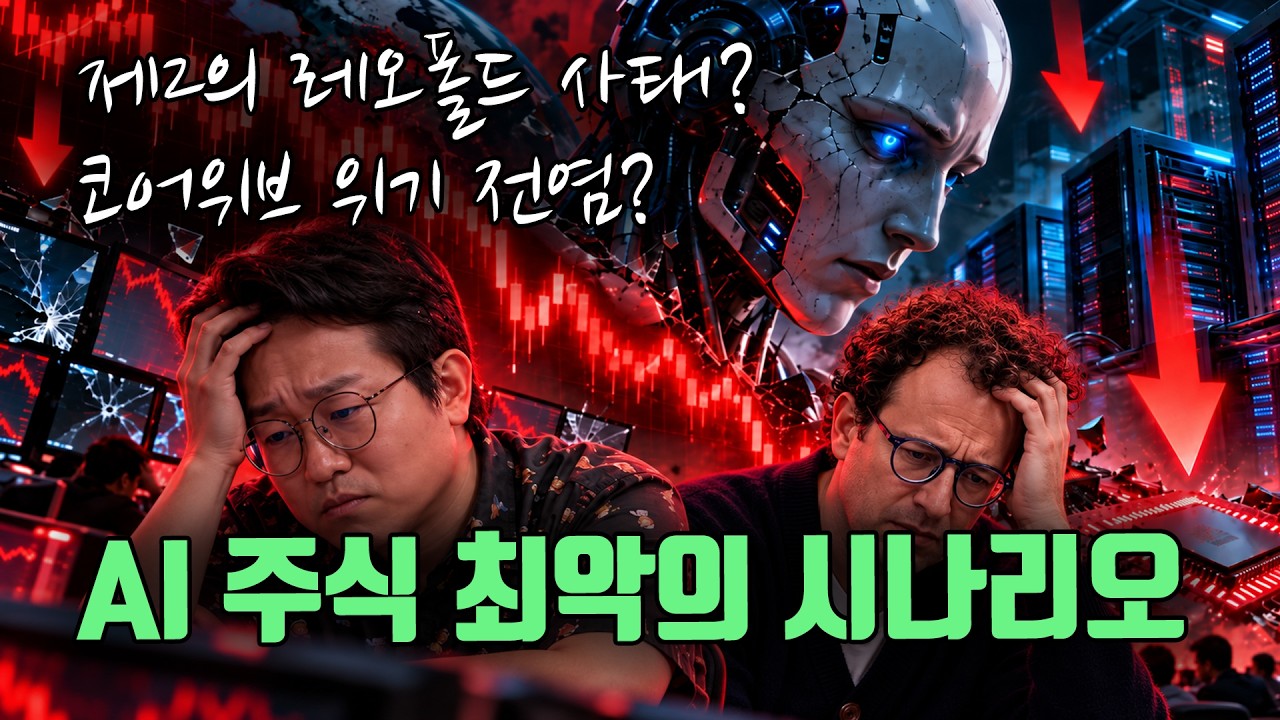
● Trump Shockwave, Global Market Turmoil, Korea on Edge
Why a Democratic Victory in the Midterm Elections May Still Not Contain Trump: Signals for Global Markets and the Korean Economy
The key point is not simply whether Democrats win or Republicans hold the line.
The more important issue is that Trump-era foreign, security, and trade policies are likely to remain forcefully implemented regardless of the midterm outcome.
Even if Democrats win the House, or even achieve a so-called blue sweep by taking both chambers, tariff policy, pressure on China, export controls, recalibration of U.S.-Korea relations, and executive-order-driven governance may continue with limited restraint.
This may appear to be a U.S. political issue, but in practice it is directly linked to the U.S. economic outlook, global financial markets, exchange rates, trade rules, and risks for Korean exporters.
Rather than relying on the simplified view that “a Democratic victory will constrain Trump,” the more important structural implications are outlined below.
1. Core conclusion: Even if Democrats win, Trump’s administration will remain difficult to restrain
The central conclusion is clear.
Even if Democrats take control of the House, it will still be difficult to preemptively block the Trump administration’s core policies, especially in foreign affairs, national security, and trade.
This reflects the U.S. institutional structure, under which substantial authority over foreign affairs, security, and trade remains with the president and the executive branch.
-
Foreign policy is heavily dependent on presidential discretion.
-
Security policy is typically initiated by the executive branch, with Congress responding later through appropriations or legislation.
-
Trade policy includes some areas requiring congressional authority, but measures such as Section 301 actions, export controls, and sanctions on specific countries or firms can be advanced largely by the executive branch.
As a result, Democrats may increase political pressure through hearings and investigations, but stopping the administration at the outset is difficult.
This is the most important point to consider when assessing the U.S. midterm elections.
2. Scenario 1: Republicans hold the Senate while Democrats take the House
The most likely scenario discussed in the source is Republican control of the Senate and Democratic control of the House.
At first glance, this may seem to imply that House control would reduce Trump-related uncertainty.
However, the interpretation is different.
House control alone is unlikely to block Trump’s core agenda, and may instead deepen conflict between Congress and the executive branch.
What a Democratic House can do
-
Form investigative committees.
-
Summon executive officials to hearings.
-
Apply political pressure on immigration, trade, and tariff policy.
-
Investigate conflicts of interest involving Trump family business interests.
-
Create operational and political friction for the administration.
Why it remains difficult to block policy
-
Legislation must be passed to impose institutional constraints on the executive branch.
-
If Republicans control the Senate, House-passed legislation is likely to be blocked there.
-
Even if Congress passes legislation, the president can veto it.
-
Overriding a veto requires a two-thirds majority.
-
Securing that threshold is highly unlikely in the current environment.
In effect, a Democratic House can apply pressure, but it cannot easily stop policy execution.
Accordingly, the view that a House win alone would significantly reduce Trump risk is likely too simplistic.
3. Scenario 2: A Democratic blue sweep of both chambers
The second scenario is a Democratic victory in both the House and Senate.
This would constitute a blue sweep.
Even in this case, the overall conclusion does not change materially.
Democratic control of Congress would still not make it easy to block Trump’s foreign, security, and trade agenda at a structural level.
However, one important difference would emerge.
If Democrats control the Senate, they can block presidential nominees for cabinet positions, the Supreme Court, and other senior posts.
This would place meaningful operational pressure on the administration.
Even so, the Trump administration would likely seek alternatives.
Trump-style workarounds: acting appointments and executive orders
-
If the Senate blocks cabinet confirmations, Trump could rely on acting officials.
-
He could move policy through loyalists inside the executive branch.
-
He could rely more aggressively on executive orders to bypass Congress.
-
Even without a confirmed defense secretary or commerce secretary, the president could effectively direct policy himself.
The source frames this as a situation in which Trump effectively becomes his own defense secretary and commerce secretary.
While the expression is hyperbolic, the core point is clear.
Greater congressional resistance could push the administration toward a more centralized and unilateral style of governance.
4. Institutional limits in Congress: veto power and the two-thirds barrier
In the U.S. system, Congress must pass legislation to restrain the president.
However, passage alone is insufficient.
If the president vetoes the bill, Congress must override that veto.
That requires two-thirds support.
-
In the Senate, 67 out of 100 votes are required.
-
The House also requires a two-thirds majority.
-
In today’s polarized environment, reaching that threshold is difficult.
As a result, a simple Democratic majority would not be sufficient to control the Trump administration.
From a Korean political perspective, an opposition-controlled legislature might appear capable of severely constraining the president, but the U.S. system operates differently.
This is especially true in foreign affairs, national security, and trade, where presidential discretion is broad.
5. The judiciary is not an easy check: U.S. courts tend to avoid politicized disputes
Democrats could also pursue legal challenges.
For example, they could argue that certain Trump administration actions are unconstitutional and seek judicial review.
However, the source treats this option as limited.
The U.S. judiciary has traditionally been cautious about directly ruling on political questions.
Courts are generally reluctant to intervene in highly political disputes.
This restraint is especially strong in foreign policy and national security.
Accordingly, courts are also unlikely to be a strong barrier to Trump’s foreign or trade agenda.
6. Impeachment: politically possible, practically unlikely
One of the strongest conclusions in the source concerns the possibility of impeaching Trump.
The conclusion is clear.
After the midterm elections, the likelihood of Trump’s impeachment is extremely low.
Impeachment in the U.S. requires two stages:
-
The House must pass articles of impeachment by a simple majority.
-
The Senate must then approve removal by a two-thirds vote, or 67 out of 100 senators.
Even if Democrats control the Senate, they are more likely to hold only 51 or 52 seats.
That is far below the 67 votes needed for removal.
In practical terms, impeachment is impossible unless a large number of Republicans defect.
Comparison with Nixon and why Trump is different
The most prominent historical example of a president leaving office under political pressure is Richard Nixon.
During Watergate, even Republican leadership concluded that Nixon could no longer be protected.
He ultimately resigned before a Senate vote.
However, the source argues that Trump does not face a comparable political trigger today.
Trump has already survived multiple scandals and controversies, lowering the political threshold for tolerance.
As a result, issues that might once have been fatal are less likely to translate into impeachment within the Republican Party and Trump’s base.
7. A lame-duck scenario: unlikely without a severe defeat
Another question is whether Trump could become a lame-duck president if Republicans lose the midterms.
The source does not dismiss this possibility entirely.
However, it argues that the conditions are demanding.
Trump would likely need a politically severe defeat, not just a modest loss, for a meaningful lame-duck dynamic to emerge.
Thresholds that could trigger a lame-duck phase
-
A Democratic Senate majority of 60 or more seats is identified as a critical benchmark.
-
Sixty Senate seats are enough to neutralize the filibuster in practice.
-
The Senate filibuster remains a powerful blocking tool, and ending it requires 60 votes.
-
If Democrats reach 60 seats, their legislative capacity would rise materially.
-
In the House, 230 to 240 Democratic seats would also create significant pressure on Republicans.
But a 60-seat Senate majority is difficult to achieve.
Since 67 seats are required for impeachment, even 60 seats would still not be enough for removal.
Therefore, even a strong Democratic showing would not automatically place Trump in a deep lame-duck position.
8. Why Republican lawmakers are unlikely to break with Trump
Another question is why Republican lawmakers do not simply oppose Trump internally.
The source highlights a practical obstacle.
Trump maintains strong influence over Republican primaries.
He can publicly endorse or attack candidates, and those signals often affect primary outcomes directly.
This is especially relevant for House members, who must run for reelection every two years.
By 2028, they will again need to secure renomination and cannot easily ignore Trump’s base.
As a result, even Republicans who dislike Trump have limited incentive to oppose him openly.
That is the core source of his continued influence within the party.
9. U.S. political polarization: why low approval does not necessarily produce a collapse
Low approval ratings do not automatically translate into a broad Republican defeat.
The reason is severe political polarization.
The U.S. functions as a de facto two-party system.
Republican voters rarely support Democrats, and Democratic voters rarely support Republicans.
As a result, election outcomes often depend less on broad persuasion and more on turnout among each party’s base.
Why Trump focuses on red-state mobilization
-
He seeks to consolidate support in states such as Alaska, Alabama, and Texas.
-
His strategy prioritizes base mobilization over persuading moderates.
-
In midterm elections, turnout and base discipline are decisive variables.
This is why low approval alone does not necessarily produce a collapse for Republicans.
That point matters for how global markets should assess U.S. political risk.
10. Political culture differences between Korea and the U.S.: presidential involvement in elections
The source also highlights a notable difference between Korea and the United States.
In Korea, even the appearance of presidential involvement in candidate selection can trigger a major political controversy.
In the U.S., however, a president publicly endorsing candidates and influencing primaries is relatively normal.
This is partly because the U.S. Constitution strongly protects freedom of expression and association.
The president is also treated as a political actor with speech rights.
Such conduct may face criticism, but it does not automatically lead to impeachment or legal sanctions.
This difference may feel unfamiliar to Korean readers.
11. Monetary policy pressure: Trump and the Federal Reserve
The latter part of the source discusses Trump’s public pressure on monetary policy.
Trump has repeatedly called for lower interest rates and pressured the Federal Reserve chair to resign.
In Korea, similar comments by a president could generate significant criticism if they appeared to interfere with central bank policy.
In the U.S., however, such statements have been part of Trump’s political style.
This remains a key variable for the U.S. economic outlook.
If the Trump administration continues to challenge Fed independence, dollar volatility, U.S. Treasury yields, and global market volatility could rise.
For Korea, which is highly sensitive to exports and exchange rates, this would be a direct risk.
12. Crypto and conflict-of-interest concerns: characteristics of the U.S. regulatory environment
The source briefly mentions the Clarity Act and controversies surrounding the crypto industry.
The issue is the perceived overlap between Trump family business interests and digital asset markets.
In Korea, the intersection of political power, family business interests, and digital assets would be highly sensitive.
In the U.S., however, political controversy does not always translate into immediate institutional restraint.
This is important for investors tracking AI, digital assets, and the broader regulatory environment.
U.S. regulation is shaped not only by principles and institutions, but also by political power, industry lobbying, and election strategy.
13. Implications for the Korean economy and U.S.-Korea relations
This discussion is not limited to domestic U.S. politics.
For Korea, it affects U.S.-Korea relations, defense cost-sharing, semiconductors, batteries, automobiles, steel, shipbuilding, AI infrastructure, and power-grid investment.
If the Trump administration can advance trade policy by bypassing Congress, Korean companies and policymakers should not assume that a midterm result alone will reduce risk.
Areas of particular concern for Korea
-
Tariff policy: Even if broad-based tariffs are not introduced, pressure on specific industries or countries may continue.
-
Export controls: The executive branch may retain broad discretion over semiconductors, AI chips, and advanced manufacturing equipment.
-
Defense cost sharing: A more transactional Trump approach could increase cost pressure on Korea.
-
China strategy: Stronger U.S. pressure on China could force Korean firms to accelerate supply-chain realignment.
-
Exchange rates and interest rates: Fed independence concerns and fiscal uncertainty could increase volatility in the dollar-won rate.
For Korea, the key issue is not the election result itself, but how the administration uses executive authority after the election.
14. The most important point often missed in mainstream coverage
First, a Democratic win does not automatically mean policy stability.
Many reports imply that if Democrats control Congress, Trump risk will fall.
In practice, however, presidential authority remains strong in foreign, security, and trade matters, so policy uncertainty may continue.
Second, stronger congressional resistance may push Trump toward more executive-order-based governance.
Instead of stopping policy, congressional resistance may encourage the administration to seek alternative channels.
Third, impeachment is a political slogan more than a realistic outcome.
The 67-vote Senate hurdle makes removal extremely difficult under current political conditions.
Fourth, a lame-duck phase would require a severe Republican defeat, not merely a narrow loss.
Democrats would likely need around 60 Senate seats or a decisive House victory to trigger meaningful distance between Trump and his party.
Fifth, Korea should focus less on the election headline and more on how the executive branch exercises power.
Tariffs, export controls, defense cost sharing, and AI semiconductor rules can move faster through the administration than through Congress.
15. Key checkpoints for investors and companies
-
Track whether executive orders increase after the midterm elections.
-
Monitor references to Section 301, export controls, and industry-specific tariffs.
-
Watch Trump’s pressure on Federal Reserve independence.
-
Observe whether Senate confirmation delays and acting appointments become more common.
-
Assess whether open criticism of Trump rises within the Republican Party.
-
Monitor direct pressure on Korean semiconductor, automobile, and battery companies.
In the end, U.S. political risk should be assessed through institutional structure, not headlines alone.
A Democratic victory does not by itself eliminate uncertainty for global markets.
< Summary >
Even if Democrats win the U.S. midterm elections, it will still be difficult to materially constrain Trump’s administration.
Foreign, security, and trade policy remain heavily driven by presidential and executive authority, limiting congressional checks.
If Democrats take the House, they can increase political pressure through hearings and investigations, but policy blocking will remain difficult.
Even with control of both chambers, the veto power and the 67-vote Senate threshold make impeachment highly unlikely.
Trump’s lame-duck risk would require a severe Republican defeat, which is difficult under current polarization.
For Korea, the more important variables are tariff policy, export controls, defense cost pressure, Fed independence, and changes in U.S.-Korea relations.
[Related Articles…]
*Source: [ 경제 읽어주는 남자(김광석TV) ]
– 민주당이 이겨도 트럼프는 못 막는다…중간선거 뒤 ‘독주’ 시작될까 | 경읽남과 토론합시다 | 민정훈 교수 [2편]