● Tesla-SpaceX Shock, Barclays Boosts, 450 Call
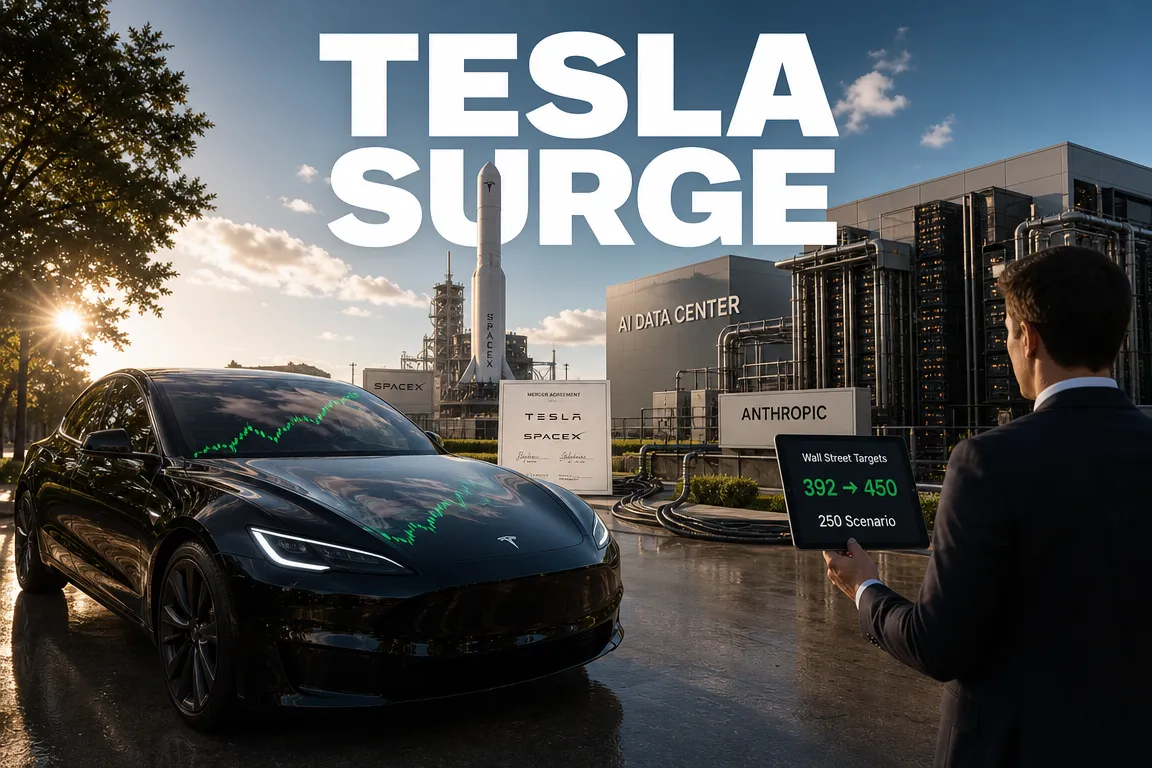
Tesla Shares Surge 5.2% as Barclays Sets a $450 Target: Key Conditions for Shareholders at $392
The central issue is not simply the higher price target.
Tesla’s valuation is beginning to incorporate electric vehicle sales, Full Self-Driving, energy storage, robotaxi growth, and the potential for a combination with SpaceX.
However, the reported $450 price target represents only about 15% upside from the current share price, while the downside scenario indicates a decline to $250 if merger expectations dissipate.
Investors holding Tesla near $392 should focus less on the potential upside to $450 and more on who would control Tesla’s cash and voting rights following a merger.
The original Barclays report, merger terms, robotaxi mileage data, and SpaceX borrowing details were not provided with supporting corporate filings.
The following analysis is based on the figures presented in the source. Investors should independently verify the information through official Barclays research and disclosures from Tesla and SpaceX.
1. Why Tesla Shares Rose 5.21% in One Session
According to the source, Tesla shares gained 5.21% to close at $391.62 after reaching an intraday high of $397.
The primary catalyst was a reported rating upgrade by Barclays.
Barclays analyst Dan Levy reportedly raised Tesla from Equal Weight to Overweight and increased the price target from $370 to $450.
-
Previous price target: $370
-
Revised price target: $450
-
Increase in price target: $80, or approximately 21.6%
-
Upside from $391.62: Approximately 14.9%
-
Downside scenario cited in the source: $250 if merger expectations disappear
A 21.6% increase in the price target from $370 to $450 does not imply 20% upside from the current market price.
Based on a share price of $391.62, the upside to $450 is approximately 14.9%.
At $450, the potential gain is about $58 per share. A decline to $250 would represent a potential loss of approximately $142 per share.
Under the reported Barclays scenarios, the risk-reward profile for an investor entering near $392 is not clearly favorable.
2. Three Factors Supporting Barclays’ Positive View
1. Recovery in the Core EV Business and Deliveries
Barclays reportedly expects Tesla vehicle deliveries to reach 1.8 million units this year and 1.92 million units the following year.
If achieved, the forecast would represent approximately 6.7% year-over-year growth.
This would indicate a return to growth after two consecutive years of weak delivery performance.
However, higher deliveries do not necessarily translate into higher earnings. Price reductions and sales incentives could increase unit volumes while reducing automotive gross margins.
Key indicators for the next earnings release include automotive gross margin, average selling price per vehicle, inventory levels, and operating cash flow.
2. Expansion of Recurring Revenue Through FSD Subscriptions
The source states that FSD was included in more than 75% of Tesla vehicles delivered in North America and that FSD subscriptions increased 67% year over year to 1.74 million.
Applying the U.S. monthly subscription price of $99 would imply annualized revenue of approximately $2.07 billion if all subscribers were paying customers.
This differs from the source’s estimate of nearly $1 billion in annual subscription revenue.
The discrepancy could reflect free trials, customers who purchased FSD upfront, regional pricing differences, or a narrower definition of paid subscribers. The subscriber methodology must therefore be verified.
The strategic value of FSD lies in shifting Tesla from a one-time vehicle sale model toward recurring software revenue.
Recurring software revenue could generate higher margins than vehicle sales and support a higher long-term valuation.
However, subscriber growth may not translate directly into earnings until regulatory approval, liability standards, autonomous-driving performance, and revenue recognition policies become clearer.
3. Growth in Energy Storage and Megapack
Barclays reportedly expects Tesla’s Megapack order book to remain substantially committed through 2027, with deployments increasing by at least 50% in the following year.
Tesla’s energy business is directly exposed to grid stabilization, renewable energy adoption, and rising power demand from AI data centers.
Data centers require reliable, high-capacity electricity supply, increasing the economic value of utility-scale battery storage.
Rapid energy-storage growth could reduce Tesla’s dependence on cyclical EV demand.
However, order backlogs may not immediately convert into recognized revenue. Production expansion, delivery schedules, and raw material prices will also affect profitability.
3. Robotaxi and Autonomous Driving: Separate Expectations From Cash Flow
According to the source, Tesla robotaxis had accumulated 3.1 million driverless miles, or approximately 5 million kilometers, across six cities as of October 18.
If cumulative mileage increased from 400,000 miles in mid-July to 3.1 million miles, total mileage rose approximately 7.8 times over a relatively short period.
If verified, this would indicate a significant acceleration in technical testing.
However, mileage alone is insufficient to determine robotaxi enterprise value.
-
Verify whether operations were fully autonomous or involved safety personnel.
-
Distinguish paid passenger services from internal testing.
-
Review accident and remote-intervention frequency.
-
Assess operating permits and service hours by city.
-
Measure revenue and operating costs per vehicle.
-
Calculate contribution margins after insurance and depreciation.
Barclays reportedly does not expect robotaxis to make a material near-term contribution to Tesla’s earnings.
This suggests that the firm recognizes the technology’s long-term potential without incorporating substantial near-term robotaxi profits into its valuation.
ARK, by contrast, argues that the robotaxi network may be approaching an inflection point for large-scale cash generation.
The primary disagreement is therefore not whether robotaxis can succeed, but when they can generate meaningful cash flow.
4. European FSD Approval: Conditions Matter More Than the Number of Countries
The source states that Latvia became the tenth European country to authorize Tesla’s supervised autonomous-driving system, described as Assisted Driving.
It also states that EU-wide adoption would require support from at least 15 of the 27 member states representing at least 65% of the EU population.
Regulatory progress in Europe could allow Tesla to generate additional recurring software revenue from its installed vehicle base.
However, approval for supervised driver assistance is fundamentally different from authorization for fully driverless commercial services.
European regulatory progress does not necessarily imply imminent robotaxi commercialization. Investors should assess the authorized functions and the driver’s legal responsibility.
5. The Scenario of SpaceX Acquiring Tesla
The strongest catalyst cited in the source is the possibility of combining SpaceX and Tesla.
Barclays reportedly identified a stock-for-stock acquisition of Tesla by SpaceX as the most plausible structure.
The assumed exchange ratio is approximately 3.1 SpaceX shares for each Tesla share.
Under this assumption, an investor holding 100 Tesla shares would receive approximately 310 SpaceX shares.
However, the exchange ratio alone is insufficient to determine transaction value. Investors would need to know the value per SpaceX share, share class, voting rights, and transfer restrictions.
The more relevant metrics are the companies’ fully diluted valuations and the percentage of the combined company allocated to Tesla shareholders.
New share issuance, stock options, and convertible securities could dilute existing shareholders’ effective ownership.
6. Is the $450 Premium Sufficient?
A $450 valuation represents approximately 14.9% upside from $391.62.
A 20% premium may apply relative to a lower pre-announcement price, but shareholders entering near $392 would receive only about 15% additional value.
In exchange, Tesla shareholders could receive private or transfer-restricted SpaceX shares in place of publicly traded Tesla shares.
If SpaceX shares are subject to lockups or transfer restrictions, their stated valuation may differ materially from their realizable cash value.
Investors should assess the following factors:
-
Tesla’s reference price immediately before a merger announcement
-
SpaceX’s officially stated valuation
-
The combined-company ownership allocated to Tesla shareholders
-
The class and voting rights of the shares received
-
Transfer restrictions and listing plans
-
Potential tax liabilities arising from the share exchange
-
Appraisal rights or comparable protections for dissenting shareholders
7. The Most Sensitive Issue: Elon Musk’s Reported 53% Voting Control
The source states that Elon Musk could control approximately 53% of the combined company’s voting rights following the transaction.
If accurate, this would provide Musk with effective control over most shareholder votes.
Even if the combination has strategic merit, concentrated voting control could materially reduce the influence of minority shareholders.
Key concerns include related-party transactions, transfers of capital between businesses, asset allocation, and investment priorities that may not align with minority shareholder interests.
The voting structure may therefore be more important to Tesla shareholders than the merger itself.
Because Musk has influence over both companies, the transaction would require review by independent directors, external fairness assessments, and robust conflict-of-interest procedures.
8. Why ARK Views a Combination Favorably
ARK representatives Brett Winton and Sam Korus have argued that combining Tesla and SpaceX could increase returns for shareholders of both companies.
ARK’s thesis is based on the complementary cash-flow profiles of the two businesses.
SpaceX has substantial investment opportunities in Starlink, communications satellites, AI satellites, and launch infrastructure, but these projects require significant capital.
Tesla, according to ARK’s view, could generate substantial cash flow if robotaxi commercialization succeeds.
ARK also argues that capital is not the primary constraint for Optimus; execution in robotics hardware and software is more significant.
Under this framework, Tesla’s future free cash flow could be allocated to SpaceX satellite and space infrastructure projects with potentially higher returns on capital.
Before a merger, such transfers could be viewed as moving Tesla capital to a separate company. After a merger, they would become internal capital allocation decisions.
For Tesla shareholders to benefit, however, the exchange value between Tesla’s cash-generating assets and SpaceX’s growth assets must be fair.
9. Areas of Disagreement Between Barclays and ARK
Barclays and ARK appear broadly positive on a potential combination but differ on the timing of robotaxi cash generation.
| Category | Barclays View | ARK View |
|---|---|---|
| Robotaxi | Limited near-term earnings contribution | Approaching an inflection point for substantial cash generation |
| Merger structure | SpaceX acquires Tesla through a stock transaction | Shareholders of both companies receive ownership in the combined company at a reasonable ratio |
| Tesla’s role | Provides growth assets and a potential merger premium | Supplies future free cash flow for space and AI infrastructure |
| Primary risk | Valuation decline if the merger does not occur | Robotaxi cash generation arrives later than expected |
ARK’s thesis requires the robotaxi business to generate substantial cash after accounting for vehicles, data centers, insurance, maintenance, and charging costs.
If Barclays’ more conservative view proves accurate, Tesla may need substantial capital for its own robotaxi and Optimus programs, limiting the funds available for SpaceX.
10. SpaceX’s Reported $40 Billion Borrowing and AI Data Center Investment
The source states that Elon Musk disclosed $40 billion in SpaceX borrowing to finance GPU purchases.
This would represent a significant capital commitment.
SpaceX’s ability to raise funds using its credit profile and revenue from Starlink and launch services could indicate financial strength.
It could also suggest that planned investment requirements exceed internally generated cash flow.
The source states that SpaceX generated $4.4 billion in third-quarter net income but planned $35 billion to $40 billion in fourth-quarter capital expenditures.
If verified, the planned investment would substantially exceed quarterly earnings.
Because SpaceX is privately held, its financial information is less transparent than that of a listed company.
The borrowing amount, interest rate, maturity, collateral, and early-repayment terms should be confirmed through official debt documents or company disclosures.
11. Impact of Higher U.S. Interest Rates on Tesla and AI Companies
The source indicates that oil prices approached $100 per barrel and the U.S. 10-year Treasury yield moved close to 5%, increasing concerns over interest rates.
Higher interest rates create three principal risks for growth companies such as Tesla:
-
Higher discount rates reduce the present value of future earnings and pressure valuation multiples.
-
Higher auto financing rates may weaken demand for electric vehicles.
-
Financing costs increase for factories, GPUs, and data centers.
Companies financing AI data centers with debt may face repayment pressure if revenue growth is delayed.
Musk’s reported warning regarding potential restructuring among neocloud companies reflects this risk.
Businesses that own GPUs and lease computing capacity may remain vulnerable in a high-rate environment without long-term customers and stable cash flow.
If the Tesla-SpaceX combination is under consideration, higher U.S. rates would also affect financing costs and the combined company’s valuation.
12. Capital Gains Tax Considerations for International Investors
The source also refers to a petition seeking to defer capital gains taxes on foreign share exchanges until the investor sells the replacement shares.
The petition reportedly had 9,138 supporters, equivalent to approximately 18% of the 50,000 target.
With 25 days remaining, it would require approximately 40,900 additional supporters, or an average of about 1,636 per day.
If Tesla shares were compulsorily exchanged for SpaceX or combined-company shares, investors would need to determine whether the transaction constitutes a taxable disposal under their local tax rules.
If a tax liability arises without a cash payment, investors may need to sell part of their holdings to fund the tax payment.
This could be particularly problematic if the replacement shares are private or subject to transfer restrictions.
The tax treatment would depend on the transaction structure, jurisdiction, valuation methodology, and applicable law. Professional tax advice would be required.
13. The Most Important Issue Overlooked by Other Coverage
The central issue is not whether Tesla gains access to SpaceX, but who controls Tesla’s future cash flow.
Following a merger, cash generated by electric vehicles, FSD, energy storage, and robotaxis could be directed either toward Tesla’s vehicle and Optimus programs or toward SpaceX satellites, GPUs, and space infrastructure.
If Musk obtains 53% of the voting rights, ordinary shareholders may have limited ability to influence capital allocation.
The key considerations are therefore the ownership and voting rights received by Tesla shareholders, the liquidity of SpaceX shares, and the combined company’s capital allocation framework.
The reported Barclays upside and downside scenarios are also materially asymmetric.
From $391.62, a rise to $450 represents approximately 14.9% upside, while a decline to $250 represents approximately 36.2% downside.
Using only these two outcomes, the break-even probability is approximately 70.8%.
Accordingly, an investor entering near $392 would need to assign a probability above approximately 71% to the $450 outcome for the expected return to be positive.
Actual market outcomes will vary, but the calculation indicates that a higher price target alone may not justify momentum-driven buying.
14. Checklist for Tesla Shareholders Near $392
First, determine whether the merger discussion is based on an official corporate announcement.
An analyst scenario is fundamentally different from board approval or an executed merger agreement.
Second, separate the components of the price target.
Investors should distinguish the value attributed to the EV, FSD, and energy businesses from robotaxi and merger premiums.
Third, evaluate robotaxi cash flow.
Paid rides, revenue per vehicle, intervention rates, insurance costs, and contribution margins are more relevant than cumulative mileage alone.
Fourth, focus on post-merger ownership rather than the headline exchange ratio.
An exchange ratio of 3.1 SpaceX shares for each Tesla share does not establish economic value without additional terms.
Fifth, review Musk’s voting rights and minority shareholder protections.
Independent board review, external fairness opinions, and conflict-of-interest safeguards would be critical.
Sixth, calculate tax and liquidity implications.
Investors should determine whether the share exchange would be taxable and whether the replacement shares could be sold immediately.
Seventh, prepare for a no-merger scenario.
If the market price includes a substantial merger premium, an official denial or less favorable terms could produce significant volatility.
15. Key Events and Indicators That Could Drive the Share Price
In the near term, Federal Reserve policy, the U.S. 10-year Treasury yield, and oil prices may determine the direction of growth stocks.
For Alphabet, Microsoft, and Amazon, investors should monitor AI data center capital expenditure and the corresponding increase in revenue.
For Tesla, automotive margins, paid FSD subscriptions, energy-storage deployments, and free cash flow may be more informative than vehicle deliveries alone.
For robotaxis, the key indicators are the number of paid service areas, the scope of fully autonomous operation, and the disclosure of accident and intervention data.
For SpaceX, investors should monitor whether an official merger agreement, valuation, exchange ratio, voting structure, listing plan, or liquidity mechanism is disclosed.
< Summary >
Tesla shares rose 5.21% following the reported Barclays upgrade, a $450 price target, and expectations surrounding a possible SpaceX combination.
The positive thesis is based on a recovery in EV deliveries, growth in FSD subscriptions, expansion of Megapack deployments, and the long-term potential of robotaxis.
However, the upside from $391.62 to $450 is approximately 14.9%, compared with a potential 36.2% decline to $250 if merger expectations dissipate.
In a potential SpaceX transaction, the critical variables are not the reported 3.1-to-1 exchange ratio, but Tesla shareholders’ ownership percentage, voting rights, liquidity, and control over future cash flow.
ARK argues that Tesla’s future cash generation could finance higher-return investments in SpaceX’s satellite and AI infrastructure. Barclays appears more cautious regarding the timing of material robotaxi cash flow.
Shareholders near $392 should prioritize verification of the transaction, exchange terms, tax treatment, share liquidity, minority shareholder protections, and the downside risk if no merger occurs.
[Related Articles…]
*Source: [ 오늘의 테슬라 뉴스 ]
– 테슬라 +5.2% 끌어올린 바클레이즈 — 근데 보고서 끝 단서 하나, $392 주주는?
● AI-Boosted Rally
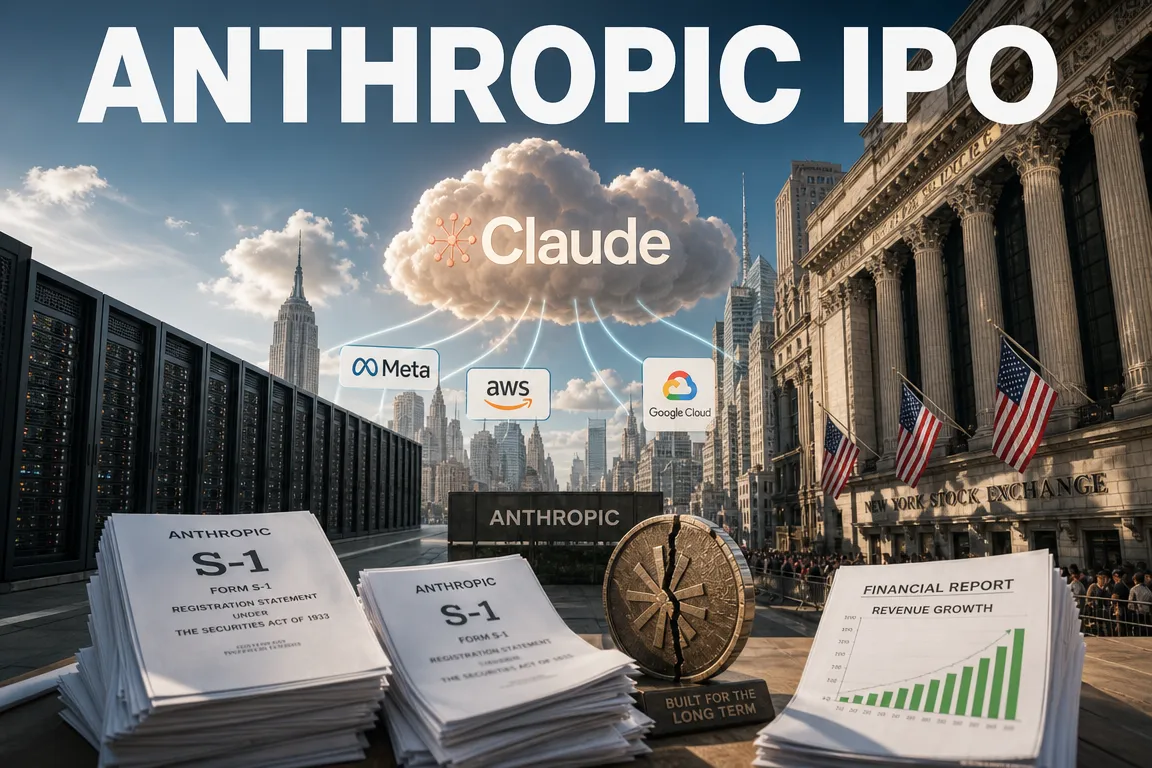
Did Anthropic IPO Expectations Lift the KOSPI and SK Hynix? AI Data Center Investment Prospects and Key Facts to Verify
This report examines whether expectations surrounding an Anthropic IPO were a decisive factor behind the KOSPI rally, whether KRW 175 trillion refers to cash or enterprise valuation, and why SK Hynix outperformed Samsung Electronics.
Anthropic’s potential fundraising and public listing could support investor sentiment toward AI semiconductor investment.
However, claims that Anthropic formally initiated an IPO and would invest KRW 175 trillion in cash into data centers require a clear distinction between verified facts and market interpretation.
The KRW 175 trillion figure is more likely to refer to Anthropic’s valuation or an estimated post-listing valuation than to cash holdings.
1. Core Claims
- Anthropic reportedly submitted registration documents for an initial public offering.
- IPO proceeds could fund data centers, GPUs, and AI memory investment.
- Strength in US AI infrastructure stocks reportedly extended to the Korean market.
- SK Hynix outperformed Samsung Electronics.
- Expectations for stronger shareholder returns and clearer management guidance ahead of SK Hynix’s earnings announcement reportedly supported the stock.
The investment thesis is straightforward: additional capital could expand Anthropic’s AI model development, increasing demand for GPUs and HBM and benefiting semiconductor suppliers such as SK Hynix.
However, this narrative combines unverified information with market expectations and presents them as a confirmed sequence of events.
2. Has Anthropic Formally Initiated an IPO?
A company seeking a US listing generally files an S-1 registration statement with the US Securities and Exchange Commission.
During the preliminary stage, however, a company may submit a confidential draft without publicly disclosing detailed information.
Any report that registration documents have been submitted should therefore distinguish among a public S-1 filing, a confidential draft submission, the appointment of underwriters, and an internal review of listing options.
A public S-1 would normally disclose detailed financial information, including revenue, losses, major shareholders, cash holdings, cloud contracts, and material risks.
Without an official company announcement or regulatory filing, the IPO timetable and fundraising target cannot be treated as confirmed.
The source material does not provide a specific reference date, document type, or regulatory filing.
Relative time references such as “yesterday” and “tomorrow” are not actionable without the original publication date.
A potential Anthropic IPO and a formally confirmed Anthropic IPO are materially different events.
3. The KRW 175 Trillion Figure Requires Verification
The claim that Anthropic holds KRW 175 trillion in cash warrants particular scrutiny.
Depending on the exchange rate, KRW 175 trillion exceeds approximately USD 120 billion.
This would be an unusually large cash balance for a privately held AI company.
A valuation of KRW 175 trillion is fundamentally different from holding KRW 175 trillion in cash.
Enterprise valuation is the value investors assign to the company as a whole.
Fundraising proceeds are funds received by the company through newly issued shares or similar financing instruments.
Cash holdings represent the amount remaining after research and development, payroll, cloud computing, and other expenditures.
IPO proceeds represent new capital raised through a listing. Proceeds from secondary share sales may go to existing shareholders rather than the company.
If the KRW 175 trillion figure is cited, investors should determine whether it refers to:
- An estimated pre-IPO or post-IPO valuation.
- Cumulative capital raised.
- A targeted IPO fundraising amount.
- Actual cash and cash equivalents.
Based on the available context, the figure may have been mischaracterized as cash when it more likely relates to valuation.
4. Potential Uses of Additional Capital
If Anthropic raises substantial capital through an IPO or private financing, AI computing would likely remain a major expenditure category.
Advanced generative AI models require significant computing resources for both training and inference.
Major cost items include GPUs, AI accelerators, cloud services, data centers, high-bandwidth memory, networking equipment, power infrastructure, and research personnel.
However, capital raised by Anthropic would not necessarily translate directly into purchases of Nvidia GPUs or SK Hynix HBM.
Anthropic may continue to rely on infrastructure provided by strategic partners such as Amazon Web Services and Google Cloud rather than building data centers independently.
Under this model, Amazon or Google would execute much of the underlying capital expenditure.
AI workloads may also use custom accelerators, including AWS Trainium and Google TPUs, in addition to Nvidia GPUs.
Anthropic’s fundraising could signal broader artificial intelligence investment, but the beneficiaries and magnitude of the impact would depend on the supply-chain structure.
5. Transmission Channels to Korean Semiconductor Companies
Higher usage of Anthropic’s models could require cloud providers to deploy additional AI servers and accelerators.
Increased production of AI accelerators would likely support demand for HBM integrated with GPUs and other computing devices.
HBM is a high-value memory product that vertically stacks multiple DRAM dies to provide high data-transfer bandwidth.
Because AI models process large volumes of data simultaneously, HBM is substantially more important to AI systems than conventional DRAM.
Potential Korean beneficiaries include:
- HBM and server DRAM suppliers such as SK Hynix and Samsung Electronics.
- HBM packaging equipment companies, including Hanmi Semiconductor.
- Suppliers of substrates, power-management systems, cooling equipment, and transformers.
- Enterprise SSD and NAND flash suppliers serving AI servers.
Actual earnings effects should be assessed through cloud providers’ capital expenditure plans and semiconductor shipment volumes rather than AI companies’ investment announcements alone.
AWS and Google capital expenditure may be more directly relevant to Korean semiconductor earnings than Anthropic’s valuation.
6. Why Anthropic Alone Cannot Explain a KOSPI Rally
Equity markets reflect multiple variables simultaneously rather than a single news event.
Anthropic-related expectations may have supported sentiment, but they are unlikely to explain the entire KOSPI rally.
Given the large index weightings of Samsung Electronics and SK Hynix, the Korean market is particularly sensitive to US semiconductor stocks and foreign investor flows.
Investors should assess at least the following factors:
- Performance of the Philadelphia Semiconductor Index and Nvidia shares.
- Foreign investors’ net positions in both KOSPI cash equities and futures.
- Movements in the won-dollar exchange rate and their implications for foreign capital flows.
- US Treasury yields and expectations for policy-rate reductions.
- Government capital-market policies, tax changes, and shareholder-return initiatives.
- Revisions to earnings forecasts for Samsung Electronics and SK Hynix.
A balanced KOSPI outlook should therefore consider foreign investor flows, semiconductor earnings, exchange rates, and interest rates rather than Anthropic’s potential IPO alone.
Anthropic-related news is better viewed as a catalyst reinforcing the existing AI semiconductor investment thesis than as the sole cause of market gains.
7. Why SK Hynix May Outperform Samsung Electronics
Although SK Hynix and Samsung Electronics are both memory semiconductor producers, the market assesses their AI exposure differently.
SK Hynix has generally received a valuation premium based on its HBM supply position and early customer penetration.
As AI accelerator demand expands, investors focus increasingly on HBM revenue exposure and next-generation product delivery schedules rather than total memory revenue.
Samsung Electronics has a broader business portfolio spanning smartphones, foundry services, and conventional memory, creating additional variables that affect its share price.
SK Hynix has greater earnings sensitivity to the AI memory cycle, which can result in stronger share-price movements following AI infrastructure news.
Key indicators for the semiconductor market include:
- Shipment schedules for HBM3E and next-generation HBM products.
- Quality certification and supply agreements with major AI accelerator customers.
- HBM average selling prices and profitability.
- Pricing trends for conventional DRAM and NAND.
- Capital expenditure required to expand production capacity.
- Potential pricing pressure from increased competitor supply.
8. Assessing SK Hynix Shareholder-Return Expectations
Expectations for stronger shareholder returns ahead of an earnings announcement may support SK Hynix shares.
However, an AI upcycle does not automatically result in higher dividends or larger share repurchases.
Maintaining leadership in HBM requires substantial investment in production lines, advanced packaging, and next-generation manufacturing processes.
The company must allocate operating cash flow among capital expenditure, debt repayment, dividends, and share repurchases.
Investors should focus on:
- Whether annual capital expenditure exceeds previous guidance.
- The proportion of HBM supply secured through long-term contracts.
- Whether improvements in free cash flow are cyclical or structural.
- Potential supplementary dividends or share-repurchase policies.
- The specificity of management guidance on demand and major customers.
Ambiguous management guidance can lead to a share-price decline even after strong reported earnings.
Conversely, earnings broadly in line with expectations may receive a positive market response if management provides clear guidance on HBM supply and shareholder returns.
9. Key Issues Often Overlooked
The first issue is the sustainability of AI inference costs rather than the IPO itself.
As generative AI usage increases, computing costs also rise.
If inference costs grow faster than revenue, newly raised capital may finance operating losses rather than profitable expansion.
The second issue is that AI funding does not translate directly into Korean semiconductor revenue.
When Anthropic pays cloud-service fees, AWS and Google determine the mix of accelerators and servers. HBM suppliers are selected at a subsequent stage.
Investors should therefore prioritize cloud-company orders and AI accelerator shipments over Anthropic’s fundraising amount.
The third issue is the migration of data center bottlenecks from semiconductors to power infrastructure.
Even when GPUs and HBM are available, limited grid connections, transformers, cooling systems, suitable sites, and regulatory approvals can delay deployment.
Future data center investment may therefore affect the earnings of power-equipment, cooling, and energy-storage companies in addition to semiconductor suppliers.
The fourth issue is that an IPO is not necessarily an exclusively positive market catalyst.
Public filings could disclose substantial losses, high cloud-computing expenses, dependence on specific partners, and material stock-based compensation.
AI-related equities could rise on listing expectations and subsequently experience higher volatility after the financial statements are disclosed.
10. AI Infrastructure Investment in the Global Economic Outlook
AI infrastructure is an important driver of global capital expenditure.
However, persistently high interest rates or an economic slowdown could weaken corporate cash flows and cause cloud providers to moderate investment.
Conversely, lower interest rates combined with productivity gains could extend AI data center investment across semiconductors, power infrastructure, and software.
The global economic outlook should therefore be assessed through AI industry growth, interest rates, power availability, and corporate capital expenditure capacity.
For South Korea, higher semiconductor exports could support the trade balance and broader economic activity.
However, excessive export concentration in HBM and advanced semiconductors could increase economic volatility if the AI investment cycle slows.
11. Investor Verification Checklist
- Check Anthropic’s official website for IPO or fundraising announcements.
- Verify whether a public registration statement is available through the US Securities and Exchange Commission.
- Confirm whether KRW 175 trillion refers to cash, valuation, or another financial metric.
- Review quarterly capital expenditure guidance from AWS and Google.
- Monitor shipment forecasts for Nvidia products and custom AI accelerators.
- Assess SK Hynix’s HBM shipment and average selling price outlook.
- Track Samsung Electronics’ HBM customer certification and supply expansion.
- Review foreign cash-equity and futures flows alongside the won-dollar exchange rate.
- Evaluate capital expenditure and free cash flow before focusing on shareholder returns.
< Summary >
Anthropic’s potential IPO and fundraising could strengthen sentiment toward AI infrastructure investment.
However, the claim that Anthropic holds KRW 175 trillion in cash may reflect confusion between cash holdings and enterprise valuation and requires source verification.
The KOSPI rally is more reasonably attributed to a combination of US semiconductor performance, foreign investor flows, exchange rates, interest rates, and earnings expectations.
SK Hynix’s relative strength reflects its HBM position and higher earnings sensitivity to AI memory demand.
For investors, AWS and Google capital expenditure, AI accelerator shipments, and HBM supply contracts are more relevant indicators than Anthropic’s valuation alone.
[Related Articles…]
*Source: [ 내일은 투자왕 – 김단테 ]
– 앤트로픽의 ‘이것’이 코스피를 떡상시켰다고? #코스피 #앤트로픽 #하이닉스