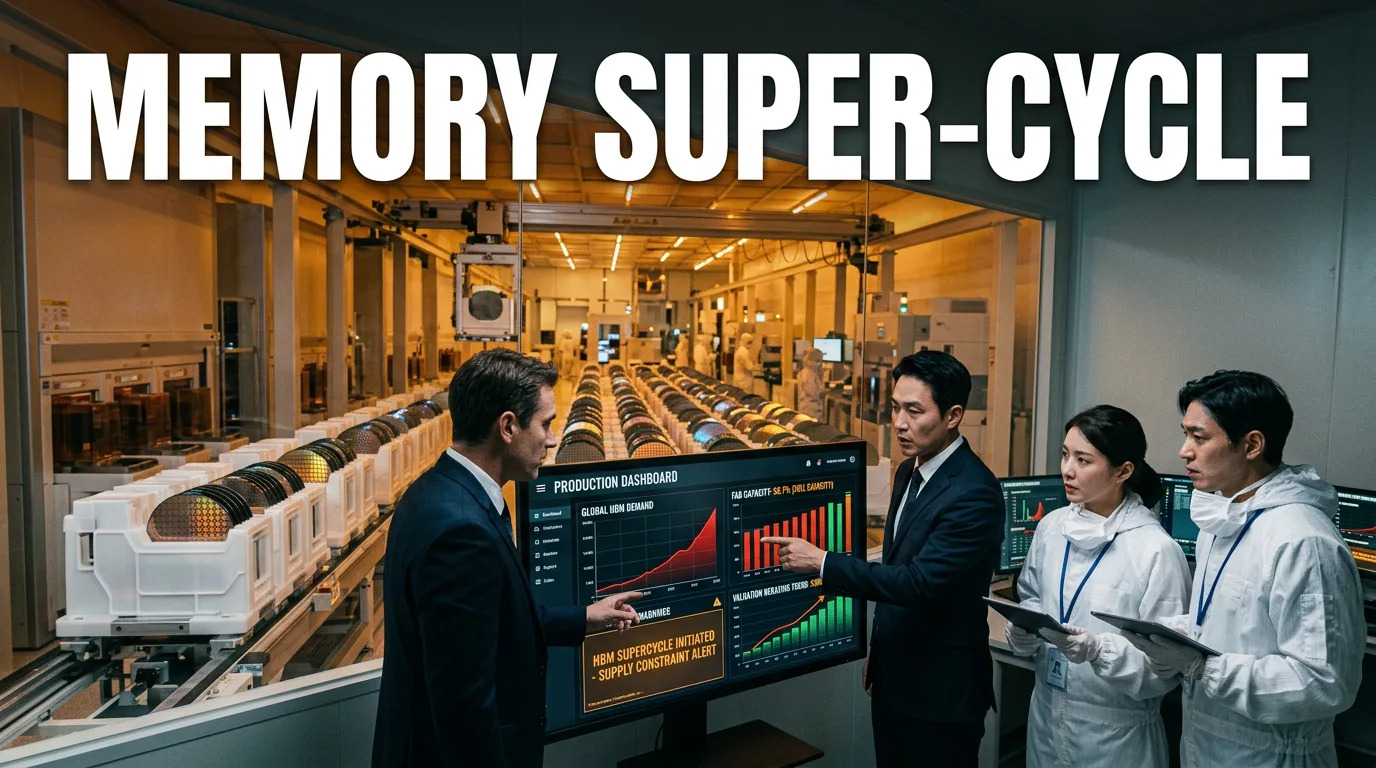
● AI-Driven Memory Supercycle
SK Hynix Earnings Signal That Matters More Than Results: What DRAM and HBM Being Essentially Sold Out Means for the Reassessment of the Semiconductor Supercycle
In this latest SK Hynix issue, the truly important point is not simply that “earnings were good.”
The key takeaway is that DRAM and HBM volumes are effectively sold out through 2029.
This means the memory semiconductor upcycle is no longer a short-lived 1- to 2-year bump that fades as before; instead, it is shifting into a longer and stronger structural cycle driven by AI infrastructure investment and data center demand.
In particular, SK Hynix’s forward P/E is said to be around 3.8 times, while its P/B is around 1 time.
The most important point in this article is that earnings are at all-time highs, yet valuation is still being treated as if it were at the bottom of a cyclical stock.
In this piece, we will take a single look at SK Hynix’s earnings, HBM4 supply shortages, the surge in DRAM prices, the real impact of China semiconductor risks, and why AI world models like Google Genie 2 are causing memory demand to explode.
1. SK Hynix earnings: what matters more than the numbers is proof of shortage
SK Hynix delivered results that significantly beat market expectations this time.
According to the original text, revenue reached 100 trillion won for the first time, and operating profit was also said to have hit a record high.
Revenue came in about 8.2% above market expectations, and operating profit exceeded estimates by nearly 10%.
What matters is not simply that these were “good earnings,” but that they directly countered market concerns about falling memory prices.
In particular, DRAM prices were said to have risen in the high 20% range this quarter.
Shipments also increased by about 10%.
Both price and volume rose at the same time.
In semiconductors, when both price and volume rise together, it is a powerful signal that demand is very strong and supply cannot keep up.
As a result, with both P and Q improving at the same time, total revenue growth can be interpreted as having expanded by more than 35%.
2. The core point of the CEO’s remarks: DRAM and HBM are effectively sold out through 2029
The most important statement in this earnings release came from SK Hynix CEO Kwak Noh-jung.
The remark indicated that DRAM and HBM are effectively sold out through 2029.
When you add the already secured LTA, or long-term supply agreement volumes, to the demand currently being discussed with customers, it means supply capacity will be extremely limited for the next three years or more.
This matters because the market had been worried that once new fabs are completed in 2027 or 2028, semiconductor supply could rise and the cycle might turn down.
There were also concerns that if Chinese memory makers increased supply, prices could collapse.
But this statement is the exact opposite of those concerns.
Even if more factories come online, and even if Chinese makers catch up, demand from AI servers and data centers is so strong that major high-value-added memory products are already being claimed by customers.
This should be seen not as a simple business cycle, but as a signal that AI investment is structurally becoming a larger share of the global economic outlook.
3. Next year’s demand outlook: DRAM growth in the mid-20% range, NAND growth in the high-10% range
SK Hynix’s outlook for next year’s demand was also stronger than expected.
DRAM demand was described as growing in the mid-20% range.
NAND demand was also expected to grow at a high rate in the high-10% range.
It is difficult to explain such growth using only ordinary smartphone or PC demand.
The key takeaway is AI servers, cloud data centers, high-performance computing, and corporate server replacement demand.
In particular, server DDR5 shipments were said to have increased by more than 40%.
In the AI era, GPUs are not the only thing that matters.
If GPUs handle computation, DRAM and HBM are the core infrastructure that delivers data quickly.
No matter how strong computing performance is, without sufficient memory bandwidth and storage capacity, AI models cannot function properly.
4. HBM4 shortage: when customers want 1, Hynix can only make 0.5
The strongest product in this cycle is unquestionably HBM.
HBM4 in particular appears to be facing a much more serious supply shortage.
The original text explained that if the volume requested by customers is 1, SK Hynix can actually produce only about 0.5.
In simple terms, it can supply only half of what is desired.
If HBM is in short supply, it is not just HBM prices that rise.
To make more HBM, part of existing DRAM production capacity must be sacrificed.
In other words, increasing HBM output reduces general DRAM supply, and when general DRAM supply falls, DRAM prices rise again.
Conversely, if more DRAM is produced, HBM becomes scarce.
In the end, HBM and DRAM end up competing for supply capacity, pushing up prices across the memory semiconductor market.
5. DRAM and NAND prices: much stronger gains than the market expected
The market appears to have expected DRAM prices to rise by about 15% this quarter.
But in reality, increases in the high 20% range were mentioned.
This is not just a boom; it means the supply shortage is much more severe.
NAND flash prices were also said to have risen in the mid-20% range.
Since the market had expected roughly a 15% increase, NAND can also be seen as tight on supply.
This is important because the market had previously assumed that “HBM may be strong, but the rest of memory could be weak.”
However, in reality, price pressure is appearing across HBM, DRAM, and NAND alike.
This is a sign that the semiconductor supercycle is not confined to just one product, but is spreading across memory broadly.
6. Long-term supply agreements: the balance of power in the memory industry is shifting
In the past, memory semiconductor companies were relatively weak when negotiating with large cloud companies.
When hyperscalers said, “Let’s renegotiate the price,” memory suppliers often had little choice but to accept.
But the situation has changed in the HBM era.
HBM requires customer-specific design and packaging.
HBM produced for a particular customer is not easy to resell to another customer.
So customers cannot easily cancel contracts, and suppliers can demand stronger terms.
The original text said that more than 50% of supply through 2027 or 2028 is already locked in through long-term contracts.
There was also a view that the share of long-term contracts could rise to 60% to 70% in the future.
This means that the earnings volatility of SK Hynix and Samsung Electronics could be lower than in the past.
Memory has always been a highly cyclical industry, but the combination of AI infrastructure investment and long-term contracts raises the chance that the profit cycle will become more stable.
7. China semiconductor risks: fears about CXMT and YMTC may have been exaggerated
The market continues to cite Chinese memory makers CXMT and YMTC as risks.
In particular, there has been concern that if China increases DRAM and NAND supply, Samsung Electronics and SK Hynix could lose pricing power.
But the original text includes an interesting point.
Chinese hyperscalers such as Alibaba, Tencent, and ByteDance reportedly requested long-term contracts for server DRAM, and some even wanted 10-year agreements through 2035.
If CXMT supply inside China were sufficient, Chinese big tech companies would have little reason to ask SK Hynix for long-term contracts.
In other words, it is reasonable to interpret this as evidence that high-performance server memory supply is still insufficient even within China.
It was also mentioned that China’s HBM market share is expected to remain around 2% even in 2027.
At present, China’s HBM appears to be close to HBM2, and the technological gap with global cutting-edge HBM remains large.
In the end, China semiconductor risks do exist, but they do not appear large enough right now to shake SK Hynix and Samsung Electronics’ position in the high-value-added memory market.
8. TrendForce outlook: DRAM price increases could continue through the first half of 2028
TrendForce was said to have projected that DRAM price increases could continue through the first half of 2028.
This forecast differs from the market’s earlier worry about a “2027 peak-out.”
It is based on the view that server demand remains solid, AI data center investment keeps rising, and capacity expansion will not immediately lead to oversupply.
AI servers in particular require much more HBM and DRAM than ordinary servers.
The memory capacity required per GPU is increasing, and as AI model parameters and context length grow, memory requirements also continue to rise.
So when evaluating the semiconductor cycle, it is not enough to simply say “supply is increasing.”
The key is whether AI demand is growing faster than supply.
9. Google Genie 2 and world models: why AI progress increases memory demand even more
One particularly interesting part of the original text is the mention of Google’s Genie 2.
Genie 2 is described as a world model in which AI creates a virtual world in real time.
For example, if you type “a shooting star passes through the sky,” a scene is created immediately, and if you type “a bird walks toward a white piano,” the piano appears and the scene continues.
When the user changes the viewpoint with the WASD keys, the AI generates new video in real time to match.
These world models require much more memory and computing resources than simple video generation AI.
That is because scene consistency must be maintained.
Existing video generation models often had problems where backgrounds, people, or objects would shake or change form over time.
One reason is insufficient memory and insufficient context retention.
World models, AI agents, physical AI, and robot learning all require more memory capacity and faster memory bandwidth.
In the end, as AI evolves from text generation to video generation and from video generation to real-time world generation, demand for HBM, NAND, and DRAM will only increase further.
10. NVIDIA is not the only customer: HBM demand is exploding across Broadcom and AMD as well
Initial HBM demand was interpreted as being centered on NVIDIA.
But now the customer base is much broader.
Broadcom and AMD are also emerging as major HBM customers.
The original text mentioned that Broadcom TP6 and AMD MI450 could require even more raw HBM capacity than NVIDIA.
NVIDIA is already interpreted as being unable to supply enough chips due to shortages.
On top of that, there was also a forecast that NVIDIA revenue could grow 100% next year, Broadcom could also grow 100%, and AMD could grow 130%.
If those figures become reality, HBM demand will have no choice but to become much larger than it is now.
As AI semiconductor companies make more accelerators, each accelerator requires HBM.
As GPUs and ASICs increase, HBM demand rises along with them.
11. HBM price outlook: potential for more than doubling next year
The outlook for HBM prices was also presented very strongly.
The original text mentioned a forecast that HBM prices could rise by about 122% next year.
SK Hynix was estimated at around $3.7 per gigabyte, while Samsung Electronics was said to have proposed around $4.1.
At that level, the price increase could even widen to more than 150%.
Of course, actual contract prices can vary depending on the customer, product generation, yield, and packaging conditions.
But the direction is clear.
HBM is in short supply, customers want more volume, and pricing power is shifting toward suppliers.
12. SK Hynix valuation: does a forward P/E of 3.8 times make sense?
According to the original text, SK Hynix is currently being mentioned at a forward P/E of about 3.8 times.
P/B is also around 1 time.
Samsung Electronics is also viewed as very undervalued on a P/E and P/B basis.
In general, memory semiconductor companies tend to see lower P/E ratios at the peak of the cycle.
That is because when earnings are at their best, the market assumes they are about to turn down and assigns a lower multiple.
But this time could be different from the past.
That is because AI server and data center investment are structurally changing the traditional memory cycle.
Long-term contracts are increasing, customers are accepting prepayments and stability mechanisms, and HBM is becoming a customer-specific product.
Under this structure, the pattern of earnings surging and then collapsing immediately afterward may become much weaker than before.
If so, the stock market valuation applied to SK Hynix and Samsung Electronics could also be re-rated.
13. The TSMC example: re-rating is slow, but it eventually comes through earnings
The original text also mentions TSMC as an example.
TSMC too once traded at less than 10 times earnings.
But over time, it came to be valued at 15 times and later close to 20 times.
That process did not happen overnight.
It took time for the company to repeatedly prove its earnings and for the market to recognize that “this company’s profits are structural, not temporary.”
SK Hynix and Samsung Electronics may be in a similar phase.
If DRAM, NAND, and HBM shortages are confirmed in earnings one or two more times, the case for a valuation above 10 times becomes stronger.
In particular, if Samsung Electronics and SK Hynix show enough profit strength to rank near the top of global operating profit rankings, the argument that their market capitalization is too low could grow much stronger.
14. Why net income looks low: not a core business problem, but one-off factors
The reason net income looked relatively low even though operating profit was very strong was also discussed.
The first reason is foreign exchange losses.
It was explained that recent large moves in the exchange rate reflected FX losses.
The second reason is losses on investment assets.
It was mentioned that the value of SK Hynix’s stake in Japan’s Kioxia recorded an unrealized loss due to a drop in the share price.
However, this is closer to a one-off accounting factor than a deterioration in core profitability.
Therefore, the key is to look not only at net income, but at operating profit, price increases, long-term contracts, and HBM supply shortages together.
15. Shareholder returns: treasury share cancellation and dividends could be catalysts for re-rating
The original text also mentioned shareholder returns on the scale of 100 trillion won this year.
Of that, more than 60 trillion won was described as treasury share buybacks and cancellations, and about 30 trillion won as cash dividends.
However, such large numbers must be verified against actual disclosures and units.
Even so, the direction is important.
When semiconductor companies combine improved earnings with treasury share cancellations and higher dividends, the chance of a stock re-rating increases.
In particular, buying and canceling shares at a P/B level of 1 times can have an even stronger effect on per-share value.
When earnings, long-term contracts, supply shortages, and shareholder returns all align at once, it becomes a combination that the market cannot easily ignore.
16. The core point overlooked in other coverage: this is not a “semiconductor earnings” story, but an “AI supply chain power” story
Many news reports only say that SK Hynix had good earnings or that HBM demand is strong.
But the really important point is that SK Hynix and Samsung Electronics are beginning to gain bargaining power in the AI supply chain.
In the past, memory companies were closer to component suppliers that simply moved with the cycle.
But now HBM is the bottleneck in building AI data centers.
Even if you have GPUs, you cannot build AI servers without HBM.
Even if you have ASICs, it is difficult to secure large-scale AI inference and training performance without HBM.
In other words, memory makers are changing from simple parts suppliers into key players that determine the pace of AI infrastructure investment.
This shift is the core basis for the valuation re-rating.
More important than simply saying earnings are good is the fact that the power structure within the industry is changing.
17. Key checkpoints to watch going forward
First, actual mass production yield for HBM4.
No matter how strong customer demand is, if yield is low, the supply bottleneck can get even worse and prices can rise further.
Second, whether DRAM prices continue rising through 2028.
If DRAM prices do not weaken, the possibility of a structural shift in the memory cycle becomes larger.
Third, whether Chinese hyperscalers sign long-term contracts.
If Chinese companies actually sign 10-year contracts, the market’s interpretation of the CXMT risk could change.
Fourth, the shipment volumes of AI chips from Broadcom and AMD.
If growth from customers other than NVIDIA is confirmed, HBM demand becomes more diversified and more stable.
Fifth, whether Wall Street re-evaluates Korean semiconductor valuations.
No matter how good earnings are, if global capital does not acknowledge them, re-rating can still be delayed.
Still, as in the TSMC case, repeated proof of earnings could eventually change the market’s view.
18. Conclusion from an investment perspective: more important than “cheap” is the “durability of profits”
The argument that SK Hynix and Samsung Electronics are undervalued is not simply based on low P/E ratios.
The important question is how long profits can last.
If AI is not a bubble, HBM and DRAM demand is unlikely to end as a one-year event.
AI models will get bigger, data centers will expand, and world models and physical AI will require even more memory.
If long-term contracts continue to increase, the earnings visibility of memory companies could become far higher than in the past.
Then the current low P/E and P/B may not be simple undervaluation, but a pre-re-rating stage.
Of course, semiconductor stocks are volatile, and short-term prices can swing sharply depending on exchange rates, interest rates, the global economy, and supply-demand conditions.
But from an industry-structure perspective alone, SK Hynix and Samsung Electronics are increasingly likely to be re-evaluated as core infrastructure companies of the AI era.
< Summary >
The most important point in SK Hynix’s earnings is not revenue or operating profit, but the signal that DRAM and HBM are effectively sold out through 2029.
DRAM prices rose in the high 20% range and NAND prices in the mid-20% range, far exceeding market expectations.
HBM4 appears to be so short that only about half of customer demand can be supplied.
The spread of AI servers, data centers, world models, and physical AI is structurally increasing memory demand.
China’s CXMT and YMTC risks do exist, but there still appears to be a large gap in high-performance server memory and HBM.
SK Hynix’s forward P/E of 3.8 times and P/B of 1 time could fuel re-rating debates if earnings durability is confirmed.
The core issue is whether the semiconductor cycle ends quickly as in the past, or whether it is prolonged by AI infrastructure investment.
The current data are showing signals closer to the latter.
[Related Articles…]
HBM semiconductor supercycle and AI data center investment outlook
How expanding AI infrastructure investment affects the global stock market
*Source: [ 월텍남 – 월스트리트 테크남 ]
– “이래도 안올라?” 하이닉스 실적보다 더 중요한 “이것”