● Dollar Stablecoins Rattle Korea and Turbocharge US Power
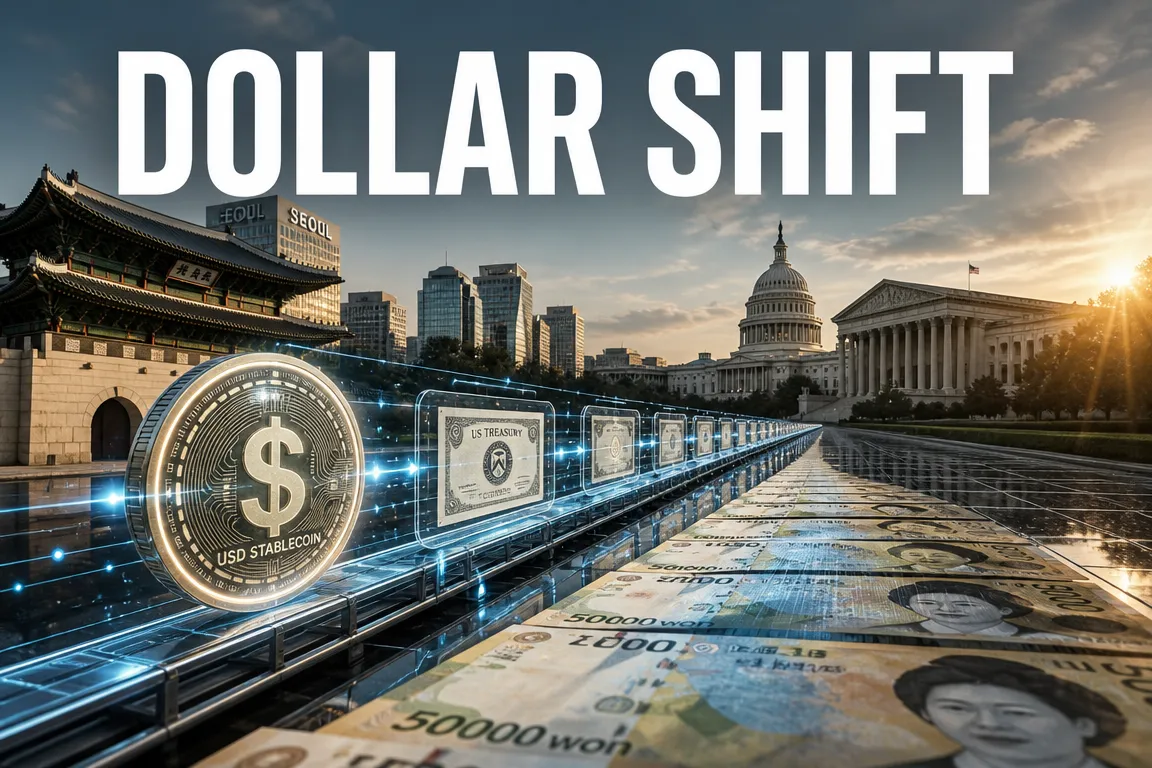
Why Dollar Stablecoins and RWA Could Weaken the Korean Won and Draw Global Capital to the United States
Three issues are central to this analysis.
First, the primary US objective in promoting dollar stablecoins may be to support demand for US Treasuries and preserve dollar dominance rather than merely expand the digital asset market.
Second, broader asset tokenization and 24-hour trading could shift Korean investment capital, corporate listings, and financing activity to the United States.
Third, reduced use of the won could weaken not only the currency but also the effectiveness of Bank of Korea monetary policy and the government’s tax base.
The underlying discussion includes forward-looking statements about the legislative status and implementation timeline of US regulations.
The final status and effective dates of the CLARITY Act and related legislation should therefore be verified through current announcements from the US Congress and relevant regulators.
1. Why Capital Flowed into AI Stocks and Bitcoin Despite High Interest Rates
High long-term US Treasury yields generally pressure equities, gold, Bitcoin, and other assets that do not pay interest.
Investors can earn relatively high returns by holding lower-risk US government debt.
However, capital has recently concentrated in selected assets rather than across the broader risk market, particularly profitable AI companies and Bitcoin, which has benefited from expectations of institutional adoption.
- AI companies have been viewed as capable of offsetting high interest rates through strong revenue growth and operating margins.
- Bitcoin has been supported by spot ETFs, regulatory integration, and potential investment by corporations and sovereign entities.
- Growth in stablecoins and RWA may strengthen Bitcoin’s role as collateral or a benchmark asset within the digital asset ecosystem.
Liquidity has not spread evenly across markets. It has concentrated in assets supported by credible future cash flows or structural growth drivers.
This trend is linked to widening market concentration in both the United States and South Korea.
In the United States, AI semiconductor companies and large technology firms are absorbing capital. In South Korea, trading has concentrated in semiconductor beneficiaries such as Samsung Electronics and SK Hynix.
2. Why the United States Needs Dollar Stablecoins
A practical reason for US support of dollar stablecoins is the need for a new and recurring source of demand for US Treasuries, rather than payment innovation alone.
The United States must continue issuing government debt to finance substantial fiscal deficits and public debt obligations.
However, demand from money market funds and financial institutions, which have historically purchased large volumes of short-term Treasuries, cannot expand indefinitely at the same pace.
Dollar stablecoin issuers generally hold cash, short-term US Treasuries, and repurchase agreements as reserve assets.
As stablecoin capitalization increases, holdings of short-term Treasuries within reserve portfolios may also expand.
This structure can convert global demand for digital dollars into demand for US government debt.
If Treasury buybacks and increased short-term issuance are used to manage pressure on long-term yields, a stable investor base for Treasury bills becomes increasingly important.
Stablecoin issuers could become a significant new source of short-term Treasury demand.
3. Stablecoin Growth Does Not Automatically Create New Treasury Demand
A key structural limitation must be recognized.
An increase in stablecoin market capitalization does not mean that the entire amount represents additional demand for US Treasuries.
The original source of the capital is critical.
- Conversion of offshore non-dollar funds into dollar stablecoins is likely to create incremental demand for dollars and US Treasuries.
- Migration of US bank deposits into stablecoins may weaken bank funding and increase Treasury holdings by issuers, but much of the effect is a reallocation within the financial system.
- Migration of existing MMF assets into stablecoins may simply replace Treasury holdings by money market funds with holdings by stablecoin issuers, limiting net new demand.
Increasing stablecoin issuance alone is therefore insufficient to deliver the desired policy outcome.
The United States must attract offshore capital into the dollar ecosystem while expanding the range of equities, bonds, funds, and payment services accessible through stablecoins.
This is where dollar stablecoins and asset tokenization become part of a unified strategy.
4. The Next US Objective Is Financial Products, Not Cryptoassets
Stablecoins are still used primarily for digital asset trading and transfers between exchanges.
Remittance and commercial payment use is expanding but remains limited relative to conventional financial transactions.
For the stablecoin market to enter its next stage of growth, users need access to a broader range of non-crypto financial products.
RWA and asset tokenization are likely to serve this function.
- US Treasuries and money market funds can be issued in tokenized form.
- Equities and ETFs can be traded through blockchain-based infrastructure.
- Real estate, infrastructure, and private credit can be divided into smaller investment units.
- Trading, settlement, and ownership transfer can occur on a single network.
- Transactions may be conducted 24 hours a day, independent of traditional market hours.
If the United States expands tokenized securities markets and regulatory sandboxes, global investors may access US financial products using dollar stablecoins without local bank accounts or complex foreign exchange procedures.
This could increase funding for US companies, deepen capital market liquidity, and expand the international use of the dollar.
5. Why Stablecoins Matter in the AI Agent Economy
AI agents are evolving beyond email management and scheduling toward consumer spending, investment, and other economic decisions.
Agents acting on behalf of users require payment instruments that machines can access and execute directly.
Stablecoins can support programmable conditions, cross-border transfers, continuous availability, and automated micropayments.
These characteristics make them a potential form of programmable money for AI agent economies.
For example, a user could allocate funds to an AI agent under the following rules:
- Increase exposure to tokenized Treasuries when US government bond yields exceed a defined threshold.
- Raise the stablecoin allocation when equity market volatility increases.
- Purchase flights and accommodation when travel costs fall below a target price.
- Automatically allocate unused daily cash to yield-bearing digital assets.
AI agents could generate substantially more transactions at higher frequency than human users.
If machine commerce scales, the stablecoin market could grow well beyond the current human-centered market.
AI agents are not required to use blockchain infrastructure.
Bank APIs, tokenized deposits, and central bank digital currencies can also support automated payments.
The competitive position of stablecoins will depend on global liquidity, regulatory compatibility, refund and dispute mechanisms, and wallet security rather than technology alone.
6. Do Dollar Stablecoins Strengthen the Dollar?
A central issue is whether the expansion of dollar stablecoins would strengthen the dollar or potentially contribute to dollar weakness.
The case for a stronger dollar is relatively direct.
If companies and individuals in emerging and non-dollar economies hold dollar stablecoins instead of local currencies, demand for dollars increases.
Reduced use of and confidence in local currencies could weaken those currencies.
In South Korea, stronger household and corporate preference for dollar assets could increase depreciation pressure on the won.
There is also a counterargument.
When a stablecoin is issued, existing dollar-denominated funds are generally transferred into reserve assets. Issuance does not necessarily create an equivalent amount of new dollars.
If bank deposits or MMF assets are converted into stablecoins, the process primarily changes the form of dollar-denominated financial assets rather than the aggregate supply of or demand for dollars.
The relationship between stablecoin adoption and the USD/KRW exchange rate should therefore not be interpreted as one-to-one.
The exchange rate also reflects interest-rate differentials, relative growth, trade balances, overseas investment, risk sentiment, and foreign capital flows.
Dollar stablecoins primarily expand the dollar’s usage and network effects rather than directly determining its exchange value.
Broader international use does not always increase the dollar index, but it may reinforce the concentration of capital in dollars during periods of market stress.
7. Structural Factors Behind Won Depreciation
Stablecoins alone cannot explain weakness in the Korean won.
However, easier access to dollar-denominated financial products can accelerate capital flows from South Korea to the United States.
- Korean investors may identify stronger growth opportunities in US AI and semiconductor companies.
- Korean companies may consider US listings to obtain higher valuations and deeper liquidity.
- Exporters expecting won depreciation may retain dollar revenue rather than convert it into won.
- If tokenized US equities become available for 24-hour dollar trading, the incentive to use the domestic equity market may decline.
- If AI agents and global platforms adopt the dollar as the default settlement currency, the use of the won may contract.
Historically, overseas equity investment required currency conversion, foreign brokerage accounts, restricted trading hours, and relatively high fees.
Asset tokenization could materially reduce these barriers.
As capital mobility costs decline, investors can move more rapidly toward markets offering higher returns and liquidity.
The United States currently offers the world’s deepest liquidity and a substantial valuation premium.
If these trends continue, historical averages may no longer represent the future equilibrium USD/KRW exchange rate.
Even if the exchange rate declines periodically, slower Korean growth, rising overseas investment, and sustained preference for dollar assets could establish a structurally higher trading range.
However, specific levels such as KRW 1,500 or KRW 1,700 per dollar should not be treated as inevitable.
Semiconductor exports, foreign investment, tourism balances, US interest-rate cuts, and changes in global risk appetite could support won appreciation.
8. How Dollar Settlement Could Spread into Korea’s Domestic Supply Chain
Dollar stablecoins are likely to gain adoption first in cross-border corporate payments.
For example, a Korean headquarters and its US subsidiary could reduce settlement time and intermediary fees by replacing conventional dollar transfers with stablecoin payments.
Even modest reductions in payment costs can improve operating margins.
The risk is that dollar settlement initially used by large companies for international transactions could spread into domestic supply chains.
If large companies request payment in dollar stablecoins, first- and second-tier suppliers may begin holding them.
As dollar settlement becomes common in business transactions, employees may also seek to receive part of their compensation in dollar stablecoins.
A digital dollar introduced for cross-border efficiency could consequently replace part of domestic won settlement.
9. Reduced Use of the Won Could Weaken Monetary Policy
The larger risk from dollar stablecoins is not only currency depreciation but also weaker monetary sovereignty.
The Bank of Korea sets its policy rate based on inflation, economic growth, household debt, the property market, and financial stability.
If companies and households increasingly use dollars instead of won, changes in the policy rate may have less influence on domestic economic activity.
If South Korea needs to lower interest rates during a downturn while the United States maintains restrictive policy, domestic dollar funding costs could remain high.
Conversely, if Korean inflation remains elevated while the United States cuts rates, dollar liquidity within Korea could expand excessively.
The Korean economy would become more directly exposed to US monetary policy.
In an extreme scenario of significantly reduced won usage, the Bank of Korea could continue setting won interest rates while losing part of its ability to influence actual economic activity.
The central bank would remain operational, but the effectiveness of its monetary policy would decline.
10. The Underappreciated Risk to Tax Revenue and State Capacity
A less frequently discussed issue is the effect of stablecoins on taxation and administrative capacity.
Governments provide welfare, defense, education, and infrastructure based on the assumption that households and companies conduct domestic economic activity and pay taxes.
If assets and transactions migrate rapidly to cross-border digital networks, tax authorities may face greater difficulty identifying income and capital gains.
Stablecoin transactions do not inherently constitute tax evasion.
With identity verification, transaction reporting, and international information exchange, blockchain records may improve tax enforcement.
However, offshore wallets, decentralized platforms, and lightly regulated exchanges can complicate tax jurisdiction and compliance.
A more significant issue arises when companies and capital market activity relocate to the United States.
If Korean companies list in the United States, raise funds through US financial institutions, and settle transactions in dollars, related fees, tax revenue, and skilled employment may also move abroad.
This would have more persistent consequences than a temporary outflow of portfolio capital.
11. Why RWA Could Threaten the Korean Equity Market
South Korea needs an RWA strategy not because blockchain is new, but because the United States is using tokenization to reduce access barriers for global investors.
If US equities become available in tokenized form for continuous trading and immediate settlement in dollar stablecoins, Korean investors may find the US market more accessible than the domestic market.
Foreign investors may also gain exposure to Korean equities through offshore tokenized instruments without directly purchasing shares in Korea.
This could reduce both foreign capital inflows into the Korea Exchange and demand for won conversion.
South Korea’s security token framework has the advantage of integrating investor protection and issuance structures into existing capital market law.
However, a closed market in which domestic investors trade only domestic assets would struggle to compete with a US RWA ecosystem designed to attract global capital.
Investors should evaluate the following factors before considering 24-hour trading capabilities:
- Whether token holders have legal ownership of the underlying shares or bonds.
- Whether underlying assets are bankruptcy-remote if the issuer fails.
- Whether tokens can be redeemed for the underlying assets or cash.
- How voting rights, dividends, and taxes are processed.
- How liability is allocated if an oracle or custodian fails.
12. Strategic Priorities for South Korea
First, South Korea should establish won-based digital money infrastructure.
Won stablecoins and tokenized bank deposits need not be mutually exclusive.
Multiple forms of digital won could compete and interoperate based on issuer type, reserve assets, and intended use.
Second, the strategy must extend beyond the domestic market.
A won stablecoin limited to domestic payments would struggle to compete with the global network effects of dollar stablecoins.
Use cases should be expanded through areas in which South Korea has competitive advantages, including digital content, e-commerce, gaming, tourism, and remittances.
Third, RWA and security token policy should be redesigned for global investors.
Foreign investors should be able to access Korean equities, bonds, intellectual property, and infrastructure assets efficiently.
Digital identity verification, automated tax reporting, and real-time cross-currency settlement should be developed.
Fourth, digital asset taxation requires a consistent framework.
Different tax treatment for spot assets, derivatives, offshore platforms, and decentralized finance creates opportunities for regulatory arbitrage.
Authorities should clarify legal asset classifications, loss offsets, tax deferral, withholding, and overseas transaction reporting.
Fifth, regulatory sandboxes should prioritize controlled experimentation.
A system requiring full government approval before market testing may not keep pace with technological change.
Services should be allowed to operate within limited parameters, subject to customer asset segregation, transaction limits, and disclosure obligations.
Sixth, public-sector expertise should be developed over the long term.
Frequent rotation of officials responsible for AI, blockchain, and stablecoin policy can repeatedly reset institutional knowledge.
Governments should facilitate private-sector recruitment, industry secondments, and long-term performance objectives for policy specialists.
13. Facts and Projections Investors Must Distinguish
- US strategic use of stablecoins and asset tokenization represents an important structural shift.
- Growth in stablecoins does not automatically create an equivalent amount of new dollar or Treasury demand.
- Expansion in the international use of the dollar and appreciation of the dollar are related but distinct concepts.
- The won may be influenced more directly by interest-rate differentials, relative growth, trade balances, and overseas investment than by stablecoins alone.
- AI agents may use stablecoins, but bank APIs and tokenized deposits remain credible alternatives.
- An RWA token without enforceable ownership and redemption rights may be only a price-linked instrument.
Investors should therefore look beyond the price of Bitcoin.
The key issue is whether Treasury market structure, stablecoin reserves, legal rights attached to tokenized assets, and AI-based payment systems are converging into an integrated financial infrastructure.
14. The Most Important Issues Often Overlooked
First, the US objective is not merely to expand crypto markets but to connect global financial accounts to US capital markets.
Stablecoins provide the digital transport layer for dollars, while RWA supplies the investable products.
AI agents could become automated participants within this system.
Second, the principal risk for South Korea is capital market hollowing rather than exchange-rate depreciation alone.
If investors, companies, listings, settlement activity, and tax revenue move together to the United States, domestic liquidity and corporate valuations could weaken simultaneously.
Third, issuing a won stablecoin alone would not provide an adequate defense.
Without investable products, global platforms, and broad merchant acceptance, won-based digital money may function more like a domestic payment credit than an international currency network.
Fourth, stablecoins are not a complete solution to US government financing needs.
If bank deposits and MMF assets merely migrate into stablecoins, the result may be a reallocation of funds within the US financial system.
The more consequential objective is to attract new offshore capital into dollars and US assets.
Fifth, future competition will be between financial ecosystems rather than currencies alone.
If dollar stablecoins, tokenized US equities, US Treasuries, and AI asset management services are delivered as an integrated package, a standalone won strategy will be insufficient.
South Korea will need to coordinate currency policy, capital market development, industrial policy, and AI strategy within a unified ecosystem.
< Summary >
The United States is seeking to use dollar stablecoins to expand global dollar usage and potentially increase demand for short-term US Treasuries.
RWA and asset tokenization could broaden the range of financial products available for stablecoin settlement and channel more global capital into US markets.
As AI agents take a larger role in investment and payments, the use of programmable money may accelerate.
Without an effective response, South Korea could face won depreciation, weaker domestic market liquidity, reduced monetary policy effectiveness, erosion of its tax base, and migration of high-quality corporate listings to US markets.
Priorities include won-based digital money, globally accessible RWA markets, consistent taxation, and rapid but controlled regulatory experimentation.
[Related Articles…]
*Source: [ 경제 읽어주는 남자(김광석TV) ]
– [풀버전] 세계 돈이 미국으로 빨려간다…원화 약세 피하기 어려운 이유 | 경읽남과 토론합시다 | 3자토론 정구태x김동환x김광석