● Tesla Korea FSD Shock, 180000 Cars, 398 Dollar Stock Risk
The Strategic Significance of Tesla Korea’s FSD Application: 185,000 China-Built Teslas, Cybercab, and Tesla Shares at $398
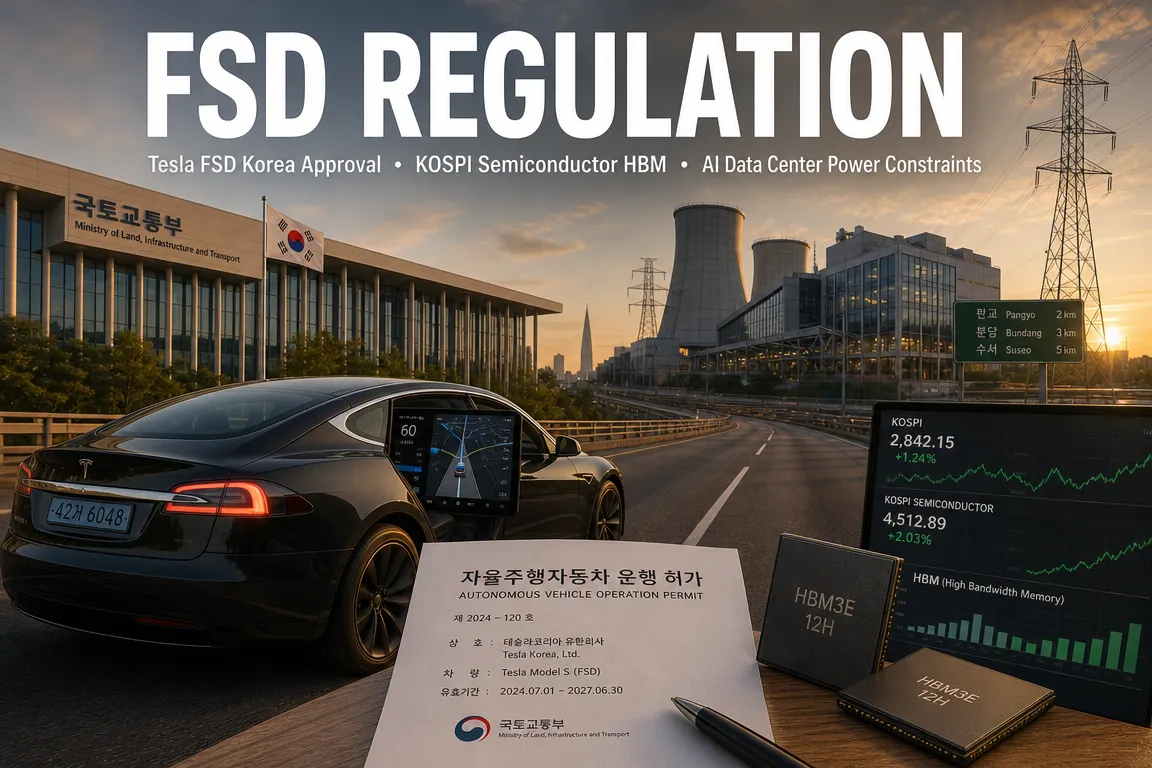
Tesla Korea reportedly submitted an FSD-related application to the Ministry of Land, Infrastructure and Transport approximately two weeks after stating during a parliamentary audit that it had not applied for formal testing.
The issue could affect FSD availability for approximately 185,000 China-built Teslas in South Korea, subscription revenue at about KRW 150,000 per month, the possible application of regulatory exemptions, the domestic exhibition of Cybercab, and Tesla’s share price.
Some figures and descriptions in the original report require correction.
Vehicles with recorded FSD usage represent approximately 6.2% of FSD-eligible Teslas in South Korea, substantially below the reported claim of six out of ten vehicles.
The central issue is not near-term revenue but the legal framework under which South Korean authorities may recognize software functions in China-built Teslas.
1. Tesla Korea’s First Reported FSD Application to the Transport Ministry
Tesla Korea reportedly submitted an FSD approval application on the 22nd of last month to the autonomous-driving and mobility division of the Ministry of Land, Infrastructure and Transport.
This was described as Tesla Korea’s first formal application related to domestic FSD deployment.
At a parliamentary audit held the following day, ministry officials reportedly confirmed receipt of the application.
The timing is notable.
Approximately two weeks earlier, Tesla Korea’s representative stated during a parliamentary audit that the company had not formally applied to the ministry or other relevant agencies for FSD testing.
The representative added that Tesla would cooperate once the government established appropriate verification procedures and regulations.
The subsequent filing suggests that parliamentary scrutiny may have accelerated Tesla Korea’s administrative process.
However, publicly available information does not identify the vehicle models, autonomous-driving hardware versions, software scope, or legal basis covered by the application.
Submission of an application does not constitute approval.
The ministry may request supplementary documentation or require separate testing and safety assessments.
2. Why U.S.-Built Teslas May Qualify While China-Built Teslas Do Not
Domestic FSD eligibility is not determined solely by vehicle performance or price.
The principal factors are the country of manufacture and the applicable vehicle safety standards.
Under the South Korea-U.S. Free Trade Agreement, U.S.-built Teslas may use a regulatory pathway under which compliance with U.S. vehicle safety standards can be recognized as satisfying South Korean requirements.
By contrast, Model 3 and Model Y vehicles produced at Gigafactory Shanghai are generally subject to South Korean vehicle safety standards.
According to Tesla Korea data cited in the report, 238,968 Teslas are registered in South Korea.
Of these, 53,477 vehicles, or approximately 22.4%, are eligible for FSD.
The remaining 185,491 vehicles, or approximately 77.6%, are restricted from using FSD. A substantial portion reportedly consists of Model 3 and Model Y vehicles produced in Shanghai.
| Category | Number of Vehicles | Share |
|---|---|---|
| Registered Teslas in South Korea | 238,968 | 100% |
| FSD Eligible | 53,477 | Approximately 22.4% |
| FSD Restricted | 185,491 | Approximately 77.6% |
Approximately eight out of ten Teslas in South Korea therefore face FSD restrictions primarily because of certification rules rather than vehicle capability.
3. Automatic Lane Changes Are the Primary Regulatory Conflict
The most sensitive issue under South Korean regulations is how FSD executes automatic lane changes.
Under the domestic standards described in the report, the driver must first operate the turn-signal lever before the vehicle initiates an automated lane change.
The lane change must begin within a specified period, and the function is limited to qualifying road conditions.
These generally include roads where pedestrian and bicycle access is restricted and opposing traffic lanes are physically separated.
Typical examples include expressways and limited-access roads with at least two lanes traveling in the same direction.
Tesla FSD, however, can assess traffic and road conditions and determine when to change lanes, including on urban roads.
This operating model differs from one requiring the driver to issue a prior command through the turn-signal lever for each lane change.
If the ministry determines that this difference conflicts with domestic safety standards, a software update alone may not resolve the issue.
4. Why the Same Vehicles Can Operate in China but Remain Restricted in South Korea
A Model Y produced in Shanghai may use supervised FSD in China while remaining restricted in South Korea.
The distinction primarily reflects differences in national laws and certification standards rather than insufficient vehicle capability.
Chinese authorization of supervised FSD does not automatically apply in South Korea.
South Korean authorities must independently assess domestic road conditions, traffic laws, accident liability, driver-monitoring systems, and data-governance requirements.
The application therefore concerns how South Korean regulations classify the technology, not simply whether the technology functions.
5. A New-Technology Exemption May Be More Practical Than Legislative Reform
A potential exemption for new technology is an important variable.
A regulatory pathway may be available when a new system differs from devices specified under existing rules but provides equivalent or superior safety.
For Tesla, obtaining recognition of FSD as a new type of safety system could be faster than seeking a comprehensive revision of domestic vehicle regulations.
It has not been disclosed whether Tesla Korea based its application on such an exemption.
Even if the ministry considers an exemption, immediate authorization without verification is unlikely.
Possible requirements include simulations, closed-course testing, public-road trials, driver-monitoring assessments, and accident-response procedures.
6. Potential Revenue if FSD Becomes Available to 185,000 China-Built Teslas
Tesla offers FSD in South Korea through both an outright purchase and a monthly subscription.
The report used an estimated monthly subscription fee of KRW 150,000.
If all 185,491 currently restricted vehicles subscribed, monthly revenue would be approximately KRW 27.8 billion.
Annualized revenue would be approximately KRW 333.9 billion.
| Assumption | Estimated Subscribers | Monthly Revenue | Annual Revenue |
|---|---|---|---|
| 100% Subscription Rate | 185,491 | Approximately KRW 27.8 billion | Approximately KRW 333.9 billion |
| 20% Subscription Rate | Approximately 37,098 | Approximately KRW 5.6 billion | Approximately KRW 66.8 billion |
| 10% Subscription Rate | Approximately 18,549 | Approximately KRW 2.8 billion | Approximately KRW 33.4 billion |
| 5% Subscription Rate | Approximately 9,275 | Approximately KRW 1.4 billion | Approximately KRW 16.7 billion |
A 100% subscription rate is not realistic.
Adoption would depend on hardware compatibility, price sensitivity, the roads on which FSD can operate, and the availability of free trials.
At a 10% subscription rate, annual revenue would be approximately KRW 33.4 billion.
This would not materially alter Tesla’s consolidated revenue in the near term.
South Korean subscription revenue alone is therefore unlikely to determine whether Tesla shares reverse direction near $398.
7. Driving Data and Recurring Software Revenue Matter More Than Near-Term Sales
South Korea’s strategic value may lie more in real-world driving data than in subscription revenue.
The country presents demanding autonomous-driving conditions, including complex urban intersections, narrow roads, rapid lane changes, motorcycles, and illegally parked vehicles.
Extending FSD access to approximately 185,000 China-built Teslas could provide Tesla with a broader range of driving scenarios.
Such data could support FSD development and the regional expansion of future robotaxi and Cybercab services.
Unlike vehicle sales, software subscriptions generate recurring revenue with relatively limited incremental manufacturing costs.
As electric-vehicle competition shifts from pricing and batteries toward autonomous-driving software, recurring software revenue could become increasingly relevant to Tesla’s valuation.
8. Numerical Discrepancies Requiring Correction
The report states that 3,303 vehicles in South Korea have recorded FSD usage.
It also identifies 53,477 vehicles as FSD eligible.
Dividing these figures produces an actual usage rate of approximately 6.2%.
This represents approximately six out of 100 eligible vehicles, not six out of ten.
If the six-out-of-ten claim were correct, approximately 32,000 vehicles would need to have recorded FSD usage.
Either the figure of 3,303 vehicles or the stated percentage may therefore have been reported incorrectly.
Cumulative FSD driving distance was reported at 91.8 million kilometers.
Dividing this total by 3,303 vehicles produces an average of approximately 27,800 kilometers per vehicle.
This relatively high figure requires further verification of the measurement period, vehicle population, and whether all eligible U.S.-built vehicles were included.
Investors should independently verify numerators, denominators, and reporting periods rather than relying solely on figures cited in media reports.
9. Cybercab’s South Korean Exhibition Is More Relevant as a Regulatory Signal Than a Sales Event
Tesla reportedly announced plans to exhibit its two-seat Cybercab, which has neither a steering wheel nor pedals, at Starfield Anseong in Gyeonggi Province.
Cybercab is not currently available for sale in South Korea, and no commercial robotaxi service has been confirmed for the market.
The exhibition is therefore better viewed as a demonstration of Tesla’s autonomous-driving strategy than as an immediate sales initiative.
The proximity of the FSD application and the Cybercab exhibition is notable.
Together, the events may indicate that Tesla Korea increasingly views South Korea as a strategic market for autonomous-driving policy and technology, rather than solely as an electric-vehicle sales market.
However, the exhibition should not be interpreted as confirmation of Cybercab’s domestic launch or regulatory approval.
10. South Korea’s Growing Importance to Gigafactory Shanghai
The report states that Gigafactory Shanghai sold and exported 67,829 vehicles in October.
This figure reportedly includes domestic Chinese sales and exports to Europe, Asia-Pacific markets, and Canada.
The total represented year-over-year growth of approximately 10.3%.
The report also indicated that South Korea accounted for a substantial share of Shanghai’s exports from January through September.
According to the Korea Automobile Importers & Distributors Association, Tesla’s South Korean sales exceeded 89,000 vehicles during the same period.
Although the measurement periods and reporting methodologies require confirmation through official data, South Korea has clearly become an important export market for Gigafactory Shanghai.
As South Korean sales increase, Tesla has a stronger incentive to address FSD restrictions on China-built vehicles.
11. Factors Supporting Faster or Slower Approval
One factor supporting a relatively faster review is that U.S.-built Teslas have already accumulated supervised FSD driving data on South Korean roads.
The government may consider cumulative driving distance and safety records submitted by Tesla Korea.
If U.S.-built and China-built vehicles have limited hardware and software differences, the required testing scope could potentially be reduced.
However, several factors could extend the approval process.
If authorities have limited experience directly testing FSD, they may need to establish a dedicated evaluation framework.
Liability allocation among drivers, manufacturers, and software providers also remains a sensitive issue.
Given that testing in some European markets has required extended closed-course and public-road validation, South Korea’s review could take several months or more than one year.
Investors should monitor interim developments, including requests for supplementary documents, designation of test vehicles, and approval of public-road trials, rather than assuming approval within the year.
12. Key Considerations for Tesla Shareholders at $398
The report cited Tesla shares at $398.50, down 1.32%.
The decline occurred despite strength in AI semiconductor stocks during the same session.
In the near term, Tesla’s share price is likely to remain more sensitive to U.S. interest rates, vehicle deliveries, price reductions, automotive margins, and the commercialization timeline for robotaxis than to South Korean FSD approval.
Potential FSD subscription revenue from South Korea alone would have a limited effect on Tesla’s consolidated results.
However, South Korean approval for China-built vehicles could provide a reference point for regulators in other markets.
If similar approvals follow across Asia and Europe, the effect on software revenue and valuation could become more significant.
Investors should focus on the scope and conditions of any approval rather than the headline figure of 185,000 vehicles.
- Determine whether approval covers all China-built Model 3 and Model Y vehicles.
- Confirm whether both Hardware 3 and Hardware 4 vehicles are included.
- Assess whether urban-road functionality is authorized.
- Identify any restrictions on automatic lane changes.
- Monitor paid conversion rates following free trials and the actual subscription rate.
- Evaluate whether South Korean approval influences certification decisions in other markets.
13. The Impact of AI Semiconductor and Memory Prices on Tesla
The report also noted that the Philadelphia Semiconductor Index rose 2.64% and that AMD recorded substantial growth in data-center revenue.
These developments indicate continued strength in AI semiconductor demand.
Higher memory prices, however, could increase costs for electric-vehicle and robotics manufacturers as well as smartphone producers.
Tesla vehicles incorporate autonomous-driving computers, infotainment systems, camera-data processors, and storage devices.
As FSD capabilities become more advanced, the volume of data processed and stored within vehicles is likely to increase.
Higher memory and advanced-semiconductor prices could place near-term pressure on automotive margins.
Expansion of higher-margin FSD subscriptions and robotaxi services could partially offset increased hardware costs.
14. Why Merger-Related Tax Deferral Matters to Overseas Equity Investors
The report also referenced a National Assembly petition seeking to defer capital-gains taxation when overseas shares are converted into other securities through a merger or similar transaction until the investor actually sells the replacement shares.
The issue is significant because investors may incur a tax liability without receiving cash proceeds.
For widely held overseas equities such as Tesla, future mergers, spin-offs, or corporate restructurings could affect a large number of South Korean investors.
Petition participation figures and deadlines are time-sensitive and should be verified through the National Assembly’s official website.
Key Issues Often Overlooked in Other Reports
First, the potential global regulatory precedent is more important than several tens of billions of won in annual South Korean subscription revenue.
If South Korea recognizes FSD in China-built Teslas through an exemption, other jurisdictions may consider similar interpretations.
Second, Tesla’s principal obstacle may be the legal definition of turn-signal operation and automatic lane changes rather than technical capability.
Approval may be delayed if FSD’s operating method differs from the method specified under existing regulations, regardless of comparative safety performance.
Third, the reported FSD usage rate appears to contain a calculation error.
A total of 3,303 vehicles represents approximately 6.2% of 53,477 eligible vehicles, not 60%.
Fourth, the Cybercab exhibition is more likely to be a technology demonstration for regulators and consumers than a domestic launch announcement.
The timing allows Tesla to present its long-term autonomous-driving model while FSD approval remains under review.
Fifth, the primary issue for Tesla’s valuation is whether FSD can become a scalable global software business, not the immediate revenue generated in South Korea.
South Korean approval and adoption rates may provide an incremental test of that business model.
< Summary >
Tesla Korea reportedly submitted an FSD-related application to the Ministry of Land, Infrastructure and Transport approximately two weeks after a parliamentary audit.
If approved, approximately 185,000 China-built Model 3 and Model Y vehicles could become potential candidates for FSD activation.
At a monthly fee of KRW 150,000, the theoretical maximum annual revenue would be approximately KRW 333.9 billion, although actual revenue would be substantially lower after accounting for realistic subscription rates.
The principal regulatory issue is whether FSD’s automatic lane-changing and turn-signal operation comply with South Korean safety standards.
The reported 3,303 vehicles with recorded FSD usage represent approximately 6.2% of eligible vehicles, making the claim of six out of ten vehicles subject to further verification.
The Cybercab exhibition in South Korea is more reasonably interpreted as a strategic signal related to autonomous-driving regulation and market development than as an immediate sales initiative.
For Tesla shareholders, the primary consideration is whether South Korean approval could establish a regulatory precedent supporting broader global FSD deployment.
[Related Articles…]
*Source: [ 오늘의 테슬라 뉴스 ]
– 국감에선 “신청 안 했다”던 테슬라코리아, 2주 뒤 국토부에 낸 서류 한 장 — 중국산 18만 대, $398 테슬라 주주는?
● Korea-Market-Alarm
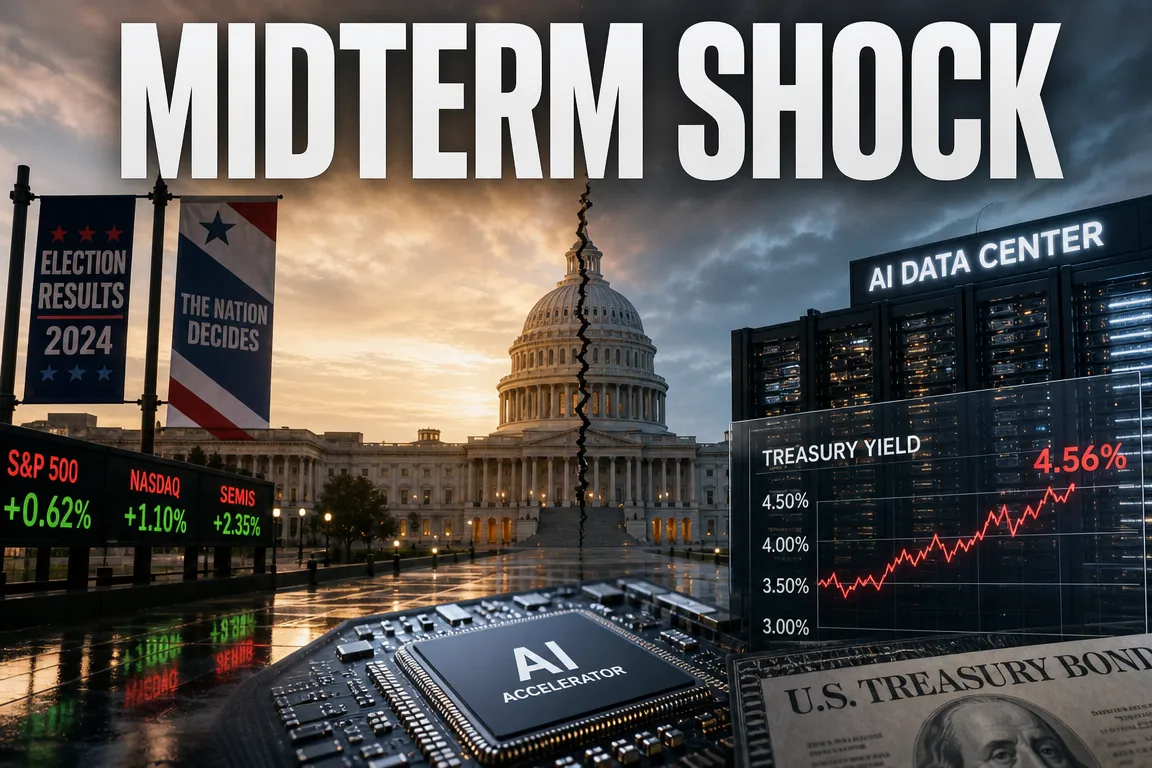
Could the U.S. Midterm Elections Undermine the KOSPI? The Real Variables Behind Semiconductor and Data Center Investment
Assessing the direction of the KOSPI and semiconductor stocks solely on the basis of U.S. midterm election results risks overlooking more significant investment variables.
This report evaluates the argument that a Democratic sweep would lead to tighter data center regulation, lower semiconductor demand, and a sharp KOSPI decline.
It also examines factors with a more direct impact on Korean equities, including AI data center investment, HBM demand, memory semiconductor prices, U.S. export controls on China, and exchange rates.
Key Takeaways
- The claim that Democratic control of both chambers of Congress would halt data center construction is an oversimplification.
- If the original analysis referred to the 2018 U.S. midterm elections, Democrats won the House but failed to secure the Senate.
- Democrats also failed to win either the U.S. Senate race or the gubernatorial election in Texas.
- Weakness in the KOSPI and Korean semiconductor stocks at the time was driven more by the U.S.-China trade dispute, a slowdown in the memory cycle, U.S. interest-rate increases, and concerns over China’s economy.
- The primary constraints on the current data center industry are power grids, transformers, permitting, cooling water, and transmission infrastructure rather than political party affiliation.
- Korean semiconductor earnings are more sensitive to HBM supply capabilities, conventional DRAM prices, major technology companies’ AI capital expenditure, and U.S. semiconductor restrictions on China than to election outcomes.
The Original Argument and Its Causal Structure
The original argument can be summarized as follows:
- Democrats are increasingly likely to take control of both chambers of Congress in the U.S. midterm elections.
- Democrats oppose data center development because of environmental and energy concerns.
- A Democratic victory in Texas could weaken planned data center investment.
- Reduced data center construction would lower demand for server semiconductors.
- Samsung Electronics, SK hynix, and other Korean semiconductor stocks would decline, placing additional pressure on the KOSPI.
The argument appears to connect politics, industry, and financial markets.
However, several stages of the proposed causal chain are either inconsistent with the facts or materially overstated.
Fact Check 1: Did Democrats Win Both the House and Senate?
The original content appears to have been based on the 2018 U.S. midterm elections.
In the November 6, 2018 elections, Democrats secured a majority in the House of Representatives.
Republicans, however, retained and expanded their Senate majority.
A full Democratic sweep of Congress therefore did not occur.
The argument would also be inaccurate if it referred to the 2022 midterm elections.
In 2022, Republicans won the House while Democrats retained control of the Senate.
An analysis based on complete Democratic control of Congress is therefore inconsistent with the actual results of either election.
Fact Check 2: Were Democratic Candidates Leading in Texas?
In the 2018 Texas U.S. Senate election, Republican Ted Cruz defeated Democrat Beto O’Rourke.
The relatively narrow margin attracted significant attention, but the Democratic candidate did not win.
Republican Greg Abbott also defeated Democrat Lupe Valdez in the Texas gubernatorial election.
Abbott again defeated O’Rourke in the 2022 gubernatorial election.
The scenario in which Democratic victories in Texas would block data center investment therefore did not materialize.
Fact Check 3: Do Democrats Oppose Data Center Construction?
It is not accurate to characterize the Democratic Party as uniformly opposed to data center development.
Democratic officials and local governments may apply stricter standards to environmental regulation, carbon emissions, electricity consumption, and cooling-water usage.
Nevertheless, investment in data centers and advanced semiconductor facilities has continued in Democratic-led jurisdictions.
The U.S. federal government has also provided substantial incentives for domestic semiconductor manufacturing and supply-chain development through the CHIPS and Science Act.
During the Biden administration, major companies including Microsoft, Google, Amazon, Meta, and Oracle expanded data center investment.
As AI competitiveness has become linked to national security and economic growth, data centers have evolved from conventional real estate projects into strategic infrastructure.
Individual projects may still face delays or conditional approval because of electricity demand, water consumption, and potential increases in local utility rates.
The central issue is not whether Democrats oppose data centers, but whether power grids and regional infrastructure can support the pace of AI data center expansion.
The Primary Drivers of the KOSPI Decline at the Time
The weakness of the KOSPI, Samsung Electronics, and SK hynix in 2018 cannot be attributed to the U.S. midterm elections alone.
Several adverse factors affected the market simultaneously.
1. U.S.-China Trade Dispute
Escalating tariff measures between the United States and China raised concerns about slower global trade and manufacturing activity.
South Korea was particularly exposed because of its dependence on exports and manufacturing.
Investor sentiment weakened rapidly in semiconductors, chemicals, and machinery because of their significant intermediate-goods exports to China.
2. Concerns Over a Peak in the Memory Cycle
Following the memory semiconductor upcycle that began in 2017, expectations increased that DRAM and NAND flash prices would decline.
Equity markets typically price in future earnings rather than current performance.
This explains why Samsung Electronics and SK hynix shares weakened despite reporting strong profits at the time.
Data center demand did not disappear. The market was instead pricing in supply growth and inventory adjustments.
3. U.S. Interest-Rate Increases and Dollar Strength
The Federal Reserve was raising interest rates during this period.
Higher U.S. Treasury yields and a stronger dollar increased the likelihood of capital moving from emerging markets into U.S. assets.
Given its high level of foreign investor participation, the KOSPI was sensitive to the KRW/USD exchange rate and U.S. monetary policy.
4. Slowing Chinese Growth
Slower consumption, industrial production, and capital investment in China increased concerns about Korean exporters’ earnings.
China and Hong Kong represented a substantial share of Korean semiconductor exports, making the Korean market directly exposed to a Chinese slowdown.
5. Foreign Fund Flows and Risk Aversion
When multiple risks emerge simultaneously, foreign investors may reduce exposure at the country or sector level rather than evaluate individual companies separately.
Because Samsung Electronics and SK hynix account for a significant share of KOSPI market capitalization, declines in both stocks can materially lower the index.
KOSPI analysis should therefore incorporate exchange rates, foreign investor futures positioning, and semiconductor earnings estimates in addition to political developments.
Current AI Data Centers Differ From Earlier Data Centers
Earlier data center demand was primarily driven by search, e-commerce, cloud storage, and enterprise servers.
Current investment is increasingly led by high-performance computing requirements for generative AI training and inference.
AI servers require more accelerators, high-bandwidth memory, and high-performance networking equipment than conventional servers.
Server unit volumes alone therefore provide an incomplete measure of semiconductor demand.
Two facilities of similar physical size can require substantially different investment levels and semiconductor content depending on their GPU, HBM, and power-system configurations.
In the current AI semiconductor market, accelerator shipments, rack-level power density, HBM content, and major technology companies’ capital expenditure are more relevant than the number of data centers.
Six Key Variables for Korean Semiconductor Companies
1. HBM Supply Capabilities
AI accelerators require HBM to process large volumes of data at high speed.
HBM is more difficult to manufacture than conventional DRAM and requires lengthy customer qualification procedures.
Production expansion does not immediately translate into sales, making yield, advanced packaging, and thermal management critical competitive factors.
Samsung Electronics and SK hynix shares may respond more strongly to customer qualification and mass-production schedules for next-generation HBM than to total memory shipment volumes.
2. Conventional DRAM and NAND Flash Prices
Conventional DRAM and NAND flash prices remain important to the overall earnings of Korean memory manufacturers despite rapid growth in AI semiconductors.
Weak PC and smartphone demand or increased supply from Chinese memory producers could partially offset growth in AI-related products.
An investment view based only on HBM developments may overlook the conventional memory cycle, which still accounts for a substantial portion of company earnings.
3. Global Technology Companies’ Capital Expenditure
Data center investment by Microsoft, Alphabet, Amazon, Meta, and Oracle is a key indicator of AI server demand.
However, not all capital expenditure is allocated to semiconductor purchases.
A growing share is being directed toward land, construction, power generation, transmission infrastructure, and cooling systems.
Investors should distinguish total data center investment from actual spending on GPUs and HBM.
4. U.S. Semiconductor Export Controls on China
U.S. restrictions on exports of advanced AI chips and semiconductor equipment to China create both opportunities and risks for Korean companies.
The expansion of a U.S.-centered AI supply chain could benefit Korean memory manufacturers.
However, tighter restrictions on sales to Chinese customers or equipment deliveries to China-based facilities could disrupt production and investment plans.
If U.S. elections affect the semiconductor market, the impact is more likely to occur through technology controls on China and industrial subsidy policy than through direct opposition to data center construction.
5. Power Grids and Energy Supply
AI data centers consume significantly more electricity than conventional cloud facilities.
In some regions, completed facilities may still face delayed operations because sufficient electricity cannot be supplied on schedule.
Shortages of transformers and transmission equipment, delays in power-generation projects, and long grid-connection queues have become major constraints on AI infrastructure.
The most competitive locations may therefore be those with reliable electricity and transmission capacity rather than those with the least restrictive regulations.
6. KRW/USD Exchange Rate and Foreign Fund Flows
A weaker won can improve the reported local-currency earnings of semiconductor exporters that generate revenue in U.S. dollars.
However, a sharp exchange-rate increase caused by financial-market stress may coincide with foreign capital outflows and a lower KOSPI.
KRW/USD depreciation should therefore not be viewed as uniformly positive for semiconductor companies.
How U.S. Midterm Elections Actually Affect the KOSPI
U.S. midterm elections can influence Korean equities.
However, the effects often emerge through subsequent budgets, legislation, and regulatory implementation rather than immediately after the election result.
First Channel: Fiscal Policy and U.S. Treasury Yields
A change in congressional control can alter tax, government spending, and fiscal-deficit policies.
Expectations of wider fiscal deficits may lead to increased Treasury issuance and higher long-term yields.
Higher U.S. yields can reduce valuations for growth and technology stocks while weakening foreign investor flows into the KOSPI.
Second Channel: Semiconductor Subsidies and Supply-Chain Policy
Changes to subsidies and tax credits for U.S. semiconductor facilities can affect global companies’ investment schedules.
Korean companies must evaluate both the benefits of U.S. investment incentives and related conditions, including profit-sharing provisions, customer-information requirements, and restrictions on investment in China.
Third Channel: Export Controls on China
U.S. lawmakers have maintained relatively broad bipartisan support for restricting China’s access to advanced technology.
Regardless of which party wins an election, restrictions on AI chips and semiconductor manufacturing equipment are unlikely to disappear abruptly.
The more relevant variables are the scope of the restrictions and the degree to which controls on indirect exports are tightened.
Fourth Channel: Environmental and Energy Policy
Democrats generally place greater emphasis on renewable energy and carbon-emissions regulation.
Republicans generally prioritize energy-supply expansion and deregulation, including natural gas, nuclear power, and fossil fuels.
Because AI data centers require stable, continuous electricity, both approaches can create advantages and disadvantages for the industry.
The Critical Issue Often Overlooked
In the AI data center era, electricity shortages may constrain growth before semiconductor shortages do.
Market attention has primarily focused on GPU and HBM production capacity.
However, delayed grid connections can limit the availability of facilities capable of installing and operating purchased semiconductors.
In such cases, major technology companies may postpone facility activation or relocate investment rather than immediately cancel semiconductor orders.
This could appear as delayed demand recognition rather than structural demand destruction.
Quarterly results may indicate weaker orders, while long-term contracts and infrastructure investment plans may support a different conclusion.
Rising AI investment also does not guarantee that semiconductor company profits will increase at the same rate.
In-house AI chip development, supplier diversification, and stronger price negotiations by major technology companies could reduce the market share and margins of individual semiconductor suppliers.
The broader expansion of AI investment should therefore be assessed separately from the prospective returns of individual semiconductor stocks.
Investor Checklist
- Determine whether U.S. election outcomes translate into enacted legislation and budget allocations.
- Review specific semiconductor subsidy and China export-control provisions rather than relying on general party positioning.
- Assess the proportion of major technology companies’ data center expenditure allocated to servers and AI accelerators.
- Evaluate HBM shipment volumes together with yields, customer qualifications, and average selling prices.
- Monitor conventional DRAM and NAND flash inventories and pricing trends.
- Track grid-connection delays and changes to data center activation schedules.
- Review the KRW/USD exchange rate alongside foreign net purchases of Samsung Electronics and SK hynix.
- When a sharp KOSPI decline is attributed to a single political event, compare the timing of the market decline with the timing of the related news.
Conclusion: Earnings and Industry Cycles Matter More Than Elections
U.S. midterm elections can affect investor sentiment in the short term.
Over the medium to long term, however, corporate earnings and the memory semiconductor cycle remain the principal drivers of the KOSPI and Korean semiconductor stocks.
The formula of a Democratic victory leading to tighter data center regulation and a semiconductor selloff does not adequately reflect actual election outcomes or industry conditions.
The data center market expanded under Democratic administrations, and its strategic importance has increased further with the adoption of generative AI.
Investors should focus on HBM competition, AI data center investment, power infrastructure, U.S. technology restrictions on China, and exchange rates rather than election headlines alone.
< Summary >
The projected Democratic sweep did not correspond with the actual U.S. midterm election results.
The KOSPI decline at the time was driven more by the U.S.-China trade dispute, a weakening memory cycle, interest-rate increases, and concerns over China’s economy.
The principal variables in the current AI semiconductor market are HBM, major technology companies’ capital expenditure, export controls on China, and power-grid capacity.
U.S. political developments are more likely to affect Korean equities through interest rates, industrial subsidies, and technology controls than through direct restrictions on data center construction.
KOSPI analysis should therefore incorporate semiconductor earnings, global liquidity, and exchange rates rather than relying on a single election outcome.
[Related Articles…]
*Source: [ 내일은 투자왕 – 김단테 ]
– 미국 중간선거에 코스피 개박살? #중간선거 #블루웨이브 #코스피