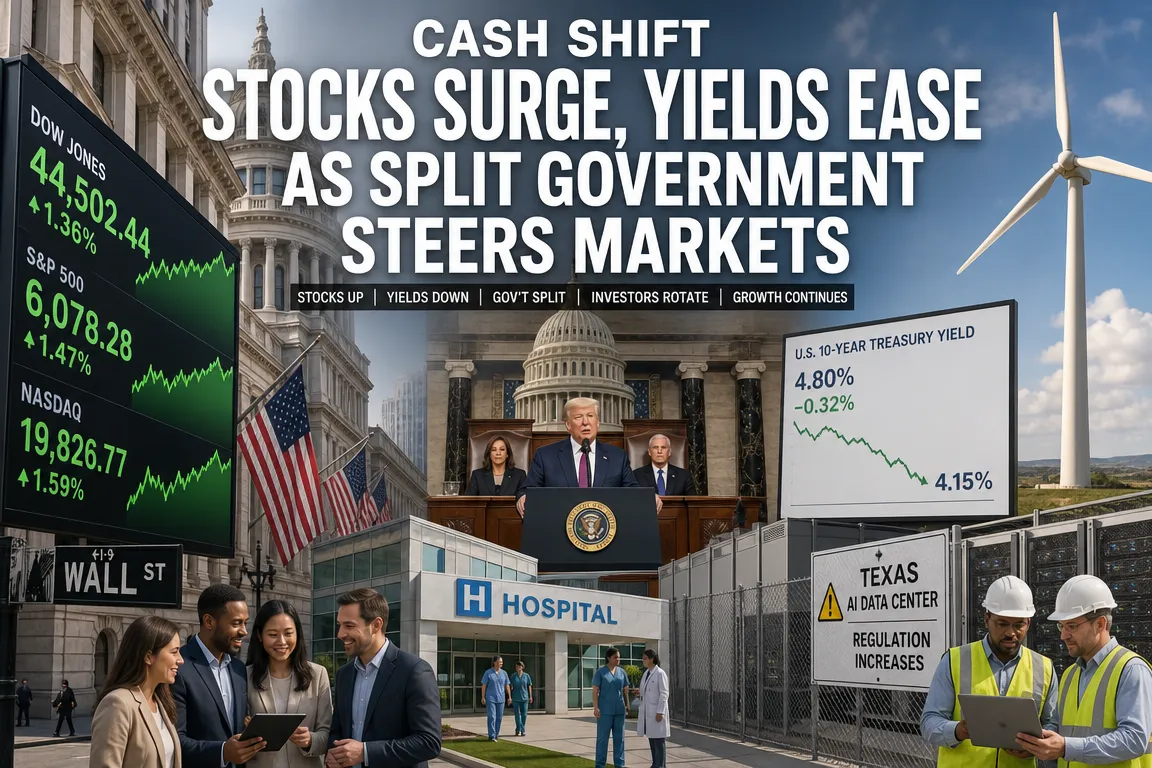
● Democrats Squeeze Markets, Dow Soars, Bond Yields Sink
Post-2026 U.S. Midterm Election Market Analysis | Democratic Control of Congress, Dow Surge, and Potential Reduction in Long-Term Treasury Issuance
The market significance extends beyond the Democratic election victory.
A divided government, with the White House and Congress controlled by opposing parties, could reshape fiscal spending, tariffs, defense budgets, clean-energy policy, and AI data center regulation.
Signals that the U.S. Treasury could revise its long-term debt issuance strategy beginning in 2027 contributed to a surge in the Dow, small-cap stocks, and healthcare shares, while long-term yields declined.
Conversely, AI data centers, semiconductors, defense contractors, and assets associated with Tesla and SpaceX faced increased political and regulatory risk.
This report examines why the midterm election results drove the Dow higher, why Wall Street often favors legislative gridlock, and how U.S. Treasury yields and AI investment trends could evolve.
This analysis is based on a Maeil Business Newspaper New York briefing published on November 4, 2026.
Seat counts, individual stock-price movements, and SpaceX-related transaction data reflect information available at the time of the original report and require confirmation through official election authorities and regulatory filings.
1. U.S. Midterm Election Results | Democrats Take Control of Both Chambers
According to the original report, Democrats secured 54 Senate seats and 232 House seats, gaining control of both chambers of Congress.
With a Republican president retaining control of the White House and Democrats controlling the legislature, the United States entered a conventional divided-government structure.
Democratic victories in the Texas Senate and gubernatorial races, historically considered Republican strongholds, were cited as a significant indication of political change.
President Trump’s acceptance of the election results and stated willingness to cooperate with Democrats also helped reduce market uncertainty.
- White House: Republican control of the executive branch maintained
- Senate: Democratic majority
- House: Democratic majority
- Policy structure: Democratic support required for tax cuts and fiscal expansion
- Market interpretation: Greater emphasis on checks, balances, and negotiation rather than abrupt policy changes
2. Cost-of-Living Pressures Were the Decisive Electoral Factor
Analysts identified inflation and living costs, rather than party affiliation alone, as the issues that most strongly influenced voters.
Elevated consumer prices, compounded by tariff-related costs, increased dissatisfaction with spending on food, housing, energy, and healthcare.
Even when economic growth remains resilient, persistent increases in household expenses can weaken support for the incumbent administration and governing party.
The result may also signal that future U.S. trade and tariff policies will be reassessed through the lens of price stability.
3. Why Dow Futures Surged More Than 1,000 Points
After the election results were priced in, Dow futures rose by more than 1,100 points at one stage, representing a gain of over 2%.
The S&P 500 and Russell 2000 also advanced, while Nasdaq 100 futures recovered from early underperformance and extended their gains.
The Dow outperformed partly because it has relatively high exposure to healthcare and clean-energy companies expected to benefit from Democratic policy priorities.
The Russell 2000 strengthened on expectations that lower long-term interest rates would reduce borrowing costs.
The Nasdaq initially lagged as concerns emerged over AI data center regulation and the capital intensity of semiconductor investment.
- Dow: Strength in healthcare, financials, and clean energy
- Russell 2000: Reduced financing pressure on smaller companies as Treasury yields declined
- S&P 500: Lower political uncertainty and a rebound in mega-cap technology stocks
- Nasdaq 100: Initial underperformance on AI data center concerns, followed by a recovery
- VIX: Approximately 9% decline, indicating reduced risk aversion
4. Why Wall Street Favors Divided Government and Gridlock
Gridlock refers to a political environment in which conflict between the White House and Congress slows legislation and policy implementation.
Although potentially inefficient from a governance perspective, gridlock can improve predictability for financial markets.
When one party controls both the executive and legislative branches, large tax cuts, fiscal programs, and regulatory changes can be implemented rapidly.
Under divided government, legislation typically faces a longer approval process, reducing the likelihood of abrupt changes in taxes and regulation.
Bond markets may also anticipate constraints on fiscal expansion and a lower future Treasury issuance burden.
However, gridlock is not uniformly positive for financial markets.
Failed budget negotiations can increase the risk of a government shutdown, while debt-ceiling negotiations may become more contentious.
The market rally is therefore better attributed to the resolution of election uncertainty and expectations of fiscal restraint than to the Democratic victory alone.
5. Potential Changes in U.S. Economic Policy
Further tax cuts are likely to face greater constraints.
Because additional tax reductions would lower revenue and widen the fiscal deficit, approval from a Democratic-controlled Congress may be difficult to obtain.
The probability of large cash transfers and additional fiscal expansion has also declined.
Costly proposals, including the reported plan to distribute $5,000 per adult, may face limited prospects for congressional approval.
Tariff policy could be eased for allied economies.
Congress may seek to restrict trade authority previously delegated to the president, potentially reducing trade tensions with Europe, Canada, and other allies.
Oversight of digital assets and the AI industry may intensify.
If electricity consumption, water use, environmental impact, and local opposition become broader political issues, approval timelines for new AI data centers could lengthen.
Defense-budget expansion will be subject to congressional negotiations.
Large defense-spending increases proposed by the Trump administration could be reduced or delayed during negotiations with Democrats.
6. Sector Winners and Losers
6-1. Healthcare and Managed-Care Companies
Democrats have traditionally supported broader Medicaid eligibility and health insurance coverage.
Expectations that Medicaid spending cuts could be reduced or postponed supported health insurers and hospital operators.
Molina Healthcare, Centene, HCA Healthcare, and Universal Health Services were identified as potential beneficiaries.
Major pharmaceutical and healthcare companies, including Eli Lilly, Johnson & Johnson, AbbVie, and Merck, also advanced.
6-2. Solar and Wind Companies
Clean-energy stocks did not rise because new subsidies had already been approved.
Instead, investors priced in the possibility that Congress could constrain efforts to reduce existing subsidies and loosen environmental regulations.
Solar companies such as Sunrun, First Solar, and Enphase, as well as wind-related companies including Vestas and Orsted, recorded gains.
Actual policy changes would still require substantial negotiation because the president could veto clean-energy legislation passed by Congress.
6-3. Small-Cap and Housing-Related Stocks
Small companies are generally more sensitive than large corporations to bank lending rates and corporate bond yields.
Lower long-term interest rates could reduce financing costs, supporting small-cap stocks represented in the Russell 2000.
Housing-related retailers such as Home Depot and Lowe’s also gained on expectations of lower mortgage rates and a potential housing-market recovery.
6-4. Defense Stocks
Defense contractors such as Lockheed Martin, RTX, and Northrop Grumman rely heavily on the federal government as their principal customer.
If defense-budget increases are reduced or delayed during congressional negotiations, new orders and long-term revenue expectations could be affected.
However, continuing geopolitical tensions suggest that the sector’s long-term demand outlook cannot be assessed solely from the immediate post-election decline.
6-5. Private-Prison Operators
GEO Group and CoreCivic operate correctional institutions and immigration detention facilities.
Stricter immigration enforcement tends to increase demand for these facilities, while Democratic restrictions on funding or operating practices could weaken profitability.
These companies consequently traded lower following the midterm election.
7. Why AI Data Center and Semiconductor Stocks Came Under Pressure
The original report attributed regulatory concerns to a campaign pledge by the incoming Texas governor to suspend new data center construction.
Texas has become a major U.S. AI data center hub due to relatively low electricity costs and abundant land.
Rapid data center development, however, has increased pressure on the power grid and water supply while raising concerns over electricity prices, noise, and environmental effects.
Exit-poll data indicating broad local opposition to data center construction further increased market concerns.
Oracle, CoreWeave, Palantir, and other companies exposed to data center development and AI software declined, while semiconductor companies including Nvidia and Micron also faced pressure.
AMD performed relatively well following stronger-than-expected results.
The principal issue is not a decline in AI demand.
Rather, the focus of AI investment is shifting from GPU procurement toward electricity, transformers, transmission networks, cooling systems, water availability, and local permitting.
AI companies’ competitiveness may increasingly depend not only on their ability to purchase semiconductors but also on access to power and their capacity to manage regulatory requirements.
8. Political Risk for Tesla and SpaceX
According to the original report, Elon Musk contributed $474 million to support Republican candidates, with a substantial portion directed toward elections in Texas.
Democratic victories in Texas and other major races led to assessments that this political strategy had produced limited results.
Statements by some Democratic legislators regarding possible investigations into Musk and affiliated companies increased concerns about government contracts, permits, antitrust reviews, and corporate oversight.
The concentration of key Tesla and SpaceX operations in Texas could represent an additional risk.
SpaceX-related pricing and transaction data require independent verification.
SpaceX is not traded like a conventional exchange-listed company, and reported prices may reflect private-share transactions or other secondary-market valuations.
Reports concerning a potential Tesla-SpaceX combination and a jointly operated semiconductor facility also require confirmation through official corporate filings and regulatory disclosures.
9. Why Long-Term U.S. Treasury Yields Declined
U.S. Treasuries strengthened after the midterm election, particularly at the long end of the yield curve.
Because bond prices and yields move inversely, increased demand lowered yields on 10-year, 20-year, and 30-year securities.
The primary driver was an expectation that divided government would constrain large tax cuts and fiscal expansion.
A narrower fiscal deficit could reduce future Treasury issuance, lowering the supply burden for long-duration securities.
- Fiscal constraints: Expectations of slower growth in future Treasury issuance
- Reduced long-term supply: Supportive of Treasury prices and lower yields
- Lower oil prices: Reduced inflation expectations
- Lower political uncertainty: Potential inflows into both safe-haven and risk assets
The original report indicated that the 10-year Treasury yield declined by approximately 3 basis points, which is insufficient by itself to explain a Dow gain of more than 2%.
The equity rally likely reflected a combination of lower yields, reduced election uncertainty, short covering, and sector rotation.
10. Potential Reduction in Long-Term Treasury Issuance Beginning in 2027
The U.S. Treasury did not immediately make a substantial change to quarterly debt issuance.
However, it removed the phrase “at least” from previous guidance stating that issuance would remain stable for “at least several quarters,” providing greater flexibility for future adjustments.
Wall Street interpreted the revision as a possible signal that the Treasury could reduce long-term issuance and increase Treasury bill issuance beginning in the first half of 2027.
Lower long-term Treasury supply could reduce long-term yields and ease valuation pressure on technology and growth stocks.
Small-cap companies and the housing market could also benefit.
However, excessive reliance on short-term debt would require more frequent refinancing, increasing the government’s sensitivity to interest rates and rollover risk.
11. Why JPMorgan Proposed Ending 20-Year Treasury Issuance
JPMorgan’s global head of fixed income publicly recommended that the U.S. Treasury discontinue issuance of 20-year bonds.
The 20-year Treasury lacks the benchmark status and liquidity of the 10-year note and does not benefit from the same structural demand from insurers and pension funds as the 30-year bond.
Weak demand can cause 20-year yields to trade above 30-year yields.
If the U.S. government pays a higher yield on 20-year debt than on longer-maturity 30-year debt, its funding structure becomes less efficient.
- 10-year Treasury: Global benchmark with substantial trading liquidity
- 20-year Treasury: Relatively weak demand base and liquidity
- 30-year Treasury: Structural demand from insurers and pension funds matching long-duration liabilities
- Treasury bills: Strong demand supported by money market funds
Eliminating the 20-year bond could reduce long-term supply pressure but might also weaken liquidity for existing holders.
A reduction in new issuance or a gradual adjustment to the maturity structure may therefore be more practical than immediate termination.
12. Are AI Corporate Bonds Displacing Demand for U.S. Treasuries?
AI companies are issuing substantial amounts of corporate debt to finance data centers, semiconductors, and power infrastructure.
This has raised concerns that AI-related corporate bonds could absorb investment capital and weaken demand for U.S. Treasuries.
However, minutes from the Treasury Borrowing Advisory Committee indicated that there was no clear evidence that AI-related corporate issuance had materially displaced Treasury demand.
The committee instead suggested that expectations of stronger productivity and economic growth from AI investment had increased real interest rates.
This distinction is material.
If yields are rising because of increased AI corporate bond supply, the issue primarily concerns bond-market supply and demand.
If yields are rising because AI is expected to strengthen economic growth, the movement reflects improved macroeconomic expectations.
The latter could support corporate earnings while maintaining elevated discount rates, creating valuation pressure for highly priced growth stocks.
The committee indicated that demand for AI computing capacity could exceed supply through 2028.
AI-related corporate issuance and borrowing demand may therefore continue to expand in 2027.
Investors should assess both the productivity gains generated by AI capital expenditure and whether the associated investment costs can be recovered through sustainable cash flow.
13. Implications of Lower Oil Prices and Higher Precious-Metal Prices
WTI and Brent crude declined by approximately 3% on expectations of an agreement and reduced tensions in the Middle East.
Lower oil prices generally support equities by reducing energy expenses for companies and living costs for consumers.
They may also reduce future inflationary pressure from the Federal Reserve’s perspective.
Gold, silver, platinum, and palladium advanced, while the U.S. dollar weakened.
Despite lower political uncertainty, precious metals were supported by declining long-term yields and a weaker dollar.
14. CVS Separation and Restructuring of the U.S. Healthcare Industry
CVS reportedly announced a plan to separate its pharmacy operations from its insurance and pharmacy-benefit management businesses.
Approximately 9,000 pharmacies would be transferred to a separate company, while insurer Aetna and pharmacy-benefit manager Caremark would remain within CVS Health.
The separation is targeted for completion in the first half of 2028.
CVS acquired Aetna for $78 billion in 2018, pursuing a vertically integrated model combining insurance, prescription management, and retail pharmacies.
The proposed separation would represent a reversal of that strategy approximately eight years after the acquisition.
The decision reflects competition from Amazon’s online prescription-delivery services and growing antitrust pressure.
Ownership of both a pharmacy-benefit manager and pharmacy network may create conflicts of interest and competition concerns.
A separation could allow each business to receive an independent valuation, although it may reduce cost efficiencies previously generated through integration.
15. ADP Employment, Wage Growth, and the Federal Reserve Outlook
According to the original report, ADP private payrolls increased by 86,000 in October, exceeding market expectations.
Employment reportedly increased across small, medium-sized, and large companies, led by service-sector hiring.
Elevated growth in base salaries and total compensation for workers changing jobs increased concerns about wage inflation.
Combined with strong third-quarter GDP growth and elevated personal consumption expenditure inflation, these data reduced the probability of rapid Federal Reserve rate cuts.
However, the ADP report alone is insufficient to establish a case for renewed rate increases.
ADP data can diverge from the official employment report, and the Federal Reserve evaluates unemployment, hourly earnings, core inflation, inflation expectations, and financial conditions collectively.
The report is better interpreted as a signal that restrictive interest rates may remain in place for longer rather than as evidence of an imminent rate increase.
16. Key Developments That May Be Overlooked
First, sector rotation was more significant than the headline index gains.
Capital previously concentrated in technology stocks broadened into healthcare, financials, clean energy, and small-cap companies.
The Dow’s outperformance relative to the Nasdaq suggests a near-term shift in market leadership.
Second, the principal risk to the AI industry is infrastructure approval and local politics, not weaker demand.
Data centers consume substantial electricity and water, allowing community opposition to directly influence elections and permitting policy.
Analysis of AI-related companies should therefore include grid access, generation capacity, cooling, transmission infrastructure, and local regulation in addition to GPU shipments.
Third, reduced long-term Treasury issuance would support growth stocks but would not eliminate fiscal risk.
Replacing long-term debt with short-term issuance could lower long-term yields initially but would require more frequent refinancing.
If short-term rates remain elevated, federal interest expenses could increase more rapidly.
Fourth, political gridlock may shift regulation rather than reduce it.
Large federal legislation may slow, while congressional investigations, state-level regulation, and budget conditions could place greater pressure on companies.
For Tesla and AI data center operators, state permitting policy in Texas and other jurisdictions may be more consequential than federal legislation.
Fifth, declining long-term yields and strong employment conditions may not coexist indefinitely.
Even if political factors lower long-term yields, persistent strength in employment, wages, and inflation could keep Federal Reserve policy restrictive.
The market outlook will depend on the balance between reduced long-term Treasury supply and the Federal Reserve’s higher-for-longer interest-rate policy.
17. Investor Checklist
- Official election results: Final Senate and House seat counts and inauguration schedules
- Budget negotiations: Adjustments to tax cuts, defense spending, Medicaid, and clean-energy subsidies
- Treasury announcements: Long-term and short-term issuance composition for 2027
- 20-year Treasury: Formal discussion of issuance reductions or termination
- Federal Reserve policy: Rate outlook based on official employment data and core inflation
- AI data centers: New permitting rules and power-grid regulation in Texas
- Corporate disclosures: Official confirmation of the CVS separation and Tesla-SpaceX-related plans
- International oil prices: Whether reduced Middle East tensions translate into higher supply
< Summary >
Democratic control of the Senate and House has created a divided government consisting of a Republican White House and Democratic Congress.
Expectations that fiscal expansion and Treasury issuance could be constrained drove strong buying in the Dow and Russell 2000.
Healthcare, financials, clean energy, and small-cap stocks benefited, while defense contractors, private-prison operators, AI data center companies, and Musk-related assets faced increased regulatory uncertainty.
The possibility that the U.S. Treasury could reduce long-term issuance beginning in 2027 strengthened expectations for more stable long-term yields.
However, strong employment and wage growth could extend the Federal Reserve’s restrictive policy stance, limiting the case for a sustained equity rally based solely on political developments.
Investors should focus on budget negotiations, the Treasury’s issuance structure, AI data center regulation, and the Federal Reserve’s rate outlook rather than the election result alone.
[Related Articles…]
*Source: [ Maeil Business Newspaper ]
– [중간선거 증시 분석] 민주당, 美 상·하원 장악|월가는 권력 분점을 좋아한다? 다우 급등 왜��내년 美 장기국채 발행 축소 가능성|홍혜진의 뉴욕브리핑