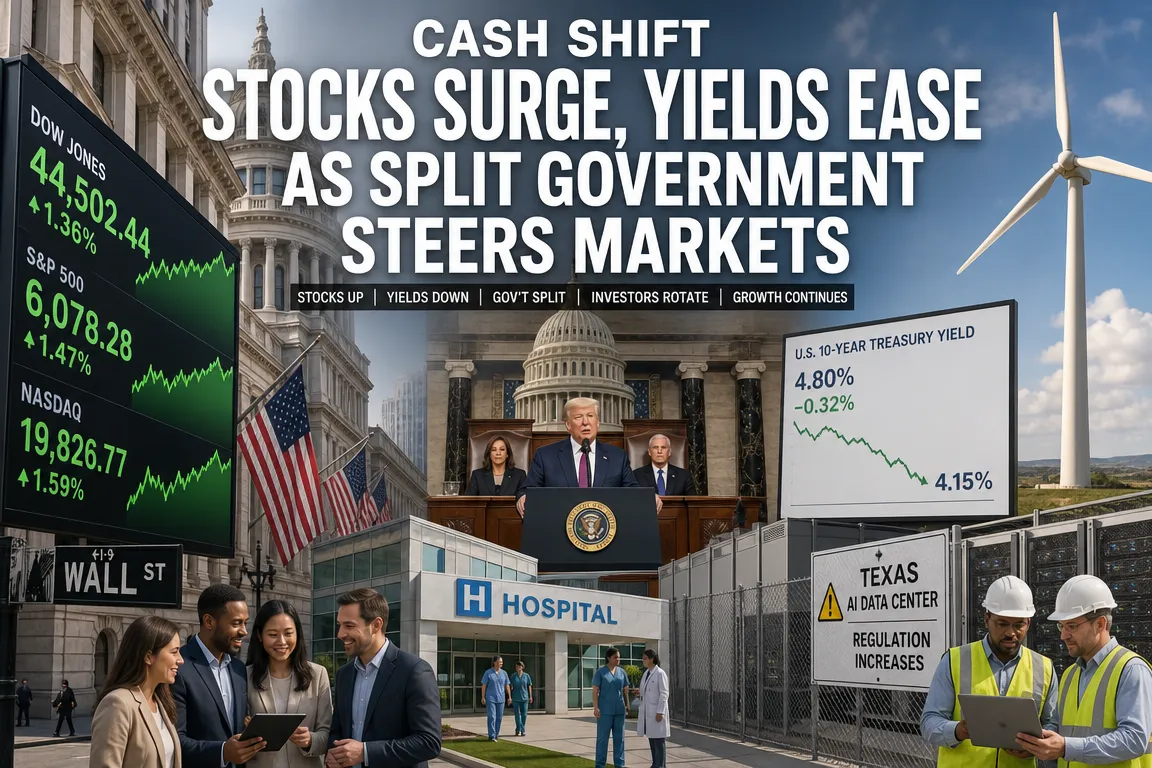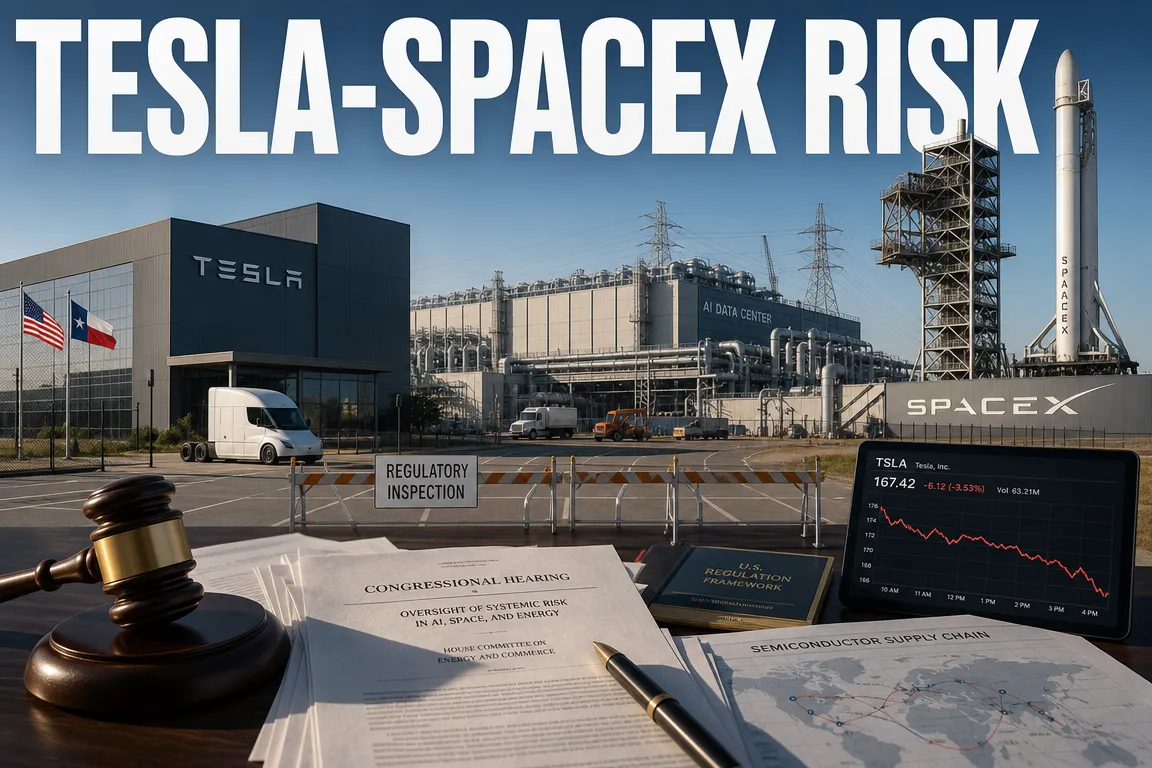
● Musk-Shock, Texas-Turmoil, Tesla-Risk
Elon Musk’s $500 Million Political Bet, Texas Policy Shifts, and Key Risks for Tesla Shareholders at $385
Investors should assess the potential effects of post-midterm congressional oversight, Texas AI data center regulation, SpaceX government contracts, and speculation about a Tesla-SpaceX merger.
However, the source material combines election projections, corporate claims, and merger speculation that require official verification.
SpaceX is privately held, so the statement that its shares “closed at $135” cannot refer to an official public-market closing price.
Claims that Tesla owns approximately 19 million SpaceX shares and that the companies have established a merger timetable have not been confirmed through official disclosures.
The relevant investment question is not whether a merger is certain, but how political changes could affect the costs, operations, and growth plans of Musk-controlled companies.
1. Key Facts Requiring Verification
- SpaceX is privately held.
The reported $135 figure may represent a private-market transaction or internal valuation rather than an official public-market closing price. - A Tesla-SpaceX merger has not been officially confirmed.
Without a disclosed timeline, exchange ratio, special committee, or regulatory filing, a merger should not be treated as an investment assumption. - Claims regarding Tesla’s ownership of SpaceX shares require verification.
Any reported shareholding not documented in Tesla’s filings or U.S. Securities and Exchange Commission records should not be presented as fact. - Elon Musk’s reported $500 million in political funding requires classification.
The implications differ depending on whether the funds were direct candidate contributions, donations to super PACs or political organizations, or spending on election advertising and related groups. - Initial seat projections may not represent final election results.
Mail-in ballots, recounts, and runoff elections can delay certification. Investors should consult state election authorities and multiple sources, including AP and Reuters.
The first step is to separate confirmed facts, media projections, and market rumors.
2. Why U.S. Midterm Elections Matter to Musk-Controlled Companies
U.S. midterm elections determine all House seats and a portion of Senate seats during the middle of a presidential term.
A change in congressional control can affect legislation, budgets, hearings, subpoenas, document requests, and investigative priorities.
SpaceX is a major federal contractor serving NASA, the U.S. Department of Defense, and other government agencies.
Congress cannot unilaterally cancel SpaceX contracts, but budget reviews, hearings, and audit requests can affect implementation timelines and political risk.
Investigations involving X, Starlink, communications support for Ukraine, or government-efficiency initiatives could transmit risks from Musk’s political activities to his companies.
Congressional scrutiny would not automatically suspend existing SpaceX contracts or result in direct sanctions against Tesla.
Political rhetoric and enforceable administrative action should be evaluated separately.
3. Measures a Democratic-Controlled Congress Could Take
The congressional majority can hold hearings and summon corporate executives and government officials as witnesses.
It can also request records involving government contracts, subsidies, tax benefits, and national-security decisions.
Final authority to approve or challenge corporate mergers generally rests with competition regulators such as the U.S. Department of Justice and the Federal Trade Commission rather than Congress.
Communications and satellite operations may require Federal Communications Commission review, while rocket launches and aviation safety fall under the Federal Aviation Administration. Government contracts are also subject to agency-specific oversight.
State attorneys general may bring antitrust actions, meaning a major transaction could face review by multiple authorities.
Congress is therefore more likely to expand investigations and delay procedures than to block a merger or major contract directly.
4. Implications of the T-Mobile-Sprint Merger
T-Mobile and Sprint announced their merger in 2018 and subsequently faced congressional hearings and litigation from state governments.
Despite significant political opposition, the transaction was completed.
Approval included conditions such as the divestiture of prepaid wireless assets and temporary pricing commitments.
This precedent cannot be applied directly to a hypothetical Tesla-SpaceX transaction, but it illustrates an important principle.
Politically controversial mergers may still receive conditional approval, with review duration and required concessions becoming more important than a binary approval decision.
Because no official Tesla-SpaceX transaction exists, the T-Mobile case is relevant only as a reference for scenario analysis.
5. Potential Effects of Texas Political Changes
Texas is central to Musk’s industrial ecosystem, hosting Tesla’s headquarters, Gigafactory Texas, and SpaceX’s Starbase.
Tesla moved its headquarters from California to Austin in 2021.
In 2024, Tesla pursued a move of its state of incorporation from Delaware to Texas following shareholder approval.
SpaceX has also announced plans to move its headquarters from California to Texas.
Texas gubernatorial and legislative policies can therefore affect tax incentives, factory expansion, power generation, water access, environmental permitting, and launch-site operations.
A change in governor would not, by itself, immediately halt existing factories or launch operations.
Existing contracts and approved incentives may have legal protection, while the composition of the state legislature and the authority of administrative agencies also remain relevant.
6. Data Centers Represent the Most Material Texas Risk
The principal risk is not corporate relocation but permitting for AI data centers that require substantial electricity and water.
Texas has attracted data center investment because of available land, relatively low energy costs, and historically business-friendly regulation.
Rapid AI data center development has increased concerns over grid reliability, electricity prices, water consumption, and emissions from gas-fired generation.
Stricter environmental reviews and community-protection standards could delay large projects.
Reduced tax incentives or higher grid-upgrade contributions could also weaken project economics.
These risks could affect Tesla, xAI, SpaceX, CoreWeave, and major cloud-computing companies.
7. Why AI Data Center Regulation Could Divide the Market
If new data center approvals become more difficult, existing infrastructure and secured power agreements held by Amazon, Microsoft, and Google may gain relative value.
Companies dependent on external financing for new facilities may face both construction delays and higher financing costs.
Power producers and utilities are not guaranteed beneficiaries.
Although demand may rise, stronger regulation, transmission investment requirements, community opposition, and rate controls could reduce expected returns.
Within the same AI investment theme, established infrastructure owners and companies focused on new construction may therefore experience divergent equity performance.
AI demand may remain strong while a larger share of industry returns accrues to companies that have already secured power and infrastructure.
8. Why Tesla Shares Have Become More Sensitive to Political News
Tesla’s valuation can no longer be assessed solely through electric-vehicle deliveries.
The market also assigns value to FSD, robotaxis, Optimus, energy storage, proprietary AI chips, and data center capacity.
Musk’s political activities may affect brand perception, consumer demand, regulatory relationships, and talent recruitment.
As a result, Musk-related companies could underperform even during a broader market rally if investors assign a higher political-risk discount.
However, a single day’s share-price movement should not be attributed exclusively to election results.
Interest rates, options positioning, technology-sector valuations, vehicle deliveries, and margin expectations may also be material drivers.
9. Potential Changes to SpaceX Government Contracts
SpaceX is closely integrated with the U.S. government through launch services, spacecraft programs, and satellite communications.
Greater political scrutiny could lead to more detailed reviews of contract structures, costs, and national-security decisions.
Restrictions on Starlink service in specific regions and its military use may intensify debate over corporate discretion and government control.
SpaceX’s limited number of near-term substitutes remains a significant defensive factor.
Falcon 9’s launch cadence and reusability, together with the Starlink network, represent strategically important assets for the U.S. government.
Even under heightened political conflict, stronger oversight and revised contract terms are more plausible than a complete termination of government relationships.
10. Assessing Tesla-SpaceX Merger Speculation
The source material presents a merger as a question of timing rather than probability.
Based on publicly available information, that conclusion is premature.
Because Tesla is publicly traded and SpaceX is privately held, a transaction would require valuation analysis, a share-exchange ratio, conflict-of-interest review, shareholder approval, and regulatory scrutiny.
Musk’s influence over both companies would make an independent board review particularly important.
Combining SpaceX’s aerospace and defense operations with Tesla’s automotive and consumer businesses could raise national-security and antitrust concerns.
Potential industrial synergies could include AI chips, energy storage, communications, and launch capabilities.
A merger should remain one scenario among several until an official board resolution or regulatory filing is published.
11. Could Space-Based Data Centers Provide a Regulatory Alternative?
Terrestrial data centers require land, electricity, cooling water, transmission capacity, and environmental approvals.
Space-based data center concepts propose using solar power and radiating heat in a vacuum environment.
SpaceX could have a theoretical advantage because of its launch economics and satellite network.
However, space-based data centers remain an early-stage concept requiring technical and economic validation.
High-performance AI chips consume substantial power and generate significant heat, potentially requiring large and heavy radiator systems.
Maintenance, component replacement, radiation exposure, transmission latency, orbital collisions, and space debris also present major challenges.
Regulatory applications involving hundreds of thousands or one million satellites would not constitute approval or evidence of actual deployment.
In the near term, orbital infrastructure may be more viable for specialized AI inference and satellite-data processing than as a replacement for terrestrial data centers.
12. The Most Important Underappreciated Issue
The central issue is not the election outcome itself, but the shift in AI’s primary bottleneck from GPUs to electricity and permitting.
Even if AI chip availability improves, computing capacity cannot expand without grid connections and adequate power supply.
Stronger community opposition and environmental reviews in Texas, Georgia, Ohio, and other major markets could delay U.S. AI investment.
Data center demand would not necessarily disappear, but companies with pre-secured power and land could command higher premiums.
Persistent electricity constraints could provide a relative advantage to countries with greater available generation capacity, including China.
U.S. competitiveness in AI will therefore depend not only on semiconductor performance but also on the speed of securing generation, transmission, substations, water, and community approval.
13. Tax Considerations for South Korean Overseas-Equity Investors
The source material also references a public petition requesting that capital-gains taxation on overseas share exchanges be deferred until the resulting shares are sold.
If a merger or share exchange is treated as a taxable disposal despite the absence of cash proceeds, investors may face an immediate tax liability.
The tax treatment would depend on the transaction structure, residency status, exchange mechanism, and applicable domestic tax law.
If Tesla and SpaceX announce a transaction, South Korean investors should evaluate both the exchange ratio and the timing of taxation.
Even if a petition receives 50,000 endorsements, legislation would not change automatically. Parliamentary review, government consultation, and formal tax-law amendments would still be required.
14. Key Indicators for Tesla Shareholders
- Certified U.S. election results
Investors should rely on results certified by state election authorities rather than preliminary media projections. - Congressional committee leadership
Monitor whether the House Oversight, Judiciary, and Armed Services Committees initiate investigations involving Musk-controlled companies. - Budgets for SpaceX government contracts
The key distinction is whether NASA and defense-related budgets are reduced or merely subjected to stronger oversight. - Texas data center policy
Monitor whether permitting restrictions, reduced tax incentives, or grid-cost allocation requirements become enacted policy. - Environmental and power-generation permits
Changes to the schedules for gas-fired generation, data centers, and Gigafactory Texas expansion are material. - Tesla’s official disclosures
Claims regarding SpaceX ownership or a merger should not be treated as confirmed without Tesla SEC filings or board announcements. - Cash flow relative to AI investment
Investors should assess whether expanded computing capacity generates revenue and earnings or primarily increases capital expenditure and financing requirements.
15. Investment Implications for Tesla Shareholders at $385
A $385 share price is a reference point, not evidence of intrinsic value.
Tesla’s near-term performance may reflect political uncertainty, electric-vehicle results, interest rates, and AI expectations simultaneously.
In a positive scenario, growth in FSD, robotaxis, Optimus, and energy operations could support a premium valuation.
In a negative scenario, higher data center investment and regulatory costs, combined with weaker automotive profitability, could increase volatility.
Valuation should focus on current-business cash flows and officially confirmed projects rather than unverified merger speculation or expectations for space-based data centers.
The election is unlikely to impair Tesla’s long-term competitiveness immediately, but Musk’s political activity may increase the risk discount borne by shareholders.
< Summary >
Following the U.S. midterm elections, Congress may strengthen oversight of Musk and SpaceX, including budget and contract reviews.
Congress cannot independently and immediately terminate corporate mergers or government contracts.
The primary Texas variable is not corporate relocation but the electricity, water, and environmental permitting required for AI data centers and power generation.
A Tesla-SpaceX merger, Tesla’s reported SpaceX ownership, and the timeline for space-based data centers remain unverified.
Tesla shareholders should prioritize government-contract budgets, Texas regulation, AI capital expenditure, cash flow, and SEC disclosures over political headlines.
This report is informational and does not constitute a recommendation to buy or sell any security.
[Related Articles…]
*Source: [ 오늘의 테슬라 뉴스 ]
– 일론 머스크 5억 달러 건 선거, 텍사스까지 뒤집혔다 — 테슬라·스페이스X 본사 옮긴 땅, $385 주주는?
● KOSPI Crash, Blue Wave, AI Data Center Clampdown, Semiconductor Shock
Did the U.S. Midterm Elections Trigger the KOSPI Sell-Off? The Real Links Among a Blue Wave, AI Data Center Regulation, and Semiconductor Stocks
The recent KOSPI decline cannot be explained simply as a semiconductor sell-off caused by a Democratic victory in the United States.
The analysis must distinguish among the confirmation of the U.S. midterm election results, the effect of AI data center regulation on semiconductor demand, the signal from Micron’s share price for Samsung Electronics and SK Hynix, and the limitations of National Pension Service purchases.
A key point is that data center regulation may not be negative for every major technology company. It could create barriers to entry that benefit Amazon, Microsoft, and Google, which have already secured substantial infrastructure.
Because election results and market movements may change with vote counting and the timing of announcements, the following analysis focuses on market scenarios and investment implications rather than treating the reported outcomes as confirmed facts.
1. The Market’s Initial Explanation for the KOSPI Sell-Off
The initial market thesis is relatively straightforward.
If the Democratic Party gains control of both the Senate and the House in a blue wave, the likelihood of tighter regulation could increase, potentially delaying new AI data center projects.
Delays in data center construction could postpone near-term orders for high-bandwidth memory, DRAM, NAND flash, GPUs, and networking equipment used in servers.
These concerns could first be reflected in lower share prices for U.S. semiconductor companies and subsequently affect the KOSPI, where Samsung Electronics and SK Hynix carry substantial index weight.
- Increased probability of Democratic control of Congress
- Concerns about tighter regulation of Big Tech and data centers
- Potential delays in new data center investment
- Concerns about weaker demand for server semiconductors
- Weakness in U.S. semiconductor stocks, including Micron
- KOSPI declines led by Samsung Electronics and SK Hynix
The logic is coherent, but financial markets rarely move on election results alone.
A reliable KOSPI outlook must also consider U.S. interest rates, the USD/KRW exchange rate, foreign investor flows, memory prices, and corporate earnings forecasts.
2. Facts That Require Immediate Verification
Immediately after a U.S. midterm election, control of the Senate and House may remain unresolved because of mail-in ballots and close races.
Any statement that Democrats have won both chambers should therefore be based on official counts and confirmed projections from major news organizations.
Even if a blue wave occurs, it would be inappropriate to assume that all Democratic lawmakers support the same regulatory policies.
Data center policy is shaped not only by the federal government but also by state governments, local authorities, utilities, and regulatory agencies.
Political regulation is only one of several factors that can delay data center projects.
- Grid interconnection backlogs and insufficient generation capacity
- Delays in substation and transmission network construction
- Cooling-water availability and environmental approvals
- Community opposition and land-use restrictions
- Higher construction and electricity costs
- Supply shortages of high-performance GPUs and power equipment
The central issue is not whether an election result automatically reduces data center investment, but whether electricity, environmental, and competition policies materially increase regulatory costs.
3. What Could Democratic Data Center Regulation Target?
A Democratic-controlled government could adopt a relatively stricter approach toward data centers and Big Tech.
However, the primary objective would more likely be to manage environmental impacts, market concentration, privacy, and AI safety than to halt data center development.
Environmental and Electricity Regulation
Large-scale AI data centers consume substantial electricity and may require significant volumes of water for cooling.
If concerns about local electricity prices and carbon emissions increase, new projects could face additional power-procurement obligations or environmental reviews.
Big Tech Competition Regulation
The combined dominance of Amazon Web Services, Microsoft Azure, and Google Cloud in cloud computing and generative AI infrastructure could attract competition scrutiny.
Potential areas of concern include cloud switching costs, long-term contracts, software bundling, and conditions governing access to AI models.
AI Safety and Data Regulation
Stricter standards for training data, privacy, copyright, and cybersecurity could increase data center operating costs.
However, these regulations may consolidate the market around large operators capable of meeting compliance requirements rather than eliminate demand for AI computing.
4. Would Data Center Regulation Undermine Semiconductor Demand?
In the near term, delays in data center construction or server deployment could postpone semiconductor orders.
However, delayed investment and destroyed demand are fundamentally different.
If generative AI usage continues to expand, companies will ultimately need to secure additional computing capacity.
Demand may therefore shift into subsequent quarters or fiscal years rather than disappear.
The impact will also vary by semiconductor category.
- HBM: As a critical component of AI accelerators, HBM may have greater demand resilience than conventional server memory.
- Commodity DRAM: This segment is relatively sensitive to lower server investment and inventory adjustments.
- NAND flash: Enterprise SSD demand and the pace of price recovery remain critical.
- GPUs and AI accelerators: Project delays may affect demand, but persistent supply constraints could limit the downside.
- Power semiconductors and networking chips: These segments may follow separate growth trends linked to energy efficiency and high-speed connectivity investment.
A decline in semiconductor stocks does not necessarily indicate simultaneous deterioration in demand across all semiconductor categories.
Investors should separately assess memory pricing, inventories, customer capital expenditure plans, and product-level profitability.
5. Why a Sharp Decline in Micron Matters for the KOSPI
Micron is a major participant in the global memory market alongside Samsung Electronics and SK Hynix.
When Micron shares decline sharply in the U.S. market, investors often interpret the move as a leading indicator for Korean memory producers.
However, the cause of Micron’s decline must first be identified.
- Expectations of lower memory prices
- Customer inventory adjustments
- Weak earnings or guidance
- Concerns about slower AI data center investment
- A broad valuation correction in U.S. equities
- Company-specific production costs or product competitiveness
If the decline reflects Micron-specific issues, applying the same impact to Samsung Electronics and SK Hynix would be inappropriate.
If it signals weaker orders for server DRAM and HBM, however, it would represent a direct risk to the Korean semiconductor sector.
Because Samsung Electronics and SK Hynix have large KOSPI weights, simultaneous declines in both stocks can translate into a pronounced index-level sell-off.
6. Potential Beneficiaries of Data Center Regulation: Established Hyperscalers
One significant implication is that data center regulation could benefit Amazon, Microsoft, and Google.
If new data centers become more difficult to build, the value of existing facilities, power contracts, networks, and land holdings could increase.
New cloud competitors would need to absorb higher electricity costs, permitting expenses, and GPU procurement challenges.
Established hyperscalers could use existing infrastructure to serve additional customers and potentially strengthen pricing power.
- Higher scarcity value of existing data centers
- Greater strategic value of long-term power purchase agreements
- Higher market-entry costs for new competitors
- Potentially stronger cloud pricing power
- Greater enterprise dependence on major cloud providers
Stricter regulation could slow overall market growth while increasing the market share of incumbent operators.
This could produce divergent equity performance, with semiconductor stocks declining while selected hyperscalers advance.
7. Key Issues Often Overlooked in Market Coverage
First, data center regulation may constrain supply rather than destroy demand.
If grid and permitting restrictions limit data center capacity, the price of cloud services and AI computing could rise.
This could improve profitability for companies that already control substantial infrastructure.
Second, customer concentration may pose a greater risk than lower semiconductor demand.
If the data center market consolidates around a limited number of hyperscalers, semiconductor companies could become more dependent on a few major customers.
Order volumes may remain stable while pricing leverage shifts toward those customers.
Third, AI semiconductors and commodity memory may follow different cycles.
If AI investment remains resilient, HBM and high-performance networking products could expand even as commodity memory for smartphones and PCs remains weak.
Fourth, power infrastructure companies may benefit more than semiconductor manufacturers.
Data center construction requires generation capacity, transmission networks, transformers, cooling equipment, and energy storage systems.
If policy requires cleaner electricity procurement, investment could increase across nuclear power, natural gas, renewable energy, and electrical equipment.
Fifth, foreign capital flows may be a more direct cause of a KOSPI sell-off than U.S. politics.
When the U.S. dollar and Treasury yields rise simultaneously, foreign investors often reduce exposure to Korean semiconductor stocks.
Election news may provide a catalyst for selling, but exchange rates and interest rates are more likely to determine the scale of outflows.
8. Can the National Pension Service Continue to Support the KOSPI?
Purchases by the National Pension Service and other public pension funds can stabilize sentiment during sharp market declines.
However, pension funds do not have an unconditional market-support mandate. Their investments are governed by long-term return objectives and asset-allocation targets.
If domestic equities exceed their target allocation, additional purchases may be limited even during a sell-off.
If falling prices reduce domestic equity exposure below the target, rebalancing purchases may occur.
A single day of net buying by the National Pension Service is therefore insufficient to identify a KOSPI market bottom.
- Domestic equity allocation targets of public pension funds
- Foreign investor activity in futures and cash equities
- Direction of the USD/KRW exchange rate
- Investor flows in Samsung Electronics and SK Hynix
- Program trading and options-market volatility
A sustained reduction in foreign selling is a more important stabilization signal than short-term institutional buying.
9. Key Scenarios for the KOSPI and Semiconductor Market
Scenario 1: Regulatory concerns prove excessive
If post-election policies are less restrictive than expected and AI data center investment remains intact, semiconductor stocks could recover rapidly.
Improved HBM shipment forecasts and memory pricing could allow Samsung Electronics and SK Hynix to lead a KOSPI rebound.
Scenario 2: Data center projects face temporary delays
Near-term earnings forecasts may decline, but if long-term AI demand remains intact, the equity correction could represent valuation normalization rather than structural earnings deterioration.
The timing of renewed customer capital expenditure would be the critical variable.
Scenario 3: U.S. economic weakness and tighter regulation occur simultaneously
If weaker corporate earnings, high interest rates, and reduced data center investment converge, memory pricing and Korean export expectations could deteriorate together.
In this case, a downgrade to the broader global economic outlook could extend the duration of the KOSPI correction.
Scenario 4: Restricted data center supply strengthens hyperscaler dominance
This could benefit the cloud businesses of Amazon, Microsoft, and Google while increasing semiconductor suppliers’ dependence on a small number of customers.
Investors would need to assess not only semiconductor shipment volumes but also the balance of pricing power between suppliers and customers.
10. Key Indicators for Investors
- Official U.S. Senate and House election results
- Federal and state data center permitting policies
- Capital expenditure guidance from Amazon, Microsoft, Google, and Meta
- Micron’s revenue outlook and memory inventory levels
- HBM and server DRAM pricing trends
- Foreign investor flows in Samsung Electronics and SK Hynix
- The USD/KRW exchange rate and U.S. Treasury yields
- Domestic equity purchases by the National Pension Service and other pension funds
- Investment plans for power grids, transformers, and cooling systems
Investment decisions should not be based on election headlines alone. The key question is whether policy changes materially affect corporate orders and earnings expectations.
< Summary >
The U.S. midterm elections and concerns about a blue wave could weigh on the KOSPI and semiconductor stocks through expectations of tighter data center regulation.
However, an election result does not automatically imply the cancellation of data center investment or a collapse in semiconductor demand.
Restrictions on new data center supply could strengthen the competitive position of Amazon, Microsoft, and Google, which already control extensive infrastructure.
The duration of the KOSPI decline will depend less on Micron’s share price alone than on memory pricing, Big Tech capital expenditure, foreign investor flows, the USD/KRW exchange rate, and U.S. interest rates.
National Pension Service purchases may provide short-term support but are unlikely to reverse the market trend independently.
[Related Articles…]
AI Data Center Regulation and the Competitive Position of Big Tech
Global Semiconductor Trends and the KOSPI Outlook
*Source: [ 내일은 투자왕 – 김단테 ]
– 중간선거에 코스피 대폭락 #중간선거 #블루웨이브 #코스피