● Tesla-Musk-Risk Shock
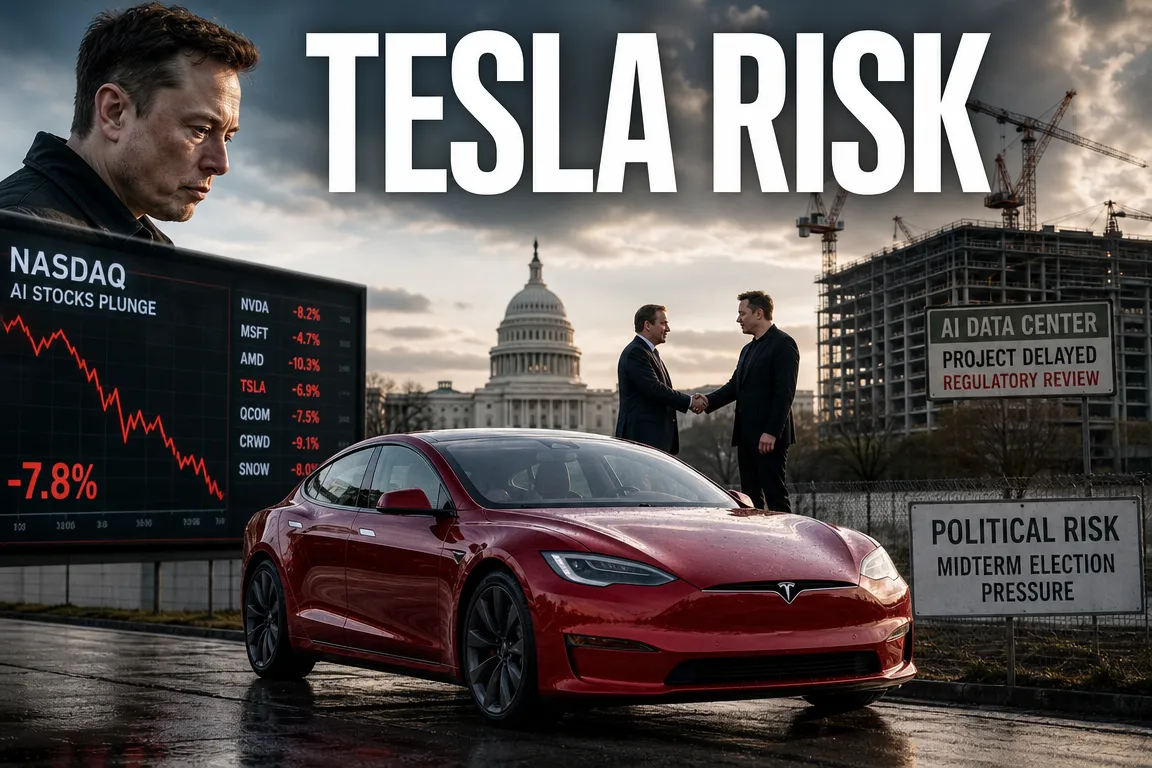
Tesla’s Share Price Decline, Musk’s Political Risk, and the Significance of a Senator-Elect’s Conciliatory Signal
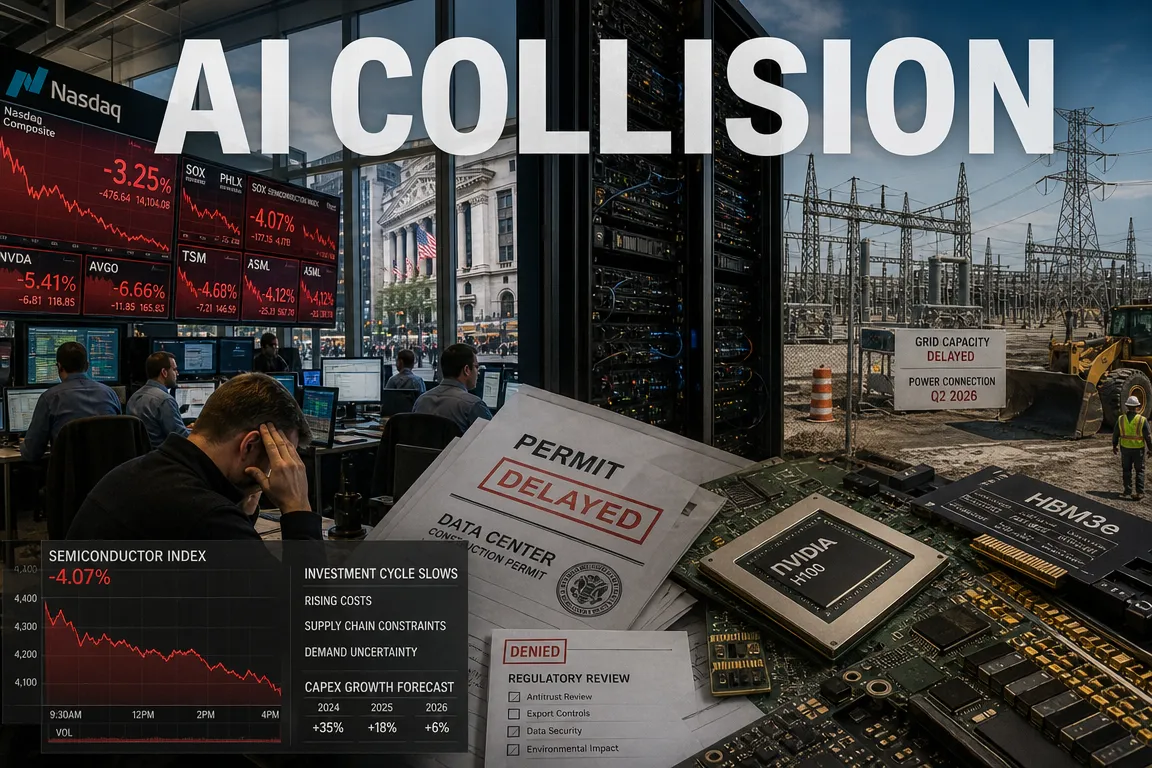
The central issue extends beyond Tesla’s share price decline.
Potential delays in AI data center permits, reduced political influence for Elon Musk, and weakening expectations surrounding Tesla and SpaceX have affected investor sentiment simultaneously.
However, a politician who clashed with Musk during the election stated a willingness to cooperate with all parties, providing an initial signal that regulatory conflict could shift toward practical negotiations.
Several claims in the source material appear inconsistent with publicly disclosed corporate structures or require independent verification.
This report therefore distinguishes verifiable facts from unconfirmed scenarios and focuses on the factors most relevant to Tesla shareholders.
1. Key Errors and Claims Requiring Verification
The description of SpaceX requires particular scrutiny.
The source presents SpaceX as if it were publicly listed and provides specific claims regarding its share price, quarterly results, data center leasing revenue, and a potential merger with Tesla.
These claims require confirmation through official corporate statements, U.S. Securities and Exchange Commission filings, and corroboration by major news organizations.
-
The reported SpaceX share price of $123.62 must be assessed to determine whether it refers to publicly traded shares or a private-market transaction.
-
The claim that Tesla is a current SpaceX shareholder requires confirmation through Tesla’s official disclosures.
-
The assertion that more than half of SpaceX’s revenue comes from AI computing rentals differs materially from its established launch and satellite communications business model.
-
The reported agreement under which Anthropic would pay SpaceX $45 billion over three years for data center capacity requires official confirmation from the parties involved.
-
The alleged formation of a special committee to evaluate a Tesla-SpaceX merger must be verified through Tesla board disclosures or SEC filings.
Specific figures do not establish factual accuracy.
Private-company valuations, merger speculation, AI contracts, and political financing are particularly vulnerable to unsupported narratives that may influence market expectations.
Tesla investors should treat these figures as unverified claims rather than use them directly in investment decisions.
2. Technology Investors Are Focused on the Pace of AI Investment
A relevant market concern is not the end of AI growth but a potential deceleration in its pace.
AI data center development requires land, construction permits, grid interconnection, water access, environmental reviews, and community approval.
Delays in any of these areas can postpone orders for semiconductors, transformers, generation equipment, cooling systems, and energy storage systems.
AI data center development connects the following supply-chain segments:
-
AI semiconductor companies such as Nvidia and AMD
-
Server and networking equipment suppliers
-
Power-generation equipment and transformer manufacturers
-
Utilities and renewable-energy developers
-
Cooling and water-treatment companies
-
Cloud and neocloud data center operators
-
Large-scale battery storage suppliers, including Tesla Energy
Delays in new data center permits may not affect current-quarter results immediately, but they can defer the recognition of future orders.
High-valuation technology stocks are sensitive not only to lost revenue but also to delayed revenue because their valuations depend heavily on the present value of future cash flows.
This dynamic is also relevant to the broader outlook for the Nasdaq.
3. A Data Center Moratorium Suspends New Permits Rather Than Closing Existing Facilities
A moratorium generally does not require operating data centers to close.
It typically suspends new development applications or construction permits while authorities reassess electricity demand and environmental effects.
Markets may fail to distinguish between these measures and sell related stocks broadly.
Even if a moratorium is introduced, it does not necessarily eliminate all AI investment.
Projects may move to other regions or resume after developers satisfy stricter power-supply requirements.
However, requiring companies to finance grid upgrades and community support programs can reduce project returns.
Investors should evaluate the following conditions rather than react solely to the term “moratorium”:
-
Whether the measure applies statewide or only to specific municipalities
-
Whether it covers only new projects or also facility expansions
-
Whether the suspension lasts for months or years
-
Whether facilities with on-site generation and energy storage qualify for exemptions
-
Whether developers can obtain approval by financing grid infrastructure
Claims that 45% of planned data center capacity could be affected are meaningful only when accompanied by clear scope and methodology.
4. Three Reasons Tesla Is Sensitive to AI Data Center Regulation
The first is Tesla’s energy business.
Data centers require reliable electricity, supporting potential demand for large-scale battery energy storage.
Tesla’s Megapack can support grid stability for power-intensive industrial facilities and utilities.
Data center delays would be more likely to postpone Megapack installations and revenue recognition than eliminate underlying demand.
The second is Tesla’s positioning as an AI company.
Tesla’s valuation reflects expectations for FSD, robotaxis, autonomous driving, Optimus, and proprietary AI infrastructure, in addition to vehicle deliveries.
If AI investment sentiment weakens, Tesla’s growth premium could contract independently of automotive performance.
The third is the market’s integrated assessment of Musk-affiliated companies.
Although Tesla, xAI, X, and SpaceX are legally separate entities, investors often assess them collectively through Musk’s financing capacity and political influence.
Regulatory or financing problems at one company may result in a broader “Musk risk discount” across affiliated businesses.
5. Why Tesla May Decline More Than the Broader Market
Tesla has historically exhibited greater volatility than the Nasdaq.
Its valuation depends heavily on growth expectations and options activity, while Musk’s public statements and political involvement can directly affect investor sentiment.
The following factors may amplify declines during market stress:
-
Risk-driven capital outflows from highly valued growth stocks
-
Forced liquidation by leveraged investors
-
Reduced call-option activity and changes in dealer positioning
-
Compression of the AI growth premium
-
Increasing political risk associated with Elon Musk
-
Unwinding of unverified merger expectations
A single-day decline should not be attributed exclusively to weaker vehicle demand.
It would also be an oversimplification to attribute the entire decline to data center regulation.
Interest rates, options positioning, profit-taking, semiconductor-sector selling, and political uncertainty may have contributed simultaneously.
6. The Effect of Musk’s Political Positioning on Corporate Value
The more strongly Musk supports a particular party or candidate, the greater the likelihood that election outcomes will translate into corporate risk.
A victory by favored candidates may support expectations for deregulation and expanded government contracts.
A victory by opposing candidates may increase concerns regarding hearings, investigations, contract reviews, and permitting delays.
For companies such as Tesla and SpaceX, which are materially affected by government policy, practical relationships with federal, state, and legislative authorities are more important than formal political neutrality.
Political contribution amounts and candidate-level election outcomes should be verified through public campaign finance databases.
Specific contribution and win-loss figures should not be treated as confirmed facts without independent verification.
7. Why a Willingness to “Work With Anyone” Is an Initial Conciliatory Signal
The most relevant political development is the reported willingness of a senator-elect opposed by Musk to cooperate after the election.
Although candidates may criticize the influence of billionaire political spending during campaigns, elected officials must also consider local employment and investment.
If Tesla or SpaceX provides substantial employment and infrastructure investment, political leaders may pursue negotiation while maintaining public criticism.
A statement expressing willingness to work with anyone does not indicate support for Musk’s political positions.
It more likely signals readiness to negotiate over corporate investment, employment, power infrastructure, and environmental costs.
A positive response from Musk could indicate that campaign conflict may transition into post-election negotiations.
However, the official’s election status, position, original statement, and Musk’s response require verification through official accounts and credible media interviews.
8. The Most Important Factors Often Overlooked
The principal issue is not party affiliation but who bears the cost of electricity infrastructure.
Community opposition to data centers is often driven by electricity prices, water consumption, noise, environmental burdens, and limited local employment benefits rather than political ideology.
Political resistance may ease if developers finance substations and transmission upgrades while preventing higher electricity costs for residents.
Conversely, permits may face opposition even in business-friendly jurisdictions if infrastructure and environmental costs are transferred to local communities.
Tesla shareholders should therefore focus less on partisan conflict and more on how much data center operators will pay for power infrastructure and how much equipment they will order from suppliers such as Tesla Energy.
The second key consideration is the distinction between canceled AI investment and geographic relocation.
If permitting is delayed in one jurisdiction, well-capitalized companies may relocate projects to states with greater power availability and less restrictive regulation.
National AI investment could remain intact even as the geographic distribution of beneficiaries changes.
The third consideration is that political reconciliation does not imply regulatory withdrawal.
Officials may cooperate with Musk while still demanding campaign finance restrictions, stricter environmental reviews, and greater corporate responsibility for power infrastructure costs.
9. SpaceX’s Telecommunications Expansion Scenario
The source claims that SpaceX is pursuing a nationwide U.S. mobile communications network combining satellites with terrestrial base stations.
If officially confirmed, this strategy could represent diversification beyond data center-related revenue.
A network using terrestrial infrastructure in urban areas and direct satellite communications in remote regions could reduce coverage gaps.
However, a nationwide mobile network would require substantial spectrum investment, base-station deployment, device compatibility, regulatory approval, and service-quality management.
Satellite communications offer broad geographic coverage, while terrestrial networks remain better suited to indoor service and high-capacity traffic in densely populated areas.
Satellite systems are therefore more likely to complement existing carriers or provide wholesale network services than immediately replace terrestrial operators.
The referenced equipment suppliers, spectrum agreements, and 2027 deployment schedule require separate verification through corporate announcements and Federal Communications Commission records.
10. Evaluating a Potential Tesla-SpaceX Merger
Merger speculation may be attractive to investors, but unconfirmed expectations should not be incorporated into valuation without supporting evidence.
A transaction would require company valuations, a share-exchange ratio, conflict-of-interest reviews, minority shareholder protections, government contract transfers, and national security assessments.
SpaceX’s government and defense-related contracts could make regulatory review more complex than for a conventional technology-sector merger.
A merger would not automatically benefit Tesla shareholders.
If SpaceX received a high valuation and Tesla issued substantial new equity, existing Tesla shareholders could face significant dilution.
The following official documents would be more important than merger speculation:
-
Formal approvals by both boards of directors
-
Disclosure of an independent special committee
-
Corporate valuation reports
-
The proposed share-exchange ratio
-
Regulatory filings
-
A shareholder approval timetable
Without such documentation, a merger should be treated as a hypothetical scenario rather than an investment thesis.
11. Developments Tesla Shareholders Should Monitor
The first is the implementation of policies by the new legislature and state governments.
Campaign commitments do not automatically become laws or executive actions.
Investors should monitor post-inauguration documents covering data center permits, grid costs, and environmental reviews.
The second is Tesla Energy’s order and revenue performance.
Megapack production, deployments, backlog, and energy-segment gross margin will indicate whether data center delays are affecting demand or revenue timing.
The third is Tesla’s AI capital expenditure.
Investors should assess whether the automotive and energy businesses generate sufficient cash to support rising spending on AI chips, computing infrastructure, and FSD training.
The fourth is transactions among Musk-affiliated companies.
Agreements involving Tesla, xAI, SpaceX, or other related entities may create conflicts of interest and concerns about transfers of shareholder value.
The fifth is the availability of official filings.
For mergers, major investments, and equity acquisitions, SEC filings should take precedence over social media statements.
12. Practical Scenarios for Tesla’s Share Price
Under an optimistic scenario, data center restrictions could evolve into conditional approvals rather than broad prohibitions.
If developers finance power infrastructure and expand energy storage, Tesla Energy could gain additional opportunities.
Practical negotiations between political authorities and Musk could also reduce part of the political risk discount.
Under a neutral scenario, AI investment may be delayed by 1-2 years rather than canceled.
The long-term growth thesis could remain intact, while near-term valuation and earnings expectations decline.
Under a pessimistic scenario, permitting delays, political investigations, slower AI investment, and weaker vehicle demand could occur simultaneously.
Tesla could then lose a substantial portion of the premium associated with its dual positioning as an automotive and AI company.
Ultimately, Tesla’s share price is more likely to be determined by official permit decisions, capital deployment, energy-segment performance, and cash flow than by short-term political headlines.
< Summary >
Tesla’s decline may reflect a combination of slower AI data center investment, political risk, and compression of its growth premium rather than automotive demand alone.
A conciliatory statement from a politician who opposed Musk during the election may indicate that regulatory conflict could shift toward practical negotiations.
However, claims concerning a SpaceX share price, data center revenue, an Anthropic contract, Tesla’s ownership interest, and a potential merger require confirmation through official sources.
The most important factors for Tesla shareholders are data center power costs, actual permitting policies, Megapack orders, related-party transactions, and official regulatory filings.
The central investment question is whether delays in AI spending represent temporary scheduling adjustments or a structural deceleration in growth.
[Related Articles…]
*Source: [ 오늘의 테슬라 뉴스 ]
– 머스크와 싸웠던 상원 당선인 “누구와도 일한다” — 폭락한 날 나온 첫 화해 신호, $[종가] 테슬라 주주는?
● Tech Shock, AI Rout, Market Panic
U.S. Stocks Plunge After Midterm Elections: Implications for AI Data Centers and Semiconductor Investment
The Nasdaq selloff cannot be attributed solely to the election outcome.
This report examines why the prospect of Democratic control of Congress raised concerns about AI regulation, when data center construction delays could affect semiconductor earnings, and how capital is shifting from equities to U.S. Treasuries.
It focuses on several underappreciated risks: declining free cash flow among hyperscalers, potential front-loading of AI investment, and practical data center constraints involving power grids and local opposition.
The market data and election results below are based on the source material provided.
If vote counting and certification remain incomplete in some districts, Democratic control of both chambers should be treated as a projection rather than a confirmed result. Official election authority and exchange data should be consulted.
1. What Happened in U.S. Equity Markets?
According to the source, all three major U.S. equity indexes fell sharply on the 5th, local time.
- Nasdaq Composite: Down 1,421.52 points, or 5.52%, to 24,315.00
- S&P 500: Down 334.89 points, or 4.36%, to 7,353.73
- Dow Jones Industrial Average: Down 1,833.06 points, or 3.44%, to 51,523.06
The Nasdaq was more than 10% below the high recorded in the previous month, prompting assessments that it had entered a technical correction.
A decline of at least 10% from a recent peak is generally classified as a correction, while a decline of at least 20% is considered a bear market.
However, a single-day selloff does not confirm a sustained downward trend.
Post-election position adjustments, elevated technology-sector valuations, caution ahead of employment data, algorithmic trading, and leveraged liquidations may also have contributed.
2. Why Did the Midterm Elections Affect AI Stocks?
The central concern was that Democratic control of Congress could result in tighter regulation and oversight of AI data centers.
New data center development requires more than buildings and servers. Key requirements include:
- Large-scale power supply and grid interconnection
- Water resources for cooling systems
- Local construction and environmental permits
- Community acceptance
- Negotiations over electricity rates and tax incentives
- Stable supplies of semiconductors and networking equipment
Stricter environmental reviews, electricity-use requirements, consumer power-rate protections, and privacy standards could delay construction and commissioning.
Markets may therefore be pricing in slower growth for suppliers of AI servers, GPUs, HBM, memory, and networking equipment.
3. A Democratic Sweep Would Not Automatically Halt AI Investment
An important distinction is required.
Even if Democrats secure both the Senate and the House in the midterm elections, the presidency does not change hands.
The result would represent a change in congressional control, while the president and executive branch would continue their existing terms.
It should therefore not be treated as equivalent to a unified government in which the presidency and Congress are controlled by the same party.
Congress can influence AI policy through legislation, budget approval, hearings, and oversight of regulatory agencies.
Actual policy outcomes, however, remain subject to presidential veto authority, executive enforcement, judicial review, and state permitting powers.
The election result therefore implies greater policy uncertainty and potential project delays, not a definitive suspension of AI investment.
4. The United States Is Unlikely to Abandon AI Competition with China
Tighter data center regulation would not necessarily indicate that the United States is abandoning its strategic AI competition with China.
There is broad bipartisan support for maintaining U.S. leadership in advanced semiconductors, generative AI, defense AI, and cloud computing.
The principal challenge is the conflict between national strategy and local interests.
Voters may support U.S. leadership in AI while opposing data centers and transmission infrastructure near their communities.
Electricity costs, noise, water consumption, environmental effects, and land prices directly affect local residents.
This resembles public support for essential infrastructure combined with opposition to its construction in a specific locality.
Such local resistance has become an important political variable in AI infrastructure expansion.
5. Why Political Support for Slower AI Development May Increase
Political parties respond not only to national strategy but also to elections and voter approval.
If opposition to data center development materially affects voting behavior, Democrats may have an incentive to maintain a more restrictive position through the 2028 presidential election.
Republicans may also find it difficult to focus exclusively on the need for additional data centers.
As voters experience higher electricity prices and living costs, policymakers may need to balance AI industry support with affordability concerns.
The policy debate is therefore likely to shift from whether data centers should be built to the following questions:
- Where should data centers be located?
- Should companies or residents bear the cost of grid expansion?
- How should nuclear power and renewable energy be combined?
- What compensation should host communities receive?
- Should the federal government intervene in local permitting delays?
6. Semiconductor Earnings and Share Prices May Diverge
Real-economy conditions and capital-market pricing should be evaluated separately.
Strong HBM and memory sales by Samsung Electronics and SK Hynix do not necessarily imply continued gains in their share prices.
Corporate earnings reflect existing supply contracts, shipment volumes, product prices, and production costs.
Share prices discount expected growth and earnings over multiple years.
Even with strong current earnings, stocks may decline if investors expect slower future data center investment.
Conversely, stocks may recover before earnings improve if regulatory conditions ease and demand expectations strengthen.
Semiconductor analysis should therefore include new orders, customer capital expenditure plans, inventories, long-term supply agreements, and utilization rates, rather than current exports alone.
7. Potential Impact on South Korean Semiconductor Companies
South Korean semiconductor exports are highly sensitive to server, smartphone, and industrial demand in the United States and China.
Demand for AI-server HBM and high-capacity DRAM is particularly dependent on data center investment by U.S. hyperscalers.
However, delays in U.S. data center construction would not immediately reduce the earnings of Samsung Electronics and SK Hynix.
Existing orders and long-term supply agreements remain in place, while semiconductor production and server installation involve material lead times.
The effects would likely emerge in the following sequence:
- Hyperscalers reassess new data center projects.
- Growth in server and networking equipment orders slows.
- GPU and AI accelerator orders are adjusted.
- Incremental orders for HBM and high-performance memory decelerate.
- Semiconductor pricing and supplier bargaining power weaken.
Share prices may react immediately, while the effect on revenue and operating profit may take several quarters to emerge.
This timing gap is critical when connecting the U.S. equity outlook with semiconductor export forecasts.
8. Hyperscaler Cash Flow Is a Key Risk Indicator
Revenue and net income alone are insufficient for assessing the sustainability of AI investment.
A more relevant indicator is free cash flow, calculated as the difference between operating cash flow and capital expenditure.
Free cash flow = Operating cash flow – Capital expenditure
Hyperscalers such as Alphabet, Microsoft, Amazon, and Meta are committing substantial capital to AI servers and data centers.
Even if revenue reaches record levels, free cash flow may decline when capital expenditure grows more rapidly.
The source states that free cash flow at some companies has deteriorated significantly.
Any reported free cash flow deficit and its magnitude should be verified through official corporate cash flow statements.
Lower free cash flow does not automatically imply an investment halt.
Large technology companies can continue investing through cash reserves, bond issuance, bank loans, project financing, and data center lease arrangements.
However, greater reliance on debt introduces additional risks through higher interest expenses and wider credit spreads.
9. Front-Loaded Third-Quarter AI Investment Could Create a Subsequent Gap
The source suggests that U.S. data center capital expenditure may have been concentrated in the third quarter.
If companies brought forward spending originally planned for the fourth quarter or the following year, third-quarter U.S. GDP could appear stronger than expected.
Subsequent quarters could then experience slower investment growth.
The claim that the government deliberately accelerated private-sector capital expenditure to support GDP requires additional evidence.
Investment timing may instead reflect expiring tax incentives, semiconductor delivery schedules, power connection dates, year-end budget execution, or customer demand.
The pace of quarterly spending is more relevant than the headline investment total.
Technology stocks may correct if AI capital expenditure continues to rise but grows more slowly than markets expect.
10. Why Equity Prices and Treasury Yields Declined Together
According to the source, investors sold equities and purchased U.S. Treasuries during the market decline.
Treasury prices and yields move inversely.
When demand for Treasuries increases, prices rise and yields fall.
Concurrent declines in equities and U.S. Treasury yields can therefore indicate risk aversion.
Investors may have shifted toward government bonds in response to concerns about slower growth and technology-sector volatility.
Over time, however, lower Treasury yields may support growth stocks by reducing the discount rate applied to future earnings.
The reason for the yield decline remains critical:
- Lower yields driven by easing inflation: Potentially positive for technology stocks
- Lower yields driven by recession concerns: Potentially negative for corporate earnings
- Lower yields driven by short-term risk aversion: Potentially reversible as markets stabilize
11. Key Issues Receiving Less Market Attention
First, data center regulation is more likely to change the location and timing of AI investment than eliminate demand.
If projects are delayed in highly regulated states, investment may shift to regions with greater access to electricity and water.
Sites capable of securing immediate grid connections may become as strategically important as GPU availability.
Second, the principal AI infrastructure bottleneck is shifting from semiconductors to power infrastructure.
Data centers cannot operate without substations, transmission lines, and generation capacity, even when GPUs are available.
This supports demand for electrical equipment, transformers, cooling systems, nuclear power, natural gas generation, and energy storage.
Third, actual cash expenditure is more informative than AI investment announcements.
Investment plans can be revised, while capital expenditure, advance payments, and lease liabilities provide clearer evidence of implementation.
Fourth, local permitting may create a larger bottleneck than federal regulation.
Federal support for AI development cannot prevent delays caused by local electricity, environmental, and water approvals.
Fifth, the AI industry may be entering an investment-efficiency validation phase rather than a broad contraction.
Markets are likely to focus increasingly on the revenue and cash flow generated by AI investment rather than total announced spending.
12. Key Indicators to Monitor
- U.S. employment data and the unemployment rate
- Consumer prices and core inflation
- Federal Reserve policy-rate projections
- U.S. 10-year Treasury yield
- Quarterly hyperscaler capital expenditure
- Operating cash flow and free cash flow
- Data center grid-connection waiting periods
- AI server and GPU order cancellations
- HBM pricing and long-term supply agreements
- U.S. congressional legislation concerning AI, power, and the environment
For the global economic outlook, investors should distinguish between declining yields driven by stable employment and easing inflation and those caused by recession concerns.
For AI data center investment, actual construction, grid connection, equipment delivery, and commissioning dates are more relevant than announced investment totals.
13. Three Potential Market Scenarios
Scenario 1. Regulatory concerns remain political rhetoric
If no material legislation is enacted and permitting does not stop, technology stocks could rebound after an excessive selloff.
Scenario 2. Data center permitting is materially delayed
Power equipment and construction schedules could be postponed, followed by slower growth in incremental orders for AI servers and semiconductors.
Scenario 3. Federal policy is adjusted to support strategic AI objectives
Rather than stopping, data center investment could shift toward regions with nuclear power and adequate grid infrastructure, changing the composition of industry beneficiaries.
A restructuring of investment timing, location, and financing appears more plausible than a broad collapse of the AI industry.
< Summary >
- According to the source, the Nasdaq declined 5.52%, the S&P 500 fell 4.36%, and the Dow dropped 3.44%.
- The prospect of Democratic control of Congress increased concerns about AI regulation and data center construction delays.
- The midterm election does not change the presidency or automatically halt AI investment.
- National AI strategy is increasingly conflicting with local concerns over electricity costs and environmental impacts.
- Semiconductor stocks may decline before earnings weaken if future growth expectations deteriorate.
- Rising hyperscaler capital expenditure and declining free cash flow are key risk factors.
- Power grids, permitting, water resources, and financing may become more important constraints than semiconductor supply.
- Concurrent equity selling and Treasury purchases indicate stronger risk aversion.
- A realignment of AI investment timing, location, and efficiency is more likely than an industry-wide collapse.
The market decline cannot be explained by a single political event.
Election outcomes, corporate cash flow, Treasury yields, employment data, and data center permitting should be assessed collectively.
This material is provided for informational purposes only and does not constitute a recommendation to buy or sell any security or financial product.
[Related Articles…]
*Source: [ 경제 읽어주는 남자(김광석TV) ]
– 블랙 프라이데이. 중간선거 후폭풍 [즉시분석]