● AI-Bubble-Bust
The Truth Behind the AI Stock Collapse Narrative: Citrini’s Warning on the Shifting AI Infrastructure Investment Cycle
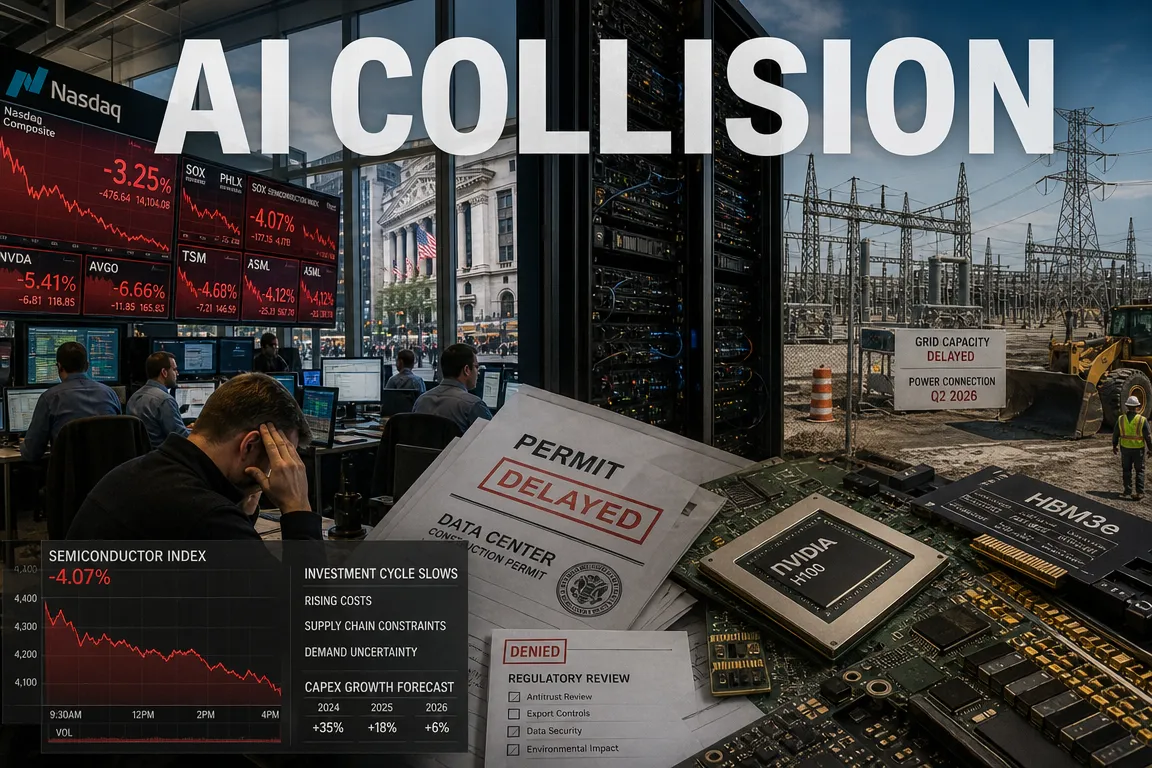
The recent decline in AI stocks does not indicate the end of the AI industry.
The more significant development is that markets are beginning to assess investment recovery, financing capacity, and data center completion risk rather than focusing solely on AI usage growth.
This report examines the gap between AI capital expenditure and revenue, potential data center loan impairments, AI model price competition, risks embedded in Big Tech backlogs, and the role of forced hedge fund liquidations in amplifying market volatility.
AI investing is entering a more selective phase. Investors should evaluate cash flow, balance-sheet strength, customer creditworthiness, and valuation rather than relying primarily on headline growth.
Several claims require independent verification.
The source material includes market decline figures, U.S. election outcomes, individual data center project suspensions, and estimates concerning Anthropic’s IPO timing and valuation. These items are therefore presented as elements of Citrini Research’s investment thesis and market scenario rather than as confirmed facts.
1. The Central Message of the AI Stock Sell-Off
Citrini Research’s argument can be summarized as follows: “AI is not over, but the AI trade as previously understood may be ending.”
The AI trade refers to buying highly valued companies primarily on expectations of continued AI infrastructure expansion, with limited regard for earnings or cash flow.
- AI usage may continue to increase.
- Enterprise AI adoption is likely to expand over the long term.
- AI-related spending is unlikely to disappear abruptly.
- However, growth in AI capital expenditure may be approaching a peak.
- Returns on investment will become more important than total spending.
Markets evaluate not only absolute growth but also changes in expected growth rates. A company can report higher revenue and still experience a share-price decline if growth decelerates relative to expectations.
The recent correction in AI stocks is therefore more appropriately viewed as a reassessment of valuations and expected growth than as an industry collapse.
2. The Gap Between AI Capital Expenditure and Revenue
AI data centers require GPUs and networking equipment, as well as land, power-grid capacity, cooling systems, generation equipment, and construction labor.
The source estimates that annual AI-related capital expenditure by major technology companies is approaching $1 trillion, while annualized revenue across the AI ecosystem is approximately $200 billion.
These figures vary significantly depending on methodology. The key issue is that investment is expanding faster than monetization.
At least one of the following conditions would be required to justify current investment levels:
- AI revenue must grow substantially faster than expected.
- Data center investment growth must moderate.
- Operating costs, including GPU and electricity expenses, must decline materially.
- AI service pricing and profitability must stabilize.
- Enterprise customers must move from experimentation to large-scale commercialization.
AI model prices continue to decline, while capital expenditure remains elevated. If revenue faces pricing pressure while power and construction costs rise, industry growth may not translate into adequate investor returns.
3. Why the Peak in Investment Growth Matters
Equity markets focus on the direction of growth rather than its absolute level.
If capital expenditure rises from 100 to 150 and then to 180, total spending continues to increase, but the growth rate declines from 50% to 20%.
Under these conditions, data center equipment companies may continue to report revenue growth while experiencing lower price-to-earnings and price-to-sales multiples.
Highly valued AI infrastructure companies already reflect expectations of sustained rapid growth. Even a modest reduction in growth forecasts can produce significant share-price volatility.
- Companies driven primarily by high-growth expectations may experience greater volatility.
- Order growth and forward guidance may become more important than reported revenue.
- Companies with weak operating cash flow will be more vulnerable to higher financing costs.
- Companies with strong customers and long-term contracts may receive valuation premiums.
- Investment recovery periods will matter more than AI-related branding.
4. Why a Large Backlog May Not Provide Sufficient Protection
RPO, or Remaining Performance Obligations, represents contracted amounts that have not yet been recognized as revenue.
It is generally viewed as a measure of potential future revenue.
The source states that RPO growth among AI-related companies has slowed to one of its lowest levels in recent years.
Slower RPO growth may indicate a deceleration in new AI project activity.
However, backlog size alone can be misleading. If customers have weak financial positions or contractual cancellation rights, reported backlog may not convert into cash.
Large computing commitments from frontier AI companies and neocloud providers may carry elevated risk if those customers cannot generate sufficient revenue or secure additional financing.
Investors should evaluate backlog quality rather than backlog size alone.
- Identify the underlying customers.
- Review contractual cancellation provisions.
- Assess prepayments and collateral.
- Determine whether Big Tech guarantees are available.
- Distinguish contract duration from the timing of revenue recognition.
5. The Core Question Has Shifted from Demand to Financing
The previous market question was whether meaningful AI demand existed.
AI demand has become more visible, but a new issue has emerged.
The principal question is whether the industry can continue financing the required investment.
Even the largest technology companies may be unable or unwilling to fund all data center investment entirely through internal cash flow.
External financing may include corporate bonds, project finance, equity issuance, joint ventures, and private credit.
- Higher corporate bond issuance absorbs market demand for credit.
- Equity issuance may dilute existing shareholders.
- Higher interest rates reduce data center investment returns.
- Credit-rating downgrades increase refinancing costs.
- Multiple large IPOs may divert equity-market liquidity.
These developments may affect both U.S. equities and markets with substantial semiconductor and electrical-equipment exposure.
Investors assessing Korean equities should monitor not only total AI capital expenditure by U.S. technology companies but also spending growth and financing costs.
6. Data Center Bottlenecks Can Become Credit Risks
Power shortages and construction delays have often been interpreted as evidence of strong data center demand.
However, the risk profile changes if projects cannot be completed.
Data center developments frequently use short-term construction loans that are refinanced with long-term loans or bonds after completion.
If construction is delayed, the project may face takeout risk, meaning it cannot transition to permanent financing.
A failure to complete the project and repay construction financing may result in a completion default.
- Delayed power-grid connections
- Shortages of gas turbines and transformers
- Limited construction labor and critical materials
- Higher construction and financing costs
- Environmental permitting delays and local opposition
- Political restrictions related to electricity prices
- Customer contract changes or cancellations before completion
Banks and private credit funds providing short-term financing may face the earliest losses when projects are suspended.
Neocloud companies and independent data center projects without Big Tech guarantees may face significantly higher interest rates or lose access to new financing.
Data center investment should therefore not be assumed to translate directly into semiconductor and power-equipment revenue.
7. Policy and Local Opposition May Reduce Data Center Returns
Data centers consume substantial electricity and water, making them sensitive to local political and regulatory conditions.
Local governments may impose conditions without prohibiting development outright.
- Securing renewable energy or dedicated generation capacity
- Funding power-grid expansion
- Preventing increases in residential electricity costs
- Increasing local employment and tax contributions
- Reducing water consumption and carbon emissions
These requirements may provide public safeguards but represent additional costs for developers.
Higher regulatory expenses, combined with rising financing and construction costs, can reduce project-level internal rates of return.
Claims regarding specific state elections, moratoriums, and individual project suspensions require verification through official sources.
8. AI Model Price Competition and Commoditization Risk
AI model providers face pressure to respond when competitors reduce prices.
As model performance converges, customers increasingly compare token prices, response speeds, security, and cloud integration rather than relying solely on brand recognition.
Improving open-source and Chinese AI models may further intensify pricing competition.
- Token prices decline.
- Revenue generated from a given level of usage decreases.
- Customers increase their use of multiple models.
- Individual model providers lose pricing power.
- Inference-cost efficiency becomes a critical competitive advantage.
Even rapid usage growth may not produce expected revenue growth if unit prices decline more quickly.
AI models are unlikely to become fully interchangeable, but commoditization may emerge in general-purpose services, resembling the early price competition seen in railways and telecommunications.
The long-term winners may not be the companies operating the largest models, but those capable of generating stable cash flow at low cost.
9. Why Anthropic and OpenAI Matter to the Broader AI Backlog
The source argues that large computing commitments from Anthropic and OpenAI may represent a significant share of the reported backlogs of major technology and cloud companies.
If these frontier model companies sustain rapid revenue growth and secure stable financing, their commitments are more likely to convert into recognized revenue.
If price competition weakens profitability or financing becomes less available, the reliability of those commitments may decline.
Risk therefore extends beyond individual model providers.
Model-company financing → cloud contracts → data center construction → GPU and power-equipment orders
Disruption at one stage may affect the entire chain.
The source also discusses market speculation concerning Anthropic’s potential IPO, valuation, and offering size.
Specific IPO schedules, valuations, and annualized revenue estimates should not be treated as confirmed without regulatory filings or official company disclosures.
- Reported revenue and revenue growth
- Gross margin and inference costs
- Operating cash flow
- Minimum cloud-service payment obligations
- Customer concentration
- Stock-based compensation
- Additional financing requirements
10. SoftBank and Stargate-Related Claims Require Verification
The source references social-media claims concerning attempted sales of large data center loans and possible nonperformance under SoftBank turbine contracts.
However, the identity of the alleged loan seller and whether SoftBank failed to meet contractual obligations remain unverified.
In volatile markets, unverified information can circulate faster than confirmed facts.
Statements from prominent individuals should not be treated as equivalent to regulatory filings or announcements from contractual parties.
- Facts officially disclosed by companies
- Information confirmed by reputable media through multiple sources
- Speculation and rumors distributed through social media
11. Stagflation Risk and AI Equities
Citrini characterizes the current economic environment as a late-cycle phase.
According to the source, several asset classes are showing characteristics associated with slowing growth and persistent inflation.
Stagflation would create a challenging environment for AI growth stocks.
- Economic weakness may constrain corporate IT spending.
- Persistent inflation may limit central-bank rate cuts.
- Higher interest rates reduce the present value of future earnings.
- Rising power and construction costs weaken data center profitability.
- Wider credit spreads increase project financing costs.
However, indiscriminately buying defensive and consumer-staples stocks after substantial gains may also carry risk.
If positioning becomes crowded, heavily sold AI momentum stocks may experience short-term rebounds.
In an uncertain global environment, investors should assess valuation, earnings, and positioning rather than relying solely on sector classifications.
12. How Forced Hedge Fund Liquidations Amplify Declines
Market volatility may reflect forced risk reduction rather than a sudden change in investors’ fundamental views.
Some hedge funds impose strict loss limits on portfolio managers.
When losses exceed predefined thresholds, managers may be required to sell positions or reduce capital exposure regardless of their investment outlook.
- Highly valued AI stocks decline.
- Loss limits and margin requirements are triggered.
- Forced selling begins.
- Prices decline further.
- Stop-loss selling and redemptions spread to other funds.
During liquidation events, both strong and weak companies may decline simultaneously.
Once forced selling ends, prices may rebound rapidly without a corresponding improvement in fundamentals.
Rapid information flows, mobile trading, and algorithmic execution have accelerated this process relative to previous market cycles.
13. Is the Current Decline More Similar to 1998 or the Early 2000s?
A central question is whether the correction resembles the 1998 liquidity shock that preceded a final market rally or the prolonged repricing associated with the dot-com collapse.
In 1998, systemic concerns involving large financial institutions and hedge funds led to policy intervention, followed by renewed strength in technology stocks.
During the dot-com collapse, business models and valuations were fundamentally reassessed, producing an extended correction.
- Actual defaults among major data center projects
- Losses incurred by banks and private credit markets
- The potential for Federal Reserve liquidity support
- AI service revenue growth relative to price declines
- Big Tech capital expenditure guidance
- Corporate credit spreads and refinancing conditions
If the issue is a temporary financial-system liquidity shortage, policy intervention could support a recovery.
If AI revenue and cash flow fail to justify investment expectations over an extended period, the correction may not remain a temporary liquidity event.
14. Key Issues Often Overlooked in Market Coverage
First, the principal AI bottleneck is shifting from GPUs to capital.
The ability to finance projects through completion is becoming more important than access to chips alone.
Second, backlog value depends on customer credit quality.
Even large contracts with prominent AI startups may lose economic value if those customers cannot continue raising capital.
Third, power shortages are not unconditionally positive.
Delayed grid connections can prevent project completion and refinancing, turning infrastructure constraints into credit risk.
Fourth, lower AI prices can separate usage growth from revenue growth.
If token prices decline faster than usage expands, revenue and earnings may underperform expectations.
Fifth, the next AI market leaders may not be the most aggressive investors.
Companies with low capital costs, substantial cash reserves, long-term customer contracts, and stable margins may be better positioned.
Sixth, U.S. customer financing capacity may matter more than headline AI demand for Korean equities.
Even if Korean semiconductor and power-equipment suppliers report strong orders, U.S. data center refinancing constraints could slow future procurement.
15. Criteria for Selecting AI Stocks
Investors should assess AI-related companies using the following criteria rather than relying on thematic exposure alone.
- Cash flow: Determine whether accounting earnings translate into operating cash generation.
- Financing capacity: Assess whether investment can continue without excessive bond or equity issuance.
- Customer quality: Evaluate counterparty creditworthiness and customer concentration.
- Investment recovery period: Estimate how quickly data center and equipment investments can generate cash returns.
- Pricing power: Determine whether margins can withstand competitor price reductions.
- Valuation: Assess whether the current share price remains reasonable under slower growth assumptions.
- Debt maturity profile: Review short-term borrowings and future refinancing schedules.
- Guarantees: Verify whether projects carry guarantees from Big Tech companies or other high-quality customers.
These criteria help distinguish the different risk profiles of AI semiconductor, cloud, data center, and power-infrastructure companies.
< Summary >
The AI industry and AI usage are not ending.
However, as AI capital expenditure growth approaches a potential peak, high-beta momentum strategies may become less effective.
The principal risks include capital expenditure growing faster than AI revenue, data center completion delays, refinancing failures, and model price competition.
Investors should evaluate customer creditworthiness and contract quality rather than relying solely on reported backlog.
Forced hedge fund liquidations may amplify both short-term declines and subsequent rebounds.
The basis for AI investment is shifting from growth expectations toward cash flow, financing capacity, profitability, and valuation.
[Related Articles…]
*Source: [ 내일은 투자왕 – 김단테 ]
– AI 주식 멸망 (ft. 시트리니)
● Stock-Market-Rule-Shock
From KRW 200 Million to KRW 3 Billion: Rebuilding Investment Principles After an 80% Loss
More important than growing KRW 200 million into KRW 3 billion over five years was the 80% investment loss that preceded the recovery.
This case illustrates why relying solely on external stock recommendations can eliminate disciplined exit criteria, how an investment journal can help control fear and greed, and what investors should assess before holding a high-quality company for the long term.
It also examines commonly overlooked risks involving bonus share issues, liquidity constraints in unlisted and thinly traded stocks, and concentrated portfolios.
Key Development | The Conditions Behind Growth from KRW 200 Million to KRW 3 Billion
Author Choi Seo-yeon stated that she experienced repeated failures and losses over approximately 20 years before shifting to a strategy focused on holding high-quality companies for extended periods.
She reported that assets of approximately KRW 200 million grew to around KRW 3 billion over five years.
Growing KRW 200 million into KRW 3 billion represents a 15-fold increase in principal.
Assuming no additional contributions or withdrawals, the implied compound annual growth rate is approximately 72%.
This is an exceptionally high return that most individual investors would find difficult to replicate consistently.
The case should therefore not be interpreted as a formula that can be reproduced by following a particular stock selection or investment method.
Because details regarding additional capital, taxes, currency effects, position sizes, and the distinction between realized and unrealized gains were not disclosed, the primary focus should be the evolution of the investment framework rather than the headline return.
First Major Failure | Buying a KONEX Stock Based on Another Investor’s Success
The largest loss occurred approximately 10 years ago through an investment in a thinly traded company listed on KONEX.
At the time, the desire to generate rapid gains took priority over investment principles and security-selection criteria.
The primary basis for the purchase was a news article reporting that a well-known individual investor had acquired shares in the company.
Instead of independently examining the business model, financial condition, listing prospects, and fair value, the investment relied on another investor’s decision.
The share price subsequently declined by 30%, 40%, and 50%, eventually producing an 80% loss.
Delays in the expected transfer to the KOSDAQ market further weakened the original investment thesis.
The Primary Risk of an 80% Loss Was Illiquidity
The most important issue was not only the magnitude of the price decline.
Even when the investor was prepared to realize the loss, there were insufficient buyers at the quoted price.
A displayed market price does not guarantee that a low-volume security can be converted into cash at the desired time or price.
This is liquidity risk.
Unlike large-cap stocks, KONEX-listed companies, unlisted shares, and small-cap stocks may have wide bid-ask spreads and limited transaction execution.
Investors should assess not only potential returns but also daily trading value, average volume, order-book depth, controlling shareholder ownership, and lock-up restrictions.
The quoted market value of an illiquid asset may differ materially from the cash that can actually be realized.
Recovering from an 80% Loss Requires a 400% Gain
Losses and the returns required to recover principal are not symmetrical.
- A 10% loss requires an approximately 11.1% gain to recover the principal.
- A 30% loss requires an approximately 42.9% gain.
- A 50% loss requires a 100% gain.
- An 80% loss requires a 400% gain.
If KRW 1 million declines by 80%, only KRW 200,000 remains.
Returning from KRW 200,000 to KRW 1 million requires a fivefold increase, equivalent to a 400% gain.
Avoiding severe losses is therefore as important to portfolio management as generating high returns.
Holding a declining investment without reassessing the underlying thesis may represent deferred decision-making rather than long-term investing.
Bonus Shares Do Not Create Free Returns
The investor initially viewed a bonus share issue as equivalent to receiving an additional product at no cost.
The assumption was that receiving more shares would proportionally increase the value of the investment.
In practice, a bonus issue is an accounting transaction in which retained capital reserves are transferred to paid-in capital and new shares are distributed proportionally to existing shareholders.
The number of shares increases, but the theoretical price per share declines through the ex-rights adjustment.
For example, if an investor owns one share priced at KRW 100,000 and receives one additional share through a 100% bonus issue, the investor will hold two shares, but the theoretical price will adjust to approximately KRW 50,000 per share.
No new cash enters the company, and its competitive position does not improve automatically.
A bonus issue may affect short-term trading volume and investor sentiment, but it does not independently increase enterprise value.
Following a Recommendation Also Outsources the Exit Decision
The main risk of buying a stock based on an expert or acquaintance’s recommendation often emerges after the initial purchase.
Equity investing does not consist solely of one purchase and one sale.
Each day of ownership represents a continuing capital allocation decision.
Investors must repeatedly determine whether to add to a declining position, exit when the thesis deteriorates, or realize part of a gain after an increase.
Without a clear understanding of the original purchase rationale, investors cannot determine which developments are material or when the position should be sold.
This can result in buying more during price increases because of greed and selling at unfavorable levels during declines because of fear.
External opinions may provide research ideas, but the final investment thesis should be explainable in the investor’s own terms.
Investment Journal | Analyze Investor Behavior Before Selecting New Stocks
A practical response to recurring losses is not another stock recommendation but a disciplined investment record.
An investment journal does not require technical or sophisticated language.
If a stock was purchased because of a favorable online video or a personal recommendation, that reason should be recorded accurately.
The purpose is to reconstruct the actual decision-making process rather than rationalize it after the outcome is known.
Memory is often revised in response to subsequent results.
When a stock rises, investors may attribute the outcome to analytical skill; when it falls, they may transfer responsibility to the person who made the recommendation.
Recording the original rationale can reduce outcome bias and retrospective distortion.
Required Elements of a Practical Investment Journal
- Purchase rationale
Summarize the primary reason for owning the company in one sentence. - Supporting evidence
Record verifiable indicators such as revenue growth, operating profit, market share, and customer growth. - Reason for selecting the company over alternatives
Identify the company’s advantages relative to industry competitors. - Expected holding period
Distinguish between a short-term event-driven position and a long-term investment of five years or more. - Conditions that would invalidate the thesis
Define exit criteria in advance, including weaker results, the loss of a major customer, or rising debt. - Conditions for increasing the position
Determine whether valuation has become more attractive relative to intrinsic value rather than relying solely on a lower share price. - Emotional state
Assign scores to urgency, confidence, anxiety, fear, and greed. - Post-investment review
Evaluate whether the decision was reasonable based on the information available at the time, rather than solely on the result.
Accumulated records can reveal recurring behavioral patterns across different investments.
Investors can identify whether they repeatedly chase stocks after sharp gains, realize small profits too quickly, or retain loss-making positions for excessive periods.
Assess a High-Quality Company as Carefully as a Long-Term Relationship
Choi compared selecting a high-quality company with choosing a reliable long-term associate.
The relevant question is whether the business remains credible enough to retain during a significant share-price decline.
This requires separating movements in the share price from developments in the underlying business.
If the price declines because of a broad market correction or temporary external shock while business fundamentals remain intact, the decline may present a long-term opportunity.
However, continued ownership becomes risky when the core business deteriorates and competitive advantages weaken.
Assessing business quality requires clear answers to the following questions:
- What products and services does the company sell, and who are its customers?
- Will customers continue paying for those products and services in five or 10 years?
- Are revenue and cash flow growing on a sustainable basis?
- Does the company possess technology, intellectual property, or brand strength that competitors cannot easily replicate?
- Are management’s long-term interests aligned with those of shareholders?
- Are debt issuance and new equity issuance diluting existing shareholder value?
- Does the current valuation already reflect excessive expectations for business quality?
A high-quality company is not necessarily an attractive stock at every price.
Even an exceptional business may produce weak long-term returns if purchased at an excessive valuation.
Concentrated Investment in Two or Three Companies
The case suggests that deeper knowledge of two or three companies generated better results than a superficial understanding of 10 companies.
The principle is to prioritize sustained research on understandable businesses rather than increasing the number of holdings without sufficient analysis.
A smaller portfolio allows closer monitoring of financial results, industry developments, competitive conditions, and management’s capital allocation.
However, concentration increases both potential returns and downside risk.
Accounting problems, regulatory changes, or the loss of technological competitiveness at a single company can materially affect the entire portfolio.
A concentrated strategy therefore requires both company-specific analytical capability and an asset allocation framework that limits intolerable losses.
Investing emergency reserves and essential living funds in a single security eliminates the financial buffer required to sustain a long-term strategy.
The Same Principles Apply to AI Investing
Growth in generative AI and the semiconductor industry has increased investor interest in Nvidia and other AI-related companies.
However, investors holding the same stock will not necessarily generate the same return.
Some investors may hold the position based on an analysis of long-term AI infrastructure demand, while others may trade in response to price momentum, fear, and greed.
AI investors should distinguish between industry growth and the profitability of individual companies.
Even if the broader industry expands, company-level returns may vary because of intensifying competition, elevated valuations, customer development of proprietary chips, regulation, and supply-chain changes.
Macroeconomic forecasts and AI trends should be assessed alongside revenue growth, margins, cash flow, market position, and current valuation.
Key Issues Often Overlooked in Financial Media and Online Content
First, the increase from KRW 200 million to KRW 3 billion may be subject to survivorship bias.
Successful concentrated investment cases receive substantial attention, while comparable strategies that produced large losses are less visible.
Second, long-term investing is a process for managing an investment thesis, not merely an extended holding period.
Holding a weak company for a long period does not improve its fundamentals or expected return.
Third, an exit decision should be based on deterioration in the investment thesis rather than the percentage loss alone.
A 30% decline may present an opportunity if competitive advantages remain intact, while a 5% decline may require reassessment if the core thesis has been invalidated.
Fourth, the primary purpose of an investment journal is to measure decision quality, not merely portfolio returns.
A sound decision may produce a loss because of external market factors, while a weak decision may generate a gain through favorable circumstances.
Fifth, asset value should incorporate practical liquidity and exit capacity.
The reported value of a thinly traded position may differ materially from the cash available after liquidation.
Seven Investment Principles for Individual Investors
- Use external recommendations only as research ideas, not as sufficient grounds for a purchase.
- Define exit criteria and the conditions that would invalidate the investment thesis before buying.
- Assess liquidity, debt, and valuation alongside business growth.
- Do not interpret bonus issues or stock splits as automatic increases in enterprise value.
- Record the rationale and emotional state associated with both gains and losses.
- View long-term investing as continuous monitoring of business developments, not passive holding under all conditions.
- Even when using a concentrated strategy, separate emergency reserves and essential living funds from investment capital.
< Summary >
The central lesson is not the increase from KRW 200 million to KRW 3 billion, but the change in investment discipline following an 80% loss.
Investors who purchase securities based on external recommendations may also lose control over subsequent buying and selling decisions.
An 80% loss requires a 400% gain to recover the original principal, while insufficient trading volume may prevent an exit even when the investor is prepared to realize the loss.
A bonus share issue increases the number of shares but does not automatically increase enterprise value.
An investment journal should document the purchase rationale, supporting evidence, emotional state, and exit conditions to identify recurring decision-making errors.
Long-term investment in high-quality companies requires analysis of both business competitiveness and valuation, while concentrated portfolios require explicit risk controls.
This article is an informational reconstruction of publicly available discussions and does not constitute a recommendation to buy or sell any security.
[Related Articles…]
*Source: [ 경제 읽어주는 남자(김광석TV) ]
– 2억이 30억 됐다…마이너스 80%에서 배운 투자 원칙 | 경읽남과 토론합시다 | 최서연 작가