● AI, Surge, Rebound
CoreWeave Surges 24% as Anthropic IPO Expectations Rise: Has a Sustainable Recovery in AI Stocks Begun?
The most important factors behind this rebound extend beyond CoreWeave’s revenue growth and expectations surrounding a potential Anthropic IPO.
Investors must also assess CoreWeave’s shift from expensive unsecured debt toward financing backed by GPUs and customer contracts, the possibility that AI demand has been counted multiple times, and the gap between interest in AI agents and actual transaction conversion.
Investor sentiment toward AI semiconductor and neocloud stocks has clearly improved. However, debt, power availability, customer concentration, and cash flow remain key issues that must be resolved before the move can be classified as a sustainable recovery.
1. Market Conditions: Nasdaq Rises 2% as AI Stocks Lead the Rebound
The Nasdaq gained approximately 2%, while KOSPI overnight futures rose about 3.39%, indicating a rapid recovery in risk appetite.
Nvidia rebounded approximately 4.5% after earlier controversy and selling pressure.
Broadcom and AMD also advanced, suggesting that the recovery extended beyond Nvidia. Micron may have been the company identified as rising approximately 13%.
Semiconductor, software, and AI infrastructure stocks moved higher together, easing some concerns about the broader generative AI industry.
Two factors primarily drove the advance:
- CoreWeave’s results and financing plans exceeded market expectations.
- Prospects for an Anthropic IPO and strong investor demand gained attention.
The technology-sector rebound also has implications for the global economic outlook. The US equity market is increasingly shifting from a focus on interest rates alone toward AI infrastructure revenue growth, financing capacity, and cash-flow generation.
2. CoreWeave Shares Surge 24%: Why the Market Responded Positively
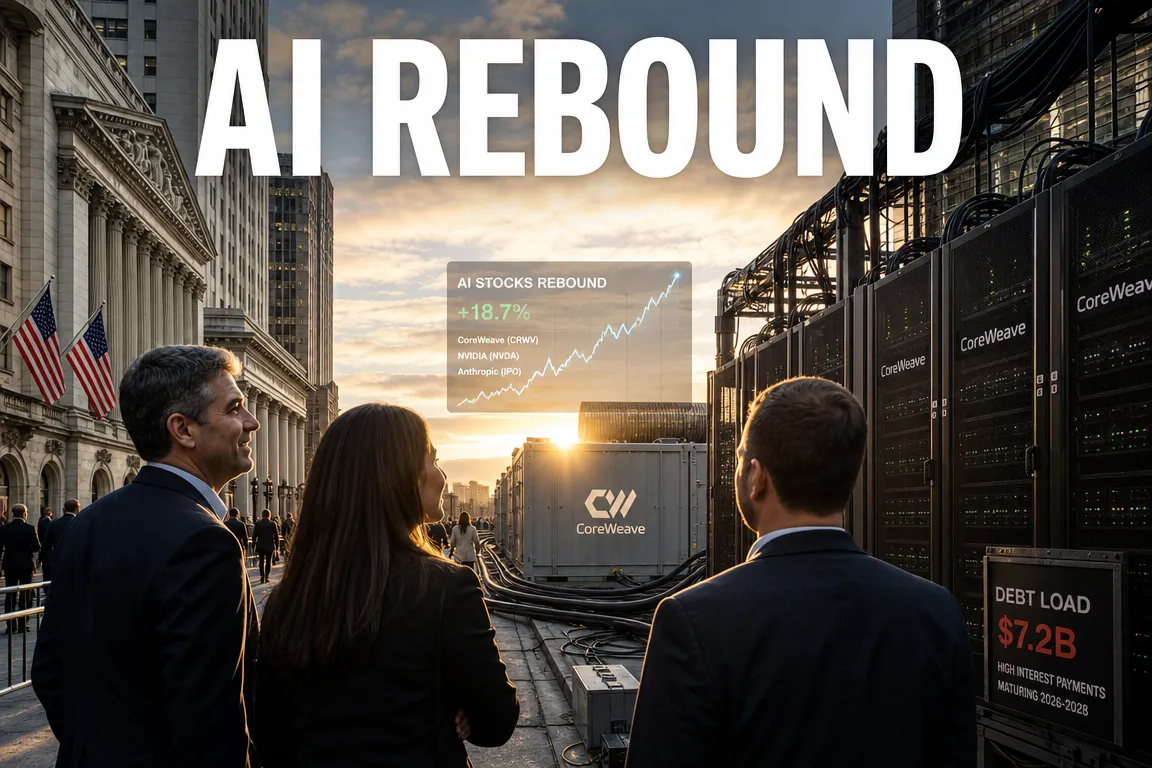
CoreWeave shares rose approximately 24%. Although the stock remained below its previous peak, a one-day gain exceeding 20% indicated a meaningful reassessment of prior concerns.
Rapid Growth in CoreWeave Revenue and Adjusted EBITDA
CoreWeave’s revenue reportedly increased approximately 168% year over year, while adjusted EBITDA rose about 170%.
The company also raised its guidance, supporting the view that demand for AI computing capacity may extend beyond a short-term cycle.
Investors responded positively because operating earnings from servers and data centers increased alongside revenue.
GPU rental prices also remained elevated despite concerns that AI semiconductor demand could weaken, reinforcing confidence in CoreWeave’s operating performance.
Demand Is 10 Times Available Capacity, but the Composition Matters
CoreWeave management indicated that qualified demand through 2027 was approximately 10 times the capacity expected to be available.
This suggests that customer demand for GPU resources substantially exceeds CoreWeave’s available data center, power, and server capacity.
However, investors must distinguish among binding contracts, conditional orders, and nonbinding pipeline opportunities.
If the same AI company requests capacity from several neocloud providers, industrywide demand may be counted multiple times.
Accordingly, the statement that demand is 10 times capacity should not be converted directly into projected revenue.
3. CoreWeave’s Financing Structure Is More Important Than Its Revenue Growth
The primary market concern surrounding CoreWeave has been leverage rather than growth.
AI data centers require substantial upfront investment in GPUs, power access, cooling infrastructure, and networking equipment.
Reports that yields on CoreWeave’s unsecured debt had approached approximately 15% indicated that the market assigned significant financial risk to the company.
Even with rapid revenue growth, shareholder value may deteriorate if interest expense exceeds operating profit.
How Delayed-Draw Term Loans Work
CoreWeave plans to use delayed-draw term loans more actively for additional financing.
This structure establishes a total borrowing commitment in advance while allowing the borrower to draw funds incrementally as needed.
CoreWeave can therefore align borrowing with GPU installation and data center commissioning schedules.
If construction or grid connections are delayed, the company can limit interest expense on unused capital.
Matching investment execution with borrowing dates may also improve cash-flow management.
SPV Financing Backed by GPUs and Customer Contracts
More importantly, some financing may be structured around specific GPU assets and customer contracts rather than CoreWeave’s corporate credit alone.
A special-purpose vehicle can hold the GPUs and long-term usage contracts.
Customer payments may then be directed toward principal and interest payments before funds are transferred to CoreWeave.
This allows lenders to evaluate GPU residual values and the stability of customer contracts rather than relying solely on CoreWeave’s overall credit profile.
Such arrangements could reduce financing costs relative to unsecured corporate debt.
Even if CoreWeave encounters financial distress, continuing cash flow from SPV assets and customer contracts may improve lender recoveries.
Customer Prepayments as an Additional Funding Source
CoreWeave also intends to increase its use of customer prepayments rather than relying exclusively on additional debt.
Large AI customers can reserve future GPU capacity and pay in advance, enabling CoreWeave to finance servers and data center construction.
This approach can reduce interest expense and encourage long-term customer commitments.
However, service delays may create refund obligations or contractual penalties, meaning prepayments are not risk-free financing.
4. Three Remaining Financial Risks for CoreWeave
First, interest expense remains higher than adjusted operating profit.
Management has stated that operating profit is growing faster than interest expense and has indicated that net income could turn positive in 2028. This outlook depends on data centers becoming operational on schedule.
Second, customer concentration remains significant.
Using customer contracts as collateral can reduce borrowing costs, but the associated assets and liabilities could both come under pressure if a major customer reduces or does not renew its contract.
Third, GPUs face technological obsolescence.
GPUs currently generating premium rental rates may experience faster-than-expected declines in rental pricing and collateral value when next-generation processors become available.
CoreWeave’s competitive position therefore depends less on the number of GPUs it owns than on its ability to recover capital expenditure and interest costs within the assets’ economic lives.
5. Data Center Delays: Strong AI Demand May Not Translate Immediately Into Revenue
The primary constraint in the AI data center market appears to be power availability, permitting, and construction delays rather than insufficient demand.
Morgan Stanley reportedly shifted part of approximately 4.9 GW of data center capacity previously expected to become operational in 2028 into 2029.
At 4.9 GW, the adjustment represents a material change rather than a minor scheduling revision.
Community concerns over electricity prices, water consumption, noise, and grid pressure may delay data center approvals.
Delayed supply can support GPU rental prices, but it may also defer revenue recognition for operators such as CoreWeave that need to expand capacity rapidly.
Record GPU Rental Prices Are a Mixed Signal
GPU rental prices reportedly continued to reach record levels.
This indicates that customers still face shortages of high-performance AI computing capacity, supporting near-term profitability for neocloud providers.
However, persistently high rental prices may encourage customers to build proprietary data centers, adopt lower-cost AI accelerators, or deploy smaller and more efficient models.
High prices therefore demonstrate strong demand while also accelerating the adoption of substitute technologies.
6. Anthropic IPO Expectations: Distinguishing Confirmed Information From Market Expectations
The second major catalyst was the possibility of an Anthropic IPO and indications of strong investor demand.
Anthropic was reportedly conducting investor meetings, with demand potentially exceeding the available allocation.
Private financing rounds and formal IPOs follow different procedures. References to oversubscription may therefore relate to private placements rather than a public offering.
Without an official company announcement or regulatory filing, the IPO schedule and valuation should not be treated as confirmed.
Anthropic’s Reported Competitive Advantages
- Enterprise security and reliability differentiated from open-source models
- Strong AI research personnel and model-development capabilities
- The potential for the AI market to consolidate around a limited number of providers
- Enterprise customer acquisition supported by high model performance
Anthropic has reportedly expressed confidence that it could capture a significant share of the AI market if it executes effectively.
However, the market may not develop into a complete winner-takes-all structure.
Enterprise customers are likely to use models from OpenAI, Anthropic, Google, and open-source providers simultaneously, depending on cost, security, latency, and performance requirements.
Anthropic Financial Figures Require Verification
Reported figures included development costs of $10 billion for a next-generation model, fourth-quarter revenue of $19.3 billion, October annual recurring revenue of $81 billion, and November and December levels of $77 billion.
Relative to Anthropic’s known operating scale, these figures may reflect missing decimal points. Possible alternative values include $1.93 billion, $8.1 billion, and $7.7 billion.
Quarterly growth was estimated at approximately 14%, down from growth exceeding 40% in the previous quarter.
Year-over-year growth was reported at approximately 9.5 times.
Anthropic reportedly attributed its conservative outlook partly to seasonal declines in enterprise usage during the year-end holiday period.
Until audited financial statements are available, the direction of growth may be informative, but absolute values should not be treated as verified.
7. OpenAI Results Highlight the AI Industry’s Central Dilemma
OpenAI’s quarterly revenue was reportedly approximately $10 billion, representing sequential growth of about 50%.
This would indicate faster near-term revenue growth than Anthropic and a renewed acceleration in OpenAI’s growth rate.
The principal concern is the scale of operating losses.
Adjusted operating losses reportedly increased from $10.1 billion to $10.9 billion.
If revenue was $10 billion and the operating loss was $10.9 billion, the adjusted operating margin would be approximately negative 109%, not negative 19%.
This implies that the company lost approximately $109 at the operating level for every $100 of revenue.
Because adjusted losses typically exclude certain expenses, including some share-based compensation, the reported accounting loss could be larger.
If these figures are accurate, the central challenge for generative AI companies is not revenue growth but developing a profitable model while absorbing substantial computing and personnel costs.
8. Why Sam Altman’s Warning About a Neocloud Bubble Matters
Sam Altman reportedly discussed the risk of a neocloud bubble and the potential duplication of demand estimates during a question-and-answer session with Samsung executives.
An AI company may request substantial GPU capacity from several cloud providers, with each provider recording the inquiry as prospective demand.
If the customer ultimately signs contracts with only one or two providers, total industry demand may have been overstated.
CoreWeave’s strong demand indicators and warnings of a neocloud bubble are not necessarily contradictory.
GPU demand may remain strong while becoming overstated when the same customer requirement is included in the revenue expectations of multiple providers.
9. AI Agents: High Market Attention but Limited Transaction Volumes
ByteDance is also reportedly developing a personal AI agent.
Several agent services have gained attention, and some have ranked highly in app-store productivity categories.
Web Traffic and Purchase Conversion Are Distinct Metrics
Internet infrastructure providers such as Cloudflare have reported rapid growth in automated and AI-agent traffic.
However, consumer transaction platforms including DoorDash, Uber, Booking Holdings, and Expedia have indicated that orders and reservations completed through AI agents remain limited.
DoorDash reportedly stated that total orders generated through third-party agents amounted to only several hundred transactions.
Compared with more than 900 million orders processed by DoorDash in a single quarter, the current share of agent-generated orders is statistically immaterial.
Uber similarly indicated that AI agents completed very few rides during the relevant period.
Travel platforms have also reported lower-than-expected traffic and booking conversion from AI agents.
Why AI-Agent Adoption Has Not Yet Accelerated
- Authentication and payments: Agents cannot yet handle user accounts and payment methods securely across platforms.
- Liability: Responsibility for incorrect purchases or reservations remains unclear among users, platforms, and agent providers.
- Terms of service: Many platforms restrict automated access and purchasing.
- Limited trust: Users may delegate search and summarization to AI but still prefer to confirm final payments directly.
- Lack of standards: Authentication, payment, and refund protocols have not been standardized across platforms.
AI agents remain in an early validation stage rather than representing either a clear commercial success or failure.
Downloads and daily active users may continue to rise, but commercial adoption should be measured through completed transactions and repeat usage.
10. The Most Important Developments That May Be Overlooked
First, CoreWeave is effectively converting GPUs and customer contracts into financeable assets.
The model extends beyond purchasing and renting GPUs. CoreWeave can use future cash flows from long-term usage agreements as collateral for additional financing.
If the structure performs as intended, the company may expand data center capacity rapidly while limiting its equity contribution.
If GPU prices or customer contracts weaken, however, asset values and debt stability could deteriorate simultaneously.
Second, matching the timing of power availability and debt maturity is becoming a core capability for AI infrastructure companies.
GPUs cannot generate revenue without an operational power connection.
Borrowing too early creates interest expense before operations begin, while borrowing too late may disrupt GPU procurement and construction schedules.
Delayed-draw loans can reduce the financing costs created by these timing differences.
Third, strong AI demand and the existence of an investment bubble can occur simultaneously.
GPU shortages and high rental prices are observable, but long-term supply plans may become excessive if several providers count the same customer demand.
Fourth, AI-agent performance should be evaluated through completed transactions rather than app rankings.
App-store rankings and web traffic indicate attention, but the economic value of agents will depend on payments, reservations, and repeat usage.
11. Checklist for Assessing Whether the Rebound Is Sustainable
- Determine whether CoreWeave’s operating cash flow is improving faster than revenue.
- Evaluate net income and free cash flow after interest expense rather than adjusted EBITDA alone.
- Confirm whether the share of high-cost unsecured borrowing is declining.
- Review the pricing and terms of customer prepayments and SPV financing.
- Monitor additional delays to data center commissioning schedules in 2028 and 2029.
- Assess whether GPU rental prices and utilization rates remain elevated simultaneously.
- Evaluate an Anthropic IPO based on official filings and company announcements.
- Compare OpenAI’s and Anthropic’s gross profit with computing costs rather than focusing solely on revenue growth.
- Measure AI-agent adoption through completed orders and repeat usage rather than downloads.
12. Investment Conclusion
The recent advance was not driven solely by speculative expectations.
CoreWeave’s rapid growth, financing diversification, elevated GPU rental prices, and investor interest in Anthropic all contributed to the rebound.
CoreWeave’s proposed response to high-cost debt is particularly significant because leverage has been one of the primary weaknesses of the neocloud business model.
However, CoreWeave must demonstrate that its operations can generate cash after interest payments, rather than merely reporting strong revenue growth.
Anthropic and OpenAI also face substantial model-development and computing expenses despite their high growth rates.
The second phase of AI investing is therefore shifting from the speed of growth toward the cost and structure of financing that growth.
The rebound indicates that the AI industry may be entering another upward cycle. Confirmation of a durable trend will require stronger cash flow and evidence that new data center capacity is becoming operational as scheduled.
< Summary >
- The Nasdaq and AI-related stocks rebounded, while CoreWeave shares rose approximately 24%.
- CoreWeave’s revenue reportedly increased 168% year over year, while adjusted EBITDA rose 170%.
- The most significant development is the use of GPUs and customer contracts as collateral for lower-cost financing.
- Delayed-draw loans can reduce interest expense by aligning borrowing with data center commissioning schedules.
- AI demand remains strong, but multiple providers may be counting the same customer requirements.
- Anthropic’s IPO prospects and financial figures require confirmation through official disclosures.
- OpenAI continues to report strong revenue growth but faces substantial operating losses.
- AI-agent traffic and user interest are increasing, but completed orders and reservations remain limited.
- The rebound is meaningful, but its sustainability will depend on cash flow, interest costs, and data center execution.
[Related Articles…]
*Source: [ 내일은 투자왕 – 김단테 ]
– 코어위브 앤트로픽 대박? 찐반등 오나?
● Trump Shockwave, Oil, Stocks, AI, Risk
Trump’s Hard-Line Strategy and the “2007 Parallel” | Implications for Oil, U.S. Equities, and AI Infrastructure Investment
How could markets change if President Trump responds to an election defeat with confrontation rather than negotiation?
The central issue for investors is not a personnel reshuffle alone.
More important considerations include whether the White House aggressively uses executive orders, emergency powers, and vetoes instead of negotiating with Congress; whether conflict in the Middle East drives oil prices and inflation higher; and how tariffs and immigration restrictions affect AI infrastructure investment.
The George W. Bush administration increased troop levels in Iraq after losing the 2006 midterm elections. This precedent indicates that expectations of policy moderation following an election may not materialize.
However, claims concerning Stephen Miller’s appointment as White House chief of staff, a proposed press secretary role for Dana White, election results, and military operations in the Middle East require verification through current official announcements and multiple independent sources.
The following analysis separates verifiable historical facts from the source scenario and focuses on signals relevant to investors.
1. Priority Fact-Checking Items
The source states that President Trump replaced moderate advisers after a midterm election defeat and appointed Stephen Miller as White House chief of staff.
Miller has been a central architect of hard-line immigration policy and the America First agenda since Trump’s first administration.
If placed at the center of White House personnel and policy coordination, his appointment could signal tighter policies on immigration, tariffs, border enforcement, and executive authority.
Any official appointment and effective date should be independently confirmed through White House announcements and major news agencies.
- Personnel: Confirm the position and effective date through an official White House announcement.
- Election results: Assess the Senate and House balance using state-certified results.
- Military operations: Verify aircraft carrier deployments and reported attacks through the Department of Defense and multiple international news agencies.
- Corporate disclosures: An Anthropic IPO should not be treated as confirmed until the company announces it or files documents with the U.S. Securities and Exchange Commission.
- Market data: Claims that oil prices have “doubled” depend on the reference date and benchmark. WTI and Brent prices should be reviewed separately.
Investors should prioritize official personnel announcements, executive-order texts, court rulings, congressional votes, and crude oil futures over political interpretation or exaggerated claims.
2. Core Scenario | From Negotiation to a Confrontational White House
The source argues that President Trump could interpret an election defeat not as a reason to retreat, but as justification for a harder line intended to mobilize his political base.
Under this scenario, the White House could prioritize presidential authority over negotiations with Congress.
2-1. Why Hard-Line Appointments Matter
The White House chief of staff does more than manage the president’s schedule.
The role determines which information reaches the president, coordinates disputes among agencies, and influences policy priorities.
Replacing a consensus-oriented official with an ideologically committed figure could change both the substance and pace of policy implementation.
If Stephen Miller assumes a central policy role, markets are likely to focus on the following areas:
- Expanded enforcement and deportation of undocumented immigrants
- Restrictions on legal employment visas, including H-1B visas
- Higher tariffs and tighter import controls
- Expanded executive authority related to border and national emergencies
- Reductions in federal spending and government agencies
- Direct confrontation with a Democratic-controlled Congress
More confrontational political messaging can reduce policy visibility and increase the risk premium demanded by financial markets.
2-2. Implications of a “Fighter-Style” Press Secretary
The source also claims that President Trump offered UFC CEO Dana White a White House press secretary role.
This claim requires official confirmation, but if accurate, the strategic message would be relatively clear.
It would suggest a preference for a spokesperson capable of publicly confronting the media and mobilizing supporters rather than presenting policy in a conciliatory manner.
This could indicate that communications conflict and political mobilization are taking priority over policy moderation.
3. Would Democratic Control of Congress Stop Trump’s Agenda?
Presidential policy capacity would weaken but would not disappear.
A change in congressional control would make new legislation and budget approval more difficult, while the executive branch would retain substantial authority under existing statutes.
| Policy Instrument | Presidential Authority | Primary Constraints |
|---|---|---|
| Executive orders | Change federal agencies’ implementation priorities | Courts may block actions that violate existing law or the Constitution |
| Tariff authority | Adjust certain tariffs under trade and national security statutes | Requires statutory authority and investigative procedures; subject to litigation |
| Immigration enforcement | Change enforcement priorities and allocate administrative resources | Budget constraints, due process, and federal court oversight |
| Legislative veto | Refuse to sign legislation passed by Congress | Congress can override a veto with a two-thirds vote in both chambers |
| Commander-in-chief authority | Conduct limited military operations and deploy forces | Long-term operations depend on funding and congressional oversight |
The claim that a president becomes powerless when the opposition controls Congress is overly simplistic.
Conversely, declaring an emergency does not give the president unlimited authority.
Executive power remains constrained by congressional appropriations, existing statutes, federal court decisions, and state-level litigation and enforcement cooperation.
The principal market risk may be less about whether policies ultimately succeed and more about the volatility generated by conflict between the executive and legislative branches.
4. Why the Current Scenario Could Reverse the 2025 Tariff Signal
The source identifies April 2025 as an important turning point, when U.S. equities faced tariff-related pressure, hard-line adviser Peter Navarro appeared to lose influence, and Treasury Secretary Scott Bessent assumed a leading role in negotiations.
Markets responded not only to tariffs but also to indications that negotiation-oriented officials were gaining influence inside the White House.
Even if tariffs are not fully withdrawn, delays, negotiations, and narrower coverage can remove the most adverse scenarios from market pricing.
The current scenario points in the opposite direction.
If policy coordinators are replaced by immigration and tariff hard-liners, the probability of compromise may decline.
However, the rise of a particular adviser is not sufficient to conclude that equity prices will fall.
Market direction will also depend on tariff rates, implementation dates, affected countries, corporate exemptions, court rulings, and Federal Reserve policy.
5. The “20-Year Parallel” Between the Bush and Trump Administrations
The source compares the current situation with the George W. Bush administration after 2006.
In the 2006 U.S. midterm elections, Democrats gained control of both the Senate and the House amid opposition to the prolonged Iraq War and the Bush administration.
Defense Secretary Donald Rumsfeld resigned shortly after the election.
Many voters expected the election result to lead to a reduction in the U.S. military presence in Iraq.
Instead, President Bush announced in January 2007 that approximately 21,500 additional troops would be deployed under the Iraq War troop surge.
The election defeat therefore led not to policy retreat, but to a final effort to achieve the administration’s objectives before the end of its term.
5-1. Similarities Between the Two Situations
- Prolonged conflict and higher living costs can weaken support for the governing party
- A president may continue existing policies despite opposition control of Congress
- An administration may respond to perceived policy failure with stronger measures rather than reversal
- Energy prices and inflation can directly affect elections and financial markets
- Conflict between the executive branch and Congress can increase policy uncertainty
5-2. Important Differences
The Iraq War and current conflicts in the Middle East differ in scale, U.S. troop involvement, alliance structures, and exposure to oil supply chains.
The increase in oil prices during 2007 cannot be attributed solely to the Iraq War.
Demand growth in emerging markets, including China, limited spare production capacity, the value of the U.S. dollar, and financial speculation also contributed.
The financial instability that began in late 2007 was not caused by high oil prices alone. It reflected declining housing prices, subprime mortgage losses, and excessive financial leverage.
Similar political dynamics would therefore not necessarily produce another financial crisis of the same form.
6. Downside Scenario | Wider Conflict and Renewed Oil Price Inflation
The most adverse market combination would be an expansion of military operations in the Middle East, disruption to oil supplies, rising crude prices, and renewed inflation.
Higher oil prices would quickly affect U.S. consumers through gasoline and transportation costs.
Companies would also face higher expenses for logistics, air travel, chemicals, packaging materials, and electricity.
The transmission mechanism to financial markets could be as follows:
- Escalating conflict and supply concerns raise global crude oil prices.
- Higher gasoline and transportation costs feed into consumer inflation.
- Rising inflation expectations delay Federal Reserve rate cuts.
- U.S. Treasury yields rise, increasing discount-rate pressure on growth equities.
- Valuation volatility increases for highly valued technology and AI infrastructure companies.
- Lower household purchasing power increases concerns about slower economic growth.
If oil prices and long-term interest rates rise simultaneously, the outlook for U.S. equities could become more defensive.
Even with resilient earnings, higher discount rates can compress price-to-earnings multiples.
7. Alternative Scenario | Strong Rhetoric May Not Translate Into Full Implementation
Trump’s policy approach may involve presenting aggressive demands before delaying or modifying implementation during negotiations.
Hard-line appointments do not necessarily imply a wider war or comprehensive tariff increases.
The administration could maintain forceful political messaging while adjusting implementation if market disruption becomes excessive.
More market-supportive outcomes include:
- Military operations in the Middle East remain limited
- Higher production by oil-exporting countries restrains crude prices
- Tariff announcements include longer transition periods and broader exemptions
- Congress and the administration reach partial agreements on spending and debt issues
- Stable inflation preserves the Federal Reserve’s capacity to reduce interest rates
Investors should focus on the actual scope of implementation rather than political rhetoric.
8. Implications for AI Infrastructure Investment
The effects would extend beyond political and energy-related equities.
Tariff, immigration, interest-rate, and energy policies directly affect investment in data centers, semiconductors, and broader AI infrastructure.
8-1. Tariffs Could Increase Data Center Costs
AI data centers require not only GPUs and servers, but also transformers, cooling systems, cables, power-distribution equipment, structural steel, and electronic components.
Tariffs on imported equipment could increase both construction and operating costs.
Large technology companies may respond by reprioritizing projects or extending completion schedules rather than canceling investment entirely.
8-2. Immigration Restrictions Could Constrain AI Talent
The U.S. AI industry relies significantly on foreign-born researchers and engineers.
Restrictions on H-1B visas and legal employment-based immigration could raise recruitment costs for large technology companies and start-ups.
If skilled workers relocate to Canada, the United Kingdom, Europe, the Middle East, or Singapore, U.S. AI competitiveness could weaken over time.
Although restrictive immigration policies may support a short-term political objective of protecting domestic employment, they could constrain labor supply in advanced technology industries.
8-3. Electricity Prices and Interest Rates May Matter More Than Oil
AI data centers consume substantial electricity and are sensitive to energy prices and grid investment costs.
Natural gas prices, regional wholesale electricity prices, and grid-connection delays directly affect AI project economics.
If renewed inflation raises Treasury yields, the valuations of AI growth companies with long-duration expected cash flows could come under pressure.
AI investors should monitor not only GPU shipments, but also the U.S. 10-year Treasury yield, electricity prices, transformer availability, and data center utilization.
8-4. Official Filings Should Determine the Status of an Anthropic IPO
The source discusses a possible Anthropic IPO, but any listing decision or timetable should be assessed through official corporate announcements or regulatory filings.
Investors should not assume a listing date or valuation based on market speculation.
If Anthropic pursues an IPO, key considerations would include revenue growth, model-training costs, cloud agreements, relationships with major shareholders, AI safety regulation, and cash burn.
9. Key Issues That May Be Overlooked
First, the legal terminology and authority invoked by the president may matter more than personnel changes.
Repeated references to invasion, insurrection, terrorism, or national security may indicate preparations to use emergency powers or existing national security statutes.
Political rhetoric alone does not create legal authority; specific statutory grounds and judicial review remain necessary.
Second, divided government may change the policy channel rather than produce complete paralysis.
If legislation becomes difficult to pass, the executive branch may rely more heavily on tariffs, regulations, enforcement priorities, and executive orders.
Such measures may be less durable and more exposed to litigation and reversal.
Third, the main equity-market risk from higher oil prices is a change in the interest-rate path, not merely gains in energy stocks.
A temporary oil price increase may be manageable, but a sustained rise that increases inflation expectations and delays Federal Reserve easing would present a larger risk.
Highly valued AI and growth equities may react more strongly to interest-rate changes than to near-term earnings.
Fourth, restrictive immigration policy could disrupt the human-capital component of the AI supply chain.
Semiconductors and data centers alone do not establish AI leadership.
Restrictions on the mobility of researchers, software engineers, and data scientists could slow innovation at U.S. technology companies.
Fifth, the principal lesson from the 2007 parallel is not that another financial crisis is inevitable, but that expectations of policy moderation can fail.
An administration that loses an election may not adopt a more moderate agenda.
It may instead intensify policy implementation in an effort to secure results before the end of its term.
10. Indicators Investors Should Monitor Weekly
- WTI and Brent: Determine whether geopolitical risk is producing actual supply disruption.
- U.S. 10-year Treasury yield: Assess whether higher oil prices and fiscal concerns are increasing discount rates for growth equities.
- Inflation expectations: Monitor whether near-term oil price increases are affecting longer-term inflation projections.
- U.S. Dollar Index: Evaluate whether risk aversion and higher U.S. yields are supporting the dollar.
- White House appointments and executive orders: Confirm whether political statements are becoming enforceable policy.
- Federal court rulings: Track whether executive actions involving immigration, tariffs, and spending remain in effect.
- AI corporate capital expenditure: Monitor whether major technology companies are reducing data center investment.
- Electricity and natural gas prices: Assess whether AI data center operating costs are rising.
11. Investment Strategy | Emphasize Response Over Prediction
In a period of elevated political and geopolitical uncertainty, diversified exposure and adequate liquidity may be more practical than concentrating on a single scenario.
Even if U.S. equity indices maintain a long-term growth trend, short-term corrections may be deeper than expected due to political events, oil prices, and interest-rate changes.
- Investors may consider staggering index purchases across different prices and dates.
- AI infrastructure companies should be evaluated on valuation, leverage, and cash flow as well as revenue growth.
- Energy equities may benefit from higher oil prices but could reverse quickly if geopolitical tensions ease.
- Cash should be viewed not only as a low-return asset, but also as a source of flexibility during periods of elevated volatility.
- Investors should avoid momentum buying or panic selling based solely on political headlines.
The most vulnerable strategies are those based on predetermined conclusions, such as assuming that Democratic control of Congress will end all hard-line policies or that hard-line appointments will inevitably cause a U.S. equity market collapse.
Personnel may influence markets, but implementation matters more. Oil prices and interest rates are more important for near-term valuation, while earnings and cash flow remain decisive over the long term.
< Summary >
If President Trump adopts a harder line following an election defeat, uncertainty surrounding tariffs, immigration, and Middle East policy could increase.
The Bush administration’s 2007 Iraq troop surge after its 2006 midterm election defeat demonstrates that electoral setbacks do not necessarily result in policy moderation.
The most adverse scenario would combine wider conflict in the Middle East, higher oil prices, renewed inflation, and delayed interest-rate cuts.
Tariffs and immigration restrictions could also increase data center construction costs and constrain access to AI talent.
However, recent claims concerning personnel, election results, and military operations require confirmation through official sources.
Investors should prioritize oil prices, Treasury yields, executive orders, court rulings, and corporate capital expenditure over political rhetoric.
[Related Articles…]
*Source: [ 소수몽키 ]
– 20년 전 부시 행정부와 똑같다? 초강경 모드 진입한 트럼프, 분위기 바꿀까