● Tesla-Waymo Shock, Cybercab Surge, 390 Stock Breakout
Has Tesla Overtaken Waymo for the First Time? Key Figures Behind the Cybercab Korea Showcase and Tesla’s $390 Share Price
Tesla reportedly surpassed Waymo by five vehicles in registered autonomous vehicles in Texas.
However, registration figures alone do not indicate a change in leadership in the robotaxi market.
The key metrics are active vehicles, paid rides, revenue per mile, vehicle cost, and the pace of regulatory approvals.
Tesla’s valuation also reflects expectations surrounding the Cybercab’s first Korean showcase, potential European FSD approvals, U.S. interest rates, and the AI semiconductor supply chain.
Tesla may be approaching or exceeding Waymo’s scale in Austin, but Waymo remains ahead across the broader U.S. market.
1. Has Tesla Overtaken Waymo for the First Time?
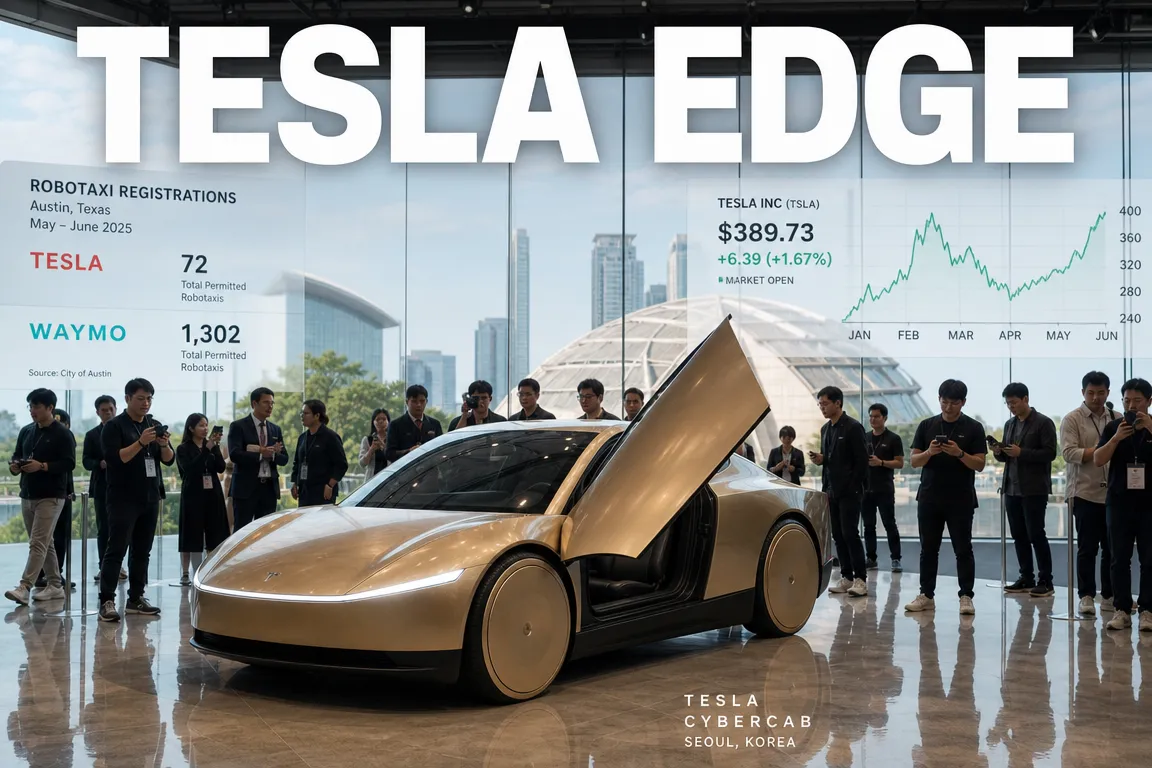
According to the source, a November 10 registration list from Texas vehicle authorities showed 1,302 vehicles registered to Tesla’s robotaxi entity and 1,297 to Waymo.
If accurate, Tesla exceeded Waymo by five vehicles in Texas registrations for the first time.
Tesla reportedly had 42 vehicles when the list was first released in late May.
This represents an increase of more than 30 times in approximately six months.
The report also stated that 573 Cybercabs without steering wheels or pedals accounted for approximately 44% of Tesla’s registered fleet.
The critical distinction is between registered vehicles and vehicles actively providing commercial service.
A registration list primarily indicates the maximum number of vehicles an operator may deploy.
It does not establish that every registered vehicle is transporting passengers daily.
The data therefore signals Tesla’s preparations for a large-scale autonomous driving operation in Texas, but it does not prove that Tesla has surpassed Waymo’s overall business scale.
2. Tesla May Lead in Austin, While Waymo Leads Nationwide
An unofficial robotaxi tracker cited by the source identified approximately 451 Tesla vehicles operating in Austin without a driver in the front seat.
Another estimate based on Tesla-related tracking data placed the potential total at up to 744 vehicles.
Waymo’s Austin fleet was estimated at approximately 300 vehicles.
If measured on a comparable basis, Tesla may already operate more vehicles than Waymo in Austin.
The comparison changes at the national level.
According to the source, Waymo operates more than 4,000 vehicles across 15 cities and provides approximately 500,000 paid rides per week.
Unofficial tracking data identified approximately 700 driverless Tesla vehicles across nine cities.
Assuming consistent measurement standards, Waymo’s nationwide fleet would be approximately six times larger than Tesla’s.
- Texas registrations: Tesla reportedly holds a narrow lead.
- Active operations in Austin: Tesla may be ahead.
- Nationwide U.S. fleet: Waymo remains ahead.
- Paid-ride experience and service coverage: Waymo has a longer operating history.
- Vehicle manufacturing cost and scaling potential: Tesla may have a structural advantage.
A more accurate conclusion is that Tesla may have moved ahead in Texas registrations and Austin deployment, rather than having overtaken Waymo across the robotaxi market.
3. Pricing and Margins Matter More Than Fleet Size
Robotaxi economics depend on vehicle utilization, paid rides, revenue, and operating profit rather than registered fleet size alone.
Based on 91 ride records cited by the source, the median fare for Tesla’s Austin service was $14.06.
The average trip covered approximately 4.5 miles, implying a fare of about $3.80 per mile.
Waymo’s median fare across all cities was reported at $13.67, with an average distance of approximately 6.3 miles and a fare of about $3.30 per mile.
In this unofficial sample, Tesla charged approximately $0.50 more per mile than Waymo.
This contrasts with expectations that Tesla would enter the market with lower fares.
However, the data were based on voluntarily submitted ride records and do not represent official company-wide average fares or revenue.
Results may vary materially by time, demand, location, promotions, and trip distance.
The principal investor question is not which operator charges less, but which operator generates higher margins at comparable prices.
4. Cybercab’s Primary Advantage May Be Vehicle Cost
Cybercab is a two-seat vehicle designed specifically for driverless commercial transportation.
Tesla has also considered operating most Cybercabs directly rather than selling them to consumers.
Under this model, Tesla’s primary revenue source would shift from vehicle sales to recurring passenger fares.
According to the source, Elon Musk previously indicated a Cybercab price below $30,000 before 2027.
Whether this target translates into actual production cost or retail pricing remains uncertain, but a dedicated robotaxi could be less expensive than modifying conventional vehicles.
Waymo uses vehicles manufactured by third parties and adds lidar, cameras, radar, computing hardware, and autonomous driving systems.
The source estimated the total cost of a Jaguar I-PACE-based Waymo vehicle at $150,000 to $200,000.
It also estimated that a next-generation Zeekr-based vehicle could cost more than $100,000 after tariffs and autonomous driving equipment.
These figures have not been officially confirmed by Waymo and should be treated as third-party estimates.
If Cybercab achieves a cost of approximately $30,000 while Waymo’s vehicles cost more than $100,000, the initial capital-cost difference could exceed three times.
Lower vehicle cost would reduce depreciation at comparable fare levels.
It would also provide greater flexibility to reduce fares as competition increases.
Geographic expansion could require less aggregate capital.
Lower vehicle cost alone does not guarantee market leadership.
Consumers also consider safety, wait times, geographic availability, application quality, accessibility, and brand trust.
Waymo’s ability to attract customers despite sometimes charging more than Uber demonstrates the commercial value of established safety and service performance.
5. Key Metrics for Evaluating Tesla’s Robotaxi Economics
Currently available fleet data are insufficient to evaluate Tesla’s robotaxi profitability.
Investors should monitor whether future earnings disclosures include the following metrics:
- Average paid rides per vehicle per day: Measures utilization efficiency.
- Share of paid miles: High empty-mile ratios reduce profitability.
- Average revenue per mile: Should reflect discounts and demand fluctuations.
- Maintenance cost per vehicle: Includes tires, cleaning, charging, repairs, and remote support.
- Insurance and accident costs: Potentially a major variable in driverless operations.
- Remote intervention rate: Determines the level of human support and associated costs.
- Fleet uptime: Regulatory or maintenance downtime can offset the benefits of lower manufacturing costs.
Low manufacturing costs may not produce attractive margins if insurance and remote operating expenses remain high.
Conversely, low intervention rates and efficient empty-mile management could support platform-like margins above those of traditional automotive manufacturing.
6. Significance of Cybercab’s First Korean Showcase
According to the source, Tesla Korea scheduled a Cybercab exhibition from November 12 to 15 near the Tesla store at Starfield Anseong in Gyeonggi Province.
Operating hours were listed as 10:00 a.m. to 9:30 p.m.
Cybercab is not currently available for sale in Korea, and access to the vehicle interior may be restricted for safety reasons.
Admission may also close early depending on visitor volume.
The exhibition should not be interpreted as confirmation of a Korean launch or domestic robotaxi service.
A vehicle without a steering wheel or pedals would need to satisfy Korean vehicle safety standards, temporary operating requirements, autonomous transportation licensing rules, and insurance regulations.
The event is better viewed as a product showcase intended to build consumer awareness and assess market and regulatory responses.
From an investment perspective, the event indicates that Tesla is positioning Cybercab as a global autonomous mobility platform rather than a U.S.-only product.
Showcasing the vehicle in Europe and Korea may help build familiarity before regulatory approvals are secured.
7. European FSD Approval: The 65% Population Threshold Matters More Than 11 Countries
The source reported that Finland became the 11th European country to permit Tesla’s driver-assistance functions after accepting provisional approval from the Netherlands’ vehicle certification authority.
In Europe, the system was reportedly presented under a driver-assistance designation rather than the FSD name.
The permitted speed-setting margin was also reduced from 50% above the limit to 10%.
Individual national approvals are constructive, but European Union-wide approval requires thresholds for both the number of countries and their population share.
According to the source, approval requires support from at least 15 of the 27 EU member states representing more than 65% of the EU population.
The 11 supporting countries reportedly account for approximately 15.5% of the population.
Adding Germany and Italy would increase the share to approximately 47.4%, leaving support from a large country such as France or Spain necessary.
Approximately 6,500 vehicles in Finland were estimated to be eligible for the function.
Finland’s approval alone is therefore unlikely to materially affect Tesla’s revenue.
The more significant catalyst would be approval in major European markets, enabling large-scale monthly software subscriptions.
A European autonomous driving subscription business could increase lifetime revenue per vehicle even if vehicle sales remain flat.
However, classification as driver assistance rather than full autonomy could constrain liability structures and marketing claims.
8. U.S. Regulation Will Determine Cybercab’s Expansion Pace
Expansion of a vehicle without a steering wheel or pedals requires resolution of U.S. federal vehicle safety requirements.
The source stated that regulators began reviewing in early September how Tesla had self-certified Cybercab’s compliance with applicable safety standards.
A special order requesting sworn responses was reportedly issued afterward.
An investigation or information request does not constitute a finding of noncompliance.
Existing rules may also be poorly suited to new vehicle designs, including requirements written around conventional steering-wheel controls.
Regulatory revisions could accelerate Cybercab deployment, while accidents or software failures could delay approvals.
The source identified Dallas as a potential first passenger market for Cybercab outside Austin.
If operations begin, investors should focus on service coverage, paid fares, fleet size, onboard safety personnel, and remote intervention requirements.
9. Why Political Developments in Texas Matter to Tesla
Tesla relocated its headquarters from California to Austin, Texas, in 2021.
Gigafactory Texas is a major production facility and a central location for Cybercab and robotaxi development.
SpaceX also operates launch facilities and Starbase in Texas.
The source reported that a Florida member of the U.S. House of Representatives publicly invited Tesla to relocate its headquarters to Florida.
The proposal cited changes in Texas politics and Florida’s business-friendly policies.
A public invitation from a politician is materially different from a corporate relocation decision.
Given Tesla’s factories, workforce, supply chain, and robotaxi infrastructure in Texas, another near-term headquarters relocation would require substantial justification.
For investors, the more relevant issue is how Texas regulates driverless vehicle permits, accident reporting, insurance, and local government authority.
Tighter regulation could slow deployment.
A unified statewide approval framework could allow Tesla to expand more quickly across cities.
10. Tesla at $390: What Expectations Are Reflected in the Share Price?
The source reported that Tesla shares closed 2.91% higher at $390.84.
On the same day, the Dow Jones Industrial Average rose 0.49%, the S&P 500 gained 1.31%, and the Nasdaq advanced 1.6%.
The figures and applicable trading date should be confirmed against exchange data before publication.
Tesla’s outperformance relative to the Nasdaq may have reflected a combination of Finland’s approval, higher Texas registrations, and expectations for Cybercab production.
However, a single day’s share-price movement cannot be attributed to one news item.
Interest rates, options activity, broader technology-sector sentiment, and institutional flows also affect performance.
Tesla’s valuation is widely viewed as incorporating substantial future value from FSD, robotaxis, Optimus, and AI platforms in addition to its automotive business.
If vehicle registrations do not translate into revenue, valuation risk could increase.
If low-cost Cybercabs are deployed rapidly and generate recurring transportation revenue, Tesla could increasingly be valued as an AI services platform rather than solely as an automaker.
11. Impact of U.S. Interest Rates on Tesla
The source stated that markets were assigning a higher probability to a rate increase at the next Federal Reserve meeting.
Rate expectations can change rapidly and should be verified using CME FedWatch, the Federal Reserve’s official calendar, and current inflation and employment data.
Higher interest rates increase the discount rate applied to future earnings.
Companies whose valuations depend heavily on long-term expectations, including robotaxis and humanoid robotics, tend to be more sensitive to higher rates.
Higher auto financing costs could also weaken electric vehicle demand.
Conversely, expectations of rate cuts may support growth-stock valuations and reduce vehicle financing costs.
Tesla investors should therefore monitor inflation, Treasury yields, and Federal Reserve policy alongside autonomous driving developments.
12. Nvidia and AI Semiconductor Claims Require Verification
The source included serious allegations involving Nvidia’s board and CEO Jensen Huang, as well as speculation about his potential removal.
Such claims could materially affect individual reputations and financial markets and should not be treated as fact without independent confirmation from reliable sources, regulatory filings, or official company statements.
Unverified personal allegations should not be used or redistributed as investment information.
The commercial relationship between Tesla and Nvidia remains relevant.
Tesla uses substantial computing resources, including GPUs, for autonomous driving training and data-center infrastructure.
Disruptions to Nvidia’s supply or higher AI semiconductor prices could increase Tesla’s training infrastructure costs.
Tesla is also developing proprietary AI chips and the Dojo system, making its ability to reduce long-term dependence on external suppliers a key consideration.
The source also referenced a price that appeared to represent a SpaceX closing share price, although SpaceX is not listed on a public exchange.
The figure should not be presented as an official market closing price without determining whether it represents a private-market transaction or a separate financial product.
13. Key Issues Often Overlooked in Other Coverage
First, the Tesla-Waymo competition is fundamentally a contest in capital efficiency rather than fleet size.
Low-cost dedicated vehicles will not generate attractive returns if utilization remains low.
Conversely, Waymo’s more expensive vehicles could produce stable cash flow if daily operating hours and paid-ride utilization remain high.
Second, Cybercab’s two-seat configuration provides both cost advantages and demand limitations.
Many urban trips involve one or two passengers, but the design may be less suitable for airport trips, families, groups, or wheelchair users.
Investors should assess the proportion of ride demand that Cybercab can serve rather than focusing solely on vehicle cost.
Third, empty miles may be more important than the fare charged per mile.
Long distances between passenger drop-off and the next pickup increase energy consumption and depreciation.
Tesla’s ability to use fleet data and demand forecasting to reduce empty-mile ratios could become a central competitive factor.
Fourth, regulatory approval is not a single-stage process.
Vehicle certification, driverless operating permits, commercial transportation licenses, insurance, and accident-reporting requirements are separate procedures.
A pilot service in one city should not be interpreted as nationwide commercialization.
Fifth, a genuine competitive reversal must be visible in Tesla’s financial statements.
Investors cannot verify unit economics unless Tesla discloses robotaxi revenue and gross profit.
Future filings should be reviewed for separately reported service revenue, deferred revenue, vehicle depreciation, and operating expenses.
14. Tax Petition Concerning Foreign-Share Exchanges
The source also discussed a National Assembly public petition seeking to defer capital-gains taxation on foreign shares received through mergers or share exchanges until the shares are actually sold.
At the time cited, the petition had received 33,952 signatures, equivalent to 68% of its target.
The current status should be verified directly because participation figures change over time.
The issue is not limited to Tesla shareholders.
The principal concern is that foreign-company mergers or share exchanges may create tax liabilities even when investors receive no cash.
Reaching the petition threshold would not automatically amend the law; legislative review and formal tax-law revisions would still be required.
15. Key Tesla Developments to Monitor
- Cybercab exhibition in Korea: Determine whether it remains a global marketing event rather than a domestic launch announcement.
- Potential Dallas operations: Confirm whether Cybercab begins transporting paying passengers outside Austin.
- U.S. safety-standard review: Monitor how regulators apply existing rules to vehicles without steering wheels or pedals.
- Approvals in major European markets: France, Spain, and other high-population countries will be critical.
- Quarterly earnings: Assess whether robotaxi revenue and costs are disclosed separately.
- Cybercab production: Focus on vehicles deployed and utilization rates rather than nominal production capacity.
- Fare trends: Monitor whether Tesla and Waymo initiate price competition to increase adoption.
< Summary >
Tesla reportedly exceeded Waymo by five vehicles in Texas autonomous vehicle registrations.
Tesla may operate more vehicles in Austin, while Waymo remains ahead in nationwide fleet size, service coverage, and paid-ride experience.
Tesla’s principal potential advantage is Cybercab’s lower manufacturing cost and scalability.
However, the competitive outcome will depend on fares, utilization, empty-mile ratios, insurance costs, and operating profit per vehicle.
Cybercab’s Korean exhibition is primarily a global awareness initiative, while European expansion requires approvals from countries representing a much larger share of the EU population.
The next major valuation inflection point will be evidence of robotaxi revenue and margins in Tesla’s reported financial results.
Several corporate, personal, and private-market pricing claims in the source require verification through official or independently reliable information.
[Related Articles…]
- Tesla Robotaxi and Cybercab Business Value Analysis
- Tesla vs. Waymo: Autonomous Driving Market Competition
*Source: [ 오늘의 테슬라 뉴스 ]
– 테슬라, 웨이모 첫 역전 — 사이버캡은 오늘 한국에, $390 주주는?
● Nvidia – Crash, Jensen Huang – Ousted, AI – Shock
Nvidia After-Hours Shares Drop 7% Amid Jensen Huang Removal Rumor: Key Facts to Verify First
The central issue is not the sensational personal allegations, but whether the claims are credible and whether Nvidia’s corporate governance, AI investment ecosystem, and China export exposure could face simultaneous disruption.
The source claims that Nvidia shares fell 7% to 9% in after-hours trading, that the board was preparing to remove CEO Jensen Huang, and that additional allegations involving a company executive had emerged.
However, the source does not provide an official board statement, a U.S. Securities and Exchange Commission filing, an Nvidia press release, or a verifiable Bloomberg article.
The analysis must therefore distinguish among confirmed facts, unverified claims, and potential investment scenarios if the reported events occur.
1. Key Conclusion
The available source is insufficient to establish the credibility of the claims concerning Jensen Huang’s removal or personal conduct.
Allegations involving personal relationships or workplace conduct should not be presented as fact without credible evidence and the findings of an official investigation.
By contrast, Nvidia’s dependence on its CEO, U.S. restrictions on AI-chip exports, the financing structure of AI data-center investment, and high borrowing costs are material structural risks for investors.
Investors should prioritize business variables that may affect Nvidia’s revenue and cash flow rather than unverified rumors.
2. Principal Claims in the Source
The source states that Nvidia shares declined by an additional 7% to 9% in after-hours trading after rising during the regular session.
It also claims that the share price fell from approximately $240 one month earlier to around $160, representing a decline of more than 30%.
A decline from $240 to $160 equals approximately 33.3%.
The source attributes the decline to the potential removal of CEO Jensen Huang and additional personal allegations.
It further claims that Nvidia’s board has engaged an external organization to identify potential CEO candidates.
Merely citing a media organization in a video or social-media post does not confirm that the reported article exists or that the claims are accurate.
3. Confirmed Facts and Unverified Claims Must Be Separated
The first item to verify is an official statement from Nvidia’s board.
A CEO dismissal or resignation is a material corporate event that should be checked through Nvidia’s investor-relations website and SEC filings.
If a CEO transition is finalized, a U.S.-listed company would generally issue a regulatory filing and an official press release.
The second item is the actual date, price, and volume associated with the reported after-hours decline.
The after-hours price must be compared with the regular-session closing price for the same trading date.
Because after-hours markets may have limited liquidity, a small number of trades can cause substantial price movements. Trading volume and the next regular session should also be reviewed.
The third item is the source of the personal allegations and whether an investigation exists.
Unverified personal claims should not be used as an investment basis. Without a disclosed investigation by the board, an ethics committee, or another authorized body, such claims should be treated as rumors.
The fourth item is the original article allegedly published by a major news organization.
Investors should verify the article title, publication time, author, and original link rather than relying on statements that Bloomberg or another outlet reported the matter.
4. A 3x Leveraged ETF Is Not Automatically Liquidated
The source suggests that investors in 3x leveraged ETFs would have been liquidated if Nvidia shares declined by more than 30% over one month.
However, leveraged ETFs are generally designed to deliver a multiple of the underlying asset’s daily return.
Liquidation risk cannot be assessed by simply multiplying the underlying asset’s monthly decline by three.
Actual returns depend on the daily sequence of gains and losses, volatility, daily rebalancing, management fees, and tracking error.
A series of substantial declines can eliminate most of the invested capital, but a roughly 33% decline in the underlying asset does not automatically liquidate every 3x leveraged product.
Higher volatility can nevertheless cause long-term returns to diverge materially from three times the underlying asset’s cumulative return.
5. Potential Implications of a CEO Transition
Nvidia has greater founder and CEO concentration than many companies led by professional managers.
Jensen Huang has played a central role in transforming Nvidia from a GPU-focused company into an AI computing platform provider, directly influencing product strategy, the developer ecosystem, and customer relationships.
An unexpected CEO transition could therefore raise concerns about the continuity of Nvidia’s long-term strategy rather than merely create an executive personnel issue.
Key areas to monitor would include next-generation GPU launch schedules, supply-chain execution, negotiations with cloud providers, and continued expansion of the CUDA ecosystem.
The impact could be limited if Nvidia has a credible succession plan and a strong internal candidate.
The market response would ultimately depend on whether the successor can preserve the technology roadmap, retain key personnel, and maintain major customer relationships.
6. Three Priorities for a New CEO
The first priority would be the timely launch of next-generation products.
New management would need to demonstrate that GPU and networking product schedules remain on track.
The second priority would be maintaining revenue growth and profitability.
Stable data-center revenue growth and gross margins would reduce concerns about a leadership disruption.
The third priority would be retaining key employees and customers.
Departures among senior executives and engineers, or accelerated migration by large customers toward proprietary AI chips, could create greater valuation pressure.
Restoring market confidence could require two or three earnings cycles demonstrating continued operational stability.
7. Corporate Governance Matters More Than Personal Controversy
Personal allegations become a corporate risk when they involve workplace authority, conflicts of interest, misuse of corporate assets, violations of internal policies, or false reporting.
If company employees are involved, the independence of the board, internal investigation procedures, and audit-committee oversight become material considerations.
If the matter is unrelated to company operations, whether it constitutes grounds for removal would require a separate legal and policy assessment.
Investors should focus on whether the board has initiated a formal investigation, which policies may have been violated, and whether the matter has caused measurable operational damage.
8. AI-Chip Export Restrictions Represent a More Material Risk
The potential expansion of U.S. restrictions on AI-chip exports to China is among the source’s most relevant investment considerations.
Stricter restrictions on high-performance GPUs could require Nvidia to develop compliant products or relinquish part of the addressable Chinese market.
Concerns regarding diversion through third countries, including Singapore and Malaysia, could lead the U.S. government to strengthen customer verification and end-use controls.
However, claims that Nvidia products sold in specific countries were re-exported to China require evidence from government investigations, corporate disclosures, or other credible sources.
Expanded controls could reduce the addressable market while increasing compliance, licensing, and customer-screening costs.
Over the longer term, tighter restrictions could accelerate the development of domestic AI chips and software ecosystems in China.
9. Potential Benefits for South Korea
South Korea may have relatively favorable access to advanced GPUs because of its supply-chain cooperation with the United States.
However, access to GPUs does not automatically improve the profitability of domestic AI companies.
Potential benefits depend on GPU availability, data-center power capacity, cooling infrastructure, networking equipment, and end-customer demand.
Limited AI-chip supply may support demand for high-bandwidth memory, semiconductor packaging, power equipment, liquid cooling, and data-center operations.
Companies whose valuations rise primarily on expectations may face significant corrections if earnings fail to materialize.
10. Assessing Nvidia’s Circular Financing Exposure
The source characterizes Nvidia’s investments in AI start-ups and cloud providers, followed by those companies’ purchases of Nvidia GPUs, as a form of circular financing.
Nvidia has made strategic investments in AI software and infrastructure companies to expand its platform ecosystem.
However, it would be excessive to conclude that all Nvidia revenue is artificially generated through invested capital.
Large customers such as Microsoft, Amazon, Alphabet, and Meta finance AI data-center investment largely through their own cash flows.
The greater risk lies with smaller AI cloud providers and start-ups.
These companies may need to borrow at elevated interest rates to acquire expensive GPUs. If AI-service revenue grows more slowly than expected, their debt burden could increase rapidly.
A decline in the value of Nvidia’s portfolio companies could result in investment losses, while weaker customer finances could affect future GPU orders.
Investment valuation losses and lower GPU revenue are separate accounting items and should be evaluated independently through Nvidia’s financial statements.
11. Broader Issues That May Be Overlooked
The first issue is the return on AI investment rather than Nvidia alone.
Large technology companies are committing substantial capital to AI data centers, but the pace at which AI-service revenue is growing relative to that investment remains under review.
The critical question is whether incremental revenue and cost savings from AI can exceed depreciation, electricity, and networking expenses.
The second issue is the distinction between GPU demand and customers’ ability to finance purchases.
Strong interest in GPUs does not guarantee completed orders if customers cannot secure funding.
Persistently high interest rates could increase financing costs for emerging AI cloud providers and data-center developers, creating broader ecosystem pressure.
The third issue is that Nvidia’s competitive position extends beyond individual chips.
Nvidia’s advantages include GPU performance, CUDA software, networking, development tools, and integrated server systems.
Even if leadership uncertainty emerges, the company’s competitive position is unlikely to disappear rapidly if this ecosystem remains intact.
The fourth issue is the need to separate market sentiment from operating performance.
In the Nasdaq market, valuations may contract when uncertainty increases even before earnings deteriorate.
A sharp decline in Nvidia shares would not necessarily indicate an immediate collapse in GPU revenue or the broader AI industry.
12. Claims of a Coordinated Short-Selling Strategy Lack Evidence
The source suggests that negative reports appearing after positive AI developments may reflect a coordinated strategy by short sellers.
However, claims that short sellers are deliberately releasing allegations in sequence to reduce the share price require specific supporting evidence.
Interest rates, valuation concerns, options positioning, profit-taking, and regulatory developments can affect the share price simultaneously.
Attributing all market movements to a single group oversimplifies a complex set of variables.
Investment decisions should be based on trading volume, regulatory filings, earnings estimates, institutional ownership changes, and options-market volatility rather than unsupported short-selling theories.
13. Indicators to Monitor When Evaluating Nvidia
Data-center revenue growth indicates whether AI demand is converting into reported sales.
Gross margin may signal product-transition costs, increased supply, stronger competition, or weaker pricing power.
Inventory and advance payments should be monitored for signs of supply-chain pressure or changing demand.
Capital expenditure by major cloud providers can serve as a leading indicator of Nvidia’s medium- and long-term order outlook.
China export restrictions and licensing policies directly affect Nvidia’s addressable market.
The expansion of proprietary AI chips is also material.
Growth in Google TPU, Amazon Trainium, Microsoft Maia, and similar products could reduce dependence on Nvidia for selected workloads.
14. Considerations for U.S. Equity Investors
Investors should avoid reactionary selling or speculative buying based solely on unconfirmed CEO removal rumors or personal allegations.
Nvidia’s official announcements, SEC filings, and original reports from established news organizations should be reviewed first.
After-hours prices should not be assessed in isolation. Investors should also examine trading volume and institutional activity during the next regular session.
If Nvidia represents an excessive portfolio concentration, risk management may be appropriate regardless of the company’s long-term outlook.
Leveraged products can require increasingly large gains to recover from losses, making predefined short-term risk controls essential.
Interest-rate trends, the global economic outlook, and the AI data-center investment cycle should be evaluated alongside company-specific developments.
< Summary >
The available source does not provide official filings or verifiable reporting sufficient to confirm the claims concerning Jensen Huang’s removal or personal conduct.
The reported after-hours decline must be verified using the relevant trading date, closing price, after-hours volume, and subsequent regular-session activity.
Nvidia’s more material risks include AI investment returns, China export restrictions, customer financing capacity, and competition from proprietary AI chips.
A 3x leveraged ETF cannot be assumed to face liquidation by simply multiplying the underlying asset’s monthly decline by three.
Investors should prioritize data-center revenue, gross margins, cloud capital expenditure, customer cash flow, and the financial sustainability of the AI-chip ecosystem over short-term price volatility.
[Related Articles…]
Nvidia Share Price and AI Chip Outlook
AI Data Center Investment and Global Economic Outlook
*Source: [ Jun’s economy lab ]
– 젠슨황 불륜 한명이 아니었다, 엔비디아 시간외 7% 하락