● AI Power Struggle
The Real Reason the AI Investment Cycle Is Shaking: 4 Variables Bigger Than the Nvidia CEO Risk
The core point of this issue is not simply that “Nvidia’s stock fell.”
The points causing tension on both Wall Street and in Silicon Valley are that AI infrastructure investment, the semiconductor supply chain, strengthened control from U.S. politics, the AI regulation war, and the profitability of Korea’s memory industry are all becoming entangled at once.
The original article covers rumors about Jensen Huang stepping down as Nvidia CEO and various theories about hidden forces, but from an investment perspective, the more important question is not “who pushed him out,” but where the money flow of the AI supercycle started getting blocked.
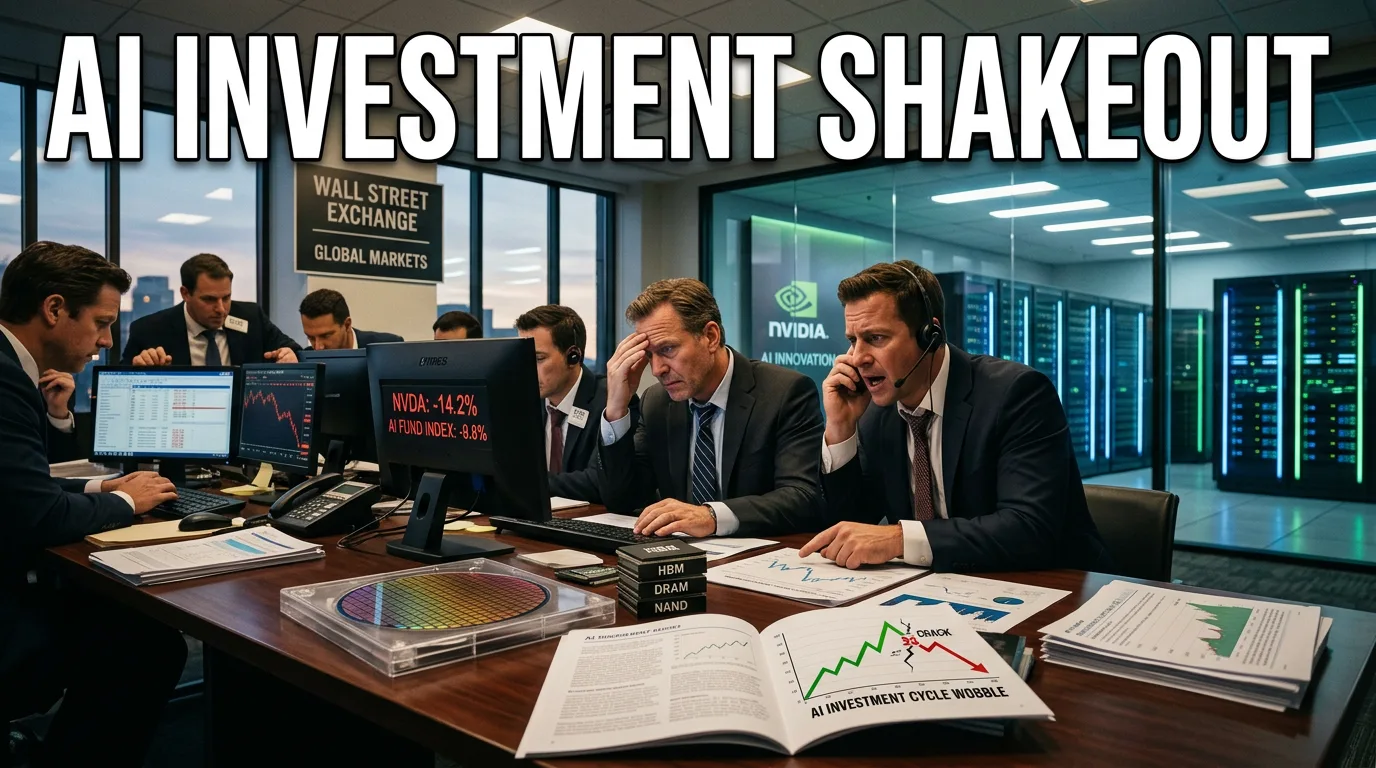
In particular, the part about memory components such as HBM, DRAM, and NAND taking up a rapidly larger share of data center investment costs is relatively undercovered in other news, but it is a core variable that could shape global economic outlook and stock market volatility going forward.
1. First, what needs to be clarified: the original article is not a confirmed news report, but a mix of rumors and interpretation
The original article proceeds on the assumption that Jensen Huang stepped down as Nvidia CEO, Nvidia’s stock fell about 10% in one day, and it dropped 30% from its peak within a month.
However, before using such claims for investment decisions, they must be verified through official disclosures, Nvidia IR materials, major media reports, and SEC filings.
In particular, claims involving a specific individual’s private life, relationships with certain people, illegal export allegations, or blaming specific ethnic or religious groups as hidden forces carry a high risk of slipping into conspiracy theory rather than investment analysis if they are not verified.
Therefore, this article strips away the sensational wording of the original and reinterprets it around structural variables that could actually affect the market.
2. Core news ①: Washington has started to view AI semiconductors as a “strategic weapon”
The first major axis in the original article is the interpretation that U.S. politics is trying to control Silicon Valley.
This may sound like a conspiracy theory, but the overall direction has a realistic basis.
AI semiconductors, especially GPUs, are no longer just IT components; they have become strategic assets directly tied to national security, defense, cyber warfare, financial markets, and industrial automation.
Just like oil, nuclear power, and the defense industry of the past, the AI semiconductor supply chain has become a core element of national competitiveness.
Why Washington is sensitive about Nvidia
-
Nvidia GPUs are core components of generative AI model training and inference infrastructure.
-
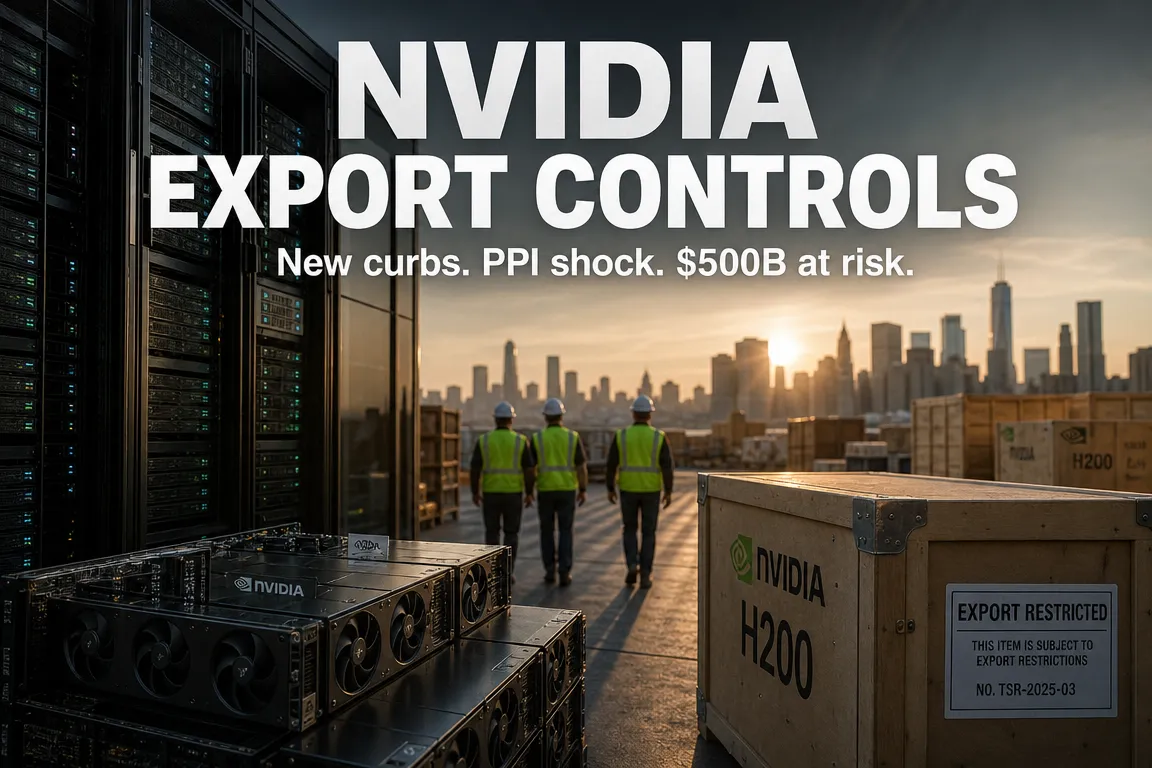
The United States has strengthened export controls on high-performance semiconductors to slow China’s advancement in AI technology.
-
Nvidia is not a company that has completely eliminated dependence on China revenue, so it remains exposed to policy risk.
-
From the U.S. government’s perspective, a single CEO controlling the bottleneck of global AI infrastructure can be seen as burdensome.
The key point investors should focus on here is not “whether politicians dislike Jensen Huang.”
The real core point is that the AI industry is moving from a free-market domain into a national strategy domain.
This change affects not only Nvidia but also AMD, Broadcom, TSMC, Samsung Electronics, SK Hynix, and Micron.
3. Core news ②: Wall Street is more worried about the “AI financial structure” than about AI overheating
The second most important point in the original article is suspicion about a structure in which Nvidia injects funds into a customer’s supply chain, and that customer then buys Nvidia chips again.
Broadly speaking, the market can interpret this structure as vendor financing, circular investment, or AI infrastructure leverage.
Simply put, it is a structure that “creates the customer’s investment capacity in order to sell AI chips.”
Why this could be seen as a problem
-
As AI data center construction costs become enormous, customers are increasingly unable to handle them with internal cash flow alone.
-
The likelihood is increasing that GPU suppliers, cloud companies, private equity firms, and investment banks will jointly build financing structures.
-
In the process, it becomes difficult to distinguish real demand from demand created by financing.
-
If the market decides that part of AI revenue is demand pulled forward by financial structures, valuations can re-rate quickly.
This point is also important when looking at big tech earnings.
Microsoft, Amazon, Google, and Meta continue spending on AI data centers, but investors are now starting to ask not “how much did they invest?” but “when will that investment turn back into cash flow?”
When rates in the U.S. remain high and the payback period for long-term investments becomes longer, AI company stocks can swing sharply even on small disappointments.
4. Core news ③: Nvidia’s weakness may be governance, not technology
One of the more realistic analyses in the original article concerns Nvidia’s governance structure.
Meta’s Mark Zuckerberg, Google’s founders, and some big tech founders maintain strong control rights even with low ownership stakes through dual-class share structures.
By contrast, Nvidia is closer to a standard one-share-one-vote structure, and Jensen Huang’s personal ownership stake is reported to be in the single digits.
The founder’s symbolic influence is overwhelming, but institutionally the company may be more exposed to board and shareholder judgment.
Why this is an investment risk
-
A significant portion of Nvidia’s premium valuation already reflects Jensen Huang’s vision and execution ability.
-
If the market begins pricing in a leadership vacuum, stock volatility can rise regardless of technological strength.
-
Already signed cloud contracts are likely to hold in the short term, but long-term strategic direction can be affected by CEO leadership.
-
Sensitive decisions such as export controls, product roadmaps, China strategy, and customer financing support require strong leadership.
So Nvidia risk is not simply “it’s over if the CEO changes.”
The problem is that AI is moving too fast, and if strategic judgment slows down, competitors and regulators can exploit the gap.
5. Core news ④: The clash between AI safety advocates and open-access advocates is intensifying
The original article explains that Anthropic, the AI safety camp, policy research groups, and some political connections were critical of Jensen Huang.
Claims that a specific group actually led a particular incident require verification.
However, it is clear that within the AI industry, the regulation-tightening camp and the open ecosystem camp are colliding.
The logic of the AI regulation camp
-
High-performance AI can be misused for military, biochemical, and cyberattacks.
-
If cutting-edge chips flow to China and other competitors, it could threaten U.S. security.
-
Therefore, GPU export controls and AI model regulations are seen as necessary.
The logic of the AI open camp
-
If chips are not sold to China at all, China may build its own ecosystem faster.
-
Instead, supplying a certain level of chips within the U.S. ecosystem is seen as necessary to maintain influence.
-
Rather than blocking AI development, they believe it is more important to capture the market first and dominate standards.
This debate could determine the direction of AI infrastructure investment going forward.
If the scale tips toward tighter regulation, Nvidia’s China revenue will be constrained, and data center investment in the U.S. will become more political in nature.
Conversely, if the open-access argument gains strength, Nvidia and semiconductor equipment and memory companies could benefit in the short term.
6. What the market is really afraid of: the cost structure of AI data centers is changing
The most important point that is relatively less covered in other news or on YouTube is exactly this.
We are moving past the era when only GPUs mattered in AI data center investment costs.
Going forward, HBM, DRAM, NAND, power, cooling, networking equipment, land, and transmission infrastructure all become bottlenecks.
In particular, the original article mentions a forecast that memory’s share of cloud capital expenditure could rise from around 47% in 2026 to 68% in 2027.
That figure itself needs further verification, but the direction is extremely important.
Why rising memory share is a big issue
-
AI servers require far more HBM and high-performance DRAM than ordinary servers.
-
As GPU performance rises, memory bandwidth and capacity requirements rise as well.
-
For data center operators, rising memory prices may feel like a bigger burden than GPU prices.
-
If memory prices rise too much, the pace of AI data center investment could slow.
The reason this matters to Korean investors is simple.
Earnings at Samsung Electronics and SK Hynix are heavily driven by HBM pricing and supply agreements.
But if U.S. big tech and cloud firms feel the burden of rising memory prices too strongly, they may try to suppress price increases by using political leverage or customer bargaining power.
In other words, Korean semiconductor stocks must be viewed not only through demand growth, but also through customer margin pressure and U.S. policy risk.
7. Why AI infrastructure stocks like Nebius are falling
The original article cites an example where Nebius Cloud’s earnings were good, yet the stock fell sharply.
Even if earnings are better than expected, EBITDA margins are solid, and a significant portion of future capex is covered by contractual backing or prepayments, the market can still react negatively.
This phenomenon can apply across AI infrastructure companies in general.
Why stocks fall even when earnings are good
-
The market already prices in extremely high growth.
-
If guidance is near the lower end of expectations, it can be interpreted as “growth slowing.”
-
As AI data center investment costs rise, concerns about cash flow increase.
-
Leadership risk related to Nvidia can hurt sentiment across the entire AI infrastructure sector.
In the end, AI infrastructure stocks have become assets that reflect not just growth, but also high interest rates, large debt, long payback periods, and policy risk.
This trend may remain a drag on the market until U.S. interest rates come down.
8. Korean memory companies face both opportunities and risks
From Korea’s perspective, the most realistic question is this.
“If AI investment concerns increase, are Samsung Electronics and SK Hynix good or bad?”
The answer is not simple.
Positive factors
-
HBM demand is structurally increasing as AI servers proliferate.
-
The importance of high-performance DRAM and NAND is also rising.
-
As Nvidia, AMD, and cloud providers launch next-generation chips, memory content per system is likely to increase.
-
In the constrained HBM market, pricing power may work in favor of memory makers.
Negative factors
-
If the U.S. strengthens semiconductor tariffs or supply-chain regulations, costs and uncertainty for Korean companies could rise.
-
If big tech becomes burdened by rising memory prices, long-term contract terms may become tougher.
-
If AI investment slows, companies whose stock prices have overly reflected HBM optimism may face corrections.
-
Stricter China export controls can also affect Korean semiconductor companies’ production bases and customer structures.
Therefore, Korean semiconductor stocks are risky if approached with a simple “HBM demand is rising” mindset alone.
Going forward, investors need to look at the semiconductor supply chain, U.S. policy, big tech capex, and AI data center profitability together.
9. The most important hidden point: AI investment is unlikely to stop, but it will be selectively filtered
Many investors ask whether the “AI bubble will burst,” but a more accurate question is “which parts of AI investment will survive?”
The chance of AI investment stopping altogether is low.
Big tech is already connecting AI to search, advertising, cloud, software, security, robotics, and autonomous driving.
But not every AI infrastructure company can grow at the same pace.
Areas most likely to survive
-
AI infrastructure companies with confirmed customer contracts and cash flow.
-
Data center operators with power access and cooling technology.
-
Memory companies with HBM supply competitiveness.
-
Semiconductor and software companies that lower AI inference costs.
-
Companies that have secured a U.S.-centered supply chain in line with the regulatory environment.
Areas to be cautious about
-
AI infrastructure companies where investment announcements come before revenue.
-
Data center companies with few customers and dependence on financing.
-
Companies with high dependence on China revenue but weak ability to respond to U.S. regulations.
-
Small and mid-cap stocks whose valuations have risen excessively on the AI theme alone.
In other words, the market is not abandoning AI; it is beginning to separate the companies that truly make money from the ones that rely only on the story.
10. Five signals investors should check right now
-
First, Nvidia’s official announcements and board movements.
Whether the CEO risk is real or just rumor could change sentiment across the entire AI sector.
-
Second, the strength of U.S. export controls on semiconductors to China.
If strategies for China-bound products such as H200 and H20 are blocked, Nvidia’s revenue outlook and the global AI supply chain could be shaken.
-
Third, big tech capex guidance.
If Microsoft, Amazon, Google, and Meta cut back or slow AI data center spending, AI infrastructure valuations will come under immediate pressure.
-
Fourth, HBM prices and long-term supply agreements.
The outlook for Samsung Electronics and SK Hynix depends not only on HBM volume, but also on pricing, yields, and customer diversification.
-
Fifth, U.S. interest rates and credit market sentiment.
AI data centers are long-term projects requiring massive funding, so if rates and the corporate bond market worsen, investment pace could slow.
11. Conclusion: the essence of the Nvidia issue is “a reshaping of AI power”
The most sensational part of the original article is the rumor about Jensen Huang stepping down and the hidden forces behind it.
But the real essence moving the market is not the story of who pushed whom out.
It is that power in the AI industry is being redistributed among founders, big tech, Wall Street, Washington, and the semiconductor supply chain.
GPUs are no longer just products; they have become national strategic assets, and data centers are turning into something more like global financial products than simple capital expenditures.
Memory is no longer a secondary component; it has become a core bottleneck in AI infrastructure costs.
So even if the AI investment cycle continues, the stock market is likely to become much more selective about which companies it rewards.
Investors should ask not “AI means it goes up,” but “does this company have real cash flow, policy response capability, supply chain control, and financing power?”
< Summary >
The core point of this issue is the reshaping of power in the AI industry rather than the Nvidia CEO risk.
The U.S. government is viewing AI semiconductors as strategic assets and tightening control.
Wall Street has begun to suspect that AI infrastructure investment structures depend excessively on financial leverage.
The clash between the AI regulation camp and the open camp could change semiconductor export controls and the direction of data center investment.
Korean memory companies are facing both the opportunity of rising HBM demand and the risks of U.S. policy and big tech cost pressure.
AI investment is more likely to be filtered than stopped, and going forward, earnings, cash flow, supply chains, and policy response will be the key criteria.
[Related Articles…]
-
AI Data Center Investment Cycle and the Global Semiconductor Outlook
-
HBM Memory Price Increases and the Outlook for Korean Semiconductor Stocks
*Source: [ 월텍남 – 월스트리트 테크남 ]
– AI 투자 이대로 멈출지도?… 현재 월가와 실리콘밸리에서 도는 무서운 이야기 4가지