● Jackpot Hype, Brutal Crash, Survival Rules
Beyond Turning KRW 200 Million into KRW 3 Billion: Investment Principles from an 80% Loss
Before identifying high-return stocks, investors should establish a portfolio structure that protects financial stability and decision-making during severe losses.
This report examines how to assess exceptional investment outcomes, the impact of an 80% loss on compounding, and the use of investment journals to manage behavioral biases.
It also distinguishes long-term investing from indiscriminate holding, reviews ISA and IRP accounts, and outlines safeguards for AI-assisted investing.
1. Core Assessment|From KRW 200 Million to KRW 3 Billion: Examine the Process Before the Outcome
Cases in which individual investors recover from substantial losses and build significant wealth attract attention.
However, translating such outcomes directly into target portfolio returns is risky.
Asset growth and returns attributable to investment performance are not equivalent measures.
- Additional contributions: Determine whether employment income or proceeds from other asset sales were added during the investment period.
- Leverage: If borrowing or margin financing was used, assess the associated risk alongside returns.
- Valuation basis: Distinguish current portfolio market value from realized assets after taxes.
- Investment path: Examine interim drawdowns, not only the final return.
If KRW 200 million grew to KRW 3 billion over exactly 5 years without contributions or withdrawals, the compound annual growth rate would be approximately 71.9%.
This is a hypothetical calculation, not a verified measure of the cited investor’s actual performance.
Such an exceptional outcome is not an appropriate benchmark for a typical personal investment strategy.
The transferable lesson is the process of documenting mistakes and improving decisions, not the final asset value.
2. Loss Analysis|The Principal Challenge of an 80% Loss Is the Required Recovery Return
Does an 80% gain restore capital after an 80% decline?
No.
If KRW 10 million falls to KRW 2 million, a subsequent 80% gain raises the balance to only KRW 3.6 million.
| Loss | Remaining Capital | Gain Required to Recover Initial Capital |
|---|---|---|
| -10% | 90% | Approximately +11.1% |
| -20% | 80% | +25% |
| -50% | 50% | +100% |
| -80% | 20% | +400% |
The calculation is the magnitude of the loss divided by the remaining capital share.
Required recovery returns rise sharply as losses deepen. Managing the risk of severe losses is therefore essential to preserving compounding.
① Liquidity Risk Can Exceed Price Risk
A displayed share price does not guarantee that an entire position can be sold at that price.
Limited trading volume and insufficient buyers can delay execution or result in substantially lower sale prices.
KONEX is a stock market operated by the Korea Exchange, not an unlisted securities market.
Liquidity risk nevertheless varies by security, trading volume, and order-book depth. Listing status and practical tradability require separate assessment.
② Bonus Share Issues Do Not Create Free Wealth
A bonus share issue generally allocates additional shares by transferring reserves into share capital.
The increase in share count does not itself increase corporate cash holdings or earnings capacity.
For example, a one-for-one bonus issue doubles the share count, while the theoretical price per share adjusts to approximately half its previous level, all else equal.
The relevant measures are total enterprise value and future cash generation, not share count.
3. Investment Psychology|Why Investors Holding the Same Stock Achieve Different Outcomes
Investment decisions extend beyond the initial purchase and final sale.
During the holding period, investors repeatedly choose whether to add, reduce, maintain, or exit a position.
Relying on others for the initial investment rationale can leave subsequent decisions vulnerable to external opinion.
- Fear of missing out: Committing more capital than planned after observing others’ gains.
- Loss aversion: Delaying a sale despite a failed investment thesis to avoid realizing a loss.
- Confirmation bias: Seeking favorable information while disregarding adverse disclosures.
- Disposition effect: Selling profitable positions prematurely while retaining losing positions excessively.
- Overconfidence: Treating several gains in a rising market as evidence of reliable forecasting ability.
These biases are not limited to investors with weak self-discipline.
Procedures that constrain impulsive decisions are more useful than general commitments to remain calm.
Useful measures include reviewing contrary evidence before unplanned purchases and requiring a predefined review period for large orders.
Increasing leverage or shifting into more volatile assets to recover losses warrants particular caution.
4. Practical Tool|An Investment Journal Records Decision Quality, Not Just Returns
An investment journal should do more than record reactions to portfolio gains.
Its primary purpose is to preserve the information and assumptions underlying each capital allocation decision.
Without contemporaneous records, investors may attribute gains to skill and losses to external recommendations.
| Item | Information to Record |
|---|---|
| Initial purchase trigger | Record the actual source of interest, such as a personal recommendation, news report, or earnings release. |
| Investment thesis | Explain which business developments are expected to improve revenue, earnings, and cash flow. |
| Verified facts | Record sources and dates for disclosures, financial statements, and contract information. |
| Contrary evidence | Identify potential weaknesses, including competitive pressure, customer losses, and debt burdens. |
| Purchase valuation | Distinguish business quality from the attractiveness of the current share price. |
| Position size and loss impact | Estimate how a substantial decline would affect total financial assets and living expenses. |
| Review triggers | Define operating developments or financial risks that would prompt consideration of a reduction or exit. |
| Emotional state | Record urgency, confidence, anxiety, and social comparison that may have influenced the decision. |
Evaluate outcomes separately from decision processes.
A price increase does not validate an unsupported purchase, and a loss does not establish that every element of a well-researched decision was flawed.
Repeated errors, however, should lead to changes in trading practices or portfolio weights.
5. Long-Term Investing|Holding Longer Is Not the Same as Remaining Financially Resilient
Long-term investing does not guarantee protection against losses.
Individual companies can lose competitiveness or be delisted. Diversified equity indices can also generate prolonged losses depending on entry valuations and holding periods.
Dividends, fees, taxes, exchange rates, and inflation further affect realized investment outcomes.
Distinguish a Strong Business from an Attractive Investment
- Assess why customers will continue paying for the company’s products and services.
- Determine whether revenue growth translates into earnings and cash flow.
- Review the company’s capacity to service debt and meet funding needs.
- Evaluate whether the current share price already reflects excessive growth expectations.
- Reassess the position if the original thesis fails, regardless of the holding period.
Understanding a business is important, but attachment to it should not obstruct an exit decision.
Studying two or three companies intensively is also distinct from concentrating total assets in two or three stocks.
Compounding Has No Predetermined Turning Point
Assuming a constant 7% annual return, full reinvestment, and no additional contributions, KRW 10 million would grow to approximately KRW 19.67 million after 10 years, KRW 38.70 million after 20 years, and KRW 76.12 million after 30 years.
These illustrative calculations exclude taxes, costs, and inflation and are not return forecasts.
Compounding begins immediately. Its observable impact depends on initial capital, returns, additional contributions, and time.
The objective is not to avoid every unrealized loss, but to reduce permanent capital impairment and forced sales that disrupt long-term plans.
6. Wealth Management|Review Cash Flow and After-Tax Returns Before Pursuing Higher Performance
Factors investors can manage relatively directly include savings capacity, investment costs, funding horizons, and tax treatment.
Macroeconomic research cannot compensate for investing essential living funds in risky assets, which can undermine a long-term strategy.
① Separate Emergency Reserves from Long-Term Investment Capital
Maintain reserves appropriate to personal circumstances for unemployment and unexpected expenses.
Funds needed soon for housing, education, or debt repayment should remain separate from long-term equity capital.
Where debt exists, compare the certain reduction in interest expense from repayment with uncertain expected investment returns.
② ISA and IRP Accounts Offer Different Benefits
| Account | Principal Benefit Structure | Key Constraints |
|---|---|---|
| Pension Savings Accounts and Individual Retirement Pension Accounts | Eligible contributions may qualify for tax credits within applicable limits, with tax deferral during the investment phase. | Review taxation of early withdrawals, termination, and pension distributions, along with account-specific investment restrictions. |
| Individual Savings Accounts | Key benefits include eligible gains-and-losses netting, a limited exemption for net income, and separate taxation of amounts above the exemption. | Review eligibility, minimum holding requirements, contribution limits, and permitted investments. |
ISA contributions do not receive the same contribution tax credits as pension accounts.
The value of tax credits also depends on income, contributions, applicable limits, and actual tax liability.
Tax benefits should therefore not be presented as a uniform, guaranteed deposit-equivalent yield.
Rules may change. Review National Tax Service guidance and financial institution terms applicable at the time of enrollment.
③ Design Diversification Across Three Dimensions
- Time diversification: Regular contributions reduce dependence on a single entry date and the burden of market timing.
- Security diversification: Broad-market index products can reduce the impact of an individual company’s failure.
- Asset diversification: Combine equities, bonds, and cash equivalents according to objectives and investment horizons.
Diversification does not guarantee protection against losses.
Periodic investing does not always outperform lump-sum investing, and interest-rate shocks can cause equities and bonds to decline together.
Diversification aims to reduce dependence on any single source of failure, not to promise maximum returns.
7. AI Investment Trends|Prioritize Recordkeeping and Rule Monitoring Over Prediction
When integrating AI agents into investing, stock selection is not the only relevant question.
A more practical starting point is whether AI can help monitor adherence to predefined investment principles.
- Investment journal analysis: Classify recurring behaviors, including impulsive purchases and position increases following losses.
- Disclosure comparison: Summarize quarterly changes in revenue, earnings, debt, cash flow, and risk disclosures.
- Counterargument review: Identify conditions that could invalidate an optimistic thesis and convert them into review criteria.
- Portfolio monitoring: Support checks for deviations from target weights and overlapping exposures.
Verify AI-generated figures and summaries against original disclosures.
Before submitting portfolio information, remove account numbers, authentication credentials, and other sensitive data, and review the service’s data-handling policies.
Automated trading integrations require order limits, human approval procedures, emergency shutdown controls, and execution logs.
Automating flawed rules can reproduce errors rapidly and repeatedly.
AI can support decisions, but it cannot eliminate loss risk or assume investment responsibility.
8. Overlooked Principles|Investment Discipline Depends on a Resilient Financial Structure
① Financial Capacity Comes Before Psychological Endurance
A willingness to hold through a decline differs from the financial ability to avoid selling.
Emergency reserves, stable income, and manageable debt help investors retain control over their investment horizons.
Long-term investing depends on household cash flow, not determination alone.
② Distinguish Product Returns from Personal Returns
Published fund or ETF returns can differ from investor outcomes because of transaction timing and invested amounts.
An investor who commits substantial capital after a rally and withdraws after a decline can lose money despite strong long-term product performance.
Where contributions are frequent, a money-weighted return calculation such as XIRR can incorporate the timing of cash inflows and outflows.
Fees, taxes, and exchange rates can also contribute to return differences and should be assessed alongside cash flows.
③ Extensive Research Does Not Automatically Justify Concentration
Analysis improves understanding but does not eliminate accounting irregularities, regulatory changes, technological displacement, or customer losses.
The critical question is not the strength of conviction, but the size of the loss that can be absorbed without disrupting the financial plan.
④ Individual Investors Do Not Need to Outperform Institutions to Earn Returns
Differences in information, staffing, and trading infrastructure matter in short-term trading and the pursuit of excess returns.
However, the equity market is not a simple zero-sum system in which every gain requires an equivalent loss elsewhere.
Investors can participate over time in corporate earnings, dividends, and business growth.
Reducing costs and turnover while securing an appropriate investment horizon may be more suitable than competing aggressively on forecasts.
⑤ Macroeconomics Is a Scenario Framework, Not an Answer Key
Inflation and interest rates affect corporate earnings, discount rates, and financing costs.
Rate cuts do not invariably lead to equity gains.
If rates are reduced in response to a recession, deteriorating earnings may have a greater effect.
Market prices reflect earnings, interest rates, liquidity, and expectations, not sentiment alone.
An allocation that remains viable across multiple scenarios is more robust than committing all capital to a single forecast.
9. Action Checklist|Priorities Before Selecting the Next Stock
- Separate essential funds: Distinguish near-term spending needs from long-term investment capital.
- Document holding rationales: Write one sentence each for the investment thesis and contrary evidence for every position.
- Assess concentration: Check whether multiple holdings share the same sector, country, or risk exposure.
- Review costs and taxes: Examine transaction costs, product fees, account tax treatment, and withdrawal conditions.
- Define review rules: Establish conditions for additional purchases, position reductions, and rebalancing.
- Maintain records: Compare decisions with outcomes regularly and correct recurring errors.
The objective of equity investing is not to be correct every time, but to manage capital so that errors do not eliminate future opportunities.
< Summary >
- Assess exceptional investment outcomes only after reviewing additional contributions and risks assumed.
- An 80% loss requires a 400% recovery gain, underscoring the importance of managing severe drawdowns.
- Investment journals preserve decision rationales and emotional context to help reduce recurring errors.
- Long-term investing does not guarantee returns; business quality, valuation, diversification, and cash flow require joint management.
- ISA and IRP accounts have different benefits and restrictions. Selection should reflect after-tax outcomes and funding needs.
- AI is better used for recordkeeping, verification, and rule monitoring than as an unquestioned forecasting authority.
[Related Articles…]
*Source: [ 경제 읽어주는 남자(김광석TV) ]
– [모아보기] 2억이 30억 됐다…마이너스 80%에서 배운 투자 원칙 | 경읽남과 토론합시다 | 최서연x송태헌x김원장
● France Debt Time Bomb, Welfare Crisis, AI Lifeline
France’s Economic Challenges: Public Debt, Welfare Spending, and AI Competitiveness in the European Outlook
France’s primary risk is not imminent sovereign collapse, but the erosion of its capacity to invest in future growth as debt servicing absorbs fiscal resources.
This report examines the interaction between public debt and welfare spending, conditions for European Central Bank support, shifts in African resource supply chains, and the potential contribution of AI to growth.
Analysis based on the supplied material dated November 17, 2026.
Fiscal figures for 2026 and claims about the scale and spread of individual protests have not been verified against current official data. Claims requiring verification are distinguished from established institutional facts.
1. France’s Central Challenge Is Shrinking Policy Flexibility, Not Economic Collapse
Attributing France’s economic difficulties solely to extensive welfare provision overlooks broader structural pressures.
Growth is slowing while pensions, healthcare, defense, and interest payments continue to require spending that is difficult to reduce.
- Low growth: Weak corporate earnings and labor income constrain revenue growth.
- Population aging: Pension and healthcare expenditure face sustained structural pressure.
- Interest costs: Refinancing sovereign debt at higher rates reduces resources available for other priorities.
- Security expenditure: Defense spending competes with welfare, education, and infrastructure investment.
The government must combine tax increases, expenditure adjustments, additional borrowing, and growth measures.
Each option imposes costs on particular groups, complicating political consensus.
France’s fiscal challenge therefore concerns both financing and social agreement on how adjustment costs should be distributed.
2. Debt Sustainability Depends More on Growth and Interest Rates Than on the Debt Stock Alone
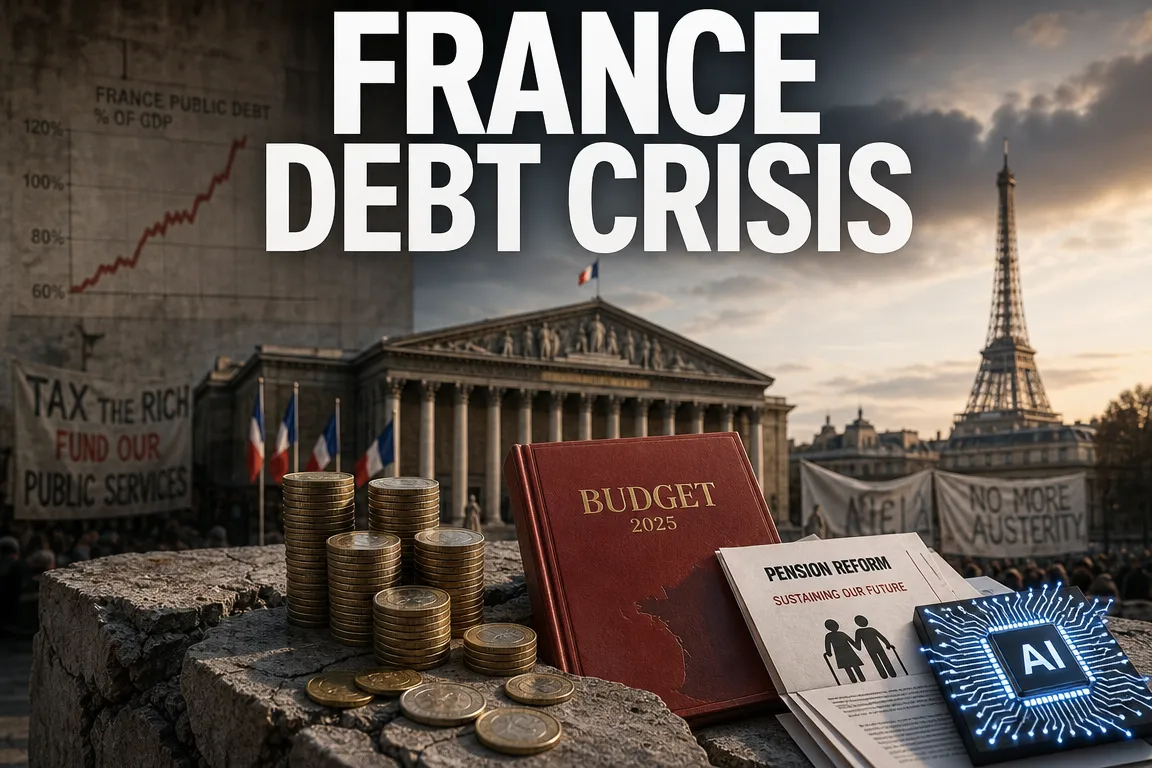
The supplied material cites public debt of approximately 119% of GDP and annual sovereign interest costs equivalent to approximately KRW 100 trillion.
Before treating these as confirmed 2026 statistics, the reporting period, government coverage, and conversion exchange rate require verification against French national statistics and Eurostat data.
GDP-based ratios are more useful for international comparisons than won-denominated amounts, which fluctuate with exchange rates.
Three variables are central to assessing debt sustainability.
- Nominal economic growth: The expansion of economic output reflecting both real growth and inflation.
- Average effective interest rate on government debt: The average cost of the outstanding debt stock, rather than the yield on newly issued bonds.
- Primary fiscal balance: The balance between government revenue and expenditure excluding interest payments.
Stabilizing the debt-to-GDP ratio generally becomes more difficult when the average interest rate exceeds nominal growth and primary deficits persist.
Conversely, stronger growth and an improving fiscal balance can reduce risks even when debt is high.
Higher market yields do not immediately translate into an equivalent increase in interest costs across the entire debt stock.
The maturity profile determines how refinancing costs accumulate over several years.
3. Welfare and Public-Sector Reform: Composition Matters More Than the Scale of Cuts
France ranks among countries with high social expenditure relative to GDP.
Social expenditure includes pensions, healthcare, family benefits, and unemployment support; these categories should not be treated as economically interchangeable.
① Pension Reform Must Address Both Contributions and Benefits
France’s pension system is predominantly pay-as-you-go, with current workers’ contributions financing current pension benefits.
Contributor numbers, employment rates, wages, and benefit duration directly affect its finances.
Raising retirement or pension eligibility ages can shift costs to unemployment benefits and other programs if older workers cannot remain employed.
The 2023 reform legislated a gradual increase in the statutory pension eligibility age from 62 to 64. Any subsequent changes in 2026 require separate verification.
② Public-Sector Reform Must Consider Service Productivity Alongside Staffing
Countries classify teachers, healthcare workers, and public-agency employees differently.
Cross-country differences in public-sector wage bills cannot therefore be interpreted directly as available budget savings.
Reducing administrative duplication and inefficiency is necessary, but cuts that worsen frontline shortages in healthcare and education may increase long-term costs.
③ Neither Tax Increases nor Tax Cuts Offer an Automatic Solution
Higher taxes can raise revenue, but their effects on tax-base mobility and investment require assessment.
Tax cuts can widen deficits if they fail to generate sufficient investment and employment.
Policy design must balance tax equity, realized revenue effects, investment incentives, and measures against tax evasion.
4. European Protests and Housing Pressures: Living Costs Are Eroding Purchasing Power
European social tensions cannot be explained solely by resistance to welfare reductions.
For younger households, living standards can deteriorate even when wages rise if rent and essential expenses increase faster.
- Housing costs: In employment centers, insufficient housing supply allows rents to absorb a growing share of income.
- Employment insecurity: Delayed access to stable employment postpones independent living, marriage, and asset accumulation.
- Weaker public services: Deteriorating education, transport, and healthcare services can increase households’ out-of-pocket costs.
Short-term rental platforms can reduce long-term rental supply in some tourist destinations.
Housing pressures also reflect insufficient construction, urban concentration, permitting constraints, and financing costs.
Rental regulations differ across European countries.
Rather than assuming that one protest movement spread directly across borders, a more robust interpretation is that shared pressures from living costs, housing, education, and security are producing country-specific responses.
Names alone do not establish the origins or immigration backgrounds of violent participants, and unverified proportions should not be generalized to entire protest movements.
5. ECB Support for France: Understanding the TPI
The European Central Bank does not finance individual countries’ welfare budgets.
Its central responsibilities are price stability and the effective transmission of monetary policy across the euro area.
① The TPI Addresses Disruption in Sovereign Bond Markets
The Transmission Protection Instrument is a bond-purchase tool available when unwarranted, disorderly market dynamics threaten monetary policy transmission.
Purchases have no predetermined quantitative limit, but this does not imply unconditional, unlimited support.
② Eligibility Assessments Include Fiscal and Economic Policy
Key considerations include compliance with EU fiscal rules, severe macroeconomic imbalances, debt sustainability, and sound economic policies.
Describing a separate bailout austerity program as a mandatory TPI requirement would conflate it with other support mechanisms.
③ Bond Purchases Do Not Automatically Trigger Euro Depreciation
Exchange rates reflect interest-rate differentials, growth expectations, market confidence, and global capital flows.
Intervention that stabilizes markets can strengthen confidence in the euro.
Assessments of Europe’s economic outlook should track both French sovereign yields and the yield spread between French and German government bonds.
A widening spread alone does not establish an imminent sovereign default or ECB intervention.
6. France’s Reduced Influence in Africa: A Supply-Chain Issue, Not Direct Evidence of Welfare-System Failure
Changes in France’s influence in Africa are important geopolitical variables affecting energy, minerals, logistics, and security costs.
Establishing a causal link between declining benefits from Africa and the deterioration of France’s welfare finances would require substantially more detailed fiscal and trade evidence.
First, monetary arrangements must be distinguished by region.
The CFA franc comprises separate West African and Central African monetary systems.
Reforms to the West African system have included ending mandatory foreign-exchange reserve deposits with the French Treasury. Historical arrangements should not be assumed to apply unchanged to all member countries.
Second, resource disruptions are distinct from industrial collapse.
Changes in relations with Niger may complicate uranium procurement, but France’s nuclear fuel supply chain cannot be characterized as dependent on a single country.
Assessment requires consideration of supplier diversification, inventories, long-term contracts, and fuel-processing stages.
Third, cooperation with China and Russia requires contract-specific analysis.
African countries are diversifying their partners for security assistance and infrastructure investment.
Not all Chinese infrastructure financing produces long-term operating concessions, while Russian security arrangements vary by organization and country.
For Korean companies, the key issues are changes in mineral access rights, local processing requirements, logistics costs, and contractual stability rather than shifts in influence alone.
7. Can AI Support France’s Economic Recovery?
Characterizing France as an economy sustained only by luxury goods and tourism understates its industrial capabilities.
France retains strengths in aerospace, nuclear energy, defense, and industrial software, alongside AI companies such as Mistral AI.
Individual researchers moving abroad do not establish a comprehensive loss of domestic innovation capacity.
However, possessing AI talent is not equivalent to capturing domestic economic value from AI.
- Growth capital: Promising companies need funding to move beyond research and development into global sales and infrastructure expansion.
- Computing infrastructure: Competitiveness depends on GPU access, electricity supply, data-center connectivity, and operating costs.
- Industry adoption: AI must generate measurable productivity gains in manufacturing, finance, healthcare, and public administration.
- Domestic value capture: Research outcomes must be assessed against their contribution to domestic revenue, employment, and tax receipts.
In the public sector, AI could improve document processing, service-request classification, and procurement analysis.
Initial deployment nevertheless entails system integration, data preparation, security, and training costs.
The appropriate test is whether AI improves service delivery within a given budget, rather than whether adoption immediately reduces public-sector payroll costs.
8. A Critical Risk: Debt Service Crowding Out Future Investment
① The Composition of Fiscal Consolidation Matters More Than Headline Cuts
As difficult-to-adjust spending such as interest payments and pensions rises, education, research and development, and infrastructure maintenance may face disproportionate pressure.
Such cuts can reduce deficits initially while weakening long-term productivity and revenue, potentially renewing fiscal stress.
Budget announcements should therefore be assessed by the categories affected, not just the aggregate reduction.
② Sovereign Debt Risk and Corporate Investment Attractiveness Are Distinct
Companies with substantial overseas revenue may perform differently from France’s domestic economy.
Even globally competitive businesses can be affected by fiscal deterioration through government procurement exposure and financing costs.
Investors should distinguish revenue geography, debt structure, pricing power, and policy dependence rather than rely on corporate nationality.
③ Fiscal Sustainability and Growth Investment Are Not Mutually Exclusive
Reducing low-impact spending while protecting education, infrastructure, and innovation can support long-term fiscal sustainability.
Conversely, investment expansion without rigorous assessment of economic returns can merely increase debt.
The central issue is not government size alone, but the social and economic outcomes generated from a given level of taxation.
9. Indicators for Korea and Investors to Monitor
France’s experience does not imply that Korea should indiscriminately reduce welfare or focus exclusively on corporate support.
The principal lesson is to establish fiscal priorities and productivity strategies before population aging places greater pressure on public finances.
| Indicator | Analytical Significance |
|---|---|
| French–German sovereign yield spread | Relative credit-risk perceptions and market stress affecting France |
| Interest expenditure as a share of government revenue | The share of revenue absorbed by servicing existing debt |
| Primary fiscal balance and nominal growth | Underlying conditions for stabilizing the debt-to-GDP ratio |
| Employment rate and labor productivity | Potential improvement in pension financing and the long-term tax base |
| Composition of education, research and development, and public investment spending | Whether fiscal adjustment is weakening future growth capacity |
| AI adoption outcomes and private capital expenditure | The extent to which technological capabilities translate into output and earnings |
Global asset allocation requires separate assessments of sovereign finances, industrial competitiveness, corporate earnings, and currency risk rather than a blanket negative judgment on Europe.
France’s trajectory will depend less on protest intensity than on its ability to build consensus for fiscal adjustment while preserving the foundations of growth.
< Summary >
- France’s central economic risk is the narrowing of policy flexibility through low growth and rigid expenditure commitments.
- Debt sustainability requires joint assessment of growth, average interest costs, and the primary fiscal balance.
- Welfare reform should emphasize employment and service efficiency rather than cuts alone.
- The ECB’s TPI is not unconditional bailout financing, and intervention does not automatically weaken the euro.
- Changes in France’s African influence should be assessed through resource, logistics, and security supply chains.
- AI competitiveness depends on converting talent into domestic productivity, revenue, and tax receipts.
- Korea also needs to preserve fiscal capacity while protecting education, research and development, and other foundations of future growth.
[Related Articles…]
*Source: [ Jun’s economy lab ]
– 프랑스가 몰락한 진짜 이유(ft.손진석 기자 1부)