● AI Data Center Financing Crackdown
NVIDIA Jensen Huang Return Possibility, the core point is not a “CEO personal issue” but the AI infrastructure financing structure
The real point to look at in this issue is not simply, “Will Jensen Huang come back?”
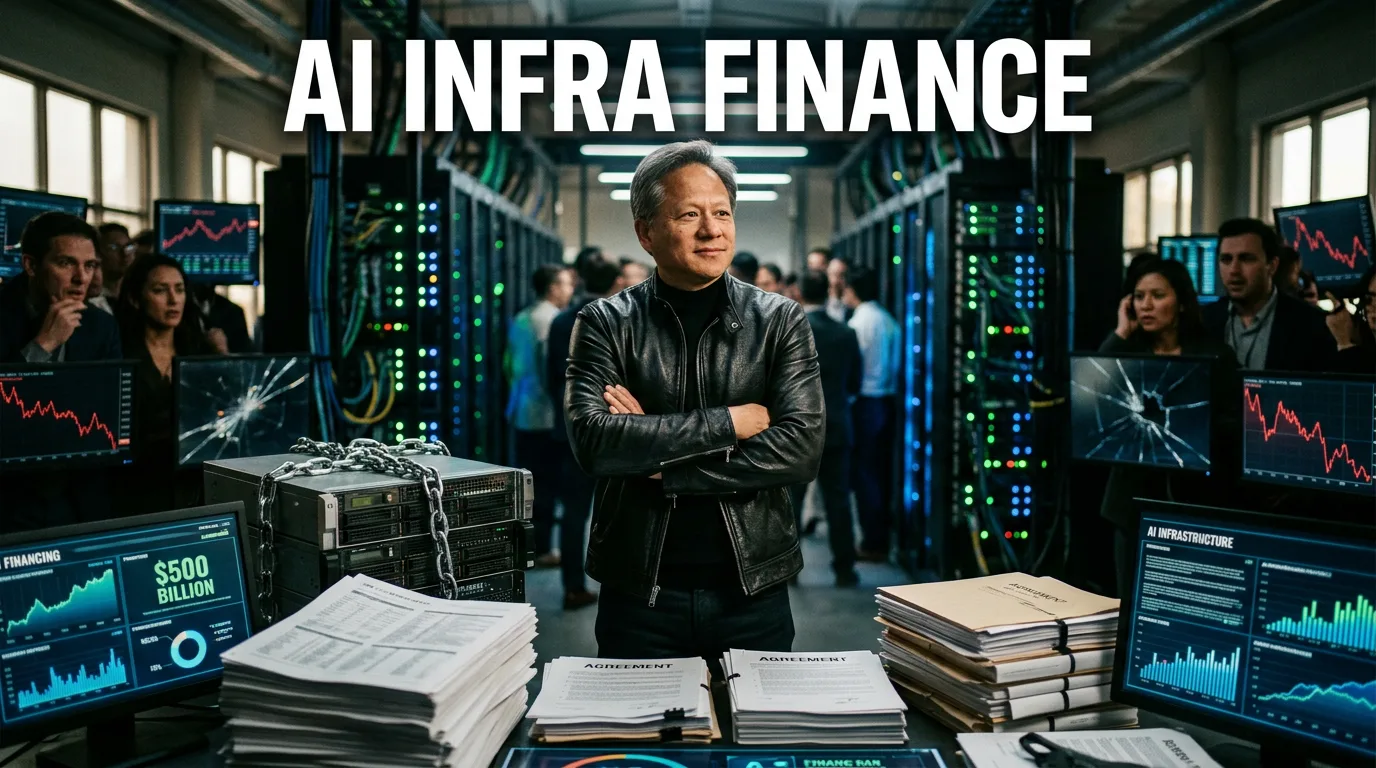
The core point is that the $500 billion in AI infrastructure investment promised by Wall Street has not actually been deployed.
And behind that, the data center operators, NVIDIA chip purchases, loan collateral values, semiconductor supply chains, and even the AI bubble debate are all intertwined at once.
On the surface, it looks like an NVIDIA CEO return issue, but underneath, it is closer to a collision between global capital markets and the AI data center investment cycle.
In particular, the fact that Jensen Huang publicly said, “If the board wants it, I can return,” can be seen not as a simple personal statement, but as a move aimed at both NVIDIA’s governance and restoring investor trust.
1. Wall Street’s $500 billion AI infrastructure investment, why has it still not been deployed?
Six major U.S. financial firms said they would raise more than $500 billion for AI infrastructure construction.
However, three months later, reports emerged that the funds had not actually been deployed, changing market sentiment.
At first glance, AI infrastructure investment sounds spectacular.
But for money to actually move, profitability for data center operators, NVIDIA GPU prices, power costs, interest rate burdens, and collateral recovery potential must all be calculated.
From Wall Street’s perspective, it is difficult to lend hundreds of billions of dollars immediately based only on the outlook that “AI will grow.”
When financial firms make loans, they look first at the worst-case scenario.
If the data center business fails, how much can be recovered by reselling NVIDIA chips?
If GPU secondhand value alone is not enough to recover the loan, the financial firms may ask NVIDIA to guarantee part of the losses.
This is the key point of the issue.
AI infrastructure investment is no longer just a technology industry issue; it has become a matter of Wall Street loan underwriting.
2. Why do data center operators need to borrow money to buy NVIDIA chips?
Building AI data centers requires enormous upfront capital.
When servers, GPUs, cooling equipment, power infrastructure, land, and network equipment are all included, it becomes not a simple IT investment but a massive infrastructure project.
In particular, NVIDIA AI chips are currently regarded as the most important assets in the AI training and inference market.
The problem is the price.
Data center operators must purchase NVIDIA GPUs in bulk, but they cannot easily handle this with equity alone.
So a structure is created in which they borrow from Wall Street financial firms to buy the chips.
In that case, the financial firms do not look only at the data center operator’s future revenue.
They also look at how valuable the NVIDIA chips they purchase are as collateral.
In other words, NVIDIA GPUs have become not just a product but a core collateral asset in AI infrastructure financing.
3. Wall Street looking at Broadcom and NVIDIA financing conditions at the same time
In June, Apollo and Blackstone announced an initial $35 billion financing deal with Broadcom.
What is interesting is that the names of these financial firms later also appeared in AI infrastructure financing announcements related to NVIDIA.
This means the same Wall Street firms can compare Broadcom and NVIDIA financing conditions at the same time.
No matter how outstanding Silicon Valley’s semiconductor technology is, Wall Street ultimately decides the loan terms for buying those chips.
Broadcom and NVIDIA are technology companies, but now they are also competing in capital-raising conditions.
Especially as the AI semiconductor market grows, not only technical strength but also “who can present a transaction structure the financial sector will accept more readily” becomes important.
This is a very important variable in future AI infrastructure investment competition.
4. Why the market is paying attention to Jensen Huang’s resignation and return message
Jensen Huang expressed gratitude in his statement to those who showed kindness to him and his family.
He said he came to the United States 53 years ago and is proud to have obtained citizenship.
He also described NVIDIA as the work of his life.
But at the same time, he acknowledged that he failed to meet the company’s standards and that there was serious personal misconduct.
He expressed regret over the situation caused by this issue and said he would cooperate with an independent investigation.
The important phrase is “my departure,” meaning he clearly referred to his own stepping down.
However, he said employees, investors, partners, and customers are asking for his return.
And he said it would be an honor to return as CEO if the board judged that it would benefit shareholders, employees, the company, and the United States.
This statement directly reveals a willingness to return while clearly signaling that the board has the final decision.
5. The return condition is not “personal will” but the board and shareholders decide
Jensen Huang designed the message in a structure of “I can return if the board calls me.”
This expression is highly strategic.
He did not say he would return unconditionally; he drew a line that it would be possible only if the board determined it was beneficial for the company and shareholders.
By saying it this way, responsibility for the return shifts from the individual to the board’s judgment.
At the same time, because employees, investors, partners, and customers publicly asked for his return, the board has no choice but to be aware of market scrutiny.
It is also important that Jensen Huang posted this message on a public platform.
He let the market know who was demanding his return, and now the board is effectively in a position where it must publicly respond to that demand.
6. NVIDIA’s earnings are strong, so why is the market uneasy?
NVIDIA mentioned in its earnings release that revenue more than doubled from the same period last year.
The business itself is still strong.
Demand for AI semiconductors remains high, and data center revenue continues to grow.
But the stock market does not look only at earnings.
The faster a growth company expands, the more the market also watches CEO risk, supply chain risk, and large-scale financing risk.
NVIDIA is not just a semiconductor company; it is the central pillar of the global AI industry.
So a CEO vacuum or uncertainty in governance can affect sentiment across the entire AI infrastructure investment landscape.
Especially if Wall Street has still not deployed large-scale funds, investors will ask whether NVIDIA can grow at the same pace without Jensen Huang.
7. Why reactions from Trump, Musk, Sam Altman, and Tim Sweeney matter
This issue is not just an internal corporate matter.
Because it involves NVIDIA, a central company in the AI industry, politicians, big tech firms, and investors are all reacting.
Tim Sweeney took a position that was closer to supporting Jensen Huang’s return.
Sam Altman said he was shocked, but withheld judgment.
Investor Gavin Baker mentioned the possibility of a conditional return.
The reason these reactions matter is that each party has different interests.
The gaming and platform industries look at GPU ecosystem stability.
AI model companies look at NVIDIA’s supply chain and computing costs.
Investors look at governance and stock volatility.
Politicians look at U.S. AI dominance and national competitiveness.
In the end, whether Jensen Huang returns is not just a matter for one company; it is expanding into an issue of U.S. AI strategy, the global semiconductor supply chain, and Wall Street capital allocation.
8. The real core point that is not often discussed elsewhere
The most important part of this issue is not Jensen Huang’s return itself, but the fact that “AI infrastructure investment is getting stuck at the stage where actual cash must be deployed.”
In the market, AI is discussed as a future growth industry, but the financial sector approaches it far more coldly.
If the data center cannot make money, the loan must be recovered.
What remains then are the building, power contracts, servers, and NVIDIA chips.
If the financial firm values chip collateral too low, loan terms worsen.
If loan terms worsen, data center operators delay investment.
If investment is delayed, NVIDIA’s revenue growth rate is also pressured.
In other words, the bottleneck in the AI boom is not just GPU production volume.
Going forward, “who can raise capital for AI data center investment at the lowest cost” is likely to become the key competitive advantage.
From this perspective, Jensen Huang’s return is not just a restoration of leadership.
It could be an event that signals to Wall Street and customers that “NVIDIA’s AI infrastructure growth story continues.”
9. Investment checkpoints to watch
First, the board decision.
Whether Jensen Huang returns will ultimately be decided by NVIDIA’s board.
If the board allows his return, the market may see it as a short-term stability signal.
Conversely, if returning is deemed difficult, the competence and strategy of the successor CEO will immediately be put to the test.
Second, the results of the independent investigation.
The specific details of the personal misconduct Jensen Huang referred to, and the investigation results, are key variables that will determine the possibility of his return.
Investors will have no choice but to place more importance on legal and ethical risk than on emotional support.
Third, whether AI infrastructure funds are actually deployed.
It is important whether the announced $500 billion actually turns into investment.
Announcements create expectations, but actual deployment creates performance.
Fourth, the possibility of NVIDIA’s guarantee burden.
If financial firms require NVIDIA to guarantee losses on data center loans, that could become a future financial risk.
The moment NVIDIA becomes not just a seller but part of the financing structure, the company’s risk profile changes.
Fifth, the competitive landscape in AI semiconductors.
Broadcom, AMD, and big tech companies developing their own AI chips may try to exploit NVIDIA’s gap.
The longer Jensen Huang’s leadership vacuum lasts, the more opportunities arise for competitors.
10. Conclusion: the possibility of Jensen Huang’s return is a “market stability card,” but the core point is the flow of money
Whether Jensen Huang actually returns still depends on the board’s judgment and the results of the independent investigation.
But the reason the market is reacting strongly to the possibility of his return is clear.
NVIDIA is currently the central company in the AI infrastructure investment cycle, and Jensen Huang is the figure who represents that growth story.
However, what investors should look at more deeply is not the CEO return news.
They need to check whether Wall Street’s funds are actually flowing into data centers and GPU purchases.
The AI industry does not move on technological innovation alone.
Growth requires interest rates, loan terms, collateral value, and capital market trust to all work together.
In the end, the most important question when looking at NVIDIA and the AI industry going forward is this.
Not “Is AI demand strong?” but “Is the money to support that demand actually being deployed?”
< Summary >
The core point of the NVIDIA Jensen Huang return issue is not a CEO personal issue but the AI infrastructure financing structure.
The $500 billion in AI infrastructure investment promised by Wall Street has not yet turned into actual deployment.
Data center operators need loans to buy NVIDIA chips, and financial firms are weighing GPU collateral value and the possibility of loss guarantees.
Jensen Huang issued a conditional message saying he could return if the board believes it would benefit shareholders and the company.
Investors should pay more attention than to the return itself to whether AI infrastructure funds are actually being deployed and whether NVIDIA will end up taking on financial risk.
[Related Articles…]
AI Infrastructure Investment Cycle and Data Center Growth Outlook
NVIDIA Semiconductor Supply Chain and Global Capital Market Changes
*Source: [ 월텍남 – 월스트리트 테크남 ]
– 트럼프 “젠슨이 돌아왔음 좋겠다”…진짜 가능할까?