● Tesla FSD Europe Showdown – 15 Nations or Bust
Tesla FSD Approval in Europe: The 15-Country, 65%-Population Threshold and Key Variables for Shareholders at $380
The key issues for Tesla’s European autonomous-driving business are approval conditions and the pace of revenue conversion, rather than the voting date.
This report examines national voting thresholds, Germany’s regulatory requirements, the distinction between robotaxis and FSD, and the implications of interest rates and AI investment sentiment for Tesla shares.
1. European FSD Approval: The Double-Majority Requirement Matters More Than Timing
The supplied material states that a European vote on Tesla FSD was postponed from December 1 to December 15. The schedule has not been independently verified against official sources.
Even if confirmed, a delay alone would not indicate a higher probability of approval or rejection.
Potential explanations include further review, adjustments to technical conditions, and consultations among member states.
Investors should first verify the applicable voting procedure and the composition of supporting countries.
The EU’s standard qualified-majority threshold requires support from at least 55% of member states—at least 15 of 27 countries—representing at least 65% of the EU population.
Whether and how this threshold applies to the automotive technology proposal requires confirmation through the relevant committee documents and legal framework.
- Country threshold: Support from a few populous countries is insufficient.
- Population threshold: Support from numerous smaller countries may still fall short of the required population share.
- Voting intentions: National authorization for use must be distinguished from a country’s final vote at the EU level.
An increase in the number of countries permitting use does not necessarily mean that sufficient votes have been secured for EU-wide approval.
2. Why German Support Alone Would Not Be Sufficient
The supplied material identifies 12 countries with existing approvals, representing approximately 29% of the EU population.
Assuming these figures are accurate and all 12 countries vote in favor, the following scenarios apply. These are hypothetical calculations, not verified voting positions or approval probabilities.
| Assumed Supporting Countries | Country Count | Share of EU Population | Assessment |
|---|---|---|---|
| Existing 12 countries | 12 | Approximately 29% | Below both thresholds |
| Existing countries + Germany | 13 | Approximately 47% | Below both thresholds |
| Existing countries + Germany + France | 14 | Approximately 62% | Below both thresholds |
| Existing countries + Germany + Spain + Poland | 15 | Approximately 66% | Meets both thresholds under these assumptions |
Germany would be influential, but its support alone would not be sufficient. Accurate calculations require a non-overlapping country list, official population figures, and confirmed voting intentions.
Additional support from other populous member states could still be required.
Investors should therefore focus on which countries support approval and under what conditions, rather than simply counting additional national authorizations.
3. Germany’s Regulatory Requirements: Responsibility Boundaries Matter More Than Feature Restrictions
The supplied material refers to changes in European product naming, narrower settings for speeds above posted limits, and steering-wheel grip requirements at high speeds.
Implementation and scope require verification through Tesla’s regional manuals, software release information, and regulatory approval documents.
The central regulatory question is clear:
To what extent may drivers rely on the system, and when must they intervene?
- Naming and descriptions: Disclosures must prevent driver-assistance features from being mistaken for fully autonomous driving.
- Speed settings: Configurable system speeds are distinct from legally permitted road speeds.
- Driver supervision: Hands-free operation under certain conditions does not necessarily eliminate the obligation to monitor the road or the driver’s responsibility.
A setting that allows a speed 10% above the posted limit must not be interpreted as legal permission to exceed that limit.
From an investment perspective, feature restrictions are not necessarily negative.
Modifying certain features to access a larger market may be commercially rational.
However, restrictions that reduce perceived convenience could weaken subscription conversion.
4. After European Approval: Subscription Conversion Matters More Than Vehicle Sales Alone
European approval would not automatically make identical features available in every country or vehicle.
Investors must assess the final approval scope, vehicle hardware, software versions, and regional rollout schedules.
Approval for supervised FSD is distinct from authorization to operate a driverless robotaxi service.
The following relationship is central to evaluating Tesla’s software business:
Annual subscription revenue ≈ Eligible vehicles × Paid conversion rate × Average monthly subscription price × 12 months
- Eligible vehicles: Assess both new vehicle sales and the installed fleet capable of supporting the service.
- Paid conversion rate: The proportion of free-trial users who become paying customers is critical.
- Subscription retention: Continued usage determines the quality of recurring revenue.
- Operating costs: Include AI computing, adaptation to mapping and road conditions, customer support, and regulatory compliance.
For illustration, 1 million eligible vehicles, a 10% paid conversion rate, and a monthly subscription price of €100 would generate approximately €120 million in annual subscription revenue.
This is not a forecast of Tesla’s European pricing or results. It assumes stable subscriber numbers and pricing throughout the year; actual revenue would depend on subscription timing, cancellations, discounts, and exchange rates.
Market access is the starting point; sustained willingness to pay is the foundation of monetization.
5. Three Risks for Tesla Shareholders with a $380 Cost Basis
The supplied closing price of $380.14 and intraday price near $357 lack a verified trading date.
They should be treated as examples of volatility, not current quotations or trading thresholds.
① Broad U.S. Equity Market Risk
If AI and semiconductor stocks declined concurrently, Tesla’s performance cannot be attributed solely to European approval developments.
Technology-sector sentiment, bond yields, and trading volume should also be assessed.
② Valuation Risk from Interest Rate Expectations
Companies whose valuations depend heavily on future earnings are sensitive to changes in discount rates.
Persistently high rates can reduce the present value of expected long-term cash flows.
The release dates of the cited PCE inflation and GDP figures require verification. A single inflation release is insufficient to establish that further Federal Reserve rate increases are likely.
③ Tesla-Specific Execution Risk
European approval delays, electric-vehicle pricing competition, FSD subscription conversion, and robotaxi operating costs are company-specific variables.
A share-price recovery does not establish that regulatory risks have been resolved, and regulatory progress does not automatically improve automotive profitability.
Even with a $380 cost basis, investment decisions should reflect current valuation, investment horizon, portfolio exposure, and loss tolerance rather than the purchase price alone.
6. Assessing Robotaxi and Space-Based Data Center Developments Separately
Robotaxis: Technology demonstrations and paid commercial operations represent different stages.
In California, investors must distinguish among permits for testing with a safety driver, driverless testing, commercial deployment, and passenger transportation.
The DMV’s vehicle-technology oversight role differs from the CPUC’s oversight of passenger transportation services.
Rather than assuming that every operator follows an identical sequence, investors should verify the precise scope of each company’s permits.
Whether a company has applied for driverless testing authorization is not, by itself, evidence of technological superiority or weakness.
Application strategy, safety validation, operational readiness, and business priorities may all influence the decision.
Service-area expansion should be evaluated alongside the following metrics:
- Vehicles deployed and available operating hours
- Paid trips and revenue per vehicle
- Remote-assistance frequency and safety metrics related to incidents and interventions
- Operating costs, including insurance, maintenance, cleaning, and charging
Space-Based Data Centers: Approval, construction, and monetization are separate milestones.
The supplied claims concerning SpaceX approval for up to 1 million satellites, substantial data center investment, and merger negotiations could have significant investment implications. They should not form part of an investment thesis without official verification.
Verification should begin with FCC orders and docket numbers, company announcements, and relevant regulatory filings.
AI data center investment must be assessed not only by project scale but also by power procurement, cooling, communications latency, equipment replacement, and financing costs.
An increase in SpaceX’s business value does not automatically accrue to Tesla shareholders.
Any economic benefit to Tesla must be assessed through actual ownership interests, contracts, and transaction terms.
7. The Central Issue: The Economics of Approval
First, the number of approving countries is not a proxy for revenue potential.
EU population shares matter for voting, while national Tesla vehicle fleets and purchasing power for paid services have a more direct influence on revenue.
Countries critical to securing approval may not be the largest subscription markets.
Second, approval delays may create both timing costs and development costs.
A delayed launch defers revenue, while additional requirements may increase development, validation, and support expenses.
However, concluding that a two-week delay materially damages long-term enterprise value would be excessive.
The key distinction is between a short scheduling adjustment and a structural delay caused by changes in approval requirements.
Third, greater regional variation in features may reduce software-business efficiency.
Maintaining different features and supervision requirements across countries could complicate validation and update management.
Long-term profitability depends not only on the number of approved markets but also on the extent to which a common product can serve them.
Fourth, rejection, reconsideration, and requests for additional information are different outcomes.
The impact of an adverse EU-level decision on existing national approvals depends on the authorization framework and the legal effect of the final decision.
It would therefore be inappropriate to assume that rejection automatically requires immediate suspension in countries with existing approvals.
The central investment question extends beyond when approval occurs to the conditions attached and the recurring revenue it can generate.
< Summary >
- The European FSD voting schedule and national approval status require confirmation through official documents.
- If the 15-country and 65%-population thresholds apply, both requirements must be met.
- German support alone would not be sufficient; the positions of other large member states matter.
- Supervised FSD approval and driverless robotaxi operating authorization are separate matters.
- Tesla’s share price reflects U.S. equity market conditions, interest rate expectations, and execution alongside regulatory developments.
- Long-term monetization depends more on paid conversion, subscription retention, and operating costs than on the number of approving countries.
[Related Articles…]
*Source: [ 오늘의 테슬라 뉴스 ]
– 유럽 FSD 표결 2주 연기 — 27개국 중 15개국, 인구 65%의 산수, $380 테슬라 주주는?
● Rate Shock, Won Surge, Housing Squeeze
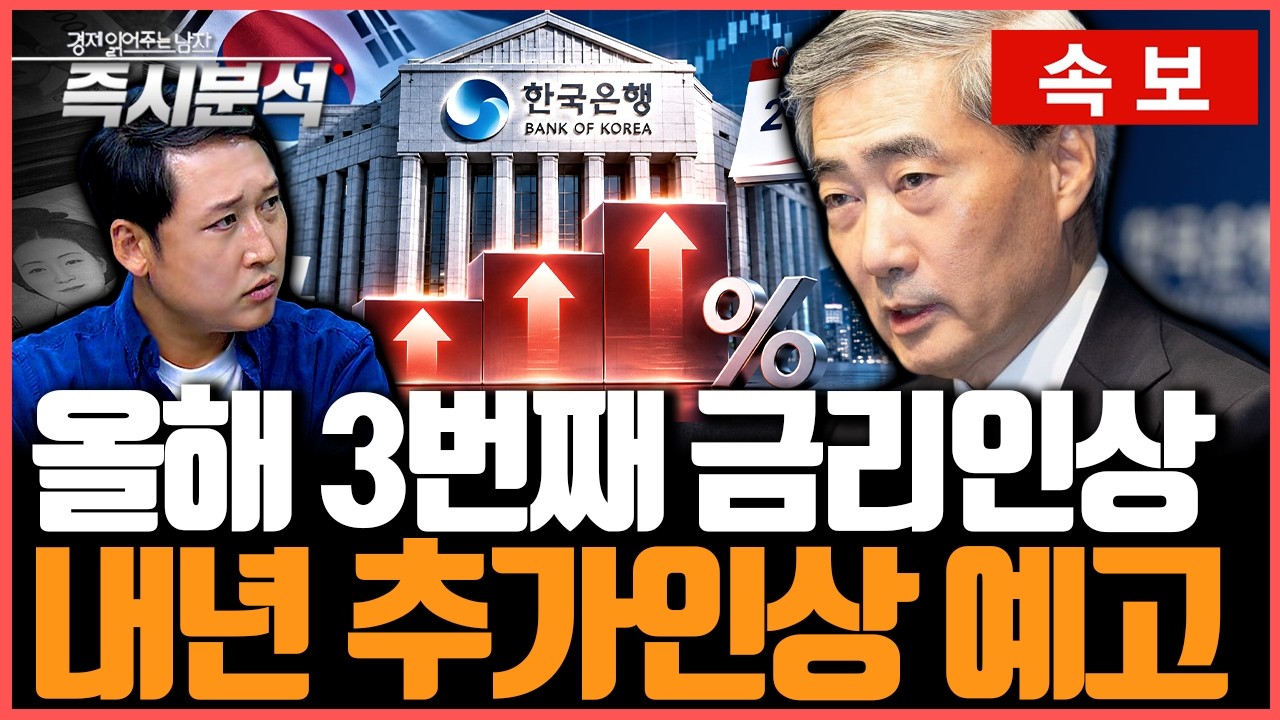
Bank of Korea Rate-Hike Scenario to 3.25%: Implications for Exchange Rates, Real Estate, and Borrowing Costs in 2027
The central issue is not the 0.25-percentage-point increase itself, but the conditions for further tightening and the sequence in which higher rates affect households and businesses.
Key considerations include the rationale for tightening as inflation moderates, the mixed effects of won appreciation on corporate earnings, and the divergence between GDP growth and household financial conditions.
This analysis is conditional on the supplied figures and assumptions.
The November 2026 policy decision, economic projections, governor’s remarks, and meeting schedules have not been verified against official Bank of Korea or Federal Reserve publications. They should not be treated as confirmed developments or official forecasts.
1. Key Figures: Implications of a 3.25% Policy Rate
The scenario assumes that the Bank of Korea raises its policy rate from 3.00% to 3.25%, marking its third increase of the year.
The increase would be 0.25 percentage points, or 25bp, rather than 0.25%.
| Indicator | Supplied Figures | Verification Requirements |
|---|---|---|
| Policy rate | 3.00% → 3.25% | Confirm the decision and effective date |
| 2026 GDP growth forecast | 3.9% | Confirm the publication date and revision from the previous forecast |
| 2027 GDP growth forecast | 4.1% | Assess contributions from exports, consumption, and investment |
| 2028 GDP growth forecast | 3.0% | Confirm whether an official forecast has been published |
| Consumer price inflation forecast | 2026: 2.7%, 2027: 2.4%, 2028: 2.1% | Assess the pace of convergence toward the 2% inflation target |
If officially confirmed, these figures would suggest greater policy emphasis on inflation and financial imbalances than on economic stimulus.
Strong growth alone, however, neither establishes the need for a rate increase nor confirms further tightening.
Assessment also requires the sources and durability of growth, domestic demand conditions, and the effects of previous tightening.
2. Why Raise Rates as Inflation Moderates?
Central banks assess not only whether inflation has peaked, but whether it will return sustainably to target.
- Consumer inflation: Assess both direction and persistence.
A decline from the 3% range to the 2% range does not establish price stability if services inflation and wage pressures remain elevated.
- Core inflation: Examine underlying trends beyond temporary oil-price declines.
Persistently elevated core inflation, which excludes selected volatile components, may indicate broader price pressures.
- Inflation expectations: Limit the persistence of anticipated price increases.
Elevated inflation expectations among businesses and households can influence pricing decisions and wage negotiations.
Rate increases cannot directly resolve supply-driven inflation caused by Middle East tensions or oil supply disruptions.
Their role is to moderate demand and limit the transmission of initial cost shocks into broader prices and expectations.
The relevant question is therefore not whether higher oil prices warrant tightening, but how persistent and widespread their effects become.
Inflation rates must also be distinguished from price levels.
A product rising from KRW 10,000 last year to KRW 10,300 this year records a 3% price increase.
If inflation slows to 2% the following year, its price still rises to KRW 10,506.
Price stability generally means a stable pace of price increases, not a return to earlier price levels.
Individual prices or the aggregate price level can nevertheless decline; continuous price increases should not be assumed.
3. Monetary Policy Operates with Lags: Borrowing Costs May Be Felt First
A policy-rate increase influences market interest rates and bank funding costs before transmitting to lending and deposit rates, consumption, and investment.
Rates do not necessarily adjust simultaneously or by the same amount.
- Financial markets: Bond yields and exchange rates may incorporate expected policy changes before a decision.
- Banking products: Lending and deposit rates depend on funding structures, competition, and repricing schedules.
- Real economy: Household consumption and business investment adjust over time.
- Inflation: Changes in demand and expectations affect prices cumulatively.
For a KRW 500 million loan, a 0.25-percentage-point increase in the applicable interest rate would raise annual interest expense by approximately KRW 1.25 million, assuming an unchanged balance.
This equals approximately KRW 104,000 per month. Actual costs depend on the repayment structure and repricing date.
A policy-rate increase does not automatically produce an immediate, equivalent increase in loan costs. Borrowers should first check their contractual reference rate and next reset date.
4. USD/KRW Outlook: Interest-Rate Differentials Alone Do Not Determine Won Appreciation
Relatively higher Korean interest rates can increase the appeal of won-denominated assets.
However, rate increase → foreign capital inflows → won appreciation is not an automatic sequence.
- Dollar direction: U.S. growth, inflation, and Federal Reserve policy expectations influence broader dollar trends.
- Exports and the current account: Foreign-currency inflows affect won supply and demand.
- Risk aversion: During geopolitical shocks, safe-haven demand can outweigh interest-rate differentials.
- Market pricing: An anticipated rate increase may produce only a limited immediate exchange-rate response.
Three Korean rate increases versus one U.S. increase would not, by itself, establish that Korean policy tightening is more restrictive.
Comparisons require cumulative increases, initial rate levels, and real interest rates adjusted for expected inflation.
Any Korea-U.S. policy-rate differential should also specify whether it uses the upper bound of the U.S. target range.
Won appreciation can reduce import-price pressures while weighing on exporters.
Import costs in won generally reflect both foreign-currency prices and exchange rates.
Even if dollar-denominated commodity prices rise, a sufficiently large decline in USD/KRW can reduce Korean importers’ won-denominated costs.
Exporters may receive less won when converting dollar revenue, although lower imported-input costs and currency hedging can partially offset the impact.
Claims that the Bank of Korea favors a specific exchange-rate level or seeks currency appreciation through further tightening require official evidence.
5. Real Estate and Household Debt: Weaker Housing Demand and Higher Delinquency Risk
Higher interest rates increase financing costs for homebuyers and tend to restrain credit demand.
They also raise debt-servicing costs for existing borrowers, creating mixed financial-stability effects.
- New lending
Higher repayment burdens can reduce borrowing capacity and housing demand.
- Existing loans
Floating-rate borrowers and borrowers facing refinancing may experience higher costs and greater delinquency risk.
- Market structure
Price responses depend on housing supply, regional incomes, lending restrictions, and the share of cash purchases.
Rate increases alone are therefore insufficient to address rising housing prices.
Analysis should also consider debt-service ratio limits, vulnerable-borrower oversight, and housing supply policy.
Price movements in selected Seoul districts or high-end apartment developments should not be extrapolated to the national market.
Regional price indices should be assessed alongside transaction volumes, listings, jeonse lease prices, and mortgage lending growth.
6. Why Strong GDP Growth May Not Improve Household Conditions: AI and Semiconductor Linkages
Rapid GDP growth does not imply comparable revenue or wage gains across all industries.
If AI infrastructure investment drives semiconductor exports, aggregate indicators may strengthen while restaurants, retail, and construction recover more slowly.
In this environment, monetary tightening aimed at inflation can place additional pressure on weaker domestic-demand sectors.
Export revenue alone is insufficient to assess AI industry prospects and corporate performance.
- Demand durability: Determine whether data-center and AI-server investment reflects temporary orders or sustained demand.
- Domestic spillovers: Assess how export growth translates into capital expenditure, supplier revenue, and employment.
- Financing conditions: Large semiconductor companies and AI startups dependent on external funding may face different exposure to high rates.
- Profitability: Evaluate how won appreciation and electricity and equipment costs offset revenue growth.
Targeted support and business restructuring may be needed in vulnerable sectors alongside inflation management.
Broad-based stimulus could conflict with disinflation, making the scope and design of support important.
7. Further Rate Increases in 2027: Focus on Conditions Rather Than Dates
Further tightening remains a possible scenario, but specific timing or the number of increases cannot be projected with confidence.
Economic forecasts are conditional assessments that change with incoming data, not policy commitments.
| Scenario | Conditions to Monitor | Policy Implications |
|---|---|---|
| Greater likelihood of further increases | Stalled core disinflation, rising inflation expectations, sustained credit growth | The case for additional tightening could strengthen |
| Greater likelihood of unchanged rates | Continued disinflation, moderating credit growth, need to assess previous increases | Maintaining rates while monitoring transmission could become more appropriate |
| Greater scope for easing discussions | Price stability alongside weaker domestic demand and employment, rising financial stress | The need to address growth and financial risks could increase |
Late-2026 and early-2027 meeting dates should be verified against official Bank of Korea monetary policy decision schedules and Federal Open Market Committee calendars.
U.S. meeting dates and announcement dates in Korean time may differ.
Policy assessment should incorporate inflation, employment, growth, and household lending data released before each meeting.
8. Three Additional Considerations in Assessing Rate Increases
① Unchanged nominal rates can still imply tighter real monetary conditions.
The real interest rate is approximately the nominal rate minus expected inflation.
If inflation expectations decline while the policy rate remains unchanged, real interest rates rise, potentially increasing the real borrowing burden.
As inflation moderates, the duration of restrictive rates matters alongside the possibility of further increases.
② Market reactions depend more on surprises than on the decision alone.
If a 0.25-percentage-point increase is already priced in, forward guidance may have a larger market impact.
Bond yields can decline following a rate increase if the perceived likelihood of further tightening falls more than expected.
③ Debt-servicing capacity matters alongside total debt.
Financial risks can increase despite slower household lending growth if incomes weaken and delinquencies rise.
Assessment should include borrower income, principal and interest obligations, delinquency rates, and financial institutions’ loss-absorbing capacity.
For households, maintaining cash flow sufficient to withstand higher rates or prolonged restrictive conditions is more important than predicting the rate cycle.
< Summary >
- The 3.25% policy rate and supplied economic projections remain conditional assumptions until officially verified.
- Further tightening depends primarily on core inflation, inflation expectations, growth durability, and household debt.
- Won appreciation can ease import-price pressures while weighing on exporters’ won-denominated earnings.
- Rate increases restrain new borrowing but can raise repayment risks for existing borrowers.
- AI- and semiconductor-led growth should be distinguished from a broader domestic-demand recovery.
- For 2027, the duration of elevated rates and cash-flow resilience matter more than the number of rate increases alone.
[Related Articles…]
*Source: [ 경제 읽어주는 남자(김광석TV) ]
– [속보] 한국은행 올해 마지막 금통위 3번째 금리인상. 내년 추가 금리인상 예고 [즉시분석]