● Tesla FSD Europe Approval Roadblock
Tesla FSD Approval in Europe: Why German Support Alone May Not Be Sufficient
Germany’s position is only one factor in the approval process.
Even if Tesla adjusts the operating conditions of its driver-assistance features, European expansion depends on the scope of technical approval, support from member states, and commercial deployment requirements.
Key considerations include speed-setting changes, voting thresholds, and commercial variables relevant to Tesla’s valuation and the autonomous-driving market.
1. Tesla’s Adjustments: Prioritizing Regulatory Compliance Over Broader Functionality
The information presented suggests that Tesla is adjusting its system’s operating scope and driver-intervention requirements to facilitate entry into Europe.
These adjustments do not establish that Germany’s requirements have been fully satisfied or that Europe-wide approval is imminent.
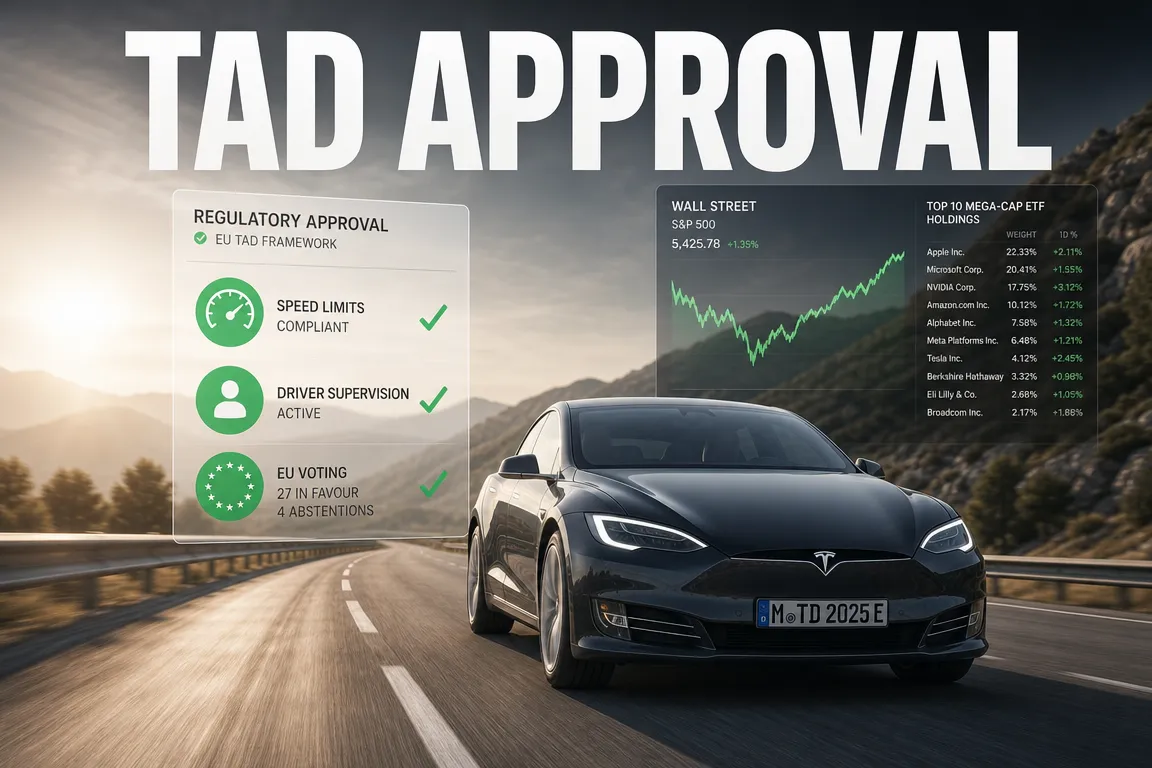
- Reported name change: The system would use the name “Tesla Assist Driving” instead of FSD.
- Reported speed-setting adjustment: The maximum speed-setting allowance above the posted limit would decline from 50% to 10%.
- Reported high-speed requirement: Drivers would need to keep their hands on the steering wheel above 130 km/h.
If officially confirmed, these changes would indicate an effort to reduce excessive reliance on the system and clarify its operating conditions.
Driver responsibility matters more than branding.
Regardless of the product name, a system requiring continuous driver supervision and immediate intervention must be distinguished from a driverless service.
Hands-free operation does not imply permission to divert attention from the road.
2. Reducing the Speed-Setting Allowance From 50% to 10%
Based on the stated figures, the maximum selectable speed on a road with a 100 km/h limit would fall from 150 km/h to 110 km/h.
However, the speed selectable within the system is separate from the legally permitted driving speed.
A 10% setting allowance does not authorize driving 10% above the posted limit.
- Safety: The adjustment would reduce the scope for selecting excessively high target speeds.
- Regulation: Narrower operating parameters could reduce the range of conditions requiring validation.
- User experience: The impact on flexibility and convenience would depend on implementation.
The adjustment should not necessarily be interpreted solely as a reduction in capability.
Commercially, it could represent a decision to pursue market entry under approvable conditions rather than retain broader functionality.
Official documentation is needed to establish which roads and software versions would be affected.
3. Why German Support May Not Be Sufficient for European Approval
Germany is a major market, but it cannot independently determine an EU-wide decision.
Before assessing voting thresholds, the applicable legal approval pathway and voting rules must be established.
These determine how national support translates into an approval decision.
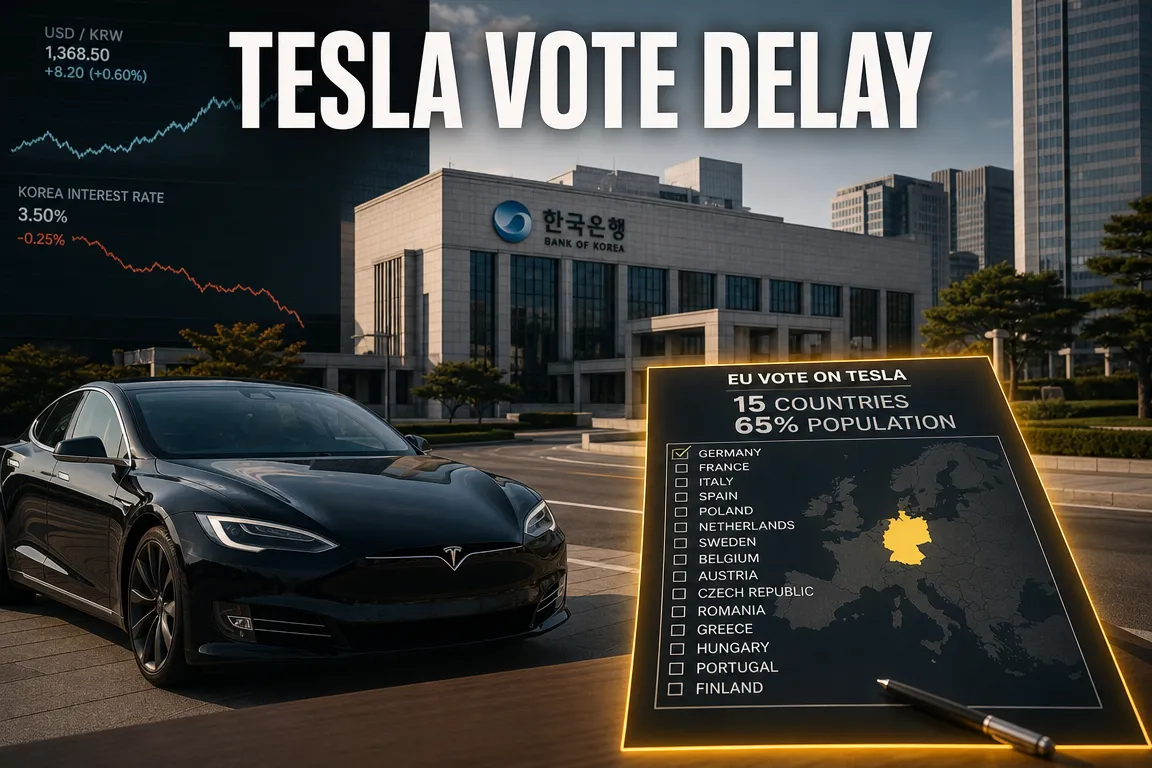
The standard qualified-majority thresholds commonly used in the Council of the EU are:
- Member-state threshold: At least 55% of member states must vote in favor.
- For 27 member states: At least 15 countries must support the proposal.
- Population threshold: Supporting countries must represent at least 65% of the EU population.
If these dual thresholds apply, German support may still leave either the country-count or population requirement unmet.
Germany accounts for approximately 19% of the EU population, giving it substantial weight under the population criterion, but it adds only one country to the supporting coalition.
The following examples illustrate the thresholds.
- If 13 countries support a proposal, Germany’s addition would bring the total to 14, below the country-count threshold.
- Even with at least 15 supporting countries, the population threshold would remain unmet if their combined population were below 65% of the EU total.
These figures illustrate the voting structure and do not represent the actual distribution of national support.
Vehicle type-approval and exemption procedures may be governed by specific rules. These thresholds therefore cannot be assumed to apply directly to Tesla’s FSD case.
The available information is insufficient to calculate any actual voting shortfall following German support.
4. Dutch RDW Approval Is Not Equivalent to a Europe-Wide Launch
RDW is the Netherlands’ vehicle approval authority.
A statement that RDW has granted approval does not, by itself, establish what was approved or the extent of its legal effect.
- Approval subject: Determine whether approval covers a software update, a specific driver-assistance feature, or a vehicle type.
- Approval pathway: Distinguish standard EU type-approval from an exemption for new technology.
- Scope: Identify the countries, vehicle configurations, and road environments covered.
- Launch requirements: Hardware compatibility, software deployment, and national operating conditions may affect availability after approval.
Under the EU framework, type-approval issued by one member state’s authority can have legal effect in other member states.
Depending on the approval category, additional procedures or restrictions may apply.
Accordingly, the legal basis and scope of the approval document matter more than the phrase “Dutch approval.”
5. Commercial Viability Matters Beyond Approval
Regulatory attention can obscure a central commercial question: which features customers will pay for, and at what price.
The business value of driver-assistance software in Europe cannot be determined by an approval announcement alone.
① Functional restrictions affect both approval prospects and product appeal.
Tighter speed parameters or driver-intervention requirements may help address regulatory concerns.
However, paid purchases or subscription conversions could be limited if the perceived convenience falls short of customer expectations.
A high-speed hands-on requirement alone does not establish weaker product appeal; actual usage conditions also matter.
② Driver-assistance approval is separate from authorization for robotaxi operations.
Approval of a supervised driving feature does not automatically authorize driverless operation or paid passenger transport.
For AI investment analysis, driver-assistance software revenue and driverless mobility revenue should be assessed as separate business scenarios.
③ Revenue depends on conversion after approval.
A useful framework is eligible vehicles × paid conversion rate × realized price × usage duration.
Approval across additional countries may contribute less than expected if vehicle compatibility is limited or paid conversion remains low.
Conversely, greater utility and sustained improvements through software updates could expand recurring revenue.
6. Tesla Shares and the EV Industry: Indicators to Monitor
Tesla shares may respond to approval expectations before deployment, but medium- to long-term business value requires validation through launches and customer usage data.
- Official branding and feature descriptions: Confirm any name change and the stated driver-supervision obligations.
- Approval documents: Review RDW and relevant EU documentation for the approval subject and legal effect.
- Voting procedures and national positions: Verify Germany’s official position, the number of supporting countries, and the applicable decision thresholds.
- Deployment eligibility: Confirm supported countries, vehicle hardware, and software versions.
- Commercial performance: Monitor pricing, paid conversion, subscription retention, and perceived feature utility.
Competition in the EV industry increasingly extends beyond vehicle sales to the sustained value delivered through software.
The central issue is not simply whether Germany supports approval, but the conditions under which approval is granted and the commercial demand achievable within those conditions.
< Summary >
- The reported name change and speed-setting adjustments require confirmation through official documentation.
- A speed-setting allowance does not constitute legal permission to exceed the speed limit.
- If both country-count and population thresholds apply, German support alone cannot guarantee approval.
- Calculating an actual voting shortfall requires the applicable procedure and confirmed national positions.
- Investors should focus on eligible vehicles, paid conversion, and recurring revenue after approval.
[Related Articles…]
*Source: [ 오늘의 테슬라 뉴스 ]
– 독일 요구 다 받은 FSD / 유럽 선택은?
● AI Stock Bloodbath, Rebound Hunt
Identifying Recovery Opportunities After an AI Stock Sell-Off: A Checklist for U.S. Mega-Cap Stocks and ETFs
The strongest candidates after a sell-off are not necessarily those with the largest price declines, but companies capable of sustaining AI investment while increasing earnings.
This report examines the advantages of U.S. mega-cap companies, evidence of AI monetization, the benefits and risks of top-10 equity ETFs, and the importance of cash flow over headline growth.
This analysis is based on the supplied materials, not real-time market data or independently reviewed current filings.
1. Core Assessment: AI Industry Growth Does Not Guarantee Stock Returns
Broader AI adoption does not imply that all AI-related stocks will appreciate.
Some companies will lose competitive ground, while even businesses with improving results may experience share-price corrections if valuations are excessive.
Investors should assess AI market expansion separately from a stock’s attractiveness at its current price.
- Industry growth: Assess whether AI usage and enterprise adoption are increasing.
- Corporate competitiveness: Determine whether the company converts additional demand into revenue and earnings.
- Investment attractiveness: Evaluate how much expected growth is already reflected in the share price.
Earnings and cash flow influence long-term share prices, but neither the timing of a recovery nor a return to previous highs is guaranteed.
Before treating a sell-off as an opportunity, distinguish between a valuation correction and a deterioration in business expectations.
2. AI Stock Volatility: Identify the Underlying Drivers
AI-related valuations often depend heavily on distant future earnings, making share prices sensitive to relatively small changes in expectations.
Rapid information flows and global capital movements can amplify short-term volatility, but not every decline can be attributed to fund flows or sentiment.
① Interest Rates and Valuations
Higher long-term interest rates can reduce the present value of future earnings, weighing on growth stocks.
U.S. equity analysis should therefore consider Treasury yields and earnings expectations alongside technology developments.
② The Gap Between AI Capital Spending and Monetization
Upfront spending on data centers and GPUs can weaken near-term cash flow when service revenue materializes later.
The key issue is whether subsequent revenue and earnings justify the investment, rather than the size of the spending increase.
③ Changes in Earnings Expectations
Share prices may decline despite earnings growth if results fall short of market expectations.
Conversely, stronger-than-expected profitability may support a valuation reassessment even when growth is modest.
④ Concentrated Positioning
Overlapping holdings among funds and ETFs can intensify selling pressure during risk-off periods.
However, ETF growth does not invariably increase volatility; ETFs can also support liquidity.
3. K-Shaped Growth in AI: The Advantages and Limits of Scale
Companies with established capital resources, data, talent, and customer access begin the AI competition with structural advantages.
This may produce K-shaped growth, with profits concentrated among a limited number of leaders.
Four Advantages of Mega-Cap Companies
- Financial capacity: Resources to sustain substantial research, development, and capital expenditure.
- Distribution: Existing cloud, search, and enterprise software customers provide channels for selling AI capabilities.
- Data and operating experience: Live services create opportunities for product improvement.
- Business diversification: Established operations can fund the initial costs of AI businesses.
Scale alone does not guarantee success.
Narrowing model-performance gaps and wider open-source adoption may weaken pricing power in some services.
Antitrust and privacy regulation may also constrain incumbent expansion.
AI semiconductors, cloud infrastructure, models, and application software are distinct markets; a uniform winner-takes-all framework is inappropriate.
4. Structural Advantages of U.S. Mega-Caps: Talent, Capital, and Investment Conditions
Assessing U.S. AI competitiveness requires examining the ecosystem that converts technology into commercial businesses, rather than simply counting technology companies.
① Pathways from Research to Commercialization
Connections among universities, research institutions, startups, and major platforms can facilitate commercialization.
However, talent inflows remain sensitive to immigration policy and international relations.
② Diverse Financing Channels
Public markets, venture capital, private investment, and corporate bonds can support large-scale investment.
Financing is not always accessible or inexpensive, and companies with substantial losses remain vulnerable to changing market conditions.
③ Tax Policies Affecting Investment Costs
Immediate expensing and accelerated depreciation can reduce early tax payments and improve cash flow.
However, the marginal effective tax rate estimates the tax burden on incremental investment; it is not a simple tax rate applied to total corporate earnings.
Cross-country comparisons depend on asset types, financing structures, and deduction rules. Individual figures do not establish a definitive investment advantage.
④ Power Supply and Operational Data Center Capacity
Capital availability alone is insufficient to deliver AI infrastructure.
Power procurement, grid connections, permits, cooling systems, and semiconductor supply must align before capacity becomes operational.
The United States faces regional grid bottlenecks, while Europe, South Korea, Japan, and Taiwan retain strengths in specific industries.
Assessing a company’s role in global value chains is more informative than categorizing entire countries as winners or losers.
5. Five Characteristics of Potential Post-Sell-Off Opportunities
Strong candidates demonstrate a measurable link between investment and returns, rather than relying on claims of AI exposure.
| Key Characteristic | Metrics to Review | Warning Signs |
|---|---|---|
| Cash generation sufficient to fund investment | Operating cash flow, capital expenditure, free cash flow | Rising investment accompanied by rapidly declining cash balances |
| Demonstrable AI monetization | Paying customers, contract revenue, usage, revenue per customer | Weak paid conversion despite user growth |
| Sustainable competitive advantages | Customer retention, switching costs, distribution, pricing power | Competitive pressure reducing both prices and margins |
| Financial resilience | Cash holdings, net debt, debt maturities | Persistent reliance on equity issuance or expensive borrowing |
| Reasonable valuation | Price relative to expected earnings, enterprise value relative to cash flow | Valuations already incorporating highly optimistic growth assumptions |
Free cash flow generally represents operating cash flow less capital expenditure, indicating the cash remaining after investment.
Temporary weakness may be consistent with expansion, but revenue and profitability trends should support a credible recovery.
Do Not Assess Business Quality Through ROE Alone.
Return on equity is useful, but it can rise when share repurchases reduce equity or leverage increases.
Assess return on invested capital, operating margins, and cash flow alongside ROE to evaluate underlying business quality.
6. U.S. Mega-Cap TOP10 ETFs: Benefits and Risks
ETFs concentrated in the largest U.S. companies can reduce the burden of selecting individual future winners.
However, simplifying stock selection is not equivalent to reducing investment risk.
Benefits: Convenient Exposure to Leading Companies
- A single product provides exposure to multiple mega-cap companies.
- Constituents and weights are adjusted according to predefined index rules.
- Market-capitalization-based products may include large companies from sectors beyond technology.
Risks: Ten Holdings Can Still Move Together
- Heavy weighting in a few companies increases sensitivity to their results.
- Shared exposure to interest rates and AI investment trends can limit diversification.
- Market-capitalization weighting can increase exposure to companies whose prices have risen; it is not a strategy for identifying undervalued stocks.
- Holdings may overlap substantially with existing S&P 500 or Nasdaq-100 ETFs.
Due Diligence for the RISE U.S. Mega-Cap TOP10 ETF
The supplied materials describe a fund investing in the 10 largest U.S. companies by market capitalization, with periodic rebalancing and conditional inclusion rules for newly listed companies.
Because the materials include promotional content, investors should verify the details against the latest prospectus and index methodology.
- Eligible securities and current holdings and weights
- Rebalancing frequency and accelerated inclusion criteria for newly listed companies
- Other expenses and trading costs beyond the stated management fee
- Currency-hedging policy and foreign-exchange exposure
- Trading volume, bid-ask spreads, premiums or discounts to net asset value, and tracking error
- Eligibility and restrictions for pension savings accounts, individual retirement pension accounts, and other account types
Automatic rebalancing updates holdings according to rules; it neither prevents losses nor identifies future winners in advance.
7. Additional Analysis: Investment Growth and Sustainable Profits May Accrue to Different Companies
The central question is not which companies invest the most, but which companies convert that spending into sustainable profits.
① Distinguish Capital Spenders from Beneficiaries
Cloud providers’ data center investments can generate revenue for semiconductor, networking, and power-equipment suppliers.
The investing companies’ profitability depends on utilization, AI service pricing, and customer demand.
Suppliers may also experience slower growth if capacity competition intensifies or customers reduce investment.
② Higher AI Usage Does Not Necessarily Produce Higher Profits
Lower inference costs can stimulate usage, but margins may contract if competitive pressure drives selling prices down faster.
Assess unit costs, selling prices, and gross margins alongside usage growth.
③ Data Center Investment Entails Depreciation and Replacement Costs
Capital expenditure consumes cash upfront and subsequently affects earnings through depreciation.
Rapid semiconductor innovation may shorten equipment’s economic useful life relative to expectations.
Analysis should therefore consider how long investment assets can generate adequate returns, not merely near-term revenue growth.
④ Industry Leadership Does Not Guarantee Superior Stock Returns
Even a dominant company may deliver disappointing returns if purchased at an excessive valuation.
Long-term investing requires managing entry valuations and position sizes, not simply owning high-quality businesses.
8. Implementation Framework: Prioritize Review Criteria Over Market-Bottom Predictions
- Review existing holdings first.
Multiple ETFs may still create concentrated exposure to the same mega-cap technology companies. - Separate near-term spending needs from investment capital.
Funds needed soon are poorly suited to the volatility of long-duration growth equities. - Attach review criteria to phased purchases.
Evaluate earnings expectations, cash flow, and competitive developments rather than buying solely because prices have fallen. - Assess exchange-rate effects on returns in Korean won.
Won appreciation can reduce returns on unhedged products even when U.S. equity prices rise. - Define conditions that would invalidate the investment thesis.
Customer losses, weaker pricing power, or financial deterioration warrant reassessing whether a decline reflects temporary conditions or structural business changes.
The next market cycle’s winners cannot be identified with certainty, but investment selection criteria can be established.
Start with companies that convert AI demand into cash flow, then assess how much of that potential is already reflected in their valuations.
< Summary >
- AI industry growth does not guarantee gains across AI-related stocks.
- U.S. mega-caps benefit from capital, talent, and customer scale, but valuations and investment efficiency remain critical.
- Key indicators include AI revenue, free cash flow, ROIC, and financial resilience.
- TOP10 ETFs simplify stock selection but introduce concentration and portfolio-overlap risks.
- Post-sell-off decisions should prioritize phased-purchase criteria and asset allocation over recovery timing.
This report provides general information and does not constitute a recommendation to purchase any security or ETF, or a guarantee of returns.
[Related Articles…]
*Source: [ 소수몽키 ]
– 이번 하락장 이후 올라갈 주식은 정해졌다? 기회가 될 주식들의 특징