● Leverage ETF Shock
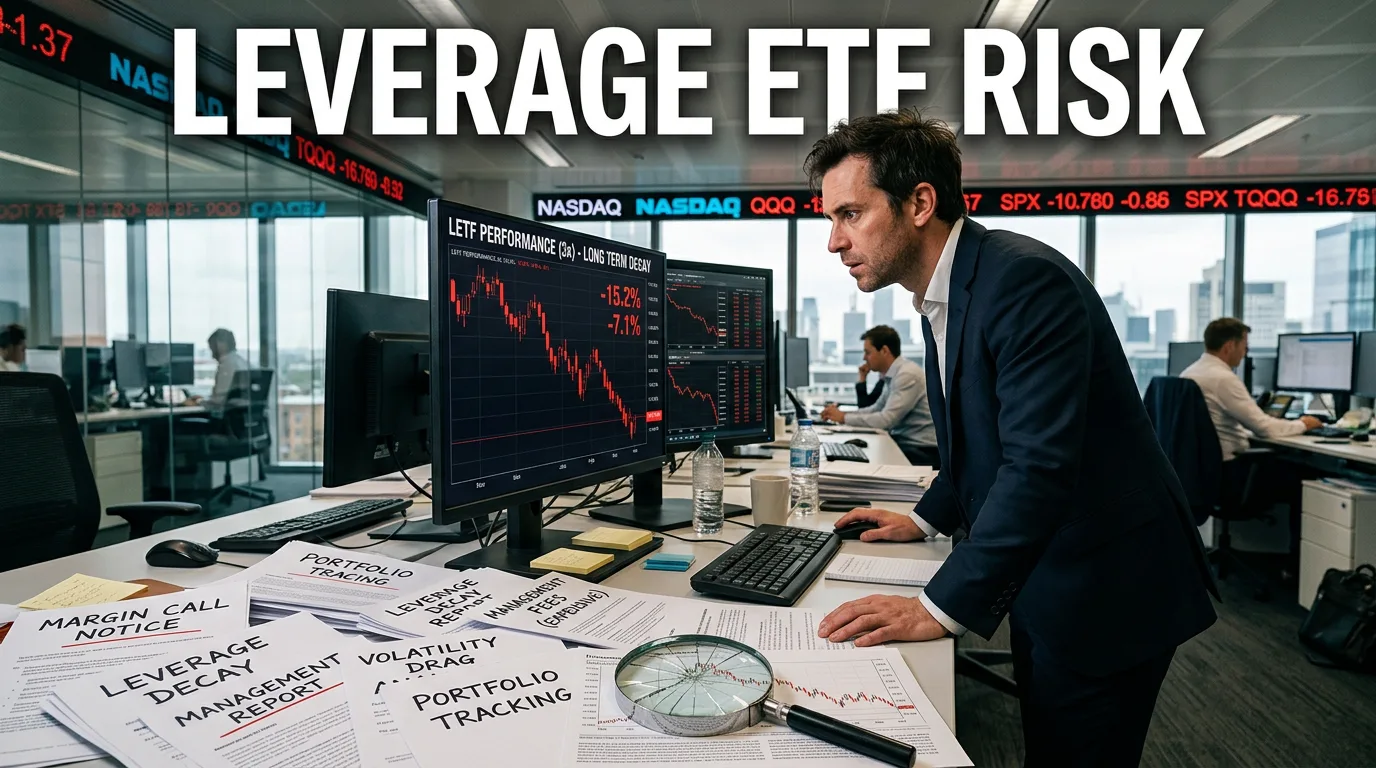
The Real Risks Seen from 30-Year Leverage ETF Holding Results: What You Must Know Before Long-Term Investing in TQQQ and SOXL
The core point of this article is simple.
A leverage ETF is not a “2x or 3x return” product, but a high-risk structure that tracks daily returns at 2x or 3x.
So even if you invest in assets that appear to have long-term growth potential, such as the Nasdaq, semiconductors, or Tesla, your account can be damaged much faster than expected because of volatility, interest rates, hidden costs, and compounding losses.
In particular, if you are approaching popular leveraged ETFs like TQQQ and SOXL from a long-term investing perspective, you must check today’s content.
1. The Biggest Misconception About Leveraged ETFs: It is Not “3x Returns,” but “3x Daily Returns”
At first glance, leveraged ETFs seem very intuitive.
If the Nasdaq rises 1%, TQQQ rises about 3%, and if the semiconductor index rises 1%, SOXL rises about 3%.
The problem is that this 3x is not 3x of long-term cumulative returns.
Most leveraged ETFs track 2x or 3x based on daily returns.
-
If a 1x Nasdaq ETF rises 20% over one year, a 3x ETF does not automatically rise 60%.
-
Because it resets returns every day and tracks 3x, heavy volatility in the middle severely damages performance.
-
Because of this structure, it can surge in a bull market, but in a sideways market or a sharp decline, the account can melt quickly.
If you do not understand this, you will end up using leveraged ETFs not as investment products, but effectively as directional bet products.
2. A Real Example of Volatility Loss: The Index Can Be Down -1%, but the 3x ETF Can Be Down -9%
The core risk of leveraged ETFs is volatility loss.
In English, this is called Volatility Decay, and simply put, it is the phenomenon where returns are continually eroded during the up-and-down process.
| Category | Underlying Index | 3x Leveraged ETF |
|---|---|---|
| Start | 100 | 100 |
| 10% Rise | 110 | 130 |
| 10% Drop | 99 | 91 |
The underlying index fell from 100 to 99, so the loss rate is -1%.
But the 3x leveraged ETF fell from 100 to 91, so the loss rate is -9%.
The index is almost back where it started, but the leveraged ETF suffered a much larger loss.
What happens if this repeats?
Even if the underlying index can recover again over the long term, the increase needed for a leveraged ETF to recover keeps getting larger.
In particular, in periods when market volatility increases, such as recessions, interest rate hikes, or inflation shocks, this loss appears much more strongly.
3. Why Are SOXL and TQQQ, Which Korean Investors Often Hold, Especially Risky?
The 대표적인 U.S. leveraged ETFs favored by Korean retail investors are SOXL and TQQQ.
SOXL is an ETF that tracks the Philadelphia Semiconductor Index at 3x.
TQQQ is an ETF that tracks the Nasdaq 100 Index at 3x.
-
SOXL has a strong character of betting on semiconductor industry growth and the AI semiconductor cycle.
-
TQQQ reacts strongly to bull markets centered on Nasdaq big tech and growth stocks.
-
Both products are powerful in bull markets, but in bear markets, losses happen extremely quickly.
In particular, semiconductor ETFs often surge in the short term due to issues like expanded AI investment, data center demand, or Nvidia earnings.
But the semiconductor industry is inherently highly sensitive to the economy, and stock prices move significantly with inventory cycles and weakening demand.
Products like SOXL that track the semiconductor index at 3x are exposed to this volatility almost three times over, making them very difficult to hold long term.
4. Hidden Costs Are the Real Danger: Your Account Shrinks Every Year Even If You Do Nothing
The risk of leveraged ETFs is not just stock price volatility.
What many investors overlook is hidden costs.
Leveraged ETFs are not simply products that charge management fees.
-
Management fee: Higher than ordinary index ETFs.
-
Borrowing cost: A structure is involved in borrowing additional funds to create 3x exposure.
-
Spread cost: The difference between bid and ask prices can create losses when trading.
-
Tracking error: Costs that arise because the ETF price does not perfectly match the movement of the underlying asset.
For example, a 3x leveraged ETF like TQQQ may appear to have a management fee of less than about 1%.
But if you examine the actual structure, the borrowing cost, trading cost, and tracking error make the effective cost much larger.
In a high-interest-rate environment, this cost burden becomes even greater.
In particular, when U.S. benchmark interest rates are high, the borrowing cost of leveraged ETFs works against investors.
Even if I put in 1 million won, to create 3 million won of exposure, financing costs are required for the remaining 2 million won.
This cost is not deducted separately as an obvious fee; instead, it is naturally reflected in the ETF price.
So investors feel like “I never paid a fee,” but in reality, the ETF price is slowly reduced every day as costs are reflected.
This is extremely fatal in long-term investing.
5. The Core of a 30-Year Long-Term Holding Simulation: MDD Comes Before Return
The Nasdaq is a representative growth asset that has shown a strong upward trend over the long term.
So many investors think this way.
“Since the Nasdaq ultimately goes up over time, wouldn’t long-term holding of TQQQ generate much more money?”
That logic seems plausible.
But what truly matters is not the final return, but whether you can endure the process.
| Category | Long-Term Characteristics | Maximum Drawdown MDD | Core Risk |
|---|---|---|---|
| 1x Nasdaq | High chance of long-term upward trend | Has experienced around -82% | Long-term slump like the dot-com bubble |
| 2x Nasdaq | Expanded returns in bull markets | May be possible to around -98% | Very difficult to endure psychologically |
| 3x Nasdaq | Explosive in short-term bull markets | Losses of about -99% or more possible | The account can effectively approach zero |
MDD stands for Maximum Drawdown.
Simply put, it is the maximum loss from the peak.
Even 1x Nasdaq experienced a decline of about -80% or more during the dot-com bubble collapse.
It took more than 10 years to recover.
But for 2x or 3x leveraged ETFs, those losses become far more extreme.
If your account falls by -50%, you need a 100% return to recover the principal.
If your account falls by -90%, you need a 900% return to recover the principal.
If your account falls by -99%, you need a 9,900% return to recover the principal.
At that point, even if recovery is possible on paper, in reality most investors cannot endure it.
6. Even if 2x Looks Better Than 3x, It Is Still Not Easy
Looking only at long-term data, 2x leveraged products can sometimes seem more reasonable than 3x leveraged products.
That is because volatility loss is less severe than with 3x, and in bull markets you can expect higher returns than a regular index.
That is why many investors consider a Nasdaq 2x ETF like QLD as a long-term investment candidate.
But 2x leverage is by no means easy.
In a period where 1x Nasdaq falls -30%, a 2x ETF can lose more than -50%.
If the market environment is worse, losses of -70% or -80% are entirely possible.
What matters in an investment strategy is not “Can I theoretically make money?”
The truly important question is “Can I hold on without selling during that loss period?”
Most investors have lower risk tolerance than they think.
In a bull market, anyone becomes a long-term investor.
But once the account is cut in half and the news starts talking about recession and interest rate uncertainty, people think differently.
7. Single-Stock Leverage Is Even Riskier: The Trap of Tesla 3x and 5x Products
Index leveraged ETFs are already risky, but single-stock leveraged products are far riskier.
Products like Tesla 3x, Nvidia 2x, or a specific semiconductor stock 3x fall into this category.
Single stocks are far more volatile than indexes.
Just company earnings, CEO comments, regulation, competitor issues, or valuation adjustments can move them sharply in a single day.
Adding 3x or 5x leverage to that makes the product more of a short-term speculation tool than an investment.
In particular, a 5x leveraged product can theoretically approach a -100% loss if the underlying asset falls only 20% in one day.
Depending on the structure of the product, this can lead to trading halts or situations close to liquidation.
Single-stock leverage is closer to a tool for professional hedging or ultra-short-term trading.
For ordinary individual investors, the risk is too high for long-term holding.
8. The Most Important Point People Often Miss: It Is About Survival Probability, Not Returns
When looking at leveraged ETFs, many investors first look at the return chart.
But what really matters is not return, but the probability of surviving in the market.
Investing is not a game where one big hit ends everything.
You need to stay in the market for 10 or 20 years to enjoy the effect of compounding.
But leveraged ETFs can damage the account severely before compounding even has a chance to work if the entry timing is wrong.
In particular, underestimating the following four things is dangerous.
-
First, the daily reset structure means long-term cumulative returns are not simply 2x or 3x.
-
Second, volatility loss slowly melts the account in sideways markets.
-
Third, during rising interest rate periods, the borrowing cost burden of leveraged ETFs increases.
-
Fourth, because it is psychologically hard to endure a sharp drop, most people give up near the bottom.
These four are the most essential risks in leveraged ETF investing.
But in reality, investors often focus more on return screenshots or short-term surge percentages.
9. If You Must Invest in Leveraged ETFs, You Must Set 3 Rules
This does not mean you should never use leveraged ETFs.
However, only those who understand the structure accurately and set rules should approach them.
① You Must Clarify Your Investment Purpose
Leveraged ETFs are more suitable for short-term tactical investing than for long-term installment investing.
You must have confidence in the market direction and be able to enter and exit within a short period.
② You Must Set a Loss Limit in Advance
For example, you need a rule that you will liquidate unconditionally if losses reach -10%, -15%, or -20%.
If you enter without a rule, the more losses grow, the stronger the psychology becomes to say, “Let’s just hold a little longer.”
That is the most dangerous moment in leveraged ETF investing.
③ You Must Use Only a Very Small Portion of Your Total Assets
Leveraged ETFs are more realistic as satellite assets rather than core assets.
Investing retirement funds, housing deposit money, borrowed money, or living expenses is extremely dangerous.
You should only approach them within a range where losing the money will not destroy your overall financial situation.
10. Why Leveraged ETFs Are Even More Difficult in the Current Market Environment
The current global financial market is much more complex than before.
AI industry growth, semiconductor investment expansion, and strong U.S. big tech earnings are clearly powerful upside factors.
But at the same time, you must also watch interest rates, inflation, the possibility of a U.S. recession, dollar liquidity, and geopolitical risks.
Leveraged ETFs are highly sensitive to these variables.
In particular, in a high-interest-rate environment, the valuation burden on growth stocks increases, and the financing cost of leveraged products also rises.
The forecast that the Nasdaq may rise over the long term and the idea that you can hold TQQQ long term at any time are completely different stories.
If you want to invest in the AI trend and the semiconductor supercycle, leveraged ETFs are not the only answer.
You can build an investment strategy sufficiently through ordinary ETFs, individual high-quality stocks, cash allocation adjustments, dollar-cost averaging, and rebalancing.
11. Conclusion: Leveraged ETFs Are Not Products That Make You Rich Fast; They Are Products That Can Also Ruin You Fast
Leveraged ETFs are powerful tools when used properly.
But if you hold them long term without understanding the structure, they become very dangerous products.
In particular, 3x leveraged ETFs look attractive in short-term bull markets, but in bear markets and sideways markets, volatility loss and hidden costs work at the same time.
As a result, even if the underlying index recovers, your ETF account may recover much more slowly than expected.
What matters in investing is not the highest return.
It is surviving for the long term within risks you can handle.
Before investing in leveraged ETFs, you must first check the product structure, costs, maximum drawdown, stop-loss criteria, and investment allocation.
To sum it up in one line.
Leveraged ETFs are products where the ability to control losses matters far more than the ability to predict the market.
< Summary >
Leveraged ETFs are products that track 2x or 3x of daily returns, not 2x or 3x of long-term returns.
When volatility increases, ETF prices can suffer large losses even if the index goes nowhere.
3x leveraged ETFs like TQQQ and SOXL are strong in bull markets, but in bear and sideways markets, volatility loss and hidden costs are large.
When management fees, borrowing costs, spreads, and tracking error are included, the burden of long-term holding can grow significantly.
The Nasdaq has trended upward over the long term, but in the past it fell more than -80% and once took over 10 years to recover.
2x leverage may still require you to endure losses of more than -50%, and 3x leverage can even create periods where the account approaches zero.
Leveraged ETFs are closer to a short-term tactical tool than a core long-term asset.
Before investing, you must set your loss limit, allocation, holding period, and rebalancing rules.
[Related Articles…]
- Risk checklist you must review before investing in leveraged ETFs
- Key summary of the AI semiconductor cycle and SOXL investment strategy
*Source: [ 월텍남 – 월스트리트 테크남 ]
– 레버리지 ETF로 30년 보유한 결과…”소름”