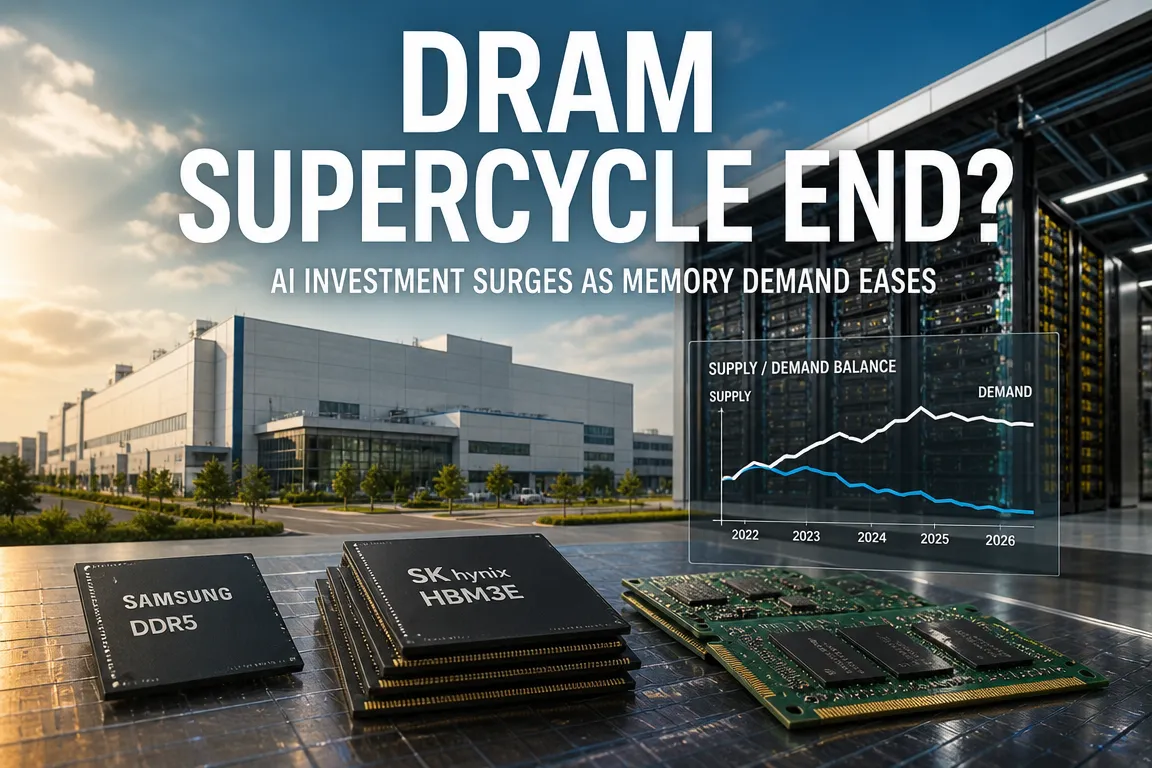
● DRAM Shock, AI Bubble Test
Is the Memory Supercycle Ending? DRAM Price Outlook for 2027–2028 and Key Variables in AI Investment
The primary risk in the memory market is not disappearing demand, but supply expansion based on elevated prices outpacing demand growth.
Three issues warrant attention.
The conditions for a DRAM price downturn, the sustainability of AI data center investment, and potential earnings distortions behind the KOSPI’s apparently low P/E ratio.
1. Core Assessment: Focus on Potential Supply Relief Rather Than a Confirmed End to the Supercycle
The memory semiconductor cycle is not determined solely by AI growth.
Prices reflect the interaction of memory demand growth, supply growth, and customer inventory policies.
- Demand: Server, smartphone, and PC shipments, alongside memory content per device, are key drivers.
- Supply: The timing of additional shipments from capacity expansion and process transitions matters.
- Inventory: Reduced advance purchasing can weaken orders even when end demand remains stable.
DRAM prices can therefore decline even as AI service usage increases.
AI industry growth and memory suppliers’ pricing power are distinct variables.
Macroeconomic analysis should distinguish long-term technology growth from short-term capital expenditure cycles.
2. DRAM Price Outlook for 2027–2028: Two Conditional Scenarios
The supplied material presents a baseline scenario and a downside scenario attributed to TrendForce.
The original report has not been verified. The timelines below should not be treated as confirmed forecasts or institutional consensus.
| Scenario | Proposed Price Trajectory | Underlying Conditions |
|---|---|---|
| Baseline Scenario | Slower price increases in the first half of 2027 → stabilization in the second half → declines in the first quarter of 2028 | Moderating demand growth alongside increased supply from capacity expansion and process transitions |
| Downside Scenario | Commodity DRAM price declines in the fourth quarter of 2027 → further weakness in 2028 | Simultaneous reductions in server purchases, customer inventories, and the pace of AI infrastructure investment |
The priority is identifying the conditions for a price reversal, rather than predicting the precise quarter.
Contract prices vary by customer, product, and contract duration. A simultaneous decline of equal magnitude across all products should not be assumed.
Extreme figures cited in the material, such as a “75% price decline,” are unsuitable for investment decisions without confirmation of the product, reference price, and forecast period.
3. Demand: AI Data Centers Face Financing and Profitability Constraints
① PCs and Smartphones: Higher Memory Prices Can Delay Purchases.
Rising memory prices increase device manufacturers’ costs.
Passing these costs through to consumers may delay replacement purchases, while absorbing them may compress margins.
The impact depends on memory’s share of total costs, exchange rates, product mix, and pricing strategy.
② Cloud Providers: Actual Spending Matters More Than Announced Investment.
Large cloud providers and GPU rental-focused neocloud operators have different financing capacities.
Operators dependent on external borrowing or new funding are more likely to revise investment plans when interest rates remain high or GPU rental profitability weakens.
This can slow both server orders and memory purchases.
Claims that a specific GPU supplier is changing its financing support require verification. Nevertheless, infrastructure demand’s sensitivity to financing conditions remains a key risk factor.
③ Regulation and Power: Data Center Plans Do Not Immediately Translate Into Semiconductor Revenue.
Export controls, grid connections, permits, and cooling infrastructure can alter project timelines.
Export controls may reduce demand in one region while redirecting investment elsewhere.
Tighter restrictions should therefore not be assumed to produce an equivalent reduction in global memory demand.
4. Supply: Why Bit Supply Matters More Than Factory Counts
Factory additions alone do not adequately measure memory supply.
Process scaling and yield improvements can increase total memory capacity produced per wafer.
Bit supply and bit growth measure these changes in aggregate capacity.
- New Production Facilities: Equipment installation, customer qualification, and stable volume production matter more than construction completion.
- Process Transitions: These can improve long-term productivity but may temporarily disrupt production during implementation.
- Product Allocation: The allocation of production resources between HBM and commodity DRAM affects product-specific supply.
HBM and commodity DRAM should not be treated as a single price cycle.
HBM is particularly sensitive to customer qualification, advanced packaging, and product-generation transitions.
Supply constraints may persist for certain HBM products even when commodity DRAM weakens, and the reverse is also possible.
Semiconductor investment analysis should assess company-specific product mix and deliverable supply alongside overall market size.
5. AI Investment Outlook: Expectations May Outpace Commercial Progress
Improved AI model performance does not necessarily translate into equivalent revenue or cash flow growth.
Enterprise deployment requires data preparation, security reviews, integration with existing systems, and workflow changes.
AI agents also face accountability and management-cost barriers when moving from pilots into production.
User growth alone is insufficient to assess the AI industry.
- Paid Conversion and Renewals: Assess whether free or experimental usage generates recurring revenue.
- Inference Costs: Determine whether higher service volumes also generate higher profits.
- Customer Productivity: Verify whether deployments reduce labor costs, processing times, and error-related expenses.
- Cash Flow: Evaluate whether revenue growth can support substantial infrastructure investment and operating costs.
Numerical units also require scrutiny.
The annualized revenue figures cited in the material—$5 billion and $8 billion—sum to $13 billion.
Reaching $1 trillion would require approximately 77-fold growth, not 8–9-fold growth.
ARR and annualized revenue can differ in methodology. Neither is equivalent to recognized annual revenue or profit.
The companies’ revenue figures, listing status, share-price movements, and price-target claims require separate verification.
The proposition that superintelligence will eliminate most existing corporate value is a long-term hypothesis, not a fact applicable directly to near-term earnings forecasts.
A practical AI investment outlook must assess technological potential alongside customers’ ability to pay.
6. Chinese Equity Support and a KOSPI Rebound: Price Stability Is Not Earnings Improvement
China’s “national team” is a market term for equity and ETF purchases by state-owned investment institutions and similar entities.
Policy-driven purchases, measures encouraging long-term capital inflows, and higher dividends and share buybacks can support sentiment and market flows.
They do not guarantee government protection against all market declines.
Equity support measures may cushion sharp selloffs without automatically restoring corporate profitability.
The daily Nasdaq and KOSPI gains cited in the supplied material are not presented as current market data because the trading dates and closing figures have not been verified.
A one-day rebound does not establish that concerns over AI investment or semiconductor conditions have been resolved.
KOSPI analysis should pay particular attention to the earnings denominator in forward P/E ratios.
Forward P/E divides the current share price by expected earnings.
If earnings forecasts still reflect a semiconductor upcycle, falling share prices can make valuation multiples appear unusually low.
Subsequent earnings downgrades can raise P/E ratios even without a change in share prices, weakening the undervaluation case.
P/B ratios also cannot independently determine fair value.
The same P/B ratio can imply different valuations depending on return on equity, the cost of equity, and shareholder distributions.
Ultimately, the direction of earnings revisions matters more than a low P/E, while sustainable ROE matters more than a low P/B.
7. An Important Distinction: Falling Memory Prices Are Not Necessarily Negative for the Entire AI Industry
① Falling Memory Prices Can Redistribute Profits Across the Industry.
Lower prices pressure memory suppliers’ profitability but can reduce server buyers’ capital costs.
AI service providers may use these savings to lower prices or expand services, potentially generating additional demand.
Equating a memory downturn with an AI industry collapse overlooks this redistribution.
② Lower Orders Must Be Distinguished From Lower End Usage.
Customers drawing down existing inventories can sharply reduce new orders even when usage remains stable.
Conversely, advance purchases prompted by expected price increases can make demand appear stronger than underlying consumption.
Order values should be assessed alongside inventory days, server shipments, and data center utilization.
③ Falling GPU Rental Rates Can Have Multiple Causes.
Rental rates may decline because of excess supply, new product launches, depreciation of older equipment, or increased competition.
Prediction-market prices reflect participant expectations, not actual transaction prices or guaranteed future returns.
Meaningful comparisons require actual rental rates and utilization for the same GPU models under comparable contract terms.
④ Higher Data Center Investment Does Not Necessarily Mean Higher Memory Orders.
Investment includes land, buildings, power equipment, cooling, and networking, as well as GPUs and memory.
Rapid growth in power infrastructure spending can increase total capital expenditure while server purchasing growth slows.
The composition of AI capital expenditure matters more than the headline total.
8. Practical Monitoring Checklist
- DRAM Contract Prices: Distinguish slower price increases from outright declines by product.
- Customer Inventories: Determine whether weaker orders reflect inventory normalization or declining end demand.
- Cloud Investment: Track actual expenditure and server-related spending rather than announced plans.
- Supply Growth: Monitor production schedules, yields, and bit shipments rather than capacity announcements.
- HBM Competitiveness: Assess customer qualification, product mix by generation, and supply constraints.
- Corporate Earnings Outlook: Track operating margins and cash flow alongside revenue growth.
A decline in semiconductor share prices does not confirm a subsequent industry downturn.
Share prices respond to interest rates, risk appetite, and investor positioning as well as earnings expectations.
The appropriate approach is to verify whether demand moderation and supply expansion are appearing simultaneously in actual data, rather than declaring the supercycle over.
< Summary >
- DRAM price-decline forecasts for 2027–2028 are conditional scenarios requiring verification against the original report.
- Memory prices can fall despite AI growth because of supply expansion and inventory adjustments.
- HBM and commodity DRAM require separate supply-demand analysis.
- Paid demand, inference costs, and cash flow matter more than revenue expectations alone in AI investment.
- The KOSPI’s low forward P/E may reflect elevated earnings assumptions rather than undervaluation.
- Key indicators include contract prices, inventories, actual capital expenditure, bit supply, and earnings estimates.
[Related Articles…]
*Source: [ 내일은 투자왕 – 김단테 ]
– 트렌드포스 “메모리 슈퍼사이클 끝”