● US Bank Collapse Fuels Contagion Fears
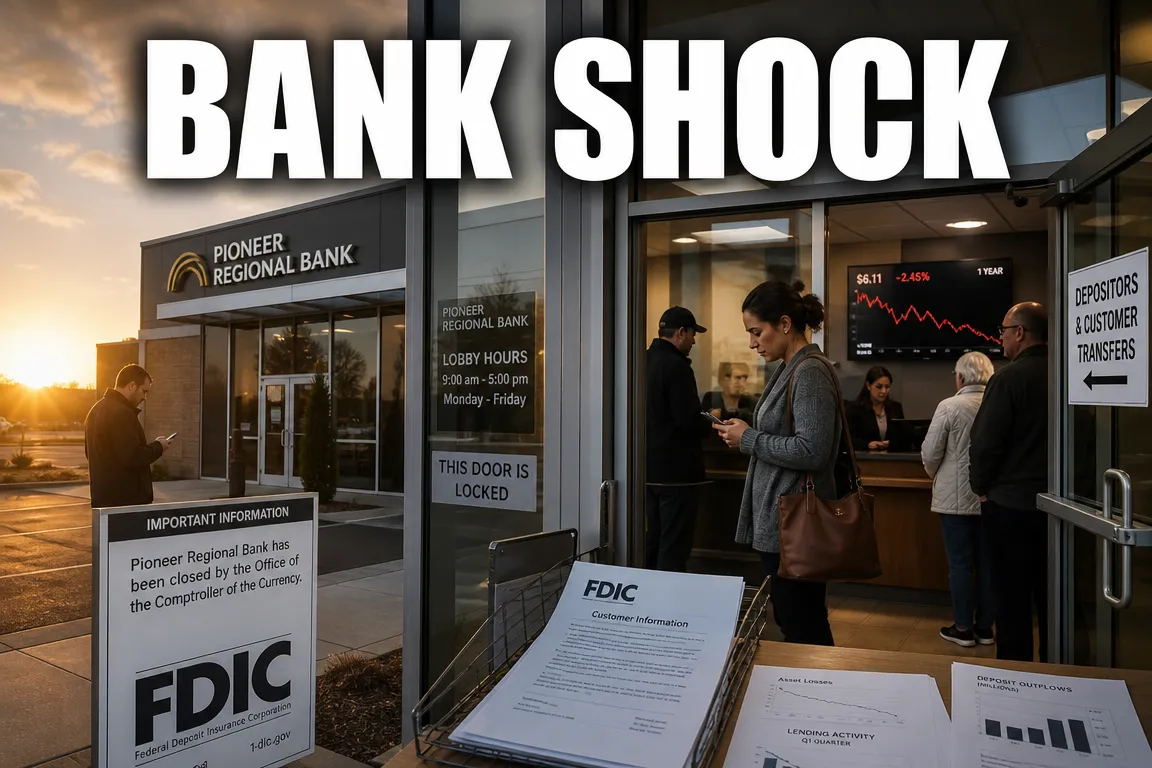
Reported Failure of United Fidelity Bank: Three Signals to Monitor Before Assessing Contagion Risk
Assessing the risk of further U.S. bank failures requires monitoring deposit flows, asset losses, and lending contraction rather than focusing on a single closure.
The key considerations extend beyond the reported $5.9 billion in assets: the implications of an estimated $1.83 billion loss to the Deposit Insurance Fund, the scope of deposit transfers, and the potential impact of financial stress on the U.S. interest rate outlook.
As of November 29, 2026, the reported figures and acquisition terms have not been independently checked against official FDIC and OCC announcements. Reported information and conditional analysis are therefore distinguished below.
1. United Fidelity Bank Closure: Key Reported Details
According to the reported terms, most deposits and a substantial portion of United Fidelity Bank’s assets would transfer to First Citizens as part of the resolution.
The structure is intended to preserve customer access to banking services through the acquiring institution.
| Item | Reported Details | Economic Implications |
|---|---|---|
| Institution closed | United Fidelity Bank, based in Evansville, Indiana | An individual bank failure must be distinguished from systemic financial distress |
| Closure date | November 27, 2026, local time | A weekend transition is intended to minimize customer disruption |
| Resolution authorities | The OCC closed the bank and appointed the FDIC as receiver | The FDIC administers the resolution following the supervisory closure decision |
| Acquiring institution | First Citizens Bank & Trust Company | The transfer of deposits and assets supports continuity of banking services |
| Total assets and deposits | Approximately $5.9 billion and $5.4 billion, respectively, as of September 30 | Systemic risk depends on interconnectedness as well as size |
| Estimated resolution cost | Approximately $1.83 billion in losses to the Deposit Insurance Fund | An estimate subject to asset recoveries and contractual terms |
| Branch network | 22 branches transitioning to the acquiring bank | Intended to minimize disruption to routine customer transactions |
The failure of a banking institution does not necessarily imply losses for its depositors.
Claims about the number of bank failures this year or the institution’s ranking among recent failures require verification against the FDIC’s official records and consistent measurement criteria.
2. Depositor Protection: Deposit Transfers and Deposit Insurance Are Different
① Deposits transferred to the acquiring bank
Under the reported terms, customers with assumed deposits would become First Citizens customers, with many existing account services continuing.
Reported guidance indicates continued access to ATMs, debit cards, checks, and loan payments. Customers should confirm service availability and system transition schedules through official notices.
A bank closure does not eliminate borrowers’ repayment obligations.
② Standard FDIC deposit insurance coverage
The standard FDIC insurance limit is $250,000 per depositor, per insured bank, per ownership category.
Coverage does not apply separately to every account. Accounts within the same ownership category at the same bank may be aggregated.
③ Deposits above $250,000 are not necessarily lost
If the acquiring bank assumes a deposit in full, the balance above the insurance limit may also transfer.
This reflects the terms of the resolution transaction, not an unlimited extension of statutory deposit insurance.
The statement that an acquirer assumes “most deposits” does not establish identical treatment for every account.
Customers with existing First Citizens accounts should also review deposit aggregation rules and any applicable temporary separate insurance coverage following the transaction.
3. Risk of Further U.S. Bank Failures: Is This Comparable to SVB?
The information presented is insufficient to characterize this event as the beginning of a financial crisis.
However, the institution’s relatively small size does not eliminate contagion risk.
The reported asset base is substantially smaller than SVB’s
Silicon Valley Bank, or SVB, had approximately $209 billion in assets at the time of its 2023 failure.
The reported $5.9 billion represents approximately 2.8% of that amount, or roughly one thirty-fifth of SVB’s size.
On size alone, the direct impact on the financial system could differ substantially.
Contagion depends on more than asset size
- Depositor composition: Concentrated corporate deposits above insurance limits can create simultaneous withdrawal risk.
- Common asset exposures: Similar problem loans or long-duration bond losses across banks can transmit financial stress.
- Liquidity capacity: Insufficient cash and collateral capacity may force asset sales to meet withdrawals.
- Confidence in resolution: Service continuity and clarity over assumed deposits influence depositor confidence.
Individual bank failures can occur within a U.S. banking system comprising thousands of institutions.
However, the argument that one failure among thousands is immaterial is not an adequate risk assessment.
The key question is whether banks with similar vulnerabilities experience concurrent deposit outflows and rising funding costs.
4. Why Profitable Banks Can Still Fail
① Profitability, liquidity, and capital are distinct
Higher aggregate banking profits do not establish the financial soundness of every institution.
Improving earnings at large banks can mask regional bank weakness, while profitable institutions may still struggle to meet sudden, substantial withdrawals.
Profitability measures earnings capacity, liquidity measures the ability to meet immediate obligations, and capital provides a buffer against losses.
② Higher interest rates do not uniformly benefit banks
Higher lending rates can increase interest income, but deposit rates and wholesale funding costs may also rise.
Growth in net interest income must be distinguished from improvement in net interest margin, which measures net interest income relative to earning assets.
Balance sheet expansion can increase net interest income even as faster funding-cost growth compresses margins.
③ Unrealized bond losses become more consequential when deposits leave
Rising market interest rates generally reduce the value of existing fixed-rate bonds.
A bank able to retain those securities may avoid immediate realized losses. Selling them to fund withdrawals can convert unrealized losses into realized losses.
Those losses can erode capital and further weaken confidence, creating a negative feedback loop.
Holding a bond to maturity does not eliminate every form of loss or economic cost.
Receipt of contractual principal and interest depends on the issuer’s ability to pay. Funding costs and opportunity costs also remain relevant.
Equities do not provide repayment of face value at maturity and cannot be assessed using the same framework.
The specific causes of this bank’s reported closure require separate verification.
Long-duration bond losses, commercial real estate credit deterioration, and internal control deficiencies are areas for investigation, not established causes based on the information available.
5. Three Considerations More Important Than the Failure Count
First, the estimated resolution cost represents approximately 31% of reported assets
Dividing the reported $1.83 billion Deposit Insurance Fund loss by $5.9 billion in assets yields approximately 31%.
This ratio warrants scrutiny of the resolution’s financial burden, independently of the institution’s size.
However, it does not mean that 31% of assets are impaired or that depositors will lose 31% of their funds.
The fund’s ultimate cost depends on asset recoveries, transferred liabilities, acquisition pricing, and other contractual terms.
The principal areas for review are the basis of the loss estimate and expected asset recoveries.
Second, depositor protection does not protect every stakeholder
Existing shareholders and certain creditors may incur losses even when deposit services continue.
The Deposit Insurance Fund is financed primarily through assessments on insured institutions and other income.
Larger fund losses may increase future assessment burdens on banks, but they should not automatically be characterized as equivalent taxpayer losses.
Third, a credit contraction can occur without further bank failures
Other banks may tighten risk controls by reducing new lending or imposing stricter collateral and pricing requirements.
Even if those institutions remain solvent, local small businesses and real estate borrowers may face deteriorating financing conditions.
The economic outlook depends not only on which bank might fail next, but also on how much otherwise sound banks reduce lending.
6. Implications for U.S. Interest Rates and Korean Financial Markets
Federal Reserve: A single bank failure does not automatically imply a rate cut
Federal Reserve policy centers on price stability and maximum employment, while financial stability influences policy assessment and transmission.
If the acquisition process contains the institution’s problems, the effect on the policy rate outlook may be limited.
Widespread deposit outflows and lending contraction could weaken activity and employment, strengthening the case for rate reductions.
However, liquidity facilities, supervision, and resolution mechanisms can address financial stress while the policy rate remains unchanged.
December policy expectations should therefore incorporate inflation, employment, and financial stress indicators rather than this event alone.
Korea: Monitor dollar demand and credit markets before assuming direct losses
- USD/KRW exchange rate: Stronger risk aversion may increase dollar demand and put depreciation pressure on the won.
- U.S. Treasury yields: Safe-haven demand and rate-cut expectations can lower yields, although inflation and fiscal conditions may offset those effects.
- Equities: Monitor whether financial-sector stress spreads to broader risk assets.
- Corporate funding: Wider credit spreads can increase effective borrowing costs even if policy rates decline.
Interest rates alone are insufficient to assess the implications for the AI sector.
Lower rates can support growth-stock valuations, but an accompanying credit contraction may constrain externally funded AI startups and data center development projects.
Large technology companies with strong cash generation may be better positioned. AI investment analysis should therefore consider both technological competitiveness and funding structures.
7. Financial Stress Monitoring Checklist
| Indicator | Stabilization Signals | Warning Signals |
|---|---|---|
| Official closure and acquisition announcements | Clear transfer scope and service timelines | Uncertainty over assumed deposits or service disruptions |
| Deposits at other regional banks | Stable deposit balances and funding costs | Deposit outflows and intensified competition through higher deposit rates |
| Bank liquidity funding | Access to funding within normal operating conditions | Rising reliance on emergency funding alongside higher costs |
| Asset quality | Stable delinquency rates and provisioning requirements | Losses spreading across institutions, including real estate lending exposures |
| Lending standards and credit spreads | Continued corporate lending and market funding access | Tighter underwriting and wider credit risk premiums |
A one-day decline in regional bank shares does not establish that a bank run is occurring.
Conversely, stable equity markets do not rule out funding pressure within individual banks.
The central issue is whether stress emerges simultaneously across deposits, liquidity, capital, and lending.
< Summary >
- The reported United Fidelity Bank closure and acquisition terms require confirmation against official FDIC and OCC announcements.
- Reported assets are approximately one thirty-fifth of SVB’s, but contagion risk depends on depositor composition and shared vulnerabilities.
- Deposit transfers differ from statutory deposit insurance; customers should verify transfer eligibility and insurance coverage.
- The estimated fund loss of approximately 31% of reported assets warrants further analysis but is not an asset impairment ratio or depositor loss rate.
- Lending contraction can weaken the real economy without further bank failures, and this event alone does not establish the case for a Federal Reserve rate cut.
[Related Articles…]
*Source: [ 경제 읽어주는 남자(김광석TV) ]
– [속보] 미국 은행 연쇄파산(뱅크데믹) 현실화 할까? 유나이티드피델리티은행 파산과 파장은? [즉시분석]
● Hormuz Crisis – Oil Shock, Won Panic, AI Power Crunch
Strait of Hormuz Risk and South Korea’s Economic Outlook: Key Implications for Oil Prices, the Cheonghae Unit, and AI Investment
The principal risk in the Strait of Hormuz extends beyond naval confrontation: both the timing and cost of oil deliveries could be disrupted.
South Korea’s key considerations include the Cheonghae Unit’s vessel protection role, the potential for simultaneous increases in oil prices and the USD/KRW exchange rate, and the impact of energy costs on manufacturing and AI data center investment.
Against the backdrop of the prolonged Russia-Ukraine war and uncertainty over U.S.-North Korea dialogue, the global economic outlook depends more on physical trade flows and agreement implementation than on summit sentiment.
1. Distinguishing Military Tensions from an Actual Blockade
Military deployments, assessments of an imminent attack, and confirmation of war represent distinct stages.
Aircraft carrier deployments can support attack preparations, deterrence, allied defense, civilian evacuations, and diplomatic pressure.
Carrier numbers alone do not establish that a major war is imminent.
- Military developments requiring verification: Claims about the simultaneous deployment of 3 aircraft carriers, an attack on Iran on a specific date, or a named blockade operation require comparison with official statements and independent reporting.
- South Korea-related developments requiring verification: Recent changes to the Cheonghae Unit’s operational area, unrestricted passage for South Korean vessels, and individual shipping companies’ shares of oil transportation require confirmation of reporting dates and measurement criteria.
- Established structural exposure: Disruptions to Middle Eastern shipping affect inflation, the trade balance, and corporate profitability in energy-import-dependent South Korea.
Claims that Iran withdrew because a South Korean warship entered the area require evidence establishing military and diplomatic causality.
Continued vessel passage does not eliminate risk, and individual transits do not establish the safety of the entire route.
2. Different Risk Profiles: Hormuz and Bab el-Mandeb
① Strait of Hormuz: A Critical Export Route for Middle Eastern Energy
The Strait of Hormuz connects the Persian Gulf with the Gulf of Oman and is a major transit route for both crude oil and liquefied natural gas.
South Korea must therefore monitor gas procurement costs and power-generation fuel costs alongside oil prices.
Some producers have bypass pipelines, but these cannot accommodate all seaborne volumes.
Any estimate of South Korea’s dependence on Hormuz must specify the reference year, distinguish crude oil from petroleum products, and account for actual shipping routes.
Equating the share of crude imports sourced from the Middle East with the share transiting Hormuz can misstate exposure.
② Bab el-Mandeb Strait: A Logistics Bottleneck Between Asia and Europe
Bab el-Mandeb connects the Red Sea with the Gulf of Aden and forms part of the shipping route through the Suez Canal.
Security concerns can force vessels to reroute around the Cape of Good Hope, increasing voyage times, fuel consumption, and vessel capacity requirements.
While Hormuz primarily poses an energy export risk, Bab el-Mandeb also affects transit distances and delivery times for energy and general cargo.
③ Concurrent Disruptions: Supply Uncertainty and Delivery Delays
Simultaneous escalation at both straits could raise oil prices, freight rates, and war-risk insurance premiums.
The magnitude of the shock depends on the duration of transit restrictions, the number of vessels affected, strategic reserve releases, and alternative supply availability.
Rather than implying an immediate halt to South Korea’s economy, the key variables are the duration of disruption and the speed of securing replacement supplies.
3. Transmission to South Korea: Oil Prices, Exchange Rates, and Inflation
① Higher Oil Prices → Larger Import Payments
South Korea imports nearly all its crude oil, so higher prices increase dollar payments for the same volume.
This can weigh on the trade balance, depending on exports and changes in other imports.
② Risk Aversion → Upward Pressure on USD/KRW
Heightened geopolitical risk can increase demand for dollars and weaken the won.
Exchange rate movements also depend on U.S. interest rates, South Korean exports, and foreign capital flows.
Higher oil prices combined with won depreciation expose domestic companies to simultaneous commodity-price and currency pressures.
③ Higher Energy Costs → Inflation and Weaker Consumption
Rising fuel costs can feed into consumer prices through transportation and production expenses.
Higher household spending on energy and essentials can reduce discretionary spending on dining, travel, and durable goods.
④ Inflation Pressure and Slower Growth → More Complex Interest Rate Decisions
Economic weakness alone may not justify policy rate cuts.
The key distinction is whether the oil shock is temporary or spreads into broader inflation through exchange rates and inflation expectations.
Middle Eastern tensions can therefore affect domestic lending rates and corporate financing conditions.
4. Economic Significance of the Cheonghae Unit: Maintaining Shipping Continuity
In 2020, South Korea temporarily expanded the Cheonghae Unit’s operational area to include the Strait of Hormuz, the Gulf of Oman, and the Persian Gulf.
Assessing any recent expansion requires comparing its geographic scope, duration, deployed assets, and command structure with the existing mission.
- Vessel and crew protection: Supporting the safe movement of South Korean nationals and relevant vessels.
- Maritime situational awareness: Gathering risk information and sharing intelligence relevant to navigation decisions.
- Crisis response: Maintaining rescue, evacuation, and other response options as conditions deteriorate.
- Reduced economic uncertainty: Improving transport predictability without automatically ensuring lower insurance premiums or safe passage.
Vessel protection and participation in offensive operations against another country are distinct missions.
Actual exposure depends on the mission’s scope, rules of engagement, international coordination, and functioning diplomatic channels.
Naval capabilities provide an important safeguard, but a single warship cannot eliminate mine, drone, and missile threats across an extensive maritime area.
5. Iran-South Korea Relations: Assessing Strategic Interests
Strong Iranian statements toward South Korea alongside continued diplomatic engagement do not, by themselves, indicate fear or capitulation.
Security disputes and economic interests can coexist in bilateral relations.
① Pressure and Negotiation Can Operate Simultaneously
Strong rhetoric can seek to influence behavior, while diplomatic channels can help prevent unintended confrontation.
Neither alone establishes a country’s underlying intentions.
② Economic Relations Must Be Assessed Within the Sanctions Framework
Historical trade ties do not imply that large-scale transactions remain unrestricted.
Trade and payment feasibility depend on sanctions, financial institutions’ compliance reviews, and product-specific restrictions.
③ South Korean-Built Vessels Are Not Necessarily South Korean-Operated
A vessel’s construction country, owner’s nationality, flag state, operator, and cargo owner may all differ.
Construction at a South Korean shipyard does not place a vessel under South Korean government control.
A shipping company’s reported market share also depends on whether the denominator represents total strait traffic or volumes observed during a specific period.
6. Sector Outlook: Higher Oil Prices Do Not Guarantee Gains
- Refining: Short-term inventory valuation gains are possible, but profitability depends on refining margins, crude procurement costs, and product demand.
- Petrochemicals: Margins may deteriorate if higher feedstock costs cannot be passed through to customers.
- Aviation and transportation: Fuel costs and rerouting expenses can rise; fuel-surcharge adjustment lags and currency hedging are material factors.
- Shipping: Higher freight rates can support revenue, but charter rates, insurance premiums, fuel costs, and service disruption risks must also be considered.
- Shipbuilding: Energy transport diversification and fleet replacement may create medium- to long-term opportunities, but short-term conflict does not necessarily generate new orders.
- Defense: Potential demand growth must be assessed against contract execution, production capacity, delivery schedules, and export approvals.
Investment analysis should prioritize pricing power and cash flow resilience over broad classifications as conflict-related sectors.
7. Russia-Ukraine War: Structural Implications of a Prolonged Conflict
Casualty statistics vary materially according to the treatment of deaths, injuries, missing personnel, prisoners of war, and the populations covered.
Allegedly hacked data should not be treated as official statistics without verifying authenticity and potential duplication.
Specific death tolls and claims of comparable losses on both sides require independent verification.
For example, applying a rate of 500 deaths per week over 4 years and 8 months produces approximately 120,000 deaths, not a cumulative total of 450,000.
The central economic implication is that a prolonged war changes Europe’s spending priorities.
- Higher defense expenditure can increase demand for weapons, ammunition, maintenance, military logistics, and communications systems.
- Countries with limited fiscal capacity face difficult trade-offs among defense, welfare, and infrastructure investment.
- Rearmament and deterrence spending may continue even after a ceasefire.
A security dilemma arises when countries respond to perceived threats from each other’s military expansion by increasing their own capabilities.
This concept does not negate responsibility for invasion or establish equivalent justification for both sides’ actions.
Ukraine’s disarmament or interest in NATO membership alone does not adequately explain Russia’s full-scale invasion.
European political opinion differs substantially across countries; dissatisfaction with a particular leader should not be generalized into a common European position.
8. U.S.-North Korea Dialogue and Summits: Implementation Matters More Than Optics
Leadership meetings can support de-escalation, but a summit alone does not guarantee denuclearization or an end-of-war declaration.
The possibility of substantive progress should not be dismissed in advance.
The key considerations are the specificity and feasibility of any agreement.
- Objectives: Establish whether negotiations concern denuclearization, a nuclear freeze, or arms control.
- Verification: Define disclosure requirements, inspection scope, and verification authorities.
- Reciprocal conditions: Assess the sequencing and conditions of sanctions relief and security measures.
- Noncompliance: Examine the measures to be taken if commitments are breached.
Joint declarations at multilateral forums such as APEC generally differ from treaties, although separate bilateral agreements may be concluded alongside such meetings.
A political end-of-war declaration must also be distinguished from a legally and institutionally established peace framework.
Markets may respond quickly to summit expectations, but sustained reductions in risk premiums require implementation.
9. Additional Considerations: Economic and AI Industry Linkages
① A Physically Open Strait Can Still Face Commercial Constraints
Even without a full blockade, reduced insurance availability and shipowners’ refusal to operate can constrain effective shipping capacity.
Monitoring should therefore cover actual transit volumes, underwriting conditions, and vessel waiting times, not merely whether passage remains possible.
Changes in shipping contracts can transmit economic shocks before a formal blockade is declared.
② Higher U.S. Energy Production Does Not Eliminate Global Oil Price Exposure
The United States is a major energy producer and exporter but also imports crude oil, reflecting differences in crude grades and refinery configurations.
Higher global oil prices can affect U.S. fuel prices and inflation.
Lower dependence on Middle Eastern crude does not eliminate the U.S. economic interest in stability around Hormuz.
③ Energy Shocks Also Affect AI Data Center Economics
AI competitiveness depends on reliable electricity, cooling infrastructure, and grid connections as well as GPU availability.
Higher LNG prices can increase data center operating costs in markets where gas prices feed into electricity prices.
Oil price increases do not translate directly into electricity tariffs; effects vary with the generation mix and long-term power purchase agreements.
AI infrastructure analysis should therefore assess power procurement prices, contract duration, and supply reliability alongside semiconductor performance.
④ Logistics Disruptions Can Affect Cash Flow Before Reported Earnings
Longer transit times can require larger safety stocks and tie up capital for longer before goods arrive.
Working capital requirements and short-term borrowing may increase even when accounting profits remain stable.
This is particularly relevant for smaller importers and manufacturers with substantial raw-material purchasing requirements.
⑤ AI-Based Supply Chain Management Cannot Eliminate Data Gaps
AI can combine vessel positions, port congestion, freight rates, and inventory data to assess alternative routes and order timing.
It cannot perfectly anticipate missing or manipulated location data or sudden sanctions changes.
Operational decisions should combine AI forecasts with contractual terms, on-the-ground information, and human judgment.
10. Five Indicators to Monitor Beyond Headlines
- Actual transit volumes: Track changes in vessel and cargo flows through Hormuz and the Red Sea.
- Energy prices: Monitor Brent crude, Dubai crude, and Asian LNG prices together.
- Logistics costs: Assess tanker freight rates, war-risk insurance premiums, and additional transit times on alternative routes.
- Domestic financial indicators: Monitor USD/KRW, import prices, and inflation expectations.
- Official measures: Review announcements from South Korea’s defense, foreign affairs, and oceans and fisheries ministries, alongside notices from sanctions authorities.
A brief escalation followed by normalization would produce materially different economic outcomes from several months of shipping disruption.
South Korea’s economic outlook should be assessed through the duration of the shock and corporate response capacity, rather than a single prediction about the likelihood of war.
< Summary >
- Hormuz-related disruption can affect crude oil and LNG procurement alongside maritime logistics costs.
- Simultaneous oil price increases and won depreciation amplify South Korea’s import-price pressures.
- The Cheonghae Unit’s vessel protection mission must be distinguished from participation in offensive operations.
- Specific claims about military deployments, shipping market shares, and war fatalities require separate verification.
- The economic effects of a Russia-Ukraine ceasefire or a U.S.-North Korea summit depend on implementation conditions.
- The AI industry is exposed to electricity costs and supply chain reliability; corporate analysis must also assess cash flow.
[Related Articles…]
*Source: [ 달란트투자 ]
– 한국 군함 호르무즈 돌격 이란 한국에 벌벌기는 이유 | 이춘근 박사 풀버전 1