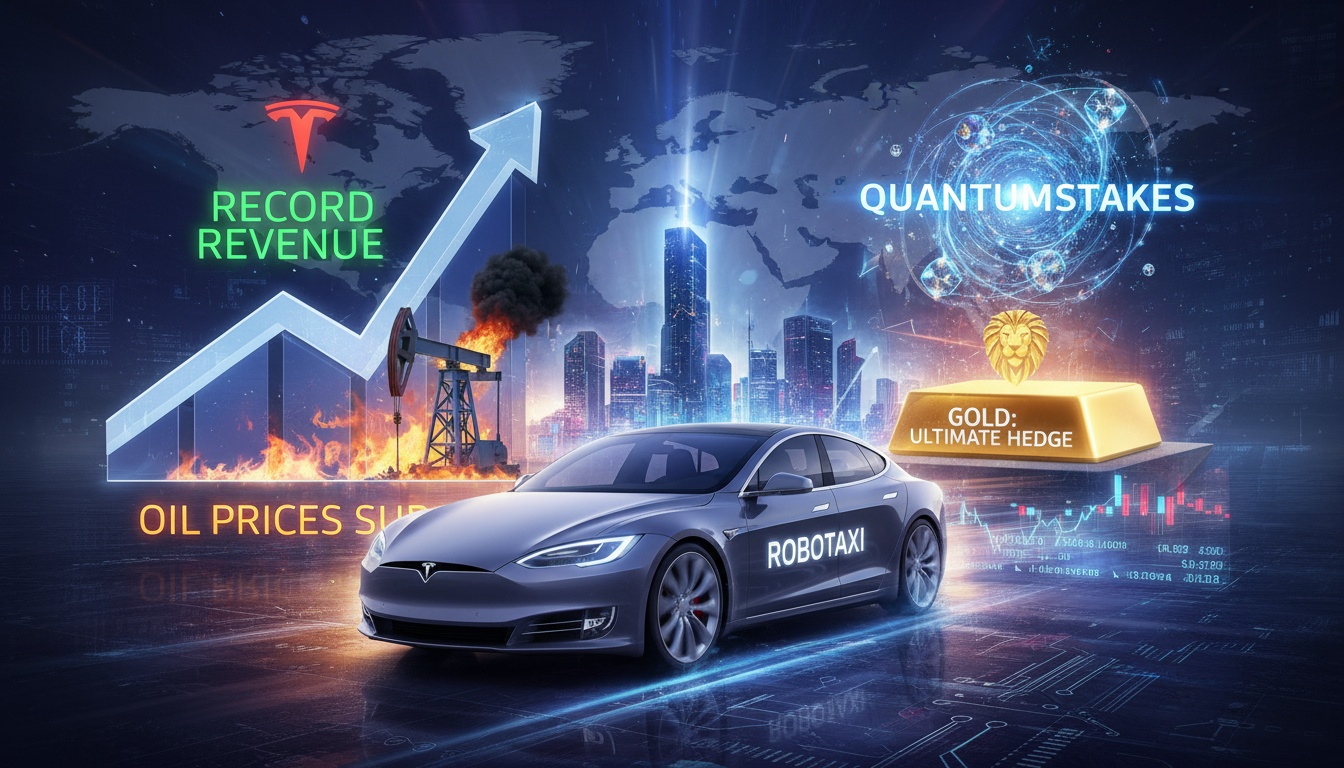
● Tesla Tops Sales, Margins Bleed, Trump Sanctions Spark Oil Surge, Quantum Stake Rumors
Tesla’s “All-Time Highest Sales” and the Real Variables Behind It: Trump’s Russian Oil Sanctions and Oil Prices, the Quantum Computing Government Stake Rumor, Gold, Student Loans, and AI Infrastructure—A One-Stop New York Briefing
Today’s article contains the key points of Tesla’s performance and signals of robo-taxi expansion.
It examines from policy and political perspectives how long the surge in oil prices will persist following Trump’s sanctions on Russian oil companies.
It systematically breaks down the policy trends implied by the U.S. Department of Commerce’s rumor of “government stakes” in quantum computing companies.
It uses numerical comparisons of EV companies’ FCF (free cash flow) to show “who will survive.”
It provides a checklist that can be directly applied to the global economy and the U.S. stock market, covering gold prices, student loans, CPI, and interest rate trajectories, along with artificial intelligence.
Core SEO keywords (global economy, U.S. stock market, inflation, interest rates, artificial intelligence) are naturally reflected.
New York Open Market Snapshot: Rebound Starts, Energy Strength, Tesla Weak
The U.S. stock market, which had declined the previous day, opened with a slight rebound.
The energy sector showed relative strength due to the surge in oil prices.
Tesla was observed to be dragged down to around -5% in early trading after its performance report, before gradually reducing its losses.
IBM was weak due to earnings issues, while Honeywell was strong, surpassing consensus expectations.
GE Vernova continued to be expected to benefit from investments in power infrastructure driven by rising AI demand.
Tesla: “All-Time Highest Sales” vs “Weakening Profitability”, and Robo-Taxi Expansion
Headline Figures
- Record quarterly sales.
- However, margin pressures due to vehicle pricing strategy, costs, and increased investments in AI, robotics, and energy.
Key Points by Segment
- Revenue from the energy business (solar and storage, etc.) surged approximately 44% year-over-year, contributing to portfolio diversification.
- Elon Musk stated that the robo-taxi business would expand to 8–10 cities within the year.
Wall Street Reaction Summary
- “Tesla’s value cannot be driven solely by its automobiles. Visibility in new businesses is needed.”
- Pessimistic view: lowering target prices and reducing position.
- Optimistic view: raising target prices by betting on the value of AI and robotics.
Key Data: The Meaning of Comparing FCF in the EV Industry
- While many EV startups are experiencing huge cash outflows, Tesla stands out as the only one with structurally positive FCF.
- Holding a large amount of cash (estimated at about $41 billion) is a “live round” that allows driving new businesses such as AI, robotics, and energy, even amid short-term profit declines.
- Signals indicate that 2026–2027 could be a survival quarter for EV startups. Tesla’s scale, brand, and vertical integration strengthen its defense.
Investment Implications
- Although there is a lack of immediate “catalysts,” it is necessary to track whether an increasing share of robo-taxi and energy business will become the next valuation axis.
- Key data points include the scope of robo-taxi regulation permits, trends in revenue proportions from the energy segment, and FSD safety indicators.
Quantum Computing: The Essence of Extreme Volatility in the U.S. Department of Commerce “Government Stake” Rumor
What Has Emerged
- According to a report from the Wall Street Journal, there is a rumor that the U.S. Department of Commerce is considering a “stake deal” option with quantum computing companies.
- However, the Department of Commerce replied, “We are not currently in negotiations with any company,” leading to the typical pattern of a pre-market surge followed by increased volatility triggered solely by a rumor.
Corporate and Technological Landscape
- Publicly traded companies: IONQ, Rigetti, D-Wave, etc.
- Privately held companies: Atom Computing, etc.
- Methods: Different implementation philosophies such as ion trap and annealing result in distinct commercialization paths.
- In reality, contracts and MOUs with the Department of Defense (DoD), the Department of Energy (DOE), NASA, etc., are expanding the ecosystem.
Why It Matters
- The combination of “subsidies + stakes” can enhance U.S. control over strategic industries and serve as a policy tool to defend the downside value of early technologies.
- However, small-cap listed companies are an extremely volatile sector, with declines of 30–40% in a week when momentum fades.
Checkpoints
- Whether the policy is materialized (stake conversion under subsidy conditions), the scale/duration of long-term contracts with defense, energy, and space agencies, and its linkage with power infrastructure investments.
A Strategic Industry Map Where “Government Stakes” Are Spreading: Semiconductors, Rare Earths, Lithium, and Steel
Summary of Notable Cases in the Market
- Semiconductors: Large-scale investments and stake acquisitions in Intel (e.g., reports of an $8.9 billion investment for a 9.9% stake).
- Rare Earths: The Department of Defense invested in MP Materials (reported at about $400 million for a 15% stake).
- Lithium: Rumors of the Department of Energy acquiring a stake (about 5%) in Lithium Americas.
- Steel: In the context of US Steel acquisitions, issues regarding securing a “golden share” have been raised.
The Bigger Picture
- Amid deepening U.S.-China supply chain divisions, the “government-industry complex” is becoming visible.
- The combination of government orders and financial measures (subsidies, loan guarantees) with stakes (control) impacts the entire value chain.
Investment Watchpoints
- Industries and companies backed by the government tend to find it easier to secure orders and financing.
- However, regulatory and policy risks also increase, making the sustainability of policies the key variable.
Oil Prices: Soaring After Trump’s Sanctions on Russian Oil Companies, But How Far Will It Go?
What Happened
- Trump’s announcement of sanctions on major Russian oil companies (Rosneft, Lukoil) led to a near 5% surge in international oil prices, with mentions of a $61 per barrel level.
Sustainability Analysis
- Russia has already established a “shadow fleet” and a network of circumvention finance to bypass sanctions.
- Rising gasoline prices in the U.S. increase political pressure, making the continuation of stringent sanctions unlikely.
- In conclusion, while there will be a short-term surge, the medium term may see a re-adjustment scenario.
Checkpoints
- Refinery margins (product spreads), inventories, freight costs, OPEC+ policies, and the U.S. Strategic Petroleum Reserve (SPR) card.
- A reheating of inflation can also affect the interest rate trajectory.
Gold: Private Holdings Soar, Forecasts for Next Year on an Upside Trend
Capital Flows
- Analysis shows that the proportion of gold holdings by private investors has significantly increased from 2021 to 2025.
- This is underpinned by geopolitical risks, increased net issuance of U.S. Treasuries, a weak dollar environment, and debates over an “AI bubble.”
Consensus Forecast
- Some global investment banks have predicted an upper scenario by the end of next year, with prices reaching between $4,900 and $5,000.
- While technical adjustments may occur repeatedly during short-term overbought conditions, the demand for safe-haven assets remains structurally strong.
Practical Points
- Monitor the dollar index, real interest rates, inflows into gold ETFs, and central bank purchasing patterns.
Student Loans: Why Are Americans Becoming Increasingly Impoverished?
On-the-Ground Changes
- With the expiration of repayment forbearance during the pandemic, student loan repayments have resumed.
- There is a growing trend of even pensioners helping their grandchildren with student loan repayments, a manifestation of “three-generation burdens.”
The Mechanism of Consumption Pressure
- The resumption of student loan repayments, coupled with rising defaults on auto loans and increased rent/insurance premiums, is squeezing household cash flow simultaneously.
- Reduced discretionary spending and increased burden from credit card interest could reflect in guidance during the earnings season of the U.S. stock market.
Policy Variables
- Should the current administration scale back repayment relief policies, the “real economy” experienced by consumers could worsen independently of any easing in inflation.
This Week’s Macro Calendar and the Data Gap Risks
Key Events
- Existing home sales, new unemployment claims, CPI (on Friday), etc., are on the radar.
- Due to some periods affected by the aftermath of a federal government shutdown, gaps in statistics could arise, increasing the margin of error in interpreting the Federal Reserve’s interest rate path.
Positioning Hints
- Pay attention to the pace of easing in the CPI’s “Shelter” component and the hypersensitivity of service and wage-driven “super core” components in the market.
- When data noise is high, reliance on forward guidance increases and volatility can escalate.
Investment Checklist: Key Points to Monitor Immediately
- Tesla: Trends in the revenue proportion from energy, the scope of robo-taxi regulatory permits, FSD safety indicators, and the trajectory of margin recovery.
- Quantum Computing: The tangible substance behind the “subsidy → stake” policy shift, long-term contracts in defense and energy, and its synchronization with power infrastructure investment cycles.
- Oil & Energy: Refinery margins, inventories, SPR, and the political limits of gasoline prices.
- Gold: Monitor real interest rates, the dollar index, and ETF inflows.
- Consumption: The impact of resuming student loan repayments, default rates on auto loans, and delinquencies among the subprime credit population.
Key Takeaways Not Covered in Other YouTube/News Briefs
- The survival of EV companies hinges on whether they have “positive FCF.” Tesla’s structurally positive cash flow positions it uniquely to drive its new businesses.
- A new pillar of U.S. policy is “subsidies + stakes + defense orders.” This pillar interlinks semiconductors, rare earths, lithium, and quantum computing with power infrastructure into one supply chain strategy.
- The surge in oil prices due to Russian sanctions is likely to encounter the political-economic reality of U.S. gasoline prices; focus more on the pathway dependence than on betting on sustainability.
- The data gaps resulting from the shutdown aftermath heighten the risk of communication errors by the Federal Reserve. As market confidence in the interest rate path weakens, volatility may increase.
- For robo-taxis, the value lies in the “data flywheel” rather than short-term revenue. City expansions serve to simultaneously enhance learning data and regulatory credibility.
Market Topical Briefing
- Big tech started mixed but with limited volatility.
- IBM was weak, while Honeywell was strong, confirming an “earnings-sensitive market” trend.
- Companies like GE Vernova in power infrastructure are supported by a robust mid- to long-term narrative of benefiting from AI and data center power demand.
< Summary >
- Tesla: Despite record sales, margin pressures persist; high growth in energy, robo-taxi expansion on the horizon, and a clear survival/expansion edge through FCF superiority.
- Quantum Computing: Increased volatility driven by the Department of Commerce “stake” rumor, with the key factors being the materialization of policy and long-term contracts in defense and energy.
- Government Stake Trend: Expanding within supply chain security across semiconductors, rare earths, lithium, and steel.
- Oil Prices: Although surging due to Russian sanctions, their sustainability is limited by U.S. gasoline pricing dynamics.
- Gold: Safe-haven demand remains solid, warranting monitoring alongside real interest rates and the dollar index.
- Student Loans: Three-generation burdens are squeezing consumer spending and impacting both earnings and macroeconomic indicators.
- Calendar: Watch the CPI, as data gaps might complicate the interpretation of interest rate paths.
[Related Articles…]
- Tesla Energy Business and Robo-Taxis: Redefining the 2026 Profit Model
- Quantum Computing in the Age of Government Stakes: The Signal Sent by the Commerce Department’s Investment Rumor
*Source: [ Maeil Business Newspaper ]
– 테슬라 역대 최대 매출, 촉매 없던 실적발표ㅣ트럼프, 러시아 석유회사 제재 후 유가 급등ㅣ미국을 가난하게 만드는 학자금대출ㅣ홍키자의 매일뉴욕