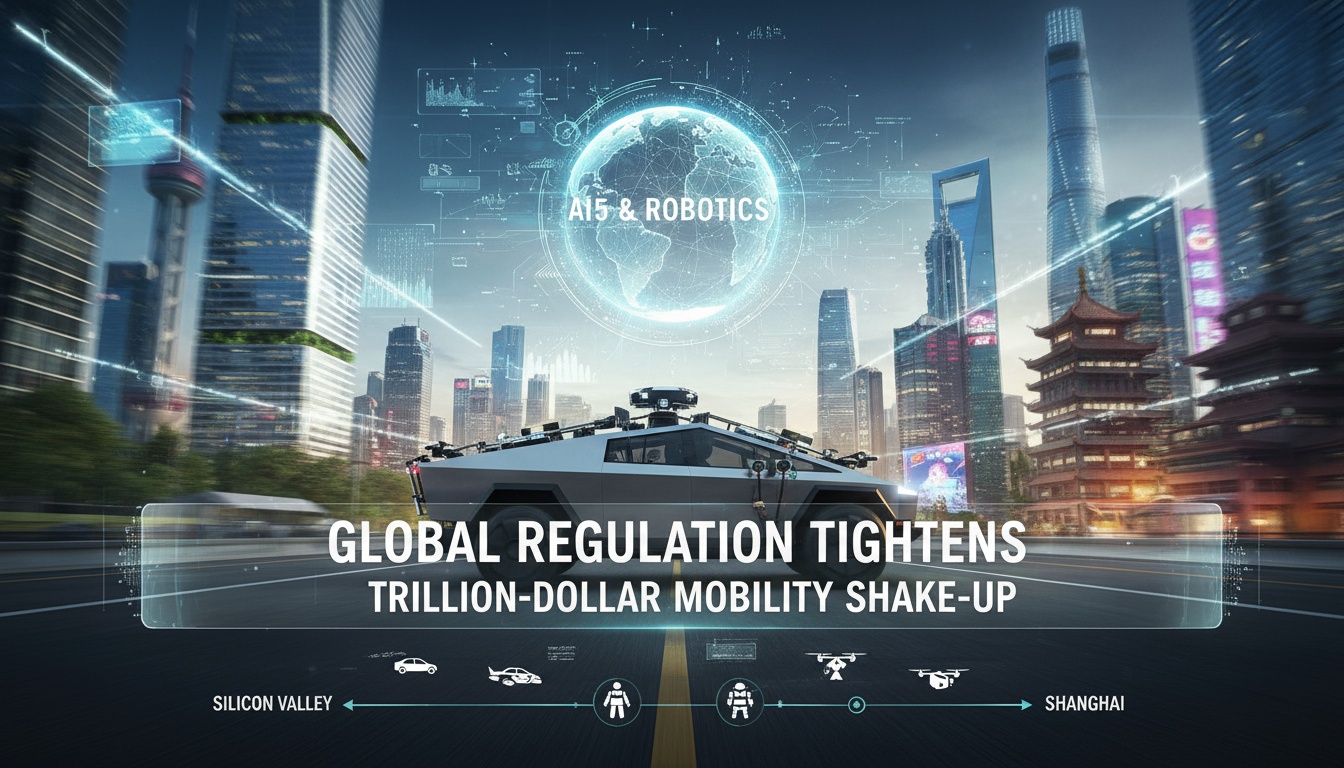
● Mad Max Autonomy, AI5 Ignites Auto-AI Arms Race
Tesla Autonomous Driving’s Secret Overview — E2E AI That Learns ‘Intuition’ Instead of ‘Rules’, AI5 Chip Supply Chain Strategy, Mad Max Regulatory Issues, and the Economic Ripple Effects of Real-World AI Expanding to Robots
This article covers everything. Why Tesla chose an intuition-based End-to-End strategy rather than a rule-based one. Why regulators are scrutinizing the Mad Max mode. The performance of the AI5 chip as revealed by Elon Musk and the ‘dual domestic foundry’ strategy. And how Tesla secures interpretability with its data engine, simulator, and Gaussian Splatting. Finally, it examines the real impact on the global economy, semiconductor cycles, interest rates, inflation, and digital transformation.
Today’s Key Headlines
• Regulation. The US NHTSA has requested additional materials related to the ‘Mad Max’ speed profile added to Tesla FSD v14.x.
• Strategy. Tesla adheres to an End-to-End driving model that connects all inputs—such as cameras, navigation, speed, and audio—into one giant neural network instead of using modular segmentation.
• Chip. Musk has announced the AI5 chip, targeting up to roughly “40 times” the performance of AI4, and stated it will be produced simultaneously in the US at Samsung Texas and TSMC Arizona.
• Data. It refines edge cases from millions of vehicle data records for training, and its simulator has evolved into a ‘virtual road’ capable of generating future camera sequences based on policy changes.
• Robots. It is pursuing a ‘real-world AI’ platform where vehicles and the humanoid Optimus share the same AI stack.
Why Intuition Instead of Rules — An Analysis of Tesla’s E2E Strategy
• Limitations of modularity. When the stages of perception → prediction → path planning → control are segmented, interface errors accumulate, and the system becomes extremely vulnerable in exceptional situations.
• The essence of human driving. Humans do not only observe signals, lanes, and signs. They integrate subtle changes in the trajectories of other vehicles, pedestrian intentions, road conditions, and weather as context to make immediate judgments.
• Tesla’s solution. A single large neural network processes sensing and decision-making in a unified representational space to approximate “intuition.” It is more like a skilled chef adjusting on the fly by assessing the condition of the ingredients than a beginner following a recipe step by step.
Learning Intuition Through Examples — Predicting Puddles, Chickens/Geese, and Slipperiness
• Puddle avoidance. It verifies that the opposite lane is clear and slightly crosses the center line to avoid the puddle. It handles such complex scenarios—where coding every threshold with rules is difficult—as ‘experience patterns.’
• Distinguishing chickens and geese. Instead of merely detecting “a bird ahead,” it differentiates intentions to decide whether to stop or swerve.
• Accident prediction. By integrating subtle vibrations from rain, road surfaces, and the trajectory of the vehicle ahead, it begins decelerating and increasing distance several seconds in advance, reproducing the instincts of a seasoned driver.
Data Engine, Simulator, and Interpretability — Tesla’s Built Toolchain
• Data Engine. It automatically discovers and refines edge cases from driving records equivalent to ‘hundreds of years’ in one day, maximizing training efficiency.
• Simulator. Evolving beyond replaying past footage, its model-based simulation now generates future camera frames when policies change. It synthesizes unlimited risky scenarios for training.
• Interpretability. Leveraging Generative Gaussian Splatting, it reconstructs the AI’s perceived world in high-resolution 3D, providing visualization windows that show which scenes were interpreted in what way and how decisions were made.
Mad Max Mode and Regulatory Risks — The Fine Line Between ‘Aggressive Yet Legal’
• Issue. The aggressive profile—characterized by rapid acceleration/deceleration and frequent lane changes—could conflict with local traffic regulations.
• Current legal stance. It retains an L2/L2+ nature based on driver responsibility, meaning speeding and lane violations are the driver’s responsibility. This structure is a transitional strategy that “accumulates data while managing regulatory risks.”
• Implication. There is potential for differential treatment in regional regulations and insurance premiums. Transparency in safety metrics will be a critical turning point.
AI5 Chip — A Leap in Performance, Dual Production in the US, and Economic Impact
• Design changes. It envisions a dedicated architecture that integrates some functions of the GPU and ISP to simultaneously improve power efficiency, latency, and cost.
• Supply chain. By concurrently producing at Samsung Texas and TSMC Arizona, it strengthens the stability of the semiconductors supply chain ‘within the United States,’ reducing geopolitical risks and logistics lead times.
• Economic effect. By applying it universally across vehicles, robots, and data centers, it distributes NRE, and reducing dependency on Nvidia is expected to lower long-term unit costs.
• Macro connection. Revitalized investments in semiconductor facilities act as an accelerator for global digital transformation. In periods of fixed interest rates, trends in AI servers and edge computing may act as a technical counterbalance to inflation.
Expanding to Optimus — ‘Cars and Robots Sharing the Same Brain’
• Reusability. The same perception, policy, and simulation stack is extended to factory, logistics, and service robots, recycling the learning capital.
• Field deployment method. After thousands of training runs in a virtual environment, it is deployed in the real world. As safety, quality, and cycle time metrics improve, the ROI of robots increases.
• Industry impact. Easing labor supply constraints and improving productivity are likely to help reduce inflationary pressures.
Investor and Industry Signals — Global Economy, Interest Rates, Inflation, Semiconductors, and Digital Transformation
• Global economy. Deepening semiconductor supply chains within the US and investments in AI infrastructure serve as a buffer against a downturn.
• Interest rates. Even in a high-interest, stagnant phase, if productivity expectations are high, the risk asset premium could be re-evaluated.
• Inflation. The field automation of real-world AI has the potential to slow down wage and service inflation over the long term.
• Semiconductors. Increased demand for edge AI opens up multi-node demand for automotive and robotics computing, with potential accompanying investments in memory and backend processing.
• Digital transformation. The closed loop of autonomous driving data and robot operation data is emerging as the core competitive advantage of ‘on-site AI.’
The Most Crucial Points Often Overlooked in Other YouTube Channels and News Outlets
• Legal and technological ‘bridge’ strategy. Maintaining driver responsibility under an L2/L2+ framework while accumulating data on a large scale is not so much “regulatory bypass” as it is “regulatory-friendly scaling up.”
• A reversal in interpretability. The notion of E2E being a black box is largely alleviated through Gaussian Splatting-based 3D reconstruction and policy simulation generation.
• The economics of a single chip across multiple products. Distributing AI5’s NRE across vehicles, robots, and data centers minimizes cost, performance, and inventory risks simultaneously.
• On-device transition. More powerful automotive chips reduce cloud inference costs, leading to improvements in long-term total cost of ownership (TCO).
• Inherent ‘world model.’ A simulator that regenerates footage based on policy changes effectively signals that it has an internal model of the world. This fundamentally changes training speed and the framework for safety verification.
Risk Checklist
• Safety and ethics. Even with interpretability tools, rare combinations of edge cases remain.
• Regulation. Differences in regional traffic norms and insurance systems could create imbalances in the pace of commercialization.
• Chip mass production. Issues with yield, heat, packaging, and software optimization might arise.
• Data privacy. Compliance costs for large-scale video data may increase with regional regulations.
• Competition. Traditional modular companies are rapidly transitioning to world model/E2E strategies. Execution speed is key to maintaining the gap.
Timeline Observation Points
• The scope and frequency of safety metric disclosures.
• Regional policy responses to profiles like Mad Max.
• Progress from AI5 sampling to pilot to mass production, along with the foundry mix.
• The number of robot pilot deployments and the extent of improvements in actual productivity metrics.
• Changes in the proportion of cloud to on-device inference and the cost structure.
Checkpoints and Actions
• Technology. Regularly monitor the disclosed demo of the interpretability tool for the E2E model and simulator performance updates.
• Economy. Monitor semiconductor facility investments, employment, and CAPEX guidance as leading indicators for the global economy.
• Regulation. Keep an eye on NHTSA correspondences, recall databases, and changes in insurance rates.
< Summary >
Tesla is transitioning to End-to-End autonomous driving that learns intuition instead of rules, enhancing interpretability and safety training with its data engine, simulator, and Gaussian Splatting.
The AI5 chip, as announced by Musk, reduces supply chain risks through dual production in the US and maximizes cost-effectiveness by being applied across vehicles, robots, and data centers.
Although the Mad Max mode has drawn regulatory attention, it is expanding data scale through a transitional strategy based on driver responsibility.
This trend accelerates semiconductor cycles and digital transformation and could trigger structural changes in the global economy, interest rates, and inflation.
[Related Articles…]
The New Power Curve in the Automotive Industry Triggered by the Transition to Autonomous E2E
Semiconductor Restructuring in the US and the AI5 Supply Chain: Who Benefits?
*Source: [ 오늘의 테슬라 뉴스 ]
– 충격! 테슬라 자율주행의 비밀이 드러났다 — AI가 규칙이 아닌 ‘직관’을 배우는 진짜 이유와 전략, 전 세계를 놀라게 한 영상 공개
● Tesla’s End-to-End AI Unleashes Productivity Bomb, Robotic Takeover
Tesla FSD’s Fundamental Edge: End-to-End, Solving the Blackbox, Signal-to-Noise Ratio, World Simulator, and the Winning Conditions for Optimus
This article covers why end-to-end is a game changer, how Tesla has solved the blackbox issue, the way signal-to-noise ratio and the world simulator explosively enhance performance, and how all of this impacts Optimus, robotics, and the economic feasibility of robotaxi services.
It also summarizes the ripple effects on productivity, interest rates, inflation, and tech investment from a global economic perspective.
One-line News Summary
Tesla trains the cognition-prediction-planning process all at once using an end-to-end neural network instead of a modular approach, statistically internalizing intuitive judgments that are difficult for humans to code.
By collecting and rigorously filtering massive amounts of real-driving data, Tesla already applies solutions in FSD v14 to amass and refine a large number of edge cases using an explainable, compact model to reduce the blackbox problem.
The key is the “neural network world simulator” that boosts the signal-to-noise ratio.
It corrects policies by amplifying failure data during training and reinforces policies through simulated driving environments with reinforcement learning.
This data-simulation-reinforcement learning pipeline is directly transplanted into Optimus’ brain, likely triggering a productivity revolution in robotics and robotaxi and revitalizing the tech investment cycle.
Why End-to-End is Important: Turning Human ‘Intuition’ into Data
Traditional modular systems separate perception, prediction, and planning and connect them with rules and interfaces.
However, real roads present a continuous series of value judgments rather than a single correct answer, making it difficult for rules alone to capture subtle trade-offs.
End-to-end maps video input directly to steering and acceleration/braking with one massive neural network policy.
Choices such as briefly crossing the centerline to avoid a large puddle or maneuvering to dodge geese on the road are statistically learned as “on-site intuition.”
In conclusion, the essence of end-to-end lies in a structure that absorbs tacit knowledge and domain context from humans through data rather than codes.
Volume and Filtering of Data: “Quantity is Fundamental, Quality Wins the Game”
Tesla collects real-driving videos equivalent to “hundreds of years” of driving daily from its fleet.
When you tokenize data from 8-camera videos, vehicle dynamics, navigation paths, and audio, even a 30-second sample is enormous.
The problem is that humans cannot review all the data, and edge cases that determine performance are rare events.
Therefore, capabilities such as automated labeling, scenario mining, trigger-based snapshots, and human intervention collection to discover and refine “meaningful rare cases” in bulk are essential.
Tesla refines a closed loop of collection → filtering → training → deployment → re-collection, circulating data with a focus on quality.
Emergence Driven by High-Quality Data: “Avoiding Danger as if Already Seen”
A model trained on sufficient edge cases exhibits emergent behavior by anticipating even the secondary effects of a collision.
This is observed in proactive responses, such as decelerating 5 seconds in advance in complex incidents like wet roads, spinning vehicles ahead, or impacts with guardrails.
This is not dictated by rules but is the result of learning statistical structures, appearing when scale and quality cross a critical threshold.
Solving the Blackbox Problem: “Make the AI Explain Its Decision”
Even if the AI reaches the correct conclusion, opaque reasoning makes it difficult to pass safety certification and regulatory approvals.
Tesla has introduced a method that combines an explainable, compact model to summarize and inspect the basis of its decision-making in text form, and according to Ashok, an early version of it has been reflected in FSD v14.
By evaluating explanation consistency, it filters out “correct results for the wrong reasons” and converges to deploying only reliable policies.
Signal-to-Noise Ratio (SNR): Simply Increasing Data Can Hinder the Model
Increasing data volume alone can obscure the model with noise.
Tesla prioritizes the “signal-to-noise ratio” as its key metric, maximizing the proportion of meaningful data.
The method is straightforward.
It automatically collects moments of user intervention, near-accident scenarios, and reproducible failure patterns to quickly amplify the “signal.”
After removing noise and retraining, the performance increment per parameter increases dramatically.
Neural Network World Simulator: Both a Data Amplifier and Policy Corrector
Tesla’s world simulator reproduces and modifies past wrong decisions, gradually increases the environmental difficulty, and generates a large volume of virtual data to boost the SNR.
It systemically corrects policies through a loop of failure replay → strategy correction → retry.
It can safely and infinitely amplify rare real-world events, such as drastic lane changes crossing two lanes, sudden pedestrian intrusions, or unexpected objects appearing after momentary visibility loss.
Evolution Towards Reinforcement Learning (RL): “From Mimicking Humans to Optimizing Exploration”
Musk mentioned during an earnings call that the simulator has paved the way for proper reinforcement learning.
The approach evolves from merely imitating human data to exploring optimal decisions within the simulation, using a reward function to optimize safety, comfort, time, and energy.
With curriculum learning, domain randomization, and risk-sensitive rewards, the policy can be aggressively improved while maintaining generalization to real-world scenarios.
Synergy Leading to Optimus: “The Same Brain, Different Body”
The visual-based world model, simulation, reinforcement learning, and explainability framework are transplanted from wheels to legs.
Optimus evolves with a vision-language-action multimodal policy, complementing or replacing some human tasks in households, logistics, and manufacturing routing.
This has the potential to boost global economic productivity and alleviate mid-to-long-term inflationary pressures.
Relieved labor supply constraints can also induce structural changes in the interplay between interest rate pathways and wage-price dynamics.
Economic and Investment Impact: Fundamental Changes in Cost Curves for Robotaxi and Robotics
In robotaxi services, costs per mile for inference along with insurance and regulatory costs are key; enhancing end-to-end and SNR improves inference efficiency, thereby reducing overall costs.
The world simulator and RL expand coverage for long distances, nighttime, and severe weather, improving both ‘utilization rate’ and ‘average operating speed’ to extend profitability.
Optimus improves productivity in repetitive nighttime operations, reduces supply chain bottlenecks, and shortens the tech investment recovery period.
On a macro scale, enhanced productivity can suppress inflation and support a lower neutral interest rate environment, accompanying qualitative growth in long-term tech investment and semiconductor demand.
Key Points Unique to This Article: The Core Others Overlook
More than the model architecture, it is the ‘data supply chain’ that forms the moat.
The pipeline of fleet scale, automated filtering, and simulation-driven SNR creates an insurmountable edge.
Explainability is the key to regulatory approval and a crucial data point for insurance pricing.
Quantifiable logs explaining ‘why something happened’ reduce accountability and recall risks.
The world simulator acts as a cost-saving ‘data amplifier’.
It multiplies one minute of real driving into hundreds of variations in the virtual world, learning a distribution of rare events that the real road does not offer.
This same framework is transplanted into Optimus, with reusing the vision-action policy dramatically cutting development costs.
Practical Checklist: What to Look for to Confirm Genuine Progress
Check whether the intervention rate (per mile) and environmental coverage (inclement weather, nighttime, complex intersections) have stabilized downward.
Monitor whether the scope of publicly available explanation reports and certification frameworks is expanding.
It is crucial that the reward function in simulator-based RL papers and demos clearly specifies safety weights and risk sensitivity.
For Optimus, speed improvements are evident by tracking the success rates and average operation times of precise tasks such as assembly, picking, and cable plugging.
Points to Watch on the Roadmap
Short term: Expansion of the operational design domain for the end-to-end policy, enhancement of the explainability module, and expansion of insurance and regulatory pilots.
Mid term: Scaling up the world simulator and full deployment of RL, commercializing robotaxi limited zones, and lowering the cost per mile.
Long term: Commercialization of Optimus in households and logistics, reactivation of the tech investment cycle due to a productivity leap, and structural changes in inflation dynamics.
Risks and Counterarguments Laid Out Objectively
Delays in regulatory approvals and issues with accountability frameworks may slow market expansion.
A vision-only sensor philosophy could lead to longer convergence times in certain environments compared to complementary radar/LiDAR systems.
If domain randomization fails to narrow the simulation-reality gap, the benefits of RL may be limited.
Nevertheless, Tesla’s strength lies in the compound lock-in of ‘data scale × SNR × explainability × RL.’
Keyword Connection Summary
The global economic shift in productivity, coupled with Tesla’s autonomous driving and robotics, could long term reduce inflationary pressures and support lower interest rate pathways, thus backing the expansion of tech investment.
Investment decisions are highly sensitive to the speed of robotaxi cost reductions, the demonstration of Optimus’ utility, and the launch of explainability and insurance data.
< Summary >End-to-end learns human intuition through data, surpassing the limitations of modular approaches.Tesla boosts the SNR by accumulating edge cases through a massive fleet and refined filtering.An explainable compact model reduces the blackbox, while the world simulator amplifies failures to correct the policy.The simulator enables reinforcement learning, simultaneously enhancing the performance and economic viability of robotaxis and Optimus.On a macro level, enhanced productivity has the potential to reshape the inflation and interest rate structure, reigniting the tech investment cycle.
[Related Articles…]
The Productivity Impact of Robotaxi Cost Reductions on the Global Economy
*Source: [ 허니잼의 테슬라와 일론 ]
– 테슬라 자율주행 기술의 초격차 이유. ‘블랙박스’ 문제마저 해결했다! 왜 알려줘도 따라 할 수 없는가? 자율주행은 당연하고 옵티머스마저 승자가 되는 이유!
● No Truce, Tech Cold War, China Restructures, AI MA Decimates Rivals
Key Global Economic Outlook for 2026: No Grand Compromise, China’s ‘Long Restructuring + AI Drive’, and Supply Chains Reorganized into Multipolarity
Even if the summit photo looks peaceful, the “economic war” of the US-China hegemonic rivalry does not stop.
China is melting away its real estate and local government debt over time while reorganizing its industrial front into a new economy.
A big wave of M&A centered on AI, semiconductors, and robotics has already begun, transforming the “weak many” into a “strong few.”
A roadmap turning unsold and unfinished housing in tier 3 and 4 cities into public acquisition and rental is becoming a reality.
The United States confronts by “closed sharing” of technology with its allies, while China counters with an “open diffusion” strategy towards the global South.
It is time for Korea and its companies to reassess their positioning in supply chains, exports, and investments.
News at a Glance
- Headline 1. A grand compromise between US and China is unlikely, and a “prolonged confrontation” with only a change in topics continues.
- Headline 2. China is managing its debt, centered around domestic issues, with a long-term workout to avoid immediate crises.
- Headline 3. Deflation is largely due to oversupply and price competition (domestic market), while inward-oriented regulations and industrial restructuring proceed in parallel.
- Headline 4. New growth engines in AI, semiconductors, robotics, and power grids are accelerating, as private-sector driven M&A begins to integrate industries.
- Headline 5. Unsold and unfinished housing will likely be solved over 5–10 years with a two-track approach of “completion support + public acquisition and rental.”
- Headline 6. The tech order between the US and China is diverging into “closed vs open,” solidifying a multipolar global and block economy.
- Headline 7. Under the global economic outlook, Korea’s survival strategy will be supply chain and export market diversification along with an AI-driven productivity transformation.
US-China Hegemony and Multipolar Scenario
The US and China are competing not through heat but through economic, technological, and financial regulations, and the summit is merely symbolic management.
The United States restricts the sharing of core technologies primarily among its allies, while China expands its technology and talent development packages to the global South.
Digital and infrastructure linkages with ASEAN, India, the Middle East, and Africa are expanding, and alternative supply chains are taking shape.
With increased tariffs, subsidies, and anti-dumping measures by Europe and the US, Chinese exports are responding with alternative routes and localization.
From Korea’s perspective, geopolitical risk premiums and regulatory volatility remain constant, making selective alliances and pragmatic diplomacy essential.
China’s Macroeconomy: Debt, Deflation, and the Policy of “Buying Time”
Debt related to local governments (LGFV) and real estate is expected to be reduced over time through a strategy that relies on its domestic share, focusing on time and growth.
The central government’s fiscal capacity remains relatively sufficient, so targeted support is possible, but “moral hazard” management will be conducted concurrently.
Weak PPI and low CPI are more significantly influenced by oversupply and price competition than by weak demand, with inward-oriented measures attempting to ease the situation.
Supply-cut policies from 2015 (aimed at reducing overcapacity, overproduction, and excessive debt) are now being extended to new economy sectors.
Since private companies account for a high proportion of employment, abrupt supply cuts could cause employment shocks, making gradual adjustments and M&A integration a more realistic solution.
Industrial Restructuring: Structural Adjustments and a Big Wave of M&A in the New Economy
Electric vehicles and solar power are quickly being consolidated around a “top few” amid an excess of brands.
The oversupplied sectors are finding balance through production cuts, domestic conversion, and overseas localization, while undersupplied sectors include semiconductors, AI, industrial robots, and power electronics.
Since the second half of 2023, there has been a surge in M&A driven by private companies, advancing both horizontal and vertical integration.
Expectations for the improvement of ROE in companies internalizing AI are rising, and the path for the integrated “champions” to expand globally is being reinforced.
In conclusion, the transition is from “a bleeding competition of the weak many” to “global play by a strong few.”
Real Estate: Roadmap for Handling Unsold and Unfinished Housing
For pre-sold but unfinished complexes, financial support will prioritize completion, with tenant protection being paramount.
Local and central governments are expected to expand programs that purchase certain complexes and convert them into public rental housing for youth and others.
While first-tier cities have sufficient absorption capacity, tier 3 and 4 cities will likely undergo a realistic long-term “slicing” process over 5–10 years.
Considering the deterioration of sentiment and commercial areas, management through packages including shopping centers and infrastructure is necessary for a rapid recovery.
The share of real estate in GDP is structurally decreasing, with investments in the new economy increasing as the “engine” is replaced.
Policy Focus: The Tech Order of ‘Closed vs Open’
The United States is reorganizing its supply chains with an alliance-centered approach on advanced semiconductors and AI tools.
China, on the other hand, is increasing its global South partners with initiatives in AI education, open ecosystems, and localized solutions.
Dual-use technologies such as drones, satellite navigation (Beidou), and power electronics are expanding with both civilian and military applications.
Although the frequency of export restrictions and sanctions is increasing, markets tend to maintain transaction volumes even amidst segmentation.
Korean and Corporate Strategy: Positioning in Supply Chains and Investments
The basic strategy for supply chains is diversification across three angles: China’s domestic market, the global South, and allied nations.
For the US market, localization is key; for China, collaborations with local partners and AI cooperation are necessary; and for third countries, joint R&D and procurement should be bundled.
Investment points include AI infrastructure, industrial robotics, power semiconductors, battery materials and recycling, and digital transformation of power grids.
Risk management should focus on core variables such as tariffs, sanctions, exchange rates, regulatory isolation, data localization, and ESG/security reviews.
Under the global economic outlook, selecting stock beneficiaries of restructuring and “champion integration stocks” is the turning point for success.
Data Checklist (6–12 Months)
Monitor Total Social Financing (TSF), China’s PMI, housing completion rates, and local government land use rights income.
Track the number and scale of M&A among private companies, investments in AI/robotics facilities, EV operating rates, and inventory days.
Export trends should be understood by the proportion of Chinese exports rerouted from ASEAN to the United States and localization CAPEX.
Price dynamics should be checked by the PPI-CPI gap, domestic discount rates (promotions), and the strength of inward-oriented measures.
Policy triggers include public acquisition and rental quotas, semiconductor and power grid subsidies, LPR adjustments, and industrial capacity reduction guidelines.
Key Points Overlooked by Other Media
- The essence of China’s deflation lies not in a collapse of demand but in an oversupply and price war, with the solution being inward-oriented measures combined with M&A integration.
- Since private companies are central to employment, supply cuts directly lead to employment shocks, necessitating a “gradual adjustment” that is structural in nature.
- The internalization of AI acts as a “lever” for improving ROE, enabling the top few, once integrated, to possess even stronger global competitiveness.
- Unsold housing in tier 3 and 4 cities will be managed as a long-term slice over 5–10 years through “completion priority + public acquisition and rental,” while debt tied to domestic dynamics will be reduced over time.
- The opposing strategies of the US—closed tech alliances—and China—open diffusion to the global South—are cementing multipolarity.
Practical Checklist (For Companies/Investors)
- Exports and Procurement. Separate the product lines for China’s domestic market and Western directions, and activate early local assembly and parts production in ASEAN.
- Technology and Data. For AI, robotics, and power electronics collaborations, pre-assess China’s domestic data and security regulations.
- Partnering. Hedge risks by forming joint ventures or collaborative developments with integrated leaders, and diversify secondary and tertiary vendors.
- Finance. Secure simultaneous arrangements for RMB settlements, local procurement lines, and dollar hedging.
- Governance. Regularly check a ready checklist for sanctions, tariffs, ESG reviews, and security inspections on a quarterly basis.
< Summary >There will be no grand compromise between the US and China, and a long-term tech and economic war continues.
China will gradually handle its real estate and LGFV debts over time while switching its engine to the new economy.
M&A centered on AI, semiconductors, and robotics is integrating industries, with a strong few expanding globally.
Unsold and unfinished housing is realistically expected to be resolved over 5–10 years with a dual approach of prioritizing completion and public acquisition/rental.
Korea must respond through a three-pronged diversification of supply chains, AI transformation, and managing regulatory risks.
[Related Articles…]
2025 Supply Chain Redesign: A Guide to the Three-Pronged Diversification Strategy of China, ASEAN, and the US
The AI Transformation Roadmap for Manufacturing: A Productivity Leap from Robotics, Power Electronics, and Semiconductors
*Source: [ 경제 읽어주는 남자(김광석TV) ]
– [풀버전] “무서운 구조조정의 그림자가 온다” 경제적 대타협 어렵다… 멈추지 않는 미중패권 전쟁 | 경읽남과 토론합시다 | 신형관 대표