● Credit Cataclysm, AI Bubble Clash
2025-2026 Financial Crisis? The Collision of Credit Destruction and AI Cycle Through ‘Economic Pathology’
Right now, I will first highlight only the core points that can be found in this article.
- It summarizes how to capture the credit destruction mechanism, overlooked by traditional economics, using numerical data.
- It clearly distinguishes between the paths and remedies of financial crises, foreign exchange crises, and fiscal crises.
- It explains how Trump’s tariffs and the Federal Reserve’s policies serve as triggers for bubbles.
- It presents an in-depth view of the macro collision between the 2025-2026 global economic scenario and the AI investment cycle.
- It provides a practical liquidity and credit checklist rarely covered by the news or YouTube.
Key Summary of Kyung-Ik-Nam x Choi Yong-sik Part 3: News Format Summary
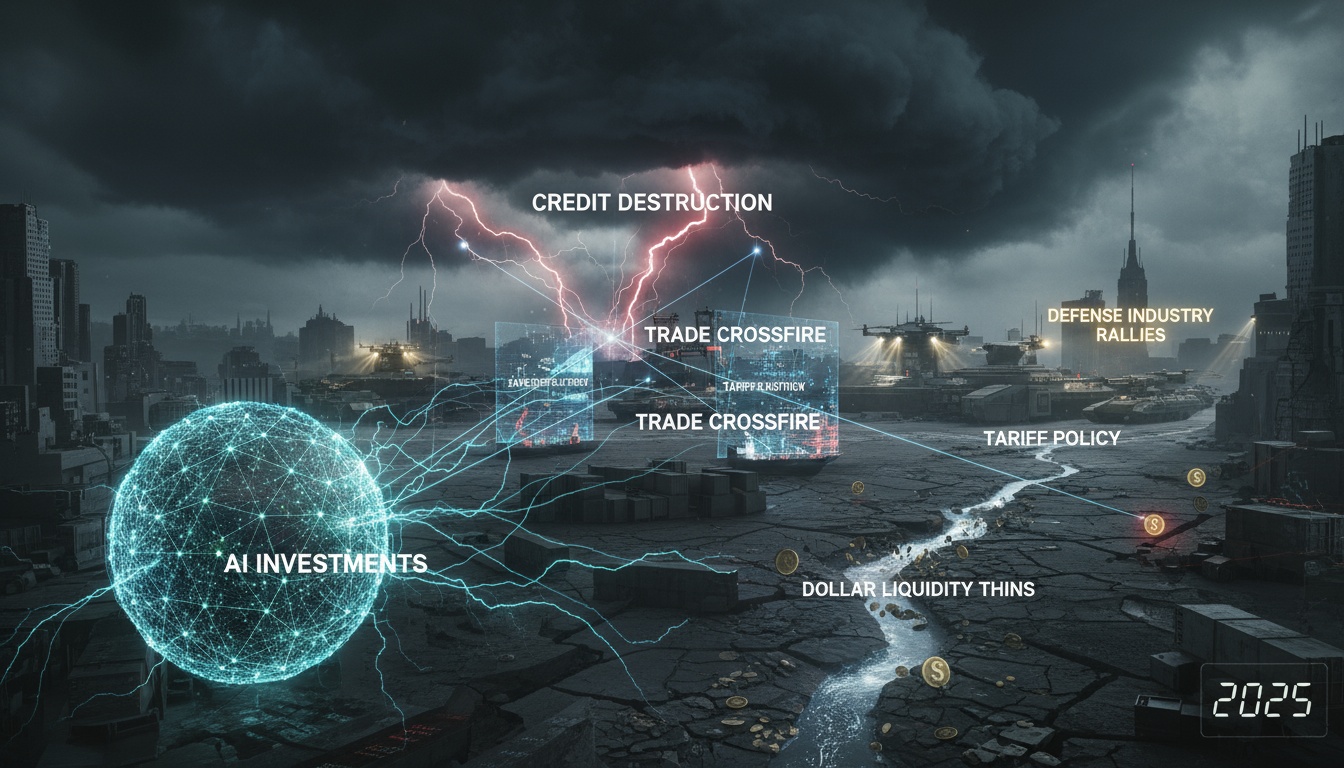
Director Choi Yong-sik dissects the essence of financial crises from the perspective of ‘economic pathology’ that cannot be explained by conventional theories.The core argument is that credit destruction, the counter-effect of credit creation, is accompanied by a contraction in the money supply and a bubble burst.It presents the view that bubbles do not naturally contract but collapse suddenly through panic.Opponents argue that financial distress and financial crises should be distinguished, and that gradual adjustments are possible in a tightening environment, as seen in 2022.They all agree on the need to strictly separate financial, foreign exchange, and fiscal crises, as mixing the terminology distorts policy prescriptions.The case of Greece offers the lesson that the crisis was prolonged because current account deficits and liquidity outflows were overlooked.Trump’s tariffs are diagnosed as needles that pop the bubble and trigger an economic downturn.In conclusion, risk becomes systemic when internal mechanisms (credit cycles) and external shocks (policies/tariffs) combine.
Terminology and Classification: Financial Crisis, Foreign Exchange Crisis, Fiscal Crisis – Different Paths Mean Different Remedies
A financial crisis refers to a situation where the credit intermediation function within banks and capital markets is paralyzed.A foreign exchange crisis centers on external liquidity shortages, rapid spikes in foreign exchange rates, and failures in rolling over external debt.A fiscal crisis unfolds with a collapse of confidence in national debt and fiscal deficits, leading to surging interest rates and a dysfunctional government bond market.Grouping them under the same term blurs diagnosis and jumbles the order of response, so it is essential to separate triggers from mechanisms.
- Remedy for financial crises: Guaranteeing deposits, loan guarantees/public capital, and providing liquidity to collateral markets are crucial.
- Remedy for foreign exchange crises: Improving the current account balance, securing foreign liquidity, and managing currency swaps and capital outflows are key.
- Remedy for fiscal crises: Restoring fiscal confidence, restructuring maturities, and strengthening the demand base for government bonds are prerequisites.
How to Quantify Credit Destruction: The Core That Is Rarely Covered Elsewhere
Check the practical indicators for gauging the progression of credit destruction that are rarely highlighted in the news or on YouTube.
- Credit Impulse: It observes the change rate of the growth rate in private credit.When it turns to below 0, real investment and employment slow down with a lag of 2-3 quarters.
- Bank Loans YoY – Nominal GDP YoY: When loan growth lags behind, it indicates a phase of deleveraging.
- Changes in Deposit Composition Relative to M2: An expanded shift from deposits to MMFs and an inverted liquidity curve in banks are stress signals.
- Currency Hedge Costs and Cross Currency Basis: They capture the early warning of a tightening in dollar funding.
- Short-term Dollar Liquidity: The balance of reverse repos (ON RRP) and fluctuations in the Treasury General Account (TGA) determine market liquidity.
- Corporate Bond Refinancing Month: The concentration of high-yield and leveraged loan maturities in 2025-2026 increases rate-sensitive risks.
- Commercial Real Estate Maturity Structure: Checking the bank’s loss absorption capacity is necessary by combining office/retail LTV and vacancy rates.
- Stablecoin Market Cap and Net Inflows: The rise or fall in global crypto-dollar liquidity acts as a precursor to beta in risk assets.
- Volatility Indicators: A simultaneous expansion of interest rate volatility (MOVE) and credit spreads marks the acceleration phase of ‘credit destruction.’
Bubbles Inevitably Burst, or Is Gradual Adjustment Possible?
From the perspective of economic pathology, when the cost of pulling future demand into the present (‘mania’) is paid, panic-collapse occurs suddenly.The opposing view suggests that if liquidity is supplied and policy responses work, a track of gradual tightening, revaluation, and slight fall—like in 2022—can be possible.In reality, both paths intersect.
- If policy responses are proactive and banks have sufficient capital buffers, a gradual adjustment is absorbed.
- If external triggers coincide with internal vulnerabilities, collapse speeds up on an already thin layer of liquidity.The key difference lies in the “absorption capacity of credit” and “dollar liquidity.”
2025-2026 Global Economic Scenario: A Triple Collision of Interest Rates, Tariffs, and Liquidity
- Scenario A: A gentle slowdown, close to a soft landing.Service deflation continues and interest rate cuts are implemented only to a limited extent.Credit spreads widen, but systemic risk remains under control.
- Scenario B: Simultaneous impact of trade/tariff shocks and credit refinancing walls.A slowdown in manufacturing demand and a strong dollar may trigger problems in the foreign exchange leveraged sector.There is an increased possibility of ‘partial financial crises’ in some regions or sectors.
- Scenario C: A hard landing where policy mistakes and liquidity crunches coincide.Accompanied by prolonged high rates, rising corporate bond defaults, reduced bank credit supply, and a sharp fall in risk assets.The key variables in the global economy are interest rates, inflation paths, dollar liquidity, and tariff policies.What is more critical than a recession is whether the “paralysis of credit transmission channels” is avoided.
AI Trends: The Clash Between CapEx Super Cycle and Macro Forces
Investments in AI data centers and the expansion of power and semiconductor supply chains will drive the global capital expenditure cycle from 2024-2026.The issue lies in the cost of capital.If the peak in interest rates is prolonged, AI capital expenditure will not be able to dodge the effects of credit destruction.
- Large-scale upfront investments based on projected future revenues carry risks similar to the pathological ‘pulling of demand.’
- Power constraints and limitations in the supply of HBM and GPUs can trigger cost inflation, increasing profit volatility.
- Companies with a large gap between sales and cash flow may experience rapid valuation re-adjustments if the refinancing environment deteriorates.On the other hand, AI represents costs in the short term and productivity in the mid-term.
- After 2026, if the adoption rate of copilot and automation surpasses the critical point, unit labor costs may fall and margins could recover.
- Software, semiconductors, and power equipment will form part of a ‘barbell’ strategy, but high valuations and interest rate sensitivity must always be monitored concurrently.
Investment and Business Response Checklist: A Practical Guide
- Liquidity Management: Secure a portion of cash by investing in short-term bonds and MMFs, and layer downside hedges on key investments with options/inverse strategies.
- Duration: Gradually extend medium-term durations in anticipation of normalization in the short and long interest rate curves, while staying flexible for rapid drops.
- Credit: Defend high-yield proportions by diversifying maturities and prioritizing collateral, and consider rapid widening of primary issuance spreads as a signal.
- Sectors: Configure a barbell strategy with AI infrastructure (semiconductors/power), efficiency beneficiaries (software/automation), and defensive sectors (consumer essentials/healthcare).
- Currency Hedge: Use partial hedges during strong dollar phases and explore unhedged/local currency bond opportunities as signs of a peak in the strong dollar.
- Corporate Practice: In a high-interest environment, restructure borrowing to fixed and long-term rates, and simultaneously shorten accounts receivable turnover and slim inventory.
- Policy Monitoring: Constantly monitor signals from reverse repo balances, the TGA, swap line operations, and deposit insurance messages as liquidity backstops.
My Perspective: An Interpretation from the Intersection of Pathology and Policy
Credit destruction should be viewed as a matter of ‘speed’ rather than merely a ‘concept.’What distinguishes a collapse from a gradual adjustment are the quality of leverage, the price elasticity of collateral, and the timing of public liquidity.The global economy in 2025-2026 is likely to be a struggle of shocks between interest rates and tariffs against a backdrop of a liquidity cushion.The AI super cycle is a pillar of long-term growth but, in the short term, it can amplify macro volatility through capital costs and power inflation.In the end, it is not a battle of definitions but a battle of signals.It is a matter of monitoring indicators and responding swiftly.
Summary Timeline: What to Focus on Now
- 0~3 months: Re-establish expectations for interest rate paths, and check changes in the dollar index, cross-currency basis, ON RRP, and TGA fluctuations.
- 3~9 months: Monitor corporate bond refinancing walls, concentrated commercial real estate maturities, and whether bank lending attitude indicators reverse.
- 6~18 months: Confirm trade/tariff policies, pace of alleviating bottlenecks in AI power and component supply, and turning points in productivity data.
The Most Important Content Rarely Covered Elsewhere
- The net issuance of stablecoins acts as an immediate indicator of ‘non-bank dollar liquidity’ and as a leading indicator for rallies in risk assets.
- The balance of reverse repos and the Treasury General Account directly changes the palpable liquidity in the equity and credit markets.
- The pattern where the credit impulse falls below 0 and real economic slowdown is confirmed 2-3 quarters later empirically aligns with the ‘time shift’ explanation in pathology.
- AI CapEx, by pulling future demand into the present, simultaneously contains the driving force and risks of bubble formation from a pathological perspective.
- Rather than a debate over ‘definitions,’ the battle is over ‘measurement’ and ‘speed’ in practical responses.
< Summary >
- Financial, foreign exchange, and fiscal crises are diagnosed separately, and credit destruction is addressed by measuring its speed through indicators.
- Trump’s tariffs, Federal Reserve policies, and dollar liquidity determine the triggers and cushions for bubbles.
- 2025-2026 is the collision period between refinancing walls and the AI CapEx super cycle.
- Stablecoins, reverse repos, the TGA, and credit impulse serve as early warning indicators.
- The portfolio should combine liquidity and quality credit with a barbell strategy centered on AI/power, and mechanically react to policy signals.
[Related Articles…]
- Checklist for Financial Crisis Risks (Updated)
- Insights on the Correlation Between AI Investment Cycle and Interest Rates
*Source: [ 경제 읽어주는 남자(김광석TV) ]
– “지금은 신용 파괴의 시대, 금융 붕괴는 필연이다” 순식간에 벌어질 금융 질서, 자연스럽게 꺼지지 않는다 | 경읽남과 토론합시다 | 최용식 소장 3편
● Inflation Trap, Dollar Rampage, AI Wealth Bootcamp
Economic Education from an Early Age Builds ‘Wealth Stamina’: Interest Rate & Dollar Cycle, Transformation of the U.S. Stock Market, Gold & Currency Strategies, and a Home Economics Curriculum Perfected with AI
Today’s article centers on three core elements.
The real impact of the Fed’s interest rate path and the dollar cycle on the stock market and exchange rates.
Position strategies and risk scenarios for the Nasdaq, Gold, and KOSPI.
And an AI-based home economics curriculum and implementation checklist that you can start immediately with your child.
It also includes practical tools like the seldom-discussed “CPI-linked Allowance” and “Household Rebalancing.”
They can be applied right away today.
Today’s Core Headline Briefing
Inflation and interest rates remain the central variables of the global economy.
As interest rates have lingered at high levels, both the strength of the dollar and the volatility in exchange rates have increased.
In the U.S. stock market, AI infrastructure and semiconductors, backed by solid earnings, remain key pillars even as leadership becomes more distributed.
Gold and cash-like assets maintain their roles as defenses against geopolitical and liquidity risks.
Korean investors must become more sensitive to changes in the dollar-won exchange rate regime, and the success of the KOSPI hinges on foreign capital inflows and the semiconductor cycle.
At home, aligning your child’s “money sense” with inflation is crucial for harnessing the power of compounding over time.
Macro Focus: A Triple Perspective on Interest Rates, Inflation, and the Dollar
Interest Rates: The Fed hesitates to cut rates sharply without clear evidence of disinflation.
Market rates (long-term bonds) react to expectations of growth, inflation, and deteriorating fiscal balances, increasing volatility.
Inflation: Persistent inflation centered on services and rents may remain.
Even if short-term disinflation emerges, the core inflation trajectory is what matters.
Dollar: In periods of interest rate differentials, risk aversion, and liquidity contraction, the dollar tends to strengthen.
A strong dollar triggers capital outflows from emerging markets and a weaker won, impacting import prices and company margins.
Stock Market: When interest rates remain high, valuation expansion is limited, and stocks with strong earnings momentum and cash flows tend to outperform.
These four sentences encapsulate today’s keywords: global economy, inflation, interest rates, the dollar, and the stock market.
U.S. Stock Market and KOSPI: Where to Place Your Bets
Nasdaq: AI infrastructure (data center power, cooling, and networking), semiconductors (high-bandwidth memory, packaging), and software copilots are driving first and second waves.
Leadership appears to be shifting from a few mega-cap stocks to a more distributed focus on energy infrastructure, industrial automation, and cybersecurity.
S&P 500: Share buybacks and high-margin companies provide defensive strength, but a rebound in interest rates and disappointing earnings could hit simultaneously.
KOSPI: The strength of the semiconductor supercycle and sustained net foreign buying are key.
A weaker won may benefit large export-oriented companies but poses challenges for domestic and smaller companies.
Sector Points: Structural beneficiaries include semiconductor equipment and parts, selected second batteries (companies improving costs and yields), and AI power infrastructure such as power, cables, and transformers.
Exchange Rate & Dollar Strategy: Three Approaches Individuals Can Take
1) Cash Basket: Use a default diversification of 70–80% in the won and 20–30% in the dollar, and consider adjusting the allocation when the dollar index surges.
2) Buying within Exchange Rate Bands: Habitually use “band purchasing” by buying in increments around 1,200 won and gradually exchanging or hedging risk around 1,400 won.
3) Dual Hedging for Dollar-denominated Assets: In a strong dollar phase, maintain exposure to foreign stocks while offsetting volatility with gold and short-term bonds.
Gold, Bonds, and Alternative Assets: Defense and Opportunity
Gold: Even when real interest rates and the dollar are high, it serves as a bulwark against geopolitical and fiscal risks.
Consider it as “insurance,” allocated 5–10% of the portfolio on a long-term basis.
Bonds: Long-term bonds are highly sensitive to timing.
Short-term bonds and the money market are effective as cash reserves.
Commodities: Energy and power infrastructure (demand for copper, aluminum, and cables) go hand in hand with the expansion of AI data centers.
Demographics & Consumption Structure: Why ‘Household Cash Flow’ Determines Investment Performance
Aging populations and low birth rates reduce labor supply and long-term growth, while increasing fiscal expenditures and tax burdens.
In this environment, managing fixed household expenses, loan interest structures, and maintaining a cash flow safety net are essential for investment potential.
Economics education for children is the most high-yield intangible investment that improves the household balance sheet.
The earlier you start, the longer you harness compounding, leading to a significant gap in total wealth.
AI Trends: An EdTech Toolkit for Home Economics Education
- AI Household Ledger Copilot: Collects card and account data to automatically recommend budgets and savings ideas by category.
- Allowance Coach Chatbot: When a child sets a goal, it proposes weekly savings rates and reward structures.
- News Summaries and Fact-Checking: Summarizes U.S. stock market, interest rate, and inflation news by level, tailored to the child’s perspective.
- Simulator: Provides experiential learning, such as “loan interest when interest rates rise by 1%p” and “travel costs when the dollar/won exchange rate fluctuates by 50 won.”
- Generative Quest: Allows users to manage a virtual portfolio before and after market events (e.g., FOMC) and produce reports.
Age-Specific Curriculum: Home Economics Classes to Start Today
Preschool (ages 4–6): The concept of money, exchange and choice, and the value of waiting.
Introduce an “opportunity cost game” instead of playing shop.
Elementary (ages 7–12): Divide allowance into three parts (savings, spending, sharing).
Record weekly and hold a monthly household ledger presentation.
Middle School (ages 13–15): CPI-linked allowance.
Adjust the allowance based on the inflation rate, with bonus or penalty points depending on goal achievement.
High School (ages 16–18): Household rebalancing.
Create a simulated portfolio with 3–4 ETFs and submit a rebalancing report every quarter.
Practical Tools: Operational Rules That Aren’t Widely Discussed Elsewhere
- CPI-linked Allowance: The best exercise to make inflation tangible.
After the previous month’s CPI announcement, adjust the following month’s allowance by the inflation rate.
However, implement a “performance penalty” where only 50% is applied in cases of overspending or failure to meet targets. - Household Rebalancing Day: One hour on the last Saturday of every quarter.
Review income, expenditure, and savings rate, and adjust ETF allocations with your child within a 5 percentage point range. - Family Bonds: Issue family bonds for targeted funds (such as school trips or laptops).
Pay interest to the child and design an early redemption option. - Household Stress Test: Evaluate household cash flow under scenarios such as a 1%p rise in interest rates, 100 won increase in exchange rate, and a 10% drop in income.
- News Interpretation Framework: Translate all economic news following the pathway of “interest rates → dollar → exchange rate → real economy/profits.”
2025 Scenario Map (For Household & Strategic Use)
Mild Disinflation: Gradual decline in interest rates, stabilized dollar, and valuation expansion in the stock market.
The strategy is to expand growth and quality while gradually increasing the allocation to long-term bonds.
Reignited Inflation: Rebound in interest rates, strong dollar, and heightened stock market volatility.
The strategy here is defensive, focusing on cash, short-term bonds, and gold, while condensing investments in industrial stocks with clear earnings visibility.
Growth Slowdown & Soft Patch: Slowing corporate earnings, decline in both long and short-term rates, and a preference for defensive, high-dividend stocks.
The strategy is to secure cash flow by investing in quality defensives and fixed-dividend stocks.
Note: The above scenarios are general frameworks and should be adjusted according to actual data and events.
Checkpoints for Korean Investors (Focused on KOSPI & Exchange Rates)
- First, observe foreign capital flows and the won regime.
In a weak won phase, large export-oriented companies and a higher allocation to dollar assets are advantageous. - Monitor inventory, pricing, and CapEx within the semiconductor cycle on a monthly basis.
- Update policy variables (fiscal policy, real estate loan regulations, taxation) quarterly.
- A deviation in the directional trend around 1,300 won for USD-Won is seen as a risk management signal.
Household Implementation Checklist: Execute Today
- Create a “one-month budget” with your child.
Open three-part allowance bank accounts. - Save the CPI release date to your calendar and agree on allowance adjustment rules.
- Designate the last Saturday of each quarter as “Household Rebalancing Day.”
- Connect the AI Household Ledger Copilot and enable automatic category classification.
- Prepare a family bond template (amount, interest rate, maturity, early redemption).
Risk Management: Four Critical Pitfalls Not to Miss
- Excessive Leverage: Increases the risk of cascading losses during rising interest rates and heightened volatility.
- Ignoring Exchange Rates: Holding only won-denominated assets during a strong dollar phase is a biased approach.
- Neglecting Cash Flow: Savings rate and fixed expense management take precedence over investment returns.
- Delaying Education: Missing the window for compounding in a child’s financial education is hard to recover from.
Summary of Core Investment Ideas
- U.S.: AI infrastructure, semiconductors, and power grid.
- Korea: Semiconductor value chain, power equipment, and selective secondary batteries.
- Defense: 5–10% in gold, short-term bonds, and cash reserves.
- Currency Hedge: A basket with 20–30% in dollars.
- Household: CPI-linked allowance, quarterly rebalancing, and AI coach implementation.
An Extra Step from Field Notes
The moment you bring your child to a seminar and sit together marks the beginning of their education.
View data and charts as if touring a market, and discuss why the price of a bowl of soup with rice is rising.
When they experience inflation in daily life, the interest rates and stock market news translate into language they understand.
This is the quickest path to building “wealth stamina.”
The Most Crucial Points Rarely Discussed Elsewhere
- A “CPI-linked allowance” simultaneously develops the child’s sense of pricing and negotiation skills.
When you link monthly inflation data to decision-making at home, economic news becomes a living textbook. - Household rebalancing prioritizes family stability over investment performance.
One hour per quarter can create a decade of compounding growth. - Family bonds address financial education and trust-building in one go.
Experiencing interest payments and early redemption teaches the essence of bonds and credit.
< Summary >
Let’s set strategies for the U.S. stock market and KOSPI based on the axes of interest rates, dollars, and inflation, and manage exchange rates through band purchasing.
Defend with gold and short-term bonds, and seek structural opportunities in AI infrastructure, semiconductors, and power.
At home, systematize your child’s “money sense” with a CPI-linked allowance, quarterly rebalancing, family bonds, and an AI coach.
With just these four measures, you can stand firm amid the waves of the global economy.
[Related Articles…]
- A Comprehensive Overview of the U.S. Rate Pivot and Its Impact on the KOSPI
- The Home Economics Education Roadmap Transformed by AI EdTech
*Source: [ Jun’s economy lab ]
– 어렸을 때부터 경제 교육을 해야 하는 이유!
● Hypersonic Gamechanger, China-North Arms Pipeline, Drone Apocalypse
Hyunmoo-7 Debate, The Reality of Russia–North Korea–China Arms Transactions, Korea’s Drone/Robot Battlefield Transformation, and an Investor’s Defense Industry Roadmap Summarized All at Once
This article focuses on four key elements.
1) The actual technological trajectory and limitations of the successor system, tentatively called “Hyunmoo-7”.
2) The reality of the flow of weapons and components among Russia, North Korea, and China, and the implications for the supply chain.
3) The significance of the continuous deployment of the Reaper drone in Korea and the collaboration on a Korean variant of the Gray Eagle.
4) A checklist for investment strategies in the defense industry in a time of heightened geopolitical risk.
Additional details that are often overlooked in other YouTube videos or news outlets, such as “dual-use components” and “prototype saturation strategy,” are also addressed.
Under conditions of global economic volatility, the article explains in detail how defense and supply chain issues connect to investment.
News at a Glance
- Despite the Kim Jong-un–Putin coordination, the prevailing analysis is that Russia’s military technology transfer is very limited, resembling a “salami tactic.”
- Concerns are growing that China is effectively bypassing restrictions and providing indirect support to North Korea through the supply of civilian components such as drone motors, batteries, and communication modules rather than delivering complete weapon systems.
- The accuracy of the Hyunmoo-4 series is among the world’s finest with a precision level in the meter range, and observations suggest that the successor system, tentatively called “Hyunmoo-7,” is progressing in research on hypersonic glide vehicles (HGV), last-moment maneuverability, and anti-ship ballistic capabilities.
- Preparations for a “4th generation battlefield” are accelerating with developments such as drone-mounted ballistic missiles, upgraded underground penetration capabilities, and collaboration between manned and unmanned systems (CCA) along with cooperative autonomous robots.
- On September 28, 2025, the MQ-9 Reaper will be permanently deployed at Gunsan for the first time, significantly enhancing continuous ISR and precision strike operations.
- The defense industry has secured structural growth momentum as it benefits from the confluence of escalating geopolitical risks and reshaped supply chains, although challenges such as regulation, export controls, and a strong Korean won remain as variables.
Key Issues of the Tentatively Named Hyunmoo-7 and Korea’s 4th Generation Strike Systems
-
Accuracy and Survivability.
In tests of the Hyunmoo-4, it was revealed that the missile deviates by about 1–2 meters from the target’s origin point, indicating a Circular Error Probable (CEP) in the meter range.
The rapid deployment enabled by solid fuel and the last-moment agile maneuvers are pivotal in confusing North Korea’s intercept systems. -
Possibility of a Hypersonic Glide Vehicle (HGV).
The concept of an HGV, which glides at high altitudes and changes its trajectory, is being considered as a promising option for the next-generation model.
The key lies not in its speed but in the increased difficulty of interception and enhanced operational flexibility created by its “irregular trajectory.” -
Research on Anti-Ship Ballistic Missiles (Aircraft Carrier Killers).
Research is underway on scenarios where ballistic missiles, equipped with active seekers, strike moving maritime targets.
This could enhance Korea’s anti-access/area-denial (A2/AD) capabilities within its tailored kill chain. -
Drone-Mounted Ballistic Missiles.
To overcome the weakness of ballistic missiles in tracking mobile targets, the concept of combining them with drones has emerged, enabling target re-acquisition and improved terminal guidance precision.
In this division of roles, drones perform long-endurance loitering and target designation, while the warhead executes a high-speed strike. -
Upgraded Underground Penetration Capabilities.
Improvements in penetration performance are observed, incorporating a combination of thick casings and high-explosive warheads alongside specialized propellant techniques influenced by European methods.
The focus is on optimizing penetration and the fuze system of “busters” that counter North Korea’s extensive network of tunnels. -
The Fact Regarding the “Stronger than Nuclear” Claim.
The physical destructive power of nuclear weapons is overwhelming.
However, ultra-precise, non-nuclear, high-powered strikes can be more effective in terms of crisis management, minimizing collateral damage, and battlefield operability.
Thus, the phrase is considered rhetorical exaggeration, intended to highlight increased strategic utility. -
Naming and Timing.
It is appropriate to consider “Hyunmoo-7” as a tentative name rather than an official designation.
Related details are based on publicly available materials and expert seminars and are not classified.
Russia–North Korea–China Technology and Component Flow: Salami Tactic and Dual-Use Supply Chain
-
Russia’s Salami Tactic.
Without directly engaging with decisive technologies like ICBMs, nuclear warheads, or hypersonic systems, Russia appears to limit itself to providing physical items or constrained support.
Even in the context of mutual transactions on the Ukrainian battlefield, the possibility of restoring relations with the United States after a ceasefire means that Russia is unlikely to cross major red lines. -
China’s Dual-Use Route.
Instead of providing complete weapon systems, China is primarily funneling in civilian components—such as drone motors, batteries, communication modules, and night operation equipment—that serve as the core risk.
This gray-area supply chain, circumventing export controls, could enhance North Korea’s low-cost, mass-produced suicide drones and its night combat capabilities. -
Implications for Korean Investors.
As the global economy becomes increasingly divided, the reshaping of supply chains is accelerating, with sensors, power components, and heat-resistant materials within the defense value chain emerging as strategic assets.
Extended geopolitical risks provide clearer visibility for defense capital expenditures and export pipelines, though managing risks related to sanctions and export controls (ITAR/MTCR) is crucial.
North Korea’s “Prototype Saturation” Strategy and a Rational Response
-
Summary of the Strategy.
North Korea aims to increase Korea’s response costs by showcasing a series of ever-changing prototypes every year.
This tactic induces offset expenditures on the part of the adversary by dispersing budgets through a variety of non-operational displays before full operational capability is achieved. -
Korea’s Optimal Solution.
Threat classifications should be subdivided based on “operational readiness” to determine priorities.
Maximizing combat power while minimizing cost can be achieved by emphasizing software updates, adopting open architectures, and using modular sensors and seekers.
Electronic warfare, counter-UAS, and cyber defense remain essential low-cost, high-efficiency pillars.
The Great Transformation of the Drone and Robot Battlefield: Manned–Unmanned Teaming and Collaborative Autonomous Robots
-
Manned–Unmanned Teaming (CCA) and Stealth Unmanned Strike Vehicles.
Concept models have been unveiled that demonstrate how unmanned systems can undertake high-risk missions in partnership with manned fighter jets, sharing tasks accordingly.
High-risk tasks are assigned to unmanned vehicles, while data links and AI facilitate mission distribution to secure a many-versus-one combat advantage. -
Collaborative Autonomous Reconnaissance Robots.
These robots are designed to create maps and identify threats in GPS-denied environments such as tunnels and underground facilities.
Although initially seen as rudimentary support weapons, they have the potential to be game changers on the battlefield by reducing human casualties.
Moreover, their applicability can extend widely into the civilian sector, such as in mining or underground SOC safety diagnostics.
The Significance and Limitations of Permanently Deployed Reaper Drones
-
Implications of the Gunsan Fixed Deployment.
The continuous 24-hour loitering, reconnaissance, and precision strike capabilities of the MQ-9 Reaper in Gunsan elevate the island’s ISR levels.
It can substitute for some roles previously performed by decommissioned A-10s, making a significant impact in peacetime surveillance and deterrence. -
Vulnerabilities and Mitigations.
Built on a propeller system and lacking stealth, it is vulnerable to sophisticated air defense systems in regular warfare scenarios.
Thus, in the event of hostilities, joint operations with stealth, electronic warfare capabilities, and stand-off weapons are essential. -
Fostering a Korean Ecosystem.
With Hanwha Aerospace and General Atomics reaching an agreement on a Korean variant of the “Gray Eagle,” a domestic ecosystem for operation, maintenance, and component supply is expected to open up.
Korean companies involved in drones, sensors, data links, and autonomous flight software are likely to experience significant growth opportunities.
Investor Checklist: Defense Industry Investment Strategies and Risks
-
Key Beneficiary Value Chains.
1) Guidance systems, seekers, radars, and IR/EO sensors.
2) Solid propellants, fuels, heat-resistant composite materials, and thermal protection.
3) Penetration warheads, precision fuzes, and data links.
4) Counter-drone radars, jammers, and softkill/hardkill systems.
5) Autonomous navigation systems, edge AI, middleware, and cybersecurity. -
Macro and Cyclical Factors.
Even in a global economic slowdown, defense budgets tend to be stable due to their inherently protective nature.
However, fluctuations in exchange rates, raw material prices, and interest rates can significantly impact profit margins, necessitating an assessment of cost-pass-through structures.
For companies with significant export proportions, diversifying supply chain risks and managing shipment schedules are critical. -
Risk Management.
Valuations should account for compliance with export controls, test and certification lead times, and delays in project cash flows.
Since weapon systems typically follow a long-term cycle from order to development, mass production, and MRO, a long-term “investment strategy” is advisable.
Key Points Not Found Elsewhere
-
Dual-use components are the real variable.
North Korea’s performance leap depends more on its ability to secure large volumes of civilian components like drone motors, batteries, and sensors rather than complete weapon systems.
The crux of export control is tracking the end user of these components. -
Cost-Effective “Kill Economics.”
Ultra-precise, non-nuclear strikes and counter-drone defenses are evolving to reduce cost per kill.
Software and data now constitute half of the combat power. -
“Hyunmoo-7” is not a single weapon but a system of systems.
It is a networked force composed of HGVs, last-moment maneuvering capabilities, seekers, data links, and satellite/drone ISR, which opens opportunities for individual component companies. -
North Korea’s “prototype saturation” is an information warfare tactic.
Instead of allowing mere photos and parades to shake the budget, it is essential to filter out based on “operational readiness indicators” such as productivity, maintainability, and ammunition supply viability.
Fact Check and Limitations
-
The name and detailed specifications for “Hyunmoo-7” have not been officially disclosed.
This text is based on estimates and analyses derived from public sources and expert comments.
No information sensitive to military operations has been included. -
The expression “stronger than nuclear” should be interpreted as rhetorical, emphasizing strategic utility rather than physical destructive superiority over nuclear weapons.
-
The permanent deployment of the Reaper in Gunsan and the collaboration on a Korean variant of the Gray Eagle have been summarized based on publicly available reports, and operational details may vary over time.
Recap of Key Points: Why This Matters Now
The evolution of Hyunmoo’s successor—with enhanced precision, maneuverability, and network integration—could potentially neutralize North Korea’s air defense systems.
Limited technology and component trades among Russia, North Korea, and China are fostering a gray-area supply chain, setting the stage for prolonged geopolitical risks.
Drones, robots, and CCA are changing the rules of engagement on the battlefield, and the continuous deployment of the Reaper elevates the quality of ISR and deterrence in peacetime.
Despite global economic fluctuations, the defense industry remains structurally poised for growth, warranting a selective approach based on different segments of the value chain.
< Summary >
- The tentatively named Hyunmoo-7 focuses on upgrading HGVs, last-moment maneuverability, seeker, and penetration capabilities, and the phrase “stronger than nuclear” is a metaphor for enhanced strategic utility.
- Analyses indicate that Russia employs a salami tactic, while China is circumventing restrictions through dual-use channels.
- Manned–unmanned teaming and collaborative autonomous robots are leading a revolution on the battlefield.
- Permanent deployment of the Reaper in Korea has significantly enhanced continuous ISR and precision strike capabilities.
- For investors, the focus should be on sensors, propulsion, materials, counter-drone systems, autonomous software, and managing supply chain risks in their defense industry investment strategies.
[Related Articles…]
- Hyunmoo-7 as a Game-Changer in Korea’s Defense Exports
- Reaper Drones and the Korean Gray Eagle: The Battle of Supply Chains and Regulations
The entire article has been structured with keywords such as global economy, geopolitical risks, investment strategies, defense industry, and supply chain to optimize searchability.
*Source: [ 달란트투자 ]
– “단 1발이면 끝장” 핵보다 위험할 현무-7 위력. 중국 북한 죄다 기겁할 상황 | 김민석 특파원 5부