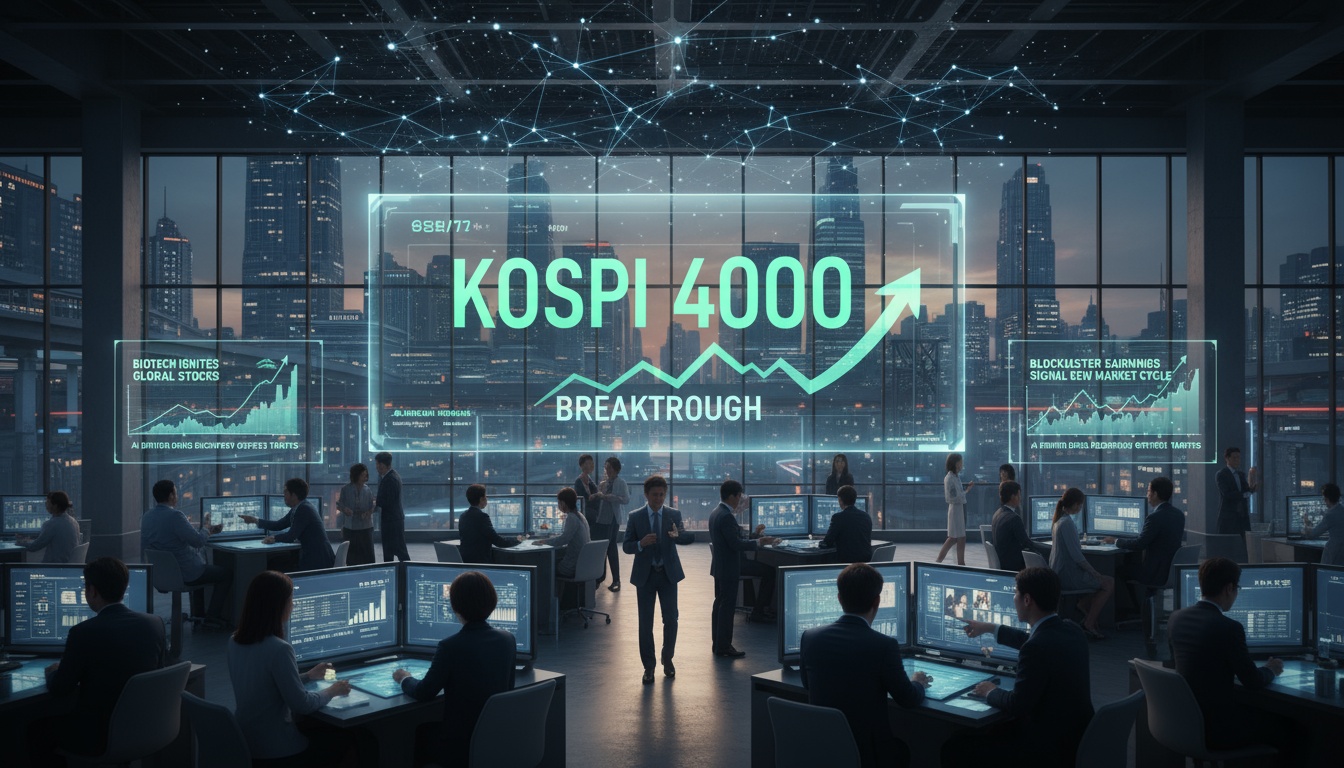
● Bio Bonanza Ahead – Rate Cuts, AI, ADC, SC Ignite Rally
Post-KOSPI 4000, Why is a ‘Bio Market Rally’ Likely: An Overview of Interest Rates, Tariffs, AI, and Earnings Calendars
This article contains five key points.
1) The direct link between the interest rate cut cycle and the bio rally.
2) How bio becomes an ‘exception’ in the high-tariff negotiations initiated by Trump.
3) The event calendar that will move bio stocks from late 2025 to the first half of 2026.
4) The triggering factors of sector leaders such as Samsung Biologics, Celltrion, Alteogen, ADC, and BBB Shuttle.
5) The turnaround to profitability of AI bio (such as Tempus AI) and the impact on domestic listed companies (Protin, Rocket Healthcare, etc.).
The trends in interest rates, exchange rates, the dollar, inflation, and economic outlook are organized into one cohesive narrative so that they can be immediately applied as an investment strategy in a news format.
[Market Situation] KOSPI is Experiencing a Cyclical Rally, While Bio Becomes a ‘Vacant House’
Domestic stocks are experiencing a cyclical rally driven by sectors such as semiconductors, nuclear power, robotics, shipbuilding, and secondary batteries.
While the bio sector’s index has been stagnant over the past year, individual momentum stocks have reached new highs.
At the sector level, large-scale technology transfers (license outs), large-scale orders, and major conference big data have been absent for the past six months, and funds are shifting daily to sectors inundated with news.
However, even a single piece of positive news in this ‘vacant house’ phase can trigger a significant rebound.
When the interest rate and bio sectors have an inverse relationship, and when the benefits of the strong dollar (earning in dollars) due to the exchange rate align, the speed of re-rating can accelerate.
[Timing] The Moment When Bio Rises Sharply
The longer the interest rate cuts accumulate, the more advantageous the high duration (high growth) bio sector becomes.
The U.S. bio (XBI, related derivative LABU) has repeatedly shown inverse behavior to interest rates.
According to the original statement, if interest rate cuts continue between late 2025 and 2026, the probability of a bio rally increases significantly.
Large domestic bio companies (Celltrion, Samsung Biologics, Alteogen, etc.) can enter a zone where the 2026 earnings estimates start to be reflected in the current stock prices.
According to the event calendar, the period around December to January, coinciding with the JP Morgan Healthcare Conference, will serve as a stock catalyst through guidance, deal announcements, and outcomes of one-on-one meetings.
[Tariffs/Policies] The Structure of ‘Bio Exception’ in Trump’s High-Tariff Initiatives
Pharmaceuticals have traditionally been exempt from high-tariff applications, and the policies often serve as negotiation tools.
According to the original text, the framework of agreements with Big Pharma comprises three elements: drug price cuts, domestic investment/employment in the U.S., and the presence of local manufacturing plants.
If these conditions are met, the possibility of tariff deferment or exemption increases, alleviating concerns about margin erosion for global pharmaceuticals and a reduction in BD (license/acquisition) activities.
CMO/CDMOs may turn neutral to positive if there are plans for local U.S. production capacity or expansion.
For biotech technology transfers and joint research, the impact of tariffs is limited since they are considered ‘technology transactions.’
From an exchange rate and dollar perspective, when the dollar strengthens, the conversion benefit of dollar-denominated revenues to won improves earnings visibility.
[Large Cap Check] Samsung Biologics vs. Celltrion vs. Epis (Spin-Off/Re-listing Issue)
Samsung Biologics is triggered by accelerated large-scale orders, global references, and signals of additional capacity expansion/geographical diversification.
The U.S. local plant issue requires careful ROI calculations considering policy, exchange rates, and labor costs, and any industry rumors must be confirmed through official disclosures.
Celltrion’s expected earnings jump in 2026 (product mix/global expansion) is the key to its return as a leading stock scenario.
The re-listing of Epis and collaborations between ADC and AI (with mentions of Intusell, Protin, and GinoSoop in the original text) are interpreted as attempts for value enhancement through a mid-to-long-term new drug development framework.
Note: Issues such as ‘acquisition/expansion of production plants in the U.S.’ are based on the context of the original interview, and the actual confirmation should be verified through company disclosures.
[Key Momentum] Why ADC, BBB Shuttle, and SC Formulations?
ADC (antibody-drug conjugate) remains the most highly regarded theme at major international conferences (European Oncology, etc.).
Domestically, platform deals such as LegoChem Bio (ADC platform) are continuously mentioned as potential triggers.
The BBB shuttle, with its ability to cross the blood-brain barrier, has extremely limited alternatives, thus companies with this technology (e.g., ABL Bio) have strong negotiating power.
SC (subcutaneous injection) conversion technology is favorable for pricing and market share strategies due to reduced injection time/costs and increased patient convenience.
The expiration period of Haloderm’s patent and the positioning of alternative technologies (e.g., Alteogen) increase the probability of forming partnerships for formulation transitions for large pipelines.
[AI x Bio] The Game Changer for 2025~2026: Data Networks and the Turn to Profitability
According to the original text, Tempus AI is mentioned to turn profitable in 2025, and it is pursuing a strategy to enhance its data/algorithm performance through contracts with Big Pharma and M&A.
AI bio investments have a structure where ‘winners take many’ rather than ‘winner takes all,’ making the participation of data consortiums consisting of large corporations, hospitals, and governments crucial.
Among domestic listed companies, Protin is expected to expand partnerships through AI integration in protein-protein interaction (PPI) based analysis.
Rocket Healthcare focuses on accumulating clinical data through organoid/regenerative medicine and AI-based design/optimization, which is key to improving performance.
Both listed and unlisted AI-bio deals were frequent between 2024 and 2025, and if interest rate cuts and easing inflation occur, there is significant potential for re-rating multiples.
[Event Calendar] Timeline with a High Probability of Moving Stock Prices
-
End of year to January: JP Morgan Healthcare Conference (guidance, deal announcements, one-on-one meeting feedback).
-
March to June: Major conferences such as ASCO, EHA, ADA (updates on clinical data).
-
Throughout the year: Announcements on technology transfers, joint developments, and long-term CDMO order disclosures.
-
Quarterly: Interest rate decisions (Fed), inflation indicators (CPI/PCE), and movements in the dollar index and exchange rates.
[Investment Strategy] Summary of News Points
-
Bulletin 1: Accumulated interest rate cuts are favorable for the valuation of the bio sector.
-
Bulletin 2: Tariff risks are likely to be neutralized by the negotiation framework of ‘drug price – investment – localization.’
-
Bulletin 3: Even one large-scale technology transfer/large order could trigger the ‘vacant house rally.’
-
Bulletin 4: The transition of ADC, BBB Shuttle, and SC formulations is high-quality momentum directly linked to 2026 earnings.
-
Bulletin 5: The signal of profitability turnaround in AI bio is a harbinger of multi-multiple re-rating.
[Practical Guide] Checklist for Gradual Buying/Portfolio Composition
1) Macro: Verify the path of interest rate cuts, the sustainability of easing inflation, and the direction of the dollar/exchange rate.
2) Industry: Check the conference calendar, pipeline updates before and after JP Morgan, and advantages over competing technologies.
3) Company: Focus on disclosed contract sizes, milestone structures, royalty ranges, cash assets, and a buffer for 8–12 quarters.
4) Category Basket: Diversify with large revenue-generating stocks (Celltrion, Samsung Biologics) 40–50%, platforms (ADC/BBB/SC) 30–40%, AI bio 10–20%, and U.S. bio ETFs (XBI, etc.) 10–20%.
5) Trigger: Look for signals such as one technology transfer, encouraging data from conferences, U.S. localization signals, and favorable exchange rate/dollar environments.
6) Risk: Be cautious of clinical failures, regulatory delays, drug price pressures, additional capital raises, and high volatility (especially leveraged products like LABU).
[The Most Important Content Not Covered by Other YouTube or News Outlets]
1) The true key to tariff risks is the “price – factory – employment” three-part deal.
If a partial concession on drug prices is made, along with expanding or constructing local U.S. facilities and promising job creation, policy headline risks can be neutralized rapidly.
Once this structure is in place, the multiples of CMOs/CDMOs with U.S. production options will be re-rated.
2) The strategic value of SC formulations is undervalued.
The conversion from IV to SC can significantly leverage revenue and market share through reduced time in medical facilities, lower administration costs, and improved patient experience.
In the period of Haloderm’s patent expiration, the scarce value of an alternative SC partner increases.
3) AI bio has strong network externalities, enabling a structure where ‘many winners’ can emerge.
A partnership between hospitals, diagnostics, pharmaceuticals, and cloud services with a robust data pipeline will soon become a competitive advantage, and the first companies to turn profitable will set the benchmark.
4) The impact of exchange rates and the dollar on contract structures.
When a high proportion of orders and royalties are in dollars, a weaker won can lead to a larger impact on earnings.
Conversely, if the dollar weakens, multiples may expand, but actual earnings conversion could decrease, so it is essential to check both macro and micro factors simultaneously.
[Geopolitical Changes After Tariffs/Biosecurity Law: Action Steps]
Centralization of U.S. production/supply chains is a fact.
Optimal: Plans for U.S. plants or capacity expansion, or partnering locally.
Second best: Secure bases in regions excluding China (Korea, Japan, Europe) and direct U.S. logistics chains.
For biotech companies focused on technology transactions, the potential for a tariff-free zone is high, so emphasis should be placed on technological competitiveness and bargaining power.
[Simultaneous U.S./Domestic Strategy] Three-Tier Matching of Macro, Theme, and Company
Macro: Check the trends in interest rate cuts, easing inflation, and the movements of the dollar/exchange rate.
Theme: Focus on ADC, BBB Shuttle, SC, AI bio, and major CDMO orders.
Company: Look at contract pipelines, cash buffers, data assets, and localization options.
In the U.S., focus on XBI (physical/cash) along with small positions in individual stocks (such as Tempus AI), while domestically, mix large revenue generators with platforms/AI bio.
[Cautions and Confirmations]
Some content from the original interview (for example, the acquisition/expansion of U.S. plants by specific companies, the timing of the profitability turnaround) is based on statements and should be verified through official company disclosures.
This article is provided for educational purposes, and investment decisions and responsibilities lie with the investor.
< Summary >
The accumulation of interest rate cuts reinforces the conditions for a bio rally, and tariff issues are likely to be neutralized by the negotiation framework of “drug price – localization – employment.”
The transitions in ADC, BBB Shuttle, SC formulations, and AI bio are key pillars that will simultaneously boost 2026 earnings and valuations.
The period from the end of the year to January with the JP Morgan event, along with conference/deal news flows throughout the year, serves as triggers, making a gradual buying and basket strategy a rational approach.
Monitor the trends in exchange rates, the dollar, and inflation alongside the company’s cash buffers and contract structures.
[Related Articles…]
The Start of a U.S. Interest Rate Cut and a Bio Rally
ADC Technology Transfer and the Re-rating of Korean Biotech
*Source: [ Jun’s economy lab ]
– 코스피4000 다음은 바이오 대세장인 이유(ft.강하나 1부)
● Tariff Truce Spurs AI Bubble, Export Controls Threaten Crash
US-China ‘Mutual Concessions’ Signals, the AI Bubble Debate, and What the Market is Really Pricing In
This article summarizes the changes in tariff scenarios implied by Trump’s statement “Concessions must be mutual”, the latest data on the AI bubble debate, the rally of Bitcoin and Ethereum and the leading signals from the Russell 2000, and key real variables of AI infrastructure such as power, HBM, and packaging all at once.
It especially focuses on analyzing “finer adjustments in export controls that are more market-sensitive than tariff easing” and “the power and memory cost curves that determine AI ROI”, topics that other channels do not cover in depth.
We separate the news summary and insights based on keywords including the global economy, US-China trade war, inflation, interest rates, and the US stock market.
US-China Tariff Negotiations: What the ‘Mutual Concessions’ Statement Changed
A former US president’s message stating “China must make concessions and perhaps we should too” has publicly confirmed the framing of mutual concessions between the two nations.
At the same time, a tone dismissing a 100% additional tariff has emerged, thus reducing the market probability of a maximum tariff scenario.
Previous remarks from a high-ranking official in the Trump administration also hinted that “by avoiding a tariff hike, a substantive dialogue framework has been reached”.
In summary, the norm has shifted from mechanically raising tariffs to a negotiation-based management, which is favorable for risk assets.
However, separate from tariffs are advanced semiconductor and AI-related export controls; while fine adjustments are possible, wholesale easing remains challenging.
Market Reaction: Risk-On Signals in Stocks, Cryptocurrencies, and Futures
Bitcoin continues its strong performance, and Ethereum reclaiming the $4,000 level has increased its beta.
In New York futures, the Russell 2000 leads by more than 1%, indicating a rally spreading among interest rate-sensitive small-cap stocks.
S&P 500, Dow, and Nasdaq futures also rose together, confirming a risk-on sentiment before market open.
Considering Korea’s sensitivity to US exports and semiconductor weighting, the KOSPI and KOSDAQ are likely to rise in tandem.
Sector-wise, cyclical rebounds are being attempted in semiconductor equipment, power facilities, industrials, and discretionary consumer sectors, while stories around strategic resources such as rare earth elements and graphite may become more volatile depending on the tone of negotiations.
AI Bubble Debate: What the Data Says Now
A global fund manager survey recorded the ‘AI bubble’ as having the highest tail risk for the first time in history.
Traditional macro risks such as the second wave of inflation, rapid rises in bond yields, and geopolitical risks have been ranked lower, shifting focus from ‘macro’ to ‘asset prices’.
Another survey showed that skepticism prevailed regarding whether corporate AI investments can be justified by corresponding financial returns.
This suggests that while AI is an essential investment theme, the gap between discount rates and cash realization—the timing of cash flow generation versus valuation—is the key factor behind market stress.
News Summary: Key Points at a Glance
Both the US and China have signaled a mutual concessions framework, reducing the likelihood of maximum tariff increases.
Amid the spread of risk-on signals, the leading strength of the Russell 2000 is confirmed, and sensitivities in semiconductors, industrials, and power facilities are increasing.
Cryptocurrencies show Bitcoin’s continued strength, while Ethereum’s upward beta serves as a risk appetite gauge.
The AI bubble debate is emerging as the greatest tail risk, with both ROI skepticism and excessive valuation concerns coexisting.
Five Core Insights Overlooked by Other Channels
1) Finer adjustments in export controls affect stock prices more than tariffs.
Adjustments in the specifications of Nvidia’s China-focused chips, threshold changes in high-performance computing export regulations, and soft controls over EDA, IP, and equipment immediately impact the performance of the supply chain.
Even if the tone on tariffs softens, as long as export controls remain, AI infrastructure investments in China are likely to be rerouted to Southeast Asia, India, and the Middle East.
2) The success of AI ROI hinges on resolving bottlenecks in power, HBM supply, and packaging.
The expansion of power grids, ultra-efficient transformers, cooling systems, UPS, and the costs and rates for data center sites determine the token cost per model.
HBM supply and advanced packaging capabilities such as CoWoS/SoIC set the training cycle time, thereby accelerating or delaying revenue recognition and cash flow timing.
3) The strong performance of the Russell 2000 is a typical response to a combination of stable interest rates and reduced tariff risks.
If nominal interest rates stabilize and yield curve steepening accompanies it, the large interest expense burden on small-cap stocks is likely to trigger a multi-price re-rating.
4) Ethereum’s rally may result from a combination of risk-on beta factors and expectations for improved fee structures.
While Bitcoin serves as a macro hedge, Ethereum is more sensitive to on-chain utility and fee chain improvements, making it a useful indicator of risk appetite.
5) For strategic resources such as rare earth elements and graphite, export licenses and quotas are more critical than tariffs.
While a softened tone may ease short-term supply constraints, the long-term narratives on domestic production and investments in alternative materials remain intact.
Investment Checklist: Key Points and Positioning Ideas for This Week
On the macro calendar, monitor US inflation and employment data, China’s manufacturing and services PMI, and comments from major central banks.
During the earnings season, check the AI capital expenditure guidance of hyperscalers, data center power costs, and comments on HBM and packaging capacity.
Scenario A (Favorable): Continued tariff easing tone coupled with subtle export control adjustments → Enhanced cyclicality in small caps, industrials, semiconductor equipment, and power facilities.
Scenario B (Neutral): Tariff freeze with sustained export controls → Continued benefits for mega-cap AI winners and countries benefiting from supply chain rerouting (Southeast Asia, India).
Scenario C (Unfavorable): Reintensification of tariffs and controls → Dollar strength, increased interest rate volatility, higher raw material volatility, requiring enhanced risk management.
Positioning tips emphasize a principle-based approach.
Select companies highly leveraged to AI infrastructure bottlenecks (power, HBM, packaging), small-cap stocks with visible improvements in interest coverage ratios, and regions that will benefit from supply chain relocation.
Risks and Reversal Signals
If policy communication shifts abruptly or if AI investments fail to translate into revenue quickly, the scope of valuation adjustments could widen significantly.
A renewed sharp rise in US interest rates, an extremely strong dollar, and escalating geopolitical risks would weaken the risk-on environment.
Conversely, stable power rates, easing HBM prices and lead times, accelerated expansion of packaging, and signals of export control relaxations are positive for defending AI-related multiples.
Data Checklist: What to Check Now
Review the annual AI capex guidance and power procurement plans of hyperscalers.
Examine the shipment guidance of HBM suppliers and timelines for enhanced advanced packaging capacity.
Monitor trends in data center power rates, lead times for power facilities, and backlogs for cooling solutions.
Keep an eye on any threshold changes in export control regulations for AI hardware and software destined for China.
Observe whether the Russell 2000 and long-short interest rate spreads move together.
< Summary >
Both the US and China have moved to a ‘mutual concessions’ framework, reducing the probability of a 100% tariff scenario.
Leading risk-on signals, as evidenced by the strong performance of the Russell 2000 and the rallies in Bitcoin and Ethereum, are spreading.
While the AI bubble is seen as a major tail risk, the core of the debate lies in physical constraints such as power, HBM, packaging bottlenecks, and export control measures.
The investment focus is not on tariffs but on finer adjustments in export controls and the AI infrastructure cost curve, with heightened sensitivities in small caps, infrastructure investments, and semiconductor equipment.
[Related Articles…]
How the US-China Tariff Easing Scenario Impacts Semiconductor and Small Caps Immediately
The Hidden Bottlenecks in AI Infrastructure: How Power, HBM, and Packaging Determine ROI
*Source: [ Maeil Business Newspaper ]
– [홍장원의 불앤베어] “중국, 양보해야 하지만, 미국도 그럴 것” AI버블 논란 여전히 현재진행형
● Seoul Shock, Tax Tsunami, Residency Trap, Asset Dragnet
Starting Overlapping Regulations ‘Designated Adjustment Areas + Land Transaction Permit Zones’ Across Seoul: A Comprehensive Overview of Acquisition, Gift, and Capital Gains Taxes, Holding Taxes Outlook, and Investigation Risks
This article contains all the practical essentials including the applicable tax rate when the contract is signed on the day of the policy implementation, the heavy acquisition and gift tax in designated adjustment areas, the “2 years of residence” requirement in addition to 2 years of ownership for capital gains tax exemption in adjustment areas, the actual residence requirement in land transaction permit zones, the possibility of an upward adjustment of the public appraisal realization rate for holding taxes, and finally the strategies for addressing full-scale investigations and verifying fund sources (including virtual assets).
It is organized in a news-style format that allows you to immediately determine, based on numbers and criteria, what needs to be decided now and what can be postponed under the real estate regulation system.
Key Changes at a Glance (News Brief)
- Seoul city and 12 locations in Gyeonggi are designated as adjustment areas, with a significant number of zones overlapping with land transaction permit areas.
- In adjustment areas, acquisition tax is raised from the second home onward, and properties received as gifts also face an almost threefold increase in acquisition tax when conditions are met.
- For capital gains tax exemption, in adjustment areas, in addition to 2 years of ownership, 2 years of residence is mandatory.
- In permit zones, the 2-year actual residence requirement effectively rules out strategies such as burdened gifts, transferring jeonse contracts, and property purchasing.
- Holding taxes may naturally increase if the public appraisal realization rate (currently about 69%) is raised.
- There is a high possibility that buyers, sellers, and real estate agents will all be subject to investigations, with requirements to provide fund sourcing plans and supporting documentation for virtual asset origins.
Implementation Timing and Transitional Provisions
- Contracts that were executed and deposits completed before the policy implementation will follow the non-adjustment criteria.
- Even if the contract is signed after the policy, a temporary situation of one household owning two homes may still receive the general acquisition tax rate, provided that the previous home is disposed of (through sale, gift, or destruction) within 3 years.
- Additional designations at the “dong” (neighborhood) level are possible, which may lead to further regulations in areas experiencing a ballooning effect.
Acquisition Tax: Adjusted Areas vs. Non-adjusted Areas
- For acquiring a single home, the general tax rate is 1–3% (progressive based on the property’s price).
- In adjustment areas, acquiring a second home incurs an 8.4% tax if the property is within the national housing standard (net area of 85㎡ or less) and 9% if it exceeds this size.
- For three homes in adjustment areas, the tax increases to 12.4% or 13.4%.
- In non-adjusted areas, for up to two homes the general tax rate of 1–3% applies, while for three homes the rate is typically 8.4%/9%, and for four homes it is 12.4%/13.4%.
- In non-adjusted areas, small homes valued at 200 million won or less previously enjoyed an exemption from the heightened acquisition tax, but this possibility is greatly reduced once the area is designated as an adjustment area.
- From an economic strategy perspective, the immediate cost shock from the increased acquisition tax is more significant than factors such as interest rate trends or macroeconomic liquidity.
Points Leading to a ‘Surge’ in Acquisition Tax upon Gift
- In designated adjustment areas, if the donor owns two or more homes and the value of the gifted home (either individually or collectively) is 300 million won or more, the recipient’s acquisition tax jumps to 12.4% or 13.4%.
- If the same property is gifted as before, instead of paying 3.8–4% the cash outlay for acquisition tax could be in the hundreds of millions, making it less feasible.
- The actual residence requirement of 2 years in permit zones effectively makes renting out, transferring jeonse contracts, or burdened gifting virtually impossible.
- As an alternative to gifting, one strategy being considered is gifting cash followed by the child purchasing the property directly, but permit zone restrictions, the residence requirement, and the need for proof of fund origins are all concurrently required.
Capital Gains Tax: Exemption Criteria and Temporary Exclusion of Heavier Rates
- For one household with one home, capital gains tax exemption applies up to a 1.2 billion won limit; however, for properties acquired in adjustment areas, both 2 years of ownership and 2 years of residence must be met for exemption.
- For example, if a property is purchased for 700 million won and sold for 1.5 billion won, the tax under the one-home exemption and long-term holding special benefit (80% reduced) could be only a few million won, but if the 2-year residence requirement is not met, it will revert to general taxation resulting in a tax liability in the hundreds of millions.
- The increased tax for multiple homeowners is currently temporarily excluded until May 9, 2026, but its extension remains highly uncertain.
- If the contract was based on a non-adjusted area at the time of signing, there is an exception whereby even if the final payment is made in an adjusted area, the exclusion from increased taxation remains in effect.
- The key to tax saving, which is less affected by capital market fluctuations, is the securement of 2 years of residence and careful management of the timeline from contract signing to final payment.
Land Transaction Permit Zones: The Game-Changer is 2 Years of Actual Residence
- In permit zones, the actual residence requirement of 2 years significantly restricts strategies such as burdened gifts, gap transactions, and property switching.
- When applying for a permit, one must submit a fund sourcing plan along with supporting documents (bank account statements, income certificates, loan certificates, etc.), and failure to meet the permit conditions carries significant risks such as disposal orders.
- The residence requirement may reduce market liquidity, potentially causing price distortions (such as forced sales or undervalued sales) and simultaneously increasing investigation risks.
Possible Upward Adjustment in Holding Taxes (Property Tax and Comprehensive Real Estate Holding Tax)
- According to research on the public appraisal realization rate (currently about 69%), if the assessment criteria are raised, holding taxes may naturally increase even without adjustments to tax rates or the fair market value ratio.
- In Seoul, Gyeonggi, and Incheon—with these regions heavily contributing to the overall comprehensive real estate holding tax—the impact of any changes in the criteria will be significantly felt.
- Discussions on tax reforms are expected to accelerate after the elections, with implementation typically following the next year.
- It is important to monitor the interplay of tax reform, interest rates, and macroeconomic cycles, keeping in mind that holding taxes are highly sensitive to policy changes and tend to be preemptively reflected in costs.
Investigation Risks: Comprehensive Scrutiny of Buyers, Sellers, and Agents
- Amid a trend of full-scale investigations in high-priced areas, even mid-to-low priced transactions that involve unusually low or atypical prices may require proof of fund origins.
- The fund sourcing plan will be scrutinized not only for the period from contract signing to the final payment but also for account activity two weeks before and after, checking for any roundabout practices such as refunds or reversals.
- Virtual assets can be tracked using exchange records that confirm inflows, outflows, and initial funding, linking with real-name account data to trace the transactions.
- In family loan agreements, the substance is key—interest and repayment details are critically examined, and mere formal agreements will not be accepted.
- Sellers are also subject to investigation, with factors such as abnormal pricing, the authenticity of payment flows, and the legality of the real estate transaction process all being closely verified.
Practical Checklist and Timing Strategies
- Secure and document records of contracts and deposit payments made before the policy implementation, and organize any special clauses and supporting documentation to defend the application of non-adjusted criteria.
- For temporary dual home ownership situations, develop both a plan for disposing of the property within 3 years (only sales, gifts, or property destruction qualify) and a residential plan that will enable achieving the 2-year residence requirement to reduce risks.
- For gifts, first assess whether cash is available to cover the increased acquisition tax, and check whether the actual residence requirement in permit zones can be realistically met.
- For items whose classification as a home may be ambiguous (such as pre-sale rights, subscription rights, officetels, etc.), verify first the applicable tax and permit regulations.
- Design the sales timeline around the end of the temporary higher tax exclusion for multiple homeowners on May 9, 2026, and monitor any potential extensions thereafter.
- Keep monitoring announcements on tax reform, adjustments to the public appraisal realization rate, interest rate trends, and capital market fluctuations, and conduct cash flow stress tests as taxes have an immediate impact on cash liquidity.
The ‘Real Core’ Often Overlooked Elsewhere
- Due to the 2-year actual residence requirement in permit zones, strategies such as burdened gifts or gap transactions become structurally infeasible, turning gifting into an issue of impractical execution rather than merely a tax problem.
- Gift-related acquisition tax cannot be financed through loans, potentially requiring immediate cash payments in the range of hundreds of millions won, along with mandatory proof of fund origins.
- Even if a property is purchased at a low price through aggressive bidding, if the price is considered atypical it triggers investigation risks for both buyer and seller.
- Profits from virtual assets are traceable through exchange records that verify initial funding, making it difficult to use them as a means to circumvent anti-money laundering measures.
- The recognized methods of disposal are limited to sale, gift, or property destruction, meaning that changes in property use or household separation are not considered valid disposals.
Conclusion: Immediate Actions Required
- If you are considering signing a contract or arranging a gift immediately, first check whether the property falls within an adjustment area/permit zone and assess the feasibility of meeting the 2-year residence requirement.
- For temporary dual home ownership situations, create a plan for disposing of the property within 3 years and simultaneously establish a roadmap to achieve 2 years of residence.
- For gifts, the ability to immediately cover the increased acquisition tax in cash is the first priority, and as an alternative, consider gifting cash followed by direct property purchase.
- Prepare a complete package of documents—including the fund sourcing plan and detailed account activity evidence—as well as printouts of virtual asset transaction details well before the transaction.
- Monitor announcements regarding holding tax assessment changes, tax reform, interest rates, and capital market volatility, and ensure you conduct cash flow stress tests, as tax changes have an immediate and direct effect on cash liquidity.
< Summary >
- The overlapping regulations in adjustment areas and permit zones lead to both increased acquisition/gift taxes and the pressure of a 2-year residence requirement.
- For acquisition in adjustment areas, capital gains tax exemption for a single household necessitates 2 years of residence.
- Gifting becomes highly challenging due to the immediate cash burden of the acquisition tax and the restrictions imposed by permit zones.
- Holding taxes are under strong upward pressure due to the potential adjustment of the public appraisal realization rate.
- Investigation risks extend comprehensively to buyers, sellers, and agents, and providing proof of fund origins—including virtual assets—is mandatory.
[Related Articles…]
- Expanded Designated Adjustment Areas and Heightened Acquisition Tax, with a Practical Checklist
- Re-evaluating Holding Taxes in the Context of Increased Realism Rates: Scenarios Beyond 2026
*Source: [ 경제한방 ]
– 서울 전역 ‘조정+허가’ 본격화…취득·증여세 어떻게 달라지나 / 이장원 세무사