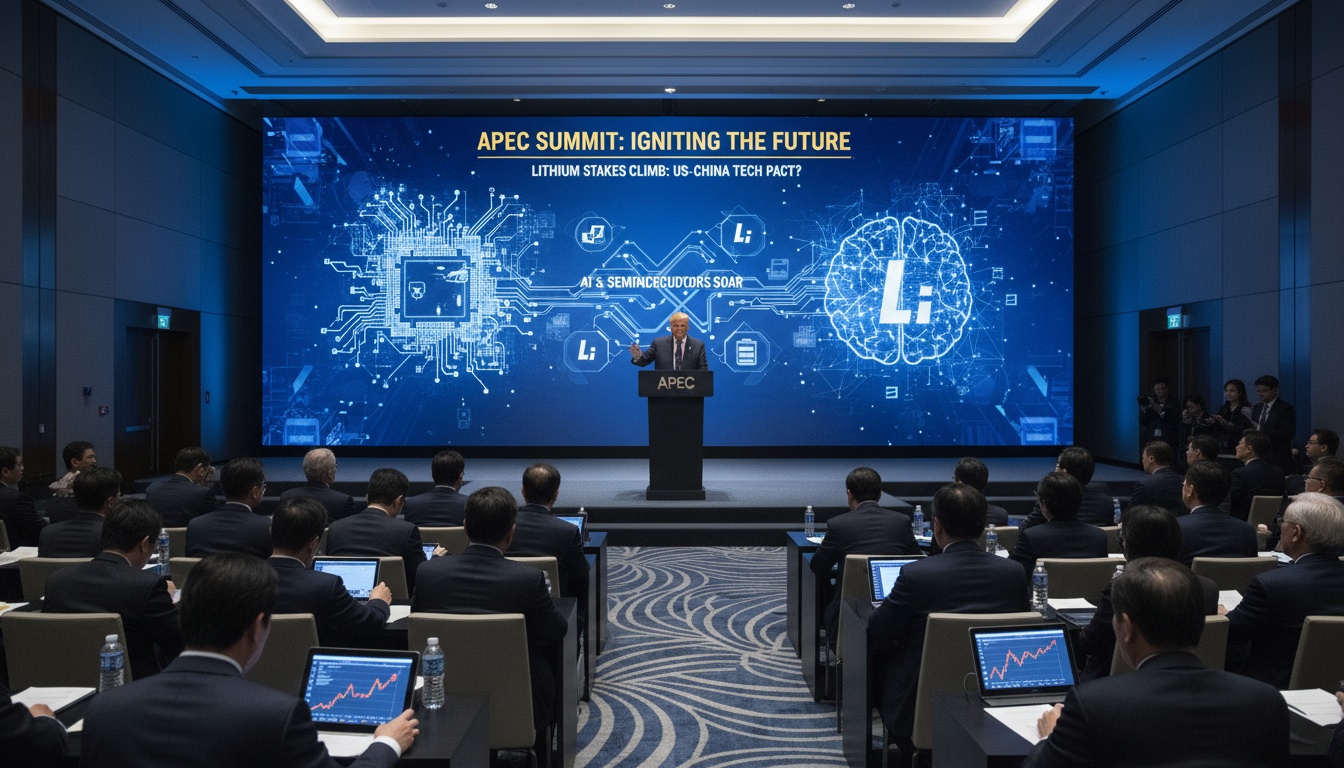
● Chip Supercycle Shock – Trump Asia Deal Sparks AI, Lithium Frenzy
APEC ‘Big Deal’ and Trump’s First Asia Tour Benefit Roadmap: Summarizing the US-China Summit, Semiconductors, AI, Defense, and Hito Materials at Once
This article covers the 1–2 week mega-week calendar with global economic variables, key points of the US-China summit, sector beneficiaries in the US market, the semiconductor supercycle and the path to expanded AI investment, strategies for defense, hito materials, and lithium ETFs, as well as the possibility of an early end to QT.
In particular, it separately outlines secondary ripple effects such as the ‘AI power shortage → ESS lithium renaissance’ that other channels rarely mention, as well as negotiation leverage like the ‘EDA duo (Synopsys and Cadence) control.’
What Will Happen and When During This Mega Week
These are the dates according to the original schedule, and some schedules may change.
-
US-China summit and multilateral meetings.
-
Trump’s first Asia tour (Malaysia → Japan → Korea) and high expectations for APEC ‘Big Deal’.
-
Issues including NVIDIA GTC in Washington and the Korean CEO Summit (covering robots, quantum, digital twin, etc.).
-
Reevaluation of the interest rate cut path and discussions over an early end to QT (Quantitative Tightening) at the FOMC.
-
Big tech earnings rush (Microsoft, Alphabet, Meta, Apple, Amazon).
In summary, this is a “high-volatility favorable zone” where policy (diplomacy and security), liquidity, and earnings all converge simultaneously.
US-China Summit Key Points: Negotiation Cards and Beneficiary Sectors
Semiconductors are the foremost negotiation card for both the US and China.
The United States regulates advanced chips and EDA software (Synopsys and Cadence), while China counters with hito materials and battery materials.
If the summit goes smoothly, the risk premium will decrease, allowing for a short-term pause before a renewed rally; if it becomes tougher, a correction may follow.
-
Key Beneficiary 1: Major semiconductor and equipment stocks.
-
Key Beneficiary 2: The spillover benefits of the US-China supply chain strategy (hito materials, lithium, and other minerals).
-
Risk: In the event of a regulatory intensification, short-term volatility in EDA and major Chinese export-related stocks may increase.
It is preferable to manage sentiment and risk through representative ETFs rather than individual stocks.
SOXX is balanced, while SMH has a heavier weighting on Nvidia, making it better at capturing the momentum of leaders.
Semiconductor Supercycle Update: AI Infrastructure Fuels All Demand
Nvidia remains the leader in AI accelerators.
Meeting and event issues, as well as any remarks from Jensen Huang, can serve as news triggers.
Broadcom benefits from an expanding structure as a partner for customized chips from big tech (especially Google TPU).
In the “Nvidia monopolization vs. expansion of in-house chips” strategy, Broadcom even acts as a hedge.
AMD is strengthening its presence in data center GPUs and CPUs, as well as in quantum and HPC stacks.
Memories such as Micron are riding a cycle upswing due to a surge in demand for HBM and DDR in AI servers.
Equipment stocks like Lam Research and Applied Materials are being supported by capacity expansion and a resumption of investments in miniaturization.
Strategy: Long-term incremental buys in SOXX/SMH, moderate speed when prices surge due to overheating, and reevaluate corrections as buying opportunities.
AI Power Shortage → ESS Demand → Lithium Re-rating
The rapid increase in power demand at AI data centers is reaccelerating the spread of solar power and ESS.
Lithium, a key raw material for ESS, is rebounding, opening up re-rating opportunities.
The establishment of a US mineral alliance and diversification of supply also support the long-term trend.
Individual mining stocks are highly volatile, making ETF exposure a rational approach.
For representative hito/commodity ETFs, refer to RMX (with allocations to lithium, neodymium, and other minerals).
Hito Materials and Minerals: A Long War in the US-China Supply Chain
If the US-China negotiations yield a moderate outcome, there may be a short-term cooling off after an overheat, but the long-term tendency for supply chain building within the US is likely to continue.
Keep an eye on news flows regarding mineral partnerships centered on the US, Australia, and ASEAN.
Strategy: Divide purchases after a sharp rise and respond flexibly when policy momentum reignites.
Quantum Computing: An Accelerated Timeline Approached Through ETFs
Following research announcements by Google and IBM, expectations have risen that the “commercialization timeline could be brought forward.”
Direct stock selection is difficult, so diversifying through themed ETFs is more realistic.
QTUM includes a basket of pure quantum plays (IonQ and Rigetti) along with relevant semiconductors (AMD, etc.).
Due to the thematic nature’s sensitivity to liquidity, careful management of allocations is essential.
Defense/Security: Japanese Defense Budget Increase and ‘Golden Fleet’ Momentum
The security strengthening drive of Japan’s new prime minister and Trump’s pressure on defense cost-sharing combine to heighten global defense demand expectations.
The US “Golden Fleet” concept stimulates chains of submarines, warships, and land-based missiles.
Representative companies mentioned include General Dynamics, Lockheed Martin, Northrop Grumman, and Huntington Ingalls.
The drone and space sectors are expanding to include AeroVironment, Kratos, and Rocket Lab.
Preferred approach using ETFs: Global defense SHLD, US defense ITA, and space/drone ARKX.
Small and mid-cap drone stocks are extremely sensitive to news, so clear stop-loss and allocation rules are essential.
Big Tech Earnings and Nasdaq Strategy
The earnings surprises from large tech stocks, which have been confined to a range for the past three months, could provide a boost to the index.
If individual stock selection is difficult, it is psychologically more comfortable to split half in anticipation through a representative ETF like QQQ and approach the remaining half after the results are reported.
Liquidity Variable: Implications of Observing an Early End to QT
According to the original text, there is growing speculation on Wall Street for an early end to QT.
If actual policy signals are confirmed, it could reaccelerate a liquidity rally along with the interest rate cut path.
In this case, buying activity may widen across policy/growth themes such as semiconductors, AI, defense, and commodities.
Practical Positioning Guide (Summary Version)
-
Semiconductors: Default to long-term incremental buys in SOXX/SMH, adjust speed when surging, and reassess corrections as opportunities.
-
AI Infrastructure: A dual approach centered on Nvidia along with Broadcom (custom silicon) as a hedge.
-
Memory/Equipment: Monitor the ongoing upcycle in HBM and equipment, and keep an eye on the Lam Research/AMAT chain.
-
Hito Materials/Lithium: Approach via ETFs like RMX, tracking news on the mineral alliance and ESS demand.
-
Quantum: Diversify via QTUM, but maintain a conservative allocation.
-
Defense: Prioritize ETFs such as SHLD, ITA, and ARKX, while limiting exposure to small-cap news-sensitive stocks.
-
Core Index: Bet on big tech earnings with QQQ to reduce stress.
-
Risk: In preparation for a failed summit, intensified regulations, earnings misses, or policy surprises, maintain cash and hedge allocations.
Key Points That Other Channels Rarely Mention
-
The AI power shortage is creating a secondary demand chain that runs “semiconductors → power → ESS → lithium.”
-
The EDA duo (Synopsys and Cadence) is repeatedly used as a negotiation lever, serving as the “leash” on the chip ecosystem.
-
Broadcom’s expansion in custom silicon is a systematic hedge that reduces the risk of relying solely on Nvidia.
-
An early end to QT is a top variable that may temporarily offset geopolitical issues and reenergize a liquidity-driven market.
-
The “Golden Fleet” not only affects warships and submarines but also has widespread implications for missile launchers, sensors, and the entire shipbuilding chain.
-
The US mineral alliance is cementing a long-term multi-sourcing structure by diversifying alternative supply chain CAPEX to Australia and ASEAN.
< Summary >
-
This mega week sees the convergence of diplomacy (US-China/US-Japan/multilateral), liquidity (QT), and earnings (big tech) all at once.
-
The semiconductor supercycle and expanding AI investments are being driven through Broadcom, memory, and equipment stocks.
-
The AI power shortage is leading to a renaissance in ESS and lithium, intertwined with the hito materials/mineral alliance.
-
Defense continues to maintain global momentum with expectations driven by Japan’s defense spending increase and the ‘Golden Fleet’ concept.
-
The strategy is to focus on ETFs for split buying (SOXX/SMH, RMX, SHLD/ITA/ARKX, QTUM, QQQ) and to manage event-driven volatility.
Investments should be made based on the research from the original text and at your own risk.
Avoid leverage and all-in bets, and maintain clear rules for splitting positions, cash allocation, and stop-losses.
[Related Articles…]
Semiconductor Supercycle Kicked Off After the US-China Summit
Trump’s Asia Tour and the ‘Golden Fleet’ Momentum for Defense Stocks
*Source: [ 소수몽키 ]
– APEC 빅딜 온다? 트럼프 첫 아시아 순방의 수혜주들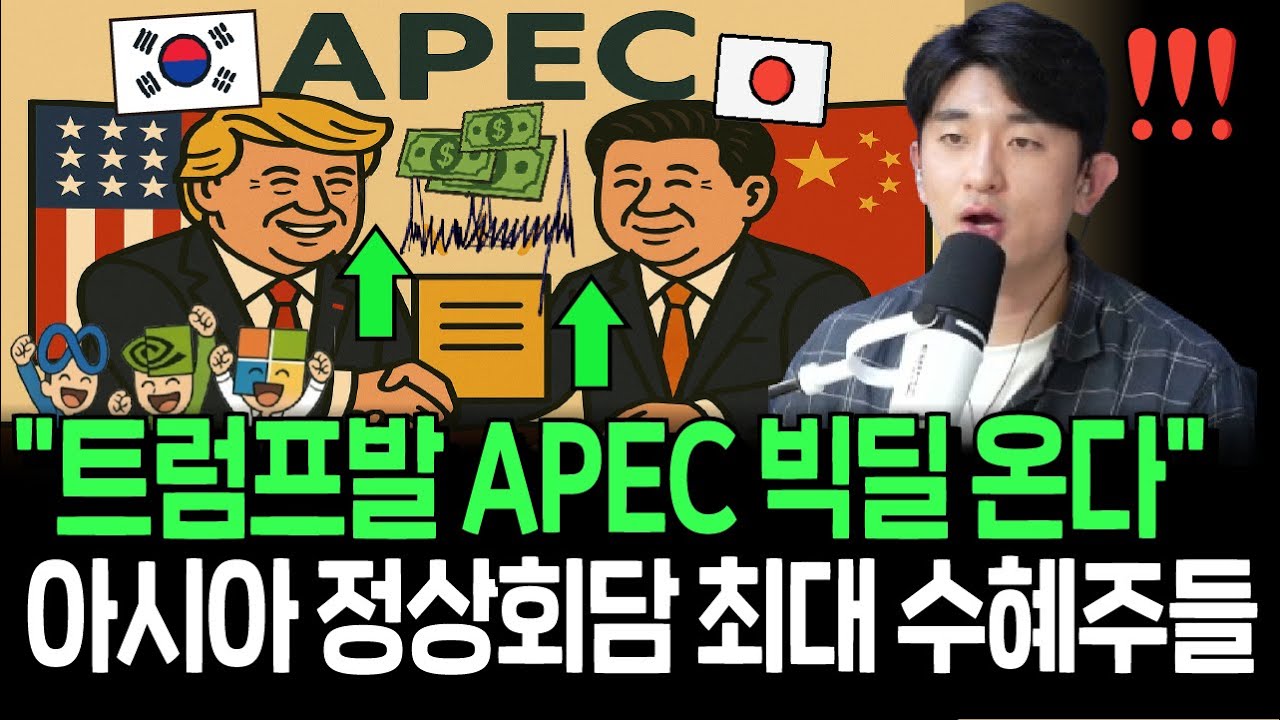
● Growth Stagnation, AI Energy Crunch
Complete Overview of the IMF’s 5-Year Outlook: Stagnant Global Growth, AI & Energy Variables, and Practical Response Strategies
The article you are about to read encompasses the core points of the global economic outlook for 2025–2030, the real reasons behind the upward adjustment from 3.0% to 3.2%, the structural factors that create entrenched low growth, India’s rapid rise and the changing position of Korea, the interest rate cut cycle and dollar flows, as well as the new variable introduced by AI electricity demand on the trajectory of energy and inflation.
It also includes separate sections on the hidden core points that other YouTube channels or news sources rarely mention, such as the “vulnerabilities in the IMF’s assumptions” and the “AI infrastructure cycle.”
Headline Briefing
The IMF has raised its forecast for global economic growth in 2025 from 3.0% to 3.2%, but projects growth to hover around 3.1% in 2030, indicating “entrenched low growth.”
The upward adjustment is based on the easing of trade policy uncertainty (TPU) and tariff shock, while the entrenched low growth is driven by subdued consumer and business sentiment, a decline in trade share, and fragmentation (geopolitical risks).
India is set to emerge as the world’s third-largest economy by 2030, the gap between the US and China narrows slightly, and Korea has a high likelihood of a one- to two-step shift in rankings.
Assuming a downward trajectory in inflation and lower energy and food prices, global interest rates are expected to enter a gradual cut cycle, yet structural factors still support strong dollar fundamentals.
AI data center electricity demand and grid bottlenecks could pose potential risks to the IMF’s assumption of falling energy prices, potentially having asymmetric effects on growth, inflation, and interest rate paths.
1. Global Economic Outlook for 2025–2026: Why the Forecast Was Raised from 3.0% to 3.2%
The latest upward revision in the IMF’s economic outlook reflects the easing of the “shock magnitude” compared to the fear phase of April 4–5.
US effective tariff rates have stabilized lower than their early-spring peaks, reflecting the expectation that the reduction in trade volume and production contraction will be less severe than anticipated.
Trade policy uncertainty (TPU) and economic policy uncertainty (EPU) have been declining since their peaks in April, partially cushioning financial conditions and business investment sentiment.
In summary, while the shock’s direction remains the same, its intensity has diminished, resulting in a partial reversal of the “downward growth” trend, which is the key to the upward revision to 3.2%.
2. The Mechanism of Entrenched Low Growth: Why It Remains in the Low 3% Range for 2030
Although consumer and business confidence indices have rebounded post-pandemic, they remain at lower levels for an extended period, restricting a substantial recovery in consumption and capital investment.
As supply chains are reshaped by tariffs, regulations, and security risks, costs are increasingly directed towards “stability” over “efficiency,” which lowers potential growth rates.
The decline in the share of global trade to GDP, indicative of increasing fragmentation, undermines productivity transfer and economies of scale, contributing to a downward trend in growth.
The impulse response to tariff and policy uncertainty shocks shows only a partial recovery following a sharp short-term drop in exports and output, suggesting limited reversion to previous trends.
Ultimately, it is not a “crisis” but rather a new normal of “low trend growth,” which is set to alter the mechanisms of policy packages and asset price dynamics.
3. The Midterm Landscape for 2030: Shifts in Economic Scale and Geography
The United States remains the largest economy, albeit with growth in the 2–3% range, while China’s growth in the 4–5% range narrows the gap slightly.
India, with a growth base of 6–7%, is highly likely to emerge as the world’s third-largest economy by 2030.
Major European countries are expected to experience entrenched low growth due to challenges related to demographics, energy, and regulatory bottlenecks, resulting in limited ranking changes though their relative share diminishes.
Korea is on track to converge with the low-growth path of developed countries, facing the risk of a one- to two-step drop in ranking, while emerging economies such as Indonesia, Mexico, and Turkey are rapidly catching up.
Some BRICS and ASEAN countries may boost their share through domestic demand, manufacturing, and reshoring benefits, but differences in fiscal and monetary vulnerabilities are expected to widen performance gaps.
4. Trade, Current Account, Inflation, and Monetary Policy: An Overview
The decline in trade’s share and the narrowing of the US current account deficit signal a reduced “world absorption” of US consumption, limiting the upper potential of global trade recovery.
Headline global inflation has eased since its peak in 2022, and the IMF assumes a downward trend in energy and food prices, leading to stable inflation and a forecast of interest rate cuts.
The United States and Europe are expected to gradually reduce interest rates between 2025 and 2027, ultimately converging toward neutral rates around 2027–2028.
Japan, following a belated normalization, is assumed to see rate increases in the 1–1.5% range, although there is a prevailing view that a reversal of the US-Japan rate inversion will remain difficult.
Structural factors—including growth, yield, liquidity premium, and the expansion of dollar-based transactions—continue to support a strong dollar, making volatility management crucial for emerging market currencies.
5. Key Points Not Often Mentioned Elsewhere
AI electricity demand shakes the energy assumption.
The rapid increase in electricity demand driven by large-scale data centers, high-density servers, and expanded cooling infrastructure could limit the downward pressure on electricity, gas, oil, copper, and transformer prices.
This is more likely to lead to “stiff price floors” and “relative energy inflation” rather than renewed inflationary pressures, potentially slowing the pace of interest rate cuts.
Digitalization of the dollar transforms capital flows.
If stablecoins and tokenized deposits under US regulatory jurisdiction become deeply embedded in payment and trade finance, the global ripple effects of US dollar liquidity could expand, ensuring that dollar demand remains structurally strong.
In this case, emerging market countries might face even greater constraints on external currency liquidity and monetary policy autonomy.
The globalization of services offsets manufacturing fragmentation.
As the export of code, models, and digital services expands, “intangible trade” maintains its growth potential.
The timing for AI to boost actual growth rates has a lag.
Substantial productivity gains from improved model performance and domain applications are expected to become visible between 2027 and 2030, with regulatory differences and disparities in grid investment speeds playing a key role.
6. Investment and Business Strategy Checklist (How to Live)
Asset Allocation
In a prolonged period of low growth and gradual interest rate cuts, a “debasement trade” strategy is effective.
Maintain core holdings of high-quality physical and cash flow assets such as prime credits, a mix of short- and long-term durations, quality growth stocks with solid cash flows, and real estate investment trusts focused on infrastructure, utilities, and data centers.
Regional & Sector
India, Indonesia, Mexico, Eastern Europe’s nearshoring clusters, and the AI supply chain (semiconductors, power equipment, copper, cooling) offer medium-term beta.
Europe requires selective focus, while Korea should simultaneously pursue themes that reduce export dependency through domestic demand, services, content, healthcare, and fintech.
FX & Liquidity
Adopt flexible currency hedging policies to prepare for dollar strength and volatility, and secure duration and liquidity buffers for emerging market local currency exposures.
Risk Management
Mitigate volatility spikes triggered by bottlenecks in energy and grid infrastructure, geopolitical risks, and headline trade regulations through a strategy of “allocation, cash holdings, and options.”
Corporate Operations
Prioritize long-term power contracts, investment in energy-efficient infrastructure, dual sourcing in supply chains, productivity enhancements through AI, and accumulation of intangible assets (data, software).
7. One-Line Briefing by Country
United States
Moderate growth with gradual interest rate cuts, coexistence of fiscal deficits and AI infrastructure investments, and continued structural support for the strong dollar.
China
A combination of domestic demand boosts, reinforced industrial policies, and regulatory easing, with the top end of growth being driven by deleveraging in the real estate sector, while managing external tariff risks remains crucial.
India
With manufacturing, digital public goods, and a demographic dividend driving 6–7% growth, the pace of resolving bottlenecks in electricity and logistics infrastructure will be key.
Europe
Growth is constrained by energy price structures, complex regulations, and bottlenecks in defense and green transition investments.
Korea
A shift away from export dependency towards domestic services and upgrading, with selective focus on AI, biotech, content, and eco-friendly infrastructure, is necessary.
News Format Key Data Points
Global economic growth in 2025 is now forecast at 3.2% (up from 3.0% in July), but it is expected to remain around 3.1% in 2030, signaling entrenched low growth.
TPU and EPU have declined since their April peaks, while the US effective tariff rate has stabilized lower than its peak, yet remains above pre-pandemic levels.
A decline in global trade’s share of GDP, along with a contraction in the US current account deficit, points to a shift towards domestic demand-driven growth in a multipolar world.
Headline inflation has eased since its peak in 2022, with the IMF assuming a downward trend in energy and food prices and forecasting a phased reduction in interest rates.
India is poised to rise to the third position, Korea may experience a slight drop in rankings, and emerging markets in BRICS and ASEAN are expected to benefit from domestic and manufacturing advances.
AI electricity demand is a potential variable that could restrict the downward adjustment of energy prices and slow the pace of interest rate cuts.
Summary of Keyword Perspectives
The “entrenched low growth” of the world economy reinforces the “liquidity bias” in policy and asset markets.
The upward revision in the economic outlook (from 3.0% to 3.2%) reflects the easing of shocks rather than an improvement in the trend.
While inflation is easing, energy and grid bottlenecks could lead to a “soft floor” effect.
Interest rates are expected to fall gradually, though at a slow pace, while structural demand factors keep the dollar strong.
AI is expected to curb downward pressures on growth and contribute to productivity gains, with its major effects becoming apparent between 2027 and 2030.
< Summary >
The IMF has revised its forecast upward to 3.2% for 2025, but it expects growth to remain around 3.1% through 2030, indicating entrenched low growth.
The short-term recovery driven by reduced tariff and uncertainty shocks is offset in the midterm by fragmentation, subdued sentiment, and a decline in trade’s share, limiting growth.
India is set to rise to third place while Korea might see a slight drop in ranking; global interest rates are expected to decline gradually, though structural factors continue to support a strong dollar.
AI-related electricity demand is a key variable that could limit the downside for energy prices, leading to a muted path for inflation and interest rates.
The strategy centers on a debasement trade, focus on India, nearshoring and the AI supply chain and infrastructure, as well as flexible currency hedging, energy efficiency, and dual sourcing in supply chains.
[Related Articles…]
Strengthening Dollar and Checkpoints for Emerging Market Capital Flows in 2025
AI Data Center Electricity Crunch and Electricity Price Scenarios
*Source: [ 경제 읽어주는 남자(김광석TV) ]
– IMF가 본 5년 후 미래 : 세계경제가 ‘저성장 고착화’ 되는 이유 [경읽남 216화]
● Stablecoin Coup, Treasury Takeover
Trump’s ‘Stablecoin War’ Scenario: It Encompasses the 2026 Midterm Elections, U.S. Treasury Demand, and the Direction of Global Payment Innovation
Today’s article covers Trump’s strategy to utilize stablecoins ahead of the 2026 midterm elections, a structure that boosts demand for U.S. Treasuries, the joint stablecoin initiatives by global banks, the transition of B2B payments by major Korean conglomerates, and the ripple effects on interest rates, exchange rates, the dollar, and inflation.
In particular, the “bank alliance stablecoin + loan bundling” as a form of non-price competition and the on-chain payment network effects that extend even to “affiliates-vendors-employees” are key points rarely addressed by other media.
1) News Summary: The 2026 Midterm Elections and the ‘Stablecoin War’
In a scenario where Trump regains power or his policy influence increases, expansive fiscal measures and voter-friendly spending will be necessary before the 2026 midterm elections.
Raising the debt ceiling alone is not enough, and having a stable buyer for large-scale issuance of national debt is a key task.
Stablecoin issuers invest primarily in short-term U.S. Treasuries with the cash dollars received on a 1:1 collateral basis to earn interest income.
That is, the larger the stablecoin issuance, the greater the structural demand for U.S. Treasuries, and the competition among issuers leads to more issuance and even higher demand for Treasuries.
This structure serves as a hidden shock absorber, softening the impact of rising short-term interest rates during fiscal expansion.
The ‘on-chain transition’ of dollar liquidity strengthens the international status of the dollar and perpetuates global demand for dollars.
From an economic outlook perspective, this sequentially influences the paths of interest rates, exchange rates, the dollar’s strength, and inflation.
2) Why Stablecoins Become a ‘Buyer of U.S. Treasuries’
Issuing stablecoins means an inflow of deposits, and issuers allocate these funds into safe assets such as U.S. Treasuries and cash-like instruments.
The larger the issuance volume, the greater the scale of Treasury purchases, and the competition among issuers leads to more issuance and thus greater Treasury demand.
This structure helps to dampen the rapid rise in short-term yields, serving as a hidden buffer during phases of fiscal expansion.
The ‘on-chain transition’ of dollar liquidity reinforces the structural strength of the dollar and perpetuates global demand for the currency.
In terms of economic outlook, this sequentially affects the trajectories of interest rates, exchange rates, a stronger dollar, and inflation.
3) Global IBs’ Counterattack: ‘Bank Alliance Stablecoin’ and Non-Price Competition
IBs share a crisis perception that “if corporate remittances and settlements shift to stablecoins, banks will miss out.”
As a solution, the issuance of joint stablecoins and the construction of networks are under discussion.
The key is non-price competition.
- By using our stablecoin, benefits such as preferential loan rates, expanded credit lines, and enhanced coverage are provided as bundled incentives.
- Trade finance, cash management, foreign exchange hedging, custody, and ERP integration are bundled together to lock-in the entire supply chain.
Companies receive not only a reduction in fees but also an integrated package for capital procurement, evaluation, and risk management, resulting in a lower overall cost.
This combination meshes the speed and flexibility of Tether and Circle with the banks’ credit, compliance, and funding capabilities, resulting in a hybrid competitive edge.
4) Corporate Field: From Intercompany Settlement to Vendor Payments and Payroll
Switching intercompany settlements to stablecoins can significantly reduce fees and allow for real-time remittances.
International remittances that once took T+2 or T+3 are shortened to a matter of minutes in T+ seconds, and conventional practices of aggregating remittances on a monthly or bi-weekly basis are replaced with real-time settlement.
Expanding to vendor payments reduces the cash conversion cycle within a supply chain, thereby improving inventory and working capital efficiency.
If the proportion of dollars in overseas payroll increases, exchange rate risks can be reduced and hedging strategies simplified.
By attaching an on-chain wallet module to ERP systems to integrate transaction and payment data in real time, cash flow forecasting accuracy is enhanced.
This raises the risk management effectiveness experienced by CFOs by three levels in an environment of high economic uncertainty.
5) Macro Ripple Effects: Paths of Interest Rates, Exchange Rates, the Dollar, and Inflation
From the perspective of interest rates, increased demand for short-term Treasuries could moderate a sharp rise in short-term yields even amid fiscal expansion.
Medium- to long-term interest rates will vary according to fiscal sustainability and inflation expectations, but the effect of stable demand is to keep the upper end in check.
Exchange rates and the dollar benefit from the structured strength provided by constant on-chain dollar demand.
Emerging market currencies might face greater volatility due to the persistent pressure of dollar demand.
Inflation, in the short term, may remain neutral as the channel from bank deposits → MMFs → Treasuries → stablecoins does not directly feed into consumer spending.
However, once fiscal spending expansion, asset price effects, and imported inflation from a stronger dollar converge, subsequent inflationary pressures may intensify.
In summary, the key points are a stronger dollar, moderated short-term interest rates, and the possibility of delayed inflationary reacceleration.
6) Regulatory and Policy Scenario Check
The U.S. is discussing a regulatory framework for payment-type stablecoins, where bank licensing, quasi-reserve, and transparency requirements are key issues.
Under a Republican-led scenario, the approach might be more open, while under a Democrat-led scenario, consumer protection and compliance burdens would be strengthened.
CBDCs (central bank digital currencies) are politically sensitive, so instead of a full replacement in the short term, a parallel coexistence with private stablecoins is more likely.
If market infrastructure upgrades such as tokenized Treasuries and reverse repo linkages are implemented concurrently, the on-chain funding market layer could be fully activated.
7) Timeline: Key Points to Watch from 2025 to 2027
2025: Pilot project for a bank alliance stablecoin, with bundled trial implementations integrating ERP, custody, and regulatory compliance solutions.
2026: Midterm election mode, accelerated fiscal execution, and observation of interest rate curve changes resulting from the collision between increased Treasury supply and rising stablecoin demand.
2027: Spread of financial products linked to tokenized short-term bonds, an approaching tipping point in the on-chain share of corporate payments, and an acceleration of standard-setting competition.
8) Risks and Backlashes
Compliance Risk: Issues relating to KYC/AML, wallet identification, and sanctions compliance could jeopardize specific chains.
Operational Risk: De-pegging, custody mishaps, chain congestion, and sudden surges in gas fees could hinder actual operations.
Policy Risk: Changes in election or congressional dynamics could lead to abrupt shifts in regulatory pathways.
Market Risk: A persistently strong dollar could impose exchange rate pressures on emerging markets and increase off-shore dollar funding costs, weighing on the real economy.
Valuation Risk: Should the transparency in reporting and auditing of stablecoin reserve assets become compromised, trust could deteriorate sharply.
9) Checklist for Korean Corporates and Investors
Corporate CFO
- Start piloting intercompany payments and overseas remittances.
- Simultaneously update ERP-wallet integrations, internal regulations and auditing systems, and transition treasury policies on-chain.
- Manage exchange rate risks with on-chain dollar cash-like assets and redesign your payment currency strategy.
Individual and Institutional Investors - Clearly establish hedging principles in line with a stronger dollar scenario.
- Separate duration and credit risks in a phase where the upper end of interest rates is moderately constrained.
- Reassess the share of tangible and high-quality assets in anticipation of a potential secondary wave of inflation.
Policy and Regulatory Officials - Clarify the frameworks for consumer protection and anti-money laundering in payment-type stablecoins, while guiding bank pilots into the regulatory sandbox.
- Expand regulatory sandboxes that support cost reductions and exchange rate risk management for export companies.
10) Key Points Often Overlooked by Other Media
- The onset of non-price competition: The banking bundling strategy of “use our stablecoin and get preferential loans and coverage” changes the game.
- The direction of network effects: When the payment network expands from affiliates → primary vendors → secondary suppliers to even include employee payroll, it directly translates into demand for Treasuries.
- Productivity through ERP-on-chain integration: Real-time cash flow visibility and the accumulation of payment data provide leading indicators for gauging economic cycles.
- Structural macro shifts: On-chain demand for dollars lifts the floor for the dollar’s strength, presses down on the upper limits of interest rates, and can distort the timing of inflation.
Conclusion: The ‘On-chainization of the Dollar’ Will Reshape the Political-Fiscal-Market Architecture by 2026
Stablecoins are no longer peripheral in the crypto market; they have become a core infrastructure that reshapes demand for Treasuries, the trajectory of interest rates, exchange rates, and the structure of the dollar.
The convergence of political timelines and corporate cost-saving needs suggests that adoption will accelerate around 2026.
The key words in the economic outlook are clear.
On-chainization of the dollar, moderated short-term interest rates, increased exchange rate volatility, and delayed inflation reacceleration.
Only well-prepared players will be able to seize the network effects.
< Summary >
- In the Trump scenario, stablecoins expand Treasury demand, contributing to fiscal expansion and interest rate stability.
- Global IBs are countering with ‘joint stablecoin + bundling’ strategies to prevent banks from being sidelined and to lock in corporations.
- Korean conglomerates are expanding on-chain payments from intercompany settlements → vendors → payroll.
- The macro impact is summarized by a stronger dollar, moderated short-term interest rates, increased exchange rate volatility, and a delayed reacceleration of inflation.
- Risks must be managed concurrently across regulatory, operational, policy, market, and valuation dimensions.
[Related Articles…]
- Reshaping U.S. Treasury Demand and Stablecoin Regulation
- How On-chainization of the Dollar Is Changing Corporate Payments and Exchange Rate Strategies
This article is provided for informational purposes only and is not investment advice.
Economic outlook, interest rates, exchange rates, the dollar, and inflation-related variables may vary according to policy and market conditions.
*Source: [ Jun’s economy lab ]
– 트럼프가 내년에 스테이블코인을 무기로 쓸 겁니다(ft.김광석 실장 2부)