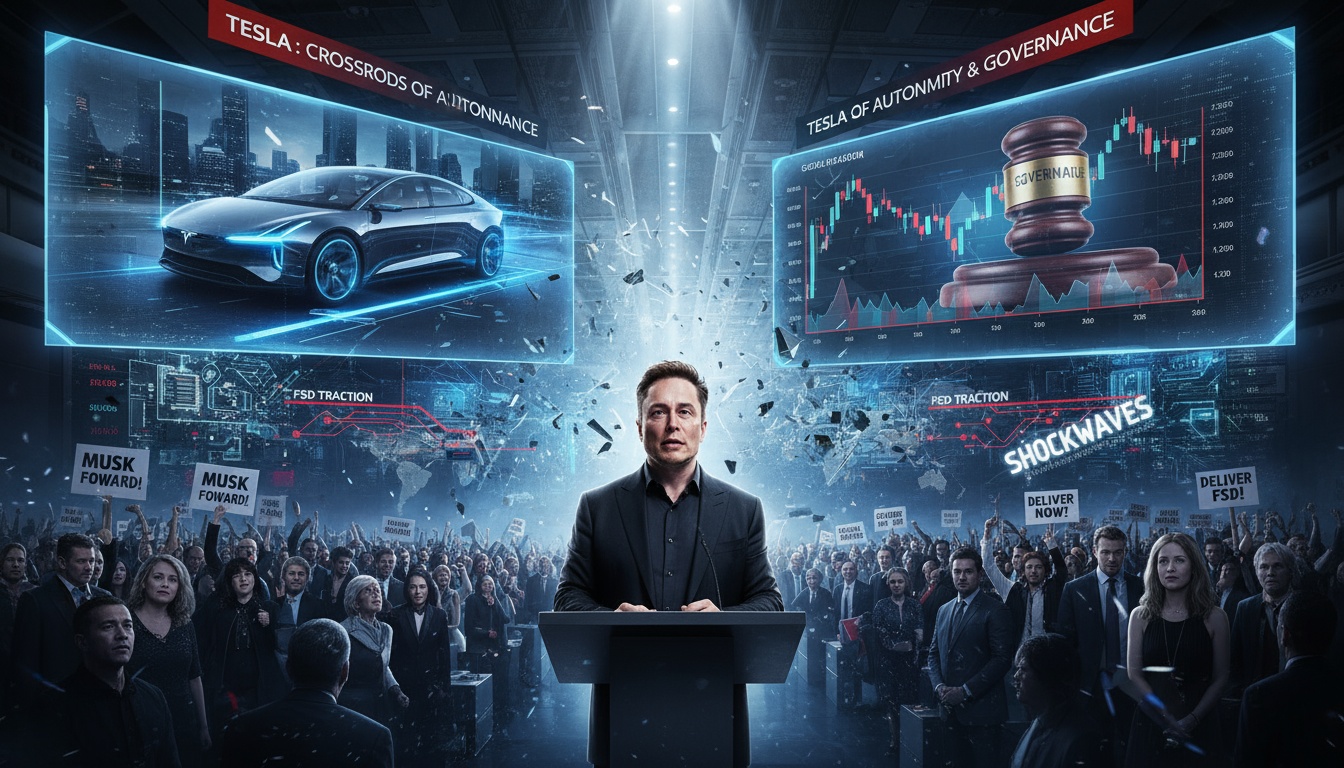
● Musk 1T Power Grab, Tesla AI Takeover
Elon Musk’s $1 Trillion Compensation Plan D-Day: A Comprehensive Review of Tesla’s AI Transformation, Governance, and Stock Market Impact
This article covers everything from the actual structure of the $1 trillion compensation plan, to the scenarios in case of approval or rejection, the hidden influence of passive funds and proxy advisory firms, the shortest route to commercializing robo-taxis (Las Vegas Loop) and its revenue points, as well as the valuation shift from an automotive company to an AI infrastructure company.
In particular, it separately summarizes the “mechanism separating voting rights and economic value” and “the next stage of legal procedures,” which other media have scarcely covered.
Today’s Key News Lineup
Tesla Board Chair Robin Denholm warned that if the proposal is rejected, Elon Musk’s continued involvement cannot be guaranteed.
This proposal emphasizes that it is not merely about compensation but about confirming leadership for the AI transformation.
ISS and Glass Lewis have issued dissenting recommendations, and many passive funds mechanically follow their advice, thus acting as a determining factor of the vote.
Major Wall Street houses have simultaneously raised their target prices.
Cantor Fitzgerald at $510, Truist at $406, Deutsche Bank at $440, Evercore ISI at $300, China Renaissance at $380, among others.
The Bay Area ride-hailing service has officially expanded to San Jose’s SJC Airport, and at the Las Vegas Loop, FSD has begun operating with actual passengers onboard.
It is predicted that full autonomy could be achieved within 1–2 months.
Massive hiring for Cybertruck production has started at the Austin Gigafactory, and with unpacked manufacturing, the signal for mass production by 2026 is strengthening.
The shareholder vote will close on November 5th (US time), with the meeting scheduled for November 6th.
A Glance at the Compensation Structure: Understanding It in Figures
Type: Performance-based stock option structure.
If the milestones are not met, the compensation is zero.
Market Capitalization Targets: Starting at $2 trillion in Phase 1, progressing through 9 stages to a final target of $8.5 trillion with staged milestones.
Operational Targets: Cumulative vehicle deliveries of 20 million units, 10 million FSD subscribers, production of 1 million Optimus units, and 1 million commercial robo-taxis.
Financial Targets: EBITDA growing from $50 billion to a maximum of $400 billion, with a phased increase track.
Vesting and Value Receipt: Even after achieving the milestones, the economic value is delayed by at least 7.5 years before being received.
Key Point: While voting rights are secured early, the economic value is received later, ensuring that shareholders gain returns first.
Arguments For and Against and the Dynamics of the Vote
Proponents: They argue that it stabilizes leadership for the AI and robotics transformation and aligns the interests of shareholders and management through performance-based measures.
They maintain that Musk’s leadership premium is central to Tesla’s value.
Opponents: They cite concerns over dilution, concentration of power, brand and political risks, and the compromise of corporate governance.
The dissenting recommendations by ISS and Glass Lewis play a decisive role in swaying the vote of passive funds.
Ultimately, a high participation rate and the choices of retail shareholders (over 30%) are expected to serve as the casting vote.
Legal and Governance Checkpoints
A similar structure in 2018 was invalidated by a Delaware court over procedural issues.
This re-vote is intended to address and correct that defect.
Even after approval, additional legal review and approval by the competent court are expected to finalize its effect.
Since the introduction of supervoting shares after the IPO was practically impossible, this design provides an alternative by separating voting rights from economic value.
Three Scenarios Based on the Outcome
1) If Approved: Elon Musk’s influence on the equity could rise to around 25%, decision-making might accelerate, and the AI platform transition could be expedited.
Short-term stock volatility is anticipated to fluctuate upward by 10–15%.
2) If Rejected: Musk might shift his focus to X, xAI, SpaceX, or attempt to spin off the AI and robotics division from Tesla.
The remaining manufacturing-centric Tesla could see its valuation framework change, becoming more sensitive to traditional automotive cycle indicators and interest rates.
3) If a Revised Proposal is Resubmitted: A tug-of-war with ISS and Glass Lewis, along with procedural adjustments and unavoidable delays, could risk postponing the strategic roadmap timeline.
AI and Robotics Roadmap: Signs Leading to Commercialization
Bay Area Ride-Hailing: Expansion to SJC Airport sends a commercial signal.
Currently, it operates under supervised FSD with safety personnel onboard, but plans to expand the service area are firm.
Las Vegas Loop: It is currently operating with actual passengers, and full autonomy is predicted within 1–2 months.
In controlled environments (tunnels), the pace of autonomous driving learning and verification is accelerating, making it likely to be the first base for robo-taxi revenue.
Cybertruck Production: Massive hiring is underway in Austin to bolster key processes such as drive units, battery packs, and general assembly.
Leveraging the unpacked manufacturing and an electronics-style high-speed production line, the goal is set to design for 2 million units per year.
Optimus: The demos featuring delicate gripping and even laundry folding are evolving, with line operation expected as early as next year.
An increase in the number of robots will directly lead to a full expansion of software and service revenue streams.
Valuation Reconfiguration: From Automobiles to an ‘AI Infrastructure Company’
The common denominator for Wall Street’s upward revisions is the cash generation from software, services, energy, and robotics.
Cantor Fitzgerald raised its target to $510, reflecting the simultaneous momentum of FSD, robo-taxis, Optimus, Megapack 3, Cybertruck, and Semi.
Truist, Deutsche Bank, Evercore, and China Renaissance also raised their target prices, emphasizing an “AI investment story beyond automobiles.”
This aligns with the trend in the stock market to reclassify Tesla not as a manufacturer, but as a platform and infrastructure company.
From a global economic perspective, expectations of the interest rate peak coming to an end favor long-term growth stock valuations, and a moderation in inflation could accelerate the investment timing for large-scale data centers and energy storage CAPEX by lowering capital costs.
The Most Important Point Other Media Missed
1) The Mechanical Voting Structure of Passive Funds: The impact of the ISS and Glass Lewis recommendations on the vote is more about the “quantity” of votes than the “quality” of logic.
Regardless of whether the logic is right or wrong, a significant number of votes move automatically, which is the fundamental risk in this voting battle.
2) The Implication of Separating Voting Rights and Economic Value: Even after achieving the milestones, the economic value is received later, which limits immediate overhang (selling pressure).
This design is crucial in mitigating short-term dilution controversies.
3) The Tunnel-First Commercialization Strategy: The Las Vegas Loop, with fewer external variables (pedestrians, cyclists, signaling systems), is an ideal test bed to quickly accumulate safety metrics and build trust with regulators.
It provides a pathway to rapidly secure a revenue case before expanding into urban areas.
4) The Energy Component Implied by the EBITDA Milestone: Achieving a $400 billion EBITDA track is difficult with vehicle margins alone.
It presupposes the expansion of Megapack and grid storage, directly linking it to the power grid investment cycle and interest rate trajectory.
5) The Valuation Framework Shift if Rejected: If AI and robotics are spun off, the remaining Tesla could revert to traditional automotive multiples, becoming more sensitive to economic and interest rate changes.
Monitoring Checklist (Not Investment Advice)
Track voter participation and the behavior of retail shareholders.
Monitor the timeline for legal procedures (post-approval court approval required).
Observe the timeline for the Las Vegas Loop’s transition to full autonomy and the disclosure of safety data.
Keep an eye on the pace of expansion for the California ride-hailing service and its unit economics.
Track hiring at Austin’s Cybertruck production, production line utilization rates, and expansion indicators for Megapack 3.
Watch global interest rate trends and inflation as they impact valuation.
Timeline Summary at a Glance
Vote closes on November 5th (US).
Shareholder meeting results are expected on November 6th.
If approved, legal review and approval procedures will continue.
The Las Vegas Loop is expected to transition to full autonomy within 1–2 months.
A scenario of accelerated mass production for Cybertruck and Semi around 2026 is anticipated.
Wall Street’s Perspective and Stock Volatility
Optimistic View: With the Musk premium and the tangible progress of the AI platform transition, a re-rating could be expected.
Pessimistic View: Governance risks and brand/political factors could increase volatility.
Depending on the vote outcome, a short-term swing of 10–15% in the stock price is being discussed.
Ultimately, the key factors are whether Musk can secure 25% influence and the execution capability of the AI and robotics roadmap.
Conclusion: This Vote Is a Matter of ‘Identity’ Rather Than Just Numbers
This vote will determine whether Tesla remains an automotive company or is re-evaluated as an infrastructure company spanning AI, robotics, and energy.
Corporate governance, legal procedures, the structure of passive votes, the first case of commercialization (Las Vegas Loop), and the trajectory of global economic interest rates and inflation will all converge to decide the final valuation.
< Summary >
The $1 trillion performance-based compensation plan separates voting rights from economic value to align the long-term interests of shareholders and management.
If approved, an accelerated AI transformation and re-rating are expected; if rejected, there are significant risks of leadership changes, division spin-offs, and delays in the roadmap.
The Las Vegas Loop’s transition to full autonomy, Bay Area expansion, and Cybertruck hiring indicate that commercialization is drawing closer.
Wall Street’s upward revisions reflect a re-evaluation of Tesla from an automotive manufacturer to an AI infrastructure company.
The unseen variable in the vote is the passive voting bloc influenced by ISS and Glass Lewis.
[Related Articles…]
Three Reasons Why Robo-Taxi Commercialization Is Changing Stock Market Valuations
Interest Rate Peak-Out and the AI Investment Cycle: 2025 Global Economic Scenario
*Source: [ 오늘의 테슬라 뉴스 ]
– 일론 머스크, 테슬라 떠나나? 1조 달러 보상안… 주총 운명의 날
● Tesla FSD Nearly Solved, Robocab Gold Rush or Leadership Collapse
Tesla FSD “Effectively Resolved” and the Shareholders’ Meeting on November 6 Approaches. From Soaring to Leadership Risks. All Covered in This Article.
This article covers Wall Street’s FSD evaluation, real-world driving and parking case studies demonstrating the technological prowess, signals of market expansion, upward revisions of institutional target prices, variables and scenarios for the November 6 shareholders’ meeting, shifts in investor positioning, and even insights into robo-taxi unit economics, insurance, and computing costs that other media rarely discuss.
It is structured in a news format that connects Tesla’s AI innovation with its potential impact on the stock market amidst global economic factors such as interest rates and inflation.
Headline Checkpoints: 7 Points the Market is Focusing On.
- Tesla stock, after challenging its yearly high, is nearing an all-time high.
- Morgan Stanley’s Adam Jonas evaluates it as entering a stage “comparable to solving the autonomous driving issue.”
- Numerous instances in FSD v14.x demonstrate “human-like decision-making.”
- Bay Area robo-taxis expand service to include precise drop-offs at individual airport terminals.
- Cantor Fitzgerald raises its target price to $510, optimistic about energy, robotics, semiconductors, and robo-taxis.
- The November 6 shareholders’ meeting pivots on Musk’s incentives and leadership maintenance.
- Short-term investors face a turning point with changes in short and leveraged positions and reverse split issues.
Wall Street’s FSD Evaluation: What “Driverless Urban Driving” Signifies.
Morgan Stanley’s Adam Jonas stated that, while not entirely without driver intervention, the system is safe enough to operate without a safety attendant in major urban areas.
It was noted that in regions such as Texas, excluding the driver may not pose significant obstacles without explicit additional approvals.
He commented that Tesla’s speed control is not due to a “lack of regulation” but rather “internal caution.”
His FSD profitability assumptions indicate the potential for full-scale subscription-based usage.
Considering 8 million vehicles worldwide with a 12% penetration rate and assuming $99 per month, annual revenue of $1.2 billion is estimated, with an operating profit contribution of approximately $1 billion at an 85% margin.
This corresponds to 15–20% of Tesla’s total operating profit, signaling a revaluation framework in the stock market that is centered on software.
Proof of FSD’s Technological Prowess: The Details of “Thinking on the Road.”
A maneuver in which the vehicle reverses just before entering an intersection to create space for pedestrian protection was evaluated as a human-level decision-making response.
At a Costco parking lot, the system predicted which parking spot would soon be available, waited accordingly, and parked immediately, demonstrating situational inference capabilities.
Since v14, parking has seen faster transitions between reversing and moving forward, with feedback noting that the angles and alignment have become more precise.
In terms of perception resolution, the system now precisely recognizes road markings using only cameras, and the shift from a voxel-based representation to a smoother scene depiction indicates further sophistication.
Update cycles have accelerated to every 4–5 days, speeding up the learn-deploy loop.
Bay Area robo-taxis now support terminal-specific drop-offs at San Jose Airport according to airline, demonstrating a level of precision in user experience that surpasses that of conventional taxis.
This route and experience design suggests the possibility of a similar enhancement for personal FSD deployment next year.
Market Expansion and External Environment: Favorable Configurations in Politics, Infrastructure, and Macroeconomics.
Favorable remarks from political figures are easing the perceived regulatory risk premium for autonomous driving in the United States.
The Supercharger network, energy storage systems (Megapack), and an expanding lineup of vehicles and robotics strengthen ecosystem lock-in effects.
In a global economy where interest rates and inflation are slowing, reduced discount rate pressures for long-term growth stocks can have a favorable impact on stock market momentum.
Conversely, if high interest rates persist, the cash flow visibility of the robo-taxi and energy businesses may serve as a defensive buffer.
Institutional Outlook (Cantor Fitzgerald): Target Price of $510 and Four Key Points.
- Strengthening the high-margin, recurring revenue pipeline through energy storage systems and FSD subscriptions.
- Clear visibility of mass production for semi-trucks, Cybercap, and Megapack in fiscal 2026.
- Preparation of the Optimus production line signals a structural change in labor cost dynamics.
- Revaluation of corporate value may occur more in terms of “fleet operations + software ARPU” than vehicle sales.
Key Event: November 6 Shareholders’ Meeting, Variables and Scenarios.
Chairman of the Board Robin Denham emphasized the need for a performance-linked incentive plan to continuously motivate Musk.
There are two objectives.
First, to maintain a leadership team capable of exploiting Tesla’s unique opportunities.
Second, to accelerate products and services that maximize shareholder value while contributing to a cleaner and safer future.
The letter hinted that if the proposal is rejected, there could be an increased risk of diminished Musk involvement or even his departure.
If approved, it could enhance execution capabilities in talent acquisition and retention, capital procurement, and partnerships.
With the vote deadline looming, the outcome could hinge on the participation of individual investors.
Market Investor Trends: The Cost of “Short” Positions and the Price of Volatility.
Short and leveraged positions based on short-term earnings disappointments have led to rapid losses and concerns over reverse splits in volatile conditions.
Instances of funds attempting to re-enter after shorting Tesla, but mistiming the market, have been reported, reinforcing the relative strength of strategies based on dollar-cost averaging and long-term holding.
However, events such as leadership issues, regulatory news, and accident reports continue to pose risks in the stock market, making position management crucial.
Seven Key Points That Other Media Rarely Discuss.
- Robo-taxi Unit Economics: By eliminating the safety attendant, a single vehicle’s annual cash flow transforms into a structure that surpasses “vehicle sales margins.”
- Computing Cost per Autonomous Mile: Total costs are rapidly declining due to improvements in model efficiency and chip supply, suggesting that, if this trend continues, unit economics on a city-by-city basis could outperform those of Uber and traditional taxis.
- Insurance and Safety Data Margins: Combining FSD driving data with insurtech can enable loss ratio management, potentially improving overall margins by around 10 percentage points.
- City-specific KPIs: Three indicators—“proportion of autonomous miles,” “serviceable area,” and “peak-time waiting time”—could serve as the triggers for revaluation.
- Energy-Fleet-Robotics Synergy: Optimizing Megapack charging hubs alongside nighttime charging strategies enhances fleet utilization, while Optimus is expected to lower maintenance and logistics costs.
- Macroeconomic Impact: Productivity improvements may act as a structural disinflationary force, indirectly affecting the trajectory of interest rates.
- Regulatory Issues: Beyond “approval,” post-hoc accountability and traceability are critical, and widespread disclosure of standardized event logs and replay systems could be the decisive catalyst for broader adoption.
Risk Map: 5 Issues to Monitor.
- Possibility of weakened leadership and execution if the shareholders’ meeting proposal is rejected or delayed.
- Risk of temporary suspension of operations in certain regions following a high-profile accident.
- Delays in update cycles due to constraints on chips, memory, and training clusters.
- Erosion of software margins due to rising insurance and legal dispute costs.
- Pressure on valuation multiples from macro factors (sustained high interest rates, economic slowdown).
Calendar & Checklist.
- Results of the November 6 shareholders’ meeting and the approval status of the compensation plan.
- Coverage of the FSD v14.4 rollout, the pace of expanding driverless zones, and the disclosure of city-specific KPIs.
- Actual usage metrics for Bay Area robo-taxi airport routes (call wait times, cancellation rates, NPS).
- Roadmap updates for production lineups in 2025–2026 (Semi, Cybercap, Megapack, Optimus).
- Quarterly revenue, margin trends, and cash flow contributions from energy storage systems.
Investment Perspective in One Line.
If FSD has reached its technological inflection point and the recurring high-margin software revenue becomes visible, the stock is likely to be revalued based on fundamental metrics such as autonomous miles, FSD ARPU, and energy margins rather than on one-off headlines.
Macroeconomic Implications: What They Mean for Interest Rates, Inflation, and the Global Economy.
Robo-taxis and robotics enhance service productivity, potentially reducing structural inflationary pressures, which in turn may exert mild downward pressure on long-term interest rates.
Even during a global growth slowdown, efficiency gains driven by AI innovation can support corporate profit margins and help shrink the stock market’s risk premium.
Conclusion: The Three Beats of “Technology – Revenue Model – Governance.”
The technology is accumulating evidence of human-like judgment with v14.x; the revenue model is diversifying through subscriptions, fleet operations, and energy; and governance will be put to the test on November 6.
This quarter’s focus is not on the narrative but on the data, which will speak through autonomous miles and cash flows.
Data Points Summary (News Format).
- Technology: Advanced FSD v14.x with pedestrian protection maneuvers such as reversing, predictive parking, and terminal-specific drop-offs.
- Wall Street: “Urban driverless operation is within reach.” Assumptions include $1.2 billion in annual FSD revenue and an approximate operating profit of $1 billion.
- Institutions: Cantor Fitzgerald’s target price is $510, with optimism about energy, robotics, semiconductors, and robo-taxis.
- Event: November 6 shareholders’ meeting, focusing on Musk’s incentives and leadership.
- Market: Ongoing losses for short and leveraged ETFs, with heightened volatility.
< Summary >
FSD’s progress toward enabling urban driverless operation, combined with the viability of high-margin subscription revenues, suggests that the stock’s revaluation will shift from one-off headlines to fundamental indicators such as autonomous miles, FSD ARPU, and energy margins.
The details observed in Bay Area robo-taxi services have elevated service quality, and the accelerated update cycle reinforces this momentum.
Cantor Fitzgerald’s raised target price of $510 emphasizes the contributions of energy, robotics, and semiconductors.
The November 6 shareholders’ meeting is a critical test of Musk’s leadership and execution, and if approved, it could accelerate ecosystem expansion.
Investment metrics are expected to converge on autonomous miles, FSD ARPU, and energy margins.
[Related Articles…]
Tesla FSD 14.4 Imminent, Robo-taxi Commercialization Checklist.
Optimus Production Line: Transforming Labor Cost Structures, the New Marginal Cost in Manufacturing.
*Source: [ 허니잼의 테슬라와 일론 ]
– 테슬라, 또 한 번의 도약 혹은 위기가 다가옵니다. 자율주행은 벌써 해결 완료, 다음 주요 과제는 폭등할 수도 혹은 일론이 떠날 수도 있는 11월 6일 주총.
● Tariff Tsunami, Fed’s Liquidity Trap
[News] Global Economy 2025-26: A Summary of the ‘Financial Crisis vs. Financial Disaster’ Debate and Practical Response Scenarios
This article contains 6 key points.
1) The conclusion of the definitional war on whether to view a financial crisis as a “process” rather than an “event.”
2) The real impact of Trump Tariff 2.0 on inflation and dollar liquidity.
3) A checklist for the side effects of the Fed’s policies and the transmission channels of liquidity contraction.
4) Global economic scenarios for 2025~2026 and asset-specific strategy roadmaps.
5) How to create an early warning system for credit and liquidity using AI trends.
6) The one most important point that other news outlets do not mention, where terminology confusion ruins policy timing.
News Summary: Key Issues and Fact Points
The key point is that Director Choi Yong-sik and Professor Kim Gwang-seok debated the essence of the “2025 Financial Crisis.”
The main issue was whether to view a financial crisis as an “event” or a “process.”
Director Choi defined the crisis as the process leading to mania – panic – collapse – prolonged recession, arguing that even with early intervention, the crisis was already underway.
Professor Kim regarded the crisis as an “event” of systemic collapse, and believed that 2022~2023 was a period when financial distress was contained as a policy tool, thus preventing it from turning into a “crisis.”
There was a shared concern that Trump Tariff 2.0 could stimulate import prices, thereby increasing inflationary pressures and the risk of prolonged Fed tightening.
The collapse of U.S. regional banks (2023) was seen as a sign of systemic risk, but deposit insurance and liquidity support prevented wider contagion.
Ultimately, the conclusion was that without unified terminology, confusion in policy and investment decision-making would escalate.
Terminology Clarification: A Common Language Comes First
To reduce confusion in the news and the market, it is recommended to use a three-stage framework.
- Financial Distress: The stage where localized distress and liquidity tightening appear. It is characterized by deposit outflows, surging spreads, and issues in specific banks or sectors.
- Systemic Risk: The phase when contagion begins, payment and money market functions are shaken, and policy institutions’ backstops are activated.
- Financial Disaster: The “event” stage where the real economy cools sharply, credit creation collapses, and unemployment soars.
Using this classification, one can practically organize the debate on whether to view the crisis as a process.
The early warning signs are clearly defined as financial distress, contagion as systemic risk, and collapse as financial disaster.
Policy and investment responses can also be automated through stage-based triggers.
Risk Triggers: Trump Tariff 2.0, the Fed, and Liquidity
The market is pricing in the possibility that Trump Tariff 2.0 could impose tariffs of around 10% on a wide range of imports.
This could re-tighten the global supply chain and reheat inflation through higher import prices.
As a result, the pace and magnitude of the Fed’s rate cuts may diminish, increasing the risk of persistently high real interest rates.
Liquidity may feel tighter in the market due to increased issuance of government bonds, a reduction in reverse repo balances, and intensified competition for bank deposits.
This combination creates a pathway that puts stress on highly leveraged companies and states, as well as long-duration and low-cash-flow assets.
2025~2026 Scenarios: Three Branches and Key Points
- Soft Landing+: Inflation gradually declines, and the Fed implements gradual cuts. Although growth slows down, there is no sharp rise in unemployment. Growth stocks may remain strong in areas backed by solid performance.
- Volatile Hard Landing: Tariffs, wages, and housing costs restrain downward inflation, and the Fed maintains high rates for a prolonged period. Credit spreads widen, and defaults increase in some sectors. Defensive sectors and cash flow-oriented strategies are advantageous.
- Disaster Avoidance with Persistently Slower Growth: Repeated policy backstops prevent a “collapse,” but potential growth diminishes and volatility increases. A barbell structure in portfolios and risk budgeting become key.
There are three scenario variables.
- The scope, timing, and possibility of retaliatory measures regarding tariffs.
- The speed of improvement in real wages and the stickiness of service prices.
- The Fed’s patience and the stability of demand in the government bond market.
Investment Roadmap: Checklists for Individuals, Institutions, and Corporations
Individual Investor Checklist.
- Three-stage cash bucket: Divide funds into 6~12 months’ living expenses, short-term government bonds/money market instruments, and opportunistic capital.
- Duration Barbell: Combine ultra-short-term T-Bills with high-quality long-term bonds to diversify interest rate directional risk.
- Focus on stocks in sectors with strong cash flows and free cash flows. Allocate weight to AI infrastructure (semiconductors, power, cloud), industrial automation, defense & energy, and high-dividend quality stocks.
- Avoid list: Zombie companies, highly leveraged floating rate companies, structurally loss-making biotech/speculative stocks, and illiquid unlisted firms.
- Hedge: Flexibly adjust the proportions of dollars and gold according to the cycle, and consider partially hedging risks with puts/inverse products during periods of sharp volatility.
Institutional Investor Points.
- Reallocate credit risk budgets from high-yield to BB/BBB investment grade and smooth the maturity structure.
- Select private credit based on collateral strength, covenants, and recovery rates, while limiting sectors with high refinancing risks.
- Secure inflation pass-through through real cash flow assets such as infrastructure, utilities, and data centers.
- Continuously monitor operational risks including margin calls, collateral haircuts, and T+1 settlement risks.
Corporate Management Checklist.
- Securing an 18~24 month liquidity runway and advancing the refinancing calendar are crucial.
- Expanding the proportion of fixed-rate conversions and managing the turnover rate of working capital (inventories and receivables) is important.
- Implement monthly reviews of the credit ratings of key counterparties, combine receivables insurance with factoring, and adopt CPI/Energy clause price escalation contracts.
- Manage currency risks through a mix of natural hedges and futures/options, and reduce raw material volatility through phased hedging.
Policy Checklist.
- Clarify deposit protection coverage, strengthen stress tests for regional banks, and pre-publish bank resolution manuals.
- Design automated triggers for stability measures in the corporate bond and CP markets, and continuously open up liquidity routes in the distressed asset market.
- Enhance payment and collateral efficiency by setting stablecoin reserve asset regulations, piloting tokenized government bonds, and testing wholesale CBDC.
- Check the rapid activation mechanism for dollar swap lines and foreign currency liquidity supply programs.
AI Trend: Automating ‘Economic Early Warning’
AI is a game changer for early crisis detection and risk communication.
- Data Pipeline: Collect real-time data such as interest rates, spreads, payment balances, loan benchmark conversion rates, corporate earnings texts, and international news.
- Feature Engineering: Standardize metrics like high-yield OAS, SOFR-OIS, cross-currency basis, on/off-the-run spreads, deposit outflow rates, and freight indexes.
- Modeling: Separate out anomaly detection and scenario-based probability estimation (e.g., the probability of transitioning from financial distress to systemic risk).
- Explainability: Use SHAP to explain variable contributions, and output in sentences to management or investors explaining why the alert was triggered.
- MLOps: Establish weekly rebalancing, data drift alerts, and a human-in-the-loop approval process.
- Business Application: Enable the finance team to auto-update cash budgets, allow IR to automatically draft communications based on bond market distress signals, and let portfolio managers automatically adjust risk limits.
Market Monitoring Indicators: 5 Domains, 15 Signals
Dollar Liquidity.
- Dollar Index (DXY), cross-currency basis (especially USD/JPY, USD/EUR), short-term dollar funding spreads.
Credit Markets. - High-yield OAS, CCC default rate trends, leveraged loan pricing.
Bank Stress. - Deposit volatility, scale of central bank emergency lending windows, distortions in short-term money market rates.
Government Bonds/Interest Rates. - 10-year vs. 3-month spread, on/off-the-run spreads, sudden changes in term premiums.
Real Economy/Trade. - Global manufacturing PMI, container freight rates, copper/oil ratios.
Korean Focus. - Whether the Won/Dollar exchange rate remains above the 200-week moving average, spread on external bonds, trends in foreign exchange reserves.
If each indicator simultaneously approaches its threshold, the likelihood of transitioning from financial distress to systemic risk is significantly increased.
At that time, automate preemptive measures such as reducing portfolio duration, increasing cash ratios, and deploying short-term hedges.
The Most Important Point That News Leaves Out
The greatest risk is that the “confusion of definitions” arrives before the crisis.
If financial distress, systemic risk, and financial disaster are not differentiated, policy and investment timing will be delayed, causing exponential costs.
The solution is to standardize the same three-stage terminology and checklists in management meetings, investment committees, and household financial reviews.
A common language is necessary for interpreting the Fed’s statements, tariff news, and bank data on the “same map.”
This is the fastest and cheapest “digital transformation” to prevent a crisis.
Summary: A Mini Guide for Action
- Terminology: Categorize stages as financial distress/systemic risk/financial disaster.
- Triggers: Automatically monitor 15 signals on a weekly dashboard.
- Asset Allocation: Shift toward a cash bucket, duration barbell, and cash flow-oriented stocks.
- Corporations: Standardize 24-month liquidity, advanced refinancing, price escalation contracts, and currency/raw material hedges.
- Policy: Prepare in advance for automated backstop triggers, stablecoin regulations, and dollar swap line inspections.
- AI: Implement early warning models while building explainability and an operational framework together.
< Summary >To end the definitional war, a common language of the three stages—financial distress, systemic risk, and financial disaster—is necessary.
Trump Tariff 2.0 and continued Fed tightening are the biggest variables for 2025~2026.
Asset allocation favors a cash bucket, duration barbell, and cash flow-oriented sectors.
Corporations should standardize 24-month liquidity and advanced refinancing, as well as price escalation and hedging systems.
AI-based early warning is the lowest-cost digital transformation for risk management.
[Related Articles…]
- Three Global Financial Crisis Scenarios for 2026: Soft Landing, Volatile Hard Landing, Disaster Avoidance
- How Generative AI is Changing the Productivity Cycle: Investment Points in Data Centers, Power, and Automation
*Source: [ 경제 읽어주는 남자(김광석TV) ]
– 구조적 붕괴 신호 “세계 경제가 위험에 빠진다” 우리는 어떻게 대응할 것인가 | 경읽남과 토론합시다 | 최용식 소장 4편