● Amazon Robot Army Triggers Automation Apocalypse – 600,000 Jobs at Risk
Amazon’s Declaration of ‘Growth Without Employment’: An Overview of Massive Automation Shift, the Rise of Dark Factories, and the Changing Landscape of Robot and AI Beneficiary Stocks
Key Points in This Article
Based on reports from Amazon’s internal documents, the figures and implications of the automation shift have been organized in a news format.
Figures such as 75% robot automation, timelines for 2027 and 2033, and a cost reduction of $0.3 per item are explained in context.
A map of robot beneficiary stocks like Tesla Optimus, Nvidia, and Unitree is categorized along with a “pick-and-shovel” strategy.
An independent analysis has been conducted on the productivity curve created by the data loop of dark factories, smart glasses, and humanoids.
It also covers truly essential aspects that are rarely addressed in other news, such as the “service inflation pathway,” “logistics REITs and power infrastructure,” and emerging “RobotOps” roles.
Keywords including US stocks, artificial intelligence, the Fourth Industrial Revolution, and inflation have been naturally integrated from a global economic outlook perspective.
Headline News Summary
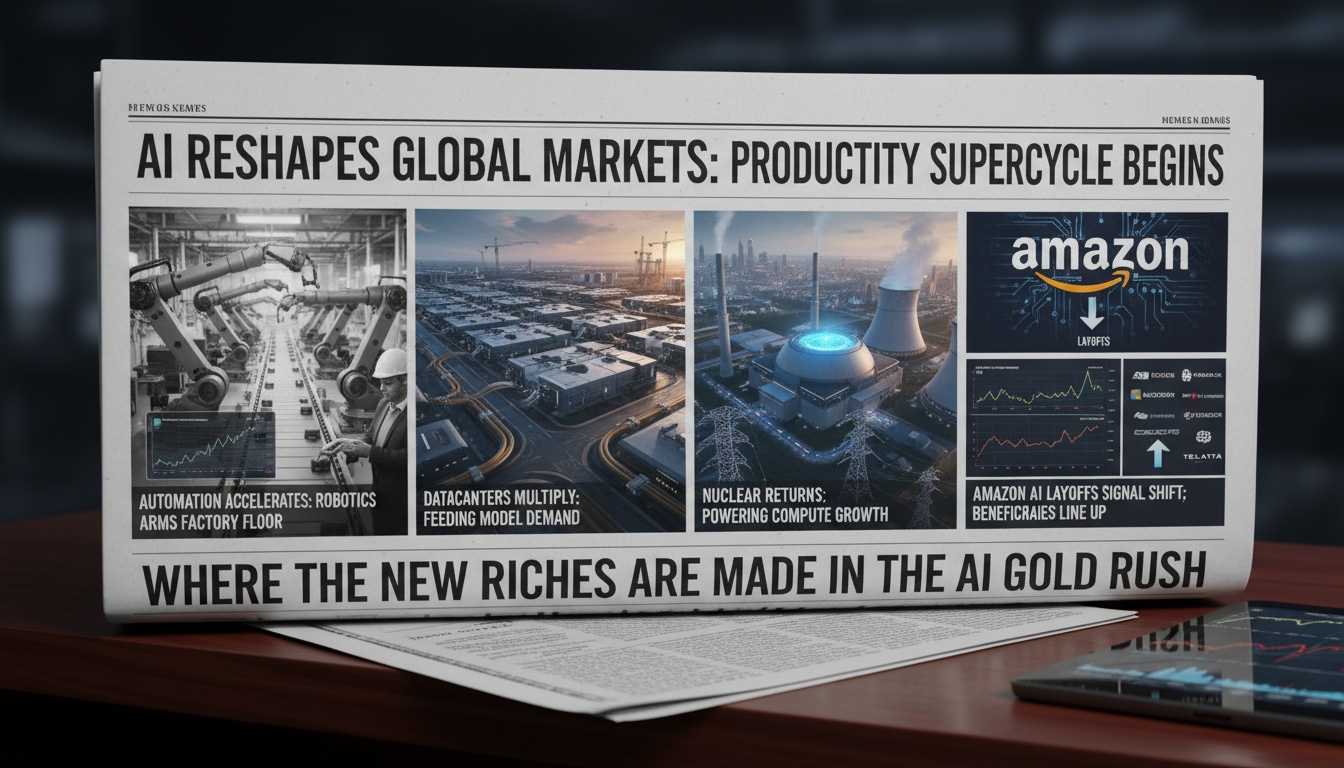
Reports based on internal Amazon documents reveal a scenario in which up to 160,000 jobs by 2027 and 600,000 cumulative jobs by 2033 are replaced by robots through “new employment substitution.”
The wording is “substitution” rather than “layoffs,” emphasizing a shift in cost structure through suppression of new hires and increased automation rather than workforce reduction.
It mentions that automating 75% of logistics could reduce costs by approximately $0.3 per item, potentially saving billions of dollars annually.
Amazon has already been operating large-scale logistics robots and has announced rapid expansion of its robot fleet.
New warehouses are likely to expand the “lights-out (dark factory)” concept, with designs reconfigured for 24/7 robot operation.
Tesla has emphasized “AI and robotics focus,” while Nvidia is strengthening its presence as a supplier of chips and platforms linking robotics, edge computing, and data centers.
The commercialization of humanoids by China’s Unitree and others is accelerating, with sales notices and order cases emerging on domestic and international online malls, speeding up the realization process.
A Reinterpretation of Amazon’s Automation Plan Details
The key is “growth without employment.”
While assuming that sales and throughput double, the workforce remains nearly the same, with any shortfall filled by robots.
The figures of 160,000 by 2027 and 600,000 by 2033 represent automation substitutions that occur when new hires are suppressed.
Though it is not the same as layoffs, the effect of reduced overall labor demand can be similarly felt.
The essence of cost reduction is a drop in “total cost of ownership (TCO)” that includes not only labor costs but also improvements in safety, reduction in errors and returns, and optimization of power and space.
The choice of language is also strategic.
Using the term “cobot (collaborative robot)” instead of “robot” aims to reduce internal backlash and ease the absorption of transition costs.
Beneficiary Landscape: Direct, Indirect, and Pick-and-Shovel
This category includes direct beneficiary stocks.
Examples include Tesla (Optimus / manufacturing automation), Nvidia (Orin, Thor, CUDA, Omniverse), Amazon (cost structure improvements / AWS robotics stack), Symbotic (North American retail automation), Ocado Solutions (European-style automation), Teradyne/Universal Robots (collaborative robots), Cognex/Keyence (machine vision), and Rockwell/Siemens (industrial control and digital twin).
Indirect beneficiary stocks include intelligent edge semiconductors (NXP, Qualcomm), industrial PCs/robot controllers, high-precision sensors/LiDAR, industrial batteries/reducers, logistics IT (WMS/TMS), and cybersecurity (OT security).
The pick-and-shovel strategy spans a wide range from AI server/storage Supermicro, network switches/optical modules, data center power/cooling, to automation retrofitting demands for industrial REITs and logistics centers.
Key Insights Unique to This Discussion
The service inflation pathway changes.
A decline in unit costs in logistics and distribution exerts downward pressure not only on goods prices but also on last-mile and fulfillment service prices.
This could affect inflation stability and interest rate trajectories in the medium term.
A new role known as “RobotOps” is rapidly emerging.
Teams that integrate robot deployment, monitoring, simulation, updates, and safety certification will be formed, creating opportunities for on-site digital talent at the convergence of IT and OT.
Real estate and power infrastructure are becoming critical bottlenecks.
Dark factories, with different criteria for ceiling height, floor load, power density, and autonomous driving pathways, will change the valuation and development specifications of REITs.
Simultaneously, distribution, UPS, and microgrids are launching a new investment cycle.
Issues of data ownership are growing.
Privacy and labor safety regulations regarding the video, location, and behavior data collected by smart glasses and last-mile robots are creating a new regulatory framework.
The Dark Factory Era: Changes in Operating Models
Designs will inherently support 24/7 uninterrupted operation.
There will be reduced reliance on lighting and HVAC, with power peak management and integration with overnight renewable energy becoming critical.
With the elimination of human traffic, warehouse layouts will be reconfigured, and SKU placement based on Pareto principles will be continuously updated by AI.
Accident and fire responses will standardly use “robot-to-robot” safety protocols and remote emergency shutdown systems.
Macroeconomic Ripple Effects: From a Global Economic Outlook
If the jump in productivity is reflected in the real economy, it could lead to an upward revision of potential growth rates and a reduction in unit labor costs.
This would serve as a medium-term factor in easing inflation and potentially exert downward pressure on the equilibrium level of long-term interest rates.
On the other hand, increased power demand and data center CAPEX, along with higher power tariffs and expanded transmission and distribution investments, remain as cost-passing factors.
In the labor market, increased friction from relocation could lead to transitional unemployment and widened wage disparities, posing risks for policy and elections.
Risk and Regulatory Check
Labor regulations and union issues could temper the pace of automation.
On-site safety incidents and quality issues may slow down the rate of spread.
Supply chain risks could repeatedly emerge with bottlenecks in reducers, precision motors, and industrial semiconductor supplies.
Data privacy and facial recognition regulations could present variables in the expansion of smart glasses and vision AI.
Investment Checklist and Timeline
From a corporate financial perspective:
Track fulfillment cost/sales ratios, cost per order, return rates, inventory turnover days, and the automation proportion within CAPEX guidance.
From an operational metrics standpoint:
Monitor robot density (robots per square meter/robots per employee), utilization rate, downtime, and the scope of digital twin applications.
Regarding product roadmaps:
Keep a calendar for Tesla Optimus pilot deployments, Nvidia robotics stack updates, and automation facility order announcements from major retailers.
For policy calendars:
Monitor public hearings on AI safety and labor regulations, data privacy legislation, and industrial power approval schedules.
Jobs and Career Strategy
Develop expertise in robot operations and IT/OT convergence.
Opportunities exist in RobotOps, safety/quality/compliance, simulation/digital twin roles, machine vision tuning, and on-site data engineering.
Skills in robotics LLM and RLHF applications dealing with “policy” in prompts are valuable.
Recommended qualifications and studies include industrial safety, basic electrical/power knowledge, and an understanding of ROS2, Omniverse, PLC, and SCADA.
Portfolio Guide (Summary)
Direct bets such as Tesla, Symbotic, Ocado, and Teradyne/Universal Robots may experience short-term volatility.
The pick-and-shovel strategy allows for diversification through investments in Nvidia, industrial controls, machine vision, data center power/cooling, and industrial REITs.
For macro hedging, consider inclusion of energy and power facilities, as well as OT cybersecurity.
For risk management, position sizing should reflect scenarios involving regulatory issues, labor frictions, and potential product delays.
Case Points: Smart Glasses → Data Loop → Humanoids
While smart glasses may appear as short-term “human aides,” they create a large-scale on-site data collection–learning–policy update loop.
Once this loop stabilizes, it will transition to humanoids and AMRs, rapidly elevating the level of autonomy.
Thus, the current penetration of wearable devices should be seen as the initial conditions for a “robot learning pipeline.”.
< Summary >
Amazon aims to change its cost structure through automation centered on “new employment substitution” rather than layoffs.
Figures like 75% automation in logistics and a reduction of $0.3 per item connect to a drop in TCO and margin leverage.
The spread of dark factories will stimulate long-term demand in areas such as REITs, power, industrial controls, and machine vision within the pick-and-shovel framework.
Preparations must be made for the dual pathway of “stag-out”—a combination of easing service inflation and increased power CAPEX.
A strategy that combines direct bets with a pick-and-shovel approach, along with career transitions into RobotOps and digital twins, is sound.
This article is for informational purposes only and does not constitute investment advice.
Be sure to assess the risks of individual stocks.
[Related Articles…]
*Source: [ 소수몽키 ]
– 이제 남일이 아니다? 아마존발 대량 해고 시작, AI 일자리 대격변의 수혜주들
● Housing Bubble Hijacks Growth
The Moment House Prices Erode the Economy, the Bank of Korea’s Interest Rate Dilemma, and the Path of ‘Productive Capital’ Transitioning to AI
This article contains three points.
First, you can immediately grasp the news-style key points on why the Bank of Korea stated that “house prices erode economic growth.”
Second, it succinctly explains the often overlooked “opportunity cost of credit allocation distortion on potential growth and AI investment.”
Third, it presents realistic 2025 policy scenarios and individual and corporate action checklists, taking into account interest rates, exchange rates, and inflation simultaneously.
[Breaking Summary] Bank of Korea: “House Prices Erode Growth”… Three Constraints on Cutting Interest Rates
In its recent explanation of monetary policy direction, the Bank of Korea diagnosed that rising housing prices undermine both economic growth and potential growth.
There are three reasons for this.
1) Increasing inequality and social unrest, 2) Credit heavily concentrated in real estate distorts resource allocation and lowers productivity, 3) Lowering interest rates may further stimulate housing prices, thereby jeopardizing financial stability.
The policy prescription is simple.
It calls for identifying “overheated housing market areas” through structural reforms and fiscal/tax adjustments, and for ensuring that monetary policy can be managed independently focusing on prices and the economy.
Key Issue 1 | Inequality and PIR: The Structure of a Broken Ladder for Ordinary People
The PIR (Price to Income Ratio) is a representative indicator of social stability.
As the PIR in the metropolitan area increases, even the middle class faces exponentially longer wait times to own a home.
For low-income households, even if house prices remain fixed, it takes decades of lack of expenditure, and in reality, house prices accelerate during that period, permanently erasing opportunities.
While measures such as curbing speculative investments and designating land transaction permit zones might temper short-term overheating, if the ladder of loans and taxes is simultaneously narrowed, the entry of genuine demand is further delayed.
The policy’s key is to simultaneously achieve ‘curbing unearned income’ and ‘maintaining the ladder for genuine demand’.
The coherence between property taxes, capital gains taxes, and lease tax policies plays a decisive role here.
Key Issue 2 | Credit Allocation Distortion: Real Estate Concentration Suppresses Potential Growth and AI Investment
Potential growth is determined by the sum of labor, capital, and total factor productivity (TFP).
If credit is concentrated in real estate, funds necessary for forming productive capital, especially for advanced manufacturing and AI infrastructure, dry up.
The data is consistent.
The higher the proportion of real estate and construction loans, the lower the TFP correlation; conversely, the higher the proportion of loans allocated to manufacturing and advanced industries, the greater the improvement in productivity.
The fact that domestic banks’ earnings structures are fixed on “net interest income” is also the background for credit flowing predominantly towards collateral-backed lending.
The result is clear.
It leads to a slowdown in economic growth, delays in innovative investments, and stagnant productivity.
Especially in the AI transition era, digital capital accumulation — including investments in data centers, semiconductors, power grids, and cloud software — is key to driving growth; if credit allocation does not support these, the opportunity costs will snowball.
Key Issue 3 | The Dilemma of Interest Rates, Exchange Rates, and Inflation
Even if prices stabilize, if housing prices remain overheated, cutting interest rates can directly trigger financial instability.
At the same time, if the exchange rate (won/dollar) remains under a strong dollar regime, a premature rate cut can provoke foreign capital outflow and push up import prices.
In other words, while the Bank of Korea wants to use interest rate cuts to stimulate economic growth, the simultaneous risks from real estate and the exchange rate act as brakes.
Policy Package | “Waterproofing the Potted Plant” First, Then the Interest Rate
Monetary policy will come down like rain.
To wet only the barren plants (real economy and innovation) and avoid the wet plants (overheated sectors), a barrier—namely fiscal, tax, and macroprudential policies—must come first.
- Redesign of real estate taxation: Rationalize property taxes focusing on genuine long-term residency and gradually lower transaction taxes to enhance mobility.
- Rental system: While reinforcing the public obligations of registered rental housing, provide incentives for landlords through expanded monthly rent tax credits under conditions of supply and transparency.
- Loan discipline: Fine-tune DSR and LTV based on region, price, and income, and ensure that long-term mortgages for first-time and genuine buyers are continuously available.
- PF restructuring: Swiftly separate non-performing PF projects, and for viable projects, induce an orderly landing through progress and final payment guarantees.
- Shift in credit allocation: Introduce a “productive loan weight” in bank regulatory capital to lower the cost of capital for growth projects such as AI, semiconductors, power grids, and data centers.
- Supply-side measures: Combine urban housing supply (fast-track urban renewal projects) with public rental and long-term lease housing, and for local areas, link the resolution of unsold housing with industrial and data center demand.
Connecting the AI Trend | How to Shift Focus from Real Estate to ‘Digital Capital’
AI is not a mere fad but an investment that changes the form of capital.
AI semiconductors, data centers, power grid and cooling infrastructure, and software stacks all generate “productivity leverage.”
There are three policy challenges.
- Establish a one-stop system for domestic data center site and power permit approvals, and alleviate power grid bottlenecks by linking renewable energy PPAs with demand response (DR).
- Operate a package combining a national AI compute fund with coordinated private investment through “public data + models + cloud credits.”
- For SMEs, combine AI adoption tax credits with policy financing and R&D investments, and promptly establish guidelines for model/prompt security and copyright.
The key is to create institutional incentives that allow credit not to be locked into real estate collateral, but to circulate into innovative capital.
Scenario 2025 | Three Paths for Interest Rates, Exchange Rates, and House Prices
- Baseline scenario: The structural barrier works to some extent.
- House prices slow their upward trend, and the Bank of Korea implements a modest interest rate cut in the second half of the year.
- The exchange rate enters a phase of reduced volatility.
- High-risk scenario: Overheating in Seoul coincides with a strong dollar.
- Prolonged stagnation in interest rate cuts, upward pressure on the exchange rate, and intensified management of household debt quality become inevitable.
- Favorable scenario: The tax, lending, and supply packages are implemented swiftly.
- The Bank of Korea secures room for two rate cuts, defends economic growth, and keeps inflation stable within the target range.
The indicators to watch are PIR, the jeonse-to-sale price ratio, trends in unsold housing, the disparity in loan growth between households and businesses, the share of banks’ net interest margins versus non-interest income, and exchange rate volatility.
Investor and Corporate Checklist
- Households: Check the ability to switch from variable to fixed interest rates, diversify maturities, and conduct DSR stress tests.
- Investment Portfolio: In anticipation of delays in interest rate cuts, combine dividend stocks with stable cash flows with a long-term accumulation in themes such as AI, power grids, and data centers.
- Enterprises: Combine facility and R&D investments with policy financing and tax credits, and quantitatively measure the ROI of data and model adoption on a quarterly basis.
Beyond the News | The Most Important Details Other Media Overlooked
- The real cost of credit concentration in real estate is not just high house prices but also the cumulative loss of potential growth and delayed AI transformation.
- If data center locations for AI and regulations on housing and land clash, neither can be resolved without investments in power grid infrastructure and innovations in permit processes.
- Resolving unsold housing in local areas is difficult with housing alone.
- It must be bundled with industrial and data center demand to be absorbed.
- If banks do not shift their KPI from “net interest margin” to the proportion of “productive loans and non-interest income,” credit will continue to flow solely into collateral-based sectors.
- Building a robust mortgage securitization market to ensure a continuous supply of long-term fixed-rate mortgages is key to maintaining the ladder for genuine demand.
Mini Q&A
Q. Why can’t interest rates be lowered?
A. Even if inflation stabilizes, if overheating housing prices and rising household debt/financial stability risks increase, the side effects of an interest rate cut can outweigh its benefits.
Q. Why is the exchange rate important?
A. A weakening won pushes up import prices by reviving inflation and also affects the flow of foreign capital.
Q. What are the unintended effects of curbing speculative investments?
A. While it is effective in deterring short-term speculation, blocking the ladder of loans and tax incentives further delays the entry of genuine demand.
Q. How do monthly rent tax benefits affect prices?
A. Depending on the design, they can reduce short-term upward pressure on rents, but they must be combined with supply incentives and transparency requirements to be effective.
Execution Roadmap Summary
- Immediately: Fine-tune LTV and DSR for overheated regions, separate performing and non-performing PFs, and continuously provide long-term mortgages for genuine demand.
- Within 6–12 months: Redesign property, capital gains, and rental taxes for coherence, fast-track urban supply, and implement a combined “housing + industry” package for local areas.
- After 12 months: Introduce a productive loan weight into bank capital regulations, promote investments in data centers and power grids, and deepen the mortgage securitization market.
< Summary >
The Bank of Korea’s message is clear.
Rising housing prices reduce both economic growth and potential growth, while increasing inequality.
Before cutting interest rates, a “barrier” must first be established through fiscal, tax, and macroprudential policies to isolate overheated sectors.
The key lies in shifting credit allocation.
When funds locked in real estate collateral are redirected into productive capital such as AI, semiconductors, and power grids, growth, price stability, and financial stability can be achieved simultaneously.
In 2025, the speed at which the policy package is implemented will be decisive.
SEO Keywords: economic growth, interest rates, real estate, exchange rates, inflation.
[Related Articles…]
- The Immediate Impact of Interest Rates and Exchange Rates on the Housing Market
- The Mechanism of Real Estate Credit Concentration and the Decline in Potential Growth
*Source: [ 경제 읽어주는 남자(김광석TV) ]
– “부동산 가격 상승이 경제성장을 갉아먹고 있다” 딜레마에 빠진 한국은행 [즉시분석]
● Amazon Fires 30,000 for AI, PayPal Rockets 14 percent, UnitedHealth Raises EPS, Nuclear Poised to Power Data Centers
Amazon HQ Cuts 30,000 Jobs Driven by AI Expansion, PayPal Surges 14%, UnitedHealth EPS Guidance Raised: The Real Meaning and 2025 Investment Strategy
Today’s discussion highlights that Amazon’s 30,000 job cuts at its headquarters are not merely a restructuring measure, but a strategic reallocation of capital toward AI transformation investments.
We analyze the hidden reasons behind PayPal’s 14% stock surge and examine the sustainability of its future performance across various factors.
We summarize the background of UnitedHealth’s EPS guidance upgrade, along with medical cost trends and the GLP-1 variable.
We detail a scenario that combines the renewed focus on nuclear power economics triggered by Trump’s remarks with the growing electricity demand of AI data centers.
We outline on one page how macro factors such as interest rates, the dollar, and inflation are linked to these issues.
Headline Briefing
News has emerged that approximately 30,000 employees at Amazon’s headquarters have been cut, driven by an expansion of AI and a reorganization of cost structures.
PayPal’s stock surged roughly 14% following strong financial results, reflecting expectations for improved profitability and a shift in product mix.
UnitedHealth not only reported strong results but also raised its EPS guidance, indicating a stabilization in medical cost trends.
Trump’s remarks have brought renewed attention to the economics of nuclear power and energy independence, increasing the potential for integration with the electricity needs of AI data centers.
From a global economic outlook, the trajectories of interest rates and the dollar are increasingly impacting valuations in the big tech, fintech, and healthcare sectors.
Amazon: Structural Significance of AI-Driven Reorganization and 30,000 Job Cuts
This round of layoffs is less about direct cost reduction and more about a large-scale reallocation of capital into AI infrastructure and services.
The strategy involves streamlining middle management and support functions at the headquarters while reprioritizing investments in data centers, chips, models, analytics, and AI copilot applications.
In effect, while short-term labor costs decrease, depreciation and fixed costs related to power, servers, and other infrastructure are expected to rise as the cost structure shifts.
From a labor market perspective, demand for back-office and middle management roles may slow, but recruitment for ML engineers, data engineers, AI product planners, and professionals in power, cooling, and server hardware may actually increase.
For Korean investors, there is a high likelihood that value chains related to HBM and AI accelerators, AI servers, power equipment, liquid cooling, optical communications, substations, and UPS systems will structurally benefit.
From a macro perspective, although long-term fixed cost investments may be burdensome in a rising interest rate environment, improved AI productivity that alleviates inflationary pressures could allow for re-rating of valuations.
PayPal: Details Behind the 14% Surge on Strong Results
The stock’s rapid rise is driven by a combination of stabilized total payment volume growth, signals that take rates have bottomed out, and expectations of margin improvement through cost efficiency.
While the share of unbranded processing such as through Braintree increases—potentially lowering fee percentages—the overall increase in transaction volume and merchant lock-in, as well as enhancements in AI-based fraud detection and conversion rate improvements, contribute to protecting profitability.
Advancements in network tokenization and one-click checkout help reduce cart abandonment, partially offsetting any declines in take rates.
Once cash flow recovers, the pace of share buybacks is likely to increase, which directly leverages earnings per share (EPS).
Key metrics to monitor include quarter-over-quarter (QoQ) growth in total payment volume (TPV), revenue per transaction, trends in active accounts, operating margins, and the profitability of the unbranded segment.
Risks to watch include a slowdown in consumer spending due to a recession, potential increases in network fees, rising delinquencies in BNPL, and the negative effects of a stronger dollar on overseas revenue translation.
UnitedHealth (UnitedHealth Group): Key Points Behind the EPS Guidance Upgrade
The guidance upgrade is interpreted as the result of a combination of normalized healthcare utilization, a favorable mix of Medicare Advantage (MA) enrollees, and growth contributions from Optum services.
The management of the medical loss ratio (MLR) within guidance ranges signals effective control over pricing and costs.
Although the cost burden of GLP-1 obesity treatments remains, strategies such as performance-based contracts and expanded preventive care help manage net costs.
Key variables that could affect annual guidance changes include star ratings, MA pricing, and risk adjustment (RADV) issues, making quarterly updates important.
On the macro side, interest rate levels influence investment returns and discount rates in the insurance sector, while stable inflation helps ease cost pressures across the healthcare supply chain.
Energy & Nuclear: Checklists Following Trump’s Remarks and AI Electricity Demand
If policy momentum aligns with market economics, nuclear power could reemerge as a baseload energy source for AI data centers.
There is a high possibility that hyperscalers will start directly linking new and existing nuclear power plants through long-term power purchase agreements (PPAs) or explore co-location with small modular reactors (SMRs).
The increase in electricity demand from AI data centers heightens the pressure to rebalance the energy mix between gas, renewable energy, and nuclear power, while also spurring investments in transmission and distribution networks and streamlining permits.
From a policy perspective, tax credits (PTC and ITC) and discussions on fast-track permitting, as well as state-level measures like RPS and ZEC, directly affect economic viability.
For Korea, this creates opportunities in the nuclear export value chain, including specialized steels for nuclear plants and transmission, transformers, high-voltage cables, and companies involved in data center cooling and power equipment.
Macro Check: Interest Rates, the Dollar, Inflation, and Sector Sensitivity
Rising interest rates increase the discount rate for growth stocks, putting pressure on valuations; however, stronger expectations for AI productivity may limit the contraction of multiples relative to performance.
A stronger dollar negatively impacts the translation of overseas sales for multinational companies but is positive for stabilizing raw material and energy import prices.
Easing inflation is a tailwind for fintech payment costs and healthcare supply chain expenses, whereas recession risks can lead to weakened consumer spending and transaction volumes.
From a global economic standpoint, normalization of the long- and short-term yield curve favors value stocks and financials, while visibility into performance remains a key milestone for big tech companies.
Portfolio Strategy and Checklist
A diversified strategy that balances investments between AI infrastructure (chips, servers, power, cooling) and software (copilot, MLOps) is recommended.
For PayPal, a phased approach is sensible by monitoring the pace of margin recovery and the potential resumption of share buybacks.
With UnitedHealth, tracking quarterly metrics such as MLR, Optum growth rate, and net additions of MA enrollees is crucial, leveraging its defensive characteristics.
In the energy and nuclear sectors, an event-driven approach that relies on monitoring policy and PPA news flows, as well as long-term PPA contract developments, is advised.
Key indicators include AWS and AI-related revenue growth rates, PayPal’s TPV, take rates, operating margins, UnitedHealth’s MLR, star ratings, Optum revenue, as well as CAPEX for grid investments and electricity contracts for data centers.
Key Points Overlooked by Other YouTube Channels or News Outlets
The Amazon job cuts signal a balance sheet shift toward fixed assets in AI, rather than a mere drive for cost reduction.
The combination of AI data center electricity demand with long-term PPAs for nuclear power could reduce volatility in electricity prices and contribute to margin stability for hyperscalers.
PayPal’s network tokenization and merchant data network serve as an unseen moat protecting its take rates.
UnitedHealth is strengthening a structure that reduces EPS volatility by managing GLP-1 net costs through performance-based contracts.
Normalization of interest rates could improve investment returns in the insurance sector, allowing for profitability protection without premium hikes.
Risk Map
Policy uncertainty such as antitrust, content regulation, healthcare regulation, and delays in nuclear plant permitting could contribute to valuation discounts.
Macro shocks including abrupt interest rate hikes and a stronger dollar pose risks to growth stock multiples and emerging market capital flows.
Earnings variables like delays in AI monetization, a slowdown in PayPal’s transaction volumes, and a potential surge in healthcare utilization present guidance risks.
Timeline and Upcoming Events
In the coming quarters, key points to watch include whether Amazon will separately disclose AI-related revenues and its CAPEX guidance.
For PayPal, monitor the prospects of an annual margin guidance upgrade and the speed of its share buyback program.
For UnitedHealth, focus on quarterly updates regarding seasonal MLR, MA star ratings, and Optum growth rates.
In the energy and nuclear sectors, keep an eye on news about PPA contracts, transmission and distribution investment plans, and pilot developments in SMRs.
Action Ideas for Korean Investors by Sector
Semiconductors & Components: Prioritize companies involved in HBM, AI accelerator packaging, CPO, optical transceivers, and server PCBs.
Power & Infrastructure: Take a medium-to-long term view on companies in transformers, GIS, HV cables, data center cooling, and distribution panels.
Software: Focus on the leverage provided by solutions for AI copilot, AIOps, and security automation.
Fintech: Check the recovery in profitability from payment gateway services and the value chain offering AI-based fraud detection and improved payment conversion rates.
Healthcare: Select companies with strong data-driven risk management capabilities in insurance, pharmacy benefit management (PBM), and healthcare IT.
News Recap: Today’s Core Points
Amazon is transforming its cost structure by cutting 30,000 headquarters jobs to accelerate its AI transition.
PayPal’s strong performance led to a 14% surge in its stock as expectations for margin recovery and a shift in product mix took hold.
UnitedHealth’s raised EPS guidance confirms both the stabilization of healthcare cost trends and the growth potential of its service business.
Nuclear power is garnering attention as a long-term growth pillar, integrated with the electricity demands of AI data centers.
Macro factors such as interest rates, the dollar, and inflation are key variables that cross-impact valuations and actual performance.
Investment Cautions
This content is an interpretation of the market based on publicly available broadcast highlights, and the figures and plans mentioned are subject to updates.
Individual stocks can experience high volatility, so it is recommended to set pre-determined benchmarks for phased buying and stop-losses.
< Summary >
Amazon’s job cuts signal a reallocation of capital toward AI infrastructure, with potential benefits for Korean sectors such as semiconductors and power infrastructure.
PayPal’s surge is driven by margin recovery and improvements in its product mix, with network tokenization acting as a key moat.
UnitedHealth’s guidance upgrade is based on strong MLR management and service growth.
Nuclear power, in conjunction with AI data center electricity demand, could become a long-term growth pillar.
Tracking metrics related to interest rates, the dollar, and inflation is essential as they have cross-impacts on both valuations and earnings.
[Related Articles…]
Amazon AI Transformation and the Map of Korean Semiconductor Benefits
The New Order of AI Data Centers and Nuclear Power PPAs
*Source: [ Maeil Business Newspaper ]
– [LIVE] AI 확대, 아마존 본사직원 3만명 감원ㅣ페이팔 호실적 주가 14% 급등ㅣ유나헬 호실적, EPS 가이던스 상향ㅣ홍키자의 매일뉴욕