● Liquidity Shock, QT Halt Sparks AI-Crypto Frenzy
Wall Street’s ‘Change of Stance’: Early End Scenario for Quantitative Tightening (QT) at the October FOMC, Liquidity Impact Paths, and AI/Crypto Beneficiary Map
This article covers the possibility of an early end to QT discussed at the October FOMC, the true meaning behind the surge in SRF/Discount Window usage, the channels through which the Treasury’s (QRA) issuance mix affects liquidity, a checklist of sectors and ETFs that could benefit from a liquidity-driven market, and realistic hedging strategies based on the Korean won.Other than what is typically covered in YouTube or news outlets, we focus on key market plumbing issues such as the ‘year-end GSIB score, RRP floor, and SOFR-IOER spread’, delivering only the essential points.It is summarized with actionable points that can be immediately interpreted based on keywords like U.S. equities, rate cuts, QT, liquidity, and inflation.
At a Glance: How Wall Street Has Changed Its Positions and the October FOMC Points
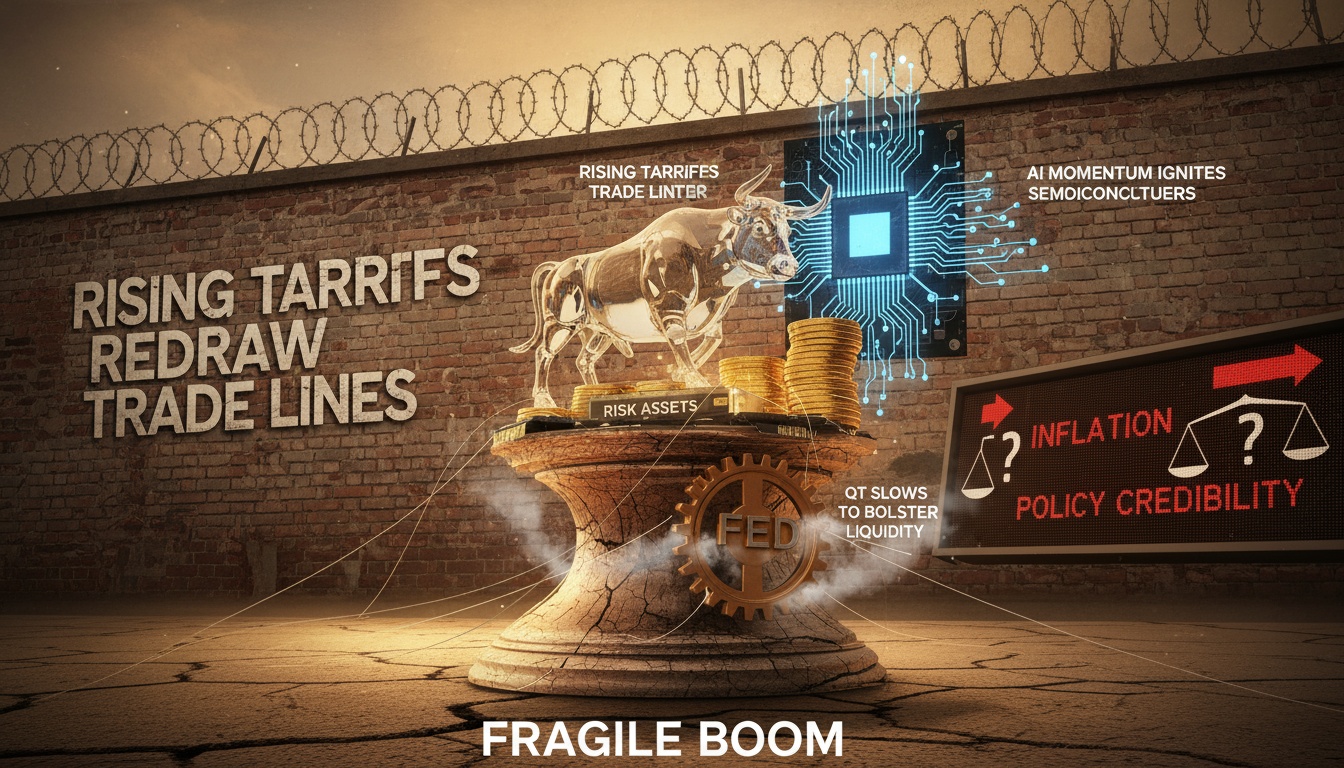
Major Wall Street houses have begun mentioning the possibility of an early end to QT in their reports alongside expectations of a rate cut at the October FOMC.The background to this is a jump in the short-term ‘emergency liquidity’ indicators.An increase in the usage of the Federal Reserve’s standing repo facility (SRF) and discount window is detected, which can be interpreted as a signal that bank reserves are becoming tight.Chair Powell’s remarks suggesting that QT could be terminated “within a few months” in October have heightened market expectations.If this FOMC meeting confirms the termination of QT or provides clear guidance, the core point is that market liquidity could improve regardless of a rate cut.In this case, U.S. equities could see a resurgence in breadth, expanding beyond big tech to include small caps and emerging stocks.
Why the QT Halt Card Is Being Considered Now: Approaching the ‘Bank Reserve Threshold’
An increase in the usage of the SRF and discount window may indicate that bank reserves are nearing a critical threshold.If the reverse repo (RRP) balance of money market funds (MMFs) is at its floor level, there is less room for further QT.Adjusting the proportion of short-term T-bills in the quarterly Treasury issuance (QRA) determines the ‘liquidity pathways’ among banks, MMFs, and the repo market.If major banks, burdened with year-end GSIB scores, refrain from expanding their repo and balance sheets, friction in the financial plumbing increases.The SOFR-IOER spread, fluctuations in GC repo rates, and crack-up phenomena are considered early warning signs of ‘liquidity stress’.The Fed has considered adjusting the QT pace or ending it early if financial stability concerns intensify, and the current trigger seems to be in play.
Market Impact Checklist (Next 3 Months)
Stocks: Big tech remains solid along with a potential expansion of gains to small caps and promising stocks. AI, data centers, fintech, and biotech are likely to outperform relative to reopening scenarios.Bonds: If QT is halted, there could be downward pressure on both short- and long-term rates, while increased fiscal issuance could expand volatility in long-dated bonds. Be cautious of excessive duration exposure.Credit: There is potential for a narrowing of HY spreads, though maintaining a quality bias is recommended.FX: Watch for signals of a peak in the strong dollar. In periods of increased volatility, maintaining hedges in the Korean won may be beneficial.Commodities: Gold may see a pullback from overbought conditions, making it a candidate for buying at low levels. Industrial metals may gain alongside investments in AI infrastructure.Crypto: There is a possibility of a rebound if policy momentum resumes. A recovery in trading volumes would be the first signal to confirm this.
Beneficiary Sectors/ETF Roadmap (Action Checklist)
Core Beta: Secure a basic exposure to AI and high-quality growth through the Nasdaq 100 (e.g., QQQ).High Liquidity Beta: Bet on a basket of innovative and promising stocks through ETFs such as ARKK.Biotech Frontier: Leverage selectively with exposure to genetic and AI healthcare (e.g., ARKG), keeping in mind the need for divided allocations and controlled weighting due to volatility.Crypto Exposure: Capture the “trading volume sensitivity” through trading platform stocks (e.g., COIN, HOOD) and mining/infrastructure ETFs (e.g., BLOK).AI Infrastructure Chain: Monitor a full-stack approach covering GPUs, servers, fiber modules, power equipment, and data center REITs, grouped under the chain ‘power → chips → network → DC’.Note: Specific stocks/ETFs are provided as examples and do not constitute investment advice. Always check risks, fees, and taxes beforehand.
AI Trend Focus: The Ripple Effect from ‘Infrastructure → Healthcare’
Between 2025 and 2026, the CAPEX share for inference is likely to increase relative to training, which means investments in servers, power equipment, cooling, and networking could expand simultaneously.Power constraints act as a bottleneck. Substations, distribution networks, UPS systems, and cooling solutions will benefit structurally.In the healthcare/biotech sector, the adoption of AI is spreading in diagnostics, imaging, and new drug discovery, and actual performance improvements will require alignment in regulations, insurance codes, and data governance.There is a growing perspective on Wall Street that the area of ‘AI healthcare innovation’ has not yet been fully reflected in the numbers.If liquidity improves, news of M&A and partnerships could trigger rating hikes and downgrades.
Guide for Korean Investors: Realistic Hedging and Operating Rules
Currency Hedging: In a scenario of a weakening Korean won, gradually increase the proportion of USD cash, dollar deposits, and dollar-denominated ETFs to reduce volatility.Systematic Purchasing: Design your allocation based on your risk tolerance with a split purchase approach—around 50-70% in core positions (e.g., QQQ) and 30-50% in satellite positions (e.g., ARKK/ARKG/BLOK).Rebalancing: Reinvest a portion of profits exceeding 10–15% into core positions. Pre-establish rules for either taking losses or supplementing positions if a drawdown of over 10% occurs.Hedging Assets: Maintain gold, cash, and short-term bonds as buffers within your ‘risk budget’.Checkpoints: Monitor the FOMC, Treasury QRA, CPI and employment data, SRF/discount window usage, SOFR-IOER spread, and RRP balances.
Key Points Often Overlooked Elsewhere (from a Plumbing Perspective)
If the RRP is at its floor, further QT directly pressures bank reserves. In this zone, even small shocks may trigger a surge in SRF usage.The year-end GSIB score burden restricts major banks from expanding their repo and balance sheets, which is why liquidity tends to become tight frequently in November–December.An increased proportion of T-bills in the Treasury’s issuance mix can lock funds into MMFs, potentially weakening the immediate inflow into risk assets.A surge in the SOFR-IOER spread and GC repo rates serves as an effective leading indicator of ‘stress signs’—the numbers alone can provide significant insight.An end to QT does not equate to “immediate QE”; however, even halting QT stops the decline in reserves, and the market discounts this as an improvement in liquidity.
Timeline: Which News Events Could Serve as Turning Points
Check the language and emphasis regarding QT in the FOMC statement, dot plot, and press conference.The issuance size and the T-bill/note/bond mix in the Treasury’s quarterly QRA will determine the liquidity pathways.Easing in employment and CPI data could reinforce expectations of rate cuts, while a re-acceleration of inflation would increase volatility.During the quarterly earnings season, if guidance confirms the AI CAPEX, data center pipeline, and order backlogs, the AI chain may be re-evaluated.
Three Scenarios and Action Guidelines
Immediate End of QT + Dovish Tone: Maintain core positions, gradually increase exposure to small caps/promising stocks, and respond flexibly to crypto-related stocks based on trading volume.QT Termination Signal Only (Stop Guidance): A confined market range. Hold core positions, approach satellite positions in split allocations, and operate in a data-driven, flexible manner.Continuation of QT + Hawkish Tone: Reduce risk by lowering exposure to duration and growth stocks, while increasing proportions of cash, gold, and dollars.
Core Thesis of the Original Text and Interpretative Notes
The original text interprets the possibility of an early end to QT at the October FOMC and the recent surge in demand for “one-day emergency funding” as liquidity warnings.It also suggests that an acceleration in Treasury issuance due to fiscal factors might stimulate market liquidity, periodically creating bubbles.The key interpretive point is the combination of both factors.A mix of ‘monetary easing (rate cuts/QT halt) + fiscal expansion’ typically results in an elevated risk premium for risk assets.However, one must always verify the actual published data on the numbers and remain sensitive to policy and political schedule changes.
< Summary >
- Wall Street has shifted its stance towards the possibility of an early end to QT. The key basis is the increase in SRF/discount window usage and the approach to bank reserve thresholds.
- Even a halt in QT signals improved liquidity, potentially re-igniting market breadth in U.S. equities.
- Beneficiaries could spread in the order of core (QQQ) → innovation (ARKK) → biotech (ARKG) → crypto-related (BLOK/trading platforms).
- The critical factors from a plumbing perspective are the RRP floor, year-end GSIB score, QRA issuance mix, and the SOFR-IOER spread.
- Korean investors should manage volatility through currency hedging, systematic purchasing, and rebalancing rules, responding in stages based on data.
[Related Articles…]
- Comprehensive Overview of the Fed’s QT Early Termination Scenario
- AI Infrastructure CAPEX Cycle and Nasdaq Outlook
*Source: [ 소수몽키 ]
– 심상치 않은 월가의 태세 전환? 3년만의 연준 항복 시작될까
● Bombshell Deal, 350B Korea Rescue – 15 Auto Tariff Truce, Won Soars
[Breaking News · Instant Analysis] Dramatic Conclusion of the Korea-US Trade Negotiations: USD/KRW Exchange Rate Plummets, Automobile Stocks Soar, and Everything from Tariffs, Investment, and AI Supply Chains Summarized at Once
Today’s article covers the direction and pace of the exchange rate, the detailed specifics of automobile and semiconductor tariffs, the structure of the US investment totaling $350 billion along with the principal recovery mechanism, the liquidity and interest rate strategy of the Trump administration, the impact on the AI value chain, and both short-term and mid-term investment strategies.
It includes a news-style summary and separately outlines the key points that other media have not mentioned.
It is organized so that from an economic outlook perspective, the key checklist and risk scenarios that the market must monitor immediately can be seen at a glance.
1) Speedy Summary: What Was Agreed
-
Structure for a $350 billion US investment.
The annual cash deployment limit is set at up to $20 billion.
Depending on the progress of the project, deployment of less than $20 billion per year is also possible.
The remaining approximately $150 billion will be pursued as long-term financing based on loans/guarantees through projects such as the “MASGA Shipbuilding & Maritime Cooperation Project.”
The US side agreed to give priority to selecting Korean companies as the project entities whenever possible. -
Tariffs (by item).
Tariffs on automobiles and parts have been confirmed at around 15%, achieving parity with Japan and the EU.
For semiconductors, a principle has been established to ensure that they are not at a disadvantage compared to Taiwan.
Pharmaceuticals will be granted Most Favored Nation (MFN) treatment. -
Profit sharing and principal recovery.
Investment profits are to be shared on a 50:50 basis between Korea and the US.
If the full principal and interest are not recovered within 20 years, adjustments to the sharing ratio, among other corrective measures, will be implemented.
A commercial rationality clause has been inserted to ensure that investments are made only in projects where the principal is effectively guaranteed. -
Immediate market reaction.
The USD/KRW exchange rate plummeted (strengthening of the won) and automobile stocks soared were observed immediately.
The reduction of tariff cap risks and the controlled pace of cash deployment contributed to the easing of volatility in the exchange rate and stock market.
2) Key Details in Numbers
-
Annual cash deployment limit: Up to $20 billion.
This is designed to prevent a sudden cash outflow and minimize shocks to the foreign exchange market.
The flexible deployment based on project progress provides greater flexibility in managing overall liquidity. -
Guarantees/Loans (approximately $150 billion): MASGA Project.
In shipbuilding, maritime, and shipping finance, this is expected to boost order and contract volumes through long-term financing.
The principle of Korean company-centric implementation increases the likelihood that the industrial ripple effects will be retained domestically. -
50:50 profit sharing plus the 20-year rule.
While adopting the safety measures used in Japan’s precedent, there is an additional safeguard: an adjustment in the profit-sharing ratio if recovery is not achieved within 20 years.
Commercial rationality is emphasized, ensuring that risk cutoffs operate during the project selection phase even if the books show a 50:50 split, thereby protecting the effective rate of return through IRR and recovery priority structures. -
The significance of a 15% tariff.
Although there is a gap from the “zero tariff” expectation of the Korea-US FTA, the key point is achieving relative parity with Japan and the EU in terms of competitive conditions.
Equal treatment for semiconductors vis-à-vis Taiwan serves as a minimum safeguard to prevent losses in pricing and delivery competitiveness in the AI and HPC supply chains.
MFN treatment for pharmaceuticals does not provide exclusive benefits but does enhance policy visibility for exports to the US.
3) Key Points Not Mentioned by Other Media
-
The technical significance of the “$20 billion per annum” limit considering the structure of foreign reserves.
Most of the foreign reserves are in securities with a low proportion of cash.
The $20 billion annual limit acts as “predictable demand” in the foreign exchange market, helping to cap the upper range of exchange rate volatility. -
The 15% tariff is focused on “relative parity” rather than an “absolute reduction.”
This agreement is a strategic defensive measure designed to match competitive conditions with Japan and Europe.
Although the restoration of a zero-tariff FTA would have been desirable, the effect of avoiding the worst-case scenario (high tariff upper limits) is greater. -
More important than the 50:50 profit sharing is “commercial rationality.”
The criteria for selecting investment targets prioritize the possibility of principal protection.
Even if the books indicate a 50:50 split, the design of the structure with a focus on IRR and recovery priority can protect the actual profitability. -
The mindset of the Trump administration: “Maintain liquidity while controlling inflation.”
With an election cycle approaching, the strategy is to continue lowering interest rates and supplying M2 liquidity, while alleviating inflationary pressures via easing tariff conflicts.
Ultimately, this dual-track design of a stable exchange rate plus expectations of lower interest rates supports asset prices.
4) Macroeconomic Ripple: Perspectives on Exchange Rate, Interest Rate, and Inflation
-
Exchange Rate.
With the removal of the tariff cap and the cushioning effect of cash deployment, the USD/KRW exchange rate faces short-term pressure towards a stronger won.
In the short-term, a trading range between 1,280 and 1,330 won is possible.
However, volatility remains, linked to the FOMC’s messaging and movements in the global dollar index. -
Interest Rate.
As expectations grow that the Federal Reserve will adopt a more dovish stance, global long-term interest rates are anticipated to experience downward pressure.
Korean government bonds with maturities in the 3-5 year range, due to their duration, might see relatively larger gains on the downside. -
Inflation.
The reduction in tariff risks is advantageous for stabilizing import prices.
However, in an environment of expanded liquidity, sticky service prices may persist, requiring careful pacing. -
SEO Key Terms.
This issue is a typical example where improved trade negotiations stimulate stable exchange rates and lower interest rate expectations, thereby influencing the path of inflation.
It is an essential checkpoint when updating economic outlooks.
5) Industry and Sector Impact: Checklist of Beneficiary and Cautious Stocks
-
Automobiles/Components.
With tariffs set at 15% ensuring parity with Japan and the EU, companies can potentially maintain margins in tandem with a strategy of domestic production in the US.
Beneficiaries include complete vehicle OEMs and key component suppliers for powertrain and electronic systems aimed at the North American market. -
Semiconductors/AI.
Equal tariff treatment with Taiwan minimizes price penalties for items such as HBM, advanced packaging, and foundry services.
During the cycle of expanding AI data centers, demand for Korean memory (HBM), advanced packaging (OSAT), and power semiconductors remains resilient.
In the mid-to-long term, companies involved in advanced packaging, securing domestic production of materials and equipment, are likely to be revalued positively. -
Shipbuilding/Maritime (MASGA).
If long-term guarantees/loans get integrated into ship financing, it could boost order momentum for LNG carriers, ultra-large container ships, and offshore plants.
The pricing power and slot strength of Korean ships would be maintained, while downstream demand for steel and ancillary equipment would remain stable. -
Biotech/Pharmaceuticals.
MFN treatment improves export visibility to the US and mitigates administrative risks (i.e., sudden drastic tariff changes).
Improvements in the sales mix in the US for CDMOs and biosimilars are anticipated. -
Finance/Insurance.
Exchange rate stability is beneficial for managing the duration of foreign currency-denominated liabilities, and expectations of falling interest rates improve bond valuation gains.
However, should the dollar regain strength, hedging costs would need to be reviewed.
6) Risks and Checkpoints
-
Official Joint Statement.
As the current interpretation is based on bilateral briefings from both Korea and the US, the nuance in the final wording must be confirmed. -
Implementation Timing and Detailed Provisions.
The tangible effects may vary according to the enforcement decrees and detailed guidelines for tariffs and investment deployment. -
FOMC and the Global Dollar.
Changes in the tone of the Federal Reserve, a potential rebound in the dollar, and a rise in raw material prices pose risks of the exchange rate rallying again. -
Geopolitical and Political Cycles.
Domestic US political timelines and issues in global supply chains (export controls and subsidy regulations) may trigger a regime change in the interim.
7) Investment Strategy: Action Plans You Can Use Immediately
-
Short term (1–4 weeks).
Engage in trading within the range of a stronger won.
Focus on momentum plays in beneficiary sectors (automobiles, shipbuilding, AI semiconductors).
Keep 15–25% of the portfolio in cash or hedged positions to manage volatility ahead of and following FOMC meetings and Powell’s remarks. -
Swing trading (1–3 months).
Expect re-rating for stocks with improved profit visibility due to the easing of tariff uncertainties.
Establish core positions centered on HBM, advanced packaging, automotive electronic components, and LNG carriers. -
Mid term (6–12 months).
Accumulate duration exposure (via government bonds and high-grade credits) in anticipation of falling interest rates.
Gradually build a position in biotech/pharmaceutical companies that are expected to expand US sales.
8) Connection to AI Trends: Why This Agreement Supports an AI Rally
-
Equal treatment of semiconductor tariffs lowers the TCO for AI servers, maintaining the economic viability of CAPEX for data center expansion in the US.
The demand for advanced packaging such as HBM, high-bandwidth interconnect, CoWoS/FO-PLP, etc., is unlikely to slow down.
Amid uncertainties in export controls and subsidy regulations, the tariff variable plays a significant role in removing “tail risks.” -
Conclusion.
The easing of trade negotiations acts as a “policy put” to prevent a decline in momentum in the AI infrastructure cycle.
Valuations for companies at the top end of the AI supply chain (memory, packaging, power semiconductors, cooling/power components) can recover favorably.
9) Today’s Observing Points (Checklist)
- Exchange Rate: Support in the lower range of 1,280–1,330 won.
- Interest Rate: Add duration exposure when yields in the 2–5 year range hit new lows.
- Tariffs: Monitor the implementation timing and transition provisions for automobiles at 15%, semiconductors at parity with Taiwan, and pharmaceuticals under MFN.
- Investment: Track the quarterly pace of the $20 billion annual cash deployment and the reactions in the foreign exchange market.
- AI: Watch for changes in HBM shipments and guidance on capacity expansion in packaging.
- With the conclusion of the Korea-US trade negotiations, tariff cap risks have been significantly reduced and the $20 billion annual cash deployment limit has eased exchange rate volatility.
- A 15% tariff on automobiles, equal treatment for semiconductors vis-à-vis Taiwan, and MFN for pharmaceuticals have ensured parity in competitive conditions for exports to the US.
- In addition to a 50:50 profit sharing, the inclusion of “commercial rationality” and the 20-year non-recovery adjustment mechanism bolsters the stability of principal recovery.
- Expectations of a stronger won and falling interest rates benefit certain stocks (automobiles, shipbuilding, AI semiconductors).
- The Trump administration is executing a policy mix of maintaining liquidity while controlling inflation, which in turn supports asset prices.
[Related Articles…]
- Key Checkpoints for Exchange Rate and Interest Rate Cycles in 2025
- How the Reorganization of the AI Semiconductor Supply Chain Will Impact the Korean Stock Market
*Source: [ 경제 읽어주는 남자(김광석TV) ]
– [속보] 한미 무역협상 ‘극적’ 타결, 원달러 환율 급락, 자동차주 급등 [즉시분석]
● Semiconductors, Defense, Power Unstoppable Surge – Medical AI Dark Horse
2026 South Korean Stock Market: What’s Really Taking Off? Semiconductor, Defense, and Electrical Equipment Maintain Leadership, Shipbuilding Faces Volatility, Automotive Awaits Demand Shift, and Medical AI & K-Content Consumer Stocks as Unexpected Dark Horses
Today’s Content, Fully Covered Here
The 2026 stock market outlook has been organized by sector in a news format.
The logic and checkpoints for maintaining leadership in semiconductor, defense, and electrical equipment are laid out numerically.
The CAPEX burden and order gap risks in shipbuilding are explained realistically, outlining a volatility scenario.
Even with an exchange rate outlook that sees prices and stocks moving together in an unusual phase, foreign buying continues, which is interpreted through the lens of exchange rate gains.
For automotive stocks, a strategy based on a weight of around 10% and signals for a shift to foreign buying is suggested.
Niche plays such as medical AI, telemedicine, and K-content tourism beneficiaries (casino, cosmetics, food) are also summarized.
Core SEO keywords including the global economy, stock market outlook, exchange rate outlook, interest rate cycles, and AI investments have been naturally reflected.
[Breaking News] The Leading Sector in 2026 Will Remain ‘Unchanged,’ But an Unexpected New Contender Delivering Surging Profits May Emerge
The key lies in the sustainability of the current market leaders.
According to fund managers’ conventional wisdom, only industries that actually see profit increases can attract large-scale capital.
Therefore, semiconductor, defense, and electrical equipment are highly likely to maintain their leadership status in 2026.
However, stocks whose profits suddenly improve (due to changes in cost, price, or order structures) could rapidly emerge as ‘unexpected market leaders.’
Sector Briefing 1 — Semiconductor: A Slight Slowdown in the High-Growth Phase Is Not a Signal but Noise
Sales and profits are following an exponential curve driven by AI server demand and an HBM-centered structure.
A minor adjustment in operating profit growth rate from 40% to 37% is insignificant during a high-growth phase.
The real risk signal would be if the growth rate sharply dropped from 40% to the 20% range.
The 2026 checkpoints are as follows:
-
Whether HBM supply remains tight and the CAPEX guidance for CSP (big tech) is maintained.
-
The extent of memory price increases and the speed of inventory cycle normalization.
-
Whether foundry unit prices increase and the utilization rate for advanced processes recovers to over 80%.
-
A new level of ASP (average selling price) driven by expanded use of AI PCs and edge AI.
Perspective: The assumption is that ‘stock prices are likely to be robust.’
From a stock market outlook perspective, short-term margin fluctuations in high-growth companies can be categorized as macro noise.
Sector Briefing 2 — Shipbuilding: 2026 Will Be a ‘Volatile Market’ with Both Order Gaps and CAPEX Pressures
This period marks the phase where orders from 2016 to 2018 are wrapping up, reducing the pre-signaling effect.
New large-scale projects require massive CAPEX, as well as advanced investments in labor and processes.
Yard expansions, equipment investments, and rising costs may destabilize financial statements.
Since MR (product line) profitability is being pressured, portfolio mix management becomes important.
The 2026 checkpoints are as follows:
-
The mix of new LNG carriers, oil tankers, and container ships and the associated margin guidance.
-
The impact of rising steel prices and labor costs, along with the exchange rate level, on EPS.
-
The level of CAPEX spending, target utilization rate, and the speed of fixed cost absorption.
-
The duration of the order gap and the order backlog coverage (in years).
Perspective: While the medium to long-term outlook is favorable, 2026 is expected to be a turbulent year, favoring a trading approach.
Sector Briefing 3 — Defense: Upgrading from a 2% Domestic Margin to an 8~10% Export Margin
Since 2024-2025, large export contracts have been fully reflected, structurally pushing up operating margins.
Products such as the K9, K2, FA-50, and integrated air-defense and command-control systems have a strong cost-effectiveness advantage in terms of specifications and delivery reliability.
Ongoing demand from rearmament in Eastern Europe, Southeast Asia, and the Middle East, along with increased defense budgets from allied nations, are positive factors.
The 2026 checkpoints are as follows:
-
The speed of recognizing large export letters and contracts, along with the prepayment/milestone structure.
-
The increased share of value-added sales in long-term A/S and MRO revenues.
-
The exchange rate level and the presence of cost-adjustment clauses.
-
Specific contract timelines such as Poland’s Stage 2.
Perspective: Order flow news throughout 2026 could push stock prices “substantially” higher.
Sector Briefing 4 — Electrical Equipment: A Rare Industry with Simultaneous Increases in Price and Quantity, a Tenbagger Candidate
The simultaneous growth in power demand from AI data centers, replacement of aging transmission networks, and expansion of facilities linked to renewable energy is evident.
This is a rare phase where both price (P) increases and volume (Q) increases occur simultaneously.
Domestic RE100 transitions and full-cycle orders for transformers, disconnectors, cables, etc., are expected to continue.
The 2026 checkpoints are as follows:
-
The pipeline for power connection and substation projects in data centers.
-
The export ratio and the mix of high-efficiency and extra-high voltage products.
-
The prices of raw materials (copper, electrical steel) and the ability to pass on price increases.
-
Backlog coverage and the ability to shorten lead times.
Perspective: With a structural growth story, the valuation premium is likely to be maintained.
Exchange Rate Outlook — An Unusual Scenario Where Stock Prices and Exchange Rates Rise Together, Why Foreign Investors Cannot Stop
Even under the assumption that the USD/KRW might reach between 1450 and 1500 won, foreign investors have strong incentives to continue buying.
Foreign investors who buy during a weak won phase maximize their total returns by combining stock profits with exchange rate gains.
If the exchange rate falls to around 1380 won at the time of profit realization, the exchange gains further enhance the internal IRR compared to individual investors.
There are historical examples, such as Japan’s major rally, where stock prices and exchange rates move in tandem, and the current phase is a special situation where policies, tariffs, and a strong dollar combine.
Perspective: An appreciating exchange rate could act as a “magnet” that keeps foreign capital flowing in.
Automotive — While Not a Market Leader Yet, It Is Not as Underpriced as It Seems Now
After a recent surge followed by a normal adjustment phase, the Hyundai Motor range, priced under 250,000 won, is reasonable for staggered purchases.
Foreign investors continue net buying centered on Mobis, while Hyundai Motor itself sees institutional net buying, leading to mixed demand patterns.
If tariff variables ease and the exchange rate level is maintained, there is ample room for the business environment and earnings to be re-rated in 2026.
Perspective: Gradually accumulating a weight of around 10%, and if a shift to foreign net buying takes hold, an expansion in weight should be considered.
Niche Opportunities — Medical AI & Telemedicine, K-Content Tourism Consumer Stocks
Medical AI has been valued based on PSR due to expanding sales, and 2026 could be the first year of profit conversion.
The easing of telemedicine regulations and increased hospital IT budgets are accelerating commercialization.
The global hit effect of K-content, along with the reopening of foreign tourism and consumer spending, benefits sectors such as casino, duty-free, cosmetics, food, and retail simultaneously.
Even consumers in Japan and Southeast Asia are increasingly using Korean cosmetics.
Perspective: This sector is highly responsive to year-end and early-year catalysts, and during periods when fund managers are inactive, individual buying could significantly increase its beta.
Key Points Summarized Separately That Are Rarely Covered Elsewhere
-
The essence of foreign investor inflows is a battle between ‘hedging costs against the won’ and ‘expectations of exchange gains.’
-
The longer the won remains weak, the more likely it is that spot purchases will continue to lower the average purchase price.
-
Electrical equipment is not merely an infrastructure theme; regulatory changes in power intake for data centers and evolving standards are gradually improving the margin structure through higher value-added equipment.
-
Defense is not a one-time order; it comes with an N-year cash cow of “tail sales” such as MRO, upgrades, and ammunition consumables.
-
Once insurance fees and regulatory codes for medical AI support systems in hospitals are finalized, the value chain will shift from a PSR-based to a PER-based system.
2026 Investment Checklist — If the Checkpoints Align, Invest; If Not, Stay on the Sidelines
-
Semiconductor: Whether HBM capacity expansion and increased CSP CAPEX, as well as the memory price increase, are maintained.
-
Shipbuilding: Order backlog coverage maintained for at least 2 years, and no downward revision in margin guidance post-CAPEX execution.
-
Defense: Quarterly announcements of large orders and prepayment recognition, and maintaining export margins of at least 8%.
-
Electrical Equipment: Increase in backlog alongside price re-increases, and a rising proportion of extra-high voltage products.
-
Automotive: Confirmation of a shift to foreign net buying, easing of tariff variables, and potential earnings leverage if the exchange rate holds at the upper end of the 1400 range or gradually declines.
-
Medical AI & Telemedicine: Finalization of insurance fee rates and regulatory codes, along with the expansion of references from major hospitals.
-
K-Consumption: Trends in foreign tourist arrivals and card sales, with normalization in duty-free and casino table hold rates.
Example Portfolio Construction (For Educational Purposes)
Core 60–70%: Centered on semiconductor, defense, and electrical equipment.
Trading 10–15%: Swing trading in the volatile shipbuilding segment.
Thematic/Growth 10–15%: Medical AI & Telemedicine.
Consumption 10–15%: Among casino, duty-free, cosmetics, and food, those stocks with high earnings visibility.
Options Around 10%: Increase exposure to automotive when signals of a shift to foreign net buying are confirmed.
Note: Adjustments should be made based on individual investment profiles and risk preferences.
Risk Map
-
An upward re-escalation of the global interest rate cycle and a stronger dollar will pressure valuations.
-
Delays in AI CAPEX and prolonged server inventory adjustments.
-
Excessive CAPEX in shipbuilding, delivery delays, and sharp rises in steel prices.
-
Delays in defense orders or political risks.
-
Delays in permits or bids for power projects.
-
Conservative shifts in medical regulation or delays in finalizing insurance fee rates.
Conclusion — Manage the Prerequisite ‘No Reason to Fall’ via a Checklist
The baseline for the 2026 stock market outlook is the extension of existing market leaders.
The focus is on whether the actual triggers that push the stock prices of each sector upward remain intact.
If the checkpoints remain valid, maintain or increase the weight; if they break down, reduce exposure immediately based on a rule-based approach.
< Summary >
Semiconductor, defense, and electrical equipment remain strong contenders for market leadership in 2026.
Shipbuilding is expected to experience a volatile market due to order gaps and CAPEX pressures.
In a scenario where stock prices and exchange rates move together, foreign buying can persist driven by expectations of exchange gains.
Automotive stocks warrant a strategy with a weight of around 10%, awaiting signals of a shift in demand.
Medical AI, telemedicine, and beneficiaries of the K-content tourism boom could emerge as unexpected winners.
[Related Articles…]
*Source: [ Jun’s economy lab ]
– 2026년 이 주식 사야 부자됩니다(ft. 차영주 소장)